Advent 1 – Ad Te Levavi
To you, O LORD, I lift up my soul.
O my God, in you I trust; let me not be put to shame.
Let not my enemies exult over me.
Indeed, none who wait for you shall be put to shame.
Psalm 25:1-3a


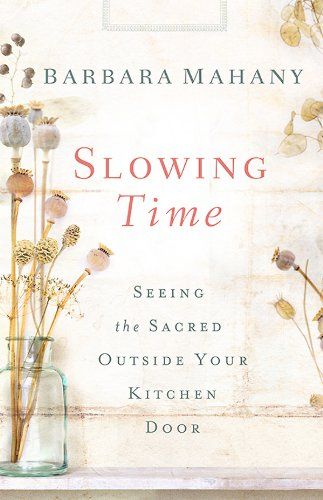 In this juncture of my own journey in faith, I don't need another creed, another confession, another article of faith, but I do need techniques and suggestions to bring those convictions into my every days. Like almost everyone, I need to learn to slow time, or at very least, to savor, appreciate, and fully live into every moment, rather than looking backwards or forewords―as important as those perspectives are.
 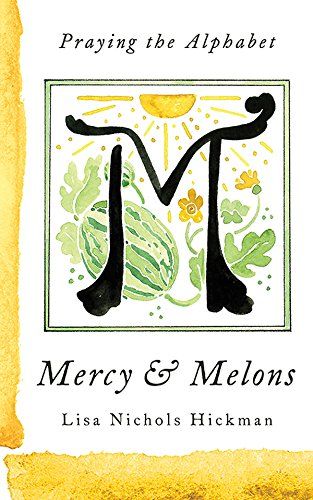 Mercy & Melons: "Thanking God for All Good Gifts from A to Z" presents a memorable and rememberable way to "pray always" and to perceive God's hiddenness in the smallest, most mundane objects and events. Lisa Nichols Hickman Prays the Alphabet by pairing a clearly theological or scriptural concept with one not obviously immediately so. "Mercy & Melons" in the title, Grasshoppers and Glory for letter G, Yellow and Yahweh Y. The Hebrew bible book of Lamentations and several psalms model an acrostic approach to devotion, so this book and our practice in response to reading Mercy & Melons has scriptural precedent.
 I invite you to sit quietly ... and consider five things about Advent. They might be images, practices, hymns, anything you like. Just let the thoughts wash over you. Be peaceful with them. Be blessed with them.
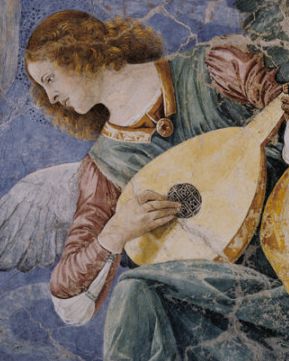 The annual Lessons & Carols: A Festival in Word & Song to Prepare for Christmas at University of San Diego on Friday, 05 December 7:30 and Sunday, 07 December 2 pm. Two years ago I attended both days, because I had to hear Daniel Pinkham's (auto-corrected to "Pumpkin," but I caught it. Too bad?!) Christmas Cantata twice. The site hasn't yet listed this year's music.
 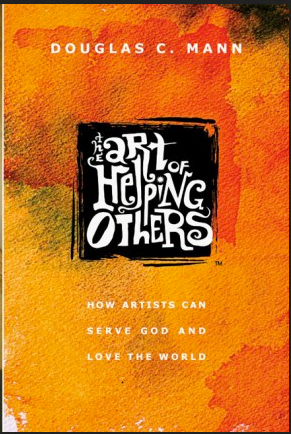 Creative Inciters in our midst! How interesting that The Speakeasy emailed me about this book months and months ago, but I finally decided I needed it after I noticed someone else's review, and for sure it is timely, apropos, and necessary for me at this time. Why? I sprung for this book because technically I'm an artist-designer and also a performing musician. I write some too, but I don't consider my writing a true aspect of my creativity. As happens to most people at one time or several, I've found myself too socially isolated for too long. I've almost entirely drained the stored value from prior life experiences and previous relationships. This is running on empty. Trying to crawl without essentials. Need refueling, refilling, and revitalizing! I'm dreaming of and trying to regenerate some creativity in my life and throughout my days.
 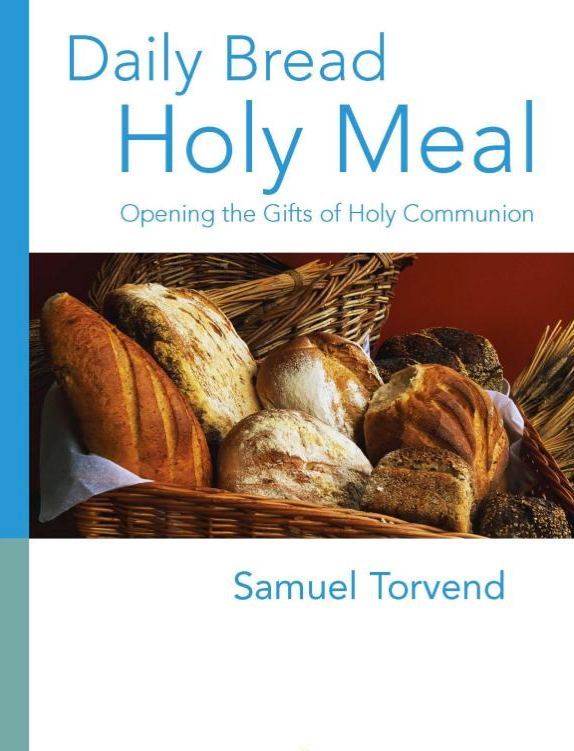 Daily Bread, Holy Meal is chronologically the earlier of Samuel Torvend's pair of books about the sacraments. In his short book about baptism, Flowing Water, Uncommon Birth, (among other details) Torvend describes the sober intentionality of preparation for baptism in some communities – particularly in those days of yore – and the expansive size of some baptismal fonts that helped emphasize its importance. In this second notebook, (also among other details) he gives us various meanings of The Meal: thanksgiving; inclusion; lives poured out; forgiveness, reconciliation... just as in his short book on baptism, the author draws upon the life of Jesus of Nazareth and his disciples, Pauline epistles, and passages from the Hebrew Bible. In fact, he brings us everything you've ever read, learned, heard, or experienced about HC—and then some: so very many possible images and realities related to the Holy Meal, not a single one exclusive of any of the others.
 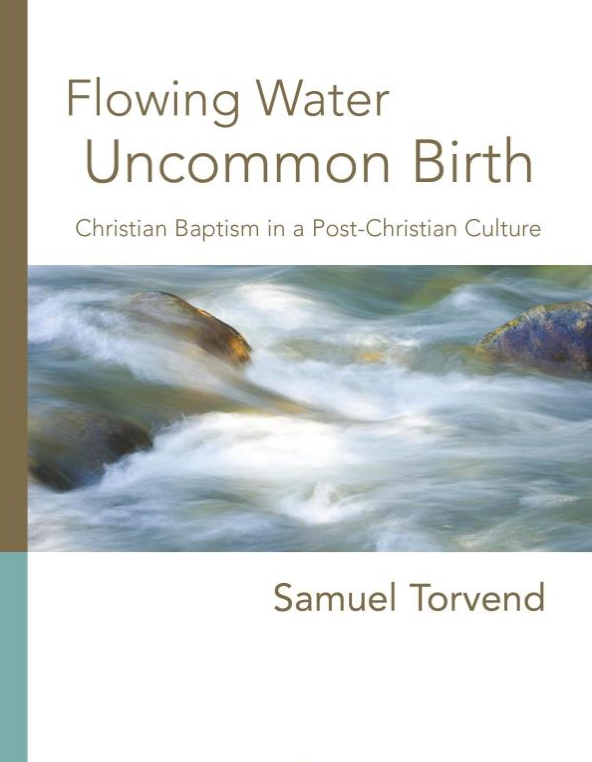 Although the publication date is later, I'll review Samuel Torvend's notebook on baptismal practices and baptismal theology before I say a little about his companion book about the other dominical sacrament, the eucharist. With fewer than 100 pages, physically this indeed is a "slim volume," yet Torvend has gathered much of the interpretive and practical riches of Christians world wide over the centuries. Flowing Water, Uncommon Birth will help you remember all the various images, symbolisms, and scripture passages (both Hebrew Bible and New Covenant scriptures) related to the baptismal event, and nudge you mightily regarding the nature and demand of God's call to live out our baptism in the world around and about us. As the author emphasizes, although we don't have group baptisms in the sense of herding dozens of candidates into the font and then pouring water over them, but rather baptize each person individually, the baptismal reality is a communal we, us, our, and ours. There's an excellent but short bibliography at the end.
"The satisfied soul loathes the honeycomb, but to the hungry soul, every bitter thing is sweet." Proverbs 27:7, NKJV
 I loved reading Sara Hagerty's story, learning a little about the yearnings of her heart, and appreciating the model she provides for very slowly, randomly, surprisingly learning to trust God. Maybe Sara teaches us how ultimately to tell about our own struggles in ways that will benefit others?
 "Open your mouth and taste, open your eyes and see―how good God is. Blessed are you who run to him." Psalm 34:8, MSG
