Showing posts with label water buffalo theology. Show all posts

Thursday, December 31, 2009

water buffalo theology review

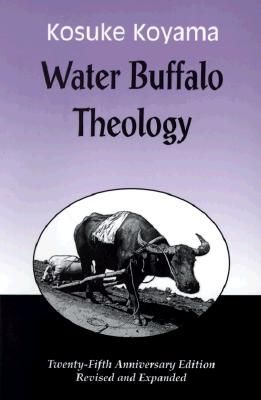
water buffalo theology coverChristianity in this country won't always be (well, it isn't now!) First Church on the corner of Main and Elm, housed in an iconic white colonial or colonial reproduction building, pews lined up facing the chancel that features a communion table topped with brass candlesticks donated by Annie and Henry's grandparents, Tiffany-type stained glass, Strawberry Shortcake Socials and picnics on a grassy lawn…

Water Buffalo Theology is liberation theology, ecological theology, theology of the cross and an offering in the Christian-Buddhist dialogue. By definition Christianity is incarnational, so cautioning every one of us in our attempts to reach others author Kosuke Koyama asks, "How can anyone be a teacher of religion unless he is at home with the language of the people?" and in the course of the book contrasts and compares many aspects of Buddhism and Christianity. Koyama challenges us to tough anthropological cross-cultural work of living with and living as the other in order to become more aware of ourselves, during the journey (hopefully) discerning essential aspects of the way of Jesus we're offering to others alongside possibilities of adapting the host culture's own practices. As an aside, to me it's interesting how the practice of many contemporary Christians is marked by passionate attachment along with attempts to live with greater perspective and more detachment.

Kosuke Koyama, who died during 2009, was born in Tokyo of Christian parents; the years he taught at a seminary in Thailand heavily influenced this book, thus "water buffalo" and careful considerations of Buddhism and Buddhists. Koyama says God's "first and fundamental gift" to us is "the constant awareness that we are under the judgment of the Word of God."

Detailing limitations of a "theology of the neglect of history" he mentions "an unmysterious God" and quotes Martin Luther's "God without strange work is God without proper work!" In fact, Koyama reveals himself as a huge fan of Dr. Luther... not surprisingly, my internet research revealed on Wikipedia that Koyama wrote his PhD dissertation for Princeton seminary on interpretation of the Psalms of Martin Luther. Introducing the chapter on page 68, he asks, "What is the matter with this God?" In other words, this God who becomes perturbed to the point of wrath is not like our idea of a perfect human; this God is no human invention!

Koyama says Thai Christian awareness of God must be "...deepened and substantiated by [their] sensing the presence of God incarnate in Christ," to the God Whose wrath has "historical and covenantal reasons," reasons of "I-Thou!" Further, in describing Buddhism's influence on the non-historical mindset of many Thai Christians, he describes it as moving away from karmic chains and away from causality: away from attachment! Clearly the God of the Bible confronts us with choices - sometimes choices between life and death, meaning we act in the midst of both existential and emotional attachment to persons and situations. Finally, and strikingly, the not-historical God is a God continuous with humanity: there's no disruption between finite and infinite.

In the half-dozen years since I first read Water Buffalo theology it has been an extremely useful resource for teaching and interpretation that bears rereading and easily carries the weight and freight of a 5-star recommendation.

my amazon review: local yet global

Friday, August 03, 2007

Church in the World; church and the world 3

Last week again I facilitated a session of the Theology of the Cross course I originally developed for Lent 2007. We discussed our living as a paradoxically hidden sacramental presence to the world, and I mentioned in passing the concept of neighborology from Water Buffalo Theology. Yes, this class also got handouts with some of my notes from WBT. Does the cross remain an outrageous offense to contemporary sensibilities, sensitivities and logic? I believe it does!

On Lent 5, toward the end of the actual Lenten series, I blogged on this site about geographically, socially, culturally, chronologically, theologically and/or spiritually liminal modes of Christian presence and asked if our presence in the world and in our neighborhoods can be a liminal, in the process of becoming, though not-quite-yet one? Partly in our own world and way, partly in theirs, and wholly in the sovereignty of heaven?

I've been trying to listen carefully and comment selectively to what people say about worship style and content; the friends with whom I attended Saturday evening worship at Rancho Bernardo Pres said something about people getting confused by "ritual." That's understandable, so how about an occasional instructed liturgy? It doesn't need to be highly detailed or elaborate, but if people learn to appreciate the origins and intent of what we do during worship, it would help worship become more meaningful to them.

Here are a few more sort of paraphrases from my old blog(s):

The synagogue's and later the church's liturgy developed and became shaped in ways that address, interact with and speak to our human condition and demonstrate God's response to creation's need. In Hebrew history, the past acts of God gave Israel confidence about the future and willingness to continue in covenantal partnership with God; because they knew about God's past faithfulness, they could face the future with a living hope. Israel persistently kept recalling and re-membering her history with the God of the Covenants with rituals, celebrations and liturgies; within a context that was play more than it was anything else, Israel told and retold the story of creation's experience with God. Like God's primal people Israel, in our worship we, the contemporary people of God, remember who God is, who we are, God's redemptive actions, and we announce our dreams and hopes for the future. Not only is much of our liturgy in the present, just as play is—like children's playtime and the various play endeavors of adults, worship also creates a new and different self-contained world existing alongside of and within our everyday world.

Similar to play, and parallel to our dreams, worship ends the dichotomy we often make between material and spiritual. When we play, when we dream, when we worship, we live fully in the present—creative, responsive, and responsible. Being Christian means to live precariously in the interplay between two worlds, just as Jesus lived. As God's children we will be completely free and alive without constraints some day, and our playful attitudes and our liturgies are the first fruit, the guarantee that finally we will end up in God's image, since it is God's indwelling Spirit that makes possible our play, our dreams, our celebrations.

In worship, and especially when we celebrate a baptism or the Eucharist, we carry with us beyond the worshiping assembly and beyond the church building a microcosm of a redeemed world; we become a living and a life-giving memory of God's actions in history, especially in Christ Jesus, as the Holy Spirit calls and enables us, Jesus again becomes alive in the world and we become sacraments mediating between God in Christ and the world. We offer the world a living connection to the heaven of God's Reign on earth, living as visible, tangible signs of God-with-us, God-for-us, God-among-us—maybe especially as we practice neighborology, the word about the neighbor?!

Sunday, March 25, 2007

Cross Pieces

After spending more time with Water Buffalo Theology by Kosuke Koyama to prepare for the Theology of the Cross series, I finally decided to blog about the book, so here it is—but only sort of!

This noontime was the 5th Theology of the Cross class of 6; the discussions have been wonderful, and my only real regret is that I started out with close to 20 pages of notes and found the amount of information so overwhelming that in the end I just "did something" related to the original outline for each class handout. For the blog at hand I'm using some of my Water Buffalo Theology notes and a few notes from the class handouts I prepared. Actually, I'd figured this would be a good opportunity to prepare for Sunday, because it would be the first of the pair of classes in which we try putting together some of the concepts we've discussed; originally I'd thought to post Saturday evening, but it's now Sunday afternoon! Disclaimer: as I revisit and assess my blogs - and my sermons - I've found the best ones, meaning those I'd "get the most from" if someone else had written them, almost always are those that aren't too tightly argued, leaving space for the HS to insinuate and make inroads. I've been thinking about this blog for too long now, so despite its needing lots of further developing, here it is.

Way back then at UMassBoston in my cultural anthro classes we learned about the concept of the liminal, which can be applied to formal, liturgical rites of passage as well as to a wide range of other social and psychological situations and encounters. Just like when you're on the limen or threshold of a building or room, in life passages and other circumstances there is a stage in space and time you're no longer where you started but not yet at your destination, either. Needless to say, just as with the pictogram depicting crisis as both danger and opportunity, when you're on the limen, there's a possibility of staying stuck neither here nor there and besides, although you have a clue as to what was in your past, you only can imagine what the future holds, making it unsettling at minimum and scary plus at maximum.

Our primary liminality text for anthro of religion was The Ritual Process: Structure and Anti-Structure by Victor Turner; one of the books about missiology we discussed on the old UCC forums was The Missionary Congregation, Leadership, and Liminality by Alan J. Roxburgh.

Regarding the geographically liminal, shorelines, the forest's edge and river's edge, a city's suburbs, the rim of the Central Business District come to mind; try the gates of a gated residential community, too, or for a more optimistic example, the door – or maybe the narthex (in some traditions termed "foyer") – of a cathedral or your local church building. Summer and winter solstice, vernal and autumnal equinox, dusk and dawn are ambiguous times neither here nor there, neither this nor that. We've particularly discussed and I've blogged almost incessantly about baptism as border and boundary between life, death and life, as well as bounded border between the world in the thrall of death and its agents and the resurrected community that in the sovereignty of life serves in the image of its Servant Lord, Jesus Christ. We've talked about the cross of Calvary as "more than atonement; more than God's definitive self-revelation; more than the ultimate example for us to follow" but a transformative reality, the way God initiates the New Creation, City of God and The Way Christ Jesus in the Spirit calls and enables us to follow. Related to this blog title, I'm now imagining the cross as a liminal place. Last week for Class 4 we talked some about God’s action and presence in the sacraments – considered a means of grace – and began imagining ways we can be means of grace in the world around us!

It's common to view the vertical piece of the cross as reaching up to heaven, while the horizontal reaches out to connect us with others--with all creation. Transformative as it ultimately can prove, for sure relationship of every kind is fragile and breaks all too easily. But in any case, at any stage, relating is an inevitably here and now aligned with an invariably not quite yet: on the limen, on the threshold of something different, some new creation, something synergistic: more than you started with and more than simply the predictable sum of the discrete parts!

This noon we specifically asked,

What does the cross mean for each of us as individuals, for this church community, for our nearby neighbors? Contextualizing the sacraments!

Theologian Jürgen Moltmann describes baptism as "sign, witness, representation and illumination of the Christ Event, and" we can claim the same about the Eucharist. We know Jesus Christ as sovereign, prophet and priest; baptized, we participate in that royal, prophetic priesthood. Especially related to those roles, how can our lives signify, witness to, represent and illuminate the birth, life, death, resurrection and ascension of Jesus Christ?

Contextualizing Eucharist

I really like this from today's handout, so here it is again:
Jesus said, "Do this!" Do this liturgical action? Recall Israel and desert manna, enabling God's people to live precariously in the [liminal] wilderness:
  • Bread = nourishing = body that is broken unto death and raised to new life
  • Christ's body = revealed in the breaking of bread/body
  • Church = Body of the risen Christ = nourishing the world, especially the stranger, the outcast and the "other"
  • Church / reveals Jesus' crucified body in its redeeming brokenness
  • Church / reveals Christ's risen body in its liberating wholeness

Water Buffalo Theology—a few notes on a few chapters, with a suggested new version of each chapter title.

Chapter 1: Theological Situations in Asia and the Mission of the Church | theological situations in Southern California and the mission of the church
Jeremiah 4-7

Thus says the LORD of hosts, the God of Israel, to all the exiles whom I have sent into exile from Jerusalem to Babylon, "Build houses and live in them; and plant gardens and eat their produce...Seek the welfare of the city where I have sent you into exile, and pray to the LORD on its behalf; for in its welfare you will have welfare."

This passage is both the original source of "where you're planted!" and practical, down-to-earth direction for living shalom-ly with self, with neighbor and with stranger.

Paraphrased from my earlier comment: I think all of us will be able together to celebrate a thanksgiving homecoming (after all, isn't homecoming the ultimate thanksgiving?) liturgy within a community gathered not only to perfunctorily and ritually evoke the presence of the risen Christ in Word and Sacrament, but when that gathered people attests to the presence of the Christ in each another: having gone slowly enough to know and to call each others' names, having gotten sufficiently grounded to ignore at least some of the babble of commerce and consumerism, having decided to "seek the welfare of the city" where they are rather than seeking the well-being of their purses and properties: looking outward to the other's interests and inward to an authentic, relational and re-creative self. The "crucified mind" can be as basic as looking to others' interests rather than our own...

Our Christian kerygma tells about our holy God's incarnation into the longitude, latitude and linear time of human history and of a particular culture and the ensuing reality of the death of death itself in the crucifixion and resurrection of Jesus of Nazareth, the One we know as the Christ of God. And the same God whose passion from the beginning has been to journey with the people, continues incarnate in the Church, the Body of the Risen Christ, and still accompanies the people on their journey in the longitudes, latitudes and linear time of human history and now within many diverse cultures. We proclaim God Among Us in the spatial and temporal liminality of human life and endeavor! At the beginning of class this noon I referred to the book of Acts in passing, and as we left for home, I suggested everyone read Acts during this coming week, or at least turn the pages to remind themselves of the content.

From WBT: Jakarta is as central as Jerusalem and London in the mission of the Risen Lord. Though initially it may sound astounding to make Jakarta or anywhere else "as central as Jerusalem," if the person and work of the crucified and risen Jesus Christ is not for Jakarta just as much as it is for Jerusalem, he truly is not and cannot be Lord of all. One of the class participants, who always is full of great ideas, said he believes that for us, Jerusalem is right here and now.

Chapter 4: The "Efficiency" of the Crucified One in the World of Technological Efficiency | the efficiency of our witness in this world of technology

Rooting the Gospel: the Bible reveals God's attachment to the world of creation to the point of totally identifying with us to the extent of living and dying as one of us: learning and knowing us, creation – God's beloved – so completely as to walk in our sandals. Tevas or flip-flops or thongs or what kind of footgear, these days? Neighborology: our attachment to our neighbors to the extent of walking a while in their shoes, eating the same food or cuisine, working at the same job, being unemployed in the same manner. My identity needs to become translucent and transparent so "I" can get out of the way and see and feel the other. We're talking neighborology, the word about the neighbor!

Chapter 6: Aristotelian Pepper and Buddhist Salt | liturgical excess and low church blandness

Kitchen imagery is exceptionally apt in discussing Christianity, as the Bible is full of references and analogies to common, ordinary, everyday things (material, physical "possessions") and activities. As the author observes and as we all know, real theology is done in the venues and locales where actually people live--we need to begin practicing more and more neighborology! My blog readers know all about my "liturgical excess - low church" subtitle for this chapter, so I'll say no more.

Chapter 12: Cool Arhat and Hot God | Cool Dudes and Hot Jalapeños

This is southern California, where a few days ago I overheard a couple of young guys talking, one saying to the other about 12301298 times worth, "Dude, man, cool, dude!" Funny! God creates in order to have a creation to become passionately - hotly - attached to, so God and God's people live in particularly close attachment to each other. The God we meet in the Bible and in Jesus Christ loves creation enough literally to die for it!

Chapter 18: Three Modes of Christian Presence | Two Versions of the Gospel

WBT's author, Kosuke Koyama, mentions suffering because we're involved with others, involved with the other; suffering because we're involved in neighborology! Participating in the "glory of the crucified Lord"--the same Paul of Tarsus also talks about "the glory of the children of God!" And isn't our glory as God’s offspring also a crucified glory and a risen glory? Exactly what our discussion today was all about!

Possible modes of Christian presence: the geographically, socially, culturally, chronologically, theologically and/or spiritually liminal? Can our presence in the world and in our neighborhoods be a liminal, in the process of becoming, though not-quite-yet one? Partly in our own world and way, partly in theirs, and wholly in the sovereignty of heaven? Encountering each other in the church and our neighbors as Jesus Christ's representatives has got to be crisis-time, in terms of danger and amazing opportunity! About those Gospel Versions--for Paul, the Gospel is death and resurrection!

Friday, March 23, 2007

Theology of the Cross 5

Theology of the Cross 5 | Lent 5 | 25 March 2007

Theology of the Cross:
what does this mean for the Church’s and especially for this congregation’s life and mission?

A Tree on Your Back

1. We meet you, O Christ, in many a guise,
your image we see in simple and wise.
You live in a palace, exist in a shack;
we see you the gardener, a tree on your back.

2. In millions alive, away and abroad;
involved in our life, you live down the road.
Imprisoned in systems, you long to be free;
we see you, Lord Jesus, still bearing your tree.

3. We hear you, O man, in agony cry;
for freedom you march, in riots you die.
Your face in the papers we read and we see.
The tree must be planted by human decree.

4. You choose to be made at one with the earth;
the dark of the grave prepares for your birth.
Your death is your rising, creative your word;
the tree springs to life and our hope is restored..

–Fred Kaan, 1966

The cross of Calvary forms the ultimate type and reality of God’s characteristically hidden and paradoxical, sacramental presence in the commonest things, situations and people. Interpreting scripture, sacraments, everything in our lives and in the world with "What preaches Christ."
  • Last week we talked some about God’s action and presence in the sacraments – considered a “means of grace” in this tradition – and began imagining ways we can be a means of grace in the world around us.

  • It’s impossible to separate out today’s discussion topics, so I’ve suggested some texts and ideas to get us started.

A Theology of Baptism

Galatians 3:26-29; Titus 3:5-8; 1 Corinthians 12:12-13; Romans 6:1-14; Ephesians 4:4-6; Mark 1:4-11; Matthew 3:11-17; Luke 3:15-22

Theologian Jürgen Moltmann describes baptism as “sign, witness, representation and illumination of the Christ Event”; we can claim the same about the Eucharist. We know Jesus Christ as sovereign, prophet and priest; alive in Christ, we participate in that royal, prophetic priesthood. Especially in regard to those roles, how can our lives signify, witness to, represent and illuminate the birth, life, death, resurrection and ascension of Jesus Christ?

Contextualizing Baptism

We are baptized for events like 9/11; we are baptized to be the Christ alongside our friends, relatives and neighbors; we are baptized to not be an exclusive community, but to risk reaching out to image and model Jesus Christ to the world – including those who are culturally, ethnically, chronologically, occupationally, educationally different from us; to recognize Jesus Christ in others and to be the presence of the crucified and risen Jesus Christ in their lives.

A Theology of the Eucharist

1 Corinthians 10:16-17; 1 Corinthians 11:23-26; Mark 14:22-25; Matthew 26:26-29; Luke 22:14-20; Luke 24:30-31; John 6:33; John 6:51; John 6:56

Jesus said, “Do this!” Do this liturgical action?

Contextualizing Eucharist

Jesus says, “I am the Bread of Life; I am the Vine!” In every culture, grain products form a substantial nutritional base; the grain may be rice, wheat, corn, wheat, barley...the fruit of the vine is a potent and pervasive biblical symbol, and beyond there and then, lately we’ve been learning a lot about grape’s benefits! In the power of the Holy Spirit, God calls the church—
  • As the body of the risen Christ, the Bread of Life, to nourish the world, especially the stranger, the outcast and the ‘other’

  • Like the Eucharist, to reveal Jesus’ crucified body in its redeeming brokenness

  • To reveal Christ’s risen body in its liberating wholeness

  • As branches of Jesus, the Vine, to pour out our lives to those around us

9. What does the cross mean for each of us as individuals?

Galatians 3:1-5; 2 Corinthians 5:16-21; Ephesians 1:17-23; Matthew 28:16-20; Luke 24: 44-49; Acts 1:6-8; 2 Timothy 2:8-13; 1 Peter 2:9-10

10. What does the cross mean for this church community?

From Water Buffalo Theology: Suffering because we’re involved with others, involved with the other; participating in the “glory of the crucified Lord”. My note: the same Paul of Tarsus also talks about “the glory of the children of God!” And isn’t our glory as God’s offspring also a crucified glory and a risen glory?

11. What does all of this mean for our nearby neighbors?

When I was on staff at the church in City of History, I wrote their Mission Statement:
We are the people of God, forgiven and set free by the death and resurrection of Jesus Christ; by the power of the Holy Spirit we are called together and sent into the world as witnesses to his resurrection. God calls us, a servant people, to proclaim in word and action the presence of the risen Lord to all those whom our lives touch, especially in this community.
The author of Water Buffalo Theology talks about “neighborology”—the word about the neighbor! The Bible and Jesus Christ reveal God’s attachment to the world of creation to the point of learning and knowing us so completely as to walk in our sandals (Tevas, or flip-flops or boots or snow boots...) and to die a physical death, just as all of us inevitably will. Especially in the shadow of the cross, how can we practice neighborology?

© Leah Chang 2007

Monday, October 18, 2004

Foolishness to the Greeks Chapter 5b

Foolishness to the Greeks: The Gospel and Western Culture on Amazon

Chapter 5b:

foolishness to the greeks coverThough for the most part, Bishop Newbigin's book has not been as engrossing to me as Professor Koyama, wow, I really liked chapter 5b! He says post-Enlightenment thought and behavior has trumped the old assumption that resources are finite and *some* of us have been acting as if resources of all kinds are infinite…hmmm…lots of familiar ideas, esp that any economy needs to be a mixed economy; he cites the need early on in industrialization and modernization for governmental intervention and even governmental controls to save people from the exploitative outcome of the purer forms of capitalism. He thinks capitalism and consumerism are the sin of covetousness, considers it "a desperately dangerous case of cancer in the body of human society." These days I'm beginning to agree, and not only because I'm living in southern California. Though his proposed alternative doesn't seem particularly realistic, either—but then Christianity's not about logic and realism.

Marian, our moderator asked:
"Should the image of Jesus Christ be in the central shrine of public life? Are we comfortable with this? Is Christianity better than other religions?...What do you think?"
Everyone who knows me [from these forums] probably has figured out I'm Barthian on this issue, so I'll start by saying asking if Christianity is "better than other religions" is like comparing mangos and avocados and then throwing in some rolled oats, because Christianity's not a religion in the common sense of the word "religion." One of the discussion participants asked, "If Christ is to be the central shrine of our culture, is it as service or as sovereignty? And if not Christ, who or what?" His question is my answer: if not Christ, who or what? Because some idea or icon or god or combination of many and/or all of those must be sovereign, since the people need a god…but without the God of Truth people and state both perish! I'll go back to something I think I wrote on Water Buffalo Theology, or maybe I didn't post it there, but lately I've sure been saying it a lot: whether or not a person - or a culture - claims Christ Sovereign Lord of All, Christ is Sovereign and Lord of All: Christus Pantocratur.

I absolutely agree Bishop Newbigin's not remotely talking about establishment of religion nor does he man a visible, physical - in Westminster language, a "sensible" - representation when he refers to "the image of Jesus Christ in the central shrine of public life."

How do we enthrone Jesus Christ in the public arena? By claiming our created-in-God image [...love, justice, community, *otherness and strangerness*, slowness, creativity...] by doing justice and mercy; by treating each person and all people as fully human, actively affirming and celebrating the Divine in them! I'd also hope a major part of the witness of the present-day church still would be "See how they love one another." So, I believe, we enthrone Jesus publicly and privately particularly with the quality of our friendships - Jesus' ultimate accolade to his companions and disciples was calling them "friends!"

Saturday, October 16, 2004

Water Buffalo Theology: Chapter 18

This is the final post of some of my ideas from our online discussion of Water Buffalo Theology by Kosuke Koyama on Amazon during Spring of 2003 on the old United Church of Christ forums. Kosuke Koyama taught for a while at Union Theology Seminary; Water Buffalo Theology is liberation theology, ecological theology and missiology, as well as an offering in the Christian-Buddhist dialogue.

water buffalo theology coverChapter 18: Three Modes of Christian Presence

This is the final chapter, though there's an epilogue consisting of Kosuke Koyama's Pilgrimage in Mission.

On to chapter 18. I love his using the word "attachment!" God's "decisive and irreversible attachment!" What hope for all of us! Christianity as a "noisy" faith…to think I've been *trying* so hard to become a little more contemplative.

Three modes of Christian presence. A hidden presence, a sacramental presence to the world. Suffering because we're involved with others, involved with the other; suffering because we're involved in neighborology! Participating in the "glory of the crucified Lord"—the same Paul of Tarsus also talks about "the glory of the children of God!" And isn't our glory as God's offspring also a crucified glory and a risen glory?

Too often I'm still finding myself comforted by other than Christ, almost keeping pace with my unchurched and marginally churched neighbors and friends. I was delighted Professor Koyama reminded us of the Luther quote, "subject to none; subject to all." That's good to remember when life's not going my way.

I'll close by quoting:
In this eschatological hour, we are called to share the pathos of God, God's pathos toward all scattered things which are held together in the glory of the crucified Lord. Amen!!!!!

Water Buffalo Theology: Chapter 17

Water Buffalo Theology by Kosuke Koyama on Amazon

Chapter 17: Toward a Crucified Mind

water buffalo theology coverFinally almost home! This is another great chapter, full of lots more ideas I need: encountering persons rather than ideas; learning a person's not a theory or an idea...as missionaries we need to live "in the complexity of history" once again part of our being in God's image! This is sensational: in the bulleted list at the start of the chapter he says, Appreciation of the complexity of history can control theological inflation. Rather than the idea of a person walking in the idea of history, a living person in history's concreteness. I think this whole book has been changing me, believe it or not!

Missiology is tamable but missionary is untamable! Martin Luther and "domesticating" God into a tame household god: as people in the image of God, why do we (I) sometimes let ourselves (me) be "domesticated?" Unity of message and messenger?

Regarding super-arrogance and super-ignorance, some time ago I gave up even pretending to try any kind of conversation with some other Christian but as someone on these boards said, by acting that way likely I'm being a fundamentalist in my own right, too.

Water Buffalo Theology: Chapter 16

Water Buffalo Theology by Kosuke Koyama on Amazon

Chapter 16: Is Christ Divided?

water buffalo theology coverKosuke Koyama's asking, "Was Luther baptized for you...was Wesley baptized for you" is so revealing regarding the way people identify themselves by denominational labels rather than by the name "Christian," indicating not only an identity but actual belonging=possession!? Possession by the UCC, the ELCA, the UMC? Wouldn't that mean being owned, possessed by an institutional structure? At least this chapter is more directly accessible than the previous ones!

Professor Koyama seems not to think very highly of denominationalism and at times I don't think highly of denominationalism, either.

Do Methodist Christians study Wesley's theology, do Lutheran Christians study Luther's theology? Many Christians study neither Bible nor theology and most members of most local churches aren't remotely biblically or theologically literate and instead pride themselves on "inherited" Christianity and sometimes even affirm their polity as their foundation! In other words, "The confessions and doctrines which are the historical basis of these world confessional organizations" aren't "living realities" in the lives of the majority of people in these confessional "families." But I also feel different from and divided from (against, at times?) fundamentalist Christianity; I'd like to protect our unique contribution and "save" people from that distortion of the gospel fundamentalist Christianity plainly is.

"...an organization built around that truth..." gets back to my earlier asking whether the organic Body of the Risen Christ can coexist with the institutional church.

Water Buffalo Theology: Chapter 15

Water Buffalo Theology by Kosuke Koyama on Amazon

Chapter 15: Tokyo and Jerusalem

water buffalo theology coverProfessor Kosuke Koyama says God's "first and fundamental gift" to us is "the constant awareness that we are under the judgment of the Word of God," (and in Jesus' death and resurrection, God's judgment leads to abundant life that doesn't decay or degrade). What a chapter about institutions, icons, institutional icons, "religious living," arrogant assumptions and idolatry! Jeremiah's situation is an fitting parallel to Koyama's other examples about Tokyo and of course about us since, as he says, the Japanese people couldn't remotely imagine anything other than being protected by the institution of the imperial system and the emperor. The religion of the Jerusalem Temple was imperial religion that sought to keep God in God's place and imagined being able to keep our God, the God we know to be free and elusive, completely responsive to human entreaty and reactive to human whim.

Safety, shelter, and all of the related static, programmable and unfree, unelusive comforts can be so enticing, but they're neither hot nor cool in any authentic sense at all - it seems to me in order to be "hot" or "cool" any entity needs to be alive! But it's also clear institutions frequently assume a life and a dynamic of their own, but not one that breathes, grieves, rejoices or encounters or interacts with much of anything or anyone else. Right now I'm listening to Steely Dan: the last call to do your shopping at the last mall! (note: I'm editing and cleaning up earlier blog posts for live links, etc. during late May 2015, and malls are so on their way out, lots already have closed, and soon there will be a single standing literal "last mall.") Back to James (and Jesus, of course) and the total folly of putting trust - "faith" - in transitory, ephemeral - sometimes even imaginary - things that ultimately will decay.

Jeremiah attacked "the deceptive theology hanging around" the Jerusalem temple. So we're getting ready for the next chapter that's about our treasured denominations in all their wonderful uniqueness and importance, about the theology and even the idolatry that often surrounds them.

But how does this connect with Thai Buddhists? Or with the institution of Thai Buddhism?

Water Buffalo Theology: Chapter 14

Part IV: Interpreting the Christian Life

Chapter 14: In Search of a "Personality" of Theology in Asia

water buffalo theology cover
Note from when I originally wrote this: This morning at the pericope Bible study, as we discussed 2 Corinthians 6, I thought of Water Buffalo Theology by Kosuke Koyama. Paul mentions endurance, troubles, hardships, distress, beatings, imprisonments, riots, hard work, sleepless night and hunger (oh, those Pauline lists!)--all of these not-pleasant ordeals are about giving up, about crucifying, even the idea of Paul, so he could become the Christ for the Corinthians. Paul also speaks of purity, understanding, patience, kindness, love, being in the Holy Spirit and in the power of God…being cool about Paul in order to be both a cool servant and a hot servant of Jesus Christ. You know the rest of Paul's text: its essence is putting "no stumbling block in anyone's path." And he's telling the Corinthians please to do the same thing!
Although I'm not at all sure the cross has universally immediately understandable meaning, I am sure of its cosmic reach and ultimately cosmic meaning. The Reformers emphasized the ongoing process of conversion, saying only being daily drowned and daily raised in baptism was adequate for regenerating the person, for getting rid to the disconnected "I" and the unconnected "me." We need to remember despite his determination to preach "only Christ crucified," for Paul, Christ Jesus is always at the same time both crucified and risen, so when we preach the cross we also preach the empty tomb.

Also for this coming Sunday, Mark 4:41b: "Who is this? Even the wind and the waves obey him!" The Lord of the monsoon...

These days (actually it was during those days, back in Spring 2003) I'm also reading Reading the Bible from the Margins, by Miguel De La Torre, who says his Hope College students always give him the "litmus test" of asking if he has a personal relationship with Jesus, and he always replies he has a public relationship with Jesus! Isn't that part of what we're trying to get at here? Rather than being about "me," our evangelism and our ministry in general needs to be about the "other-than-me." And after all, we, us, our and ours are the covenantal, baptismal words. But those words are easy, and it's easier still and highly hazardous since too often we get involved in all kinds of miscommunication and inadvertently offend people when we don't know the culture, and maybe especially when we don't understand the religious background and experiences of the people we're evangelizing.

Cogently expressing what it means to lose what we consider our previous individual identity and take on the name of Jesus Christ and therefore the identity of Christian, Clarence Hilliard says all of us "need to become like the funky black nigger Jesus!"

Water Buffalo Theology: Chapter 13

Water Buffalo Theology by Kosuke Koyama
water buffalo theology coverDuring Spring 2003 a group of us had a chapter-by-chapter discussion of the book on the old United Church of Christ online fora. Water Buffalo Theology is an offering in the Christian-Buddhist dialogue, as ecological theology and as liberation theology. Recently I've been revisiting the book and reviewing some of my comments, which I found interesting and very relevant where I am in my life at this very time, so I hope this book has something to say to a few others, as well!
Chapter 13: Apostle James in Thailand

To begin, a personal note: I tend to vacillate between austerity and elegance of expression in style of worship and in the adiaphora of worship - both "more" and "less" helping us approach the ultimate reality of our both transcendent and immanent God. But the same can be said about our evangelism, missiology and our ministry and living in general. For me, this means not measuring myself in terms of results-oriented successes and it means always remembering God's ultimate call to be faithful rather than to be productive, results-oriented or success-obsessed or focusing on "winning" numbers: I believe that's a lot of what Kosuke Koyama's addressing James is about. Someone on this book discussion perceptively observed, "Koyama's is not a hard core missiology, it's a softer, cooler approach."

Chapter 13 and James (moving away from Martin Luther for a moment in time)!!! I love this chapter, as it concisely describes how we need to live out our lives in Christ both hot-ly and cool-ly! Again, he reminds us the Buddha's type of detachment is the "very radical one" of detachment from even the very idea of oneself! James and "picture-language" ...all language is metaphor, "picture-language."

Being cool means not being attached, or more radically, being detached from whatever decays, from the "changeables." The passage of each individual human life and the life of any human group or organization, including the local church, is extremely changeable and it's easy to become hotly attached to the pressure and constraints of its changes. Slowness in James...

Living coolly as servants of our "hot" God. How can a servant to hot person (person is a hot concept) be cool? But we know our God--particularly God as revealed in Jesus Christ—as a servant-God and any servant needs to coolly do the master's will.

"Risk" also is a hot concept, and Jesus calls us to a life of constant risk, a life that gives up even the pretense of self-protection…but a life that shows no partiality, coolly imitating our God who "is not partial." To become involved in the world without becoming attached to the world, or more accurately, without becoming attached to the powerful pull of the world's fleeting, ephemeral and corrupting pleasure. Page 122: if we're cool, "the King of Death cannot seize" us! Wow, that is so Jesus, so Paul!

Friday, October 15, 2004

Water Buffalo Theology: Chapter 12

Water Buffalo Theology by Kosuke Koyama

Chapter 12: Cool Arhat and Hot God

water buffalo theology coverThis chapter is about God's restoration of the "I!" It reminds me of Martin Buber's saying how *legitimate* is the "I" of the Buddha, of Socrates, of the Christ! For most of us the problem's not so much our insistent "I, I, I," and "me, me, me"; it's the illegitimacy of our cry, the toxic way humans tend to view and relate to themselves and subsequently to everyone else and to God. It's about our unconnected "I" and disconnected "me." Prof. Koyama says according to the Buddhist a person saying "I" is chained to an illusion and a delusion of "I," an illusion of "self." God legitimates both I and self by drawing them into covenant and by calling all of those disparate I's and selves into covenant with each other. As Kosuke Koyama writes, Jesus lives with a strong sense of "I!" And Jesus' strong, legitimate "I" restores and revitalizes our illegitimate "I" that talks about "my" house and "my" spacious upper rooms, to paraphrase God's words through Jeremiah to Jehoiakim. A nirvanic human without "I" ultimately is free from both sight and blindness.

The "hot" God heats the cool outlook by placing it in the context of covenant relationship. God is not free from anger...but this doesn't mean God is quick to anger! Our slow God again!

Covenant is a hot concept, since real relationship never is cool. When relating chills off, the relatedness is gone. God warms the cool person by drawing the person into covenantal relationship. God restores (not eliminates) the "I" before, in the presence of and with the power of God's life-giving, life-enabling Spirited "I." Koyama says "Self without the knowledge of the Lord is the lost self!"

Analysis rather than living connectedness and attachment: to analyze a thing or even a person you need to look at it from some distance, you simply can't be attached and see clearly. Interesting his saying "If the Lord does not explain it to me..." in the wake of his reminding us of Martin Luther's telling us God without strange work is God without proper work! Asking "non-crisis questions" while we're caught in crisis? I do that all the time!

Buddhist holy life is lived "in order to escape completely from existence." Wow! Christian holy life is lived in order to be completely engrossed and engaged in existence. Since the primary truth about humanity is its attachment to existence that's one of the many ways in which humankind is in God's image. God creates for his own possession, in order to have a creation to become attached to!

God and God's people live in particularly close attachment to each other. As Prof. Koyama aptly says...it is this covenant-awareness which has given sharp focus to history-awareness. Theologically speaking, history is the experience of covenant.

God removes distance by attaching to history rather than by detaching from history to "Hebraize" the peculiar apatheticness of the Buddha's teaching! Page 115: God can make use of all weakly historical as well as ahistorical thoughts, convictions, and enlightenments. But the reverse is hardly a possibility.

Hebraization means covenantization. Evangelism to Thai Buddhists - and to everyone else - means bringing the experience of covenanted relationship lived within history rather than outside of history.

Homelessness: nomads aren't homeless but carry their homes on their backs rather than rejecting the idea and value of home. Home is attachment - all so true! Page 107: The principle of homelessness displays its genuine force when one becomes homeless in history... from history to "ahistory" ("historylessness"). Interesting!

Water Buffalo Theology: Chapter 11

Water Buffalo Theology by Kosuke Koyama

water buffalo theology coverPart III: Interpreting Thai Buddhist Life

A sigh and a deep breath...

Chapter 11: Buddhist, Not Buddhism

Buddhist, Not Buddhism:

"Doctrinally trained" eyes / "incarnate eyes" ... how awesomely illustrative!

"The human encounter is with a *person* and not with a *theory* or a *religion* or any other such thing." Just as God meets and encounters each of us as person rather than as a theory, an idea, or even as a Divine inspiration!

Sometimes Christians become Christianity rather than remaining Christians! A Buddhist or a Christian "complains, laughs, grieves, sweats, suffers, thirsts, and hungers." I love how he describes the idea of ice tea becoming the efficiency and effectiveness of "actualized" ice tea!

Water Buffalo Theology: Chapter 10

If you haven't visited this blog in the past couple days, I've been posting some of what I wrote during our online book discussion of Water Buffalo Theology by Kosuke Koyama (old, now defunct, but soon to be revived in a different format) United Church of Christ Forums during Spring 2003.

Chapter 10: Theological Re-Rooting in the Theology of the Pain of God

water buffalo theology coverIn this chapter Prof. Koyama seems to be repeating a lot of what he previously said about our God who lived and died as one of us, our God who not only imagines our pain but feels and lives it so truly knows our hurt intimately - because this God identified with us so completely as to "share our common lot."

I really, really like the word "enculturation!" But to be a little fussy, I think "rooting" might be more accurate than "re-rooting," since we're discussion bringing a new concept and reality rather than reworking an old one.

And still more Luther! What I particularly like about this chapter is the way it can start our moving toward imaging metaphors with which to express and convey the gospel by learning the culture, traditions, languages and especially the meanings by which the people we're sent to serve live out their lives.

I love his saying (page 87), "Incarnation means in-culturation and in-localization." "Amphibious agent" is a resonant phrase, too.

I also like his emphasis on our becoming and being cross-carrying Christians "…in the light of the Son who was crucified outside the city!" (page 89) Reading that makes me realize we need to move outside our comfort zone even to the extent of becoming the "other" we're trying to reach - just as God did in Christ Jesus. But not only does God in Christ know and share our pain - as Christians can we know and share God's pain?

Water Buffalo Theology: Chapter 9

Water Buffalo Theology by Kosuke Koyama on Amazon

water buffalo theology coverChapter 9: Ten Key Theological Issues Facing Theologians in Asia

Ages ago on this blog I posted this list, which I made in response to this chapter in this book, but here it is again:

10 theological issues facing theologians in the U.S.

• Interdependent World

• the Bible

• proclamation, accommodation and syncretism

• U.S. megalomania, economic and cultural imperialism

• economic greed and consumerism

• cultural, spiritual and religious relativism

• the Church's identity and the meaning of that identity: can the organism known as the Body of the Risen Christ coexist with the institutional church?

• education of clergy and especially education of laity

• ecumenism - can we mainline churches (Protestant and Roman Catholic) live, study, talk and work with those not-like-us church bodies?

• taking academic theology to the streets, as some already have been doing

In an excellent book I read during the past year, Exclusion and Embrace: A Theological Exploration of Identify, Otherness, and Reconciliation, Miroslav Wolf quotes Daniel Boyarin as he points out although the Pauline solution of

1) relativizing Torah;

2) discarding genealogy; and

3) for the sake of all the families of the earth embracing the crucified and resurrected Christ as the seed of Abraham in whom "there is no longer Jew or Greek, slave or free, male or female,"

...offered a "possibility of breaking out of the tribal allegiances...it also contained the seeds of an imperialist and colonizing practice; Paul's universalism even at its most liberal and benevolent has been a powerful force for coercive discourses of sameness, denying...the rights of Jews, women, and others to retain their difference." -pages 45-46

And Wolf says, "...baptism into Christ creates a people as the differentiated body of Christ...[which] lives as a complex interplay of differentiated bodies—Jewish and gentile, female and male, slave and free—of those who have partaken of Christ's self-sacrifice. The Pauline move is not from the particularity of the body to the universality of the spirit, but from separated bodies to the community of interrelated bodies—the one body in the Spirit with many discrete members. -page 48

We've talked about the West's arrogant cultural imperialism and exploitative economic greed with its super-production and super-destructiveness that keep insisting newer is better and bigger is best - particularly when we harvest most of the benefits! Those characteristics seem never-ending, though sometimes they're vaguely disguised. And this means the West will need to become more ointment than gun in the future -but how? It's easy to relativize all of the West's multitude of impacts on the non-Western world by pointing out for every act of cultural or economic violence there's always a host of positive contributions we can point to with pride - though that pride is generally smug and self-satisfied.

We do need to acknowledge not only will any true missionary encounter needs to be a 2-way street and we need to expect to gain at least as much as we give; we also need openness to the surprise of finding benefits and gains in areas we never imagined. That old adage about its being far easier to give than to receive keeps holding true - the constant challenge of the non-self-sufficiency of grace.

"Asian ointment?" For me also, tai chi and yoga are blessings of mind/body/spirit healing, but that's so individual! To an extent the sum of the individuals is synergistic, but (my thinking and writing are rambling today)…

What will "Asian ointment" suggest about God's creating, caring and self-revealing activities?

It suggests God is not partial - even to us earth creatures that sometimes imagine ourselves creation's crown! It also suggests God's passion for creation and especially for relationship with creatures, even though we're not talking about the "like us" but rather about those "not like us": "the people I created for myself that they might declare My praise!" And reminds us though creation's not necessary, still God rejoices in creativity.

As Christians, despite affirming our creation in God's image, we know God and humans are discontinuous in many ways, so at least logically absolutely everything created is the recipient of both fallenness and wholeness.

As Paul says in Romans 5, the law entered human life and awareness that offense against God's holiness might abound, but where sin abounded, grace was much more abundant: God gave Torah not so much as to actually increase the trespass but to increase human's awareness of their depravity - IOW, the law convicted a creaturely humanity that otherwise was blissfully unaware of its sinfulness and, as Paul admits, grace/resurrection is God's final Word. Because, in any case, we're talking about creatures rather than Creator, even though not about terrestrial creation. Your asking if fallenness and grace are "totally terracentric concepts" shows how fruitful this discussion is! We're all actually realizing how culture-bound we tend to be!

Scripture says one like us in every way - except sin - was born, lived, was broken and "became sin," died, was raised from death and ascended to sovereignty at the right hand of God in order to complete the salvation/wholeness of all creation; God in Christ reconciled "all creation," and not just humanity, to Godself. Having said that, even emphasizing "all creation," it's a highly humanity-centric statement! The Bible does tell us so; however, we've been celebrating our God as a still-speaking God! We also confess Jesus Christ's sovereignty not over humanity alone, but once again over all creation.

As to the possibility of God's becoming incarnate or being "present" in other forms, my reply is predictable: we're living in Pentecost, the Spirit and the gifts are ours, along with God's call to continue doing the work of reconciliation as the Body of the Risen Christ. As Luther affirmed, the right hand of God is everywhere, therefore the Lordship of God in Christ is everywhere. Why would God's "right hand" of sovereignty not also be outside of known galaxies? Aren't they part of "everywhere?" That doesn't quite answer your excellent question, though - I'm still thinking about it.

Likely you've noticed what a Luther fan Prof. Koyama is? I confess I may be becoming one too, since my reading "project" during Winter 2002-2003 was Luther's The Christian in Society..

About God's presence in other manifestations in other than this-world expressions of creation... there's only a single Logos, Jesus Christ, still the "logos" concept was one already known that Christianity seized and appropriated. That Logos was present at creation and through that Word all things were created, and there's no reason to imagine other worlds beyond ours weren't part of that creativity! Yet ultimately, isn't even that particular cosmic metaphor shaped to our human understandings and perceptions?

Water Buffalo Theology: Chapter 8

Water Buffalo Theology by Kosuke Koyama on Amazon

Chapter 8: The Wrath of God in a Culture of Tranquility

water buffalo theology coverAs I read this chapter, I felt Professor Kosuke Koyama was referring to "history" as the realm of human affairs particularly as interpreted by the salvation history of the Bible, and thus his idea of "history" is transferable to any and all times and places of human life with its broad range of interactions and relationships. He particularly contrasts history and non-history, non-history or cyclical existence leading to the ideal of "no-self," which is "the perfect state of no-pathos." Interesting since we've discussed the emotional joy, pain, distress and elation attachments to people, places - and things - can bring us!

Further, in describing Buddhism's influence on the non-historical mindset of many Thai Christians, he describes it as moving away from karmic chains and away from causality: away from attachment! Clearly the God of the Bible confronts us with choices - sometimes choices between life and death, meaning we act in the midst of both existential and emotional attachment to persons and situations. The fundamental message of Thai nature says all is cyclical and reversible, tranquil and placid; the Bible's God claims our attention and our response by showing us the irreversible nature of our actions and calling us to decision - especially decision in relational contexts.

Introducing the chapter on page 68, he asks, "What is the matter with this God?" In other words, this God who becomes perturbed to the point of wrath is not like our idea of a perfect human! This God is no human invention!

On page 72 the author says the theology of the God not-in-history "is also the theology of God who is held captive in the continual cyclical flow of cosmic time and cannot meaningfully be moved to wrath." This essentially is a domesticated God, of course. One of the revolutionary things about the God of the Bible is the God of Abraham, Isaac and Jacob, the God of the prophets and the God of Jesus the Christ not only doesn't require beseeching, appeasement, protection or tribute - our God actually is immune to such human attempts at domestication. So in part the Thai Christians' God is not the Bible's God, but more like a god of human desires - a safe god who will remain wherever he is deposited and left until the people decide to return and move the god elsewhere. This brings us back to Egyptian religion, temple religion and imperial religion in general. The Bible's God not only is free but also elusive and cannot, will not be "deposited and left and later moved elsewhere" - the sacraments so aptly image the hidden yet apparent nature of the Bible's God! I love his phrase on page 69: "the scholastic captivity of God." It really must amuse God to watch us in discussions like this!

Detailing the limitations of a "theology of the neglect of history" he mentions:
  • The temptation he calls "stratospheric flight," which many times is such a temptation for everyone. OK, I'll speak for myself in that regard
  • An unmysterious God: I love his quoting Luther that God without "strange work" is God without "proper work!" And again, that kind of God is a God humans can understand and therefore domesticate to their own ends.
  • Finally, and strikingly, the not-historical God is a God continuous with humanity: there's no disruption between finite and infinite.
He ends the chapter saying the Thai Christian awareness of God must be "...deepened and substantiated by [their] sensing the presence of God incarnate in Christ." I love the word "substantiated," as it refers so strongly to a tangible, visible, audible God, to the God Whose wrath has "historical and covenantal reasons," reasons of "I-Thou!"

What about USA-brand Christianity? Is it not obscene to define a person or a family as a 'giving unit!' Or someone casually asking how "large" your congregation is - what does that mean? Baptized? Worship attendance? Budget? Staff?"

It looks as if we're returning to "vernacular, colloquial, lingua franca, Muttersprach!" After commenting Thai Christianity's being heavily influenced by Buddhism's passivity and non-historicism, you're asking have WE been "overly influenced" by the non-ecclesiastical climate all around us? Faithful, grace-filled living means walking am extremely fine line: we can argue forever, forcefully and correctly that Jesus knew the people's language and "spoke" the people's culture. And truly there's a lot to be said for not confronting a previously unchurched inquirer with an exegesis of Romans! In not doing so, are we presenting Christianity "watered down?" If "seeker" style worship not only brings in the numbers and the offering but at the same time leads to growth in real commitment to the Lord of Life, why not? But please be assured - that's not my final answer!

About marketing and organization structure in Cleveland, Chicago, Louisville and at other denominational headquarters, I don't know. I do know "they're all doing it," and they're following what's basically a business model. We can describe the Church as "the exhibition of the Kingdom of God to the world!" According to Jesus and the Bible, that Kingdom of Heaven can be identified by agape love and by inclusion and justice, characteristics not often generated by following typical secular models.

Water Buffalo Theology: Chapter 7

Water Buffalo Theology by Kosuke Koyama on Amazon

Chapter 7: "Neighborology"

From Kosuke Koyama,

water buffalo theology cover"How can anyone be a teacher of religion unless he is at home with the language of the people?"
"... was annoyed at me for looking at her in my own terms."
Quote from John Baillie: "Reality is…the other-than-myself which pulls me up and obliges me to reckon with it and adjust myself to it because it will not consent simply to adjust itself to me." Koyama says the missionary (that's us!) is "sandwiched between Christ's saving reality and his neighbor's "other-than-myself" reality. And, the missionary (us, again) surrenders to the Word of God in order to communicate the message of the real Christ to the real neighbors:
"[the neighbor] asks the questions and [the missionary] seeks the answers in Christ."
The law prevents us from seeing and hearing our neighbors ("the other's") real claims on us. And, "we must know the difference between the legalistic I and the missionary I." "The uncushioned neighborology of Christ cuts like a knife through the cushioned [legalistic] neighborology of the ruler of the synagogue."

Sense of God's presence / sense of the neighbor's presence

Too many times after meeting with a person or in a group I've realized what a wall my assumptions and stereotypes and history have built between us. Of course my prior life experience (and even my academic background!) can be helpful and enlightening, but the problem is the way I almost inevitably filter everything and everyone through my own experience. Ages ago I saw an ad that read, "out of a sense of self, a sense of the other," and to some extent that's true, but barriers go up when I assume I know the other because some of my experience has paralleled some of theirs.

Nevertheless, doesn't a whole lot of our identity come from our history? We can't live genuinely as "Persons of Amnesia," but my identity needs to become translucent and transparent so "I" can get out of the way and see and feel the other. I've been in the greatest danger with people whose background is similar to mine! I've tried hard to convince people with whom I have some common experience - or even shared history - to please, please see me as myself and not as mirrors of who they are and where they've been.

To help celebrate one of my birthdays, I attended Herb Gardner's play, Conversations with my Father, with a now-deceased friend. It was about three generations of a Jewish-American family: the first generation doing everything they could to relinquish old country, customs and religion; a second generation halfway in-between both places and ways of being; and finally a third generation seeking roots, trying to reclaim the history the first generation had discarded and announcing to the world a person without history is no-person.

Chapter 8 to follow! This rereading (some) and rethinking (some) is lots of fun!

Thursday, October 14, 2004

Water Buffalo Theology: Chapter 6

Water Buffalo Theology by Kosuke Koyama on Amazon

Chapter 6: Aristotelian Pepper and Buddhist Salt

water buffalo theology coverOur particularly Western propensity is to equate love with emotional attachment - rather than the agape "will to love," Jesus showed and taught us. The way of love 1 John 4 teaches is the will to love - as is last Sunday's gospel from John 15: we branches are fruitful when we abide in Jesus, the vine; we produce fruit if our attachment is to Jesus. The attachment in feeling and sentiment we post-Enlightenment people call "love" often does lead to disappointment, loss and subsequent pain.

But the Bible reveals God's attachment to the world of creation as a passionate - an ardent and erotic - attachment! Though God's attachment to us also includes decision and action - of grace given to us in spite of and sometimes because of. Action and decision to the point of totally identifying with us to the extent of living and dying as one of us: learning and knowing us, creation - God's beloved - so completely as to walk in our sandals.

The kitchen imagery is exceptionally apt in discussing Christianity, as the Bible is full of references and analogies to common, ordinary, everyday things (material, physical "possessions") and activities. As Professor Kosuke Koyama observes and as we know, real theology is done in the venues and locales where actually people live and not in theology classrooms, as those of us who are so comfortable in school constantly need to be reminded!

Water Buffalo Theology: Chapter 5

Water Buffalo Theology by Kosuke Koyama on Amazon

Part II: Rooting the Gospel

Chapter 5: Bangkok and Wittenberg


water buffalo theology coverThe Luther story is especially arresting in the context of the "vernacular" we've been discussing. The picture in my head/stereotype of Luther includes immense passion, tremendous guilt and sometimes overpowering distress. Earlier, Koyama says the woman who anointed Jesus is a snapshot of the way God acts in human history: countercultural in terms of all the humanly respectable religious, economic, social and political establishments, but that event also clearly shows God reaches out to people where they are at that moment, and it reveals God's preference for the position of those who are marginalized and outcast from respectability. Back to Dr. Luther! Of course Luther interpreted that scripture text vis-à-vis his own experience with both the "in spite of" of faith and grace and the "because of" of faith and grace, which we read as very Pauline. Isn't the Canaanite woman's story also Luther's story? Our author says, "...the amazing power and capacity of faith itself."

Koyama's reaction that Luther's interpretation had to be the correct one is fascinating! He refers to "the overwhelming giant, Luther" and interpretations by persons like church parents and the Reformers and well-known contemporary theologians often do tend to overpower and overshadow our own scriptural interpretations. Sometimes I'll find myself feeling a little guilty when I disagree with them - just like Prof. Koyama felt.

Again returning to Luther - to quote Koyama, "My audience went home with the impression that some kind of neurosis constitutes the vital part of the Christian faith." And I reply, "Some kind of neurosis? Well, Martin Luther..."

Page 55: "In the relationship between God and humans, that is, in the believing situation, our 'because of'must be assaulted by God's new situation in which we are confronted by 'in spite of.'"

Does this speak to the idea of a universal factor erasing political, social, cultural, religious demarcations?

Since I've already read Chapter 6, "Aristotelian Pepper and Buddhist Salt," which gets into basic theological vocabulary and it really gets into what might be called "translating" Christianese into Buddhism's native tongue without losing the essential meaning of our kerygma.

Romans 10:13-15a
For whosoever shall call upon the name of the Lord shall be saved. How then shall they call on him in whom they have not believed? and how shall they believe in him of whom they have not heard? and how shall they hear without a preacher? And how shall they preach, except they be sent?
But this question is about faith rather than evangelism?

Idea:

We've been mentioning our God's "slowness." Scripture says we're created in God's image, an image we usually interpret as love, creativity, free will or community. Seems as if "SLOWNESS" also needs to be part of who we are if we're going to resemble God!

Water Buffalo Theology: Chapter 4

Water Buffalo Theology by Kosuke Koyama on Amazon

Chapter 4: The "Efficiency" of the Crucified One in the World of Technological Efficiency

water buffalo theology coverIn Chapter 1 the author describes Christianity's way as slow! And now he's writing about the amazingly "inefficient investment" of God's nomadic peregrinations in the desert with the people "these forty years" to learn the people's hearts and to teach them one "does not live by bread alone." In this context, "investment" is an interesting word! But since we can't live without bread and all the other means of sustaining our earthly existence, God also remains faithful to providing for our material needs: "your clothes and your shoes didn't wear out on you." Partly because of this he logically observes, "The Lordship of God has a historical substance…It is the crucified Jesus Christ in Golgotha under Pontius Pilate." Koyama calls Jesus of Nazareth a "spiritual" Messiah, asks if technology should be our Messiah. "God is love" is intangible; technology is tangible. But is technology part of God's answer to our physical, earthly needs? Or is technology humanity's answer to our wants?

"Technological shalom…must sit in the shalom feast of the Messiah."
Because of technological advancement, Wal*Mart and comparable retailers may pursue and initially actually achieve some efficiency and economies of scale, but in the long run doesn't such a arrangement become burdened by corporate organizational and end up slowing down and ultimately denigrating many of the lives it sought to make more efficient?

One of our discussion partners observed:
I see every day the truth of Koyama's statement regarding the need for the completely different form of "spiritual" or "crucified" efficiency that comes from the inefficient processes of seeking God's presence. And any search takes time, patience, persistence, and a willingness to set aside "efficient" behaviors.
Amen!!!!!

The author cites a World Council of Churches study regarding the interaction between [local] traditional culture and religion and universal technological civilization [my italics]. He says when technology intrudes traditional ways usually rebirth and transform rather than disappear, and the traditional and the new/revolutionary "...meet only in people who shape them and value them." 2 Corinthians 5:18-19 - God in Christ reconciling to world to Godself and trusting the continuing ministry of reconciliation to us! That's why we're reading this book - to become better (and more efficient?!) ministers of reconciliation!