Showing posts with label deuteronomy. Show all posts

Friday, October 10, 2025

Five Minute Friday :: Explain

Leviticus 19:34
But the stranger that dwelleth with you
shall be unto you as one born among you,
and thou shalt love him as thyself;
for ye were strangers in the land of Egypt.
I am the Lord your God. Leviticus 19:34

• Five Minute Friday :: Explain Linkup

Before listing the demands of the commands, God explains why he calls us to obedience—and ongoing freedom:

"I am the Lord your God who brought you out of the land of Egypt, out of the house of slavery. Therefore! You shall have no other gods before me."

The Ten Words of the Sinai Covenant in

• Exodus 20:1-17

and in

• Deuteronomy 5:6-21

• Martin Luther explains each of the commandments in his Small Catechism.

• More wise instruction for every one of our days—and the explanation:

When a stranger resides with you in your land, you shall not oppress the stranger. The stranger who resides with you shall be to you as the native-born among you; you shall love the stranger as yourself, because you were strangers in the land of Egypt: I am the Lord your God. Leviticus 19:33-34

You shall not oppress a stranger, because you know the heart of a stranger; because you were strangers in the land of Egypt. Exodus 23:9

Stranger is translated into English as foreigner, immigrant, alien, sojourner, wanderer. What other words or phrases help explain that concept?

I hope God's people always will be strange, alien, outsiders to the ways of empire. In the realms of oppression. The houses of slavery. At least no more than a temporary resident in any of those places. Amen? Amen!

# # #
five minute friday explain
five minute friday button icon logo

Thursday, May 08, 2025

Five Minute Friday :: Invest

farm scene painting
• Five Minute Friday :: Invest Linkup

Because invest has an overwhelming variety of nuances, I'll mainly run with Kate's agricultural picture as today's prompt.
The Lord your God is bringing you into a good land,
a land with flowers streams and springs, valleys and hills,
a land of wheat and barley, vines and fig trees and pomegranates,
a land of olive trees and honey.
Deuteronomy 8:7-8

The land shall not be sold in perpetuity,
for the land is mine;
you are but aliens and sojourners with me.
You shall grant redemption of all the land
of your possession.
Leviticus 25:23-24
It's all about the land. The dirt, sod, earth beneath our feet forms a heaven for us to live on. It's about investment and stewardship. You may remember the first humans received land as a gift and then as a task or a charge:
The Lord God took the man and put him in the Garden of Eden
to tend and guard and care for it.
Genesis 2:15
Invest conveys a sense of a long time, something not fleeting or ephemeral. You know about investing in stocks or commodities, in an education, in a dream. Some of those involve a long stretch of time; some entail money; some are about human effort and initiative. Some investments are about all of the above. Creation care in general and farming in particular require legal tender, human grunt work and intellectual insight, and dream worthy results don't happen yesterday. Sometimes not even in a year or two. Have you heard, "We don't inherit the earth from our ancestors—we borrow it from our children?" I illustrated it as one of my designs for Earth Day 2010.

Those "children" or descendants are as long-range as Abraham's were. Way beyond grandkids and great nieces. We're talking a few centuries down the line, so they can look back and retrospectively love our investments, maybe be inspired and invest a bit or a lot themselves.

For sure God majorly invested in planet earth by creating land to last, and it's been around near-countless millennia. In Romans 8:19 the apostle Paul reminds us all creation waits for us humans to claim our divine image and start (or continue) to steward creation as lovingly as God would: "For the creation waits with eager longing for the revealing of the children of God." As our Leviticus text insists, the land belongs to God. It's only on loan to us.

• Read the entire passage: Romans 8:18-23

It's about the land so we'll have food. So we'll have shelter and bigger buildings, too. So we'll have transportation, tools, and everything that's made from wood and minerals the land provides us. It's about the land because all creation – not solely human creatures – depends on land and human caretaking of the land in order to live, thrive, and flourish.

How have you invested? What have you invested? What will you invest next? Who do you have in mind as you look into the future?

# # #
land waer sun sky
earth day 2010
five minute friday invest
five minute firday button icon logo

Tuesday, June 25, 2024

Five Minute Friday :: Choice

purple flowers june 2024
• Five Minute Friday :: Choice Linkup

Choice:

• something chosen or selected

• the object of choosing or selection


For you are a people holy to the Lord your God.
The Lord your God has chosen you out of all the peoples on the face of the earth
to be his people, God's treasured possession.
Deuteronomy 7:6

For you are a chosen generation
a royal priesthood
a holy nation
a people for God's own possession.
that you may proclaim the excellencies
of the One who called you out of darkness
into the marvelous light.
1 Peter 2:9

...I have called you friends...
you did not choose me
but I chose you.
John 15:15, 16

God reminds us to remember:

I led you through the desert
I quenched your thirst with water from the rock
I fed you with manna from the sky
I zapped your enemies
I made you my chosen

# # #
segullah flower image
five minute friday choice
five minute friday button logo icon

Friday, November 10, 2023

Five Minute Friday :: Maintain

five minute friday maintain
• Five Minute Friday :: Maintain Linkup

Originally I read the prompt as mountain! That would be apt for our host Kate's words about her struggles with pain management and medication-related weight gain. It's not unusual for meds to affect a person's weight, plus it takes relatively few extra calories to cause natural weight gain and what is more, even when a person does well shedding pounds and changing their overall eating patterns, the final ten often is tough to budge because you've reached what someone called the "set point" your body wants to maintain because otherwise you might starve yourself (according to your body's logical rationale).

As it turned out, when I went back to copy the link and get the picture, I discovered maintain is this week's actual prompt. Over on my scripture blog I often write about freedom, obedience, community, and common-wealth.

Exodus 19:1-8

On the third new moon after the Israelites had gone out of the land of Egypt, on that very day, they came into the wilderness of Sinai. They had journeyed from Rephidim, entered the wilderness of Sinai, and camped in the wilderness; Israel camped there in front of the mountain.

Then Moses went up to God; the Lord called to him from the mountain, saying, "Thus you shall say to the house of Jacob, and tell the Israelites:

You have seen what I did to the Egyptians, and how I bore you on eagles' wings and brought you to myself. Now therefore, if you obey my voice and keep my covenant, you shall be my treasured possession out of all the peoples. Indeed, the whole earth is mine, but you shall be for me a priestly kingdom and a holy nation. These are the words that you shall speak to the Israelites."

So Moses came, summoned the elders of the people, and set before them all these words that the Lord had commanded him. The people all answered as one: "Everything that the Lord has spoken we will do." Moses reported the words of the people to the Lord.


You know the story! Out of Egypt, still far from promise landed liberty in the place God first promised Abraham, technically Israel was free, yet after God quenched their thirst and filled their hunger in surprising ways, Israel received the Sinai Covenant with guidelines and boundaries as gifts that would help them stay free.

Scholars consider both the nomadic desert lifestyle and the commandments constitutive events for God's people Israel, similar to how the constitution of an organization or a country defines its heart and substance.

God gifted Israel with the ten Words or Commandments after they'd been liberated from slavery, been freed from production quotas. Out of imperial Egypt, into the exodus desert, on their way but not yet at the promised land, they'd learn to maintain that freedom by keeping covenant. Slavery to empire no long would be their frame of reference; instead they would reverence God by serving the neighbor.

Just as for Israel, especially heeding the sabbath command helps us remember bondage, helps us appreciate freedom and maintain resolve to stay free. In a world of political and commercial empires, Sabbath reminds us to make life as gift a possibility for others.

"This is freedom. This is a weapon greater than any force you can name. Once you know this, and know it with all your being, you will move and act with a determination and power that the federal government cannot ignore, that the school boards cannot overlook, and that the housing authority cannot dismiss." Martin Luther King, Jr., Chicago, 1966

In the chapter after today's we find the Ten Words or Decalogue that outline how the people can maintain their freedom—what Hebrew Bible scholar Walter Brueggemann calls God's Working Papers for living together in community—for Israel's, and for ours, as well. God's people whose bounded freedom helps maintain life and avert death.

You also can find the Ten Commandments of the Sinai Covenant in Deuteronomy 5:5-21.

# # #
five minute friday maintain railroad tracks
five minute friday button icon logo

Saturday, August 13, 2022

Five Minute Friday :: Forget

Isaiah 43:18-19
Isaiah 43:18-19
Remember not the former things
nor consider the things of old.
behold, I am doing a new thing;
now it springs forth; do you not perceive it?

• Five Minute Friday :: Forget linkup

• Remember the way the Lord your God has led you these forty years in the wilderness…Therefore keep the commandments of the Lord your God. For the Lord your God is bringing you into a good land, a land with flowing streams, with springs and underground waters welling up in valleys and hills, a land of wheat and barley, of vines and fig trees and pomegranates, a land of olive trees and honey.

Deuteronomy 8:2, 6-8

• Remember not the former things
nor consider the things of old.
behold, I am doing a new thing;
now it springs forth; do you not perceive it?

Isaiah 43:18-19


Don't remember? But that means to forget! And why? Because I am doing a new thing; I will make a way in the wilderness and rivers in the desert. Isaiah 43:19

"Remember" is God's covenantal word. Next door neighbor Sara in Previous City (we've both moved house a few times since then) said the gospel in one word is remember. "Re-member" is the sacramental word. In the same way Israel reveled in the agricultural gifts of the promised land and offered thanks to the Giver, we assemble together, gather in creation's bounty, give thanks…

In these crazy times – as always – God remembers how quickly we forget.

Overcome by disappointment, broken dreams, COVID fallout, I keep trying to remember.

I keep trying to forget. Because the memories hurt too much.

But God's "remember not" (because at this particular time you need to forget) via Isaiah is something else altogether! We study scripture, and by the time we've made a few trips around the sun we've actually learned something about human propensities and about God's everlasting faithfulness along with the wisdom of recalling both of those on a regular basis. You remember how human forgetfulness tends to lead us into despair, makes us forget to hope?

How ironic is it that when we *think* we know death is not God's final answer, resurrection to new life out of the impossible always surprises us?

# # #
five minute friday forget
five minute friday icon

Friday, November 12, 2021

Five Minute Friday :: Wander

desert scene with starss
"Desert Scene with Stars" from my suntreeriver design identity

• Five Minute Friday Wander Linkup

J.R.R. Tolkien's meme-worthy, "all who wander are not lost" never stops making internet rounds. That's not my reference today, yet ties in well with what I want to say for this week's one-word free write.

The classic scriptural place – locus classicus – of "wander" remains the trek through the exodus desert testified to in the pentateuch and reenacted at passover and in the eucharist. We sometimes refer to that wandering as identity-forming, though Israel's liberation from imperial slavery was the true watershed without which a future couldn't be, but then again there was God's grace-filled gift of the Ten Words at Sinai that covenanted together God and people and land—and without which no community could long survive. So what's up with all of us today as COVID-19 trends away from the center of our news reports and the inconveniences of our lives?

Sometimes we view deserts as lifeless, but it doesn't take a geographer or geologist to realize how incredibly lively and life-giving the desert biome is underneath the apparently still surface. Doesn't that make a desert a close to perfect place to wander and grow? To trust God's surprising next thing? Because just as the desert carries only an appearance of lifeless, God's people assume only an appearance of lostness.

In words from late Ragamuffin gospeler Brennan Manning, "In the desert Yahweh and Israel rendezvoused with each other." We continue to wander through normalcy-deserted pandemic toward what never will become anyone's new normal; God continues to challenge us to trust divine provision, to acknowledge the sufficiency and "enoughness" of his daily supply, to focus on that essential what's really important with each other as we wander on to places God has prepared.
# # #
five minute friday wander
five minute friday button

Friday, September 24, 2021

Five Minute Friday • Care

Five Minute Friday Word is very near you Deuteronomy 30:14
• Five Minute Friday :: Care Linkup •

So… my illustration has the gerund caring because I love its sense of ongoing care that never quits.
Deuteronomy 30:14 "The word is very near to you; it is in your mouth and in your heart so you can do it."

Better translation: "The word is very near you in your mouth and in your heart—and you will do it!" Deuteronomy 30:14

"You will do it" carries a double meaning of charge and promise; no serious worries because the Spirit of Life will be there with you and for you.

God gave Moses' people Ten Words or Commandments amidst their tedious trek to the place God first promised Abraham. I can hear God's nascent nation Israel joyfully announcing, "We will do all the words God has spoken!" To do the words of the commands means to claim humanity's created in God's image identity of love, mercy, and justice for our neighbors. With its constant concern for caring action on the other's behalf, Deuteronomy (that together with Exodus records the actual decalogue or ten words) later on includes the statement I illustrated and that the Apostle Paul famously quotes in Romans 10:8.

The word is very near you in your mouth and in your heart—and you will do it!

We will do the word because that word of life is so close to us. You may know heart in Hebrew biology is where will, intention, and determination dwell. Our hearts also carry emotion and creativity, but more than anything if it starts in our hearts, it will end in our interactions.

This weekend on my Lectionary Project blog where I write each week about one of the scripture readings, I'll reflect on James' epistle. I hadn't been very familiar with the book, but as I read and studied, it became clear the entire letter is about the relationships of individuals in community and the community's call to care for each member. It's mutual and it's reciprocal. James the author (who probably wasn't Jesus' disciple James Zebedee, who may have been Jesus' brother James, or a different James/Jacob may have written it) describes people who rock divine holiness in their common life and in their individual lives because like Jesus, they embody love, justice, mercy, and caring.

The COVID19 pandemic continues worldwide; at least half the world has no access to vaccines yet. How about those of us who have no medical or other contraindication to getting jabbed? Have we cared enough for each other and cared sufficiently for our own well-being to get that shot? Granted some face masks are less comfortable than others, and even N95 masks don't create a perfect barrier, but every type helps protect both parties. So are you continuing to mask? Doing the word of life means taking care of each other.

What else about James? His call to pray in almost every setting and situation!
# # #
Five Minute Friday Care
Five Minute Friday button

Thursday, September 09, 2021

Five Minute Friday • Rescue

Promised Land Deuteronomy 28:2-3
Five Minute Fridays

It's been called a flash mob! Most Thursdays Kate our host publishes a one word prompt with a small image and then dozens to a couple hundred write to the prompt. The linkup party stays open seven days—until the next Thursday! If you haven't played yet, we'd love you to join us.

• Five Minute Friday Rescue Linkup
Anamnesis from Eucharistic Prayer

You are indeed holy, O God, the fountain of all holiness;
you bring light from darkness, life from death, speech from silence.

We worship you for our lives and for the world you give us.
We thank you for the new world which will come
and for the love that will rule all in all.

We praise you for the grace shown to Israel, your chosen,
the people of your promise:
the rescue from Egypt,
the gift of the promised land,
the memory of the ancestors,
the homecoming from exile,
and the prophets' words that will not be in vain.

• With One Voice, ©1995 AugsburgFortress

Taking Five…

"If you obey the Lord your God, blessed shall you be in the city, and blessed shall you be in the field." Deuteronomy 28:2-3

"…the rescue from Egypt, the gift of the promised land…"

The rescue from slavery, liberation from empire with its incessant production quotas and deadly objectification of everything. From bondage into freedom, and then? The grace-filled gift of the commands to help us stay free. After they left Egypt, the history of Israel became the story of their journey toward a land where they could settle, obey, live, farm, and thrive—a quest and a hope for flowing rivers and boundless goodness from the ground.

After they crossed the river Into Canaan, Israel would keep covenant with the God who rescued them and with each other by regarding their neighbors' needs as important as their own. They no longer depended on what they could eke out of the dregs of a system that disproportionately rewarded those who already had a lot and offered almost nothing to anyone who didn't. They didn't even depend any more on God's provision of manna and quail from the sky, water from the rock. As a sign of trusting freedom they'd keep Sabbath: a ceasing from striving, from work, from quotas.

You may know scripture has two versions of the Ten Words or Commandments of the Sinai Covenant? The one in Deuteronomy says we keep Shabbat because God freed us from slavery. In my featured verse from Deuteronomy, the land of promise would yield, the city would flourish if the people obeyed.

I opened this blog with the remembrance or anamnesis from a late twentieth-century Eucharistic prayer. Like the blessing and invocation over baptismal water, the anamnesis in a service of holy communion brings all God's people together to remember the past, celebrate this now, and anticipate the new world that will be when love rules all in all. We tell the salvation story in order to make it part of our own stories. We remember and retell the story so (just maybe) we won't need to be rescued again?

That's all for this time.
# # #
Five Minute Friday Rescue by the water
Five Minute Friday button

Tuesday, April 21, 2020

Earth Day 50 Years

Earth Day 2020
Deuteronomy 8

7For the Lord your God is bringing you into a good land, a land with flowing streams, with springs and underground waters welling up in valleys and hills, 8a land of wheat and barley, of vines and fig trees and pomegranates, a land of olive trees and honey, 9a land where you may eat bread without scarcity, where you will lack nothing, a land whose stones are iron and from whose hills you may mine copper. 10You shall eat your fill and bless the Lord your God for the good land that he has given you.

11Take care that you do not forget the Lord your God, by failing to keep his commandments, his ordinances, and his statutes, which I am commanding you today. 12When you have eaten your fill and have built fine houses and live in them, 13and when your herds and flocks have multiplied, and your silver and gold is multiplied, and all that you have is multiplied, 14then do not exalt yourself, forgetting the Lord your God, who brought you out of the land of Egypt, out of the house of slavery.

Saturday, October 28, 2017

#Write31Days 28 • Desert

And The Deserts

day 28: desert scene

For over fifteen years, this site, desert spirit's fire, has been the main place I write as I consider theology, life, ecology, and almost anything else that comes to mind. For Israel, the desert was not the place promised to Abraham; a desert was not the place of homecoming from exile. But for Israel, the exodus desert they trekked across post-Egyptian slavery was the literally inescapable place that shaped and formed their identity as a people of God, the place that taught them trust, that "where" they began to learn to live today and not in a past that in essence never would return, not in an unknown – yet still assuredly promised – future. In the desert Israel received bread from heaven—for day's hunger only. Water from the rock—solely for that thirst.

Many of us need a physical, geographical desert in order to assess "what's really important," to get stripped of nonessentials, to regain gratitude, to recognize the threats of consumerism and empire, to relearn the promise of life. Although I live in a coastal desert, the hot Sonoran desert is my place of bountiful oasis away from hectic urban coastal existence. Just as it did for Israel, the desert restores and reclaims me, reminds me of my identity. You can word search this blog to uncover more of my desert-focused posts; I also have an Arizona travel blog.

write 31 days 2017 button

Friday, September 01, 2017

Five Minute Friday: Neighbor

Neighborology is essential at any time and all the time, but maybe particularly in the wake of well-publicized (or barely mentioned) major environmental events like hurricane Harvey, acting in ways scripture instructs us and Jesus demonstrated may be more important than ever. In that case? For the Five Minute Friday free write Kate Motaung hosts, neighbor's our one word prompt.

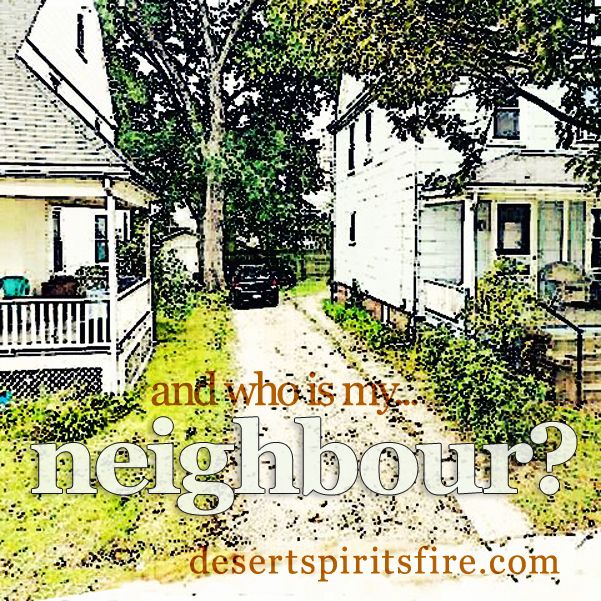
who is my neighbor?

This morning I updated the website for one of my churches in Previous City; in his front page article the pastor observed:
"Natural disasters bring out the best and the worst in us humans. They provide us with object lessons of the Lutheran anthropological insight that we are simul justus et peccator, at the same time righteous and sinful. The sinfulness is evident in the price-gouging that was occurring before the storm even hit, and there will probably be looting once the waters subside enough to facilitate it.

"But even more striking are the occasions of people reaching out to help their neighbors, taking no account of their race, class, gender, sexual orientation, political affiliation or correctness. People in a tough situation helping their neighbors. People in a tough situation not being picky about who it is that is helping them. Loving their neighbors—as themselves.

"There's a lesson here for our lives after the waters subside and we return to the elite infighting of the chattering classes and the high-horse lectures about the brazen immorality of the other side. When a sea of troubles rises around us, wounds that are not easily healed can be ignored for a time while we attend to the more basic needs of the human community."

taking five on my own...

Particularly during the last Revised Common Lectionary year C (also known as "Luke's Year") in the adult SS class I facilitate we studied quite a few passages from Luke's gospel, from the prophet Jeremiah, and from the book of Deuteronomy that in many ways reveals the heart of Torah with its concern for the other, the neighbor, those in need, the overall well-being of the community —"neighborology"— the word about the neighbor.

According to the gospel account according to Luke, after the guy asked "and who is my neighbor?" after Jesus' counsel to love your neighbor as yourself, Jesus responded with that memorable "A guy was going down to Jericho..." that ended with the commandment "go and do likewise." Jesus' example was a despised religious "other-than."

In the current national political situation in the USA, in the way Christianity has become fragmented and divided in the USA, along the world religious landscape, with immense complications of immigrant, refugee, and other non-citizen sojourner status... which of these are my neighbors? Certainly not all of, my neighbor can't be everyone one of them? God's says I'm my brother's keeper – that means my sisters and brothers are my responsibility. To what extent? Please tell me, then, who is my sister, my brother? Or not?

A long time ago I worked with a guy who told us he'd been seeing a psychotherapist who worked from a Christian perspective. One day he came to work and reported his therapist had told him to stand in front of a mirror, look at his own reflection, and declare, "I love you!" "Wow! That was hard," my colleague admitted. The late Jewish theologian Martin Buber tells us love is the responsibility of an I for a thou. Am I my own neighbor? Am I responsible for myself?

five minute friday neighbor five minute friday new button

Wednesday, August 02, 2017

Porch Stories :: 15 years

On this week's virtual Porch Stories and in their actual lives, Kristin and Greg Taylor celebrate 15 years of marriage—you can read about their very mature anniversary plans for an awesome reflection of Kristin's "Seeking God as the Author of Every Story" blog description!

desert spirit's fire porch stories – 15 years: mercy roads

desert spirit's fire @ 15: Mercy Roads


Most years I write a blogoversary post; officially and formally desert spirit's fire debuted on the middle day of July – the 16th – but it feels providential that I didn't post closer to that day, because 2017 marks this blog's 15th year, making it the perfect subject for my own Porch Story today.

Fifteen years ago I'd very recently finished a year-long certificate in Community Economic Development. After too many rough, tough, disappointing years, when I excitedly began the CED program I believed it would help me re-enter a life of meaningful service to the city and to society. Two months after graduation, I still held that conviction. In the decade plus since then, Planet Earth's itinerary has included a national and global economic downturn that's affected all individuals and entities other than the ultra-rich and super-wealthy. Along with financial struggles, I'm still (yes, "still") trying to grieve other losses and situations that turned out very other than I'd minimally anticipated.

And there I will meet with you, and I will speak with you from above the mercy seat... Exodus 25:22a

Martin Luther tells us the cross of Calvary is God's Mercy Seat or Gnadenstuhl— God's Throne of Grace and Mercy where God meets us where we are, how we are, rains boundless mercies and offers resurrection hope.

A Porch Story tends to be the type of testimony of God's faithfulness we'd recount sitting on a porch with a friend or enjoying lunch in a kitchen or at a café. In other words, most porch stories are about the little incidents and mini-moments that remind us of God's presence, that fuel and fill us so we can keep talking the talk, walking the walk.

You know how the Apostle Paul frequently lists the many disasters, shipwrecks, and other calamitous adversities he'd experienced? At least once, maybe twice in this blog I've mentioned in passing I've been through a few "Pauline-style" catastrophes, too! {Maybe especially as a woman and} in the interest of keeping on keeping on, I've done my best to sail through and hardly mention them at all to anyone.

Let's turn that around?! Truthfully – yes, really – over the course of these fifteen years, along city streets, suburban byways, urban freeways and a few country roads, other wayfarers have offered me grace-filled surprises of welcome, hospitality, and participation. Other pilgrims have put aside their druthers to rain solace, mercy, friendship, love, and inclusion on me. Is looking to the neighbor's needs rather than insisting on our own not the way of the cross? Has that not been God's call to God's people for all times and in all places? Last fall when we had several lectionary readings from Jeremiah and Deuteronomy, I talked with my adult Sunday School class about neighborology—the word about the neighbor—that's central to Torah. Neighborology that encountered us right where we lived when the guy asked Jesus, "And who is my neighbor" with Jesus' reply, "A guy was going down to Jericho..."

Who has been a neighbor to you? How have you been a neighbor? Who has shown God's mercy to you? To whom have you offered grace? What are a few of your mini-moment porch stories that fuel you along the way, fill others as they journey, to keep talking the talk and walking the walk?

porch stories button

Friday, June 30, 2017

Five Minute Friday: Blessing

Time for another Five Minute Friday—whazzup this week? Host Kate Motaung counsels us Count Your Blessings. Her button image for the prompt simply says blessing, so that's another option.

earth day 2013

This week my header is a version of my Earth Day 2013 design; to quote my blog, "from the deuteronomic historian we constantly hear the refrain, 'into the land, into the land, into the land...' Deuteronomy 28:1-3 cautions and promises:
"Now it shall be, if you diligently obey the LORD your God, being careful to do all his commandments which I command you today, the LORD your God will set you high above all the nations of the earth. All these blessings will come upon you and overtake you if you obey the LORD your God: Blessed shall you be in the city, and blessed shall you be in the country."
take five {minutes}

God's promises carry the condition of obedience; the witness of scripture shows us "grace is not all that free." Grace not all that free? But obedience is bounded freedom! Yet in the course of a year – a year?! in any week or every day – we experience countless unanticipated, completely unimagined, humanly impossible surprises of grace-filled blessing. The Deuteronomy text describes blessings even overtaking us wherever we are, everywhere we go, as God responds to our obedience! Sounds like a most welcome heavenly deluge! You know what else? The psalm writers remind us to "Bless the Lord!" Send grace and charity, praise and doxology from earth to heaven! When that happens it's our response to God's gifts; how delighted God must be that we remember, that we do our best to reciprocate.

# # #

five minute friday future five minute friday new button

Wednesday, June 14, 2017

Porch Stories: Navigating Faith

For her Porch Stories this week, Kristin considers Navigating Faith with Kids and features Susan Shipes' coloring book devotional, 52 Commands of Jesus for Children. I'll range further and bring adults into this post, though I'll still be more impressionistic than detailed since I check out Kristin's topic when I get online Wednesday mornings and try to blog by evening.

desert spirit's fire porch stories – navigating faith

I love the nautical word navigating related to our journey with Jesus! Maybe you know many traditional church buildings have been constructed in the form of a ship that appears upside-down to us as we look up at the ceiling and rafters? "Nave" – as in "navy" – still designates the central space where worshipers gather. You've probably heard ships referred to with female pronouns she and her; scripture tells us the Church is the Bride of Christ, so that's also her and she. Navigating also is especially apt because we can't see what's underneath the surface of the sea our boat is on, we can't tell what's on the other side of the horizon. As we answer God's invitation with "yes" and take a first step out in faithful trust, we never really know where God will lead us; we only know God promises to be with us every moment of everywhere we venture on our voyage.

I've taught Sunday School, confirmation, and Vacation Bible School to most every age except teeny tiny tots, though middle school's probably my favorite age group! I almost just now remembered—in City of History we had Release Time classes for inner-city 4th and 5th graders. Middle schoolers especially appeal to me because they're old enough and have enough life experience to do some sophisticated thinking, they're open to new ideas, and they're always more than ready to challenge the teacher to stay real and relevant. Kristin mostly writes about faith with kids; currently I prepare and facilitate (all the participants teach) adult Sunday School at my church—I post my notes on my urban wilderness blog. Most weeks we mainly reflect on one of the Revised Common Lectionary passages for that day, though by the gracious movement of the HS, inevitably our discussion takes us pretty far afield of where I've started with my (always deft) theological and historical intro to the text.

Recently I read and plan to blog and review The Creative Word: Canon as a Model for Biblical Education by Walter Brueggemann. Related to Biblical Education in the title, a few places he mentions the coming-up generation that's also growing up in the church, but everything he says applies to any age. Because the Old Testament is his specialty, Brueggemann focuses on the Hebrew Bible and particularly emphasizes God's gracious gifts of liberation from slavery, God's subsequent gift of the Ten Commandments of the Sinai Covenant, and God's charge to us to obey in order to maintain that freedom:
Take care that you do not forget the Lord your God, by failing to keep his commandments, his ordinances, and his statutes [because] the Lord your God brought you out of the land of Egypt, out of the house of slavery… remember the Lord your God. –Deuteronomy 8
Jesus also commands us to keep the commandments; he summarizes everything behind the Ten with only Two, to love God with our whole heart, soul, mind, and strength; to love our neighbors as we love ourselves. In fact, he shortens that into a single, "love one another as I have loved you," but the details of the ten commandments help clarify our attitudes and behaviors. I love that the title of Susan Shipes' devotional coloring book mentions Jesus' own commands—he tells us his yoke is light because in Jesus' new covenant of grace (just as under the old covenant that also was a grace-filled way) obedience leads to freedom.

Today Kristin and I both began with navigating. Many people want direct instructions for every move in every situation; young kids and chronologically mature adults alike often struggle with the finely tuned morality involved in keeping the commandments, but learning the narratives from Jesus' life and ministry we find in the four gospels gives us additional insights for putting the good of the other and the well-being of the community before our own preferences and predilections. From Jesus' own example, we know we find healing and freedom anywhere the realm of heaven is breaking out in our midst. That knowledge isn't a road map, but it still can help guide our desire for instructions and our search for reassurance. We don't know what's underneath the surface of the water we're walking on, what gift, what threat, what grace or mercy may appear when we reach that distant horizon, but in obedience we can do this! In the power and presence of the Holy Spirit of Pentecost that fills the church, you know we can navigate this voyage!

52 commands of Jesus

porch stories button

Wednesday, March 29, 2017

Porch Stories: Serving

For today's Porch Stories, Kristin Hill Taylor's about Serving Where You Are Sent (Where You Find Yourself, etc.).

Serving

I hardly can count the times of consternation I've had when people have claimed out of context God's promise to the exiles in Babylon via Jeremiah 29:11, "I know the plans I have for you... to give you a future and a hope." The God whose Word enacts resurrection to new life from the most morbid of deaths does have a future in store for everyone, one far more abundant than our most extravagant hopes. We acknowledge scripture as God's word for us, but latching onto this passage because it feels good is blatant (or maybe pathetic) eisegesis. Holding onto that verse without the full context omits the condition of God's promise: obedience. As Walter Brueggemann points out in Out of Babylon, "this text urges coming to terms with the empire as the unavoidable matrix for Jewish well-being. [page 8] and "...it is Babylon that becomes (for now) a venue for shalom." [page 9] We know Jeremiah lived deeply informed by and responsive to the tradition of Deuteronomy with its demands of hospitality and care for all, of covenantal obedience—its emphasis on forgiveness, grace, and newness.
5Build houses, and dwell in them; plant gardens, and eat the fruit of them... 7But seek the welfare [well-being; shalom] of the city where I have sent you into exile, and pray to the Lord on its behalf, for in its welfare [well-being; shalom] you will find your welfare [well-being; shalom].
Jeremiah 29
My citation's intentional—a scripture snippet from the same chapter and historical exilic context, words that relate to wherever we are and constitute a call for us to look around right here and now–not backward or foreword in time, not geographically across town or to another hemisphere, though a different city or cultural setting well may form part of God's future for us. In every case the word for "welfare, well-being" in the Hebrew text is a shalom derivative. Like some states of the USA, you also could use the common-wealth designation.

A couple weeks ago for Porch Stories I touched on some implications of shalom. I assume most readers won't backtrack to my earlier post, so I explained:
the Hebrew word and concept "shalom" extends far beyond absence of war or conflict; shalom intrinsically belongs to God's manner of living together in community, whether that "common unity" is nuclear-extended family, a particular group that gathers around Word and Sacrament as a local expression of God's called-out assembly—ecclesia; a school of any educational level dedicated to providing the best for students and teachers, a neighborhood within a city striving not to neglect anyone's needs, aiming to provide that shalom-filled "enough" food, shelter, hope, and friendship to all comers of all ages and stages. It's true when the apostle Paul and his successors open their letters with "Grace and Peace" their word for peace is the Greek eirene that gives us "irenic" in English, but with Saul/Paul's Hebrew background his offer of the peace of Jesus Christ had to be fullness of care-filled community where no one lacked, not one had more than they needed. Paul, etc. did not refer to no-apparent-conflict or to the not-Roman, not-peace-filled Pax Romana.
It's Wednesday after Lent 4; churches that follow the liturgical calendar have journeyed more than halfway through the season of Lent. When Lent ends, the Three Days of the Triduum begins with Maundy Thursday, whose texts and liturgy retell and show us Jesus' mandate (or command) to serve one another in the way he demonstrates by washing the feet of his disciples and by instituting the freedom feast of the Lord's Supper or Eucharist—the long-standing Jewish practice of remembering by re-enacting God's people's Passover from slavery and death into life and liberty, but with a new emphasis and completion into a greater, shalom-filled redemption. Right there in the midst of where any observant Jew would have been on that day, Jesus seizes the here and now and charges his friends to "do this." Repeat this blessing and breaking of bread, this pouring-out of wine? "Do this" blood of the covenant announcement? Yes, in a sense!

Similar to how a passover seder meal and a eucharistic feast re-member liberation and resurrection with all of our five senses, we serve our neighbors' whole lives by constructing houses and planting gardens. More than once I've heard how ministering to people doesn't necessarily mean giving them what they want; it means giving them – or helping them get – what they need. What could be more essential and life-engendering than shelter and food, more shalom-restoring than creating community filled with friendship and hope, where we look around right now and right here, when we notice and attend to everyone's needs and even to some of their wants? Creating shelter from trees, leaves, vines, and sod; out of a well-tended earth—growing food. Breaking open the flesh and substance of our own lives and hearts, pouring out our essence in time, labor, and talent in service to others. Our own "little deaths" that contribute to the liveliness and well-being of others.

The Three Days of the Triduum begins with Maundy Thursday, with texts and liturgy related to Jesus' mandate (or command) to serve one another in the way his entire life showed us. This long-standing Jewish practice remembers by re-enacting God's people's Passover from slavery and death into life and liberty, but with a new emphasis and completion into a greater, shalom-full redemption that reflects God's manner of living together in the common unity of covenantal community. "A greater redemption?" Today is Thursday, tomorrow's Friday—Sunday's coming!

porch stories button

Wednesday, February 15, 2017

Three Word Wednesday: 3 {things} 2 tell

Kristin Hill Taylor introduced today's topic with, "Sometimes I sit down with a friend and have multiple things to tell her … and none of them are related. We may have to catch up, talk about the books we're reading and the music we're listening to, share new recipes, and make plans for next time. Today's post is going to be that kind of conversation as I share things I want you to know about."

Although the idea is to write to any combination of three words, I always pick up on Kristin's phrase or a very close variant for my own Three Word Wednesday. {Therefore,} here are three things I want to tell you about—let's make this Three Word Wednesday sitting down to lunch together as we update each other.

3 word wednesday 15 FebruaryCreative Market – this is far from the first shoutout I've given on this blog and on my facebook page to Creative Market, the best place ever to get an astonishing variety of design assets from creatives all over the globe. Every week CM offers six design freebies; most weeks I pick up every one of them. If we've bought – either for free or for a cash transaction – a font or photo or drawing, in every case we legally can use it for our own design projects. Typefaces aside, if we want to incorporate an asset from CM into a paying client project, sometimes we need to buy an extended license. Simple guidelines that also include not needing to credit the artist/source. Most weeks I get all the freebies, but other than the fonts, I use them very rarely. Why? For the most part the paintings and drawings are in a particular artist's especially unique style. No way would I imagine passing it off as my own, but it feels not quite right. However, I've used photographs from CM about a dozen times for blog graphics, and it's easy to credit the photographer, which I always do. So about all that, I'm just sayin' for your information. Every element I used in my graphic for this post is from Creative Market, but it feels fine because this time they're all very similar to something I easily could have designed myself.

Pentateuch – for over a year I've been leading and facilitating adult Sunday School at the church I attend. We mostly discuss one of the day's readings from the Revised Common Lectionary – this is Matthew's lectionary year (A); so far the timeline of the gospel we received from Matthew's community includes genealogy, birth, magi, Herod's threat /Joseph's dream, flight into Egypt, Bap-J, wilderness temptations, return to Galilee / calling first four disciples, sermon on the mount... Aligning with rabbi Jesus' articulating his interpretation of the commandments in the Sermon on the Mount, last week we read, heard, and discussed Deuteronomy 30:15-20; this week Leviticus 19:1-2, 9-18 will be on the bill of fare, for the only instance of Leviticus in all three lectionary years! I've been almost surprised at how those Pentateuch texts have sprung to life as I've prepared for the class, as everyone's ideas have circulated around the room.

Worship Symposium – I'm very Very VERY excited to be attending Worship at the Center 2017: Engaging Worship & Culture next Sunday evening through Tuesday noon. The denomination, "church body" (or national church how ominous that always sounds) sponsors the event. I look forward to meeting more people from around town, to learning more about one of my passions, to have another résumé line item. Politics and other concerns allowing, I'd long been preparing to serve on the committee for the next hymnal: I'd know liturgy; I'd know hymnody; I'd know theology. Partly because I moved to a different denomination, but mostly because substantial parts of my life went into a holding pattern while the New Century Hymnal (NCH) and Evangelical Lutheran Worship (ELW) were in process, hymnal committee didn't happen.

3 word wednesday button

Wednesday, January 11, 2017

Three Word Wednesday: Truth, Goodness, Beauty

For her Three Word Wednesday, Kristin Hill Taylor reflects on Truth, goodness & beauty. Inspired by a quote from Andrew Kern on Instagram, "We think to determine three things: whether something is true, whether something should be done, and whether something commands our appreciation. In other words, we think to know truth, goodness, and beauty," Kristin tells us, "...especially those three words – truth, goodness, beauty – stopped my mindless social media scrolling."

"Truth, Goodness & Beauty" reminded me of Psalm 85 that in turn reminded me of the fullness of earth's bounty we ideally experience during summer.
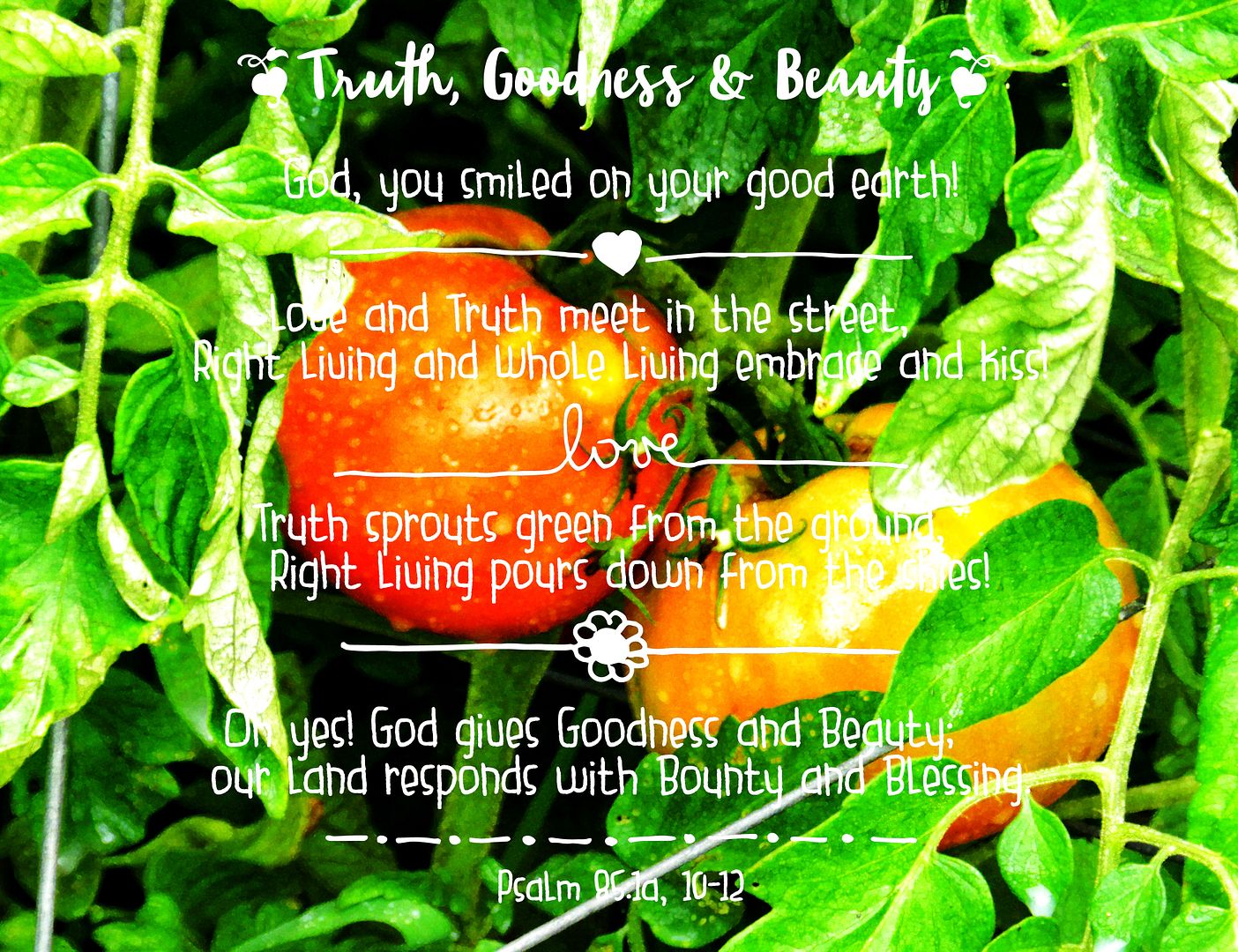
3 word wednesday tomato
Psalm 85:1a, 10-12

1God, you smiled on your good earth!

10Love and Truth meet in the street,
    Right Living and Whole Living embrace and kiss!
11Truth sprouts green from the ground,
    Right Living pours down from the skies!

12Oh yes! God gives Goodness and Beauty
    our land responds with Bounty and Blessing. MSG
Probably written down after the Babylonian exile with righteous concern for restoring land, crops, and the fertility of planet earth to its utmost so humans and everything else would be revived to thrive in interdependence, Psalm 85 is packed with dense theological words—land, salvation, forgiveness, steadfast love, faithfulness, mercy, peace, righteousness, good, truth, earth... Although some exiles chose to stay in Babylon to make lives for themselves, the place and space others returned to was the literal Good Land of Promise whose valleys and streams would generate figs, grains, grapes, pomegranates...
Deuteronomy 8

6Therefore keep the commandments of the Lord your God, by walking in his ways and by fearing him. 7For the Lord your God is bringing you into a good land, a land with flowing streams, with springs and underground waters welling up in valleys and hills, 8a land of wheat and barley, of vines and fig trees and pomegranates, a land of olive trees and honey, 9a land where you may eat bread without scarcity, where you will lack nothing, a land whose stones are iron and from whose hills you may mine copper. 10You shall eat your fill and bless the Lord your God for the good land that he has given you. NRSV
God smiling on God's good earth becomes a reality when we fulfill the commandment to steward the land, to live in covenant with all creation—not solely with human creatures. And yes, also when we seriously practice what I've called "neighborology" in the covenantal traditions of Deuteronomy and of Jeremiah. In Psalm 85, "peace" is the Hebrew shalom, a way of living together as neighbors that's far more than absence of conflict; shalom includes the broad reality of distributive justice, well-being and "enough" sufficiency for all, a common-wealth reconciled to one another and to God on every level. Shalom is "Right Living and Whole Living" in Pastor Eugene's interpretation of the psalm. Israel's Lord God Yahweh was and still is a fertility god who owns the land and loans it out for human caretaking and for the benefit of all creation. Two thousand years ago, the day of resurrection marked the end of the seemingly eternal recycling of human history (sin, violence, debt, war, greed), though in the power of the HS we still need to pray and work and hope toward the absolute completion of God's redemption.

Psalm 85:11 tells us "truth sprouts green from the ground." Every agricultural season's freshly sprouting plants of every kind – especially the beginnings and later the growth of anyone's tomato plants – become harbingers of hope for more to come, for the lively possibility of our continuing to get it right, continuing to care well for the ground and its gifts, keeping on keeping on with concern for our immediate neighbors on either side of us at home or at work, in gracious kindness and hospitality for neighbors we haven't yet met but whose lives already touch ours through other lives they touch that touch ours. You've been in conversations at work, church, club, school, where tomato plants are the main topic?

Garden Fresh Tomatoes have become a triumphant icon of a healthy summer garden, of people living into and loving all of the glory of summer's long warm days, summer's enhanced opportunities for leisure and recreation. God smiles on the good earth as truth sprouts green from the ground—right living pours down from the skies! The sacraments form models for the lives we pursue after we leave those circled around liturgy of Word and Sacrament to engage those and others the circle of the world embraces. In a parallel manner, scripture – not only the commandments – as words from heaven and Word of God for us, outline how we can work alongside God to make this southern California county – and where you make your home today – a place where love and truth meet in the street, where righteousness and integrity spontaneously hug each other, where this-seasonal veggies, fruits, berries, and flowers sprout green and all other colors imaginable. A location where God again smiles on our good earth. Essentially making our surroundings into year-round endless summer!

Let's love the earth. Care for the land. Treasure the waterways. Keep the air clean. Live locally. Remember your neighbor. Keep covenant with all creation. Let's help fill planet earth with endless truth, goodness, and beauty. Make your neighborhood into a forever summer. Thank you!

Credits: Psalter verses from Pastor Eugene Peterson's The Message; stock photo of fresh summer tomatoes by Pippalou on morguefile; edited by me as suntreeriver design. Headline font on tomato graphic is Blog Script; psalm expressed in the font garden fresh tomatoes.

3 word wednesday button

Wednesday, November 16, 2016

Three Word Wednesday: Paper Plate Thanksgiving

thanksgiving season 3 word Wednesday

3 word wednesday button On her Three Word Wednesday Kristin tells us about a Paper Plate Thanksgiving she celebrated and enjoyed last weekend. Thanksgiving day USA is eight days away; thanks to the church I serendipitously discovered and began attending, last year was the first time in forever I was able to invite people to Thanksgiving dinner. Again next Thursday we'll worship as a community of friends, neighbors, strangers, and newcomers, and then feast on traditional turkey and trimmings. Preparing fancy food and decorating for any holiday can be exciting, but I resonate with Kristin's talk about paper plates rather than stoneware or china, about not even putting on shoes because the company, the community, and the taste and nourishment of the gifts of creation harvested from the earth are the main focus. You know we need to weigh economic and environmental costs of dishes and flatware for a large gathering—for example, for Sunday after-liturgy brunch at church we now use very few disposable anythings. But sometimes their are so many guests, the meeting space is small, not enough time or kitchen real estate to prepare multiple course meals. So what do you do? You need to lighten up some less important preferences, back away a few notches from your ideal. That's a "what's really important"message to myself.

Thanksgiving Day on the way—I haven't been doing a daily Facebook or journal gratitude list, so why not make one here. Kristin concluded with, "Being surrounded by my favorites filled my soul." This year I'm still grateful to have a roof over my head every night, enough food in my belly every day. Amazed to have been teaching every Sunday for the past year—all the way through Luke's lectionary year, guiding and being guided through another year of grace. Still dismayed I'm in another temp housing situation and haven't found anything long-term yet. The Chicago Cubs won the World Series. I love to remind people how baseball mirrors the dramas, the slowness, the surprises, the anything can happens in our own lives. Now what? Is the test of my keeping covenant staying put, doing what each day's work and tasks demands, or is getting out there and risking another move the test of my trust? I don't know. I do know I still long, yearn, ache, and need to be surrounded by my own favorites now and then. My own soul needs filling again.

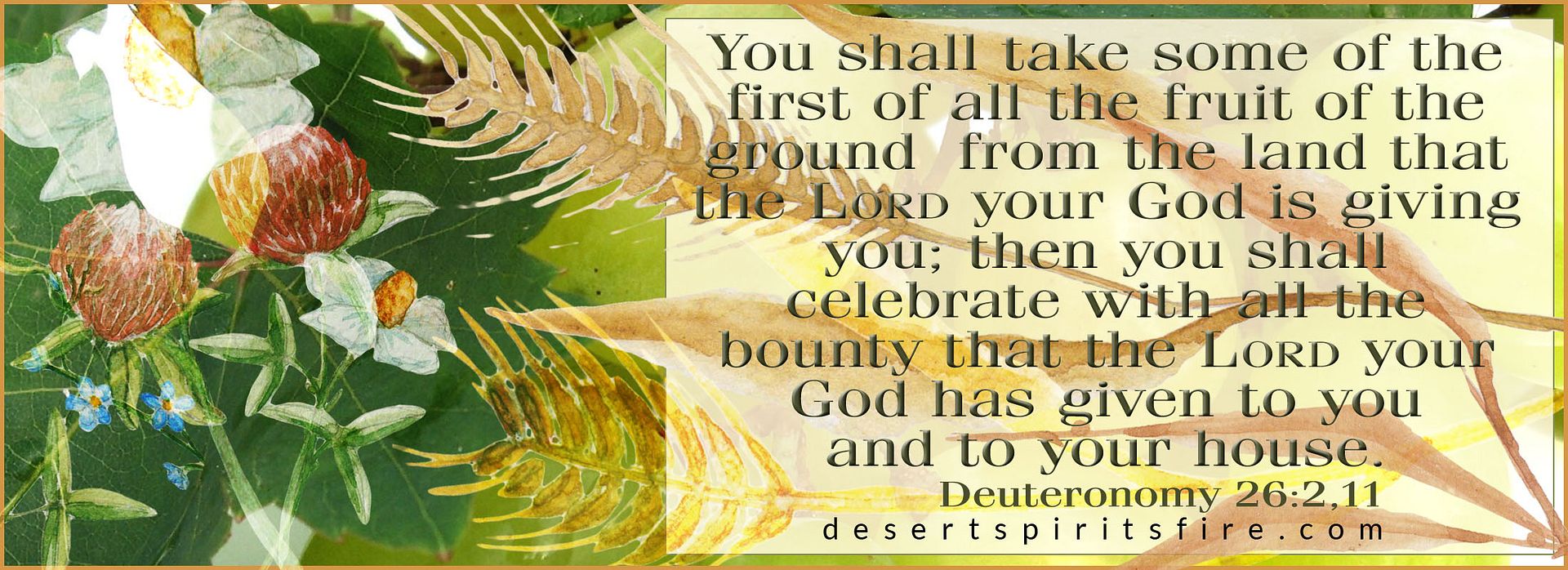
Deuteronomy 26:2,11

You shall take some of the first of all the fruit of the ground, which you harvest from the land that the Lord your God is giving you, and you shall put it in a basket and go to the place that the Lord your God will choose as a dwelling for his name. 11Then you, together with the Levites and the strangers who reside among you, shall celebrate with all the bounty that the Lord your God has given to you and to your house.

Tuesday, October 18, 2016

#Write31Days: 18 • neighbor

write 31 days 2016

Tuesday 18 October: neighbor

This is a month long series of unedited free writes, but ya know what? I'm going to copy/paste from my urban wilderness blog where I keep notes and handouts from classes I've facilitated, from a few someone else has led but I've participated in. Why? Not only did year C – Luke's Year – in the Revised Common Lectionary bring us Good Sam earlier this fall; I've been discussing a lot of Jeremiah with my adult SS class, a whole lot about the neighborly tradition of Deuteronomy that's so very consent with Jeremiah's theology and prophecy. Calling it "neighborology." I linked to the entire post, and this excerpt sure ain't five minutes' worth, but in this torn, tattered, weary, war-mongering world, all of us need to acknowledge everyone is a neighbor.

Neighborology: the Word about the Neighbor – Jeremiah / Deuteronomy

As sometimes happens, the RCL brings us texts closely related to the events of the past week in the USA. First, a relatively rare excursion into Deuteronomy, the covenantal, neighborly – neighborology – text par excellence, very much in the tradition of Jeremiah, despite its long historical sweep.

Deuteronomy is one of the five books of the Pentateuch, Ha Torah, the books of the law. However, rather than being rigidly legalistic, practicing Torah is a fluid, stretchy, flexible enterprise that's always on the side of grace, mercy, love, and distributive justice. Despite its being in the covenantal tradition of Jeremiah, Deuteronomy is compiled from sources that range over about five centuries, from the United Monarchy of Saul, David, and Solomon at least through the Babylonian exile and likely into the post-exilic period of Persian hegemony. Deuteronomy moves beyond theory and ideas to practice and reality, showing us covenantal neighborology in action. Deuteronomy demonstrates Torah neighborology lived out on turf and in time.

Deuteronomy 30:14 "No, the word is very near to you; it is in your mouth and in your heart for you to observe."

Better translation is "the word is very near you in your mouth and in your heart and you will do it." Double meaning of commandment and promise on You will do it.