Showing posts with label theology of the cross. Show all posts

Saturday, June 27, 2026

Brian Drinkwine :: Kingdom Over Empire

• The release date for Kingdom Over Empire is Tuesday 30 June. If this overview entices you to get the book, it would be best if you wait until the morning of June 30th.
kingdom over empire cover

• Kingdom Over Empire: Recovering the Gospel from Political Captivity by Brian Drinkwine on Amazon

• Brian's Website

Page numbers are from the ARC PDF and are not the same in the print copy.


Poetic, pastoral, and probing, Kingdom Over Empire provides scripture and history to help you sort out your allegiances. Pastor Brian Drinkwine doesn't advise is. He trusts us. I need this book! Whether you live in a Western-style democracy or elsewhere, you need this book!

Kingdom Over Empire. Particularly in politically blue circles in the USA, one major reaction to goings-on in the current presidential administration has been an active, vocal No Kings movement. The general idea is American colonials broke away from royal rule and chose elected leadership rather than hereditary monarchies, and we continue on that path.

Related to not having kings, in protestant mainline churches, especially some individuals in so-called professional leadership in local churches or judicatories have come close to conflating deep blue politics and progressive Christianity. Though I've hovered on the edge, I haven't quite gone there. Brian's book shows us what a Yes Kings affirmation is when the King is Lord of the Universe, Lord of Life Jesus Christ.

I plan to take seriously assessing how outside forces and influences have affected our (my) perspectives and our (my) fears. That's called formation as in the shape, the traits, instincts, love, convictions, assumptions that intrinsically are part of us—that motivate us, too.

And what we are willing to excuse! Brian offers us "companionship from nearby" because according to one of his blockquotes, You do not need a movement. You need companions.
companionship

Two critical definitions:

page 33: "Patriotism is love of place without allegiance to place." It's "grateful stewardship of the land, people, and institutions where God has planted us … At its best, it seeks the welfare of the city."

page 34: "Nationalism happens when love of country becomes something it was never meant to be. Nationalism is what happens when patriotism crosses the line from stewardship to identity."

In the church we casually talk about belief, which too many equate with intellectual assent. But first century pistis belief is allegiance, loyalty, trust; it's a whole body-essence of your being posture. [page 44]

Although it's political, social, and economic, in its essence empire is a way of organizing power over time. You likely can list biblical empires such as Egypt, Babylon, Persia, Rome; you can add in more recent Spanish, British and others. But educational, ecclesiastical, consumer, and other entities also operate in an imperial manner because Babylon/empire is pattern rather than place. It is out there. It is in here. Think about it!

Brian provides a short list of lifestyles and religions you could call Christian Pretenders because they're not the good news Mark, the earliest gospel announces to open his proclamation. They aren't Theology of the Cross; many are theology of glory that humans find appealing and humanly doable.

For the Apostle Paul, the gospel is death and resurrection. In Kingdom Over Empire, the author traces the subversive power of the cross and God's faithful actions that paradoxically create new life out of death.

Brian beautifully reminds us Jesus came announcing, "Not a kingdom built on dominance, but on restoration. Not a kingdom advanced by force, but by faithfulness. Not a kingdom that secures itself through control, but one that grows through surrender."

"In this kingdom, blessing begins with the honest recognition of need. The poor are lifted up. The imprisoned are set free. Those far from God are not threats to be managed but treasures hidden in a field. …This kingdom promises not control, but resurrection." [page 84]
formation

"Writing to a church confused about what faithfulness meant, Paul does not appeal to their influence or their success. He appeals to the resurrection."

“But Christ has indeed been raised from the dead, the firstfruits of those who have fallen asleep” (1 Corinthians 15:20).

"Firstfruits. The first sign of a harvest that is coming, proof that more is on the way. If Jesus has been raised, then death does not have the final word. And if death does not have the final word, then neither does empire. Neither does failure. Neither does obscurity." [page 162]

Short summary:

"The call is not to disengage from society but to disentangle from idolatry. You can vote without making the vote your hope. You can advocate without making advocacy your salvation. You can be present in the public square without giving the public square the allegiance that belongs to Christ.

"The call is an echo of the Exodus. It is a summons to live as exiles—in the empire but not of it.

"This does not mean we abandon society. It means we refuse to be seduced by its idols. We resist its economy, its nationalism, its violence, its counterfeit hopes.

"We live as if Jesus is King, because he is. And we hold loosely to everything Babylon promises, knowing that it will not last." [page 178]

Kingdom Over Empire is a workbook. It's devotional. It's heavy-duty theology. It offers a direction for us to travel together in order to restore life and hope to a world dominated by empires. Throughout the book, Pastor Brian offers his own testimony. Will your life testify of a King who reigns from a cross?
no king but chrisr

Disclaimer: As a member of the launch team I received an Advance Reader Copy with no expectation or obligation to write a positive review. As always, my opinions are my own (and you know I wouldn't have it any other way).

Saturday, November 02, 2013

The Prophetic Imagination

The Prophetic Imagination on amazon

prophetic imagination book cover
We need to quit imagining prophets as only foretellers or social / political protesters, because "Most of all, [prophets] understood the distinctive power of language, the capacity to speak in ways that evoke newness 'fresh from the word.'" Newness that springs from trustfully covenanting rather than frantically consuming. An alternative way of being that emerges from being satisfied with relative scarcity that's actually shalom-full "enough" for everyone in the community.

If this easily readable, "slim volume" has an ongoing theme, it's that only when we acknowledge people, possibilities, and opportunities are forever gone, and begin grieving their loss, will the paradoxical possibility of new life from death arise. In fact, in Yahweh's terms, history – newness that marks the end of uninterrupted forevers in the manner any imperial (political, economic, educational, religious) establishment measures and regulates time [chronos] – always begins with barrenness and bereavement. Read and trust the scriptural witness!

This is radical stuff about newness from the ground up, "life in the shape of death" in the final no to sin, exploitation, empire, consumerism from the Calvary cross that at dawn on the day of resurrection becomes yes to life! Just as in his later writings, in this vintage book Brueggemann reminds us we experience that newness in baptism, then relive it in the eucharist. The Prophetic Imagination is vintage Brueggemann, and it still doesn't get any better than this.

my amazon review: Classic Brueggemann

Tuesday, July 09, 2013

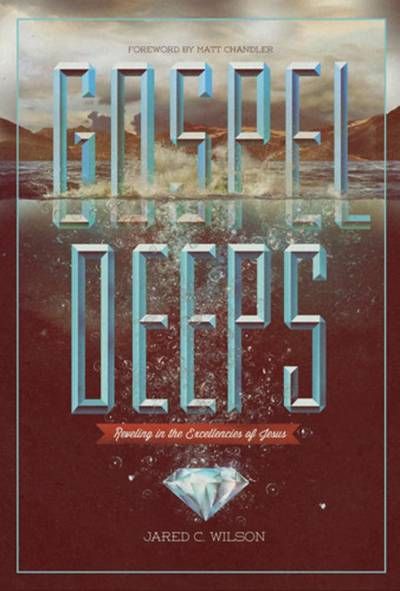
Gospel Deeps

Gospel Deeps: Reveling in the Excellencies of Jesus on amazon

Jared Wilson and /or the church he serves are affiliated in some way with:
• The Resurgence

• Gospel Alliance New England

• Jared Wilson pastors Middletown Springs Community Church in Vermont

and he has his own site:

•Jared Wilson dot com
For what it's worth, Jared Wilson is from a theologically altogether more conservative background than I am. Complementarian gender roles in marriage, all-male church officers, a less sacramental worldview—these differences and others could become obstacles for me in some conversations. However, in this book, Pastor Wilson lines out, explains, and scripturally grounds the multifaceted depth, height and breadth of the person, position, and power of Jesus Christ in a manner virtually no Christian could dispute, and without once leaving a solid trinitarian perspective behind in the dust.

With easy-going prose, not many theological technicalities, and an easygoing conversational manner that truly makes me want to meet him in person, in fewer than 200 pages Wilson reminds those who've been absent from church for a while, those who've been attending Sunday and weekday worship faithfully, pastors who preach the gospel, how it's all about Jesus, because ultimately it's also about God's total loving claim upon all creation; I especially appreciated chapter 8, "Cosmic Redemption." A scripture index at the back is useful, also. Very definitely a very high recommend!

my amazon review: deep excellence

Monday, March 25, 2013

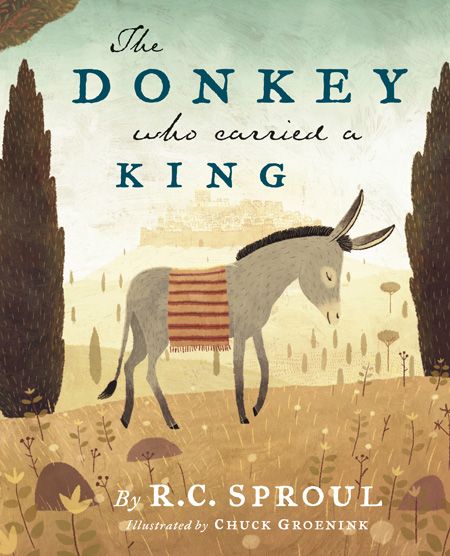
The Donkey Who Carried a King

The Donkey Who Carried a King on amazon. This book features a biblically-reflective narrative by R. C. Sproul with illustrations by Chuck Groenink.

Donkey Who Carried a King front cover In a similar manner to several books I've recently read, The Donkey Who Carried a King seeks to integrate scripture and "real life" by depicting current-day characters interacting with characters in a biblical story, or by relating scriptural characters' experiences to a present-day situation. In this instance, Reilly is a young American or Canadian (I believe, since he calls his mother "Mom") boy who isn't as popular at school as he'd like to be, so Reilly's grandfather decides to tell the Palm Sunday / Passion Week story of Jesus' triumphal entry into Jerusalem.

Yesterday was Palm Sunday 2013! Again we heard "The Lord has need!" "Hosanna!" "If these were silent, the stones would shout!" As many churches have been doing for a couple of decades, we celebrated Palm/Passion Sunday, moving too swiftly from Jesus' palms- and praise-surrounded triumphal entry to the walk with the cross, to the cross of crucifixion.

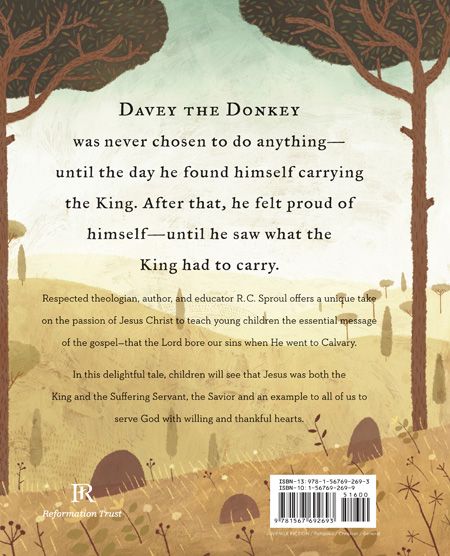
As part of creating context, author Sproul reminds us of other donkeys in the bible: diviner Balaam's donkey in Numbers 22; and Joseph's donkey – called "Barnabas" here – who carried Jesus of Nazareth's mother Mary. Through the voice of Davey the Donkey, Reilly's grandfather explains to his young grandson a servant God dying to self, and rising to new life for the redemption of the world, along with God's call to us to live as a servant creation―whether donkey or human. Donkey Who Carried a King back cover

For the Parents / Understanding the Story at the end of the book lines out some scriptural and doctrinal background. It's not comprehensive, but it is a good start in terms of reminding or teaching parents some basics and helping them explain to younger kids how the story of Donkey Davey and King Jesus is part of a larger, historically, and theologically interwoven fabric that also calls and enables us to live as servants.

Chuck Groenink's earthen-hued illustrations of both contemporary and biblical scenes are exceptionally beautiful. The book design also is exquisite, with some pages of text on a plain white background, others with words superimposed on the illustrations themselves. I realize R.C. Sproul is more accustomed to writing heavy-duty theology for adults than explanations for young people, yet he does well with this relatively simple account that alternates between donkey Davey and boy Reilly. The Donkey Who Carried a King could be a valuable addition to church or family Lenten, Palm Sunday, or Good Friday activities.

my amazon review: A Servant God, A Servant Creation

Friday, August 17, 2012

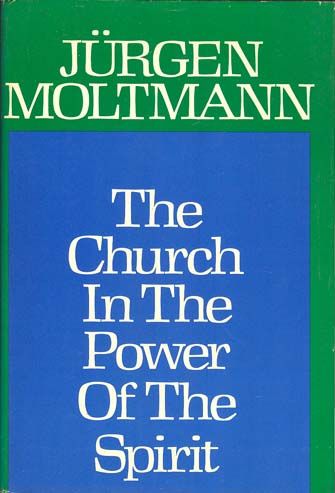
The Church in the Power of the Spirit

Jürgen Moltmann, The Church in the Power of the Spirit on Powells

Church in the Power of the Spirit coverFor a long time this now classic exposition of messianic eschatology has influenced me; at the same time I keep wanting to understand it better!

Reformed theologian Moltmann continues moving beyond theology for the church to theology for the world, essentially proclaiming the resurrection of Jesus Christ [in the power of the Spirit] as the horizon of the fullness of God's future new creation inbreaking and also becoming fully realized amidst the present suffering of creation.

Over and against theology of the first article of the Creed, or theology of the essential goodness of creation, beyond what we recognize as the Reformers' second article theology of sinful depravity over and against grace made manifest in the cross of Calvary, third article theology of church and world in the sovereignty and power of the Holy Spirit interprets the Spirit encompassing all creation in the brokenness of the cross along with the triumph and the hope of resurrection, the glory of Jesus Christ's ascension.

Almost every paragraph is packed full of ideas to contemplate and consider; I'll conclude with a couple of quotes: [page 238] "In the power of the Holy Spirit baptism is entirely and exclusively related to the Christ event and must therefore be understood as the representation, witness, sign, and illumination of this event. It points away from itself and its own happening in the direction of Christ alone." And, [page 358] "What constitutes the apostolate are the appearance and the commission of the risen Christ, not merely the discipleship of the [359] earthly Jesus."

The Church in the power of the Spirit for the world!

my amazon review: theology for the world

Wednesday, November 10, 2010

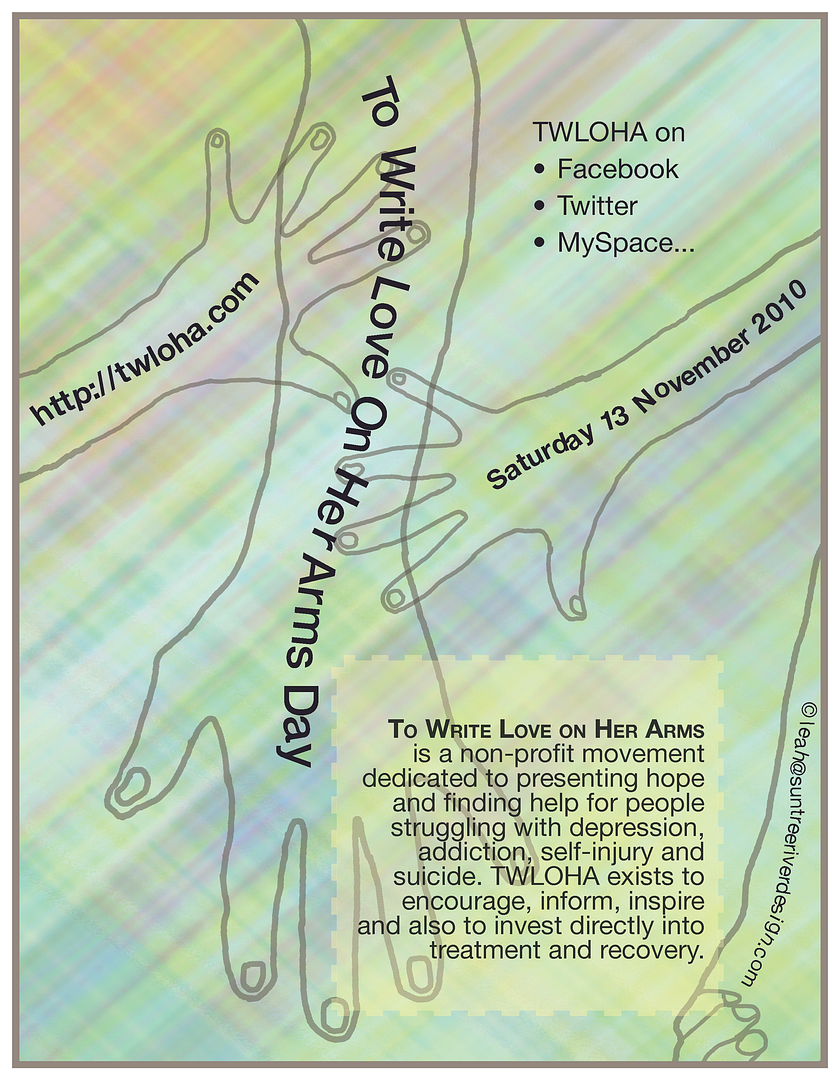
to write love on her arms day 2010...

Everywhere you are, Saturday, 13 November 2010 will be To Write Love on Her Arms Day!!!

to write love on her arms day 2010To Write Love on Her Arms—the main site: TWLOHA

To Write Love on Her Arms: Facebook

To Write Love…on Twitter

TWLOHA used to be on MySpace, "where it all started."

I'm basically re-blogging my own backstory from last year:
The subjects of addiction, self-injury and related are very close to me and to my heart. You could say I've been close to it in various forms most of my life; biologically and probably environmentally I've also inherited some of it.

Compulsive, stereotypical, addictive, and similar behaviors frequently seem to defy effective treatment and although there often is an underlying biochemical imbalance or other brain dysfunction that's frequently coupled with negative or sometimes even positive psychosocial experiences, the behaviors themselves quickly carve deep, indelible neurological paths.

For generations the side of my biological family I know something about has been captive to diseases, illnesses – "disorders" – of this type. Despite my dislike of labeling, I know the apostle Paul insisted on order, not disorder and Martin Luther says the Church isn't really there without order, in other words, when it is disordered (theology blog, remember).

telling the story buttonA huge part of reluctance to reveal, discuss, and seek intervention for substance abuse/addiction, compulsivities, self-injury, and panic is their seeming uncontrollability along with the fact insight usually comes quite easily yet barely makes a dent because of brain pathways that have formed. Whether or not they met clinical DSM criteria, most people have experienced an episode that would make them look depressed, but if you haven't been there, done that, from the outside looking in it looks as if the person with OCD or addiction needs to get a little discipline and control though often they're among the most disciplined, productive, and accomplished. In the many creatives who struggle with addictions and compulsions, their creativity and productivity essentially emerge from the same source as the undesired behaviors.

Incarnational theology is one of the labels/tags to this blog post and in all this my prayer for myself and for each of us – addicted, compulsive, mood-disordered, self-injurious, suicidal, simply creatively different and/or differently creative – is a community of embrace that will celebrate our presence and encourage everyone's full participation and that God will allow all of us to become wounded healers, the divine presence of the crucified and risen Christ we were baptized to be.

As I was watching and listening to Patrick Kennedy at Ted Kennedy's funeral, I realized that even for someone in a large, supportive family that also has sufficient resources of every kind, this kind of illness still takes a huge toll and is immeasurably costly to society and to the individual.

for every one of us to write love on each other's, others or others' arms…

Another version of my urban graffiti poster for TWLOHAD 2009: To Write Love on Her Arms Day too

Wednesday, February 10, 2010

proclaiming the scandal of the cross

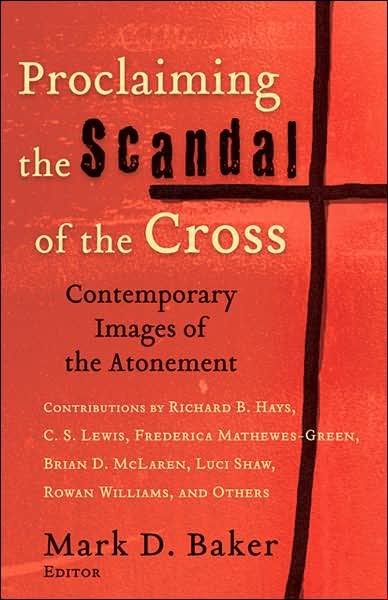
Proclaiming the Scandal of the Cross: Contemporary Images of the Atonement

proclaiming the scandal coverProclaiming the Scandal of the Cross brings the reader word and prose "images" of the atonement of Jesus Christ. The book features eighteen authors all told with a tailpiece, a headpiece and one in the center by editor Mark D. Baker. Contributors include big names like C.S. Lewis and Rowan Williams though sadly, only a scant four women. Brief bios in the front of the book show they're mostly Western Protestants, mostly pastors from English-speaking countries. Sadly surprising is the apparent total omission of anyone from a Lutheran or a Roman Catholic perspective, although I especially appreciate the inclusion of Frederica Mathewes Green, who writes from the Antiochian Orthodox tradition.

I found this book to be a helpful resource that I read very quickly. Despite my background, I've been known to get seriously bogged down in densely-written theological tomes - not to say those weren't written well - but this wasn't one of those. I especially like the real-life stories that contextualize each concept and the way each author nuances their atonement concepts a little differently. Each discrete chapter opens with introductory explanations and concludes with a descriptive wrapup of the material just presented.

Proclaiming the Scandal of the Cross goes beyond the generally popularly acknowledged models of the atonement of Jesus Christ that typically include conflict/victory, legal penal satisfaction, and moral influence/example. In his intro, Mark Baker observes [page 31] "...for centuries, Christians preached and taught the message of Christianity without the gospel leading them to the inescapable conclusion of penal satisfaction." And, "It is noteworthy that Orthodox Christians still read their Bibles without finding this theory."

[page 35, still in Baker's intro] "Through the lens of a Western legal system, anyone is just who meets the standard of the law. But a Hebraic understanding of justice is more relational: anyone is just who keeps one's covenants and commitments to others. Here, we could say that God is considered just ... because God is faithful to his covenantal promise to provide salvation to Israel and through Israel to the world."

I found material from several chapters especially helpful and revealing...

Chapter 9 from Richard B. Hays, "Made New by One Man's Obedience" based on Romans 5:12-19

page 97 "If the apostle Paul had turned this passage in to me as a short theological reflection paper, I would have told him, 'Get thee to the writing tutor.'" ... "so that he can pass my course on Greek Exegesis of Romans."

page 99 "But the Adam-Christ analogy should [page 100] never mislead us into thinking that Jesus Christ merely undoes the effects of Adam's transgression and puts us back at square one with a blank slate. Instead, Jesus has swept us into a new creation in which our identity is now positively redefined by his faithfulness rather than by our own disloyalty to God."

[page 100 continued] "Paul almost never talks about 'forgiveness of sins,' because ... he has a more radical diagnosis of the human predicament and a more radical vision of the new creation. We need far more than forgiveness or judicial acquittal. We need to be changed. [page 101] We are saved because we participate in the new humanity that Jesus, the faithful, obedient one inaugurated. ... this faithfulness not only models a different pattern of life but also actually creates a new kind of family."

chapter 3, "Rising Victorious" by Frederica Mathewes Green clearly and concisely defines the Christus Victor atonement model that remains most prominent in the Eastern Churches.

Doug Frank, in chapter 12, "Naked but Unashamed" lines out an account both psychological and told in the first person as he describes how the cross obliterates the shame, the fears about self-revelation and the self-alienation most of us feel far too often. [page 133] "...since God is so wildly and scandalously for us, who, including ourselves, can possibly be against us?" Historically, obliteration of shame in the cross of Jesus Christ has been a focus of liberation theology, and I appreciated Doug Frank's very real-life contemporary middle-class western world examples.

In another chapter (14) about shame, this one by Mike McNichols, "Jesus, the Ultimate Outsider" on page 147 quotes Dr. Ray Anderson's definition of shame as "...the perceived loss of our place with others. Those who have the power to create our history have the power to make us feel worthy or unworthy at the core of our being. ... We feel shame as loss of being."

[page 149] McNichols describes when "Jesus himself became the ultimate outsider. ...He was banished from the world of homes, family and friends, work and play."

Chapter 11, "The Cross as Prophetic Action" by Brian D. McLaren brings us Hosea 2; and on page 115 he calls the desert "a place of aloneness, trials, and reconstruction" and says "The Valley of Achor, the Valley of Trouble, ... will become a passageway to hope."

[page 116] "[Israel] was already his [God's], but he bought her back anyway." McLaren contrast the money-changers "for prophet status, in contrast to Jesus' for-prophet status."

I love Brian McLaren's asking, [page 117] "Could it be that just as Hosea in a sense exposed God's betrayed heart ... could God be saying, not just with Hosea, 'You're breaking my heart!' but also through Jesus, 'You're torturing me, killing me.'"?

McLaren continues by asking, "How different this gripping understanding of the passion of Jesus is from the formulaic transactional understanding promoted by evangelical pop-atonement theology. ... How must God feel about ... our continuing betrayal of God's heart, our ongoing missing of the point that might be funny if it weren't so sick?"

I highly recommend this book as a teaching and discussion resource; it could be helpful as part of the preaching enterprise, as well. But not including a single currently practicing Roman Catholic troubles me and I particularly consider the omission of a contributor writing from a Lutheran perspective both glaring and puzzling, especially given how central the theology of Martin Luther has been for the Church in the West and given that most of his theology was very specifically "Theology of the Cross." In fact, for Luther, the cross of Calvary formed a Weltanschauung, an all-encompassing worldview.

I'll semi-conclude by first quoting from one of the class handouts I prepared for the theology of the cross course I developed and facilitated during 2007:
The cross of Calvary forms the ultimate type and reality of God’s characteristically hidden and paradoxical, sacramental presence in the commonest things, situations and people. Especially in the cross we learn God totally subverts evil for good, as the death of Jesus Christ becomes a redemptive reality for all creation.
I also paraphrased Luther and wrote:
Theologians of the cross build their theology in the light of God’s own revelation of himself, particularly God’s self-revelation in Christ crucified. The cross of Calvary forms a paradigm and model for God’s characteristically hidden and paradoxical, sacramental presence in the commonest things, situations and people.
Four articles from the Heidelberg Disputation [1518] form my final conclusion for this blog:

19. That person does not deserve to be called a theologian who looks upon the invisible things of God as though they were clearly perceptible in those things that have actually happened [Romans 1:20].

20. He deserves to be called a theologian, however, who comprehends the visible and manifest things of God seen through suffering and the cross.

21. A theologian of glory calls evil good and good evil. A theologian of the cross calls the thing what it actually is.

22. That wisdom which sees the invisible things of God in works as perceived by man is completely puffed up, blinded, and hardened.


my amazon review: "a helpful resource despite serious omissions"

Friday, November 13, 2009

to write love day

TWLOHAD: Friday 13 November 2009, all over the world!

to write love day

To Write Love On Her Arms describes its mission:

"To Write Love on Her Arms is a non-profit movement dedicated to presenting hope and finding help for people struggling with depression, addiction, self-injury and suicide. TWLOHA exists to encourage, inform, inspire and also to invest directly into treatment and recovery."

more:
To Write Love On Her Arms Day is a day where anyone can write the words love on their arms, to support those who are fighting against depression and those who are trying to recovering. On this day, just write love on your arms, and show it off, other people will ask why you have love written on your arms, and you tell them you are supporting to write love on her arms day, and how its benefiting a non profit organization helping stop depression, and make love the movement ♥

"what will this achieve?" It will achieve the goal of people knowing that there are other people out there with the same problem, and/or people who are supporting them with love."
some of my own backstory

telling the story buttonThe subjects of addiction, self-injury and related are very close to me and to my heart; you could say I've been close to it in various forms most of my life. Biologically and probably environmentally I've inherited some of it.

Compulsive, stereotypical, addictive and similar behaviors frequently seem to defy effective treatment and although there often is an underlying biochemical imbalance or other brain dysfunction that's frequently coupled with negative or sometimes positive psychosocial experiences, the behaviors themselves quickly carve deep, indelible neurological paths.

Bearing in mind this is my theology rather than my (currently semi-inert) testimony blog, the side of my biological family I know something about for generations has been captive to diseases, illnesses – "disorders" – of this type. Despite my dislike of labeling, I know Paul insisted on order, not disorder and Martin Luther says the Church isn't really there without order, in other words, when it is disordered (theology blog, remember).

A huge part of reluctance to reveal, discuss and seek intervention for substance abuse/addiction, compulsivities, self-injury and panic is their seeming uncontrollability and the fact insight usually comes quite easily yet barely makes a dent because of brain pathways that have formed. Whether or not they met clinical DSM criteria, most people have experienced an episode that would make them look depressed, but if you haven't been there, done that, from the outside looking in it looks as if the person with OCD or addiction needs to get a little discipline and control though often they're among the most disciplined, productive and accomplished. In the many creatives who struggle with addictions and compulsions, the creativity and productivity essentially emerge from the same source as the undesired behaviors.

TWLOHAD posters

I've illustrated this blog with one of the pair of posters I designed for this special worldwide TWLOHAD. Amidst a flurry of mostly urban, mostly colorful and coastal beach graffiti the eventful day, the website, the purpose and the promise anchors it all with the hope I describe as "To write love on each other's arms" and now I notice spellcheck doesn't like other's but accepts others and others'±but not to stereotype or label (much), remember, it's urban graffiti!

and now...

"incarnational theology" is one of the labels/tags to this post and in all this my prayer for myself and for each of us – addicted, compulsive, mood-disordered, self-injurious, suicidal, simply creatively different and/or differently creative – is a community of embrace that will celebrate our presence and encourage everyone's full participation and that God will allow all of us to become wounded healers, the divine presence of the crucified and risen Christ we were baptized to be. As I was watching and listening to Patrick Kennedy at Ted Kennedy's funeral, I realized that even for someone in a large, supportive family that also has sufficient resources of every kind, this kind of illness still takes a huge toll and is costly to society and to the individual.

for every one of us to write love on each other's, others or others' arms...♥ ♥ ♥

another version of my design for TWLOHAD 2009: to write love on her arms...

Friday, September 25, 2009

celebrating Ted Kennedy

Edward Moore Kennedy, February 22, 1932 – August 25, 2009

Ted Kennedy served as the senior United States Senator from Massachusetts and came to be known as "The Lion of the Senate."

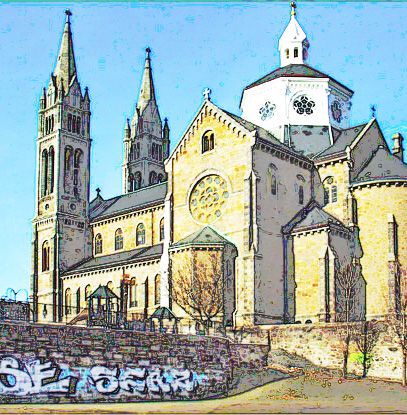
Mission Church, RoxburyHis funeral was on a rainy Saturday, 27 August 2009 at the Basilica of Our Lady of Perpetual Help, built by German immigrants and "since 1878" a parish church; with geographical designations like parish and ward, churches dare describe themselves as congregations especially for a particular neighborhood. In the Roxbury neighborhood of Boston, Mission Church is situated amidst the have a littles and have nots, creating an apt setting for the remembrance of someone who lived his life in service to often underserved and frequently disregarded populations. I've driven past the church quite a few times, though I don't recall ever being inside.

The celebration, the liturgy, the acknowledgment of Ted Kennedy's achievements and the promise of the inbreaking Reign of Heaven began with a magnificently played and sung entrance hymn:
Holy God, we praise thy name;
Lord of all, we bow before thee;
all on earth thy scepter claim;
all in heaven above adore thee.
Infinite thy vast domain;
everlasting is thy reign.
...words to stanzas 1-4 attributed to Ignaz Franz, circa 1774; translated by Clarence Walworth, 1858 (they processed into the church singing all 8 stanzas).

Scripture readings included Wisdom 3:1-9; Psalm 72 with the recurrent response, "Justice shall flourish in his time in fullness of peace forever"; Romans 8:28-31 – "nothing can separate us from the love of God"; and for the gospel, Matthew 25 – "whatever you did, for one of the least brothers of mine, you did for me."

Beginning with covering the casket in a white pall (technically a baptismal garment), the baptismal imagery was telling and pervasive: baptizing us into the death and resurrection of Jesus Christ, God clothes us in forgiven, sinless righteousness; each of the baptized wears a baptismal calling to a life of justice, a call to a journey to the cross if – "when" – necessary; a call to speak and to act prophetically against the political, economic, social, and cultural establishments. In the Spirit God calls and enables us to talk the talk and walk the walk. Figuring out and discerning a specific career path can be tough, scary, and difficult, but we all receive the same baptismal call to lives of justice and equality, to living the Magnificat...Luke 1:51-55
He has shown strength with his arm;
he has scattered the proud in the thoughts of their hearts.
He has brought down the powerful from their thrones,
and lifted up the lowly;
he has filled the hungry with good things,
and sent the rich away empty.
He has helped his servant Israel, in remembrance of his mercy,
according to the promise he made to our ancestors,
to Abraham and to his descendants forever.
Although the Kennedy clan originated from tribal cultures of ethnic Ireland and religious Rome that back in those days were not welcomed or accepted in elite residential or vacation communities in this country, these days commentators often call them America's Royalty, and they have become essentially a dynasty. In Greg Ferguson's words:
The ground is level at the foot of the cross...
We all are equal in the light of the cross
For the love of God is given freely to all
The ground is level, at the foot of the cross

Men and women, younger and older
Every culture, every color, every tongue
No more labels, no separation
As we stand forgiven at the cross
We all are one ...

Doesn’t matter your social position
Doesn’t matter if you’re rich or if you’re poor
Race or privilege, tribe or tradition
At the cross of Christ it can’t divide us anymore
Baptized into Christ, the Kennedys are God's royalty; the baptismal hymn from 1 Peter 2:9-10 would have been perfect for a reading at the service for Ted Kennedy:
But you are a chosen race, a royal priesthood, a holy nation, God's own people, in order that you may proclaim the mighty acts of him who called you out of darkness into his marvelous light. Once you were not a people, but now you are God's people; once you had not received mercy, but now you have received mercy.
The grandeur and sweep of the memorial service and media coverage were worthy of a head of state—of royalty! Ted Kennedy lived and served in the traditions of liberal, activist politics and liberal, activist, prophetic Christianity. He was a coalition-building, conciliatory politician who initiated and sponsored legislation of the people, from the people and for the people. And during the funeral liturgy, the celebrating of Holy Communion, the Lord's Supper, taken, blessed, broken and given, the Eucharist, a feast of thanksgiving, reconciliation, and life of all creation, for all creation.

Ted Kennedy's schooner Mya provided a wonderful icon of the sometimes rocky and rough, occasionally surprisingly smooth and glassy passages everyone needs to navigate through life. Water is the basic substance of creation, the essence of life: Water Is Life! We live baptized into water, drowned into our first death and raised to second birth of bounded freedom in Christ, and we need to trust God, the One Who really is the Baptizer.

On the Friday before the funeral Ted Kennedy lay in state at the Kennedy Presidential Library, located right next door to the University of Massachusetts at Boston, an urban school for non-traditional students, many of whom go on to help change their part of the world.

Psalm 72:4a insists, "He shall defend the afflicted among the people."

President Barack Obama quoted Ted Kennedy: The work begins anew. The hope rises again. And the dream lives on. Indeed it does, and it will:

Infinite Thy vast domain; everlasting is Thy reign...the dream lives on!

Monday, January 12, 2009

Losing Moses on the Freeway

Moses came and told the people all the words of the Lord and all the ordinances; and all the people answered with one voice, and said, "All the words that the Lord has spoken we will do." —Exodus 24:3

Now behold, one came and said to Jesus, "Good Teacher, what good thing shall I do that I may have eternal life?" So Jesus said to him, "Why do you call me good? No one is good but One, that is, God. But if you want to enter into life, keep the commandments." —Matthew 19:16-17

The way we know we've been transferred from death to life is that we love our brothers and sisters. Anyone who doesn't love is as good as dead. —1 John 3:14

Blessed are those who do his commandments, that they may have the right to the tree of life, and may enter through the gates into the city. Revelation 22:14
from the baptismal liturgy:
"In Christian love you have presented these children for Holy Baptism. You should, therefore, faithfully bring them to the services of God's house, and teach them the Lord's Prayer, the Creed, and the Ten Commandments. As they grow in years, you should place in their hand the Holy Scriptures..."

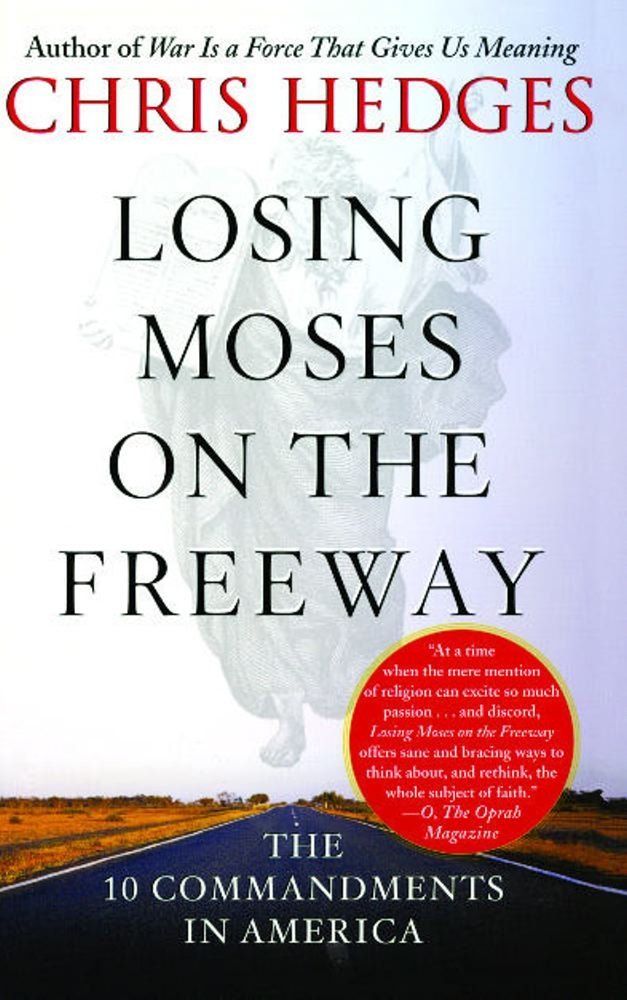
Losing Moses cover A few days ago I serendipitously happened to buy a book by former New York Times foreign correspondent Chris Hedges; it's Losing Moses on the Freeway: The 10 Commandments in America, and in the author's story I recognize major parts of my own journey. In the prologue, author Chris Hedges explains God gave us the Sinai Covenant, the commandments, in order to enable and sustain community—"They [the commandments] were for the ancients, and are for us, the rules that, when honored, hold us together and when dishonored lead to alienation, discord and violence."

Chris Hedges opens the first chapter, Mystery, with his experience as a young seminarian serving a people and a church in the inner-city Boston neighborhood of Roxbury; its normative violence and human degradation, crumpling, decaying physical infrastructure, pervasive aura of wastedness and death amounted to a setting previously unknown (and probably unimagined) by him. On page 10 he calls it ghetto, and I'll define "ghetto" as any place - whether financially affluent or impoverished, ethnically and socially self-described or characteristically anything else - where nothing much goes in or out of that wasn't there the day before. By not interfacing with or even seeing people and ideas "other than" my own and my own kind, I fail to appreciate my uniqueness or even my identity.

On page 18 Hedges, son of a pastor, admits in words essentially identical to what I've said and written dozens of times over the past few years, "The church was part of my daily rhythm. I look at the world through the eyes it gave me." And also parallel to my experience he says, "But I also knew the church's dark side, its self-righteous smugness, its crushing piety, the way it used religion to exalt itself and how it often masked human cruelty behind the quest for virtue and piety." [page 19] To that I'll add the petty viciousness, self-centeredness, and destructiveness of both local and judicatorial church politics.

I relate closely to the author's anger as he chronicles [page 11] smashing a glass bottle against the front door of the church building as "...an ending, a final conclusion to a life spent in the powerful and claustrophobic embrace of the church. It is meant to be a break from God. But you trade one god for another. This is how life works. We all have gods."

For myself, the unanticipated separation from full participation in the church to which I'd devoted years of my life and that had played a central role in shaping my goals, lifestyle, and my entire worldview is like experiencing my own death.

On page 11 Hedges says we circle back to the origins our our lives, "if not to embrace it then to understand how it shaped us, to examine with less heat and anger our marks and scars." I'm still examining the mosaic in order to find my place, just as I try to discern ways I've helped create it as it has created and recreated me.

On page 175 the author wisely reminds us "They [the commandments] do not call us to practice total self-abnegnation, empowering others, as I did at first in Roxbury, to abuse us. They call us rather toward mutual respect and mutual self-sacrifice." In words from a pastor with whom I worked alongside, "God calls us to serve, but not to be walked all over." To illustrate his advice of setting (physical, in this case) boundaries so you won't be broken and violated, Hedges gives the example of Martin Luther King, Jr. walking from Montgomery to Memphis with a detachment from the National Guard. [pages 29-30]

From the Holy Communion liturgy in the Book of Common Prayer:
God spake these words, and said:

I am the Lord thy God who brought thee out of the land of Egypt, out of the house of bondage. Thou shalt have none other gods but me.

Lord have mercy upon us, and incline our hearts to keep this law.

Examine your lives and conduct by the rule of God's commandments, that you may perceive wherein you have offended in what you have done or left undone, whether in thought, word, or deed. ...

Ye who do truly and earnestly repent you of your sins, and are in love and charity with your neighbors, and intend to lead a new life, following the commandments of God, and walking from henceforth in his holy ways: Draw near with faith, and make your humble confession to Almighty God, devoutly kneeling.

Like the Israelites formed in the searing heat and God's minimal yet faithful supply of the exodus desert, we are above all a people, a nation. In Lord's Day, Sunday, Sabbath worship we retell, re-enact in baptism and the Eucharist and reclaim the meta-narrative of our deliverance from death into life, of Jesus' death and resurrection. Although sometimes I think I loved the Church more than I loved Jesus, after beginning really to hear my story, someone asked me why on earth I'd remained in the church at all and I replied, "This is where I find the sacraments!"

As I wrote in the class handout for class 4 of the Theology of the Cross series I developed and facilitated during Lent 2007 and the following summer, Theologian Jürgen Moltmann describes baptism as "sign, witness, representation and illumination of the Christ Event" and we can claim the same about the Eucharist. We also know Martin Luther did not understand sola scriptura – "Word Alone" outside of grace alone and Christ alone. The sacraments are actions of the entire Church in every place and time. Do they belong to Jesus? Yes, of course, but Jesus uniquely charges and authorizes his followers with continuing his life-giving action in baptism and the Lord's Supper.

In the Love chapter: "But by giving up parts of ourselves for others, by accepting that we must be willing to lose life to create and preserve life, we honor the core of the commandments. The commandments hold out to us the possibility of love." [page 173] Chris Hedges [page 174]: "The covenant offered by the commandments, the covenant of life, is the covenant of love. It is a covenant that recognizes that all life is sacred and love is the force that makes life together possible. ... But it is never too late to turn back. Atonement permits a new way of being. It calls us to life." [pages 173-175] We are people of Maundy Thursday, who have been given and who have received Jesus' New Commandment, the mandate of love faithful unto death; by faith and in the Spirit we have infinite access to Jesus Christ's atonement for the buying back, the redemption, for the life of all creation.

To quote Moltmann again, "Nomadic religion is a religion of promise!" John the gospel-writer tells us God makes tabernacle, a portable temporary shelter, "pitches a tent" with us, traveling essentially unencumbered so as to be able to pick up easily to continue the journey alongside creation. Like Jesus of Nazareth, we are created in the very image of God, both fully human and completely divine and claim our Divine Nature until the human and divine hardly can be distinguished from each other.

Then Moses took the book of the covenant, and read it in the hearing of the people; and they said, "All that the Lord has spoken we will do, and we will be obedient." —Exodus 24:7

The Hebrew bible witnesses to God among us in tabernacle and temple, in the prophets and in the people. Doing The Word, "Performing the Scriptures": The Word made Flesh—doing the Word? Try simply being the Word, God's gracious, unmediated presence? Jesus and us! Losing Moses on the Freeway... people in vehicles move fast on freeways and on toll roads, too, and they tend to travel by themselves and distracted by media. In any case, it's not an optimal situation for observing a neighbor's needs or for slowing down enough to respond to anyone else's situation or recognizing one's own needs, either. Every day the implied give-and-take of "conversations" in Gmail strikes me as a possibility of moving away from anonymity and alienation to being known and connected.

In the Idols chapter about the band Phish Chris Hedges observed, "The experience of belonging to the crowd appeared to give to followers a new, vibrant community, even as it destroyed community." [page 45] But baptized into the reconciling Christ event, we no longer live under the reign of death, its idols and its artifacts, but in the alternative community countering individualisms of covetousness, greed, commoditization, consumption, superfluity and (ultimately) despair.

Here we will take the wine and the water;
here we will take the bread of new birth,
here you shall call your sons and your daughters,
call us anew to be salt for the earth.

Give us to drink the wine of compassion;
give us to eat the bread that is you;
nourish us well, and teach us to fashion
lives that are holy and hearts that are true.

Marty Haugen, Here in This Place/Gather Us In, © 1982 GIA Publications, Inc.

my Amazon review: law that binds; commands that free

Friday, December 07, 2007

God Among Us discussion 03

Advent 1: Historical Witness – Creation and Prophets

Advent 2: Historical Witness – Jesus Christ

Advent 3: Liturgy, Word, Sacrament

Advent 4: Contemporary Witness – us and our neighbors

The class will get a copy of love one another by Paul Hammer.

Backtrack

Abraham, Jesus, us—from the other side of the dominant social and economic culture of consumerism and exorbitant consumption; from the other side of death…alive in Jesus Christ!

2 Samuel 7:5-6 "I have not dwelt in a house from the day I brought the Israelites up out of Egypt to this day. I have been moving from place to place with a tent as my dwelling.'" John 1:14 And the word became flesh and tabernacled, pitched a tent among us...

Historical and contemporary

Exodus 5:1 Afterward Moses and Aaron went to Pharaoh and said, "Thus says the Lord, the God of Israel, 'Let my people go, so that they may celebrate a festival to me in the wilderness.'" From the time Israel and Yahweh rendezvoused into covenantal relationship in the desert of the Exodus, the liturgies of God's people have recounted and playfully reenacted into present-time the stories of God's faithfulness in their lives. The church gathers as the community that already has experienced its first death and second birth, fully alive under the subversive Lordship of Jesus Christ. Some congregations (not us?!) deliberately quest to become like those bigger or more ostentatious churches. But did God ever call the People of God to live in ways congruent with their local culture? Or in a radically culturally incongruent, actually counter-cultural manner? How about prophetic liturgy and prophetic living?

Theologically, psychologically, anthropologically and economically an individual becomes a person, a social entity by becoming embedded in a textured, connected, interwoven history of shared experiences and different viewpoints; there is no other way to create a humanly connected sense of your own identity, form memories and become part of history. Baptism and the Lord's Supper are cosmic events in each of our lives and part of our transformation from individual into person.

In worship, especially when we celebrate the sacraments, we anticipate, celebrate and commemorate and carry with us a microcosm of a redeemed world, a living and a life-giving memory of Jesus. In us, Jesus again becomes alive in the world and we offer the world a living connection to the heaven of God's Reign here on earth.

Liturgy, time; Sacraments, space and matter

Liturgy - Holy Time: remembering Whose we are! Who has called us! We recall, retell and re-enact our corporate and individual histories of the journey from death into life.

Sacraments - Holy Place and Holy Stuff—sacred creation: re-membering who we are! The person and communities God has called and enabled us to be and to do.

Water is the womb of creation. In baptism, we enter the state of this world yet unborn and submerge ourselves in the substance from which primal life emerged, completely engulfed by God's creative power of death and resurrection, identifying with this planet's history and with Jesus Christ.

Genesis 1:1-2 In the beginning when God created the heavens and the earth, the earth was a formless void and darkness covered the face of the deep, while a wind from God swept over the face of the waters.

Bread – in Saxon English, the Lord provided the "loaf" (of bread) essential for sustenance; we live born/baptized into the biography of Jesus, born in Bethlehem (House of Bread) baby; we recognize Jesus Christ as our Lord. The Heidelberg Catechism says in the Lord's Supper we become "bone of his bone and flesh of his flesh!"

Fruit of the Vine – a potent and polyvalent biblical symbol and reality.

Corporate Identity Package

We are the body, corpus, of Christ! Each of us is a member of the body of Christ. Jesus Christ incarnate, in the flesh again, re-enfleshed in us. Corporate Identity [package]: our logo, our résumé, our curriculum vitae, detailing where we've been, what we've learned, what we live for and die for...who are we? In Christ, we have experienced our second birth and our first death. We live under the reign of life rather than in the enslavement, the subjugation of death.

Baptism: primal experience, water, womb; Romans 6:3-10

Eucharist: we find sacred memory and discover hope for a free future in the meta-narratives of redemption, of deliverance from death to life in the Exodus and Passion/Easter stories. Theologian Jürgen Moltmann describes baptism as "sign, witness, representation and illumination of the Christ Event, and" we can claim the same about the Eucharist. We know Jesus Christ as sovereign, prophet and priest; baptized, we participate in that royal, prophetic priesthood. In the Eucharist, the church in every place and every time blesses and reintegrates all creation in every place and time; we recognize as sacred everything we see and touch and smell and hear and taste; 1 Corinthians 11:23-28

Liturgy: holy time - remembering Whose we are

Sacraments: holy space - re-membering who we are

Time and space are the conditions in which all creation lives. Living within the cycle of the liturgical year as it replicates the history of God and the people of God and celebrating the sacraments within that context helps refocus time and space as the necessary environment of God's revelation to us as human creations. But we know Creator and creature are discontinuous, so how do we discover God amidst creation? How does the Divine Presence enter our lives in decayables such as human speech, grain, grape, memory and music?

Time in space: during gestation we are immersed in time, in the rhythms of heartbeat and lungs, rather than imagining time as external to our world. Outside the maternal womb, we rework and re-collect for a lifetime the sounds and rhythms of our primal becoming. Liturgy brings both cosmic time and chronological time to an intersection where all times everywhere, past, present and future, meet in this present now, filling it with hope for a free and full future. The sacraments are actions of the entire Church in every time and every place, and connect us with the whole people of God in every time and space.

Space in time: the dwelling-spaces, schools and neighborhoods of our earliest years immersed us in space in a foundational way that continues transforming us today. In its proclamation and with the sacraments the church recovers historical events for us and helps us make all time and space sacred. We know anywhere God encounters creation is sacred space, but in the sovereignty of the crucified and risen Christ the formal sacraments expand to include all creation. Baptized into the Christ Event of God's supreme self-revelation in measurable, definable space and time, we become prophet, priests and sovereigns, in stewardship of creation and of life.

Living on the limen, the threshold

Toward the end of the Lenten series on theology of the cross, I asked, "can our presence in the world and in our neighborhoods be a liminal, in the process of becoming, though not-quite-yet one? Partly in our own world and way, partly in theirs, and wholly in the sovereignty of heaven?"

© leah chang 2007

Monday, December 03, 2007

Liturgy Proclamation Sacraments - post 333

Almost randomly, today I'm blogging preliminary notes for next Sunday's 3rd class in my God Among Us series. So far we've discussed the Divine Presence in creation, in the prophets and in the Bethlehem manger; next Sunday we'll explore God's grace-filled Presence in liturgy, word and sacraments, and most likely I'll give the class a separate file with some details about scriptural roots and historical eucharistic practice.


Liturgy—Holy Time: remembering Whose we are! Who has called us! We recall, retell and re-enact our corporate and individual histories of the journey from death into life.

Sacraments—Holy Place and Holy Stuff—sacred creation: re-membering who we are! what God has called and enabled us to be and to do.


Water, the primordial substance of the world, existed before anything else in creation; in Genesis we read:
Genesis 1:1 In the beginning when God created the heavens and the earth, 2 the earth was a formless void and darkness covered the face of the deep, while a wind from God swept over the face of the waters.
Water is the womb of creation. In baptism, we enter the state of this world yet unborn and submerge ourselves in the substance from which primal life emerged, completely engulfed by God's creative power of death and resurrection, identifying with this planet's history and with Jesus Christ.

In Saxon English, the Lord provided the "loaf" (of bread) essential for sustenance; we live born/baptized into the biography of the baby born in Bethlehem (House of Bread) baby; we recognize Jesus Christ as our Lord. The Heidelberg Catechism says in the Lord's Supper we become "bone of his bone and flesh of his flesh!" In faith and baptism Jesus' biography becomes our biography: suffered under Pontius Pilate—the conventional, death-dealing, life-killing political, social and economic and cultural establishment(s), crucified, dead, buried...on the third day he rose again from the dead, ascended to sovereignty...

We are the body, corpus, of Christ! Each of us is a member of the body of Christ. Jesus Christ incarnate, in the flesh again, re-enfleshed in us. Corporate Identity [package]: our logo, our résumé, our curriculum vitae, where we've been, what we've learned, what we live for and die for...who are we? In Christ, we have experienced our second birth and our first death. We live under the reign of life rather than in the enslavement, the subjugation of death.


We've talked about Abraham, Jesus and us being from the other side of the prevailing culture. Now let's consider all of us living on the other side of the culture of death, alive in the sovereignty of life! Baptism: primal experience, water, womb.

Eucharist: our meta-narrative, primal narrative as a community. Both cosmic events in each of our lives are part of our transformation from individual to person. Theologian Jürgen Moltmann describes baptism as "sign, witness, representation and illumination of the Christ Event, and" we can claim the same about the Eucharist. We know Jesus Christ as sovereign, prophet and priest; baptized, we participate in that royal, prophetic priesthood. Especially related to those roles, how can our lives signify, witness to, represent and illuminate the birth, life, death, resurrection and ascension of Jesus Christ? To partly quote and partially paraphrase from another blog:
Theologically, psychologically, anthropologically, and economically a lone individual becomes a person, a social entity, by becoming embedded in a textured, connected, interwoven history of shared experiences and different points of view. There is no other way to create a humanly connected sense of your own identity, form memories and become part of history. You (I need, one needs) need a stable community and probably a plot of land to give you a stable sense of self if you are going to be healthy! Without those fluid living processes in a real sense a individual or a people has no history, but lives in a neither here not there "nowhere" of a fragmented series of stories starting to form, but without a persistent core that includes people who have journeyed alongside us through time, so it's possible to "remember when" together, to evoke and rekindle tarnished dreams and splintered hopes. No matter how many other people come and go in each of our lives, each of us needs persons (and maybe places, too) of shared history, to accurately name ourselves and recognize others.
Especially in an increasingly anomic and anonymous world (this is southern California, but it's happening everywhere),we need awareness of our history with the people of God and God of the people in every time and space, and this is where scripture, sacraments and liturgy become saving realities, "means of grace" as we refer to preaching and sacraments (and, of course, the cross) in this tradition. Congregations, people, and groups can read out of the texts of scripture and the persons of the prophets, the apostles and Jesus the Christ into their own experiences; they can write, re-write and image a shared past into a full present and meaningful future, right along with awareness of themselves as community. Other people and events may enter, stay a while, leave for a while and possibly return, but being grounded and rooted in historical existence lived, narrated, written down and liturgically re-enacted keeps on and continues transforming lives.


lifelines and heartbeats—old journal notes:
The colors, texts, textures and music marking the events in the liturgical calendar were more real to me than any of my own individual history ever had been and had shaped my life into deep, indelible patterns and designs. The rhythms, pace and pulse of local church ministry with its alternating consistency and surprising interventions shaped my days and literally outlined my identity.


More paraphrases from one of my blogs:

The synagogue's and later the church's liturgy developed and became shaped in a way that addresses, interacts with and speaks to the human condition and Divine response to human need. One way Israel kept remembering the past so it would remain present was with rituals, celebrations and liturgies in which they remembered, talked about and reenacted past events as if they still were in the present, and within a context that was play more than it was anything else. Israel told and retold the story of the people’s experience with the God of the covenants, and like God’s primal people Israel, in our worship we remember who God is, who we are, how God has acted. In the power of the Holy Spirit we affirm our dreams and announce our hopes for the future.

Like play of all kinds, worship also creates a new and different self-contained world existing with and within our everyday world. In worship, but especially when we celebrate the sacraments, we anticipate, celebrate and commemorate and we carry with us beyond this building this microcosm of a redeemed world that has been created by us and God, between us and God, as we become a living and a life-giving memory of Jesus so in us, Jesus again becomes alive in the world and we become sacraments mediating between God in Christ and the world, offering the world a living connection to the heaven of God’s Reign here on earth.


liturgy, time; sacraments, space

Time and space are the conditions in which all creation lives. Living within the cycle of the liturgical year as it replicates the history of God and the people of God and celebrating the sacraments within that context helps refocus and change the meaning of time and space as the necessary context God's revelation to us as human creations.

Liturgy: holy time—remembering Whose we are

Sacraments: holy space—re-membering who we are

Time in space: we spend nine months immersed in the watery womb from conception to birth, immersed in the rhythms of heartbeat and lungs. During gestation we are immersed in time, rather than imagining time as external to our world. Outside the maternal womb, in our daily lives and in the church, for a lifetime we rework and re-collect the sounds and rhythms of our primal becoming. Through liturgy, the church recovers the sacredness of all time, not just the perfunctorily, formally schedules times of Sunday worship. Liturgy brings both cosmic time and chronological time to an intersection where all times everywhere, past, present and future, meet in this present now, filling it with hope for a free and full future. The sacraments are actions of the entire Church in every time and every place, and connect us with the whole people of God in every time and space.

Space in time: Just as the gestational womb provided an immersion in time and space prior to our physical birth, the dwelling-spaces, schools and neighborhoods of our earliest years immersed us in space in a foundational way that formed us and continues transforming us today. In our search for home, for safety and for belonging, recognition and acknowledgment, in its proclamation and with the sacraments the church recovers historical events for us and helps us make all time and space sacred. As people of the Bible, we know anywhere God meets, encounters creation is sacred space, but in the sovereignty of the crucified and risen Christ the formal sacraments expand to include all creation. Baptized into the Christ Event of God’s supreme self-revelation in measurable, definable space and time, we become prophet, priests and sovereigns, in stewardship of creation and of life. In the Eucharist, the church in every place and every time blesses and reintegrates all creation in every place and time; we recognize as sacred everything we see and touch and smell and hear and taste. (That was redundant, but for Sunday I'll choose which way to express it, or maybe invent a third way.)


As Christians, God's people in Jesus Christ, we find sacred memory and discover hope for a free future in the meta-narratives of redemption, of deliverance from death to life in the Exodus and Passion/Easter stories.

I love Exodus 5:1 Afterward Moses and Aaron went to Pharaoh and said, "Thus says the Lord, the God of Israel, 'Let my people go, so that they may celebrate a festival to me in the wilderness.'" From the time Israel and Yahweh rendezvoused into covenantal relationship in the desert of the Exodus, the liturgies of God's people have recounted the story of God's faithfulness in their lives and recollected ways in which God shaped and formed the identity of the people of God along with God's call to the people to be His Presence in the world and God's enabling and fulfilling that call in the power of the HS. Worship forms a microcosm of our daily, lively encounter with a Holy God, Who calls us to be Holy as He is! Martin Luther's story is so well-known, but no way did he minimize the awesomeness and the demands for justice of the God of Jesus Christ. It was exactly that awareness that initially led Brother Martin to extreme measures in attempts to please and placate God. Predictable I sort of needed to include Luther note! Moving on, now.

The sacraments and the order of worship create a microcosm of redeemed, restored creation, bringing to life a hint of the eschaton, the new creation. (I won't say "eschaton" on Sunday without explaining it, trust me!)


In April 2006 I blogged about Emerging Church, emerging churches
The church gathers as the community that already has experienced its first death and second birth, the community that thrives under the Lordship of Jesus Christ, in the reign of life. The barely formed churches we hear about in the epistles (I'm thinking of Corinth as especially instructive) were way different from the over-formed institutional Church Luther wrote and spoke against; in this 21st Century, the church almost has become something else altogether.

Some congregations deliberately quest to become like those other churches across the street, down the boulevard, or in geographically near, but more visibly and ostentatiously affluent areas. Although I hesitate to write "evangelical," that was the Reformer's word for Protestantism in general and evangelical remains the word for "Protestant" in non-English speaking countries. Nonetheless, my readers know what I'm trying to say!

Prayer and hymn singing in the vernacular is one of Luther's marks of the true church; the Reformers also insisted where the gospel was rightly proclaimed (Calvin added "heard) and the sacraments administered, there the church was—everything else was adiaphora. "Evangelism in the vernacular" also needs to happen for the Church, as the Body of the Risen Christ, to be true to its call, as Jesus always met people more than half-way—Jesus met people as who they were and where they were. The churches I've been visiting and the protestant mainline I identify with all have been trying to meet people where they are and speak in a language they'll understand. But did God ever call the People of God to live in ways congruent with their local cultures? Or in a radically culturally incongruent, actually counter-cultural manner? How about prophetic liturgy and prophetic living?

Evangelism in the vernacular? Telling the Good News in the people's muttersprach, in their lingua franca, which, of course, means far more than the syntax, colloquialisms and grammar of their spoken and written language. Our evangelical language needs to reach all of their cultural sensibilities as well as their actual native idiom of every aspect of their everyday lives, reaching far into their values, hopes and dreams. What do they desire for themselves, their children, their community, and even for worlds beyond their immediate ones? What would they perceive as Good News; above all, what can we demonstrate to them that would make them willing to risk change?


On Lent 5, toward the end of my Lenten series on theology of the cross, again I blogged on this site geographically, socially, culturally, chronologically, theologically and/or spiritually liminal modes of Christian presence and asked, "can our presence in the world and in our neighborhoods be a liminal, in the process of becoming, though not-quite-yet one? Partly in our own world and way, partly in theirs, and wholly in the sovereignty of heaven?"

Note that I [originally] concluded with text in fiery Pentecostal red! Now to further consider these ideas and write them down in coherent form for next Sunday's class meeting.

© leah chang 2007

Friday, August 03, 2007

Church in the World; church and the world 3

Last week again I facilitated a session of the Theology of the Cross course I originally developed for Lent 2007. We discussed our living as a paradoxically hidden sacramental presence to the world, and I mentioned in passing the concept of neighborology from Water Buffalo Theology. Yes, this class also got handouts with some of my notes from WBT. Does the cross remain an outrageous offense to contemporary sensibilities, sensitivities and logic? I believe it does!

On Lent 5, toward the end of the actual Lenten series, I blogged on this site about geographically, socially, culturally, chronologically, theologically and/or spiritually liminal modes of Christian presence and asked if our presence in the world and in our neighborhoods can be a liminal, in the process of becoming, though not-quite-yet one? Partly in our own world and way, partly in theirs, and wholly in the sovereignty of heaven?

I've been trying to listen carefully and comment selectively to what people say about worship style and content; the friends with whom I attended Saturday evening worship at Rancho Bernardo Pres said something about people getting confused by "ritual." That's understandable, so how about an occasional instructed liturgy? It doesn't need to be highly detailed or elaborate, but if people learn to appreciate the origins and intent of what we do during worship, it would help worship become more meaningful to them.

Here are a few more sort of paraphrases from my old blog(s):

The synagogue's and later the church's liturgy developed and became shaped in ways that address, interact with and speak to our human condition and demonstrate God's response to creation's need. In Hebrew history, the past acts of God gave Israel confidence about the future and willingness to continue in covenantal partnership with God; because they knew about God's past faithfulness, they could face the future with a living hope. Israel persistently kept recalling and re-membering her history with the God of the Covenants with rituals, celebrations and liturgies; within a context that was play more than it was anything else, Israel told and retold the story of creation's experience with God. Like God's primal people Israel, in our worship we, the contemporary people of God, remember who God is, who we are, God's redemptive actions, and we announce our dreams and hopes for the future. Not only is much of our liturgy in the present, just as play is—like children's playtime and the various play endeavors of adults, worship also creates a new and different self-contained world existing alongside of and within our everyday world.

Similar to play, and parallel to our dreams, worship ends the dichotomy we often make between material and spiritual. When we play, when we dream, when we worship, we live fully in the present—creative, responsive, and responsible. Being Christian means to live precariously in the interplay between two worlds, just as Jesus lived. As God's children we will be completely free and alive without constraints some day, and our playful attitudes and our liturgies are the first fruit, the guarantee that finally we will end up in God's image, since it is God's indwelling Spirit that makes possible our play, our dreams, our celebrations.

In worship, and especially when we celebrate a baptism or the Eucharist, we carry with us beyond the worshiping assembly and beyond the church building a microcosm of a redeemed world; we become a living and a life-giving memory of God's actions in history, especially in Christ Jesus, as the Holy Spirit calls and enables us, Jesus again becomes alive in the world and we become sacraments mediating between God in Christ and the world. We offer the world a living connection to the heaven of God's Reign on earth, living as visible, tangible signs of God-with-us, God-for-us, God-among-us—maybe especially as we practice neighborology, the word about the neighbor?!

Friday, March 30, 2007

Theology of the Cross 6

Although I planned this sixth class for NPC as a wrap and recap of the previous five, it was Palm / Passion Sunday, everyone participated in Holy Week and Easter prep so we didn't meet. I offered this series at OS-ELCA-NP for the adults for the five evenings of VBS during summer 2007, so we would not have needed a sixth session there anyway.


Theology of the Cross: what does this mean for the Church’s and especially for this congregation’s life and mission?
1. Go to dark Gethsemane, ye that feel the tempter’s power;
Your Redeemer’s conflict see, watch with Him one bitter hour,
Turn not from His griefs away; learn of Jesus Christ to pray.

2. See Him at the judgment hall, beaten, bound, reviled, arraigned;
O the wormwood and the gall! O the pangs His soul sustained!
Shun not suffering, shame, or loss; learn of Christ to bear the cross.

3. Calvary’s mournful mountain climb; there, adoring at His feet,
Mark that miracle of time, God’s own sacrifice complete.“It is finished!” hear Him cry; learn of Jesus Christ to die.

4. Early hasten to the tomb where they laid His breathless clay;
All is solitude and gloom. Who has taken Him away?
Christ is risen! He meets our eyes; Savior, teach us so to rise.

James Montgomery, in Selection of Psalms and Hymns, by Thomas Cotterill (London: 1820).
The cross of Calvary forms the ultimate type and reality of God’s characteristically hidden and paradoxical, sacramental presence in the commonest things, situations and people. Especially in the cross we learn God totally subverts evil for good, as the death of Jesus Christ becomes a redemptive reality for all creation.

Throughout the witness of scripture, we find God’s Self-revelation from a series of mountains: the Mount Sinai Covenant recorded in Exodus 20:3-17 and Deuteronomy 5:6-21; the Sermon on the Mount in Matthew 5:1-11 (there’s the parallel Sermon on the Plain plus in Luke 6:17...); the Transfiguration, with Mount Tabor, rising out of the Jezreel Valley as one of the traditional suspects; finally, Mount Calvary brings God’s definitive self-revelation, and ultimate covenant! (I love the name of the hymn tune, Bryn Calfaria...)

New Covenant: Jeremiah 31:31-34; 1 Corinthians 11:23-26; Luke 22:[19]-20; 2 Corinthians 3:4-8; read the book of Acts!

New Covenant: On the day of Pentecost, Jews commemorated the Sinai Covenant; on the Christian Pentecost, we celebrate the gift of the Spirit through which God enables us to perform the New Covenant. Read the book of Acts!

Jesus said, “Do this!” Do this liturgical action? In the power of the Holy Spirit, God calls the church—
  • As the body of the risen Christ, the Bread of Life, to nourish the world, especially the stranger, the outcast and the “other”;
  • As branches of Jesus, the Vine, to pour out our lives to those around us.
12. What does the cross mean for the world in which we live and serve?

Martin Luther begins his Small Catechism – traditional preparation for First Communion – with the 10 Commandments. Walter Brueggemann observes, “It is the God of the Commandments with whom we commune!” In the Book of Common Prayer, The Holy Eucharist, Rite One, begins with the Ten Commandments—with the Great Commandment as an alternative.

We’ve been discussing God’s action and presence in the sacraments, considered a “means of grace.” American theologian Robert McAfee Brown suggested that people who aren’t practicing justice and righteousness in their daily lives should be kept from the Communion Table.

Decalogue: Exodus 20:3-17; Deuteronomy 5:6-21; the Great Commandment: Mark 12:28-31; Matthew 22:36-48

Some churches practice foot washing as a sacrament or as preparation for participating in the Lord’s Supper. Think about it!

13. The cross of Jesus Christ: Foolishness to the Greeks and foolishness to us?

“When Christ calls us, he bids us come and die...to go one’s way under the sign of the cross is not misery and desperation, but peace and refreshment for the soul, it is the highest joy...we do not walk under our self-made laws and burdens, but under the yoke of him who knows us and walks under the yoke with us.” Dietrich Bonhoeffer, Nachfolge (Discipleship)

14. Concluding questions, observations and loose ends.

For Paul, the gospel is death and resurrection.

Jubilee Year Redemption for all creation: Leviticus 25:8-24; Leviticus 23 and 24:

The land must not be sold permanently, because the land is mine and you are but aliens and my tenants. Throughout the country that you hold as a possession, you must provide for the redemption of the land.

How does living as people of the cross ultimately lead to Jubilee Justice for all creation?
Let us Talents and Tongues Employ

1. Let us talents and tongues employ,
reaching out with a shout of joy:
bread is broken, the wine is poured,
Christ is spoken and seen and heard.
Jesus lives again, earth can breathe again,
pass the Word around: loaves abound!

2. Christ is able to make us one,
at his table he sets the tone,
teaching people to live to bless,
love in word and in deed express.
Jesus lives again, earth can breathe again,
pass the Word around: loaves abound!

3. Jesus calls us in, sends us out
bearing fruit in a world of doubt,
gives us love to tell, bread to share:
God, Immanuel, everywhere!
Jesus lives again, earth can breathe again,
pass the Word around: loaves abound!

–Fred Kaan, 1975–
© Leah Chang 2007

Sunday, March 25, 2007

Cross Pieces

After spending more time with Water Buffalo Theology by Kosuke Koyama to prepare for the Theology of the Cross series, I finally decided to blog about the book, so here it is—but only sort of!

This noontime was the 5th Theology of the Cross class of 6; the discussions have been wonderful, and my only real regret is that I started out with close to 20 pages of notes and found the amount of information so overwhelming that in the end I just "did something" related to the original outline for each class handout. For the blog at hand I'm using some of my Water Buffalo Theology notes and a few notes from the class handouts I prepared. Actually, I'd figured this would be a good opportunity to prepare for Sunday, because it would be the first of the pair of classes in which we try putting together some of the concepts we've discussed; originally I'd thought to post Saturday evening, but it's now Sunday afternoon! Disclaimer: as I revisit and assess my blogs - and my sermons - I've found the best ones, meaning those I'd "get the most from" if someone else had written them, almost always are those that aren't too tightly argued, leaving space for the HS to insinuate and make inroads. I've been thinking about this blog for too long now, so despite its needing lots of further developing, here it is.

Way back then at UMassBoston in my cultural anthro classes we learned about the concept of the liminal, which can be applied to formal, liturgical rites of passage as well as to a wide range of other social and psychological situations and encounters. Just like when you're on the limen or threshold of a building or room, in life passages and other circumstances there is a stage in space and time you're no longer where you started but not yet at your destination, either. Needless to say, just as with the pictogram depicting crisis as both danger and opportunity, when you're on the limen, there's a possibility of staying stuck neither here nor there and besides, although you have a clue as to what was in your past, you only can imagine what the future holds, making it unsettling at minimum and scary plus at maximum.

Our primary liminality text for anthro of religion was The Ritual Process: Structure and Anti-Structure by Victor Turner; one of the books about missiology we discussed on the old UCC forums was The Missionary Congregation, Leadership, and Liminality by Alan J. Roxburgh.

Regarding the geographically liminal, shorelines, the forest's edge and river's edge, a city's suburbs, the rim of the Central Business District come to mind; try the gates of a gated residential community, too, or for a more optimistic example, the door – or maybe the narthex (in some traditions termed "foyer") – of a cathedral or your local church building. Summer and winter solstice, vernal and autumnal equinox, dusk and dawn are ambiguous times neither here nor there, neither this nor that. We've particularly discussed and I've blogged almost incessantly about baptism as border and boundary between life, death and life, as well as bounded border between the world in the thrall of death and its agents and the resurrected community that in the sovereignty of life serves in the image of its Servant Lord, Jesus Christ. We've talked about the cross of Calvary as "more than atonement; more than God's definitive self-revelation; more than the ultimate example for us to follow" but a transformative reality, the way God initiates the New Creation, City of God and The Way Christ Jesus in the Spirit calls and enables us to follow. Related to this blog title, I'm now imagining the cross as a liminal place. Last week for Class 4 we talked some about God’s action and presence in the sacraments – considered a means of grace – and began imagining ways we can be means of grace in the world around us!

It's common to view the vertical piece of the cross as reaching up to heaven, while the horizontal reaches out to connect us with others--with all creation. Transformative as it ultimately can prove, for sure relationship of every kind is fragile and breaks all too easily. But in any case, at any stage, relating is an inevitably here and now aligned with an invariably not quite yet: on the limen, on the threshold of something different, some new creation, something synergistic: more than you started with and more than simply the predictable sum of the discrete parts!

This noon we specifically asked,

What does the cross mean for each of us as individuals, for this church community, for our nearby neighbors? Contextualizing the sacraments!

Theologian Jürgen Moltmann describes baptism as "sign, witness, representation and illumination of the Christ Event, and" we can claim the same about the Eucharist. We know Jesus Christ as sovereign, prophet and priest; baptized, we participate in that royal, prophetic priesthood. Especially related to those roles, how can our lives signify, witness to, represent and illuminate the birth, life, death, resurrection and ascension of Jesus Christ?

Contextualizing Eucharist

I really like this from today's handout, so here it is again:
Jesus said, "Do this!" Do this liturgical action? Recall Israel and desert manna, enabling God's people to live precariously in the [liminal] wilderness:
  • Bread = nourishing = body that is broken unto death and raised to new life
  • Christ's body = revealed in the breaking of bread/body
  • Church = Body of the risen Christ = nourishing the world, especially the stranger, the outcast and the "other"
  • Church / reveals Jesus' crucified body in its redeeming brokenness
  • Church / reveals Christ's risen body in its liberating wholeness

Water Buffalo Theology—a few notes on a few chapters, with a suggested new version of each chapter title.

Chapter 1: Theological Situations in Asia and the Mission of the Church | theological situations in Southern California and the mission of the church
Jeremiah 4-7

Thus says the LORD of hosts, the God of Israel, to all the exiles whom I have sent into exile from Jerusalem to Babylon, "Build houses and live in them; and plant gardens and eat their produce...Seek the welfare of the city where I have sent you into exile, and pray to the LORD on its behalf; for in its welfare you will have welfare."

This passage is both the original source of "where you're planted!" and practical, down-to-earth direction for living shalom-ly with self, with neighbor and with stranger.

Paraphrased from my earlier comment: I think all of us will be able together to celebrate a thanksgiving homecoming (after all, isn't homecoming the ultimate thanksgiving?) liturgy within a community gathered not only to perfunctorily and ritually evoke the presence of the risen Christ in Word and Sacrament, but when that gathered people attests to the presence of the Christ in each another: having gone slowly enough to know and to call each others' names, having gotten sufficiently grounded to ignore at least some of the babble of commerce and consumerism, having decided to "seek the welfare of the city" where they are rather than seeking the well-being of their purses and properties: looking outward to the other's interests and inward to an authentic, relational and re-creative self. The "crucified mind" can be as basic as looking to others' interests rather than our own...

Our Christian kerygma tells about our holy God's incarnation into the longitude, latitude and linear time of human history and of a particular culture and the ensuing reality of the death of death itself in the crucifixion and resurrection of Jesus of Nazareth, the One we know as the Christ of God. And the same God whose passion from the beginning has been to journey with the people, continues incarnate in the Church, the Body of the Risen Christ, and still accompanies the people on their journey in the longitudes, latitudes and linear time of human history and now within many diverse cultures. We proclaim God Among Us in the spatial and temporal liminality of human life and endeavor! At the beginning of class this noon I referred to the book of Acts in passing, and as we left for home, I suggested everyone read Acts during this coming week, or at least turn the pages to remind themselves of the content.

From WBT: Jakarta is as central as Jerusalem and London in the mission of the Risen Lord. Though initially it may sound astounding to make Jakarta or anywhere else "as central as Jerusalem," if the person and work of the crucified and risen Jesus Christ is not for Jakarta just as much as it is for Jerusalem, he truly is not and cannot be Lord of all. One of the class participants, who always is full of great ideas, said he believes that for us, Jerusalem is right here and now.

Chapter 4: The "Efficiency" of the Crucified One in the World of Technological Efficiency | the efficiency of our witness in this world of technology

Rooting the Gospel: the Bible reveals God's attachment to the world of creation to the point of totally identifying with us to the extent of living and dying as one of us: learning and knowing us, creation – God's beloved – so completely as to walk in our sandals. Tevas or flip-flops or thongs or what kind of footgear, these days? Neighborology: our attachment to our neighbors to the extent of walking a while in their shoes, eating the same food or cuisine, working at the same job, being unemployed in the same manner. My identity needs to become translucent and transparent so "I" can get out of the way and see and feel the other. We're talking neighborology, the word about the neighbor!

Chapter 6: Aristotelian Pepper and Buddhist Salt | liturgical excess and low church blandness

Kitchen imagery is exceptionally apt in discussing Christianity, as the Bible is full of references and analogies to common, ordinary, everyday things (material, physical "possessions") and activities. As the author observes and as we all know, real theology is done in the venues and locales where actually people live--we need to begin practicing more and more neighborology! My blog readers know all about my "liturgical excess - low church" subtitle for this chapter, so I'll say no more.

Chapter 12: Cool Arhat and Hot God | Cool Dudes and Hot Jalapeños

This is southern California, where a few days ago I overheard a couple of young guys talking, one saying to the other about 12301298 times worth, "Dude, man, cool, dude!" Funny! God creates in order to have a creation to become passionately - hotly - attached to, so God and God's people live in particularly close attachment to each other. The God we meet in the Bible and in Jesus Christ loves creation enough literally to die for it!

Chapter 18: Three Modes of Christian Presence | Two Versions of the Gospel

WBT's author, Kosuke Koyama, mentions suffering because we're involved with others, involved with the other; suffering because we're involved in neighborology! Participating in the "glory of the crucified Lord"--the same Paul of Tarsus also talks about "the glory of the children of God!" And isn't our glory as God’s offspring also a crucified glory and a risen glory? Exactly what our discussion today was all about!

Possible modes of Christian presence: the geographically, socially, culturally, chronologically, theologically and/or spiritually liminal? Can our presence in the world and in our neighborhoods be a liminal, in the process of becoming, though not-quite-yet one? Partly in our own world and way, partly in theirs, and wholly in the sovereignty of heaven? Encountering each other in the church and our neighbors as Jesus Christ's representatives has got to be crisis-time, in terms of danger and amazing opportunity! About those Gospel Versions--for Paul, the Gospel is death and resurrection!