Showing posts with label Brueggemann. Show all posts

Thursday, July 31, 2025

July 2025 :: Back in Koreatown

• Urban Wilderbess Lectionary Blog for July

Santa Monica brunch collage
• Google made a couple of impressive collages of the food pics I took at the monthly Santa Monica Tuesday Brunch.

Koreatown trees on San Marino
• With an interesting turn of events and employment in late July, I've come back to Koreatown.
view to DTLA on San Marino Street
• Street view my first morning back in Koreatown
floral arranment
• One of three presentations of succulents and assorted posies at the entrance
yellow cassia tree at koreatown bus stop
• It's been since South Central, so I was ecstatic to see yellow cassia trees. I got several good pics; this one won a spot here because of the Metro Bus sign.
ice cream cone desk cup and brueggemann, Sabbath as Resistance
• RIP, Walter Brueggemann. I'm reading his Sabbath as Resistance and wanted to show off the Vanille Ice Cream Cone desk cup I serendipitously bought.
Living Local 2025

Friday, September 01, 2023

Five Minute Friday :: Absence

empty plates

• Five Minute Friday :: Absence Linkup

Disclaimer: Faithful readers! I don't want this to sound like poor sorrowful me, but it is a lament. You can't change what you don't acknowledge, and I've gotten into the very bad, destructive habit of toxic positivity. After all, things almost always could be worse, right?

Absence.

empty plates
empty houses
empty beaches
empty lives
empty hope
it's winter all over my world

is absence devoid of life, or does something else now occupy and live in that space?

Old Testament scholar Walter Brueggemann reminds us much of life – most of life? – is sabbatarian. We spend many of our hours and even many entire days inbetween Good Friday and Easter Sunday.

People who live in places with cold snowy winters are particularly aware of (and wait expectantly for) the verdant glory that happens after winter. As a result of winter. Some flowers and plants require winter in order to bloom. To quote my linked blog, "Hushed, quiet, still, chill of winter is essential to make roots that literally give the bulbs power to make flowers; winter temps allow bulbs to grow long, deep roots."

But I can't help but wonder about the length of my winter, the almost endless absence of life. Of summer.
# # #
five minute friday absence
five minute friday icon logo

Thursday, August 18, 2022

Revised Bibliography

Justice Freedom Redemption book cover

Here are a few additions to my bibliography for [original working title], Justice, Freedom and Redemption: Divine Image and Creation's Glory, first blogged eighteen years ago in July 2004. More to follow!


New! • Bauckham, Richard, The Bible and Ecology: Rediscovering the Community of Creation. Waco: Baylor University Press, 2010.

New! • Dahill, Lisa E.; Jim B. Martin-Schramm, Jim B.; McKibben, Bill., Eco-Reformation: Grace and Hope for a Planet in Peril. Eugene, Oregon: Cascade Books, 2016.

New! • Dickinson, T. Wilson, The Green Good News: Christ's Path to Sustainable and Joyful Life. Eugene, Oregon: Cascade Books, 2019.

New! • Fox, Matthew, Creation Spirituality: Liberating Gifts for the Peoples of the Earth. New York: HarperSanFrancisco, 1991.

New! • Hiebert, Theodore, The Yahwist's Landscape: Nature and Religion in Early Israel. Minneapolis: Fortress Press, 2008.

New! • Lathrop, Gordon, Holy Ground: A Liturgical Cosmology. Minneapolis: Fortress Press, 2009.

New! • Tull, Patricia K. Inhabiting Eden: Christians, the Bible, and the Ecological Crisis. Louisville: Westminster John Knox Press, 2013.


1. Beker, Johan Christiaan, Paul's Apocalyptic Gospel: The Coming triumph of God. Philadelphia: Fortress Press, 1982.

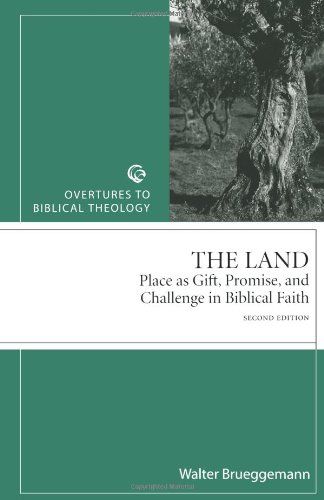
2. Brueggemann, Walter, The Land: Place As Gift, Promise, and Challenge in Biblical Faith. Philadelphia: Fortress Press, 1977.

3. Brueggemann, Walter, The Land: Place As Gift, Promise, and Challenge in Biblical Faith. Second Edition, Minneapolis: AugsburgFortress, 2002.

4. De Waal, Esther, The Celtic Vision: Prayers, Blessings, Songs & Invocations from the Gaelic Traditions. Barnhart, Missouri: Liguori Publications, 2001.

5. Fox, Matthew, Original Blessing: A Primer in Creation Spirituality. New York: Penguin Putnam, Inc., 1983.

6. Fox, Matthew, Wrestling with the Prophets: Essays on Creation Spirituality and Everyday Life. New York: Penguin Group (USA) Inc., 1995.

7. Moltmann, Jürgen, The Spirit of Life: A Universal Affirmation. Minneapolis: Fortress Press, 1992.

8. O'Donohue, John, Anam Cara: A Book of Celtic Wisdom. New York: HarperCollins, 1997.

9. O'Donohue, John, Eternal Echoes: Celtic Reflections on our Yearning to Belong. New York: HarperCollins, 1999.

10. Santmire, H. Paul, How does the liturgy relate to the cosmos and care for the earth? In What are the ethical implications of worship? Minneapolis: AugsburgFortress, 1996.

11. Santmire, H. Paul, Nature Reborn: The Ecological and Cosmic Promise of Christian Theology. Minneapolis: Fortress Press, 2000.

12. Santmire, H. Paul, The Travail of Nature: The Ambiguous Ecological Promise of Christian Theology. Minneapolis: Fortress, 1991.

13. Stendahl, Krister, Paul among Jews and Gentiles and Other Essays. Minneapolis: Fortress Press, 1983.

Tuesday, October 08, 2019

A Glad Obedience

A Glad Obedience cover

• A Glad Obedience: Why and What We Sing by Walter Brueggemann on Amazon

Inspired by the Presbyterian Church (USA)'s Glory to God hymnal, "A Glad Obedience" by Hebrew bible scholar Walter Brueggemann with a foreword by renowned liturgical scholar John Witvliet, what we sing in church is not only the Genevan Psalter (as it used to invariably be in John Calvin's Geneva Reform and in some of the American colonies)—singing in church covers many different styles, meters, rhythms, and modalities from continental Europe and from the British Isles, those places where American protestantism began.

If you've been attending church during this century, you've experienced hymns from African, Caribbean, Asian, and other cultures. (However, We Are Marching in the Light of God that originated in South Africa is the only non-traditional church song the author considers.) Alongside the kind of old favorites Brueggemann focuses on, If you've attended church even sporadically during the twenty-first century, in a more non-denominational setting you may have been surrounded by or sung what's sometimes called contemporary worship music, usually led by a band; in a mainline protestant or Roman Catholic church of any size, hymnody – and liturgy settings – almost definitely have included pieces by Marty Haugen, David Haas and cohorts.

Book is in two main sections:

• Why We Sing – an overview of four psalms explicating God's gracious, redemptive acts throughout history;

and

• What We Sing – an overview of 15 standard-issue hymns (and a chapter about sparrows) that respond to God acting in our lives. They're mostly British Isles/North American, ending with the aforementioned "We Are Marching" …no Lutheran chorales. Absence of chorales is a bit surprising, given how much of the history of new world immigration and the history of American Lutheranism run parallel, and given WB's Evangelical Reformed roots. The book concludes by considering The Covenantal Fidelity of the Psalms. After all, Walter Brueggemann is the author!

Despite finding A Glad Obedience relatively underwhelming – probably because I tend to rely on WB for biblical scholarship and incisive theology – I'm happy to have discovered this approach that could be exceptionally helpful in a small group or bible study gathering. The facilitator or another individual could choose a hymn or a stanza from a hymn to explore in terms of history, imagery, scriptural sources, and daily application. Of course, everyone present would sing together, either a cappella or with keyboard or instrumental accompaniment.

• My Amazon Review: underwhelming yet helpful overall

Thursday, August 17, 2017

Once You Know This: Emily Blejwas

Once You Know This by Emily Blejwas on Amazon
This is freedom. this is a weapon greater than any force you can name. Once you know this, and know it with all your being, you will move and act with a determination and power that the federal government cannot ignore, that the school boards cannot overlook, and that the housing authority cannot dismiss. Martin Luther King, Jr., Chicago, 1966 {ARC pages 205-206}
once you know this coverBrittany lives in inner city Chicago. Does that inevitably mean endless multi-generational recycling of WIC, welfare, worry, and weariness? Does starting life in urban (or rural) poverty mean leaving school as a dropout? Not necessarily. Once You Know This opens in Chicago, ends in Montgomery, Alabama, the city the Montgomery Bus Boycott and Rosa Parks put on the map for all time.

Without a doubt fifth-grader Brittany has inherited basic smarts, but classmates, teachers, friends, and neighbors all play essential parts in helping the eleven year old imagine and enact a future. So does the internet, though mostly by making everything easier than it would have been back in the last century.

The story moves along at an easy, interesting real-life pace; the characters are fabulous! Most of us would have loved having a creative teacher into "cultural arts" like Mr. McInnis who'd relocated north from Mississippi for his first ever teaching job. I feel as if I'd met him, met Brittany and her Mom Maureen, had more than a brief conversation with many of the other people in the book. Emily Blejwas captures reader interest and credibility, too, with micro views into Brittany's world that rang true to my own experiences growing up and later working in inner city settings.

After finding herself busted flat in Baton Rouge, Janis Joplin tried to tell us "freedom's just another word for nothing left to lose," yet freedom's really a way to claim agency, begin making choices that lead to building a future for yourself and your community. Once you know freedom... you'll be determined and powerful. No one will ignore you!

"Once you know this" isn't in the religious books category, although Brittany and Mom attend church in Chicago at least once, church ladies in their new Alabama home provide ample good eats. My Judeo-Christian tradition that affirms the Old and New Testament scriptures places a huge emphasis on freedom and obedience. Hebrew bible scholar Walter Brueggemann reminds us we celebrate the ten commandments with their bounded freedom and limits as "working papers" for life together in community.

As I've mentioned not a few times on this site and countless times in the adult Sunday School class I facilitate, we discover the neighbor at the heart of Torah, we meet our neighbor as the focus of Jesus of Nazareth's succinct summary of the ten commandments into two:

Thou shalt love the Lord thy God with all thy heart, and with all thy soul, and with all thy strength, and with all thy mind; and thy neighbor as thyself.

At the end of that summary, the gospel according to Luke includes Jesus telling the lawyer "thou shalt live" if he follows the commandments. In short, God gifted us with commandments (ordinances, precepts, statutes, law, torah) so life might thrive and harmonize with Martin Buber's definition of love as "responsibility of an I for a thou."

Brittany's Plan B worked to perfection, but back in the last century without internet, or any time during this one with internet almost everywhere, her plan wouldn't have happened without more than a little help from her friends and acquaintances. Once you know this reveals love in action. As MLK optimistically insisted, the arc of history bends in the direction of justice, and justice is where freedom, determination, power – and responsibility – live.

I'd love to see Once You Know This as a big screen or home screen movie—and I'd welcome a print sequel.

My Amazon Review: once you know... freedom!

Wednesday, June 14, 2017

Porch Stories: Navigating Faith

For her Porch Stories this week, Kristin considers Navigating Faith with Kids and features Susan Shipes' coloring book devotional, 52 Commands of Jesus for Children. I'll range further and bring adults into this post, though I'll still be more impressionistic than detailed since I check out Kristin's topic when I get online Wednesday mornings and try to blog by evening.

desert spirit's fire porch stories – navigating faith

I love the nautical word navigating related to our journey with Jesus! Maybe you know many traditional church buildings have been constructed in the form of a ship that appears upside-down to us as we look up at the ceiling and rafters? "Nave" – as in "navy" – still designates the central space where worshipers gather. You've probably heard ships referred to with female pronouns she and her; scripture tells us the Church is the Bride of Christ, so that's also her and she. Navigating also is especially apt because we can't see what's underneath the surface of the sea our boat is on, we can't tell what's on the other side of the horizon. As we answer God's invitation with "yes" and take a first step out in faithful trust, we never really know where God will lead us; we only know God promises to be with us every moment of everywhere we venture on our voyage.

I've taught Sunday School, confirmation, and Vacation Bible School to most every age except teeny tiny tots, though middle school's probably my favorite age group! I almost just now remembered—in City of History we had Release Time classes for inner-city 4th and 5th graders. Middle schoolers especially appeal to me because they're old enough and have enough life experience to do some sophisticated thinking, they're open to new ideas, and they're always more than ready to challenge the teacher to stay real and relevant. Kristin mostly writes about faith with kids; currently I prepare and facilitate (all the participants teach) adult Sunday School at my church—I post my notes on my urban wilderness blog. Most weeks we mainly reflect on one of the Revised Common Lectionary passages for that day, though by the gracious movement of the HS, inevitably our discussion takes us pretty far afield of where I've started with my (always deft) theological and historical intro to the text.

Recently I read and plan to blog and review The Creative Word: Canon as a Model for Biblical Education by Walter Brueggemann. Related to Biblical Education in the title, a few places he mentions the coming-up generation that's also growing up in the church, but everything he says applies to any age. Because the Old Testament is his specialty, Brueggemann focuses on the Hebrew Bible and particularly emphasizes God's gracious gifts of liberation from slavery, God's subsequent gift of the Ten Commandments of the Sinai Covenant, and God's charge to us to obey in order to maintain that freedom:
Take care that you do not forget the Lord your God, by failing to keep his commandments, his ordinances, and his statutes [because] the Lord your God brought you out of the land of Egypt, out of the house of slavery… remember the Lord your God. –Deuteronomy 8
Jesus also commands us to keep the commandments; he summarizes everything behind the Ten with only Two, to love God with our whole heart, soul, mind, and strength; to love our neighbors as we love ourselves. In fact, he shortens that into a single, "love one another as I have loved you," but the details of the ten commandments help clarify our attitudes and behaviors. I love that the title of Susan Shipes' devotional coloring book mentions Jesus' own commands—he tells us his yoke is light because in Jesus' new covenant of grace (just as under the old covenant that also was a grace-filled way) obedience leads to freedom.


Today Kristin and I both began with navigating. Many people want direct instructions for every move in every situation; young kids and chronologically mature adults alike often struggle with the finely tuned morality involved in keeping the commandments, but learning the narratives from Jesus' life and ministry we find in the four gospels gives us additional insights for putting the good of the other and the well-being of the community before our own preferences and predilections. From Jesus' own example, we know we find healing and freedom anywhere the realm of heaven is breaking out in our midst. That knowledge isn't a road map, but it still can help guide our desire for instructions and our search for reassurance. We don't know what's underneath the surface of the water we're walking on, what gift, what threat, what grace or mercy may appear when we reach that distant horizon, but in obedience we can do this! In the power and presence of the Holy Spirit of Pentecost that fills the church, you know we can navigate this voyage!

52 commands of Jesus

porch stories button

Tuesday, February 23, 2016

Tuesday of Reminiscere, Lent 2

During Lent 2013 I wrote, "I fear more months, years, decades of aimless drifting." It's now Lent 2016.
lent 2016 crossBecause the local marathon routed past the church building and blocked access, we had Saturday evening worship for Lent 1.

Originally the church PTB had scheduled some kind of evening service – vespers? compline? ante-communion? service of the word that's not ante-communion? – no one consulted me and I didn't inquire, but the new interim pastor assured me we'd have Holy Communion, so I knew I had to be there. And her word was "communion," not Eucharist. How fitting for the season of Lent when we often plan and try to live more simply, less extravagantly, to pare down to plain essentials—Walter Brueggemann tells us Holy Communion is pre-eucharist. In Communion the gathered assembly becomes community as the triune God whose essence is covenantal communion meets us together in Word and Sacrament.

From the Green Season of Pentecost 2010, here's some of what I need to consider from now through the remainder – the rest – of Lent: [Gilgal] Bethel [Jericho, Jordan] . A paraphrased excerpt:
We've been to Gilgal, the place of rolling away doubts, pasts, fears, transgressions, regrets and anything else that's gotten in the way. Now we need to get to God's House, to Beth-El!

From Gilgal to Bethel into Jericho, all of us carry burdens, joys, regrets, disappointments, and questions from previous phenomenological and psychological locations. Jericho is the place of often counter-cultural, counter-intuitive obedience and radical trust. At Jericho we prepare for Jordan, for "...the focal drama of baptism, which is a subversive act of renunciation and embrace summoning us 'from our several enslavements ... to a common, liberated obedience.'" [Walter Brueggemann's words]

Does that sound like our journey through Lent into Easter Vigil, baptism, and the first Eucharist of Easter?

Yes.


Friday, November 20, 2015

Brueggemann: Out of Babylon

Out of Babylon by Walter Brueggemann on Amazon

out of babylon coverFrom Egypt to Assyria, to literal geographical Babylon, on to Persia and then Rome, the bible witnesses to a series of empires that dominated the daily lives of the people of God; scripture also provides accounts of creative, resourceful, and effective ways people learned to live with and even thrive in spite of foreign hegemony. Although Babylon in the book title serves as a cipher for imperial regimes everywhere, WB also writes extensively about the southern kingdom Judah's actual Babylonian Captivity during the sixth century, at the same time reminding us "Babylon" bears the weight of geographically relocatable interpretations (page 111).

Out of Babylon references Emmylou Harris' song "Doin' time in Babylon." When they sentence you to do time, you can't choose get out of jail free. As Christians can we live faithfully surrounded by empire and its deathly apparatus? Is it living faithfully with empire, living faithfully in spite of empire, or another possibility? Our contemporary situation in the USA closely parallels the exiles' in Babylon (faithful in Rome, Spain, Great Britain...) as accretions, outrages, attractions, and demands of empire surround and often seem to overwhelm us. Truly we cannot escape to some ideal oblivion, an unknown nowhere – remember erewhon? – and in the power of the Spirit we need to create local, covenantal life where we are―in spite of empire. And then there's another reality: God's overwhelming response of grace when humans don't quite measure up to the standards of the commands.

Late during the last century people rejoiced as the Union Jack of British imperialism stopped flying over one colony after another, yet every one of us in the USA deals daily with inescapable excesses of global USA political and economic empire. Most helpful for those of us trying to live faithfully in the Spirit of Life and within the spirit of the witness of scripture are WB's reminders of the creative ways some people operated (for example) within the imperial Persian government, apparently violated no laws, yet managed to finagle and finesse their work (ministry? we often call government officials "ministers," servants) for the good of the people of God, for the benefit of all people. When he insists the Church and the Churches in the USA have sold out to empire, have been unfaithful, Professor Brueggemann has it so right. What can we do as individual persons, as individual congregations to regain faithfulness? WB cites Babylon as "matrix for Jewish well-being ... a venue for Shalom." (pages 8 & 9) Can we celebrate and live Jubilee freedom amidst empire? Or rather, how can we live in the trusting freedom of jubilee in the midst of empire? You need to read Out of Babylon and get inspired!

Christians are a People of the Book, the scriptures of the Old and New Testaments. In at least one other of his books I've read, Walter Brueggemann talks about our being (or becoming) fully texted people, gospeled communities. Out of Babylon provides some history and some ideas for ways those of us in the USA churches might learn the texts and live the texts of scripture more completely. In spite of empire is far from one size fits all! The contemporary church in the USA needs to learn diversity of style, response, actual cooperation and accommodation with the forces of empire in order to become more fully gospeled, more completely texted. Scripture also provides accounts of creative, resourceful, and effective ways people learned to live with and even flourish in spite of imperial domination. Not only is there room for many diverse approaches; a diversity of approaches to the presence of empire is essential.

my Amazon review: Walter Brueggemann on Empire

Friday, March 27, 2015

whatcha reading? friday 5

For today's whatcha reading friday 5, Mary Beth hosts and asks: What are you reading these days? Any genre, give us novels, magazines, websites, newsletters...

books:

coal wars cover Out of Babylon Cover Towards a common Vision cover let's all be brave cover
Jesus Swagger cover
1. By Richard Martin, Coal Wars: The Future of Energy and the Fate of the Planet

2. Walter Brueggemann, Out of Babylon—I am soooo Brueggemaniac!

3. Our next discussion document on the Faith, Order & Witness Committee will be the World Council of Church's Faith & Order Paper 214—The Church: Towards a Common Vision.

4. Let's All Be Brave: Living Life with Everything You Have by Annie F Downs

5. Oh My Goodness! publicity sent me a book I hadn't even heard of, just finished, and enjoyed very much: Jesus Swagger: Break Free from Poser Christianity! I need to post my blog and reviews soon.

websites:

I especially love houzz and Better Homes & Gardens

Saturday, February 22, 2014

The Land: Brueggemann

Because I read this edition from 1977, my blog may not completely apply to this 2002 revision: The Land:Place as Gift, Promise, and Challenge in Biblical Faith – Overtures to Biblical Theology

the land cover Wherever you are on this planet, actual earthly turf lies under your feet, forms the foundation of your house, your workplace, of everywhere you venture. For every one of us, "land" carries heavy literal and symbolic connotations that include dirt, soil, ground, territory, settled, belonging, rooted, secure. In this second decade of the twenty-first century we've recently experienced a major economic crash followed by far lower reevaluation of residential – and other – real estate, precipitated by people who imagined inalienable land could be "owned" as property and turn big profits. Families still get relocated by governmental and other entities from storied places into historyless spaces. We've been agonizing over seemingly endless, unstoppable atrocities against the land committed by Monsanto as well as by other huge agribusiness and manufacturing conglomerates. Especially considering those events, you need to read and take to heart this book by Hebrew Bible scholar Walter Brueggemann as he helps clarify and untangle law, gospel, history and hope!

If you've studied scripture even minimally, you know Egypt "...is not the place!" The Exodus wilderness on the way to the land of promise was not "the place," either. Unlike with those managed, controlled, counted bricks and bread under Pharaoh, in the wasteland of Israel's Sinai wanderings, human administration and management of anything (let alone land and its harvests) was impossible, so with manna and quail from the sky, with water from the rock, Moses' people experienced wildness as a life-giving, life-sustaining gift from Yahweh. For Israel, land would remain gift if they would continue trustfully obeying. Likewise for us, land will become gift if we will obey and trust.

In the Hebrew Bible there is no timeless space and no spaceless time; it all is "storied place." Brueggemann reminds us as "fructifier of the land" Yahweh is a fertility god who fully participates in the agricultural cycles with earth, farmers, vintners, and crops that typically we experience as the [almost] endless recycling of the same events. Yahweh also is Lord of history―not one who protects and assures continuities in our lives, but instead works the brand-newness of political, historical, social, and individual resurrection out of sometimes unimaginably radical discontinuities. Yahweh is Lord of the Lands and Lord of the Commands―a God who keeps covenant forever, who calls us to covenant-making, and covenant-keeping. A God who calls prophets to be a voice for the land and for the people.

Although The Land relates mostly the topic of turf and dirt, gift, obedience, and community in the Old Testament scriptures, the author also brings some possible Christological interpretations of the OT texts along with land-focused insights from NT gospels and Pauline epistles (particularly Romans 4 and Galatians 3 and 4). Remember, you simply cannot empty Abraham of land! Just as in Hebrew Bible times, during the earthly ministries of Jesus of Nazareth and of the early church, we need to be about the covenantal inter-responsibility of speaking and answering, call and response, amongst Yahweh, people, and land. "Listen to the voice and the claim of the land." WB reminds us scripture emphasizes not emancipation but rootage (you already know Paul of Tarsus' eleutheria / freedom ain't no emancipation proclamation!), not meaning but belonging―we live baptized into Christ, into the people of God in every time and place.

Blogger note: the inevitable outcome of living as covenantal, creation-care people is that we'll become an inclusive, welcoming, justice-filled Eucharistic community that displays the exhibition of the reign of God to the world.

my amazon review: land as gift, promise, and hope

Saturday, November 02, 2013

The Prophetic Imagination

The Prophetic Imagination on amazon

prophetic imagination book cover
We need to quit imagining prophets as only foretellers or social / political protesters, because "Most of all, [prophets] understood the distinctive power of language, the capacity to speak in ways that evoke newness 'fresh from the word.'" Newness that springs from trustfully covenanting rather than frantically consuming. An alternative way of being that emerges from being satisfied with relative scarcity that's actually shalom-full "enough" for everyone in the community.

If this easily readable, "slim volume" has an ongoing theme, it's that only when we acknowledge people, possibilities, and opportunities are forever gone, and begin grieving their loss, will the paradoxical possibility of new life from death arise. In fact, in Yahweh's terms, history – newness that marks the end of uninterrupted forevers in the manner any imperial (political, economic, educational, religious) establishment measures and regulates time [chronos] – always begins with barrenness and bereavement. Read and trust the scriptural witness!

This is radical stuff about newness from the ground up, "life in the shape of death" in the final no to sin, exploitation, empire, consumerism from the Calvary cross that at dawn on the day of resurrection becomes yes to life! Just as in his later writings, in this vintage book Brueggemann reminds us we experience that newness in baptism, then relive it in the eucharist. The Prophetic Imagination is vintage Brueggemann, and it still doesn't get any better than this.

my amazon review: Classic Brueggemann

Wednesday, October 30, 2013

In Man We Trust: the Neglected...

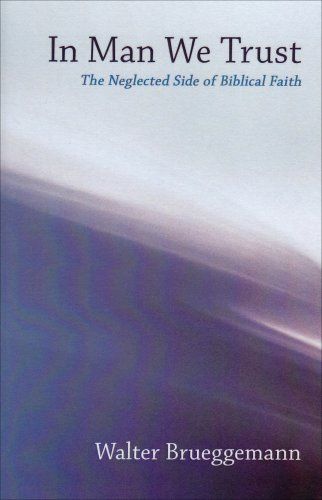
In Man We Trust: The Neglected Side of Biblical Faith by Walter Brueggemann on Amazon

in man we trust Most likely I picked up a hardbound copy of In Man We Trust in perfect condition with no dust jacket, no bookplate, or owner inscription from a free books shelf or bin at divinity school. I've recently reviewed and blogged a few other books by Walter Brueggemann, so here's another, this time it's a first reading of the ©1972 book for me; there's a later 2006 edition.
Particularly for those of us within the theological and ecclesiastical traditions of the Reformation who tend to run with a Paul – Augustine – Luther theological focus and a Heilsgeschichte theological perspective, a strong emphasis on human freedom, responsibility, capability, and competence doesn't quite ring true. Wisdom literature? For sure I'm neither the first nor the last to believe on some level that Proverbs and Ecclesiastes don't really belong in the biblical canon—or in a third or a fourth canon, either. Although Brueggemann discusses Job, Proverbs, and Ecclesiastes to some extent, more than anything he reminds us we discover the same ethos along with material from similar sources in the "J" or Yahwist Pentateuch source—supremely in the life and style of King David, to a more limited degree in the social, religious, and economic styles of United Monarchy bookends Kings Saul and Solomon. Beyond that, the author points out the life and ministry of Jesus of Nazareth (particularly in Matthew's gospel account) reveals Jesus as Son of David, as a King like unto David, and in human wholeness, freedom, and a rare ability to seize the day – including the day of resurrection – very much as the New David, dancing in the face of death.

We confess we follow the Way of the crucified and risen One. What does it mean to take his name upon us? An arduous journey to the cross? Possibly for a literally select few. What about assuming the fullness of responsible, responsive, humanity? Everyone in the Western world does not spend their days hung up with sin and guilt; in fact, even most protestants aren't mini-Luthers. This viewpoint isn't necessarily one to assume in place of Paul – Augustine – Luther; it's complementary to it in the sense of completing or rounding out, as a way to balance our days. At least since the late twentieth century, fewer and fewer have been walking that walk. Between a little too much, "God, be merciful to me, a miserable sinner, I'm here to claim forgiveness again" amongst church-going adults, and too many parents coddling their kids, absolving their offspring of taking charge of their own lives, every one of us could benefit from the wisdom literature's exploration of wise, fruitful living. You could call this celebration of human freedom, responsibility, capability, and competence a kind of "possibility thinking," and why not?

"They cut me down, and I leapt on high; I am the life that'll never, ever die. I am the Lord of the dance, said he."

my amazon review: an important perspective

Thursday, September 05, 2013

Finally Comes The Poet

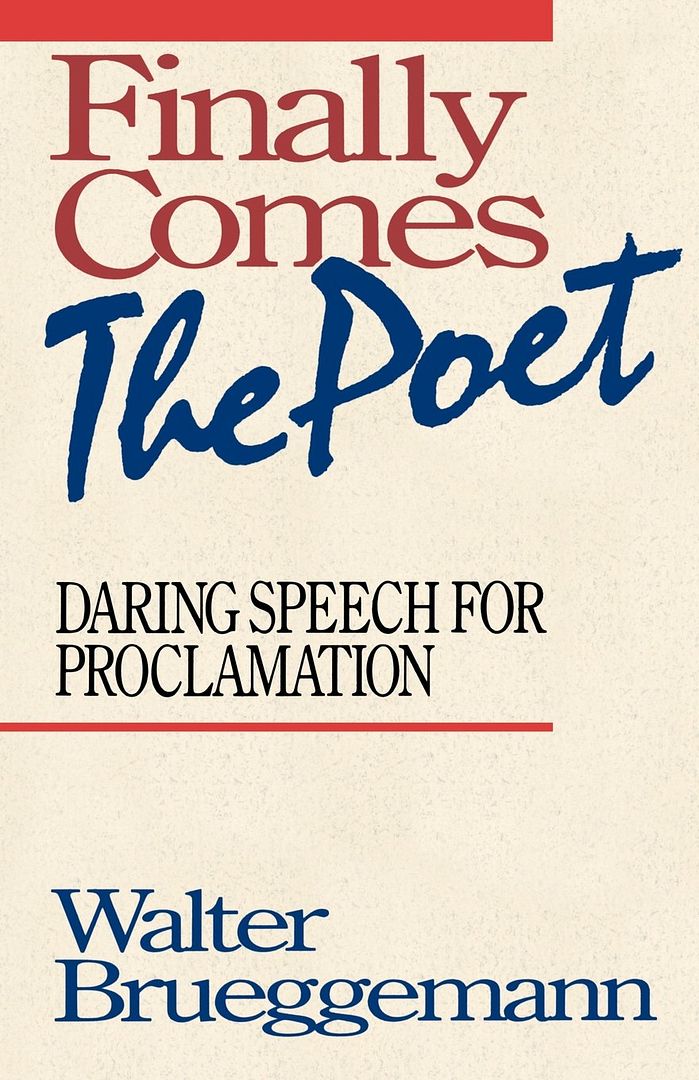
Finally Comes the Poet, Daring Speech for Proclamation by Walter Brueggemann on amazon

finally comes the poet cover Walter Brueggemann found this book title in "Passage to India," from Walt Whitman's Leaves of Grass. This world has become "prose-flattened," so an alternative mode of addressing and encountering became the subject of the 1989 Lyman Beecher Lectures at Yale Divinity School.
Poetry isn't necessarily rhyme, metaphor, or simile, but poetry is the same type of alternative to conventional verbal expression that resurrection is to the reign of death. Israel spoke of the prophet, Greece of the poet, but both poet and prophet spoke and gave (in the Spirit they still speak and still give) the world jarring, angular, prodding, probing, redemptive words.

This is Brueggemann, so you won't be surprised to know he reminds us "Word has its habitat in Sacrament. But it is to say more. It is to say that all our talking and listening is out of baptism and into baptism." (page 85)

In some ways Finally Comes the Poet is mostly a book for preachers and for those who regularly attend to preaching, but it's also a book for every one of us wherever we are. For the preacher in her or his daily sojourns to the mall or the grocery store or the watering spot. For every one of us who gathered around Word and Sacrament last Sunday, who now gather around colleagues at the office, grandkids at the kitchen table, second graders in the classroom, "bound in covenant to the life of God" (page 85), inspired to speak and evoke a lively and life-giving alternative to the reign of death.

So let's not be prose-flattened? Let's all be and become the poet for each other!

my amazon review: Finally Comes The Poet

Saturday, August 31, 2013

Deep Memory, Exuberant Hope

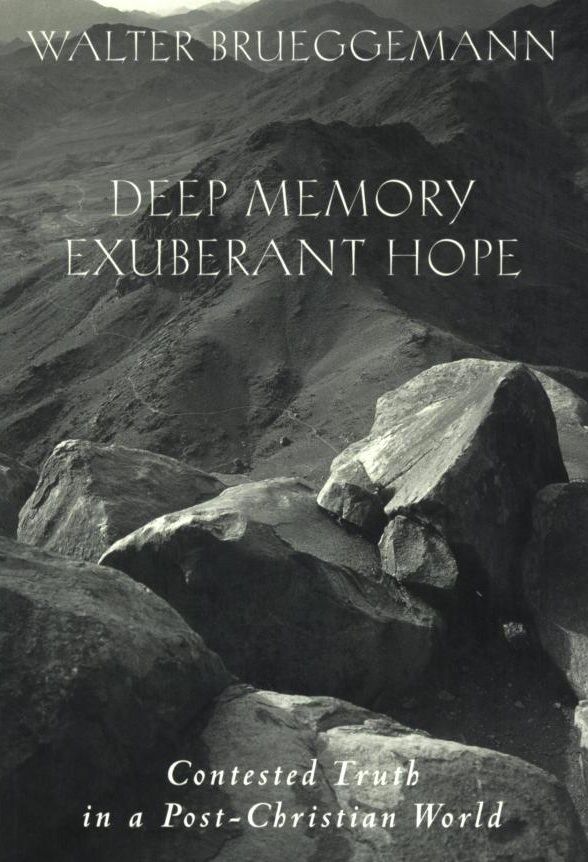
Deep Memory, Exuberant Hope: Contested Truth in a Post-Christian World by Walter Brueggemann on Amazon

deep memory, exuberant hope coverThis is the third and final offering in a trilogy of reflections on our lives together by Walter Brueggemann, published by Fortress Press at the end of the last century, beginning of this one.
In memory and in hope, "We are forever re-imagining and retelling and reliving our lives through the scandal of Friday and the rumor of Sunday." Preaching as sub-version: a life-giving word within a death-dealing situation. Staying in Egypt is not our only option, and remember, [the exilic] 2nd Isaiah "funded Handel's Messiah!"

In this last book of the series that began with The Covenanted Self, and continued with Texts that Linger, Words That Explode, Walter Brueggemann asks why on earth anyone would want to "delete YHWH" [page 119] in relating these stories, these sagas, if you weren't proclaiming YHWH's agency and part in them? Well, if it weren't for YHWH, we wouldn't be reading or talkin' about any of these mighty acts of creation, liberation, homecoming, and resurrection because they wouldn't have happened; we couldn't begin to envision the possibility of daily bread for which we do not owe empire. In fact, if you do leave YHWH out of everything, "...not much that matters remains."

All three books in this series would be outstanding preaching and teaching resources; they even include detailed endnotes, as well as author and scripture indices.

my amazon review: deep memory, exuberant hope

Texts that Linger, Words that Explode

Texts That Linger, Words That Explode: Listening to Prophetic Voices by Walter Brueggemann on Amazon.

In the first book of this 3-book series of collected lectures, The Covenanted Self, Brueggemann discussed creation in covenant with Creator—especially regarding the life-giving words of the Ten Commandments of the Sinai Covenant and their later interpretation by Jesus of Nazareth as the Great Commandment to love God, Neighbor, and self. texts that linger words that explode coverIn Texts that Linger, Words that Explode, the second group of considerations of (mostly) texts from the Hebrew scriptures, the author emphasizes prophetic words, warnings, and promises from the Hebrew bible, relates them to the "fully-texted" [page 8] community of the New Testament, and insists upon the ongoing necessity of obedient, covenantal life in our own commodity-saturated context.
It's a logical continuation to contemplate dangers and outcomes of not following the Spirit of the Sinai Covenant, of not living justly with one another and with all creation, of not making God and neighbor a priority, of succumbing to temptations of fear, anxiety, and those still-present spurious allurements of consumerism and bling. As he almost always does, Walter Brueggemann reminds us the baptized, gospeled, "fully texted" community in which we gather around word and sacrament is the foundation of our own lives in resistance to death-dealing temptations, in embrace of resurrection-risking obedience. It's impossible to highlight and cite the 80% – 90% of everything in this series I found interesting and important, so I trust you'll consider reading these books for yourself. Deep Memory, Exuberant Hope, is the third and last book of this series.

my amazon review: words that linger, texts that explode

Monday, August 26, 2013

The Covenanted Self

The Covenanted Self: Explorations in Law and Covenant by Walter Brueggemann on Amazon

covenanted self cover The Covenanted Self is the first of a three-book series of Hebrew Bible-focused articles that continues with Texts that Linger, Words that Explode, and concludes with Deep Memory, Exuberant Hope. In a formal sense, "Covenant" in the title mostly refers to the brokered-by-Moses Ten Commandments of the Sinai Covenant between Yahweh and Israel. We first hear the words of the Decalogue in Exodus, and then again in the book of Deuteronomy, where we also read accounts of real people working out life in obedience as dangers to their own freedom and threats to the Lordship of YHWH surround them. And now, as a baptized people, we follow the commandments in our own daily journeys of life together at home, in church, in nearby community, and in the larger world.
Whatever the context then or now, there or here, Brueggemann emphasizes how those flexible, dynamic, yet explicit guidelines for just, sustainable, life together within the spirit of the law could not run more counter to the consumerist debtor economy most of us in the West were born into. We need to trust God's promise depends upon grace, but also upon our obedience. The book includes excellent endnotes, an author index, and scripture references.

my amazon review: The Covenanted Self

Tuesday, July 16, 2013

desert spirit's fire is 11!

life stuff button

desert spirit's fire @ 11: part 1

Today is my 11-year blogoversary! Facebook friend Sasha posted this status a few days ago because she needed some ideas for a class assignment: "If someone asked you to put 7 items into a bag, that described a little bit about who you are; what items would you put into that bag?!" What a great writing prompt, and how appropriate for an anniversary post. My "little bit about who" I am is mostly about my creative endeavors and efforts:

1 art supplies: sketch pad; markers; crayola crayons; pencils; an eraser; sharpies; triangles, ruler, french curves.

2 camera and (paper) calendar.

3 notebook with wide lines for journaling and other writing on one side only of each page; ballpoint pens in red, blue, and black.

4 a book to read; right now I have at least three by Brueggemann almost totally unread, so one of those will go into my backpack.

5 a bible, so I can check scripture references for writing, drawing, and designing—read and study some, too!

6 I realize this prompt is more about durable goods, but I need to include snacks: iced tea; sandwich; salad; a couple pieces of fruit.

7 a long-sleeved sweater or sweatshirt… being too cold is the only thing more miserable than being hungry.

desert spirit's fire @ 11: part 2

This week also is RevGalBlogPals' birthday, and they're hosting a carnival! Two questions:

1. What's your birthday tradition?

A great meal, preferably with friends or acquaintances; failing that, a yummy meal by myself. I also love to celebrate my baptismal birthday in a similar way.

2. If you were blowing out the RevGal birthday candles, what would you wish for us? What's your dream for RevGalBlogPals?

I'd love to meet a few RevGals IRL; I've noticed how much closer and how much more interested in each others blogs and other activities the gals and guys who've met each other are. In general, I'd like the blog itself and the ring activities to keep developing, changing, and evolving as they have.

desert spirit's fire @ 11: part 3

Finally, last Sunday afternoon, Tara at Praying on the Prairie inspired me to list ten current blessings:

1 Although I'm planning to move northward in a few months, for this interim, I've been trying to create my own 3-point parish. My first blessing is the church where I'm supply organist a couple times a month. They finally excitedly welcomed a new pastor after a long interim of about 2 years!

2 "CAC," aka "Church Around the Corner."

3 "COH," that's Church On the Hillæ up the hill a piece from here.

4 My two kittehs, AlleyMalibu or AM, and Roxy.

5 I need to begin believing I'll be able to create a new normal. I am starting to believe I'll find a new normal of meaning and purpose.

6 An abundance of the fruit of the earth: good grub and refreshing drink. Local fresh berries, tomatoes, corn, peaches, nectarines, lettuce and more have been the best.

7 Eucharist every Sunday.

8 Given how sadly uncreative my writing and reflections have become (I'm thinking that will change once I have a real life again), I've especially been enjoying reviewing some books for The Speakeasy; I also appreciate being an amazon vine reviewer. I trust the authors appreciate it, too!

9 Tomorrow truly is another day.

10 My new phone—today I celebrated by finally getting a smarter phone. For about 30 seconds I actually considered going for an iPhone (MacFanatic here), but realized my very lightweight 14 MP Nikon has more photo, video, and sound capabilities than the iPhone, and I really don't need all those apps.

desert spirit's fire @ 11

Friday, June 28, 2013

take 5 friday 5

take 5 friday 5, hosted by deb

1. 5 flowers I'd like in a bouquet or garden:

sunflower on porch with other flowers1. zinnias
2. sunflowers
3. pansies
4. gardenia
5. honeysuckle

2. 5 books I want to read (or re-read):

1. Saul Alinsky, Rules for Radicals
2. William Stringfellow, An Ethic for Christians and Other Aliens
3. Henry Beston, The Outermost House
4. William Faulkner, Almost Anything by
5. Walter Brueggemann, a couple books in my collection I haven't yet read

3. 5 places I want to visit:

1. Morocco
2. Singapore
3. Hong Kong
4. India
5. Greece

4. 5 people I'd invite for tea/coffee/beer lunch/ pizza, name your own preference:

1. Joanne McGonagle of The Tiniest Tiger ... I'd love to go to her house to meet her new kittehs, or invite her to my house to meet my kittehs.
2. It would be fun to chill with some people I know only from facebook; though I have already met several in real life. Truly fun!
3. Can't think right now.
4. Fill in this blank later.
5. Someone I've yet even to hear about.

5. 5 chores or tasks I'd gladly give to someone else:

1. vacuuming. ugh.
2. washing windows
3. anything that involves going higher than first rung of a ladder
4. scaling and gutting fish
5. cleaning kitteh litter box (although I do it all the time)

bonus: A 5 ingredient recipe!

tabbouleh salad

Tabbouleh
Ingredients
  1. cucumber, diced
  2. several roma or your choice of tomatoes, diced (remove seeds if you’re not lazy)
  3. 1/2 cup bulghur wheat
  4. 1 or 2 green onion(s), thinly sliced
  5. Olive oil
  6. Lemon juice
Pour hot water over the bulghur and let soak until it is soft has absorbed most of the water. Mix diced veggies by hand then add the bulghur and mix some more; add lemon juice and olive oil to get the right flavor and consistency. Refrigerate, eat and enjoy.

Saturday, April 06, 2013

Easter Saturday

Today is the 8th day of Easter 2013; This is another of my "life stuff" blogs, particularly the series I began during late Epiphany 2013.

life stuff buttonLate, great, Preacher to the University at Boston University's Marsh Chapel Howard Thurman had essential advice for anyone trying to figure out what to do with their life—for the first time or two, or for the twentieth time or so: "Don't ask what the world needs, ask what brings you to life, because the world needs people who are fully alive." Another commonplace observes a person finds their calling – not always their career, job, or working life – where their gifts and passion intersect. At this age and stage, I'll add education and experience to the mix. I had every expectation I'd again have opps to engage world and church at levels related to my abilities. For a moment I'll discount the housing crash of September 2008 and the financial dominoes that tumbled in its wake, but anyone with my gifts, education, vision, ambition, (and hard work) could have expected to have a financial choice to attend symphony concerts, or jazz fests, a trip to Greece or the Pacific Rim every two or three years. This is not a hunter-gatherer society!

Given how a shrinking, stuttering economy has caused everyone but the super-rich to cut back on everything, I'll add September 2008 and its aftermath back into the mix and say whatever the $$$ and employment markets, I still fully expected eventually to find a welcome place of embrace and participation. By 2006 or 2007 or so, I'd started to, and then it evaporated. At Good Friday lunch with the then interim pastor at North Minster, I told him Lent and Holy Week 2007 at North Minster and at North Park finally had shown me what might be possible. It's now six years later!

Over these years I've had watersheds galore. Besides major rejections, disappointments, and other "stuff" I maybe need to look at and through, I'm also reading the literal plethora of little things I'm not getting done as symptoms of too much that needs to change. "Not getting done" not because I've been so busy and involved in more important activities... In one of her early books, Kay Jamison mentioned aging so during a certain period of her life (exactly as I have over the past decade); she said it was inevitable, "with such loss of self, such distance from shelter, such proximity to death."

What brings me to life? What makes my heart sing? I enjoyed preparing notes and class handouts for Thursday bible studies at Church Around the Corner a couple months ago, but I truly loved interacting with the class. I felt like myself again; I was alive for that short time! Thinking of ways I can help make that happen again... I easily can make a simple list of ways I'd love interact with world and church again on a regular, ongoing basis.

In my blog and review of The Outermost House, I observed:
Walter Brueggemann insists much of life is sabbatarian, spent in the interstitial, liminal time between Good Friday afternoon and Easter Sunday dawn. During winter in a four-season climate like Cape Cod's, there is a simply being who we've become thus far that has a sense of Sabbath about it. We almost hang suspended in time waiting for gifts of birth, of spring, of new life to ready themselves.
I'm talking about moving to Los Angeles. But to where, and to what? And how?

On the eve of Easter 2 I'm still in winter's holding pattern, still suspended in time waiting for new life to spring forth.

Monday, February 11, 2013

almost lent

this is part the third; here's part the first and part the second

Susan Shapiro suggests Make Me Worry You're Not O.K. by writing from the heart as part of shedding "vanity and pretension." Did you realize "The biggest mistake new writers make is going to the computer wearing a three-piece suit"? Because "This rarely inspires brilliance or self-insight." So I don't exactly flaunt 3- or 2-piece suits, but still, fresh cargos (long pants in cooler weather, shorts or skirts in warmer) with a light bright sweater and shirt is tame and safe, most places, almost any time of the day, and makes me appear as okay as most other people along this coast.

new year 2013RevGalBlogPal Julie at "The Preacher and the Party Store," wrote about being at her Dad's funeral and seeing pictures of him when he "had flesh on, was more energetic and whole. ...how quality of life slips away so slowly, it's easy to miss, easy to forget what it used to be." My story exactly! Though in terms of avoirdupois for sure I do not lack flesh, I still miss the enfleshment of being part of life, of the action. Now that we've celebrated Christmas – Incarnation! – with a star, a song, and a child, I'll dare include clothed in the vulnerability of community. And you know I long ago gave up imagining the ideal rather than the real typically – or ever – would obtain.

Like everyone, I've many losses yet to grieve; many unacknowledged, buried emotions that may or may not need liberation. In some ways my life as I knew it slowly unwound and unraveled; in other ways I simply kept on keeping on, carefully preparing for a future that simply hasn't yet dawned. My last year in City of History started becoming my index as to how I was doing. Rather than sites of bondage and imprisonment, those were spaces and places of relative freedom and service. The disappointments and devastations of the two decades since then have affected me deeply and (apparently) completely invisibly! Death takes many forms. I've predeceased my former friends, but no one has held my funeral because no one notices or realizes. Via Ezekiel [37:12], God promises, "I will open your graves!"

Phillip Phillips sings "Hold On," from Greg Holden and Andrew Pearson
Hold on to me as we go, as we roll down this unfamiliar road
And although this wave is stringing us along, just know you're not alone
Cause I'm going to make this place your home

Settle down, it'll all be clear; don't pay no mind to the demons; they fill you with fear
The trouble it might drag you down
If you get lost, you can always be found

Just know you're not alone
Cause I'm going to make this place your home 1
To paraphrase words I read a couple weeks ago 2, nature has ways to scrub things clean, through storms, winds, rains, the pasts all washed away for a fresh start, making space for seedlings to replace lost trees. There’s no way to turn back this process.

In his foreward to The Word On the Street, Walter Brueggemann reminds us, "The bread is thin and the wine is poured out, and Easter is fragile news wherever it is told and trusted. None of that is compelling, unless one is on the street to see it, unless one is free to discern it, unless some are bold enough to sing it and say it. This act of evangelical reconstrual is daring and always uphill, but in no other way will the street be seen to be congruent with the word." [xv] 3

Recently I've really really noticed a TV commercial where the main character tells us she lived for dinners with family and friends; I also lived for those sometimes frequent, more often occasional, times of good friends, good food, good drink, good conversation. "The reconstruction of [a person's] social space..." (The Word on the Street, p. 164) also is daring and always uphill. I'm very very definitely not O.K., I'm trying to convince you by shedding some vanity, pretension, and the parts of a past that no longer works for me or for anyone. I long and ache for the flesh of community back on my bones. But is church not where the baptized connect with each other, in the Spirit make space and newness, create context and community for each other? I don't know. I'm asking. I'm alone, I'm lost, lookin' to be found, my life cries out for resurrection!

life stuff button

1. lyrics © Downtown Music Publishing LLC, Razor & Tie Direct LLC, Universal Music Publishing Corp.
2. A Glimpse of Heaven: Life After the Tragedy in Sandy Hook
3. In The Word on the Street: Performing the Scriptures in the Urban Context. Stanley P Saunders and Charles L Campbell, authors; foreword by Walter Brueggemann.