Showing posts with label faves 2010. Show all posts

Friday, December 17, 2010

Cool Jazz Christmas: CD

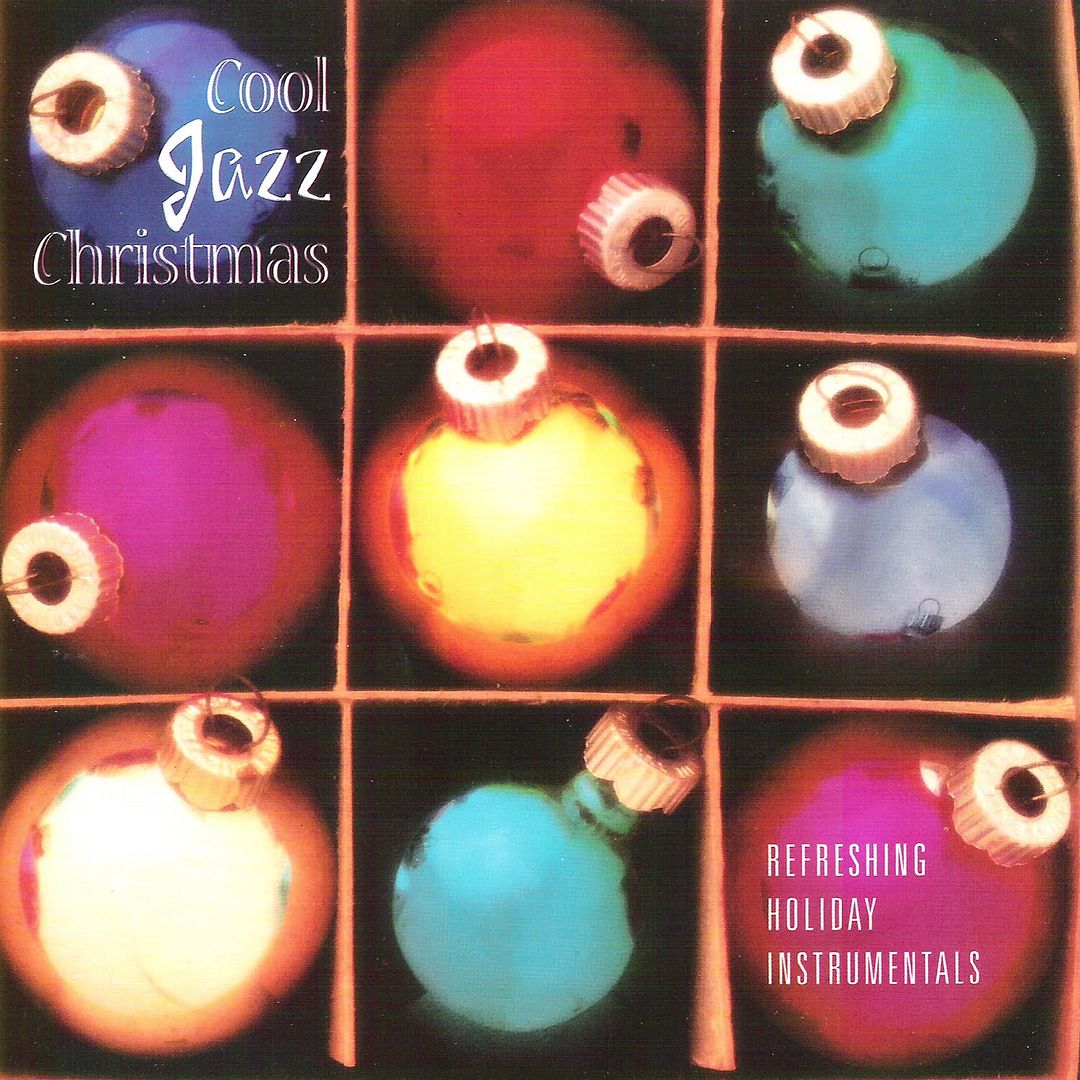
Cool Jazz ChristmasEric Darken and company bring an enjoyable Christmas music collection with another project from Nashville, Tennessee in
Cool Jazz Christmas, Refreshing Holiday Instrumentals."

For the most part the music conveys a sort of New-Agey, cool, casual and offhand sensibility that passes time pleasantly with an occasional sequence or riff that makes you want to listen again because it was unusual, unique and... repeatable. The sound is excellent and over all Cool Jazz Christmas is well-produced, but it's more the kind of performance you have playing in the background instead of sitting down with to savor every sound. However, "O Come, All ye Faithful" with Mark Baldwin on keyboards and sax by Mark Douthit is worth the price of the CD—I wanted to say there was a best out of all of tracks, and happily there is. The playlist is church, mall and radio standards, but even with quite a few newer songs and carols, what would the season be without these? Cool Jazz Christmas

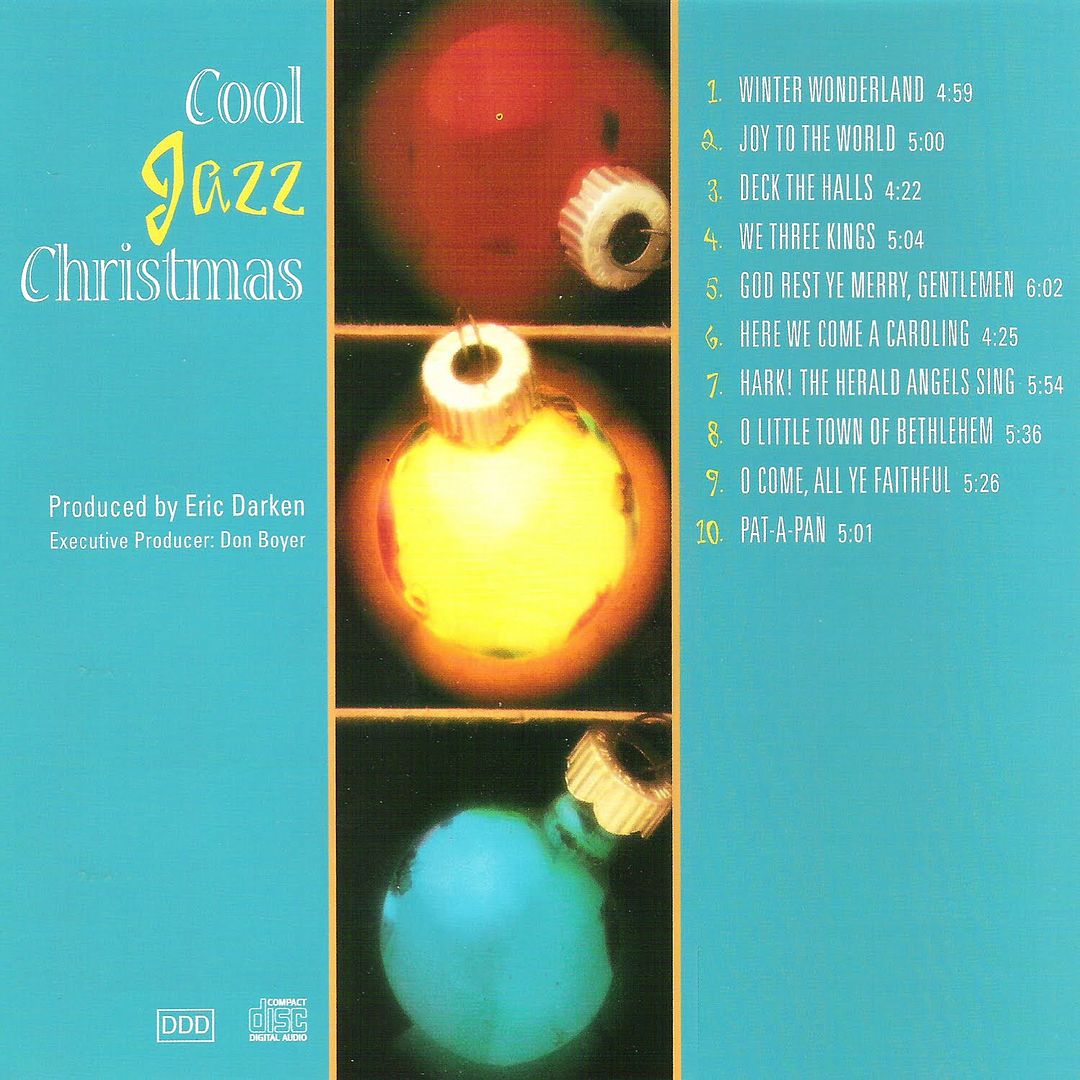
1. Winter Wonderland
2. Joy to the World
3. Deck the Halls
4. We Three Kings
5. God Rest Ye Merry, Gentlemen
6. Here We Come a Caroling
7. Hark! The Herald Angels Sing
8. O Little Town of Bethlehem
9. O Come, All Ye Faithful
10. Pat-a-Pan

Front and back cover designs are beautiful enough (almost) to make me want them in LP-album cover size—remember when we used leave our currently best and favorite ones out for show? The credits conclude with, "Above all, thanks to the Creator of such wonderful and meaningful music. Merry Christmas!" Amen!

For a Cool Jazz Christmas: my amazon review

Wednesday, December 15, 2010

sounds like...

Community Christmas at the Cathedral!
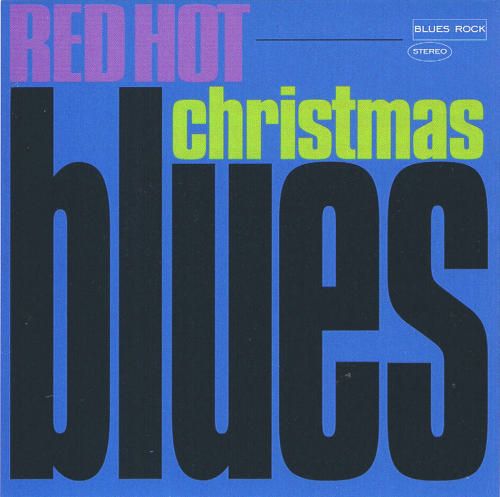
Red Hot Christmas Blues front
Released in August 2007 and featuring producer Mark Baldwin's guitar that often sears, sometimes sings and at times laments, Red Hot Christmas Blues reminds us of the frequent messiness of life, the apocalyptic hope of Advent and the surprise of God's Nativitytide appearance in the Bethlehem manger. Except for the introductory "Christmas Blues" vocal bewailing wintry conditions of broken life and broken bank account, playlist titles are Christmas carols you get to sing in church and listen to on radio and MP3 throughout the season. However, in liturgically logical order:


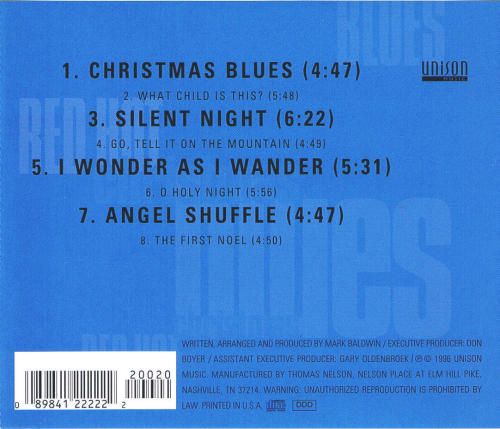
1. Christmas Blues
2. What Child Is This?
3. Silent Night
4. Go Tell It On The Mountain
5. I Wonder As I Wander
6. O Holy Night
7. Angel Shuffle
8. The First Noel
...these jazz illuminations carry a revelatory twist and provocative style you don't often get on the radio or at church. I cannot help but imagine Christmas Eve at the downtown cathedral or tall steeple, or just as easily these offerings could be from a smaller nearby parish with wide-open doors that invite and include all comers.

In 4 minutes and 47 seconds "Angel Shuffle," a wildly improvised version of "Angels we Have Heard on High" probably is my favorite among favorites on this CD. I won't try describing it but can assure you it's worth the price and the storage space—from someone (me!) Red Hot Christmas Blues backwho doesn't buy many CDs these days and gave away quite a few quite a while ago. Walter Brueggemann says only grief enables newness (something about getting out of denial, maybe?) and "Angel Shuffles" brings together sorrow, regret, loss and anger with the surprise of God's renewing presence in our very midst.
And would you believe, bible specialists Thomas Nelson published this music CD?! Not surprisingly, I love the artwork and package design by Christie Knubel. Finally, you easily can find Red Hot Christmas Blues on eBay and Amazon, so go for it!

my amazon review: sounds like... Community Christmas at the Cathedral!

Wednesday, November 10, 2010

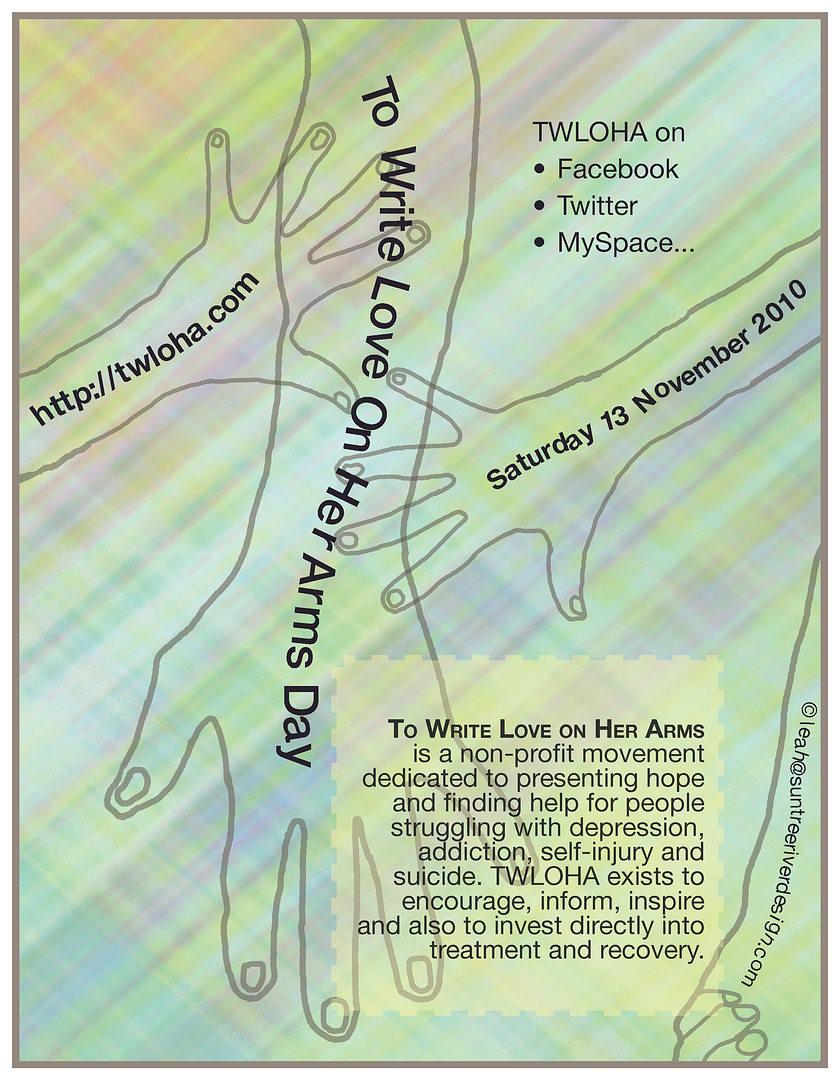
to write love on her arms day 2010...

Everywhere you are, Saturday, 13 November 2010 will be To Write Love on Her Arms Day!!!

to write love on her arms day 2010To Write Love on Her Arms—the main site: TWLOHA

To Write Love on Her Arms: Facebook

To Write Love…on Twitter

TWLOHA used to be on MySpace, "where it all started."

I'm basically re-blogging my own backstory from last year:
The subjects of addiction, self-injury and related are very close to me and to my heart. You could say I've been close to it in various forms most of my life; biologically and probably environmentally I've also inherited some of it.

Compulsive, stereotypical, addictive, and similar behaviors frequently seem to defy effective treatment and although there often is an underlying biochemical imbalance or other brain dysfunction that's frequently coupled with negative or sometimes even positive psychosocial experiences, the behaviors themselves quickly carve deep, indelible neurological paths.

For generations the side of my biological family I know something about has been captive to diseases, illnesses – "disorders" – of this type. Despite my dislike of labeling, I know the apostle Paul insisted on order, not disorder and Martin Luther says the Church isn't really there without order, in other words, when it is disordered (theology blog, remember).

telling the story buttonA huge part of reluctance to reveal, discuss, and seek intervention for substance abuse/addiction, compulsivities, self-injury, and panic is their seeming uncontrollability along with the fact insight usually comes quite easily yet barely makes a dent because of brain pathways that have formed. Whether or not they met clinical DSM criteria, most people have experienced an episode that would make them look depressed, but if you haven't been there, done that, from the outside looking in it looks as if the person with OCD or addiction needs to get a little discipline and control though often they're among the most disciplined, productive, and accomplished. In the many creatives who struggle with addictions and compulsions, their creativity and productivity essentially emerge from the same source as the undesired behaviors.

Incarnational theology is one of the labels/tags to this blog post and in all this my prayer for myself and for each of us – addicted, compulsive, mood-disordered, self-injurious, suicidal, simply creatively different and/or differently creative – is a community of embrace that will celebrate our presence and encourage everyone's full participation and that God will allow all of us to become wounded healers, the divine presence of the crucified and risen Christ we were baptized to be.

As I was watching and listening to Patrick Kennedy at Ted Kennedy's funeral, I realized that even for someone in a large, supportive family that also has sufficient resources of every kind, this kind of illness still takes a huge toll and is immeasurably costly to society and to the individual.

for every one of us to write love on each other's, others or others' arms…

Another version of my urban graffiti poster for TWLOHAD 2009: To Write Love on Her Arms Day too

Sunday, October 24, 2010

blog action day 2010: water!

9 days late...water and milk and honey!!!

blog action day 2010 world

Change dot org sponsors Blog Action Day again this year.

For this year's topic of water, first I considered "what do I know?" I know theology, so now I'm considering the biblical promised land of milk and honey.

Water is the womb of creation.
Genesis 1

1 "In the beginning when God created the heavens and the earth, 2 the earth was a formless void and darkness covered the face of the deep, while a wind from God swept over the face of the waters."

And water is the womb of our first birth and of our re-birth, our re-creation. In baptism, we enter the state of this earth when it was yet unborn; we are submerged in the substance from which first life emerged. God's creative power engulfs us as we identify with this planet's history and with Jesus of Nazareth, who was baptized in the River Jordan.

In the story of the Exodus from slavery, the Hebrew scriptures bring us a well-known account of a 40-year long wandering through an inhospitably arid, apparently barren desert, across a river and then into a place already inhabited by "others."

Remember this? Exodus 3

Exodus 33

3a "Go up to a land flowing with milk and honey..."

Milk and honey is a sign of the fullness of God's reign in justice and righteousness. Flowing honey and surging milk begin with fertile land and rivers of usable water. Ample milk means abundant cattle grazing on luxuriant grass, bovines that bear healthy calves--and that fertilize the ground. Bees make honey; bees pollinate fruits and flowers. Dairy, beef, honey and harvest mean nourishment for farmers, families and community, with overflowing everything to sell at market or barter and trade in order to get whatever you cannot grow.

The story of creation and of the people of God begins with water, continues with almost countless water-related experiences, including a great flood followed by God's covenant with Noah and with all creation, with Abram/Abraham and later Jacob's passage by the Jabbok River... water's scarcity in the exodus desert is central, since the desert became the place where the people learned to recognize and acknowledge water as gift rather than as taken for granted. In the desert's sparse economy, with surprises like water from the rock and manna from the sky, they also learned the kind of trust in God's provision that would enable them later to live in covenant with each other and with all creation.

Exodus 17

1From the wilderness of Sin the whole congregation of the Israelites journeyed by stages, as the Lord commanded. They camped at Rephidim, but there was no water for the people to drink. 2The people quarreled with Moses, and said, "Give us water to drink." Moses said to them, "Why do you quarrel with me? Why do you test the Lord?" 3But the people thirsted there for water; and the people complained against Moses and said, "Why did you bring us out of Egypt, to kill us and our children and livestock with thirst?"

Numbers 20

1The Israelites, the whole congregation, came into the wilderness of Zin in the first month, and the people stayed in Kadesh. Miriam died there, and was buried there. 2Now there was no water for the congregation; so they gathered together against Moses and against Aaron. 3The people quarreled with Moses and said, "Would that we had died when our kindred died before the Lord! 4Why have you brought the assembly of the Lord into this wilderness for us and our livestock to die here? 5Why have you brought us up out of Egypt, to bring us to this wretched place? It is no place for grain, or figs, or vines, or pomegranates; and there is no water to drink."

After they left the geographic, phenomenological Egypt, the people reached into the desert of Shur, where Elim, with its twelve springs of fresh water and seventy palm trees was one of their first stops. Palm trees and fresh springs provided shade and shelter, yet Marah, "bitter waters" was the name of the gateway to Elim's sanctuary, safety and protection.

Exodus 15

22Then Moses ordered Israel to set out from the Red Sea, and they went into the wilderness of Shur. They went three days in the wilderness and found no water. 23When they came to Marah, they could not drink the water of Marah because it was bitter. That is why it was called Marah. 24And the people complained against Moses, saying, "What shall we drink?" 25He cried out to the Lord; and the Lord showed him a piece of wood; he threw it into the water, and the water became sweet. ... 27Then they came to Elim, where there were twelve springs of water and seventy palm trees; and they camped there by the water.

Toward the last part of the texts placed last in the biblical canon there's a rich vision of rivers, trees, wholeness and integrity:

Revelation 22

1Then the angel showed me the river of the water of life, bright as crystal, flowing from the throne of God and of the Lamb through the middle of the street of the city. 2On either side of the river is the tree of life with its twelve kinds of fruit, producing its fruit each month; and the leaves of the tree are for the healing of the nations.

For God's newly constituted, post-exodus people a new phase begins with the body of water that's threshold between past and future and for the Church, waters and rivers - especially The Jordan River - remain icons of baptism, the event in which God irrevocably claims us and calls us to live in trust and in covenant with all creation. For us, baptism is a liminal, a threshold event that divides a disconnected past from new life in covenant with the church in every time and every place and with all creation.

As Christians we are People of the Book that begins with waters of the first creation and ends with rivers of the new, a book in which water is a persistent image. We people of the book also are people of the journey, a faith-filled, trusting trek that is bordered, boundaried and largely defined by the gift of water and our stewardship thereof, a kind of fluid wandering during which we're never still back there but also never have quite reached what we imagined to be our destination. You know I love Carly Simon's
Let the River Run

We're coming to the edge,
Running on the water,
Coming through the fog,
Your sons and daughters.

Let the river run,
Let all the dreamers
Wake the nation.
Come, the New Jerusalem!

Water is the womb of creation and the geographic, landed location of milk and honey cannot happen without pure, "living" water that keeps on birthing and re-birthing everything on earth. Milk and honey requires fertile ground and rivers that flow—rivers that won't catch on fire! That kind of land grows plump grains in well-stewarded prairies, juicy grapes on heavy-laden vines. Milk and honey is a lively sign of well-nourished people, animals, families and communities, of the sufficiency of shalom for everyone with neither too much nor not enough for anyone!

Only when milk and honey abounds can we offer back to heaven the feast of eucharist that gathers and welcomes all creation and all people, excluding no one (except those who exclude themselves). This "foretaste of the feast to come," as the liturgy expresses it, is the sign and realization of all creation's reconciliation, an emblem of justice and integrity of all and for all, a celebration that depends on the river that depends on the humans that depend on the river, the banquet that cannot happen without... water!

Carl Sagan observes, "If you want to make an apple pie from scratch, you must first create the universe." It's a given that we cannot create the universe, but if we want to make apple pies, we must help steward the universe's re-creation and we need to take care of the water, live in covenant with the water, with each other and with all creation.

Blog Action Day 2010: water!!!

Friday, July 02, 2010

henry beston: the outermost house and more...

Twelve Coast Guard stations with halfway houses in between arrayed themselves along the 50-mile span of sand and ocean from Monomoy Point to Race Point, Provincetown.
To understand this great outer beach, to appreciate its atmosphere, its "feel," one must have a sense of it as the scene if wreck and elemental drama.
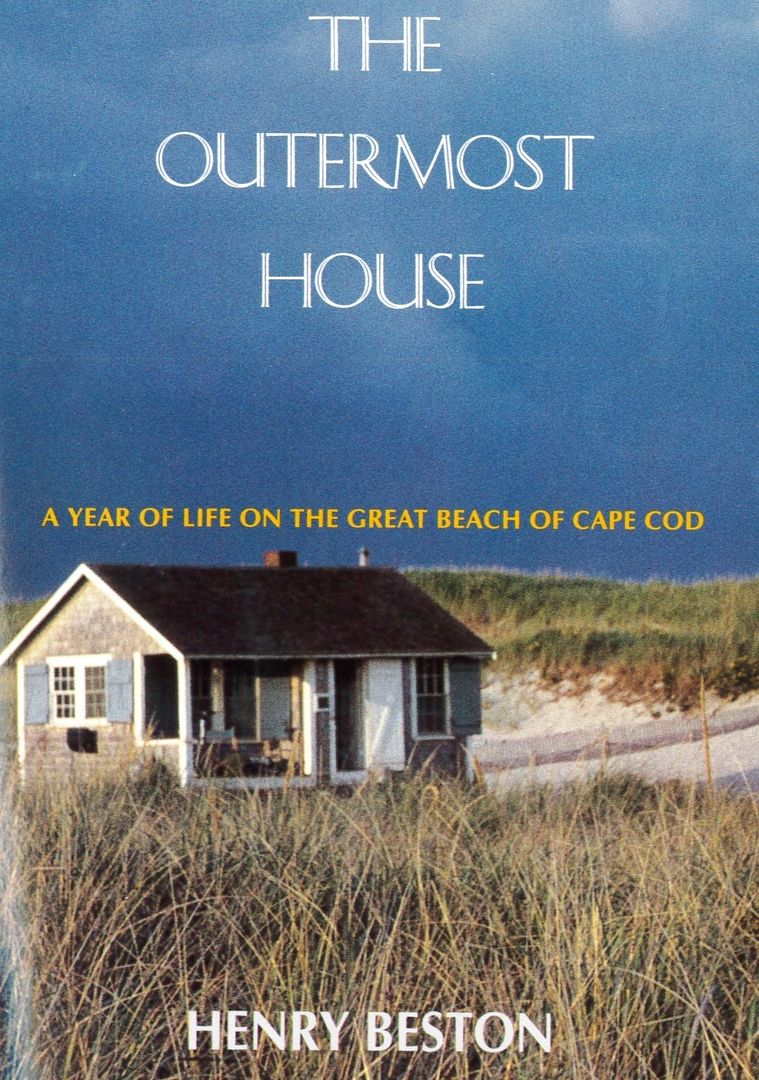
The Outermost House: A Year of Life on the Great Beach of Cape Cod by Henry Beston on Amazon.

outermost house coverOn February 6-7, 1978, high tides from The Blizzard of '78 swept the Outermost House from Coast Guard Beach in Eastham, Cape Cod, Massachusetts. Some Beston basics and some Outermost House background:

Henry Beston Society

The Outermost House from Henry Beston dot com.

You might want to look at How to write like Henry! ...although I am absolutely positive it will not lead to anyone writing like Henry Beston. Like William Faulkner, Beston is the kind of writer who makes ordinary others reluctant ever to type (or pen, as your case may be) another sentence, but we keep on keepin' on nonetheless.

In his introduction ©1988 Robert Finch explains some geography and geology of Cape Cod. Cape Cod stands a full thirty miles out in the North Atlantic; its eastern beaches front a 50 mile stretch of New England coast and frequently contend with a thousand-mile expanse of North Atlantic weather. Plentiful eponymous cod fish still are caught by mariners on "the outermost of outer shores."

Henry Beston reminds us in his forward to the 1949 edition:
Nature is a part of our humanity, and without some awareness and experience of that divine mystery man ceases to be man. When the Pleiades and the wind in the grass are no longer a part of the human spirit, a part of very flesh and bone, man becomes, as it were, a kind of cosmic outlaw, having neither the completeness and integrity of the animal nor the birthright of a true humanity.
The Outermost House The Book includes the towns of Eastham, Nauset, Brewster, Orleans, Truro and Wellfleet... Provincetown, too. Beston calls birds and other wildlife "other people, other nations..." and scatters phrases like "these ocean peoples" – "these winter folk" – "people of the outermost waters" – "those sea peoples." I love his telling us, "The gull population of the Cape is really one people ... though separate gull congregations." [page 115]

beach fenceI also know Cape Cod, not as a native, either, but from visiting grandparents at their mid-Cape house and because I settled there for a couple of years at the end of the last century. I know about Eastham, Nauset, Brewster, Orleans, Truro and Wellfleet... Provincetown, too. Nor were my grandparents CC "natives." Grandmother was born in Dearborn ("Deer Burn") Michigan and grew up in Detroit; Chattanooga-born grandfather lived for a short time in Denver, Colorado but was raised Southern Presbyterian in Jackson, Mississippi. They had farmed in Nebraska and North Carolina, then found themselves in the greater Boston area. In time they bought an old, hand-hewn clapboard-sided mid-cape house for occasional weekend and summer use and later sort of retired there, but really not quite. Decades after Henry Beston built his 2-room dwelling and sojourned for a year on the beach, the earth drew them. I'd guess that by then the year-round population was at least 4 or 5 times larger, summer definitely more touristy, but the Cape Cod mystique enticed my grandparents as it had Henry.

beach pathAlong my own 3,000+ mile span from Mobile Bay, north to New England, to southern California and back, and forth, and back and forth again, I've known more than a dozen stations of life and ways of being with countless halfway houses in between. As an adult I've preferred boundless expanses of prairie, desert and Pacific Ocean, but as I write I'm learning how much I learned about loving the earth from my grandmother and from the Cape Cod land itself. Observing and participating in the agricultural cycle, identifying which birds were natives, which migrants and when they typically arrived, gave me a feel for our human place in the meteorological seasons and for the circles of birth, life and death. A few years on the land helped me grasp how following the liturgical year, with its apparent round-trips of waiting and watching, living, dying and rebirth, connects us to the entire people of God in every place and time and helps us connect to sun, sky, sea and soil. Years on the land helped me learn to trust death.

Walter Brueggemann insists much of life is sabbatarian, spent in the interstitial, liminal time between Good Friday afternoon and Easter Sunday dawn. During winter in a four-season climate like Cape Cod's, there is a simply being who we've become thus far that has a sense of Sabbath about it. We almost hang suspended in time waiting for gifts of birth, of spring, of new life to ready themselves.

In addition to time at my grandparents' place, I spent a week with a classmate's family on the beach at Truro, in a wood-frame house where you walked out the door straight onto the sand. At least two weekends I went camping with friends at Nickerson State Park. Everyone mid-cape knew the only real surfable waves were at Nauset Beach, yet I do not recall any of those remotely approaching double-overheads I've seen in Southern California. However, when I described Atlantic Ocean storminess to someone who'd only known Pacific Ocean calmness, she said "no wonder they call it Pacific—it's relatively placid almost all the time! Yes, despite double, occasionally triple-overheads.

Henry Beston's Cape Cod was small-scale in terms of square miles, of rocks and landscape reduced by eons of erosion, but the storms he describes were epic in size, style and consequence. Early on in The Outermost House he mentions the "human scale" of Cape Cod and its beaches, and that's exactly right. Having lived in the Intermountain West and gloried in the vastness and geological diversity of the state of Utah (as well as enjoying the closer-by seven canyons of Salt Lake City) and after loving the wide-open drive up California's Central Coast, I can appreciate the greater geological age of the Appalachian Mountain Range, the ancientness of kettle ponds formed by glaciers long-retreated, the antiquity of the shores, trees, rocks and shells of Cape Cod.

Likely you've read some of those "you know you're from" – "you might be from" lists. I'm not a native, not really from Cape Cod, but I still know some Cape Cod truths; for example:
  • I know where Truro is: a few paragraphs supra I told about the idyllic week I spent in that lower-cape town.
  • I know where the Cape Cod Tunnel is: there are bumper stickers and window decals but there is no CCT.
  • I know Plymouth and Wareham are not Cape Cod: and get too tired of people saying they're from The Cape when they're really from off-The Cape.
  • I know that there still is life on Cape from Labor Day to Memorial Day weekend: I've spent more than one winter there.
  • I wear flip flops until Thanksgiving then start again in February: that's what I do in southern Alta California and it's even what I did most of the time living and schooling in Boston. Officially Thanksgiving eve was my last sandals day and I wore street-length skirts until then, too, but I'll admit it got chilly.
  • I know you're not "IN" Cape Cod you're "ON" it: well, yes, of course—it's an island, or more properly, a peninsula.
  • No one asks what mall I'm going to because there’s only one: this one.
  • I know that just because people have a house here or have summered here since they were 4 does NOT make them true Cape Codders: I can claim days, weeks, months and years on Cape Cod, but I know I'll never ever really be a Cape Codder.
life stuff button

my Amazon review: an outermost house, cape cod and more...

I want to be part of a church that...5

"I want to be part of a church that 5..." for today's Friday 5, from Sally, who says in her intro:
This has been a good week for British Methodism, The Annual Conference has discussed and debated many things and not shied away from some difficult stuff. ... In the Vice-President's Address Eunice Attwood gave an inspiring account of the type of church she wants to be a part of, almost poetic she said:

I want to be part of a church that is prayer-filled -
A church that is resourced and sustained by the Bible,
A church that can offer hope even in a credit crunch,
A church that can live well with difference and diversity.

I want to be part of a church that welcomes the wealthy, those who have power and influence -
A church that knows how to party and celebrate life,
A church that acknowledges death and speaks boldly of resurrection,
A church that doesn’t pretend to have all the answers but encourages all the questions.

I want to be part of a church that throws parties for prostitutes -
A church that welcomes those who seek asylum,
A church that longs and yearns for justice,
A church that listens to those no-one else wants to listen to.

I want to be part of a church that believes in transformation not preservation -
A church where all who are lost can be found,
A church where people can discover friendship,
A church where every person takes responsibility in sharing the good news.

I want to be part of a church whose hope is placed securely and confidently in the transforming love of God -
A church that engages faith in its communities,
A church that makes and nurtures disciples of Jesus.

A church where the story of God’s love is at the centre.
I want to be part of a church that offers outrageous grace, reckless generosity, transforming love and engaging faith.
This is God’s story Transforming Love: Engaging Faith.

My prayer is that by the power of the Spirit of God at work amongst us, it will increasingly be our story.
Very beautiful and inspiring! In Pentecostal red, here's my quick list 5:

1. I want to be part of a church with the sacraments at the centre of its practice and proclamation.

2. I want to be part of a church that does not seek to be attractive to the world and similar to the world in its style but desires to live faithfully in the Gospel, at the same time living out its life and mission in incarnational ways people can relate to.

3. I want to be part of a church that celebrates the earth and teaches stewardship of all life, that lives constantly aware of our covenant with all creation.

4. I want to be part of a church that welcomes my full participation, as well as the involvement of all comers.

5. My final 5 is from Sally's list: I want to be part of a church that acknowledges death and speaks boldly of resurrection.

Monday, June 14, 2010

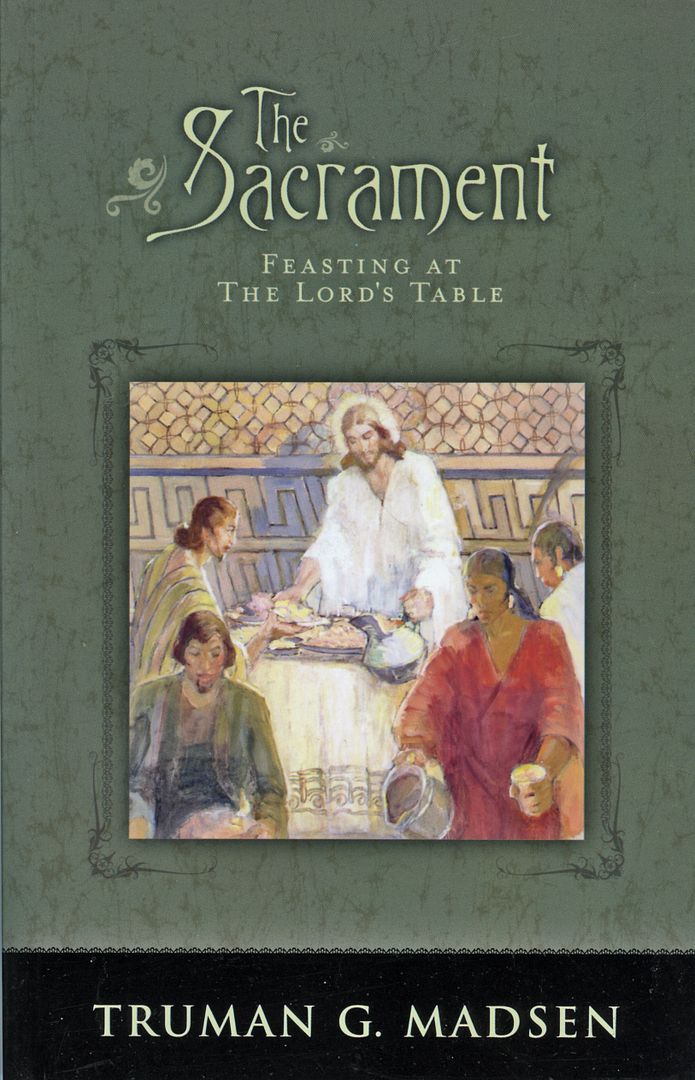
Truman G. Madsen: The Sacrament...

...Feasting at the Lord's Table

scholarship, devotion and joy!

The Sacrament: Feasting at the Lord's Table, by Truman G. Madsen. The author, who was born in 1926 and died only a year ago, on 28 May 2009, was emeritus professor of philosophy and religious studies at Brigham Young University in Provo, Utah and director of the Jerusalem Center for Near Eastern Studies. In addition to his scholarly pursuits, Truman Madsen served in many callings in the Church of Jesus Christ of Latter-day Saints, including ward bishop, stake president and stake patriarch. The LDS Church long has had a worldwide presence, but during the earlier part of Brother Madsen's life it still was something of a Wasatch Front, Utah phenom. With the exception of the exceptionally ecumenical Christian Churches-Disciples of Christ, like the other church bodies that evolved from the various 19th century restoration movements, the LDS Church has not been involved in ecumenical dialogue though it regularly cooperates with other churches and church-related entities in humanitarian endeavors and responses. As you can read in the biography I linked to (but that does not chronicle his passing, so needs to be updated), geographically, intellectually and spiritually Truman Madsen's own world grew and flourished far beyond basic Utah Mormonism, making this a book I imagine even a completely unchurched person could enjoy. And they might be astonished at the depth, breadth, inclusiveness and un-preachiness of this book by a passionately committed follower of Jesus Christ!

the sacrament - I love the content and the format; each of the ten chapters relates to different aspects of the Lord's Supper—Atonement, The Prayers, Sabbath, Fasting, Glimpses Beyond are some topics. Within each chapter there are a dozen or more sub-topics, each a single page or less. The titles ring like poetry...listen to: How Long Is an Hour? Why Not "Thy Kingdom Come?" Holiness and the Name; The Word "Always" and the Rock; Inspired Introspection; The Lower Part of the Inner Court; A Time to Trust the Silence; Invincible Gratitude; Of Union and Surroundment; Of Pistachio Oil; Can the Spirit Enter a Stone? My Power Lieth Beneath; On Beauty and Overcoming... In the preface the author points out about The Sacrament: Feasting at the Lord's Table "There is no fixed beginning or end. It need not be read in sequence, but can be 'dipped into' at random." An unusual feature for this type of book is the alphabetical topical index at the end. Similar to mudhouse sabbath this is more of a handbook than something you'd tend to read cover-to-cover, though for sure it is engaging enough to be read straight through.

The book is full of fascinating scholarly morsels! On page 104 concerning John 12:3-8 and Matthew 26:12, "Was this Mary of Bethany also Mary of Magdala?" asks Brother Madsen. But in any case, the oil with which she anointed Jesus unto death was "...a mixture of balsam and pistachio and perhaps also the balm of Gilead from trees beyond the Jordan." In Greek, pistis means faith, trust. Regarding Matthew 20:23, on page 101 he tells us "In Semitic languages, 'cup' has the same root as the word for door or vestibule or entry way. 'The cup' in antiquity was the figure of one's role in life, one's condition or one's destiny... it remains the metaphor of a divinely appointed role." That's the kind of detail I love to include in my own writing and teaching, and both delighted me since they previously were in my own who knew? category.

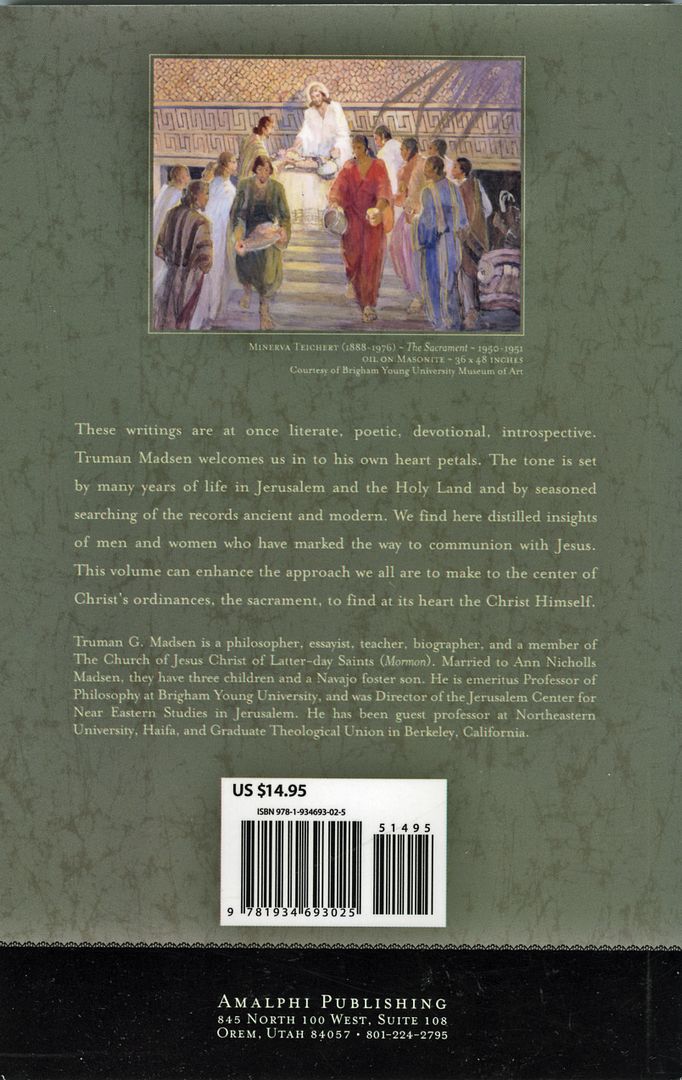
the sacrament - back coverAlthough Truman Madsen's worldview extends well beyond the perspective of a single denomination or specific ecclesiastical tradition, each of the dozen pages in the third from the last "Glorious Modern Precedents" chapter recapitulates an event in Latter-day Saint history. Vignettes range from "Tuesday Sacrament" where President Madsen says Tuesdays are the preferred day of the week for Jewish couples to marry, because on the third day of the week God pronounced "it is good" not once but twice, to a description of astronaut Don Lind's "Sacrament in Orbit" to concluding the section with "A Solemn Assembly" in the upper room of the (Salt Lake City? location not specified) Temple.

Beyond devotion, beyond scripture, doctrine and theology, beyond exquisite scholarship, beyond simply "Christian," The Sacrament: Feasting at the Lord's Table shows us glimpses and visions of the eschatological feast to which God summons all creation, from which no one and nothing ever is excluded—a true Wholly Holy Communion. This is the way God calls us to be and to live, with joy, with passion and in total trust.

my amazon review: scholarship, devotion and joy!

Tuesday, June 08, 2010

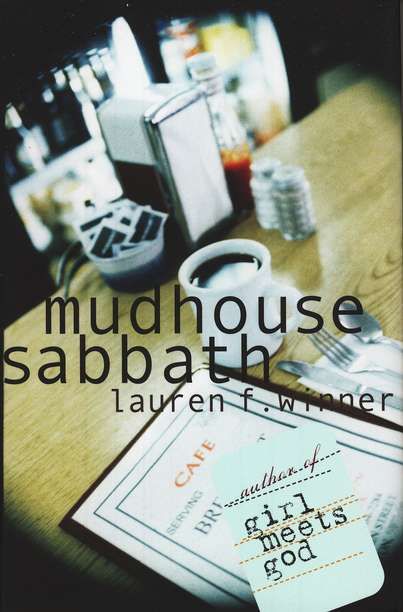
lauren winner: mudhouse sabbath

mudhouse sabbath by Lauren Winner on Amazon

Small in size and light to hold, making it easy to slip into purse or backpack, mudhouse sabbath could become a handbook and resource for almost anyone's spiritual journey. Lauren Winner writes from the perspective of two of the great Abrahamic traditions, Judaism and Christianity; from her Jewish upbringing she brings perspectives on prayer, liturgy and community and she filters her Christian experiences as a present-day member of the Episcopal Church. Each of the eleven chapters has a dual title in (transliterated) Hebrew and English; topics include sabbath, food, morning, hospitality, weddings and doorposts. Notes at the back reference scripture and other books, too. Her words and sentences flow almost exactly like real-life speech and the sentences are short enough not to need to go back and read it again to be sure you got it. Such a pleasure to read!

mudhouse sabbath"Mudhouse" is the name of the coffeehouse in Virginia the author enjoys and at the time of writing (book is © 2003) sometimes visited on Sunday after church. (The site looks very pretentious to me.) I didn't try to find the origins of the name, but I like to think of similarities with mudrooms that form a liminal space that's neither still out in the world (or even in the yard) nor quite yet completely inside the house, a conscious bridge between outside, more public space and inside, more private space. They're especially common in climates that feature winter snow, and provide a handy, safe place to shed boots, shovels, mittens and parkas so you're not out in the elements and you're not wrecking the best rug or the great room, for that matter, with mud, dirt and leaves. In each chapter Lauren talks at least a little about her own perspectives and sometimes struggles between being private and being public, about how much to bend in order to let other people into her own bent spaces, something that only can be done in spaces where you're not afraid of spoiling pristine surroundings, where you know it's okay to drop some crumbs and let sentences hang mid-air.

Lauren talks a lot about obedience. As a Jew, you don't do something because it feels good or because you desire or like the outcome; you do it because God has commanded it. And not surprisingly, in the long run you usually do feel good and discover the outcome is exactly what you desire. Life grounded in Torah and directed toward God is intentional and almost seamlessly integrated between sacred and secular, between public and personal. I particularly love how shopping for food, preparing it, feasting on it and fasting from it, preparing for Shabbat, grieving death and anticipating new life in marriage all take time and thought because they need to be done properly, in a way that almost forces you to consciously be aware of God, gracious Creator and bountiful Giver to Whom it all belongs, anyway. As I mentioned in my intro, this is literally a hand book and Lauren could have included other subjects or expanded on the chapters she chose. But one of the beauties of mudhouse sabbath is the way every chapter can apply to every reader and easily be adapted to your own circumstances. I hope you'll buy the book, enjoy it and make some of these insights, disciplines and practices part of your own daily walk.

my amazon review: bridging and integrating Judaism and Christianity

Thursday, May 20, 2010

oil and water: deepwater horizon

"Water is life," they insist. Digital, print and electronic news media have been filled with more and more devastating reports about the "Deepwater Horizon incident" oil spill that occurred in the Gulf of Mexico on 20 April. BP, the petroleum mega-giant whose equipment failure (malfunction?) caused the disaster has been filling their website with more and more unconvincing explanations and defenses.

In my recent blog, Where Can Red-Winged Blackbirds Live?, I observed
Despite current interest in ecological theology emphasizing the redemption and integrity of all creation – not solely human creatures – a lot of teaching and preaching in the Church still focuses on humanity, which in some ways may not be all that "off," given that so much of the rest of creation is in need of restoration, revitalization and resurrection from death primarily because of human sin and failure to steward creation (which naturally results in failure to take proper care of human needs).
Water, the primordial substance of the world, existed before anything else in creation; in Genesis 1 we read:
1In the beginning when God created the heavens and the earth, 2the earth was a formless void and darkness covered the face of the deep, while a wind from God swept over the face of the waters.
From the New Century Hymnal, a version of the
Thanksgiving and Blessing over the Baptismal Water:

We thank you, God, for the gift of creation called forth by your saving Word.

Before the world had shape and form, your Spirit moved over the waters.
Out of the waters of the deep, you formed the firmament and brought forth earth to sustain life.

In the time of Noah,
you washed the earth with the waters of the flood,
and your ark of salvation bore a new beginning.

In the time of Moses, Aaron, and Miriam,
your people Israel passed through the Red Sea waters
from slavery to freedom and crossed the flowing Jordan
to enter the promised land.

In the fullness of time, you sent Jesus Christ,
who was nurtured in the water of Mary's womb.
Jesus was baptized by John in the water of the Jordan,
became living water to a woman at the Samaritan well,
washed the feet of the disciples,
and sent them forth to baptize all nations by water and the Holy Spirit.

Bless by your Holy Spirit, gracious God, this water.
By your Holy Spirit save those who confess the name of Jesus Christ
that sin may have no power over them.
Create new life in those baptized this day
that they may rise in Christ.
Glory to you, eternal God,
the one who was, and is, and shall always be,
world without end. Amen!
Scripture and Church have made water and the creative word central signs of new birth in baptism and signs of the reign of heaven on earth. Studying the witness and examples in scripture, during the imperial reign of King Solomon, depletion of creation and misuse of natural resources had become the habit and the rule because of human imaginings they were the center of everything and so concomitant desires of the rich and famous for a high-end, unsustainable deluxe lifestyle could be met; that era brought the earliest biblical creation account from the writer we now refer to as the Yahwist: Genesis 2:4-25. In some ways the easy conversational intimacy between human and Creator does reflect the reality of Divine care and concern for all, but the text also exposes human arrogance and a not unusual human trait of attempting to contain, control and domesticate the elusive wildness of the God of the Bible. Remember how Israel's plea for a temple and a king partly was an attempt to become "like other nations" rather than a faithful desire to live in risk and dependence on one another as Yahweh's peculiar people? Toward the end of Solomon's rule, Jeremiah the prophet implores, "O land, land, land, hear the word of the Lord!" (Jeremiah 22:29)

After the fall of Solomon's empire, in the creation account placed first in the biblical canon, the exilic (or possibly post-exilic, since dating is a bit confounded) Priestly Pentateuch source, Genesis 1:1 - 2:3 recognized creation as orderly, the Creator God as one who acts not randomly but systematically and does not place humanity at the center or the apex of the rest of creation, but rather gives human creatures a place within the order and a call to steward, maintain, treasure and support the rest of creation. Yes, one well may argue that part of the purpose of the Priestly scribe was to grant legitimacy to an organized ecclesiastical hierarchy and given that written and orally transmitted texts are cultural artifacts likely that was a factor, but not incidentally the text carries along with it an integrated, sustainable worldview and practice rather than one subject to disintegration. Through its witness, scripture brings humanity a call to help initiate justice and redemption for all creation and an ultimate vision of the eschatological feast in which the entire earth is healthy and restored, living in mutual dependence and covenant. Without water, that dream cannot be realized.

"You choose to be made at one with the earth," sings the activist hymn written by Fred Kaan. The God outside space and outside time, God who created everything from nothing, chose decayable human flesh formed from nature's stuff, the elements of the earth, as the mode of his most decisive self-revelation. God chose to live within the bounded limits of space and time, and still chooses to do so, indwelling all creation – including streams, rivers and oceans (of course!) – with the breath of life and evidence of enduring love. On my Red-Winged Blackbirds blog I asked, "Where can God find a home?"

Back in the olden days, BP was British Petroleum, a name that evokes memories of a worldwide empire of colonies, protectorates, and other entities on which the sun never set, all administered by or somehow connected to the United Kingdom. From scriptures and other sources we recognize word and speech as both source and immanence, with lively power to initiate, suggest, birth, relate and transform. In many cultures, a person's name formally expresses the essence of the person, and it is not a stretch to suggest language carries similar power for us 21st century dwellers.

Those "theys" who remind us water is life also insist oil and water do not mix, cannot form a chemical alliance. The olive tree, giver of one of my favorite fruits, has long culinary, religious, political and liturgical histories and typically lives for a very long time. The forehead of a person being baptized is signed with a cross traced with chrism made from olive oil; just like prophets, priests and kings of Israel, they are "Christed" or chrismated, anointed. The olive tree frequently is considered the Tree of Life referred to in Revelation 22:"1 Then the angel showed me the river of the water of life, bright as crystal, flowing from the throne of God and of the Lamb 2through the middle of the street of the city. On either side of the river is the tree of life with its twelve kinds of fruit, producing its fruit each month; and the leaves of the tree are for the healing of the nations."

The tree depends on the river and the nations, the "people," the ethnos – the plain ole folk – depend on the tree that depends on the river...that depends on human care, covenant and faithfulness.

Deuteronomy 8
6Therefore keep the commandments of the Lord your God, by walking in his ways and by fearing him. 7For the Lord your God is bringing you into a good land, a land with flowing streams, with springs and underground waters welling up in valleys and hills, 8a land of wheat and barley, of vines and fig trees and pomegranates, a land of olive trees and honey, 9a land where you may eat bread without scarcity, where you will lack nothing, a land whose stones are iron and from whose hills you may mine copper. 10You shall eat your fill and bless the Lord your God for the good land that he has given you. 11Take care that you do not forget the Lord your God, by failing to keep his commandments, his ordinances, and his statutes, which I am commanding you today.
After the deluge, Noah released a dove, "And the dove came in to him in the evening; and, lo, in her mouth was an olive leaf plucked off: so Noah knew that the waters were abated from off the earth." Genesis 8:11

But also, with its purported 613 kernels, symbolizing the 613 commandments found in the Hebrew Bible, pomegranate is considered the tree of life: to be saved, whole, redeemed, shalom-full "keep the Commandments," keep covenant with all creation, that we all may live. Did I not blog, "so much of the rest of creation is in need of restoration, revitalization and resurrection from death primarily because of human sin and failure to steward creation (which naturally results in failure to take proper care of human needs)." Okay, BP, listen up!

As Lin C commented on facebook, "The ocean is the Earth's circulatory system. Kill that and we kill the earth." The whole concept of human supremacy and invincibility has been killing the earth for too long. I'm not a scientist, but from what I understand, light is life and this planet *should* survive as long as earth's Sun Star shines and is not extinguished (by human stupidity and greed). On her blog, Yearning for God, Jan linked to some beautiful, hope-filled water blessings. Where can the earth find a home and not be a stranger to itself?

my second blog about the gulf coast oil spill—last days: deepwater horizon take 2

Saturday, February 20, 2010

frog blog hymns discussion

Over on her frog blog, 1-4 grace started an interesting discussion about hymns. Her blog's not live any more, so I removed the link.
Tell me your own ideas of hymns which are meaningful, those which are painful or stir other negative feelings. What hymns do you really like? Which ones could you do without?

By the way, I am not doing any actual research. I am just interested in what folks have to say.
Good one! I'll begin with the negative stuff, which includes Amazing Grace. A while back I said to someone "it has no Christology and no theology (not to mention the near-obligatory funereal-sounding bagpipe versions at actual funerals)..." he responded "agreed, but a little soteriology..." to that one I needed to reply, "disembodied soteriology? I do not think so!" Then there's Borning Cry, part of the pain of which I know is John Ylvisaker's typically tawdry tune. The hyper-militant Lift High the Cross almost grossed me out the first time I heard it, but it's still better than Onward Christian Soldiers.

"Among the" (as our cultural anthro teacher tried teaching us not to say) more recent hymns I like a lot, I'll list Marty Haugen's Here in this Place / Gather Us In—I especially love how the harmony undulates between major and modal; Now the Silence with words by Jerry Vajda, music from Carl Schalk; Earth and All Stars, preferably in the original more rhythmically dynamic version. Rise, Shine, You People Ron Klug's text with the tune Wojtkiewiecz, after composer Dale Wood's original Polish name... "He comes to us by sin and death surrounded, with grace unbounded" moves me to tears. I love #524 in the ELCA's new Evangelical Lutheran Worship, What Is This Place and blogged about it all of three years ago. Praise songs? Definitely Shout to the Lord!

For older hymns, I love Gently Raise the Sacred Strain, #146 in the current LDS hymnal. Praise to the Lord, the Almighty – Lobe den Herren a fabulous one to lead from the organ and I have especially wonderful memories of singing it during my first interview weekend in Utah with the Utah PCUSA Presbytery and the Utah UCC Association convening together; singing with a room full of pastors almost always is a great experience. One more for now: Come, Thou Fount of Every Blessing, because What's not to love about it?

Despite my own reasonable sensitivity to inclusive (or not) language, in many cases I don't like the texts of old familiars distorted simply to make a point of being inclusive. I'll probably come back and add a few essentials when I suddenly remember I've left them out, but that's all for now.