Monday, May 16, 2005

Trinity Sunday Year A

Since I really like the notes I put together for this morning's Bible study (not that the group did much with them, but – as always – the discussion was interesting, stimulating, thoughtful and even helpful!) and, in addition, since lately I've posted so little, I figured posting this would give people something to read. But a note of caution: not surprisingly, I realized I potentially had enough material for a multi-volume book! And extremely surprisingly, one of the regular participants said he'd always found the concept of Trinity easy to understand. Moving on now with the study notes:

• Genesis 1:1 – 2:4a

• Psalm 8

• 2 Corinthians 13:11-13

• Matthew 28:16-20

trinity stained glass window probably in glendale california

Perichoresis of the Trinity
peri – around – choreo – dance

With perichoresis, the early Church described the Trinity as a dynamic and sometimes indistinguishable interpenetration, mutual indwelling, circumincession in unity, union, harmony, agreement, concord, consonance...

The Church [us!] as the Image of the Trinity

How does this Perichoresis relate to our lives in the world in general, our lives with other Christians and as we interact with people of other faiths and of no faith conviction?


Word and Sacrament: the Trinity and the means of grace
  • Written word; preached word; Living Word
  • Baptism
  • Earthy, earthly elements of creation—plain ordinary water; also, anointing with oil: kings, prophets and priests in Israel were anointed and we're baptized into royal, prophetic priesthood.
  • Baptized into the Christ Event in the name of the Trinity—in 325 The Council of Nicaea defined the doctrine of the Trinity; Matthew 28:19 is the only occurrence of the baptismal formula in the Bible, added later than the late 1st century manuscripts; the early church probably baptized in the "Name of the Lord."
  • Eucharist
  • Earthy, earthly common stuff of creation! | Creator
  • Our Lord Jesus Christ...Bread of Life; Cup of Salvation | Redeemer
  • Epiclesis | invoking the Holy Spirit

The Church and the Means of Grace
  • Jesus entrusted his followers – the church – with proclaiming the Gospel in word and action, baptizing and with remembering him by breaking the bread of life and offering the cup of salvation. The Gospel of Jesus Christ also is revealed to the world when we live our daily lives as sacraments mediating between earth and heaven—this is something no one and nothing else in the world can offer! The church as a community and each of us as individuals nurtured and discipled by that community take our cues and clues from the perichoresis of the Trinity and not from the consumer driven programmatic excesses of the world.
  • "The Church is the congregation of saints, in which the Gospel is rightly taught and the Sacraments are rightly administered." Philipp Melanchthon, Augsburg Confession, from Article 7
  • "Wherever we see the Word of God purely preached and heard, and the sacraments administered according to Christ’s institution, there, it is not to be doubted, a church of God exists." John Calvin, Institutes of the Christian Religion, Vol. 4, chapter 1, section 9.

Sunday, May 01, 2005

Pitching Tents!

Easter 6 A

Prayer: from Psalm 66:5-20

God, when we look at the wonders of Your creation and Your faithfulness in the world and in our lives, it takes our breath away! You transformed the raging sea into dry land and travelers crossed the river on foot, making every reason on earth and in the heavens for songs of festival celebration!

You set us on the road to life as You led us through Your refining fires; You pushed us to our limits, road-testing us inside and out; because of Your promises, We knew You were with us even when we didn’t feel Your presence.

God, with all our hearts we bless You; You never turn a deaf ear, but You always hear us and stay with us, loyal in love for us and for all of this world; we pray Your Spirit will fill our lives so we may become loyal in our love for You and all Your beloved creation!

In Jesus’ Name, Amen!

Pitching Tents!!!

May the grace, the mercy and the peace of our Creator, Redeemer, Sustainer God be with us all!

Seeking God and searching for holiness seem to be basic to our human nature! A couple thousand years ago, Paul of Tarsus, the follower of Jesus we know as a traveling preacher and teacher and as the author of some letters to the early church that made it into the Bible, stood in the town square and told his listeners they no longer needed to look for the Divine Presence they’d been striving to know, because the God of life, the God of all creation already had revealed Himself to the world. As recorded in the New Testament book of the Acts of the Apostles, here is part of Paul’s discourse in the plaza:
Acts 17:22-29

22 So Paul took his stand in the open space at the Areopagus and laid it out for them. “It is plain to me you Athenians take your religion seriously. 23 When I arrived here the other day, the shrines I came across fascinated me. And then I found one inscribed, TO THE GOD NOBODY KNOWS. I’m here to introduce you to this God so you can worship intelligently, know who you’re dealing with.

24 “The God who made the world and everything in it, this Lord of sky and land, doesn’t live in custom-made shrines 25 or need humans to run errands for him, as if he couldn’t take care of himself. This God still gives life and breath to all creation. 26 Starting from scratch, he made all the people and made a hospitable earth for them, marking the seasons and bounding the spaces for living, 27 so we could seek after God, and actually find him. God is not remote but near! 28 We live and move in him, can’t get away from him! One of your poets said it well: ‘We are God’s offspring, created by God.’ 29 Well, if we are the God-created, it doesn’t make a lot of sense to think we could hire someone to chisel a god out of stone for us, does it?”
Humans naturally seek to know God; in our quests for Divinity, we humans also tend to imagine a distant God, far away from earth and far outside of everyday human experience. But as Paul explained to his audience, we do not need to try to find God, because God already has come to us and found us first! Throughout the ages, the church has proclaimed God coming into this world and revealing Himself most definitively in Jesus of Nazareth. In the human Jesus, we meet a God not far away from earth and way outside of familiar experience, but we meet a God Who lived on this earth as one of us and even died a human death. In Jesus Christ’s birth and life, in Jesus’ death on the cross and God’s raising him to new life on Easter Dawn, God not only has sought us out but has done everything necessary for us to live forever reunited with Him, our Creator.

Although Christians affirm Jesus of Nazareth is the most accurate representation of God ever found anywhere, God always has desired for creation to receive a truthful picture of Himself.

Throughout the earlier witness of the Bible, God partially revealed himself in ways humans could see, touch, hear and feel—sometimes apparent in a cloud, or in the midst of fire, in dreams or in audible speech. Although none of these images completely revealed God’s nature, they did give people an idea of a God close to creation rather than far-away and distant. Many of you probably know the biblical narrative of the people’s journey through the desert of the Exodus, as they left oppressive slavery in Egypt and then spent a very long time getting to the Land of Freedom God promised to them. During those years, just as always, God’s passion was to be with the people of His creation.

The wilderness desert is not a place we typically find solidly-built houses or permanent habitations, but in that kind of setting tents are very functional: the type of light-weight shelter a person can fold up, pick up and carry along with them to the next place works best. That’s exactly the kind of arrangement the people who left Egypt had, and there in the desert, God shared their nomadic, wandering lifestyle, going before them and sojourning alongside them, frequently giving them visible, tangible or audible evidence of His Divine Presence with them—evidence such as fire, a cloud, bread from heaven or water from a rock. The Hebrew texts talk about God making Shekinah with the people, and that word, “Shekinah,” comes from a root meaning dwelling, so with the people and actually within the people, God found a home!

As recorded in the Old Covenant scriptures in the book of 2 Samuel 7, through Nathan the prophet, God counseled King David:
5 “Go and tell my servant David, ‘This is what the LORD says: Are you the one to build me a house to dwell in? 6 I have not dwelt in a house from the day I brought the Israelites up out of Egypt to this day. I have been moving from place to place with a tent as my dwelling.’”
In the passage we read earlier, Paul told the Areopagites we no longer need to seek God, but God seeks us out and actively reveals himself to us. uite a few years later than the Exodus, God was born into human history in the person of Jesus of Nazareth, as someone people could relate to as they talked, ate, socialized, walked, prayed and worshiped together. To describe God’s fluid, responsive and continually changing presence among the people in His incarnation, God’s enfleshment in Jesus Christ, the gospel writers tell us God “pitches a tent” among the people, in order to be with and to move alongside the people wherever they go!

After the resurrection, when Jesus was preparing to leave this earth, he gave some essential instructions to his followers; John the gospel-writer recorded Jesus’ words:
John 14:15-21

15 “If you love me, show it by doing what I’ve told you. 16 I will talk to the Father, and he’ll provide you another encourager so you will always have someone with you. 17 This counselor and advocate is the Holy Spirit of Truth. The rest of the world can’t take him in because it doesn’t have eyes to see him, doesn’t know what to look for. But you know him already because he has been staying with you, and even will be in you!

18 “I will not leave you desolate and abandoned; I will return to you. 19 In just a little while the world no longer will see me, but you’re going to see me because I am alive and you’re about to come alive in me. 20 At that moment you will know I am in my Father-God, and you’re in me, and I’m in you.

21 “The person who knows my commandments and keeps them, that’s who loves me. And God my Father will love the person who loves me, and I will love him and make myself plain to him.”
In this portion of John’s gospel, the word Jesus uses for love is agape; agape-love is the kind of love with which God loves us!! Agape is God’s all-embracing, unconditional love, and Jesus says we can love with God’s love when we follow his words and the example of his life. To make this kind of love and living a reality, Jesus promises to send a Holy Presence—an advocate, counselor and encourager; Jesus promises the companionship of the Holy Spirit of God living with us. Jesus assures us when we love with God’s impartial love—always acting in the best interest of others—the Holy Spirit of God and Christ Jesus will be alive in the world.

Throughout all of history, God has been with creation, constantly pitching a tent and making a dwelling-place within the people, showing the world evidence of His embracing presence. God has created each of us and the community of the church in a multifaceted image of the Divine, and one of these in-God-created images is for us to live as the presence of God in the world now, in this year 2005, as we trust the Holy Spirit of God within our community and in each of our lives enough to be people who “pitch their tents” for a time and then move on to the next situation of need, exactly like God did during the Exodus and the way Jesus of Nazareth did during the years he lived on this earth.

God wants us to be tent-making, tent-toting, tent-pitching people, day in and day out, and Jesus promises to those of us who live with God’s agape love the Holy Spirit making a home with us and living within us so we can be the embracing presence and visible evidence of God’s still making tent-pitching Shekinah at home with the world and in the world; God has come to dwell with us to make us people of God; now let us go out into the world to be God’s presence in the world; let us pitch our tents wherever the world has need!

To God alone be Glory!
Amen!!!

Friday, April 22, 2005

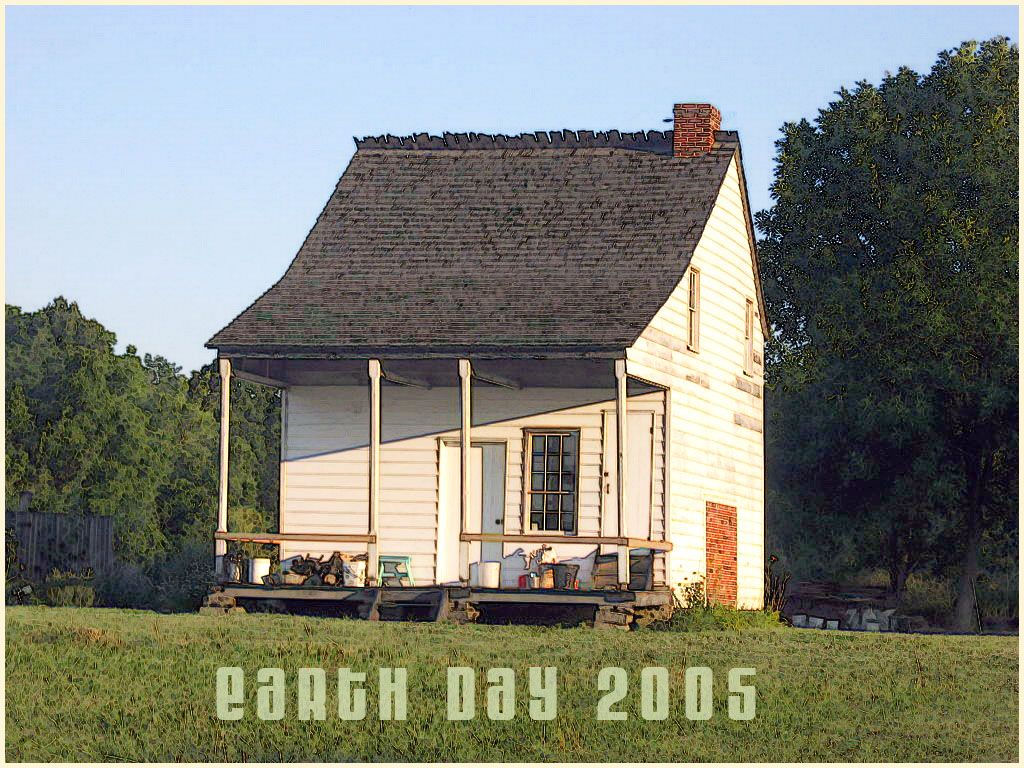
Earth Day 2005

Prophetic Commentary: Earth Day 2005

Paradise


John Prine online

earth day 2005 tutor key hills Kentucky

When I was a child, my family would travel
To western Kentucky, where my parents were born
And there’s a backward old town that’s often remembered
So many times that my memories are worn
CHORUS:
And daddy won’t you take me back to Muhlenberg County
Down by the Green River, where Paradise lay
Well I’m sorry my son, but you’re too late in askin’
Mr. Peabody’s coal train has hauled it away
Well sometimes we’d float right down the Green River
To an abandoned old prison down by Atry Hill
Where the air smelled like snakes and we’d shoot with our pistols
But empty pop bottles was all we would kill

CHORUS

Then the coal company came, with the world’s largest shovel
And they tortured the timber and stripped all the land
Well they dug for their coal till the land was forsaken
Then they wrote it all down as the progress of man

CHORUS

When I die let my ashes float down the Green River
Let my soul roll on up to the Rochester Dam
I’ll be halfway to Heaven with Paradise waitin’
Just five miles away from wherever I am


End of the Innocence

Don Henley online

Walden / Walden Woods Project

Heaven Is Under Our Feet edited by Don Henley and Dave Marsh

earth day 2005 Venoge Indiana Farmhouse

From the album, End of the Innocence

Remember when the days were long
And rolled beneath a deep blue sky
Didn't have a care in the world
With mommy and daddy standin' by
But "happily ever after" fails
We've been poisoned by these fairy tales
The lawyers dwell on small details
Since daddy had to fly

But I know a place where we can go
That's still untouched by men
We'll sit and watch the clouds roll by
And the tall grass wave in the wind
You can lay your head back on the ground
And let your hair fall all around me
Offer up your best defense
But this is the end
This is the end of the innocence

O' beautiful, for spacious skies
But now those skies are threatening
They're beating plowshares into swords
For this tired old man that we elected king
Armchair warriors often fail
And we've been poisoned by these fairy tales
The lawyers clean up all details
Since daddy had to lie

But I know a place where we can go
And wash away this sin
We'll sit and watch the clouds toll by
And the tall grass waves in the wind
Just lay your head back on the ground
And let your hair spill all around me
Offer up your best defense
But this is the end
This is the end of the innocence [Interlude]

Who knows how long this will last
Now we've come so far, so fast
But, somewhere back there in the dust
That same small town in each of us
I need to remember this
So baby give me just one kiss
And let me take a long last look
Before we say goodbye

Just lay your head back on the ground
And let your hair fall all around me
Offer up your best defense
But this is the end
This is the end of the innocence

Friday, March 25, 2005

Good Friday 2005

1 Corinthians 1:20-25

20 Where is the smart stuff of this world? Where are the world's heavy thinkers?...21 Since in God's wisdom the world did not know God through their worldly kinds of smarts, it pleased God through foolish proclamation to save anyone who trusts Him. 22 Jews demand signs and Greeks crave wisdom, 23 but we preach Christ the crucified one, a scandal to the Jews and moronic nonsense to the gentiles: 24 But to those called, both Jews and Greeks, Christ – God's living dynamic power and God's kind of wisdom. 25 Because God's foolishness is wiser than humanity's intellectual cleverness, and God's weakness is stronger than human strength!
Not long ago we celebrated Christmas, God's startling birth among us as one of us; now, since we've again begun the season of Lent, the weeks leading up to the Feast of Resurrection, Paul the theologian explains another dimension of God's paradoxical self-revelation to First Church at Corinth. God chooses what humanity, with its incessant sensation-seeking and credential-questing never could imagine: God chooses the cross supremely to show God's judgment, mercy and love for all creation!

Our scriptures – and Jesus! – are about the unmediated, unqualified presence of God absolutely everywhere, absolutely all the time, even in darkness, despair, pain, death and loss. Because of this, Paul of Tarsus endeavored to preach only Christ crucified, to proclaim the outrage of the fullness of God's power, sovereignty and glory most completely revealed in the scandal of the human, Jesus of Nazareth, dying defenseless on a cross of shame.

From Calvary Hill, Jesus reigns as sovereign Lord in vulnerability, brokenness and embrace—the ruler whose throne is a cross of judgment, but also a cross of mercy and forgiveness. And yes, the cross of Christ is one of the signs the Church displays to the world of the One who freely offers himself to the world despite betrayal and desertion…

We Christians live under the cross; we live under the judgment, mercy and grace of God taking upon Himself in Christ Jesus the world's sin, brokenness and burdens, and without the dis-grace and horror of the cross of the One crucified on Good Friday, there could be no Eastered, Risen One! The Holy Spirit calls, gathers, enlightens and inspires us, the Church of Jesus Christ, to be a people both crucified and risen, a people of the cross and of the power of God to new life! May we see; may we be!
Postscript:
As one of the participants in the online discussion of Reinhard Hütter's Bound to Be Free observed (paraphrased), "When the Church gets drunk on anything other than Christ crucified, the Church has fallen off the wagon!"
On second or third thought, that probably was before we started discussing Bound to Be Free, but it definitely was on the Yahoo! Confessing Christ discussion forum. Here's the Confessing Christ site.

Time of Singing: almost Easter!

Song of Songs 2:

11 For lo, the winter is past,
The rain is over and gone.
12 The flowers appear on the earth;
The time of singing has come,
And the voice of the turtledove
Is heard in our land.
13 The fig tree puts forth her green figs,
And the vines with the tender grapes
Give a good smell. ...

Today's, Good Friday's date is March 25, 2005; last Sunday, March 20, marked the vernal equinox; Easter is almost here!

"lo, the winter is past"... here in paradise San Diego the monsoon season with this year's horrifically destructive record-breaking deluges still hasn't quite departed, so the rain isn't quite over and gone, but this morning above the smell of fresh-turned turf I heard soft birdsongs and felt the hope of fresh wine from tender grapes...but isn't wine country somewhat north of here?

Like almost everything in the Scriptures, this text from Song of Songs is substantial and experiential; Easter is almost here! Easter received its name from the Goddess of Fertility, and we calendar Easter according to the full moon and the spring equinox. Easter and spring bring to us the sight and the smell of fresh grass, rising again to visible life; in the ancient symbol of Easter eggs we find the paradox of a world hidden within a world; we have the power of grain gathered from all the ends of the earth, planted, harvested, shaped, baked and risen into leavened Easter loaves, coming to the Table of Living Bread to which Jesus Christ welcomes us, arriving at the communion Table as a whole loaf and then sacramentally broken in response to Jesus' command to us, finally distributed, shared among us and transforming us, as in the Name of the One both Crucified and Risen we become salt, leaven and bread for the world, as with our living we claim both the cross of Good Friday and the empty tomb of Easter dawn!

During the late Middle Ages, the festival of Resurrection from the dead, Easter, as German- and English-speaking countries call it, received its name from the Anglo-Saxon Goddess of Spring, the Fertility Goddess, the Goddess of the Dawn, whose name is the almost identical-sounding Eostre, and Easter gets calendared according to the full moon and the vernal equinox. The eastern sky, where the sun of the new day rises, also takes the designation of its direction – east – from that very same Eostre, the goddess whose name comes from the Babylonian Ishtar or Astarte, from the Hebrew Esther! And at this season of new beginnings we can see the constellation Lepus, The Hare, closely associated with the moon, sitting in the sky at the feet of the hunter Orion. All of this is tangible and sensible and historical; in addition, it doesn't sound remotely religious or other-worldly!

In times before ours, people knew the first Sunday after the first full moon after the vernal equinox as the fullness of the goddess Eostre's being pregnant with new life; into our world the Easter moon visibly approaches, rising to its pregnant fullness, but we know it again will disappear into the death-instilling yet strangely enough life-kindling darkness. And then, less than two calendar days from this Good Friday morning, will come the resurrection dawn of Jesus, once crucified, dead and buried, but now become the Christ, the glorious Anointed of God; now we meet Jesus Christ in power and glory, rising in fullness, then disappearing for a while from our sight, and returning again as first one and then another of us recognize him and in obedience proclaim him in word and sacrament and service and community, making a quiet blaze of Easter light and Eastered hope in our once-despairing world.

Here comes the sun! Here comes the sun, at the vernal equinox returning to reign in natural splendor over creation while the earth grows bountiful, verdant and fragrant. So, too, in the same manner comes the Easter of Christ Jesus, who despite seeming defeat on the cross of death returns reborn, freely to bestow new growth to the entire world of this earth, bringing a new and renewed season of fruitfulness, not only to our faith in the God Who surprises us with joy as His Word evokes new life from death, but also bringing the gracious gift of another fruitful season to the striving, yearning and hoping of all creation! Sometimes when we celebrate the presence of the crucified and risen Christ in the eucharist we sing:

Let us Talents and Tongues Employ

Let us talents and tongues employ,
reaching out with a shout of joy:
bread is broken, the wine is poured,
Christ is spoken and seen and heard.
Jesus lives again, earth can breathe again,
pass the Word around: loaves abound!

Christ is able to make us one,
at his table he sets the tone,
teaching people to live to bless,
love in word and in deed express.
Jesus lives again, earth can breathe again,
pass the Word around: loaves abound!

Jesus calls us in, sends us out
bearing fruit in a world of doubt,
gives us love to tell, bread to share:
God, Immanuel, everywhere!
Jesus lives again, earth can breathe again,
pass the Word around: loaves abound!

© Fred Kaan 1975

Thursday, March 24, 2005

Dead Sea Scrolls Exhibit

Sauntering through a few ideas again!

Currently there's a traveling exhibit of the actual physical Dead Sea Scrolls. From Mobile, Alabama, Barbara emailed me:
I was so overwhelmed ... I'm a very emotional person. . . I went through the DSS exhibit with the tears flowing. I have never felt closer to God than I did while viewing his Word. I'm struggling for words here to try to convey to you how I felt. I risked the wrath of the security guards when I reached out and touched the frame surrounding Psalms. I felt like I touched the hand of God.
Touching "the hand of God!" In 2 Corinthians 4:7 Paul explains, "We have this treasure in earthen vessels…" During the Coronation ceremony the British monarch receives a Bible, given with the words: "to keep your Majesty ever mindful of the law and the Gospel of God as the rule for the whole of life and government of Christian Princes, we present you with this Book, the most valuable thing this world affords. Here is wisdom; this is the royal law; these are the lively oracles of God." Touching the pages of scripture with our own hands, actually feeling the pages of God's grace-filled rule for covenantal living, together with the Gospeled Good News, in a hint of the way God’s incarnation in Jesus of Nazareth's birth, life, death, resurrection and ascension fully realized the Old Covenant scriptures; we can look at Divine history, wiseness, prophecies and apocalyptic visions in the same way we'd read a current book or magazine, in the manner we might surf and search the internet, and in a way concretely related to our actual everyday world.

On the San Diego Ecumenical Council's Faith, Order and Witness committee, our current discussion document is A Treasure in Earthen Vessels: An Instrument for an Ecumenical Reflection on Hermeneutics (Faith and Order Paper, No. 182).

Here's a free paraphrase of ideas I found on a site I sometimes visit:
The Church is in fragments; the contemporary situation of the church reminds me of our faithful predecessors in biblical times who carried their earthly treasures of essentials for daily life – water, wine, grain – in earthen vessels, clay jars. Sometimes one of those vessels would break, rendering it no longer useful for containing anything. Under similar circumstances, we would throw away the shards, but they found a use for them: with paper not yet invented, and papyrus expensive, they used the fragments as writing material! We call those fragments ostraca, and they still exist until this very day. We might say: "The jar is broken, long live the pieces!"
God chooses the Earthen Vessels of Church, Scripture and Sacraments to proclaim His presence in our midst, and within the physical pages of a book we find a living witness of God's past activity at the same time we discover hope for our future together: a Word of resurrection from death, a Word of Life! In the Reformation tradition an objective sign, the means of grace – Word and Sacrament — is enough for the presence of the Church, and the Holy Spirit acts on us – as in the relationship between Potter and clay – by our living in communities formed by Word and Sacrament.

In seminary I took a semester-long course on the Dead Sea Scrolls; our main texts were The Dead Sea Scrolls in English and The Dead Sea Scrolls: Qumran in Perspective [Fortress Press], which is out of print, but replaced by An Introduction to the Complete Dead Sea Scrolls.

Paul truly understood the Bible's proclamation: during the historical eras to which the Bible witnesses, a lot of people – just like many of us – had the basic and fundamentally incorrect belief being God-pleasingly religious meant doing esoteric rituals and chastising their bodies in extremely pain-filled ways, or they imagined religion and God were about spectacular demonstrations of the paranormal and out-of-the-everyday; they were more into the denial of life and the sensational than about the sacramental celebration of life. In the Bible's witness and in our own lives God performs many miraculous feats, but more than anything, our God, the God who in Christ Jesus continues fully giving Himself to us, is a God of constant, unmediated and unsummoned presence. Dietrich Bonhoeffer speaks of "God's unfathomable condescension!"

Tuesday, March 22, 2005

King of Glory, King of Peace

King of Glory, King of PeaceKing of glory, King of peace,
I will love thee;
and that love may never cease,
I will move thee.
Thou hast granted my request,
thou hast heard me;
thou didst note my working breast,
thou hast spared me.

Wherefore with my utmost art
I will sing thee,
and the cream of all my heart
I will bring thee.
Though my sins against me cried,
thou didst clear me;
and alone, when they replied,
thou didst hear me.

Seven whole days, not one in seven,
I will praise thee;
in my heart, though not in heaven,
I can raise thee.
Small it is, in this poor sort
to enroll thee:
e'en eternity's too short
to extol thee.

George Herbert, published posthumously in The Temple, 1633

Thursday, March 17, 2005

Church Prayer Rug

free ramble

In my mailbox this week I found what may become an Lenten annual: another blatant example of idolatry, another human attempt to create a god in its image, another slot-machine divinity of jumbo payoffs, a deity completely congruent with one of contemporary American society's most brazenly unsubtle gods—consumerism. From a skinny envelope I unpacked purportedly a face of Jesus, sketchily represented crowned with a thorny tiara; four-color printing is the graphics industry standard, but this is a two-color likeness! In addition, nowhere in the mailing could I find either a web address nor an email address—in this year 2005?!?!?!

Next Sunday, continuing its journey through the liturgical year, the church reaches Palm Sunday, with Jesus' triumphant entry into Jerusalem, city of prophets and in ages past, home to the Temple that for the Jews formed the axis mundi between earth and heaven—Jerusalem, the biblical City of God. Following the Revised Common Lectionary, the gospel chronicles the church reads during Lent consistently focus on Jesus' going to Jerusalem and to the cross (lest you imagine I haven't read the Bible, Crucifixion Friday gradually turns into Resurrection Sunday, with its astonishing empty grave: in God's system you cannot have Easter unless Friday precedes it).

Returning to the Church Prayer Rug! Conceptually, it is closely related to the common contemporary practice of consumer-driven and marketing-modeled churches, as in let's study the location, the demographics, traffic flow, in-migration and even out-migration (likely I've missed a slew of necessary statistical assessments), and then decide what the people will be clamoring for and what consumer options they'll be needing so our church can offer the right menu to meet their needs. Is that biblical?! Most likely Martin Luther (among others) would call it an example of that humanly always-popular Theology of Glory! The designation Church Prayer Rug (contrasted with simply Prayer Rug, or other possibilities, such as Tribal Meditation Rug, Rya Prayer Rug, Dhurrie Prayer Rag, Acrylic Broadloom Whatever…) reveals a lot, too!

Jesus: friend of sinners, companion of outcasts, Son of God, Son of Humanity, liberator of women, freer of slaves, lifter-up of underdogs, putter-down of overdogs, political upstart and rouser of the rabble, challenger of the religious establishment, yet Servant, Lord of all creation, Pantocratur…but…talk about a domesticated god, idolatry?! This one is offset printed, not even engraved, flattened onto a flimsy 11" x 16" sheet of not non-acid-free paper; due to the paper's quality (not!) I doubt it would qualify as a kitchen god, since exposed to any light for any length of time, it would crumble and fade; not surprisingly, the legend on the B-side is phenomenally unbiblical:
"This Prayer Rug is soaked with the Power of Prayer for you. Use it immediately, then please return it with your Prayer Needs Checked on our letter to you."
Here the quotes end, but the centered paragraph continues with: It must be mailed to a second home that needs a blessing after you use it. Prayer works. Expect God's blessing.

Tucked into the envelope with the rug itself (how much wear and tear could a paper rug withstand, anyway? Huh? Tell me, please!), there's a list of testimonials citing Rugged Benefits. They include, "Blessed with $46,000.00 after using prayer rug…;" "God blessed me with over $5,000.00"; "Received $10,000 in a financial blessing…"; "I've gotten a new car and a job,…"; "…17 acres of land…;" "Big 6 room house..." To assuage doubters, the *they* who sent me the Church Prayer Rug even threw in a spiritual boon, "Praise God! it is so wonderful to know that my husband is saved…"

A pair of scripture verses justifies the Prayer Rug endeavor:
  • Evening, and morning, and at noon, I will pray and he shall hear my voice. ~Psalm 55:17
  • God can do anything. ~Mark 10:27
My current email signature includes this site's address and pleading lines from the hymn, Make Our Church One Joyful Choir; I haven't posted it on this blog, so I'll quote the entire hymn:
  1. Make our church one joyful choir on this glad and festive day
    and by song invoke the fire that invites our hearts to pray:
    Shape us, Christ, to live and claim all it means to bear your name.
  2. Bend us low by song and prayer, low enough to lift the cross
    and to take the weight and bear love's uncounted final cost:
    Shape us, Christ, to live and claim all it means to bear your name.
  3. Lift us up by song and prayer till the way we deal with loss
    and our acts and words of care trace the pattern of your cross:
    Shape us, Christ, to bear your name.
  4. Bend us, lift us, make us strong, send us out with wind and fire,
    so the world may hear the song that we offer as your choir:
    Shape us, Christ, to live and claim all it means to bear your name.
    Amen, amen, amen!
Thomas H. Troeger
© 1994 Oxford University Press, Inc.

Shape us, Christ, to live and claim all it means to bear your name!
Bend us low by song and prayer, low enough to lift the cross
And to take the weight and bear love's uncounted final cost…
…and our acts and words of care trace the pattern of your cross:
Shape us, Christ, to live and claim all it means to bear your name!
To bear the name of Jesus Christ! One of the greatest theologians of the cross insisted,

"I have been crucified with Christ and I no longer live, but Christ lives in me." ~Galatians 2:20a

(Oh, by the way, that's from Paul of Tarsus' collected writings; I found it in the Bible!) For Jews in Jesus' time, the Jerusalem temple formed a gathering place and holy space connecting earth and heaven; for us Christians, the cross of Jesus Christ is the axis mundi between humanity and divinity! Our baptism into the cross affirms our creation and re-creation in God's image—that particular part of our Imago Dei is one of certified cross-bearers! Living and claiming all it means to bear the name of Jesus Christ means in us, the Church, Jesus still is friend of sinners, comforter of the sorrowful, liberator of the oppressed, companion along the way, forgiver of offenses; because of us, Jesus still is in this world, still carrying the cross. The Holy Spirit calls all of us who – in the words of the Apostle Paul – are "in Christ," to become and to be cross-carriers; for everyone our lives touch, God calls us to span what often seems to be a very far distance between heaven and earth.

Amen!

Monday, February 28, 2005

Reflecting on the Law: Lent 2005

Exodus 20:1-17

Central to the freedom narrative in the book of Exodus is the Sinai Covenant – the Ten Commandments or Decalogue – with its guidelines for living in covenantal community, for worshiping as the people of God, and simply how to be the people of God. Instead of giving the Commandments during the years the Hebrews existed in slavery in Egypt or waiting until after the Israelites finally crossed the River into the Land of Promise, God wisely spoke from Mount Sinai and gave the Law during the long trek through the desert as the people Israel depended on manna from heaven and water from the rock: despite the wildness of the territory, Israel received the law and learned to live fully and worship with integrity on the way to Promised Land freedom. No, law doesn't redeem, law won't "buy back" – not God's law that guides our morals and rules behaviors in family and society, not humanly invented sacrificial law nor our local motor vehicle or real estate regulations or minimum wage laws! But those laws, codes, policies, regulations, or just plain unwritten "conventions," provide structures within which society can live with freedom and receive grace.

Sunday, February 06, 2005

Transfiguration: Until the Day Dawns

Texts – NKJV

Matthew 17:1-9

1 Now after six days Jesus took Peter, James, and John his brother, led them up on a high mountain by themselves; 2 and He was transfigured before them. His face shone like the sun, and His clothes became as white as the light. 3 And behold, Moses and Elijah appeared to them, talking with Him. 4 Then Peter answered and said to Jesus, "Lord, it is good for us to be here; if You wish, I will make here three tabernacles: one for You, one for Moses, and one for Elijah."

… 9 Now as they came down from the mountain, Jesus commanded them, saying, "Tell the vision to no one until the Son of Man is risen from the dead."


2 Peter 1:16-19
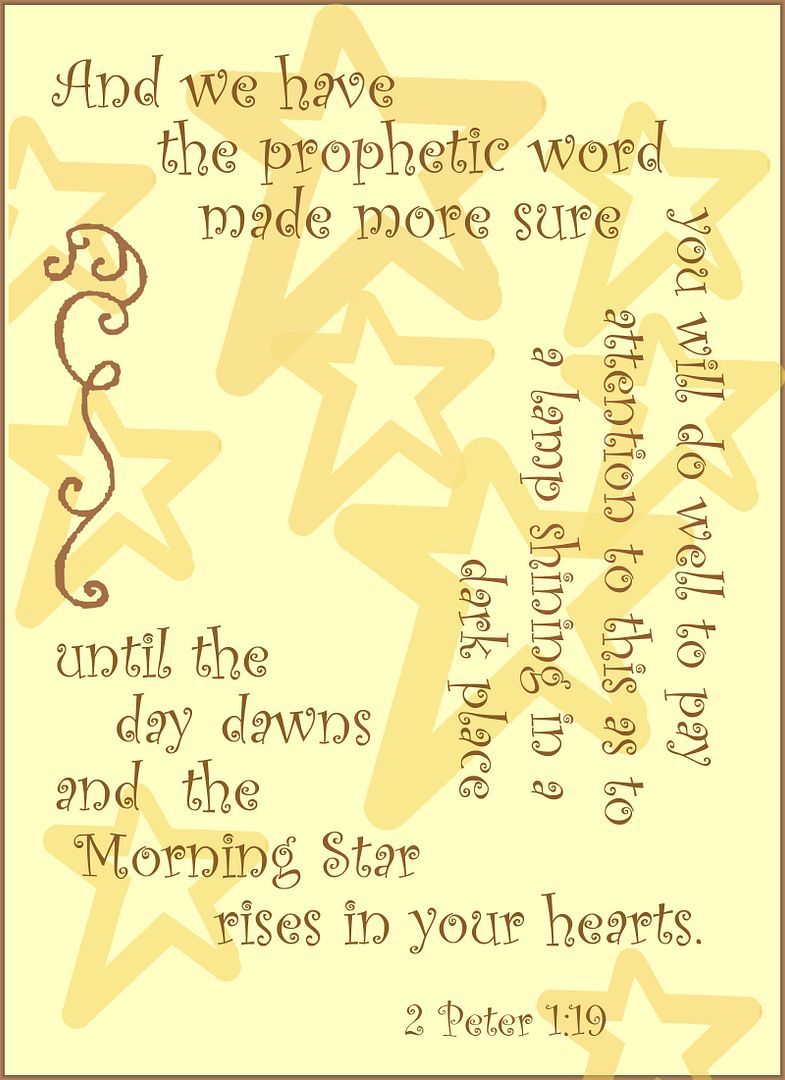
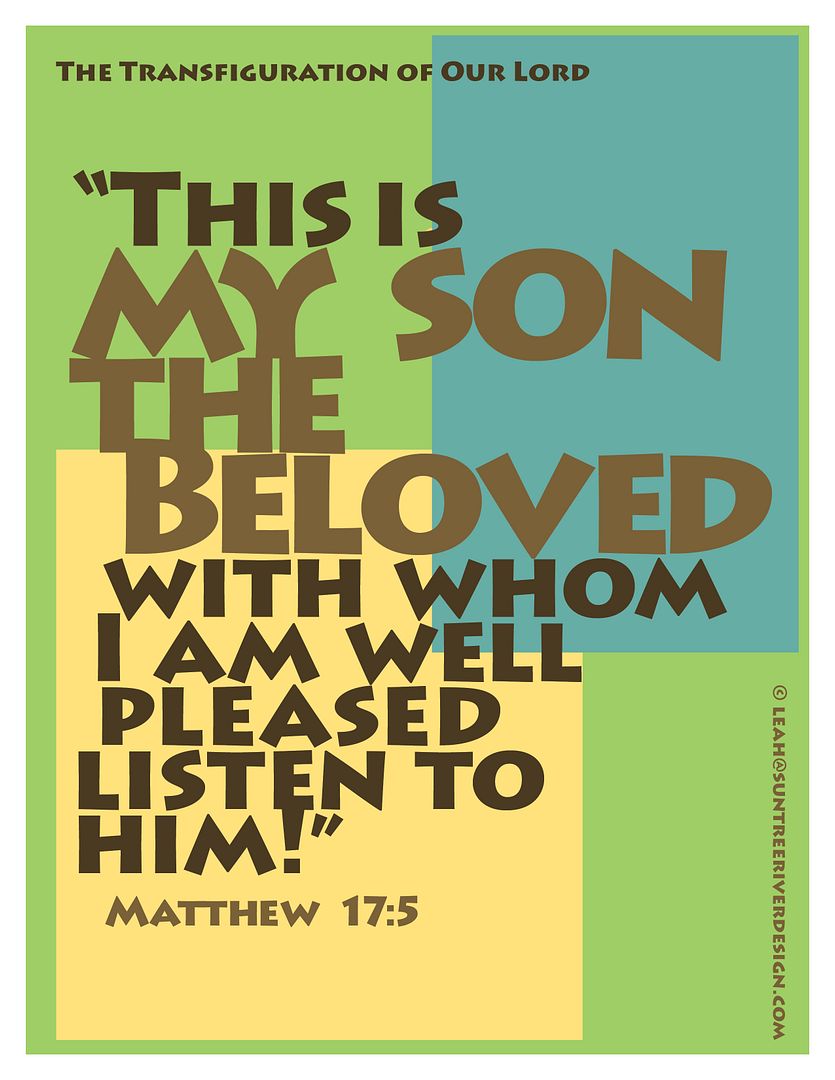
2 Peter 1:1916 For we did not follow cunningly devised fables when we made known to you the power and coming of our Lord Jesus Christ, ...but were eyewitnesses of His majesty. 17 For He received from God the Father honor and glory when such a voice came to Him from the Excellent Glory: "This is My beloved Son, in whom I am well pleased." 18 And we heard this voice which came from heaven when we were with Him on the holy mountain.

19 We also have the more sure prophetic word, which you do well to heed as a light that shines in a dark place, until the day dawns and the morning star rises in your hearts…


Until the Day Dawns
Son of the Excellent Glory, Whose birth and life among us sanctifies all creation, Creator of the Cosmic Dance and Hope Everlasting: as we celebrate another spectacular vision of your Sonship, may we relentlessly live as signs of the reconciliation of heaven and earth, in service to one another and the world. Amen!

"Tell the vision to no one until the Son of Man – the Human One – is risen from the dead!"


Also in some of Jesus’ words recorded by the gospel-writer Matthew, we hear: [12:40] An evil and perverse generation seeks signs, but no sign will be given it except the Sign of Jonah: for just as Jonah was three days and three nights in the belly of the great fish, so will the Human One – the Son of Man – be three days and three nights in the heart of the earth!

In the Good News according to Luke:[11:29] And while the crowds were thickly gathered together, Jesus began to say, "This is an evil generation. It seeks a sign, and no sign will be given to it except the sign of Jonah the prophet."

The Sign of Jonah—Death and Resurrection! For two thousand years, theologians and faith communities have struggled to learn and discern what Jesus means to them. We know Jesus as teacher and Jesus as political prophet; doubtless many of us consider Jesus a social activist, too. Jesus as a healer? Probably. But Jesus, the man of Nazareth, who died outside the city on a cross of shame as the Christ of God?

At the very heart of the story of Jesus of Nazareth stands the seven days we call Passion Week: a crucified man – but – then an empty grave, a narrative with no easy answers or clear-cut implications, a series of events so far outside the normally credible many of us would like to dismiss it as legend. But today's lections are not about death and resurrection but about something else altogether—they're about a spectacular manifestation of God's Glory on yet another mountaintop.

"We were eyewitness. We saw...with our own eyes." There on the mountain of the event called Transfiguration were Moses and Elijah and there was that voice...and there were Peter, James and John who saw, who eye-witnessed the meeting of earth and heaven, the holiness of everything created. Within Judaism, clouds, mountains and other expressions of nature were traditional signs of God's presence—you remember the cloud that went before Israel as a sign of God's presence in the Exodus story, and the mountain Moses climbed to receive the law, the Sinai Covenant? In telling about the Transfiguration,

Matthew, the gospel writer and Peter, the author of the epistle describe a meeting between heaven and earth, of the reconciliation of life, spelling God-with-us—of course, then there's the reciprocal of God's presence to us: our presence to God! Heaven comes down to earth countless times throughout the biblical witness, just as heaven and earth meet countless times in this world in which we live.

Jesus cautioned the Mount of Transfiguration Trio – Peter, James and John – to tell no one about the experience with Moses and Elijah, the law and the prophets, until he, the Son of Man, the Human One, had been raised from death. Tell no one until Easter! "Just as Jonah spent three days and three nights in the belly of the great fish..."
Matthew 17:5 transfigurationAnother Jonah, Simon bar Jonah, son of Jonah – the fisher of men renamed Peter or "Rocky" by Jesus himself – experienced the vision of Jesus transfigured and for Peter, we know the later reality of resurrection could not remain forgotten or untold! Over and over in the book of Acts and then in the later letter called 2 Peter we keep hearing Peter proclaiming the Risen Christ!

Often we recount stories about gutless Peter, almost rejoicing because he and we are similar in too many ways, but after the events of Easter and Pentecost, when preaching Christ even meant risking life itself, Peter could not help but do so.

Because of the stories of Peter's sometimes reluctance during the time he spent ministering alongside Jesus in the years prior to the crucifixion – especially the triple betrayal – I think if Peter had his human preference, he would rather not have stood up before those institutional religious leaders and assorted "others. But the word of the Risen One was not a philosophical theoretical idea out there but rather it was a word within Peter's heart, from his real-life experience walking and living with a friend who unconditionally loved him even in his weakest moments of total failure, that One he had seen crucified...

"We were eyewitnesses...with our eyes." The eye is the most sensitive part of the body; to be an eyewitness suggests vision and perception. On the Mount of Transfiguration Peter saw Jesus, Elijah and Moses; later Peter eyewitnessed Christ crucified; then he saw and experienced Christ Risen! In the life, death and resurrection of Jesus, Peter witnessed the love of God, and how could Peter be silent? Everything his teacher and companion Jesus spoke about had happened, everything – including death and resurrection, the fabled Sign of Jonah – and those events birthed hope in Rocky-Peter, so he began believing, living and proclaiming the hope of resurrection to the world.

Tell the vision to no one until the Human One is risen from the dead. A long time has passed since Jesus, James, John and Peter stood with Moses and Elijah on the Mountain of Transfiguration; a long time has passed since Peter told about seeing with his own eyes the transfigured Man of Nazareth and the glory of the Crucified and Risen Christ. In the centuries since then, far too much other than the boundless and unqualified love of God has been connected with Jesus and laid on the name of Jesus; Peter didn’t need to explain slave ships from Africa, or the Crusades, or the Salem witch trials or the decimation of villages in South America and Central America by unjust church politics; in those days of the nascent church, people hadn't yet suffered under the illegitimate authority of over-formed ecclesiastical clout.

So these days and in our own communities we can hear voices asking why we still proclaim the Crucified and Risen Lord of All!? Still today?! Like Peter? Because we too have witnessed Christ crucified in every life that falls at the hand of hatred, every heart broken by betrayal, every community brutalized by the powerful, every person left for dead; in those situations and far too many like them our eyes have witnessed Christ crucified.

And though many times we may run away like Simon bar Jonah also called "Peter," in the wake of the Day of Crucifixion we have seen and met the Risen One on Resurrection morn! Jesus promises us the Sign of Jonah—death and resurrection; Jesus charges us to "Tell no one until the Human One is risen from the dead!"

Just as the Spirit sent Peter, James and John to the Transfiguration site, the Holy Spirit takes us to places where God meets us, the contemporary people of God; the Spirit send us to places where we witness meetings between heaven and earth and see evidence of God's life-restoring and reconciling presence to us, while the Spirit enables us to be present to God, living in full response to the power of Easter within our once-devastated lives.

Together with Peter, we have been eyewitnesses of Christ's crucifixion but we also know the experience of the paradoxical power of new life born from death; those events birth hope in us—how can we be silent? Now we can believe, live and proclaim the hope of resurrection to the world!

As we prepare to enter the coming weeks of Lent, let us continue living as signs of the meeting of heaven and earth, people ready for Good Friday and eyewitness of Easter Sunday's glorious dawn!

The Word of Life,
Amen!

Monday, January 17, 2005

Martin Luther King Day 2005

Micah 6:6-8 MSG
6 How can I stand up before GOD
and show proper respect to the high GOD?
Should I bring an armload of offerings
topped off with yearling calves? ...

8 But he's already made it plain how to live, what to do,
what GOD is looking for in men and women.
It's quite simple: Do what is fair and just to your neighbor,
be compassionate and loyal in your love,
And don't take yourself too seriously—
take God seriously.

Reflections on Multiculturalism and its Cognates

What feels like a long time ago, I lived and served in very inner-city Boston; today I'll begin with a panorama! The local church I served as lay associate pastor was highly diverse in terms of class, race, age, ethnicity, economics and culture, but some time before I began serving that congregation the immediate neighborhood had experienced blockbusting, white-flight and redlining, with a subsequent decline and disarticulation of the public education system. Those particular dynamics of change followed by insurgent gentrification plus underclass growth on the neighborhood's fringes meant there was no way any mainline church could have survived unless they'd been looking at and trying out very different untraditional models for evangelism and ministry ages earlier.

Nonetheless, some streets were (re-)gentrifying, resulting in multi-generational welfare families and yuppies living within hailing distance of one another. As the senior pastor I served with once said to me, "a lot of the folks in this neighborhood never have even been in Harvard Square, let along inside a Harvard classroom"; yet again, quite a few yuppies with advanced academic or professional degrees came to the church seeking volunteer opportunities and sometimes church homes for themselves or their offspring.

Since the void the departure of the White working-class population left in the area also had meant the dissolution of most mainline-affiliated local churches, given such a large immigrant and underclass population a whole lot of independent – mostly Pentecostal and other related Wesleyan offshoots – storefront congregations gathered, evolved and prospered.

Regarding the difficult work of bridging religious and cultural differences, the church building's immediate vicinity included families and individuals whose families historically were Irish Roman Catholic, Blacks - primarily African-American with a growing influx of Caribbean islanders - and an increasingly disenchanted surfacing minority whose forebears originated in the United Kingdom or Western Europe. One of the major problems I constantly dealt with were the genuinely concerned and truly well-meaning White liberals who at the same time were extremely eager to be helpful and culturally almost completely unaware, insensitive and actually gauche! It amounted to dismaying cultural arrogance and ignorance and not remotely the "evangelism in the vernacular" we endeavored to do.

But the society full of compassionate fairness and justice for all, the impartial way of righteousness that recognizes separate means inherently unequal, the "Beloved Community," that formed a large part of the heart of MLK's quest - as always - was a tough one! Participating in the church's programming were nominally Roman Catholic kids, but when I'd visit their home and suggest they begin attending worship, a parent would inform me, "My child is Catholic!" (Typically I'd never seen any evidence of that possibility.) Or, people who seemed to be taking advantage of us for transportation and various handouts...sometimes I wonder if those of us on church staff were gullible or were we faithful servants?

On MLK Day 2005, in what feels like *now* and actually is *now*, I'm living in San Diego; these days, the very words "Southern California" by default signify a fundamentally multicultural and multilingual environment! With Baja California's city of Tijuana just south, this is the busiest land border in the world, and San Diego is very much a conventional border town; in San Diego city and county there are so many neighborhoods that carry an ethnic designation.

Practically all of the signage and most of the announcements everywhere are bilingual English-Spanish at minimum; lots are in Tagalog and Vietnamese, too, with some in an least a half-dozen more languages. Restaurants, food courts and other eating places offer an vast variety of ethnic food and Americanized-ethnic eats, too. But how much evidence of actual living in community with, celebrating with and truly understanding the folks of different-from backgrounds do I see around here? I'm not referring to the frequent Festivals of ethnic foods, dance, arts and culture: I'm searching find and longing to experience understanding and true equality that moves far beyond stereotypes and surface tolerance into making this large town a welcome place and a real sanctuary safe for differences!

As God charges us through Micah the prophet, each of one us needs to take God more seriously and ourselves less seriously, or as Bible versions a little more conventional and familiar to us than Eugene Peterson's The Message version of scripture expresses it, we need to "Do justice, love mercy, and walk humbly with our God!" In the power of the Holy Spirit, God's desire can become our lifestyle!

Still, for this day forward and counting...

Happy Martin Luther King Jr., Day, World!!! You've Come a Long, Long Way!!!

Saturday, January 15, 2005

wilderness handbook: the desert again

wilderness handbook: the desert again
desert living...
...living in the desert.
wilderness: freedom living!
the whole world changes: you shall be called Israel!
...and live as God's chosen people...

This evening I've considered these ideas just a little more and finally I'm getting them out of saved stuff and up on to my blog.


Repeatedly I've written and spoken about the desert's precariousness, life-giving and transformative austerity, as in this pair of citations:
In the desert Israel first rendezvoused with Yahweh; in the desert – driven out by the Spirit – Jesus first met the Spirit; possibly our first meeting with the real presence of the HS happens in the desert, too...not the presence we imagine we need but the Presence God knows we need.

"In the desert Israel ...and the desert frequently becomes the place of our meeting God and of self-encounter, as well." In that post I added, "For us as Christians, baptism is our primal liminal experience. As we enter the waters, should we be prepared to drown? Yes! And we should be equally prepared to be surprisingly raised from that death by drowning!"
Exactly as for God's original people Israel, for us, the contemporary People of God, the desert provides the dynamic reciprocity of intimate relationship, and doesn't relationship test us and ultimately transform us into being truly the person for others in addition to our becoming most authentically ourselves and respecting of our self? Living in the desert means living in risking trust rather than assumption and comfort; it means learning about, interacting with, about relating to an "other"; reconciling and reuniting; shedding the past while [hopefully] learning from it. In the wilderness we learn about moving into the future with hope and about thriving in spite of scarcity; fearlessly learning not to hoard during times of prosperity and relative abundance. Ditching self-reliance, depending on the human *other* and – finally – depending completely upon the Divine *Other*.

wilderness: freedom living!

Trekking through the wilds means living in liberty at that very moment just as much as our desert exoduses are passages to the land of promise. True in our wilderness as individuals and particularly for our community we seek a metaphorical Jordan, but on the way, what do we find? We find and meet insistent others with needs and gifts parallel to ours; we discover natural resources above, beneath, before and around us, assets that will help everyone meet the requirements of daily existence. Freedom living? Either in solitude or in community, when we’re in the desert we do not have a whole lot of choice about our responses; we have little choice if we seek substantial quality of life, so in the desert wilderness our easiest and most free course of action becomes obedience to God’s demands to love one another and bear each others’ burdens, eventually and ultimately holding not only a single Feast in the Wilderness but countless Feasts in the Wilderness!

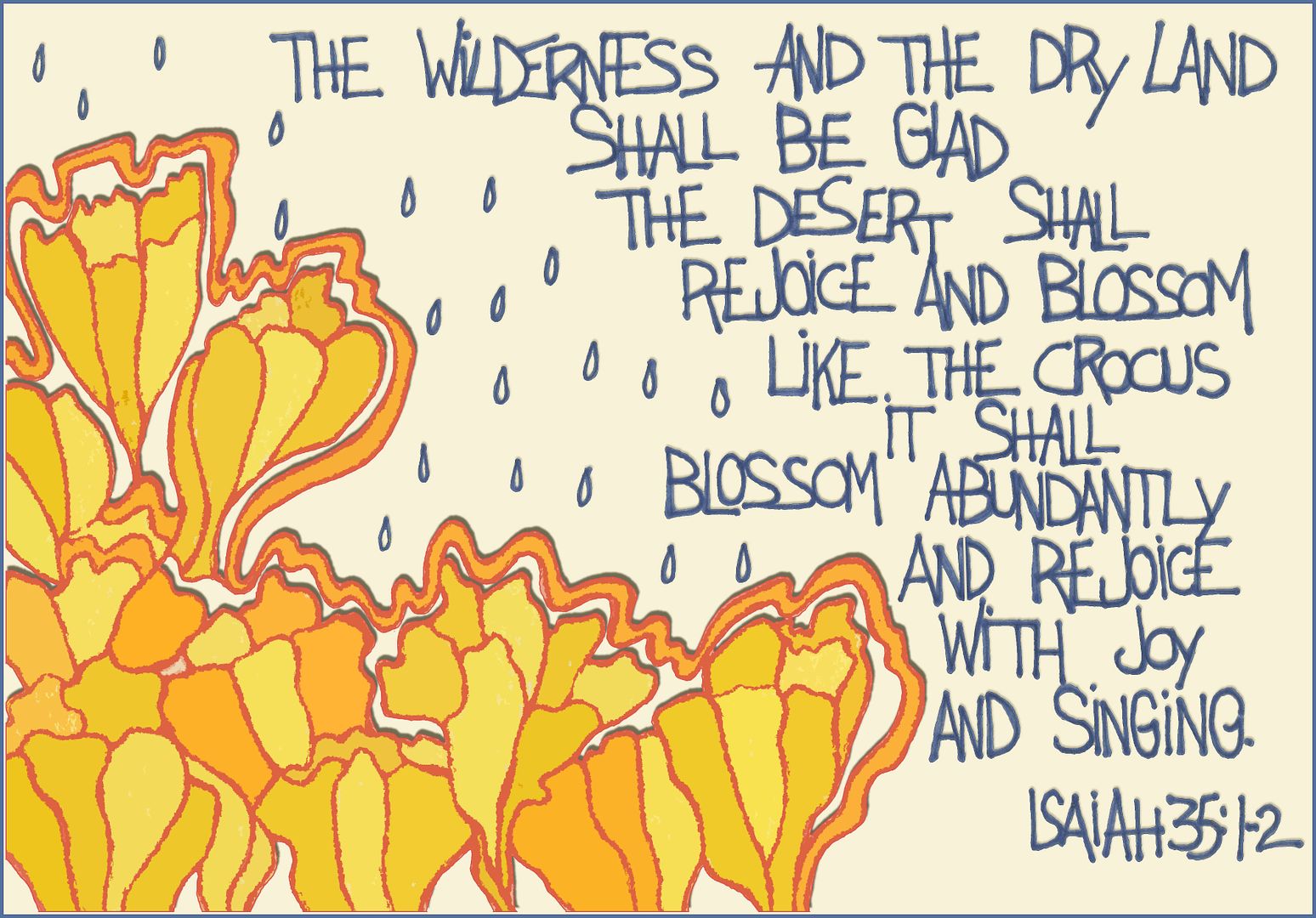
Isaiah 35

Isaiah 35:1-2

1 Wilderness and desert will sing joyously,
the badlands will celebrate and flower—
Like the crocus in spring, 2 bursting into blossom,
a symphony of song and color.
Mountain glories of Lebanon—a gift.
Awesome Carmel, stunning Sharon--gifts.
GOD's resplendent glory, fully on display.
GOD awesome, GOD majestic...
6a Springs of water will burst out in the wilderness,
streams flow in the desert...
7 Hot sands will become a cool oasis,
thirsty ground a splashing fountain.
Even lowly jackals will have water to drink,
and barren grasslands flourish richly.
—MSG
Rivers in the desert!

Once upon a time, as in ages ago, I put together a photo-collage of desert images and phrases; one of my favorites was "Don’t go bare into the wilderness," followed with, "You have the words of eternal life" and "Claim it today!" The Words of eternal life is exactly what Jesus took into the desert with him right after his baptism in the real River Jordan; Moses'people left Egypt led and accompanied by a Word-speaker who in real life interacted with the Word-giver and even mediated the celebrated Sinai Covenant. In theology, water is a recurrent metaphor for the Holy Spirit; each individual and each community has a quadrivium of needs that includes water, food, shelter and places of nurture. Scripture calls us to choose between life and death, blessing and curse and as I've stated here before, I believe the Reconciling Christ Event is so drastic, so inclusive and so all-encompassing of everything and everyone created, all creation is born, lives, dies and rises in Christ. However, God sets before us the ways of life and death, and to a limited extent, the choice of salvation, wholeness and reconciliation becomes ours.

Streams in the wilderness

Streams tend to be smaller and generally less extensive than rivers? But primarily because they're littler, streams have other attributes, such as compelling us to careful stewardship of the essential gift of water, such as making us thankful; such as leading us to bless the Giver of the Gift—including the gift of the wilderness desert that makes us so aware of its concealed beauty and unseen life.

Desert rivers

As we more and more live in trust, those "rivers in the desert" slowly and imperceptibly become desert rivers! In other words, the rivers take on characteristics of the desert. Paradox? Yes, of course!!!

Wilderness streams

In the same way rivers in the desert become desert rivers, "streams in the wilderness" become wilderness streams. How and why?

the whole world changes...

The whole world changes? Not just my, your, our smallish and more-or-less self-contained worlds? A lot of life is synergistic in a lot of ways. The "World" goes far beyond and transcends our little, proprietary universes and begins touching, reaching and transforming people, places and ideas far, far beyond our immediate heres and nows and this world of ours becomes huge! Astounding? Both yes and no! As we approaching our Jordan, we're on the cul-de-sac of life, a place with no outlet except to continue – you cannot go back (if you keep looking back you won'’t know where you’re going). Because – really! – God does not see our past...

you shall be called Israel!

Jacob refused to leave without a blessing: God loves, God blesses people who persevere, who are tenacious! After Jacob wrestled with the spirits of the [Genesis 32] human and the Spirit of the Divine, God conferred on Jacob his new name; Jacob left Gilgal and went to [genesis 28] Bethel, "House of God," because he needed to go there to get established in God’s house. After [Joshua 5] Gilgal and then at Bethel, no longer was it "God of Abraham, Isaac and Jacob,"” but rather the Jacob of God, the one newly-named Israel! Named and called by your name by the Word of Life!
22 And [Jacob] arose that night and took his two wives, his two female servants, and his eleven sons, and crossed over the ford of Jabbok. 23 He took them, sent them over the brook, and sent over what he had. 24 Then Jacob was left alone; and a Man wrestled with him until the breaking of day. 25 Now when He saw that He did not prevail against him, He touched the socket of his hip; and the socket of Jacob's hip was out of joint as He wrestled with him. 26 And He said, "Let Me go, for the day breaks."

But he said, "I will not let You go unless You bless me!"
27 So He said to him, "What is your name?"
He said, "Jacob."
28 And He said, "Your name shall no longer be called Jacob, but Israel; for you have struggled with God and with men, and have prevailed."
29 Then Jacob asked, saying, "Tell me Your name, I pray."
And He said, "Why is it that you ask about My name?" And He blessed him there.
30 So Jacob called the name of the place Peniel: "For I have seen God face to face, and my life is preserved." 31 Just as he crossed over Penuel the sun rose on him, and he limped on his hip. NKJV
Long later, the New Covenant scriptures give us this amazing text:

"To the one who overcomes I will give some of the hidden manna to eat. And I will give him a white stone, and on the stone a new name written which no one knows except the one who receives it."...and I will give her the Morning Star!... Revelation 2:17

...and live as God’s chosen people...

Well, yes, of course! The whole idea and purpose of learning to live through hot, dry days and chilly, dry nights is to learning how to live as People of the Covenant, learning how to live as people elected by grace and enabled in the power of the Holy Spirit…did I say something about water symbolizing the Spirit? Throughout the witness of scripture and in the course of our daily walk, water, wind and fire equally symbolize the gift of Divine Life!

Exodus 13

From Exodus 13:
3 And Moses said to the people: "Remember this day in which you went out of Egypt, out of the house of bondage; for by strength of hand the LORD brought you out of this place. No leavened bread shall be eaten. 4 On this day you are going out … 5 And it shall be, when the LORD brings you into the land...a land flowing with milk and honey, that you shall keep this service in this month. 6 Seven days you shall eat unleavened bread, and on the seventh day there shall be a feast to the LORD. 8 And you shall tell your son in that day, saying, "This is done because of what the LORD did for me when I came up from Egypt.

14 So it shall be, when your son asks you in time to come, saying, "What is this?' that you shall say to him, "By strength of hand the LORD brought us out of Egypt, out of the house of bondage.
[scripture text heading: The Wilderness Way]

17 Then it came to pass, when Pharaoh had let the people go, that God did not lead them by way of the land of the Philistines, although that was near; for God said, "Lest perhaps the people change their minds when they see war, and return to Egypt." 18 So God led the people around by way of the wilderness of the Red Sea. And the children of Israel went up in orderly ranks out of the land of Egypt.

21 And the LORD went before them by day in a pillar of cloud to lead the way, and by night in a pillar of fire to give them light, so as to go by day and night. 22 He did not take away the pillar of cloud by day or the pillar of fire by night from before the people.

Prophecy Word Sacrament

In Israel the prophet, the speaker of the Divine Word of Life, had ultimate authority and primacy; in the New Israel, the church, the prophet, the Divine Word-speaker, also has primal authority; both in those former days and in these latter days the just and righteous Word is manifest and apparent not only in audible, vocal speech, but the Word is hidden in the Spirit-filled people of God and the Word is paradoxically visible in the sacramental ordinances of baptism and holy communion.

In The Prophetic Faith, Jewish theologian Martin Buber writes,
"[for Jeremiah] Not the priest but the prophet he regards as the mediator between heaven and earth, messenger of God and intercessor in one. The contact between godhead and manhood in his view is not bound up with the rite but with the word...the word comes again and again from heaven as something new, and makes its abode within man...and the man who has to make it heard is over and over again subdued by the word before He lets it be put in his mouth. This is not the expression of a familiar deity, with whom man comes into regular contact in fixed places and at fixed times. He, Who speaks, is incomprehensible, irregular, surprising, overwhelming, sovereign. Therefore it is the virtue of this word, and of this alone, to lead, that is to say, to show the way. [emphasis mine] ...In order to speak to man, God must become a person; but in order to speak to him, He must make him too a person." (pages 164-165)
Jeremiah's New Covenant proclamation:

Jeremiah 31

31 "The time is coming," declares the LORD,
"when I will make a new covenant
with the house of Israel
and with the house of Judah.
32 It will not be like the covenant
I made with their forefathers
when I took them by the hand
to lead them out of Egypt,
because they broke my covenant,
though I was a husband to them,"
declares the LORD.
33 "This is the covenant I will make with the house of Israel
after that time," declares the LORD.
"I will put my law in their minds
and write it on their hearts.
I will be their God,
and they will be my people.
34 No longer will a man teach his neighbor,
or a man his brother, saying, 'Know the LORD,'
because they will all know me,
from the least of them to the greatest,"
declares the LORD.
"For I will forgive their wickedness
and will remember their sins no more."

Sunday, January 02, 2005

On Holy Communion for this New Year 2005

Text: Luke 22:7-20; 28-30

Here's the complete text for Luke 22:7-30

Or check it out in The Message

This morning, the first Sunday of the New Year 2005, we celebrated Holy Communion; Luke 22 traditionally has been a Maundy Thursday text, but it also is highly appropriate for this early January winter Sunday.

Because of our humanity, our lives need meaning if they are going to be bearable; we feel almost compelled to seek meaning in our own individual worlds and often in those worlds beyond our immediate grasp. We may passively be able to endure in surroundings not of our own making or choosing, but we're unlikely to keep on deliberately performing an action unless it says something to us and about us, unless there would be an empty space in our lives without it. Every Christian community throughout the world keeps celebrating Holy Communion as part of the community's life together: since that adds up to a lot of people in a lot of very different countries and cultures, there must be a lot that's meaningful about this sacrament!

Wherever in the Bible we read an account of the eucharistic "founding meal"—we can find it in one of Paul's letters to Corinth as well as in three of the gospels—whenever we read about it, it evokes familiar images and rings with unforgettable phrases. Possibly the central picture is Jesus' sharing a meal with his friends; no matter if it's Leonardo's Renaissance Italy or first century Palestine, the reality is the same, and precisely what Jesus shows us with his entire life is how very, very transferable and translatable that supper is. We hear a familiar phrase when at the supper, while Jesus breaks the bread and blesses the wine, he tells us to do what he does—"in remembrance." Do this religious ritual? Jesus' world already had plenty of religious rituals. Our world has enough of those, too—plus rituals for just about every other facet and aspect of our lives.

Throughout his life Jesus shows us in words and actions the way it's supposed to be in God's world, in God's sovereignty, and four times in the seventeen verses of Luke 22:7-20 and verses 28-30 Jesus mentions the Kingdom, telling us it is his Kingdom and our Kingdom. Jesus shows us how God participates in our world so we are able to participate in God's world; Jesus reveals to us a worldview that is at a 180-degree angle to most common ideas of religion and religiousness.

Jesus calls the bread his broken body and calls the fruit of the vine the blood of the New Covenant; Jesus tells us, he tells us here in this city and now in January 2005 the bread is his body broken for us and the wine is blood of that New Covenant of grace he came to bring to us and for us, and says he'll take part in this festal meal again when the worldview of the Kingdom of God is a fact among us; then, at that time, he'll celebrate with us once more.

A religious ritual? There are plenty of those. "In memory?" We keep on celebrating this sacrament, this communion, this eucharist, with each other. And we're not likely to keep on performing an action unless it has meaning, unless it says something to us and about us.

If we are to remember Jesus, do we need bread and wine? Aren't there other ways? Well, throughout the records of Jesus' life there are accounts of Jesus feeding other people and feasting with his friends; Jesus repeatedly talks about those who will banquet in the Kingdom...and about giving his body for the life of the world.

Here's how The Message version of the New Testament says it:
24 Within minutes they were bickering over who of them would end up the greatest. 25 But Jesus intervened: "Kings like to throw their weight around and people in authority like to give themselves fancy titles. 26 It's not going to be that way with you. Let the senior among you become like the junior; let the leader act the part of the servant.

There it is again, that old human thing of wanting to be powerful, great, important and admired by all! In Jesus we meet one who shows us all creation, all life and all persons are sacred or holy and worthy of being served. In addition, the Kingdom of God we meet in Jesus is nothing like a traditional kingdom where the have-nots and the have-a-littles wait on the haves; in its place, we find real community with God's justice and mercy graciously at work in the world so hunger, greed and need, judgment and exclusion are wiped out—so forgiveness of the past means and becomes the beginnings of new life. The Reign of God, this Welcome Table, and Jesus given for us on Calvary are tightly bound together.

Again in Eugene Peterson's Message version of the Bible we hear Jesus asking:
27 "Who would you rather be: the one who eats the dinner or the one who serves the dinner? You'd rather eat and be served, right? But I've taken my place among you as the one who serves. 28 And you've stuck with me through thick and thin. 29 Now I confer on you the royal authority my Father conferred on me 30 so you can eat and drink at my table in my kingdom and be strengthened as you take up responsibilities among the congregations of God's people.

Not only do we anticipate, celebrate and commemorate as we break bread and offer wine, but we carry with us beyond this building this microcosm of a redeemed world that has been created by us and God, between us and God. As we live lives in service to others and service in the world, remembering Jesus, who lived among us as "one who serves," we ourselves become a living and a life-giving memory of Jesus so in us, the Church of Jesus Christ, called by the Holy Spirit to be a servant people, Jesus again becomes alive in the world and we become sacraments mediating between God in Christ and the world, offering the world a living connection to the heaven of God's Reign here on earth.

"...eat and drink at my table in my kingdom and be strengthened as you take up responsibilities among the congregations of God's people!" Towards the end of Luke's Gospel, regarding one of Jesus' appearances after the resurrection, it says, "when Jesus was at table with them, he took the bread and blessed and broke it. And their eyes were opened and they recognized him." Like God called Jesus of Nazareth, God calls us to be visible, tangible signs of God-with-us, God-for-us, God-among-us, of the Kingdom belonging to God, to Jesus, to us and to all creation!

So what are we, God's servant people, planning to do during this newly-minted year, 2005? Where are we, God's representatives in Christ Jesus, going to be when the world cries and grieves with pain and hurt? Where will people find us when our neighbors are in need? Will we be making our world into a sanctuary, a holy place, a foretaste of the Royal, Kingly Reign of God on earth, giving the world reason to celebrate? Will the world recognize us as the body of Christ when we pour out our lives with compassion just as we break this eucharistic bread? I hope so!

Amen!