Sunday, July 17, 2005

Anticipation

I'm cross-posting this on this far by faith, my testimony blog with no changes, so please bear with me if you visit both blogs! Desert Spirit's Fire is the place for my more intentionally formal writing, but this post contains both approaches, so it belongs both places. The ideas I'm posting this evening could be developed far more, so one more time, here are some more sprawling connections—but they do cohere, however jaggedly.
Anticipation is another pungent biblical theme!
Friday afternoon at the 99¢ Only Store (local-dwellers know the store's addictiveness), for the first time in close to forever I heard Carly Simon's haunting Grammy-winner

Anticipation. Both music and lyrics are Carly Simon originals:

from Anticipation:
We can never know about the days to come
But we think about them anyway
And I wonder if I'm really with you now
Or just chasing after some finer day

Anticipation, Anticipation
Is making me late
Is keeping me waiting...


© 1971 Quackenbush Music Ltd.

Reformation Notes
Because of their historical location the Reformers, especially Luther and Calvin, necessarily concentrated on a highly humanity-focused theological model, and theologizing within that, they also developed a compelling concept of God's gracious descent to all creation, which I believe laid open extensive possibilities for developing a comprehensive theology of redemption and sanctification that would include all creation. Both of those magisterial Reformers viewed all creation – not only human creatures – as an arena for the revelation of God's glory. In the Hebrew Bible there are ample precedents for this kind of holistic view of God's passion for creation and for an all-encompassing view of the sovereignty of Jesus Christ. I love the deuteronomic historian's relentless refrain, "into the land, into the land, into the land!" Hebrew Bible scholar Walter Brueggemann is one of my favorite authors; in his The Land: Place As Gift, Promise, and Challenge in Biblical Faith, he insists theology and theologians have concentrated far too much on covenant to the often near-exclusion of The Land.

As I continue my still very preliminary study and writing for my future book about ecological theology, besides the Bible, Brueggemann's plentiful work has influenced me a lot; Matthew Fox has influenced me some (though my theology is far more sacramental than Fox's); also, I'm drawing on the historical and still-present influences and insights of Celtic spirituality. Paul Santmire and Jürgen Moltmann are a pair of contemporary theologians in the Reformation tradition I need to thank and credit, as well.

Second Isaiah
I'm always thinking a lot about how much I love 2nd Isaiah of the exile (I need to figure out how to post some of my Isaiah graphics here). Check out the persistent theme of redemption and hope running through these verses, and particularly humanity's salvation physically located in the midst of the natural creation's redemption—the Reformers' theology of God's descent and infilling of everything created so recapture these passages! Related to these 2nd Isaiah texts, note well Luther's theology of the ubiquity of the Risen and Ascended Christ! [...looks as if I'm being excessive with the exclamation points?!]

from Isaiah 41

8 "But you, Israel, are My servant,
Jacob whom I have chosen,
The descendants of Abraham My friend.
9 You whom I have taken from the ends of the earth,
And called from its farthest regions,
And said to you,
"You are My servant,
I have chosen you and have not cast you away:
10 Fear not, for I am with you;
Be not dismayed, for I am your God.
I will strengthen you,
Yes, I will help you,
I will uphold you with My righteous right hand.'
18 I will open rivers in desolate heights,
And fountains in the midst of the valleys;
I will make the wilderness a pool of water,
And the dry land springs of water."

Isaiah 43

Isaiah 43:1

1 But now, thus says the LORD, who created you, O Jacob,
And He who formed you, O Israel:
"Fear not, for I have redeemed you;
I have called you by your name;
You are Mine.
2 When you pass through the waters, I will be with you;
And through the rivers, they shall not overflow you.
When you walk through the fire, you shall not be burned,
Nor shall the flame scorch you.
3 For I am the LORD your God,
The Holy One of Israel, your Savior;
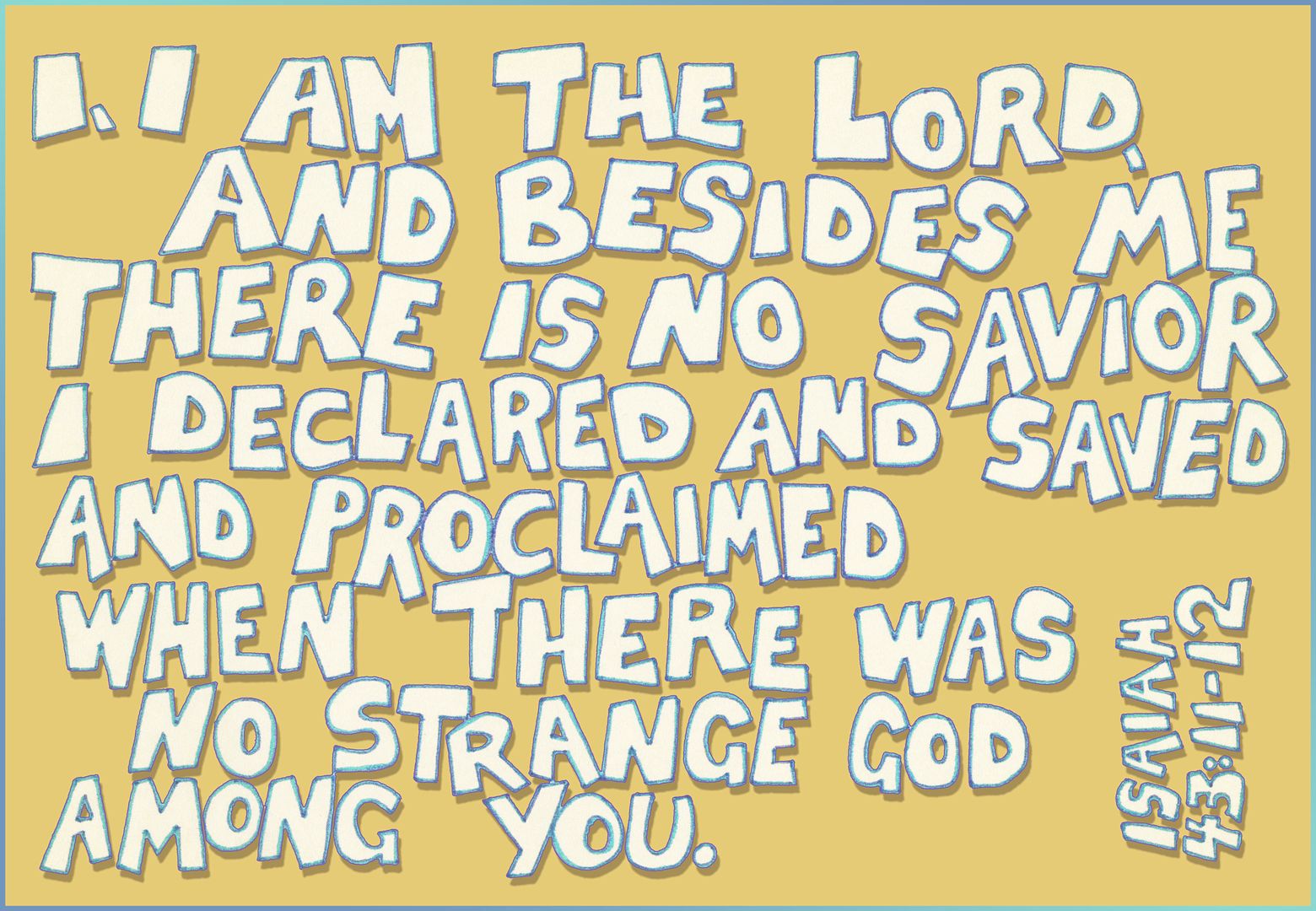
11 I, even I, am the LORD,
And besides Me there is no savior.
12 I have declared and saved,
I have proclaimed,
And there was no alien god among you;
Therefore you are My witnesses,"
Says the LORD, "that I am God.
Isaiah 43:1-2
15 I am the LORD, your Holy One,
The Creator of Israel, your King."
16 Thus says the LORD, who makes a way in the sea
And a path through the mighty waters,
18 "Do not remember the former things,
Nor consider the things of old.
19 Behold, I will do a new thing,
Now it shall spring forth;
Shall you not know it?
I will even make a road in the wilderness
And rivers in the desert.
20 The beast of the field will honor Me,
The jackals and the ostriches,
Because I give waters in the wilderness
And rivers in the desert,
To give drink to My people, My chosen.
21 This people I have formed for Myself;
They shall declare My praise."

Isaiah 44

23 Sing, O heavens, for the LORD has done it!
Shout, you lower parts of the earth;
Break forth into singing, you mountains,
O forest, and every tree in it!
For the LORD has redeemed Jacob,
And glorified Himself in Israel.

Isaiah 51

Isaiah 51:3

3 For the LORD will comfort Zion,
He will comfort all her waste places;
He will make her wilderness like Eden,
And her desert like the garden of the LORD;
Joy and gladness will be found in it,
Thanksgiving and the voice of melody.
4 "Listen to Me, My people;
And give ear to Me, O My nation:
For law will proceed from Me,
And I will make My justice rest
As a light of the peoples."

Walter Brueggemann essentially comments,

Of course the trees sing and clap their hands—no more clear-cutting! Of course the seas roar and everything in them rejoices—no more toxic waste and pollution!

Milk and Honey, Reign of Heaven: right here In the Land
Although I like mystery (how can you be a theologian and not be drawn to mystery?), I absolutely love paradox! On that theme, I need to ask how you can be a Christian without the mysterious paradox of God's clearest self-revelation in the vulnerability of a human, amazing and overwhelming and drawing you into itself? Look in the manger and look at the cross, insists Martin Luther! Milk and honey is a sign of the fullness of the sovereignty of God; in Jesus of Nazareth we meet face-to-face the embodiment of the realization of the time of salvation, the epoch of the Reign of Heaven. But this paragraph began with milk and honey! Flowing honey and surging milk begin with fertile land and rivers of usable water. Ample milk means abundant cattle grazing on luxuriant grass, producing healthy calves and fertilizing grains and vegetable gardens. Of course it includes bees pollinating fruits and flowers, vineyards and other food crops. Hearty vineyards, healthy fields and sufficient water. Dairy and beef, honey and harvest lead to nourishment for the farmers, their families and the community, with overflowing everything to sell at market or barter and trade in order to acquire whatever you cannot produce on your own. Likely I've left out a slew of probable connections, but my intent is clear: heaven's blessings aplenty on earth!

However, Israel became Israel, receiving the identifying name, not in the Promised Land flowing with milk and honey but in the desert of the trek toward that promised-landed freedom. In the desert's sparse economy, with surprising gifts like water from the rock and manna from the sky, Israel and Yahweh encountered each other into the kind of relationship that later would enable God's people to recognize God's paradoxical self-revelation in the preached Word and proffered sacraments...

Now and here, like Christ Jesus, face-to-face with the world, the church is the incarnation of the fullness of the time of salvation, the era of the Reign of Life; as persons of the ekklesia, of the church, our sacramental liturgies and lifestyles replay God's paradoxical self-revelation in the exodus desert, recognizing and celebrating God's sustaining presence in, with and under creation's commonest stuff, the utmost essentials for life produced from the heart of the earth.

We can never know about the days to come
But we think about them anyway


But, with God in charge of those days to come, we can have some ideas about a little of what will happen! First of all, (once again!) I need to include one of my favorite passages from Martin Buber's The Prophetic Faith:

In The Prophetic Faith, Jewish theologian Martin Buber writes,
"[for Jeremiah] Not the priest but the prophet he regards as the mediator between heaven and earth, messenger of God and intercessor in one. The contact between godhead and manhood in his view is not bound up with the rite but with the word...the word comes again and again from heaven as something new, and makes its abode within man...and the man who has to make it heard is over and over again subdued by the word before He lets it be put in his mouth. This is not the expression of a familiar deity, with whom man comes into regular contact in fixed places and at fixed times. He, Who speaks, is incomprehensible, irregular, surprising, overwhelming, sovereign. Therefore it is the virtue of this word, and of this alone, to lead, that is to say, to show the way.[my emphasis] ...In order to speak to man, God must become a person; but in order to speak to him, He must make him too a person." (pages 164-165)

Stewardship, Jesus and Us, the churches and the Church
Early on in the Genesis narrative God charges humanity with stewardship of everything created; that's a Yahwist text, meaning it's early! Moving forward quite a few centuries, the Heidelberg Catechism includes (approximate paraphrase), "Why is the Son of God called Jesus, meaning Savior?" "Why is he called Christ, meaning anointed?" Then the probing, "But why are you called a Christian?" "Because by faith I share in Christ's anointing, and I am anointed to reign with Christ over all creation for all eternity." Many of us (most of us?) exercise our baptismal calls to prophecy and to priesthood infrequently, but our everyday lives are replete with insistent opportunities to claim the co-sovereignty over creation we share with the crucified and risen One, or more accurately, the stewarding reign Christ graciously shares with us.

Anticipation is another pungent biblical theme!
There's a famous quote credited to Martin Luther (I've read a fair amount of Luther, but can't cite any source, so I'm saying credited to him): "Sin boldly, but trust even more boldly in the Risen Christ!" That's a glorious reality for every person, every community, and all creation to anticipate!

That's almost all for this evening...but one more Heidelberg Catechism paraphrase: we move from Christmas, with the mystery of Spirit in flesh, to Ascension, with the mystery of flesh in Spirit!

May joyful anticipation of the crucified Jesus of Nazareth, now become the Risen and Ascended One, always sustain you!

Saturday, July 16, 2005

Padres at Petco

Petco Park
Beach Towel Night!

In another expression of Americanism, Friday evening [since this'll stay on this blog for untold ages, the date was yesterday, 15 July 2005] again I attended another winning game at San Diego's extraordinarily state-of-the-art Petco Park. Amazingly, it was Beach Towel Night, so I arrived home with my awesome Padres towel that folds up into its own bag.

San Diego Padres 10, Arizona Diamondbacks 7

Fireworks from Navy Pier

Toward the ballgame's finale, fireworks from the not-too-distant Navy pier amounted to a short display, but plenty enough to crown the evening.

Half Moon, Nighttime Sky

Remember Janis Joplin's 3-times platinum Pearl?
Yesterday evening's moon reminded me of "Half Moon."

Spirit in the Sky

My review of this game gets to include some Pauline theology—believe it! At the top of the 9th they played Norman Greenbaum's one-hit-wonder Spirit In The Sky!
When I die and they lay me to rest
Gonna go to the place that's the best
Prepare yourself, you know it's a must
Gotta have a friend in Jesus

So you know that when you die
He's gonna recommend you
To the Spirit in the sky
That's where you're gonna go when you die

When you die and they lay you to rest
You're gonna go to the place that's the best
Never been a sinner I never sinned
I got a friend in Jesus

So you know that when I die
He's gonna set me up with
The Spirit in the sky
Trevor Hoffmann Saved the Game!

The absolutely unparalleled Number 51, Trevor Hoffmann's save added up to number 26 for this season and a career number 419.

Monday, July 04, 2005

Thy Strong Word

Here’s the text of Martin Franzman’s magnificent theological accolade:

Thy Strong Word
  1. Thy strong word did cleave the darkness;
    at thy speaking it was done;
    for created light we thank thee,
    while thine ordered seasons run:
    Alleluia, alleluia! Praise to thee who light dost send!
    Alleluia, alleluia! Alleluia without end!

  2. Lo, on those who dwelt in darkness,
    dark as night and deep as death,
    broke the light of thy salvation,
    breathed thine own live-giving breath:
    Alleluia, alleluia! Praise to thee who light dost send!
    Alleluia, alleluia! Alleluia without end!

  3. Thy strong word bespeaks us righteous;
    bright with thine own holiness,
    glorious now, we press toward glory,
    and our lives our hopes confess:
    Alleluia, alleluia! Praise to thee who light dost send!
    Alleluia, alleluia! Alleluia without end!

  4. God the Father, Light-Creator,
    to thee laud and honor be;
    to thee, Light of Light begotten,
    praise be sung eternally;
    Holy Spirit, Light-Revealer, glory, glory be to thee;
    mortals, angels, now and ever praise the Holy Trinity.
Words: Martin H. Franzman (1907-1976)
Music: Ton-y-Botel, Thomas John Williams (1869-1944)

Sunday, July 03, 2005

Heart Knowledge: sermon

Sunday in Ordinary Time 14 A proclamation
Sunday between July 3 and 9

Sunday, 03 July 2005

Let’s begin by hearing a Word of Life
from the Gospel according to

Matthew, chapter 11:16-19; 28-30
Jesus exclaimed:
16 “To what can I compare this age group? They are like children sitting in the marketplace and calling out to others:
17 “‘We played the flute for you, and you did not dance; we sang a sad song and you did not lament.’ 18 John the Baptist came neither eating nor drinking, and they say, ‘He has a demon.’ 19 Jesus, the Human One, Jesus, came eating and drinking, and they say, ‘Here is a glutton and a drunk, a friend of tax collectors and sinners.’ But wisdom is vindicated by wisdom’s deeds!”
Jesus continued,
28 “Come to me, all of you who are weary and burdened, and I will give you a break. 29 Take my yoke upon you and learn from me, for my heart is gentle and unpretentious, and in me you will find rest for your souls. 30 For my yoke is easy and my burden is light.”
Let’s pray together (more and less from Psalm 145:8-14):

God, for your gracious, compassionate, loving goodness to all creation, we thank You! Draw us to Yourself and let us learn from You, so we will be able to enter Your dance and show the world the glorious splendor of Your constant presence among all people of every generation. In the Name of the Living Word, Jesus Christ, Amen!
Sermon title: Heart Knowledge

Grace, mercy and peace to you from our Creator, Redeemer, Sustainer God!

How can you know someone and say something true about a person unless you know that person's heart? How can any of us say anything about God unless we know God’s heart?

Our central Christian message to the world is the way God reveals Himself to us most clearly in the human, Jesus of Nazareth; one of the primary ways we learn about God is by reading the Bible. Especially in the Gospel accounts we find in the Bible, we learn how God in Christ Jesus lived a human life like ours and learned the human heart from the experience of living human. In Jesus Christ, God learned the heart of a human person, but as humans, can we know God’s heart?

A great deal of the Bible was a product of Jewish life and culture, and in Hebrew biology, above all, the heart is the seat of the will.

Throughout all of the Bible’s witness, in the demonstration of Jesus’ life and today, in the life of the contemporary people of God, the Church, we encounter the heart of God. Maybe you know the story of Abram or Abraham from the Old Testament book of Genesis? The Bible’s text informs us Abraham was an Ivri – a Hebrew: someone from the other side! You don’t need to know formal theology or have spent time in church to realize that God is very much the Other-than-us, God is way beyond time and space, God comes from that exceedingly “other side!” However, the Bible tells us and the Church always has taught how God became incarnate, God became enfleshed as one of us, God lived as a human, in Jesus of Nazareth. From what we read in the gospels, Jesus spent most of his earthly life and ministry outside of the religious establishment and outside of the high-end social establishment; Jesus lived most of his life on the conventional systems’ and accredited authorities’ “other sides,” all the while inviting everyone to become part of his insider circle, always inviting everyone to belong to the people of God.

Back to how we can know God’s heart; from his words recorded in Matthew’s gospel, Jesus said:
16 “To what can I compare this age group? They are like children sitting in the marketplace and calling out to others:
17 “‘We played the flute for you, and you did not dance; we sang a sad song and you did not lament.’ 19 Jesus, the Human One, came eating and drinking, and they say, ‘Here is a glutton and a drunk, a friend of tax collectors and sinners.’ But wisdom is vindicated by wisdom’s deeds!”
In Hebrew biology the heart is the seat of the will; in this passage from Matthew 11, Jesus identifies with Wisdom in the Old Testament book of Proverbs; here’s part of the Wisdom text:
Proverbs 8
1 Does not wisdom call out?
Does not understanding raise her voice?
5 You who are simple, gain prudence;
you who are foolish, gain understanding.
12 “I, wisdom, dwell together with prudence;
I possess knowledge and discretion.
20 I walk in the way of righteousness,
along the paths of justice,
33 Listen to my instruction and be wise;
do not ignore it.
35 For whoever finds Wisdom finds life
and receives favor from the LORD.”
According to these words, in justice and righteousness, a wise person grabs hold of this moment, this right now; according to Jesus’ example the God-like gentle-hearted wise person invites everyone to the meal, whether it’s a banquet or a simple spread on a picnic table, helping sustain them on every life level with food and companionship, in friendship helping carry their sorrows and rejoicings.

We know Jesus as the best-ever image of God, and Jesus asks us to behave the way he did! In other words, if we’re going to be like God, one of the ways we need to imitate Jesus is by not intentionally excluding anyone...but how can we do that? We’ve already learned the heart is where the will resides, and every one of us knows how many times we fail to do what we intend to do, no matter how hard we try. A prominent author of part of the Bible, Paul, or Saul, from the city of Tarsus, has an answer for us; in the book of Romans, the letter to the Church at Rome, Paul sounds a lot like us when he says in chapter 7:
Romans 7:21a-25a

21 ...even when I want to do good, evil is right there alongside the good; 22 while in my inner being I delight in God’s law; 23 I see another law at work in my body, waging war against the law of my mind and making me a prisoner of the law of sin at work within my body. 24 What a deplorable person I am! Who will rescue me from this body of death? 25 Thanks be to God, Who rescues me through Jesus Christ our Lord!
Paul insists God rescues “through Jesus Christ our Lord.” However, for people who haven’t spent much time in church, that needs some explaining. There’s a ton of theology connected with it, but the basic truth is that in Jesus’ death on the cross of Good Friday and God raising Jesus to new life on Easter Sunday, God has done everything necessary to deliver us, to save, rescue us and forgive us from our own frustrating and often highly self-defeating behaviors, such as not feeling like bringing others into our circles, frequently wanting to put our own desires before the needs of others, constantly repeating behavior we already know leads to negative outcomes. In other words, in Jesus Christ, God rescues us from the worst parts of ourselves by re-newing and re-forming us into people who live according to Jesus’ example!

In Hebrew biology, the heart is the seat of the will! Throughout the gospels’ narrative we encounter Jesus feasting with friends, outsiders and strangers, showing the world the heart of God that wills to include, renew and restore all people into a community where everyone belongs, where there is no outsider! According to Jesus, the wise person’s - wisdom’s - practice of including everyone at meals helps lead to righteousness. We celebrate righteousness or justness as one of God’s attributes or qualities, and we recognize righteousness as one of God’s qualities Christ gives us! Does this happen when we come to faith in Jesus and in baptism? Yes, of course! But also as we continue following the gracious and inclusive Way of Jesus every day.

Via the gospel-writer Matthew, Jesus recommends, “Come to me, all of you who are weary and burdened, and I will give you a break. For my yoke is easy and my burden is light.”

During his earth-walk, Jesus found many of his examples in everyday life; in biblical days a yoke spanned the shoulders of oxen so they could share the weight of a load by pulling together. Jesus knows we need a yoke; we need to be linked together in community and connected together with Jesus, in order to lighten the many loads every one of us carries.

I can assure you – from my own experience, from other people’s testimony and from the witness of the biblical record – God knows the human heart because in Jesus Christ God has lived as one of us, God has lived a fully human life. I reassure you – from my own experience, from other people’s testimony and because of God’s faithful and unbreakable promises – as the Holy Spirit, God still lives with us, within us and among us, most specifically in the gathered assembly of the Church. In the Church we call this time in the history of the world Pentecost, meaning the days of the Reign or Sovereignty of the Holy Spirit of God.

Because the Holy Spirit of God and of the Christ is with us, we can know God’s heart as we continue fully becoming people who show the world the heart of God, including others in our insider circle. Because the Holy Spirit of God and Jesus is here, right now, we can be yoked with Jesus and yoked into community, helping friends and sometimes strangers carry their heavy loads as in turn they help bear ours. May we trust God and Jesus as together we follow the Way of Jesus!

To God Alone be Glory!!!
Amen!!!!!

Wednesday, June 29, 2005

theology rap.

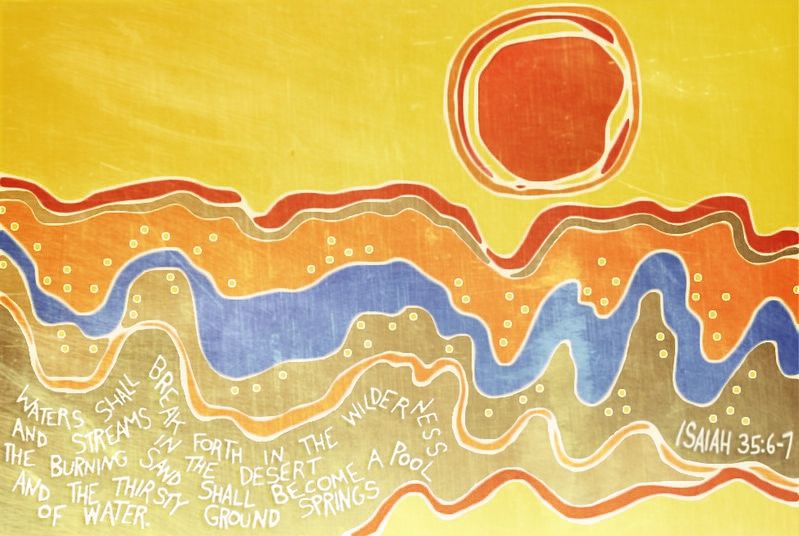
Isaiah 35:6-7

Streams in the deserts restoring us to life
Impelled by the Spirit reclaiming our strife
Bread sent from heaven and fruit of the vine
Community's nurturing right down the line
Sitting in the courtyard feeling sort of fine
Wondering what to do with no crystal-clear sign

seafood sandwich

Making lemonade and squeezing more limes
Parsing out daze but expecting few rhymes
Art world church world blog-style sites
Funky seafood burritos kiwi cranberry lights
Preachers teachers shopkeepers into God's rules
Multiplicitous musics sun-basking pools

Reading into history expectations and hope
One more time knowing now I gotta cope
Charge into the world make another new try
Instead of just settling reaching for the sky
Challenging this planet to listen now and hear
Everything I offer it experience held dear

Truro Beach House

star of india banner

Truro Massachusetts hazy morning in July
San Diego still is Paradise and this is no lie
I'm giving my sorrow and all of my pain
To God the Almighty, Lover not vain
Expecting just mercy and grace in the rain
Falling from heaven embracing the earth
God's glory incarnate declaring our worth

along the 8 June 2015

originally from Wednesday 29 June 2005

Saturday, June 25, 2005

Heart Knowledge: blog

Another reflective saunter!

Doing theology and living theology: how do you speak a valid word about a person without knowing that person's heart? How can you speak the word about God unless you know the Divine Essence from live experience? How does one - how do you, how do I, how does anyone - faithfully, authentically and with just plain reality talk about a person unless you know their experiences and especially their heart? During one of our online book discussions I’m remembering because recently I posted a lot of what I’d written, after mentioning how God in Christ Jesus shared our common lot and learned the human heart from the experience of living human, semi-rhetorically I asked, “As humans, can we know God’s heart?”

In Hebrew biology the heart is the seat of the will.

Throughout the Bible’s witness, the demonstration of Jesus’ life and the life of the Church we encounter the heart of God, which is the heart of a stranger, the heart of the *other*, the exiles, the outcast, the different ones: the anawim, least of these. Inside presupposes an outside (center/periphery? interior/exterior? probably both). Considered one of our most major progenitors in faith, Abram/Abraham was an Ivri - a Hebrew: one from the other side! In Jesus of Nazareth, God the Truly Other-than-us, God beyond time and space, from that exceedingly “other side,” became incarnate, spending most of his earthly life and ministry on the religious and social establishment’s geographic and functional peripheries and exteriors, on the conventional systems’ and accredited authorities’ “other sides.”

Remember imperial religion with its futile and fruitless quest to control and keep God at a distance (on the other side of human affairs and concerns) and at humanity’s beck and call (only coming close when humanity allowed)? As in the Jerusalem Temple, as in a lot of today’s institutional ecclesiastical entities? To shape God into exactly the *what* people wanted their god(s) to be?

Back to how we can know God’s heart: in Hebrew biology the heart is the seat of the will. Our central Christian hermeneutic is God’s definitive self-revelation in the human Jesus of Nazareth; in Christ Jesus - and in this present Pentecost, Sovereignty of the Spirit, Rain of God, in glory, grace, mercy and surprising vulnerability, the heavens are open to all the earth!

For Sunday, July 3rd (Sunday in Ordinary Time 14 A), one of the mix of at least eight Revised Common Lectionary texts is from Matthew 11; part of the part of Matthew 11 I’m planning to preach on includes:
Matthew 11:16-19; 25-30

Jesus exclaimed:
16 “To what can I compare this age group? They are like children sitting in the marketplace and calling out to others:
17 “‘We played the flute for you, and you did not dance; we sang a sad song and you did not lament.’ 18 John the Baptist came neither eating nor drinking, and they say, ‘He has a demon.’ 19 The Human One, Jesus, came eating and drinking, and they say, ‘Here is a glutton and a drunk, a friend of tax collectors and sinners.’ But wisdom is vindicated by wisdom’s deeds!”

28 “Come to me, all of you who are weary and burdened, and I will give you a break. 29 Take my yoke upon you and learn from me, for my heart is gentle and unpretentious, and in me you will find rest for your souls. 30 For my yoke is easy and my burden is light.”
To the jumble of lections for that Sunday, from Proverbs 8 I’m adding:
Proverbs 8

1 Does not wisdom call out?
Does not understanding raise her voice?
4 “To you, O humanity, I call out;
I raise my voice to all creation.
5 You who are simple, gain prudence;
you who are foolish, gain understanding.
12 “I, wisdom, dwell together with prudence;
I possess knowledge and discretion.
20 I walk in the way of righteousness,
along the paths of justice,
33 Listen to my instruction and be wise;
do not ignore it.
34 Blessed is the person who listens to me,
watching daily at my doors,
waiting at my doorway.
35 For whoever finds me finds life
and receives favor from the LORD.”
In Hebrew biology the heart is the seat of the will; in the Matthew 11 passage, Jesus identifies with Proverbs’ Wisdom. In justice and righteousness, the wise person grabs hold of this right now and feasts with friends; the gentle- and unpretentious-hearted wise one invites everyone to the banquet (or sometimes to the simple meal spread on our own picnic table), helping sustain them on every level with food and community, in the intimacy of friendship helping carry their sorrows and rejoicings. Throughout his earth-walk, Jesus’ close to indiscriminate table companionship with almost everyone except the insiders foreshadowed - yet was a taste of the completeness - of the final eschatological Reign of God. In the eucharist, in a single broken loaf and one shared cup, the assembled community of the church offers the Welcome Table’s Bread of Life in which the fruits of the totality of the redeemed and restored creation are gathered together in a single place and time.

In Hebrew biology, the heart is the seat of the will! Throughout scripture’s narrative we encounter a multitude of images of Jesus’ feasting with friends, enemies, outsiders and strangers, showing the world the heart of God that wills to redeem and restore all people and all of creation into a community where everyone belongs, where there is no outsider and not any insiders, either! Jesus’ everyday practice of eating and drinking with all gave the world a foretaste of Maundy Thursday’s New Covenant announcement, Good Friday’s New Covenant enactment and Easter Sunday’s New Covenant ratification, of Jesus’ giving his life for the lively redemption of all creation. According to Jesus, wisdom’s deeds of inclusive table camaraderie lead to righteousness, which we celebrate as one of God’s attributes, and we recognize as one of God’s attributes with which Christ attires and endows us! In faith and in baptism? Yes, of course! But also as we continue following the Way of Jesus every day.

Monday, June 20, 2005

Annihilationism

Another astonishing theological (not!) morsel from (some of) our more conservative sistern and brethren in Christ:

A couple days ago I was searching for something theological and though I can't recall my quest, I'll never forget one of the pages it turned up, but first I need to ask where have I been? I've been concerned about Purpose-Drivenism and Dispensationalism and Consumerism in the mainline churches?!

Again today I searched for the single word, Annihilationism, and got 72 hits. Here's a passage from an article I found—please note how my denying Annihilationism puts me in historically illustrious company:

Flaws in the Arguments for Annihilationism
by Stephen E. Alexander no longer is online where I originally found it

11 July 2004
Beginning in the 4th century, some Christian theologians argued that when non-believers die, their souls disappear into nothingness. Several prominent evangelicals today subscribe to this doctrine of annihilationism, and their numbers are growing. Why is this doctrine so flawed, and why should we be concerned about its prevalence?

The origins of the doctrine known as "annihilationism" go all the way back to the 4th-century when a man named Arnobius first propagated a doctrine that unbelievers passed into "nonexistence" either at death or at the time of resurrection. ...It was condemned as heresy at the Second Council of Constantinople in 553 A.D. The doctrine did not reappear again in church history until at least the 12th century. Throughout church history, leading church fathers have taken a strong stand against annihilationism ... A few of the more famous figures of Christ's church who have given whole-hearted support to the traditional doctrine include: Tertullian, Augustine, Thomas Aquinas, Martin Luther, John Calvin, Jonathan Edwards, John Wesley, George Whitefield, Charles Haddon Spurgeon, and Dwight L. Moody. The Westminster Confession of Faith was very clear in its affirming of hell as eternal punishment.

This past generation has experienced the movement of men believed to be stalwart evangelicals reaching to defend annihilationism. The well-known ones include John Stott, Clark Pinnock, John Wenham, Philip E. Hughes, Steven Travis, and their numbers (those advocating "annihilationism") appear to be growing. Why should this be so, and what is the Biblical "weight" to be given their arguments? Can it be possible that evangelicalism is being attacked from within by a low view of God and His inspired, infallible, and inerrant word?
No further comment on the afore-cited tidbit; later today I'll probably post something of my own.

Thursday, June 09, 2005

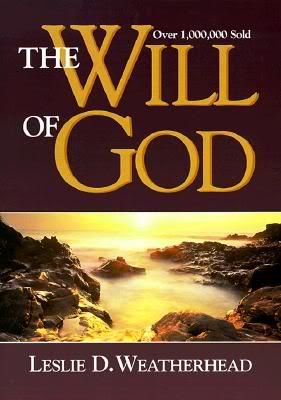
Leslie Weatherhead: The Will of God 4, 5

Leslie D. Weatherhead, The Will of God © 1944; © renewed, 1972

Will of God coverChapter 4: Discerning God's Will and Chapter 5: In His Will is our Peace


Although I read these chapters, I didn't think about them long enough or seriously enough to write any notes, but I've kept the discussion questions and maybe I'll reread both chapters so I can consider and answer the questions within the next few weeks.

Wednesday, June 08, 2005

Leslie Weatherhead: The Will of God 3

Leslie D. Weatherhead, The Will of God © 1944; © renewed, 1972

Chapter 3: God’s Ultimate Will—part 1

Will of God coverThe discussion moderator began:
Weatherhead begins by rehashing the three divisions of God"s will, as in chapters 1 and 2. Yet he offers an interesting perspective of our ability to choose and free will. How does this mesh with your view of choice and free will?
Then he asked,
Do you believe in a Devil as an actual being? Or do you believe in a metaphorical Satan--a personal adversary that can combine with other personal adversaries to create a greater, collective evil that we've seen repeatedly throughout history?
Actually, I don’t know, but I do believe in spirits of evil in the way Walter Wink talks about them in his Powers trilogy, as he draws upon deuteroPaul of Colossians and Ephesians as well as discussing the Spirits (the "Angels") of the Seven Churches in Revelation. And personally, some (most?) of us do what feels like near-constant battle with demons of various kinds, many of which very definitely live independent lives of their own--lives that seem to be ego-dystonic, something completely outside of us that inflicts themselves upon us. Not being an expert on knowledge of the bodily existence of - or the embodiment of - evil, I do think there's a real sense in which the sum of the parts frequently is greater than any of the elements of the parts: in plain English, "synergistic!"

Tuesday, June 07, 2005

Leslie Weatherhead: The Will of God 2

Leslie D. Weatherhead, The Will of God © 1944; © renewed, 1972

Chapter 2: God's Circumstantial Will

Chapter 2, part 1:


Will of God coverThis chapter deals with God's plan within certain circumstances; Weatherhead uses the image of the cross to better explain how circumstantial will works. Reading and connecting to this chapter, I keep finding myself full of gratitude for quite a few totally unintended circumstances I've found myself in--and, of course, particularly thankful for the people who've helped carry me through those times that weren't easy in any sense of the word. Here’s a little on the first part of chapter 2:

Regarding the Cross: given the circumstances of evil, the crucifixion became God's will. Dr. Weatherhead says, "The laws of the universe, which are themselves an expression of God's will, were not set aside for Jesus, the beloved Son." That fact relates to God's preference for acting in incarnational ways! Also, as our moderator observed, there are both natural and spiritual elements within God's circumstantial will.

But continuing: so, like, "every woman" has a maternal instinct...though possibly "repressed into unconsciousness?!" "...a home and husband and babies..." are a women's "primary raison d’être"?!?!?!?! This book is © 1944 and the copyright renewed in 1972. Oh, his definitive solution here is sublimation...no comment.

Chapter 2, part 2:

Whether (or not) an event is the will of God? Get our thinking straight, because the answer is both Yes and No! Once again, natural laws vis-à-vis God's [spiritual] ultimate will. "The Christian minister...he..." OK, this book was written quite some time ago...God would not allow an event to occur if of itself it had the power to defeat Godself. Dr. Weatherhead is correct that in the Bible we don't hear people explaining away diseases, etc. as "the will of God," but this has happened, or currently is happening "that God might be glorified!" He's got it right about the kingdom of evil – in deutero-Pauline terms, "powers and principalities" and their sometimes temporary sway or even what appears as their momentary rule over the Kingdom of Heaven. God's perspective is different...yes! Jesus overcoming the world rather than explaining the world!
My notes from later in this chapter:
...indeed the biblical writers were "trying to give God the credit or blame for everything that happens, even the bad stuff!" Because that's the way the people who were beholden to all those other gods were used to thinking - you remember, the temperamental nature gods and place gods that demanded tribute, propitiation, sacrifice and protection? Whatever happened, it simply had to be because of some volatile divinity's anger, pleasure, rage or approval! For a fact the Bible reveals a constantly developing, growing and evolving understanding on the people's part of Who God is and how God acts--and of God's real requirements for the people of God, coupled with increasing awareness of the gracious gifts of God that enable the people's response and fulfillment of God's holy and just demands. Of course I'll refer you to the God of love and mercy - the God of righteousness and holiness - the God Who in Jesus of Nazareth "shared our common lot." With Martin Luther I believe there's a real sense in which all scripture is not equal; like Luther, I'd definitely assign a higher position to those passages that "show forth Christ" most fully.

Monday, June 06, 2005

Leslie Weatherhead: The Will of God 1

Leslie D. Weatherhead, The Will of God © 1944; © renewed, 1972

Will of God coverFollowing the trilogy of books about mission, during the autumnal time of 2003 (that long ago!) I took part in another online book discussion; the book this time it was The Will of God. Leslie Dixon Weatherhead, the book's author, preached at City Temple in London. One site describes City Temple as "...an historic Nonconformist Congregation founded circa 1640, whose first minister was the Rev. Thomas Goodwin (chaplain to Oliver Cromwell). Today it's a cosmopolitan international church ministering in the City of London."

Since I've posted notes from at least four of our other book discussions and given the fact I don't have anything really original to put on this site at the moment, here are some my notes, mainly in response to our moderator's questions and comments. On Amazon-dot-com I found the acronym SIP and when I looked it up I discovered it meant Statistically Improbable Phrases in Amazon-speak (but likely not elsewhere). Related to this book, as SIPs Amazon listed circumstantial will, intentional will, ultimate will and evil circumstances. On to the book!

Chapter 1: God's Intentional Will—part 1

As Dr. Leslie Weatherhead points out, polar opposite outcomes cannot possibly equally be the "will of God."
  1. God's intentional will - maybe we need to reserve "God's will" for this
  2. God’s circumstantial will - in those particular circumstances
  3. God's ultimate will - in spite of evil and even through evil. As our discussion moderator mentioned, the cross achieved God's will not only in spite of but actually through.
Everything is within God's will...but human will can defeat God's will for a time, otherwise we'd have no real freedom, which we know as a facet of the image of God in which we're created. It's blasphemy to call evil, wickedness, immorality and manifestations of sin and fallenness the will of God...but he's also correct we humans sometimes imagine our imagining bad outcomes as God's will to be comforting.
Here are our moderator's questions, followed by my responses:
1) How does your concept of God's will agree or disagree with Weatherhead’s?

? on the whole it does agree – I often differentiate only between God's "perfect will" and God's "permissive will," but I like these further, more defined and refined divisions.

2) Do you also try to explain a death or other tragedy as "God’s will"?

? only in the sense of acknowledging that in sovereignty God allowed the event to happen, but not is the sense of that horrific monster sometimes known as "God’s-willa."

3) If God and his ultimate will cannot be defeated, are human efforts to combat evil in the world in vain?

? Not at all – for this I'll give that stock theological buzz-answer and say God calls us to be and to act in the image of our God who is justice, love, compassion and mercy – and in the image of our God whose name is a verb rather than a noun!

4) A participant asked, "how individual is God's will for each of us? Does God will something different for you than for me?" I responded:

? Indeed, yes - much of God's desires for us have to do with our particular circumstances and our special gifts.

Saturday, May 28, 2005

Stored Value: from Lent 2005

olive garden
Here's a spinoff on one of my favorites (Rivers, Deserts, Identity and...Freedom!) from this blog; for our Lent 2005 Church Devotional Book I reworked it some, so here's the newer version on this eve of Pentecost plus.

Exodus 16; John 6:25-34

A while ago I had lunch at Olive Garden and spent part of one of my stored value gift cards. Since I think theologically something resembling 24/7, I began thinking about the theological implications of stored value and how it could play out in our everyday lives, away from restaurants, malls, and all those shopping scenes where gift cards are easily spendable; I started connecting stored values to events defining us as Christians and as Church.

During those years of being manna-fed in the desert, Israel lived and thrived with the experience of the heavenly gifts and divine justice that meant enough for everyone and too much for no one; under Moses' leadership and Yahweh's Lordship, the wilderness sojourners lived in daily com-pan-ionship. The people Israel called the manna "Bread of Heaven," and for a long forty years wandering through the desert, the "stored value" in the manna nourished them; in trust they journeyed with the One Who bestows the bread of physical provision, gifts of mercy, and gifts of justice!

In chapter 6, John the evangelist calls Jesus, the one born in the Little Town of House of Bread, Bread of Heaven, and today, in the Lord's Supper, we know the benefit of living manna blessed and broken, given to us to supply our needs. Like the Israelites in the journey to freedom, as long as we remain faithful by doing justice and righteousness, that reality of the eucharistic manna's "stored value" will keep working for us and in us, enabling our ministry for the world and in the world.

Via the gospel writer John, Jesus called himself the real manna from Heaven, and promised anyone who ate that manna, that "Bread of Heaven," never would be hungry, would live forever and never die! Talk about stored value! Jesus the Living Word of God is the Bread of Life; Jesus is our manna and the entire world's manna. Along with the Old Covenant scriptures, Paul insists, "the Word is very near you, in your mouth and in your heart, so you can do it." (Deuteronomy 30:11; Romans 10:4) In Christ Jesus we have values of justice, mercy, and righteousness stored in our communities and in our inmost beings to give for the life of the world, to give as manna towards the world's healing and wholeness.

Tuesday, May 17, 2005

Mission and Evangelism, again:

After posting this morning, I realized including a couple more things would be a good idea; first, here's the entire Article 7 from the Augsburg Confession:

Article VII: Of the Church.
Also they teach that one holy Church is to continue forever. The Church is the congregation of saints, in which the Gospel is rightly taught and the Sacraments are rightly administered.

And to the true unity of the Church it is enough to agree concerning the doctrine of the Gospel and the administration of the Sacraments. Nor is it necessary that human traditions, that is, rites or ceremonies, instituted by men, should be everywhere alike. As Paul says: One faith, one Baptism, one God and Father of all, etc. Ephesians 4, 5. 6.
Then, here's a paraphrase of a scary incident about evangelism and mission shared by a colleague at April's Faith, Order and Witness meeting:

The close to incredible success of the Presbyterian branch of the Church in their evangelical efforts in Korea generally is well-known; however...a Presbyterian from Korea essentially maintained to an American, "We wish you could have brought us the flower of the Gospel without the flowerpot, which we definitely did not need!" As Augustana 7 insists, "Nor is it necessary that human traditions, that is, rites or ceremonies, instituted by men, should be everywhere alike." From here I'll say not only not necessary but definitely not remotely desirable, either!

Exclusion and Embrace notes

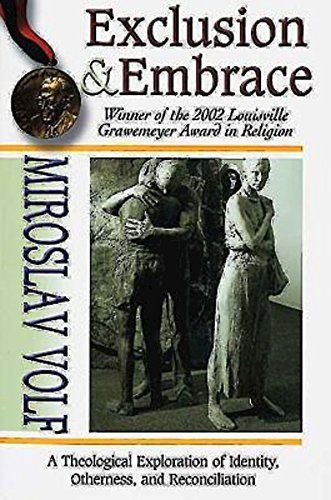
With the vital currency of mission and evangelism, (and considering the fact I've started a half-dozen ideas but developed none of those sufficiently to let them air on this blog), today I'm posting some notes from Miroslav Wolf's first book of free church ecclesiology.

exclusion and embrace cover
In Exclusion and Embrace: A Theological Exploration of Identify, Otherness, and Reconciliation, Miroslav Wolf quotes Daniel Boyarin as he points out although the Pauline solution of 1) relativizing Torah; 2) discarding genealogy; and 3) for the sake of all the families of the earth embracing the crucified and resurrected Christ as the seed of Abraham in whom "there is no longer Jew or Greek, slave or free, male or female," offered a "possibility of breaking out of the tribal allegiances...it also contained the seeds of an imperialist and colonizing practice; Paul's universalism even at its most liberal and benevolent has been a powerful force for coercive discourses of sameness, denying...the rights of Jews, women, and others to retain their difference." –pages 45-46

"...baptism into Christ creates a people as the differentiated body of Christ...[which] lives as a complex interplay of differentiated bodies—Jewish and gentile, female and male, slave and free—of those who have partaken of Christ’s self-sacrifice. The Pauline move is not from the particularity of the body to the universality of the spirit, but from separated bodies to the community of interrelated bodies—the one body in the Spirit with many discrete members." –page 48

When I read this book in early fall 2003, Wolf's articulation of Paul’s universalism really wowed me! However, it's easy to see how some of Paul's theology and ecclesiology – as well as his anthropology – could be one of many factors that has caused all too much cultural arrogance, leading in turn to cultural, economic, political and social colonialism and imperialism.