Sunday, April 09, 2006

Emerging Church

Emerging Church, emerging churches

Due to my lack of knowledge and even basic information about the subject, this will be a short blog about the Emerging Church Movement, together with a few slightly connected ideas and observations from my experience.

First question: from what, when or where is the Church, are these churches emerging, or springing forth? Already we're familiar with a structure, entity or (best definition) organic reality known as church, so the more-or-less known church could be the what. From when? A logical response could be the new church is being born from a when of incubation or gestation, usually quantifiable in linear time if not always in a where of geographical longitude and latitude. However, what, when and where all take their place within history's eventfulness, so having started this blog by attempting to seem smart, on to the real topic.

A lot of what I've noticed happening tangential to my immediate world but especially just a little further down the pike convinces me that we [the churches] need to begin imagining new liturgical models, which still will focus on Word and Sacrament in a fully participatory manner—full participation as audacious counterpoint to the entertainment worship that's becoming prevalent in the more politically and socially conservative fundamentalist world and even sneaking in to mainline Protestantism and Roman Catholicism.

Some congregations deliberately quest to become like those other churches across the street, down the boulevard, or in geographically near, but more visibly - at times ostentatiously so - affluent areas. Although I hesitate to write "evangelical," that was the Reformer's word for Protestantism in general and evangelical remains the word for "Protestant" in non-English speaking countries. Nonetheless, my readers know what I'm trying to say! To quote Krister Stendahl, "I hope we all are evangelical!" And I trust we all speak and walk the Gospel Good News, evangelion!

Mennonite, Moravian, Brethren

January's Faith, Order, Witness guest, whose house church is loosely Mennonite-affiliated, told our group the members of the community hadn't resonated with or been able to relate to more conventional churches at least for some time—if ever. When our mainline group asked, But is it sacramental??? He replied yes: we celebrate eucharist every week and we study the Word—rather, the Word studies us! He didn't mention baptism, though I'm aware Mennonites are Anabaptists and as such, officially have a low, essentially functional (sign of grace) rather than sacramental (mighty act of God and means of grace) view of baptism, despite affirming its necessity in obedience.

Our January visitor explained that his church first receives people into membership, then teaches them, and as a gradual process they assume appropriate Christian behaviors and lifestyle. In the formal Faith Journey I compiled a couple years ago, I referred to "performing the scriptures," and that particular house church tries doing exactly that, so as individuals and as community they'll become transformed into the shape of the biblical narrative as the Word re-shapes and re-forms them. But how do you line out the history of the people of God journeying in trust from slavery into servanthood? From bondage into personhood? From individualism into covenantal community? Could it happen, can it be done, by walking that walk oneself, the arduous, sometimes surprisingly joy-filled trek from pseudo-dependence upon self to total dependence upon God and community, so it becomes our (your, my) testimony to tell? That could be an exciting and a contagious way to live!

For both children and adults, the old model for full church membership was catechesis first and then full membership; however, the non-Anabaptist (Roman and Anglo Catholic, as well as we who formally identity with the Reformation's "Right Wing" ok, Lutheran and Reformed...) churches long have assumed baptized infants and youngsters as members. On Sundays and festival days the early church allowed catechumens to remain at worship only through the liturgy of the Word—the eucharistic portion was exclusively for the baptized. These days I'm giving that some thought!

Culturally Congruent=Counter-Culturally Incongruent

A dozen or more years ago "you are what you eat" was a buzz-phrase. During those same yesteryears, writing about a meeting of the local Lutheran-Episcopal Dialogue (styled LED), rather than getting arcanely theological since I wrote the paper for intro cultural anthro or anthro of religion, I observed one of the ways to be yuppie was to eat quiche and salad accompanied by box wine, though as I recall, the AELC congregation hosting the event was German in origin and probably served good wine during the repast (I'm relatively undiscriminating and quite unknowledgeable regarding spirits), especially since Angelica of Franciscan California mission origin was their usual sacramental wine.

At least the food part of the event was congruent with the current culture, though the worship and discussion sections weren't! I also stated that in every culture, food has immense symbolic meaning, and particular foods become identified with and readily recognized as belonging to certain lifestyles, and thus are capable of symbolizing those lifestyles. Early on people learn to decode what a specific configuration of food means as class, as ethnic, or as personal symbol.

In each of our lives, food is an essential part of the creation and sustenance of the self-image each one of us determines both consciously and unconsciously, and that consciously and unconsciously gets read, then received or rejected by others; whether high or low, ethnic or vernacular, cuisine is major ingredient in the interaction between individual self-definition and society's definition of that person. And a causative factor in class mobility: change your diet, change your life. Here's my invitation for you to translate this entire paragraph into Christianese?

Korean Presbyterian – assume both words are adjectives rather than nouns

The blazing success of evangelization in Korea by the Presbyterian branch of the Church is well-known, but I heard about a Korean Christian telling an American Presbyterian it was wonderful Presbyterians brought the flower of the gospel to Korea, but they definitely did not need the flowerpot!

About an hour ago I heard Bruce Hornsby and the Range singing When the sun goes down on the Water Town,...or, in my case, when the sun goes down on Watertown, Massachusetts, where I lived during my last semester in seminary. When the created sun goes down on anytown, without a doubt it rises the next morning on that same town unless it's rainy and overcast, but it rises everywhere else, too, sometimes at the same chronological hour, sometimes at different hours, but every sunsets and sunrises happens on history in motion—on a venue of God's creation and redemption.

Being Christian
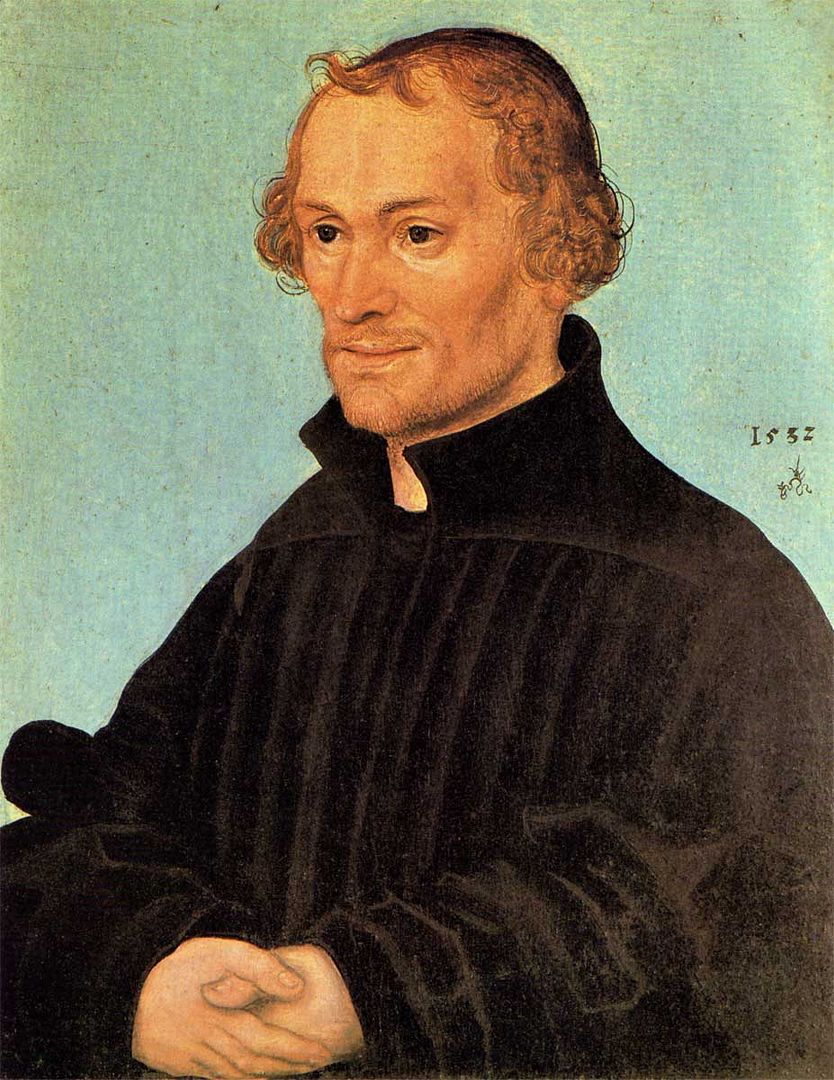
Philip MelanchthonOne more time:

•"The Church is the congregation of saints, in which the Gospel is rightly taught and the Sacraments are rightly administered. And to the true unity of the Church it is enough to agree concerning the doctrine of the Gospel and the administration of the Sacraments. Nor is it necessary that human traditions, that is, rites or ceremonies, instituted by men, should be everywhere alike. As Paul says: One faith, one Baptism, one God and Father of all, etc. Eph. 4, 5. 6." Philipp Melanchthon, Augsburg Confession, Article 7.
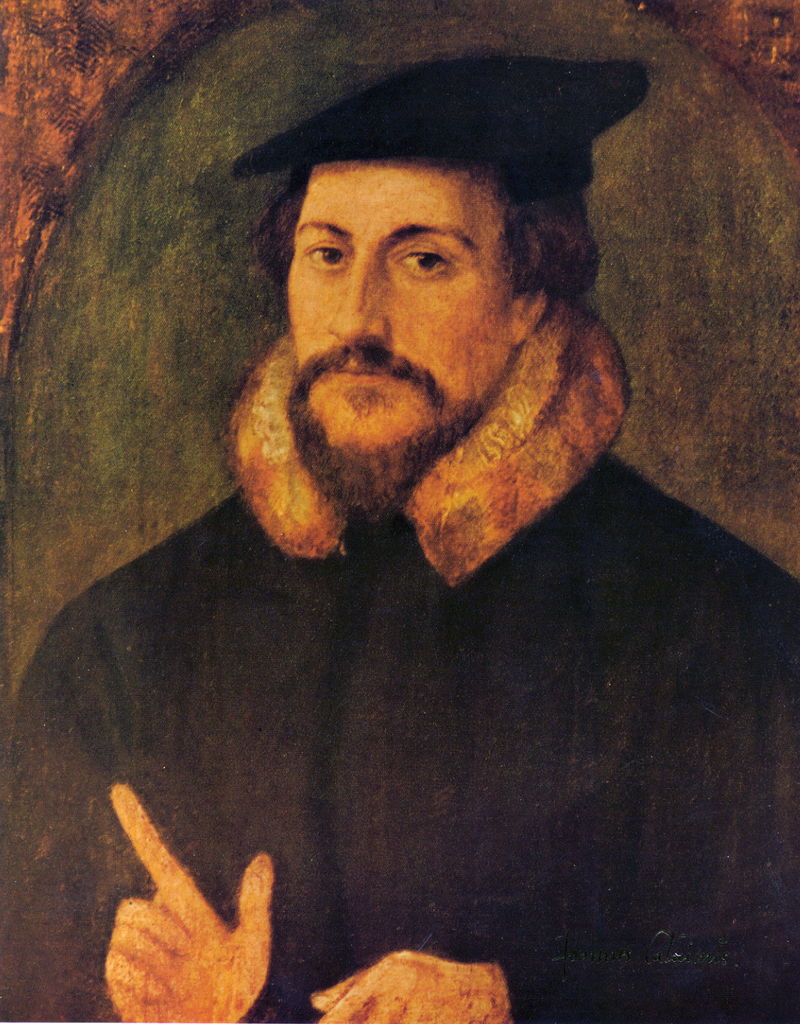
John Calvin, Holbein porterait•"Wherever we see the Word of God purely preached and heard, and the sacraments administered according to Christ's institution, there, it is not to be doubted, a church of God exists." John Calvin, Institutes of the Christian Religion, Vol. 4, chapter 1, section 9.

Luther's Seven marks of the Church

Word, Baptism, Eucharist, Office of the Keys [confession and absolution], Office of Ministry, Worship, suffering and persecution [cross].

In plain words, works are not the primary marks of the church; the primary mark of the church is the presence of Jesus Christ, being in Christ, faithfulness in Word and Sacrament. Regarding approaches to liturgy and homiletics, Nor is it necessary that human traditions, that is, rites or ceremonies, instituted by men, should be everywhere alike. As post-modern creatures yet descendants of the industrial, post-industrial, technological and cyber-revolutions, we need to trust that works are neither the major mark of any Christian person nor of the church; but as gifts of the Spirit, to the same extent as faith is a spiritual gift, works happen in strange places and in surprising ways as historical events measurable in time and space. Living in trust as human beings rather than human doings—not doing human but rather being human!

Being American

For a couple of centuries during, taking upon oneself a vital piece of American culture meant to be mainline protestant. Parents would make sure their kids went to Sunday School; often people who'd drifted away or left church would return to church because they wanted their offspring to have a moral education. So true that for ages Americanism almost equaled Protestantism, but as immigrants moved up the alleged social ladder and became financially articulate, they became hyphenated into Italian- Irish- Polish-American, so Roman Catholic Christianity gradually became a way of being American.

One of the hallmarks of the Reformation Church was biblically well-read and theologically well-educated laity—hardly the theologically and biblically close-to-illiterate folks trying to sit comfortably in the pews these days, but maybe they're trying to keep up with the assumption they grew up with that part of being American means church attendance? Word: this afternoon I noticed a song called "Springtime Jesus" in a Sunday worship bulletin. Where in the Bible can I find Springtime Jesus? Sacrament: little perceived hunger for the bread of life and the cup of salvation; too many instances of the blasphemy of rebaptism at the request of parents or significant others.

Being American 2

I mentioned "new liturgical models," so how about looking out from the church and in at secular society's new "liturgical models"? Cities of all sizes in this country and in Europe have been rediscovering neighborhood as a social setting, with the multitude of creatively revived downtown shopping centers designed to facilitate face-to-face and group interaction. Here in San Diego the Gaslamp Quarter immediately comes to mind, as does the Padre's Petco Park, whose(?) presence has been generating new and revitalized housing, with soothsaying that by 2030 I don't recall how many people will work and live downtown. Urban revivals and rebuildings have happened as reactions to decay, displacement and demolition.

Referring once more to our FOW guest's house church, the kind of coming together he describes is what people seek and are finding in the cities these days: casual, routine, social interactions that build trust and grow persons as well as communities. Ironically, I write all of this from the notoriously anomic and anonymous section of Clairemont: a few blocks down the street from here some of the 9/11 terrorists could be so invisible not a single person wondered about their comings and goings or thought anything clandestine was happening right next door. This being the section of town it is, most likely no one thought at all. My condo complex feels anonymous, too, but I'm well aware (poignantly so?) I wisely (really!) grabbed this property as soon as it was available, despite hankering after City Heights and North Park. Time to quit this reflection.

Friday, April 07, 2006

...the world celebrates...

...the world celebrates the love of God in the world celebrates...

I had to post this! Many moons ago I did graphics of it for our church newsletter and for a poster in the social hall; though I don't recall whether or not it's original, it sounds like something I'd still say today.

Saturday, March 18, 2006

Remembering and Belonging

It must be Lent! A few days ago this year's edition of the Church Prayer Rug (exactly the same as last year's and the year before last's) arrived in the snail mail. My remarks during Lent 2005 still stand but I need to say more. For the past week I've been reading Walter Brueggemann's Texts That Linger, Words That Explode: Listening to Prophetic Voices. I've read enough of what he's written to consider myself both moderately Brueggemann-ized and close to Brueggemann-ian, but in this blog, which includes permutations of my own ideas influenced by and/or combined with WB's, I won't refer to any particular books, passages or chapters, since it'd be difficult to separate out one of his books from another and almost impossible to differentiate my ideas from his.

Baptism

The scandal of baptism! I've blogged so very much about the sacraments, though possibly(?) more about baptism than about the Eucharist, and as months and years hasten by, I've arrived at an increasingly sacramental worldview, but still I'll go on record with the protestant "two only" formally liturgical aka dominical sacraments. Baptized, we no longer belong to ourselves or to a simply nuclear biological family of origin, but rather God and the church claim us in covenant...baptized, we live reborn into the water of Jesus' birth and we are alive in the fire of his death—the transforming, rebirthing power of the cross. Baptized, we no longer live under the reign of death, its idols and its artifacts, but we thrive in, with and under the sovereignty of Life. Baptized, we live together as an alternative community countering the individualisms of covetousness, greed, commoditization, consumption, superfluity, satiation, and (ultimately) despair. How do you like my Pauline list?! :) ;) Living baptized, we need to remember the story of God's people, our story, and our mutually covenanted identity, leading us to the joyful responsibility of...

Remembering

Remember, remember: tell the story, relate the history, recount the narrative. WB points out that proclaiming and teaching Heilsgeschichte memories is not mainly for the outsiders but primarily for us insiders, who easily, quickly and guiltlessly forget the liberating desert experiences that forged and continues shaping our identity, which, after all, is living in the freedom and responsibility of covenantal community, gathered in the shadow of the cross around Word and Sacrament. He also suggests that most likely during the deuteronomic period of Assyrian dominance Israel first began celebrating the Passover liturgy with its sacramental reenactment of deliverance from Egypt...and he mentions Deuteronomy's intensely covenantal theology. These days the powers-that-be also are violently (and sometimes deviously) brutalizing ones that we cannot avoid coming in contact with. How, then, will we respond? Will we remember who we are?

Obedience

Brueggemann always is huge on obedience! In at least one of his books I've read, he describes the Church as the assembly that observes the Commandments, the Sabbath and the Tithe. Again I'll mention his reminding us Luther begins his Small Catechism, traditional preparation for First Communion, with the Ten Commandments—Sinai Covenant, specifically. After all, says WB, it is the God of the Commandments with whom we commune! And he observes that Holy Communion is "pre-Eucharist," though our receiving Communion is but one facet of the Eucharistic liturgy...

Sabbath: not only an aspect of our in-God-created-ness, but Sabbath-keeping reminds us we are human beings and not human doings.

The Tithe: who owns us? To what Lord do we answer? Of whose property and assets are we stewards? It's about caring for the gifts we have, about sharing and using them in service to others—Church Prayer Rug and its ethos notwithstanding, the way of the prophets and the way of Jesus of Nazareth is not exactly about petitioning heaven and getting a windfall in investment capital, real estate or social position! Yahweh of Shalom sufficiency is the God of Jubilee Justice, Lord of commonwealth, not a deity of superfluous particular wealth. Jesus' God is the One who gifts with extravagant mercy and boundless love and whose Spirit draws us together in Pentecostal fire. Now really, does that sound like the tawdry emptiness of the Church Prayer Rug god's casino-style payoffs?

Recently

Reverting to the here and the now, a phenomenon (an abomination, an anathema such as the Church Prayer Rug) explicates the fact that overall, at this time in history, the church does not have the well-educated laity that was such a Reformation hallmark. Last Saturday evening I participated in another session(!) of Presbyterian Bingo (notice I'm not linking to the church that sponsored it?!)...a friend in attendance, who also is theologically inclined, told me Martin Luther loved games and since we were playing for prizes rather than trying to spring souls from timeless torment, the activity qualified as big "P" Protestant. That's the church where the youth held sidewalk sales during Sundays in Advent a few years ago! Sales on Sundays!?

Cornel West

To paraphrase Cornel West, "We are people of hope. Why do we party on Friday night? Why do we go to church on Sunday?" People of hope! A living hope set on the Living One Whose final Word always is resurrection. Those Friday night parties? Payday in the inner city, sustenance for living beyond subsistence existence once again, but not just for a single solitary person—for everyone! How do we party? With dance, song, talk, by laughing, celebrating together with savory food, the fruit of earth's harvest. Together, because everyone has gotten a slice of the wages, a piece of the common-wealth: an irresistible foretaste of the feast to come. Many of us observe Sundays as our Sabbath and worship day. We worship together, because we hold God's promises in common and, after all, every Sunday is anamnesis of Resurrection, of Easter, realization of the fullness of salvation and also a foretaste of the promised feast to come. This isn't a proprietary "personal Jesus" an individual might imagine they could own—it's the crucified and risen Christ Jesus who is our Lord, who has bought us and owns us, and to whom we owe allegiance, responsiveness and our very lives.

Remembering and belonging? When you remember, you will know you do belong!

Friday, March 17, 2006

The Desert, the Cross and Easter

Screen capture: Desert Sonoran Easter, ground zero
Pascal daybreak: Lepus sits tamed at Orion hunter's feet
evoking the kairos past when
Noah's God hung his weapon bow
high in the sky, surrendering disarmed
Divine capitulation to creation
for earth to claim covenant
Desert dawn's eastered hues quietly course throughout creation
equal desert's constant colors
Friday's cross seemed desolate
but from mortality's tree
on Sunday's morn bursts forth the Tree of Life:
earth all-living breathes again!

© Leah Chang

Check out this related blog from Good Friday, 2005.

Wednesday, March 15, 2006

Lent 2B Considerations: Abraham and Us

Texts: Genesis 17:1-7; Romans 4:13, 16

Opening and closing prayers are based on Marty Haugen’s Gather Us In.

God of Heaven and Earth,

Here in this place, new light is streaming; now is the darkness vanished away.
See in this place our fears and our dreamings, brought here to you in the light of this day.
Here in this room the new light is shining; now is the Kingdom and now is the day!
Gather us in and hold us forever; gather us in and make us your own
Gather us in, all peoples together—fire of love in our flesh and our bone! Amen!

Genesis 17:1-7

Now when Avram was ninety years and nine years old, Yahweh was seen by Avram and said to him: I am God Almighty, El Shaddai, the real God of the Mountains! Walk in my presence! And be wholehearted! I give my covenant between me and you, I will make you exceedingly, exceedingly many.

Avram fell upon his face. God spoke with him, saying:

As for me, here, my covenant is with you, so that you will become the father of a throng of nations. No longer shall your name be called Avram, rather shall your name be Avraham, for I will make you father of a throng of Nations!

I will cause you to bear fruit exceedingly, exceedingly, I will make nations of you, (yes,) Kings will go out from you! I establish my covenant between me and you and your descendants after you, throughout all generations, as a covenant for the ages, to be God to you and to your descendants after you.

Translation from The Five Books of Moses: Genesis, Exodus, Leviticus, Numbers, Deuteronomy, Everett Fox (The Schocken Bible, Volume 1)

Abraham and Us

When Abram was 99 years old, God appeared to him and God called Abram by his name. But why did God start a conversation with Abram? The passage we just heard tells us: to make a covenant, a binding agreement, to form an endless, everlasting relationship.

Throughout the witness of the Bible, time and time again, God reaches out and speaks to the people of his creation—God still speaks to us today! Of course, God knows each of our names, too…

Maybe you noticed in this account God is the person who acts first, speaks first, and begins the encounter into relationship? Not only does God call Abram by name; God comes to Abram right where he is, in common, familiar surroundings, in the same way God meets us right where we are, in everyday places—like right here today, for example!

Okay. So God met Abram in Abram’s here-and-now. But what else was happening?
Abram was extremely unhappy with his situation; IOW, he wanted and needed a lot that he didn’t have, and no way whatsoever was Abram – or any human – in a position to make that happen. Besides Abram and his wife having the sorrow as a couple of not having the children they desired, being childless in that era placed them in a position of cultural dis-grace: unenviable, to say the least, exactly the way every one of us finds ourselves in a situation (or sometimes multiples ones all at the same time) no one would desire or choose.

Yes. Abram wanted someone to carry on his family…and his name! But in addressing Abram God not only proposes his side of a covenant; God has a request of Abram, asking him, “Walk in my presence!”

Reading through scripture, we keep meeting God as Maker of covenants with creation, initiator of gracious agreements, partnerships with creation! Later on in the world’s history and in our own lives, we meet Abram’s God – and Jesus Christ’s God – as the One who rolls death backwards into new life! This God, whose final word always is resurrection, tells Abram, “Walk in my presence!!!” Live your days and your nights beside me, simply be in the same place as the God whose Word calls new life our of death.

We could admit Abram – now given a new name, another identity of Abraham – wasn’t yet physically in the grave, but in finite, human terms, his physical existence could evaporate at any moment and he had no human hope of receiving his heart’s desire. What else did God ask Abraham? To be wholehearted! Some versions say, “be blameless.” For his heart, his desire and his will to line up with God’s heart, will and desire–surely impossible in solitary human terms, but since he’d be walking with the Lord of Life, it definitely could and would happen, and by God’s action alone. That’s known as grace!

God promises Abraham not just one or two or a few offspring, but a throng, a noisy assembly of people as his descendants! And that’s where we come into Abram’s/Abraham’s story, the story of the people of God. Children of Abraham! That’s us! Let’s hear what the apostles Paul says about us in chapter 4 of his letter to the church at Rome:

Romans 4

13 God did not give that famous promise of inheriting the world to Abraham and his descendants because of something Abraham did or would do, but because God decided to put everything together for him;; Abraham entered into that covenant when he trusted God. 16 ...the fulfillment of God’s promises, God’s covenant, entirely depends on trusting God and taking what God does into our lives as pure gracious gift.Remember, Abraham, is the father of us all – not our racial father – that’s reading the story backwards! He is our faith father, our ancestor in trust.

Not because of anything Abraham did or would do: not through any rule or law or rule of law, but simply through trusting God’s promise enough to say “Yes” to him and to begin walking and living God’s way.

Fast forward: Abraham to Jesus to Paul to San Diego 2006. We know that in the cross of Jesus Christ, God has made the ultimate, the last covenant of grace with all creation, with each one of us. In Jesus Christ, God draws all of us into his life so we can walk with him in trust. By trusting God in Christ, we not only live as Abraham’s children, but also as sons and daughters of the Living God, who now gives us a new name, Christian!

God charged Abraham, “Walk with me and be blameless.” In Jesus Christ, God sees us as holy, complete, wholehearted and without blame: In God’s world, ultimately death, disappointment, grief, betrayal and loss are rolled backwards into new life, renewed hope and abounding joy.

In Jesus Christ, Abraham’s story becomes our story. God calls each of us by name, invites us into his gracious presence, makes an unbreakable, eternal covenantal agreement between each of us and him and…the exceedingly, exceedingly large assembly of Abraham’s descendants known as the Church of Jesus Christ. God charges each of us to trust his Word of promise enough to walk with him, to live in the way Jesus shows, one step at a time, all the rest of our days. God promises to remain with us and God’s greatest joy is for us, Abraham’s daughters and sons, to be in his presence.

Let’s close in prayer:

God, you always meet us,
Not in some heaven, light years away, but here you shall call your sons and your daughters, call us to you to be light of this day.
Gather us in and hold us forever; gather us in, all peoples together.
Call to us now, and we shall awaken, walking with you at the sound of our name
In the name of Jesus Christ, crucified and risen for the life of the world,
Amen!

Wednesday, February 22, 2006

Belonging and Remembering

Don't let me come home a stranger! This blog from August 29, 2004 was Part 3 of a series of short "God, Strangers and Saints" blogs. Eight days earlier, August 21, 2004, proportional to this current belonging and remembering topic, I wrote Culture Bound, with the subtitle, Culture, identity, home, belonging, etc...

The "ing" gerund form of the verb indicates ongoing action. Reading some of what I've written in the past frequently amazes and impresses (!) me—I need to remember and heed my own counsel. I also realize that for the most part I've been reasonably wise but often not quite intelligent! One aspect of re-membering means putting together again the biblical texts in a plain and simple manner, making the words and their meanings literally members - belonging, in the same sense as church or club or family membership - of my daily ministry and life: re-membering my walk with the Lord of Life by binding the texts between my eyes (brain stuff) and wearing them on my body (trust stuff). You accurately can claim the Reformation began in a burst of emotional despondence, but at least as accurately you can assert it started in a burst of exegesis. Truth is, God says I do belong, you belong and we belong; each of us is a part despite often feeling apart; God's Word can be trusted. It's that precarious state of both belonging and not belonging at the same time--and of course, it's yet another paradox, and you know how I love paradox. Though I'm not going to wade through his sermons to find the exact location, Paul Tillich had elegant words about it, as essentially he said we are "separated and yet bound." By creation, by baptism and by the Holy Spirit's pervasive, persuasive power in the world and in my life, I cannot unbelong myself from the church or from the family of creation.

Several times I've posted [here's another one I found with a quick search], "I, the Lord of font and cup, covenant to lift you up; splash the water, break the bread, pour out your life..." In baptism, God gives us and we take upon us Jesus Christ's name and identity (even unto suffered under Pontius Pilate, crucified, dead and buried! One of Graham Kendrick's songs includes, "To be found, my Lord, in a death like yours, so to live with you and never die"), but we also retain and get to explore, celebrate and share our unique gifts within the community and out there in the world. One of the outrageous scandals of biblical faith and sacramental theology is that we find the Divine Presence apparent (uncovered!) yet hidden (concealed!) in the commonest things—we're not talkin' hallucinogens, entheogens, fantastically elaborately esotericisms. Therefore? We need to gather around Word and Sacrament as often as possible? This is most certainly certainly true.

I began the God, Strangers and Saints 3 piece with,
But how does this gospel requirement of strange living align with our need for belonging, our need for being at home, and particularly with the gospel assertion that in Christ we no longer are strangers, in Christ we've come home to a circumstance and even to a place where we truly belong?!
Extensively I've blogged about the call to gracious hospitality God always has given the people of God; Romans 16:7, "Welcome on another as God in Christ has welcomed you." The friendship, collegiality and respect I've been feeling and getting at design school is resurrection! Maybe my readers are noticing I'm writing on my theology site the kind of thing I typically reserve for this far by faith? In ages past, for me the church not only was the exhibition of the kingdom of heaven: it literally was the kingdom of heaven incarnate--exactly what the Church is supposed to be! How some ever - as sometimes we'd say back in Boston - in the Interactive Media Certificate Program I'm experiencing what I knew I'd find in church.

Last August 14 on this far by faith, I talked more about my story and quoted a blog I'd done on this site a month earlier. Citing myself again for a necessary reminder:
I was a Daughter of the Church, daughter of the churches. Drowned, then raised to new life in the waters of baptism, sustained by the Word of Life and the Bread of Life.

Here's a passage from one of my July blogs on Desert Spirit's Fire—and here's the entire post:

However, Israel became Israel, receiving the identifying name, not in the Promised Land flowing with milk and honey but in the desert of the trek toward that promised-landed freedom. In the desert's sparse economy, with surprising gifts like water from the rock and manna from the sky, Israel and Yahweh encountered each other into the kind of relationship that later would enable God's people to recognize God's paradoxical self-revelation in the preached Word and proffered sacraments...

Now and here, like Christ Jesus, face-to-face with the world, the church is the incarnation of the fullness of the time of salvation, the era of the Reign of Life; as persons of the ekklesia, of the church, our sacramental liturgies and lifestyles replay God's paradoxical self-revelation in the exodus desert, recognizing and celebrating God's sustaining presence in, with and under creation's commonest stuff, the utmost essentials for life produced from the heart of the earth.
The theological truth remains we are baptized into the vertical and horizontal life of the Church at the same time we are baptized into Jesus Christ's birth, life, death and resurrection.

Wednesday, February 08, 2006

The Book of Daniel

book of daniel cast
Now that I'm getting around to posting, the subject may be obsolete: the last couple Friday evenings at 10 I turned on the TV and Daniel was nowhere in sight. Last night someone told me the show's been cancelled, although the NBC link still works...our more conservative brethren and sistern have raised a vociferous hue and cry about Daniel! Too bad, so sad! Nevertheless, here's my blog.

On Friday, January 6, NBC aired the first episode of The Book of Daniel. I've checked out a few reviews and won't attempt to place the show into any category, except to say the first week's episode (January 6, Epiphany) was tremendously overdrawn, even beyond caricature, though January 13's was less mannered, more tempered.

Before I say more about Daniel and Other Reflections, an intriguing note: when one attempts to access the home page of the Episcopal Church USA and one therefore types "ecusa.org," one can expect to receive a notice reading:
The Episcopal Church in the United States of America is often called ECUSA. Perhaps it is more properly called PECUSA (The Protestant Episcopal Church in the United States of America). If you think that being Episcopalian is about being proper, then you should probably call it the Domestic and Foreign Missionary Society of the Protestant Episcopal Church in the United States of America.
And a couple of observations, which may feel arrogant on the computer screen, but in person I trust I'd be careful to convey them with calmness and compassion:
  • liturgical reminder: the Eucharistic portion of the liturgy follows the Service of the Word or ante-communion... the chasuble is the wedding garment of the messianic feast and most properly worn by the celebrant only for eucharist—so in an ideal world you probably wouldn't preach in a chasuble.
  • theological observation: the New Testament uses priest in two senses only—for the unique priesthood of Jesus Christ and for the royal, prophetic, priesthood of all the baptized, our essential ordination. So depending on how you view it, technically no one of us is a priest and technically every one of us is a priest!

Book of Daniel cast
The Book of Daniel

The Episcopal Diocese of Washington (D.C., which includes four Maryland counties), used to have a blog about the show. When I checked for living and dead links, I discovered it's gone.

Andrew T. Gerns, [now former] rector of Trinity Church in the Episcopal Diocese of Easton, PA has this blog, including a post about the TV show. Father Andrew's comments on the Washington's Diocese's blog especially moved me; an excerpt:
The Book of Daniel is not about us. It is a lens into how our culture struggles with issues of faith, morals, ethics and spirituality in an age where we share no common language about how to "be" in the world we are in. If we think of this as a commentary on Christians in general and on the Episcopal Church in particular then we can be nothing but offended or, at least, put off. We would have nothing to do but defend ourselves or ignore it.

There is a third choice. We can listen to what the show is telling us. If we look at this series as what it is, the musings of these writers and producers-who seem to be mainly outside the church-about issues of meaning, spiritual life, and belief at the intersection of ideals and reality, then perhaps we can gain a better understanding of the needs, the pain, the hopes, the dreams and disappointments of our culture today. We Christians should listen to what The Book of Daniel is telling us about the world wishes belief in God and spirituality could do for them. Through the show, the culture is also telling us about where the Church is perceived as having failed them.

Relationship is key. This is a generation that does not find meaning in community but in relationship. Both rugged individualism and group therapy has failed but hope is found in our network of relationships. We are being shown that real strength lies in a kind of networked individualism. All the relationships in The Book of Daniel are broken and people exist in isolation. They are trying to find ways to meet and connect with one another. So the show is telling us that what people are seeking is meaningful connection with one another.

Related to this is the need for real intimacy, which requires trust, honesty and the ability to balance accountability with cutting slack. The most intimate relationship so far in the show is between Webster and Jesus-all the others are demonstrably broken. There are hints that healing can happen, but whether real intimacy happens remains to be seen.
From my own perspective, Friday, January 20 – the show's third episode – had at least a pair of intensely risky and potentially brittle moments (was I getting used to Daniel, or did my opinion align with a lot of others when I said the premier episode was close to farce?): the moment Daniel discerns that the Italian contractor who is so concerned about appearing gay in his self-presentation actually is gay and that's why he's so uneasy; and then later, Daniel telling his rebellious(?) son possibly he should be sent away, but Daniel wants to see his face every morning both were stunningly cinematic and will go down in my own viewer history.


Life Stuff

This being one of the sites where I write, though I wanted to say something about the TV show, I'm now going to blog some about my own life, about my relationship with the Episcopal Church and about my sometimes abject attitude toward Anglicanism in general.

First, long ago and a couple thousand miles away from here, I was baptized in an Episcopal Church. As I've mentioned in my formal faith journey, because of that cosmic event in my life God holds and embraces me—God has done a lot for me; God requires a lot from me. Does not God constantly hug all creation close to His heart? Yes, of course, but my baptism made me a daughter of the church, connecting me vertically and horizontally to the Church in all the ages. Because of my baptism, God makes unique demands on my life and my gifts and entrusts stewardship of my well-being no longer solely to any secular community or association and not only to a pastor or pastors, but to the entire community of my local church and beyond that, the worldwide Church ecumenical.

Why do I sometimes exclaim in near-horror my distress over being baptized in an Episcopal Church? I'll try these on for this evening: stereotypes about the style; the Episcopal Church in this USA sometimes feels as if it's more about England than about Jesus; probably also my lack of experience in the Anglican tradition until recently and my own love and passion for the churches of the Reformation tradition with their vast quantity of biblically-grounded theology. Fact, is, Anglicanism is not a Sola Scriptura tradition, meaning people in those churches have theological fancies unrooted anywhere I can discern.

In addition, a couple of left-wing fundamentalist theologians, Marcus Borg and John Shelby Spong, neither of whom (remember Bultmann, though?) seem tolerant of one iota of mystery, paradox or ambiguity, all of which are uncomfortably essential if you're walking by faith rather than sight and for me anyway, all of which are essential to the exciting enterprise of being a theologian! Despite all that disquiet and in spite of my wide low church streak, since I hold a high theology of the sacraments, there's no way whatsoever I could justify rebaptism. God's Word given in my – and in your – baptismal event stands forever true and cannot be questioned or second-guessed.

From my adult-life long intense interest in ecumenism, here's the text of Called to Common Mission.

During my last year or so in Massachusetts (the last time around, that is) I began attending Sunday worship plus Wednesday morning Eucharist (Rite 2), breakfast and discussion at The Episcopal Church in a section of the town where I was living; although I'd gone there to dispel myriad stereotypes – both my own and others – in retrospect, I feel I trespassed upon the most expensive real estate on the East Coast.

I keep reminding myself that both the UCC and the PCUSA claim an Anglican heritage, in times past actually treading the Canterbury Trail, while sometimes in devotion, liturgy and theology people from both denoms give a backwards bow in that direction. Besides, the 39 Articles of Anglicanism are very Calvin—would you believe I decided to list 39 blogs on this site's front page because everything I do is theological, and I got the number 39 right from there! John Wesley remained a lifelong Anglican priest; from the Wesleyan movement streamed Christian traditions such as Nazarene and countless pentecostal, charismatic and other whatevers. The Salvation Army sprung from Methodism, meaning Anglicanism is part of that church body's heritage, too.

Father Gerns wrote:
perhaps we can gain a better understanding of the needs, the pain, the hopes, the dreams and disappointments of our culture today. We Christians should listen to what The Book of Daniel is telling us about the world wishes belief in God and spirituality could do for them. Through the show, the culture is also telling us about where the Church is perceived as having failed them.
...needs, pain, hopes, dreams, disappointments...

My observation: ...the culture is also telling us about where the Church [and churches?] is perceived as having failed them. A slick, "we all fail each other and one another all the time" simply does not work to explicate my own and likely others' sense of betrayal. So well I'm aware I am far from alone in that! For many, church is about spirituality and sometimes about that oft-spoken-about hypocrisy and not atypically about unrealistically high expectations without taking into account the human, institutional aspects of ecclesial life. To remind myself, almost as much as the Church is a Divinely birthed and sustained living organism dedicated to creation, it's also a human institution dedicated to God. I need say no more about institutional life and death.

Father Gerns' saying...
We are being shown that real strength lies in a kind of networked individualism. All the relationships in The Book of Daniel are broken and people exist in isolation. They are trying to find ways to meet and connect with one another. So the show is telling us that what people are seeking is meaningful connection with one another.
... moves me so, because that has been my story for these past dozen years.

Monday, January 16, 2006

MLK Day 2006

For this year's MLK Day, I'm quoting from his Mountaintop speech; I'm including some Deuteronomy, too, plus a few remarks of my own.

Memphis, Tennessee, on April 3, 1968, the eve of his assassination
...I remember in Birmingham, Alabama ... Bull Connor next would say, "Turn the fire hoses on." And as I said to you the other night, Bull Connor didn't know history. He knew a kind of physics that somehow didn't relate to the transphysics that we knew about. And that was the fact that there was a certain kind of fire that no water could put out. And we went before the fire hoses; we had known water. If we were Baptist or some other denomination, we had been immersed. If we were Methodist, and some others, we had been sprinkled, but we knew water.

That couldn't stop us. And we just went on before the dogs and we would look at them; and we'd go on before the water hoses and we would look at it, and we'd just go on singing. "Over my head I see freedom in the air." ...

It's alright to talk about "long white robes over yonder," in all of its symbolism. But ultimately people want some suits and dresses and shoes to wear down here. It's alright to talk about "streets flowing with milk and honey," but God has commanded us to be concerned about the slums down here, and his children who can't eat three square meals a day. It's alright to talk about the new Jerusalem, but one day, God's preacher must talk about the New York, the new Atlanta, the new Philadelphia, the new Los Angeles, the new Memphis, Tennessee. ...

Well, I don't know what will happen now. We've got some difficult days ahead. But it doesn't matter with me now. Because I've been to the mountaintop. And I don't mind. Like anybody, I would like to live a long life. Longevity has its place. But I'm not concerned about that now. I just want to do God's will. And He's allowed me to go up to the mountain. And I've looked over. And I've seen the promised land. I may not get there with you. But I want you to know tonight, that we, as a people will get to the promised land. And I'm happy, tonight. I'm not worried about anything. I'm not fearing any man. Mine eyes have seen the glory of the coming of the Lord.
God sends Moses to Mount Pisgah:

Deuteronomy 3
27 Go up to the top of Pisgah and look west and north and south and east. Look at the land with your own eyes, since you are not going to cross this Jordan. 28 But commission Joshua, and encourage and strengthen him, for he will lead this people across and will cause them to inherit the land that you will see."
And presents the covenant to the gathered assembly—with plentiful promises:

Deuteronomy 5
22 These are the commandments the LORD proclaimed in a loud voice to your whole assembly there on the mountain from out of the fire, the cloud and the deep darkness; and he added nothing more. Then he wrote them on two stone tablets and gave them to me.

30 "Go, tell them to return to their tents. 31 But you stay here with me so that I may give you all the commands, decrees and laws you are to teach them to follow in the land I am giving them to possess."

32 So be careful to do what the LORD your God has commanded you; do not turn aside to the right or to the left. 33 Walk in all the way that the LORD your God has commanded you, so that you may live and prosper and prolong your days in the land that you will possess.
Deuteronomy 6
1 These are the commands, decrees and laws the LORD your God directed me to teach you to observe in the land that you are crossing the Jordan to possess, 2 so that you, your children and their children after them may fear the LORD your God as long as you live by keeping all his decrees and commands that I give you, and so that you may enjoy long life. 3 Hear, O Israel, and be careful to obey so that it may go well with you and that you may increase greatly in a land flowing with milk and honey, just as the LORD, the God of your fathers, promised you.

4 Hear, O Israel: The LORD our God, the LORD is one. 5 Love the LORD your God with all your heart and with all your soul and with all your strength. 6 These commandments that I give you today are to be upon your hearts. 7 Impress them on your children. Talk about them when you sit at home and when you walk along the road, when you lie down and when you get up. 8 Tie them as symbols on your hands and bind them on your foreheads. 9 Write them on the doorframes of your houses and on your gates.

10 When the LORD your God brings you into the land he swore to your fathers, to Abraham, Isaac and Jacob, to give you – a land with large, flourishing cities you did not build, 11 houses filled with all kinds of good things you did not provide, wells you did not dig, and vineyards and olive groves you did not plant—then when you eat and are satisfied, 12 be careful that you do not forget the LORD, who brought you out of Egypt, out of the land of slavery.
As MLK suggested, contemplating the fancy finery we'll wear after we pass into our ultimate paradisiacal dwelling is cool, as are dreams and images of milk and honey—after all, milk and honey is a sign, a visible, tangible sacrament, of the fullness of God's sovereignty and justice accomplished here on earth! (This blog includes some notes about Milk and Honey.) Talking about the sidewalks of the New Jerusalem, new city of God is trendy, too, for the people of God, because after all, God has called us and Jesus has shown us we are to help build that New Jerusalem here in San Diego, there in Chicago and Cleveland and Denver...In a very different location and time, on New Year's Day of this year I preached about the New City of God.

Parallel with the Deuteronomic historian's refrain of land, land, land—the Land of God's Promise, which will transpire on this created planet, MLK prophesies distributive justice with its accompanying redemption, "buying-back," from material want and economic paucity right here on this earthly globe; just as for Don Henley – Heaven is Under our Feet – for MLK, the Reign of Heaven will happen around us, within us and will be about us!

Deuteronomy 5,
So be careful to do what the LORD your God has commanded you; do not turn aside to the right or to the left. Walk in all the way that the LORD your God has commanded you, so that you may live and prosper and prolong your days in the land that you will possess.
Fully to possess the land, to flourish in the land? Then help make the kind of justice prophets speak about come about: keep all the decrees, commandments laws; obey! Walk in all the way the LORD your God has commanded you. Verse 31 says, all the commands, decrees and laws you are to teach them to follow in the land I am giving them to possess. To possess the land? Then teach the people so they will know how and what to obey! Justice, righteousness, rightly distributing the harvests, providing fairly-priced, adequate? no, good housing for all, shalom-full "enough" of whatever other goods and services any urban or rural person anywhere needs. As Walter Brueggemann recently reminded us [in Biblical Perspectives on Evangelism], in beginning his Small Catechism – traditional preparation for First Communion – with the Ten Commandments and their explanations, Luther insists it is the God of the commandments with Whom we commune. Life in community and life in the world makes serious demands of us and gives us amazing rewards.

...there was a certain kind of fire that no water could put out...we knew water! Yes, we know water, and anyone who has been reading my blogs or listening to my theology knows what I have to say about water!!! Water of first birth and first death, water of new birth and freedom in the air!

1 Corinthians 10:1-4 tells us,
I do not want you to be unaware that all our fathers were under the cloud, all passed through the sea, all were baptized into Moses in the cloud and in the sea, all ate the same spiritual food, and all drank the same spiritual drink. For they drank of that spiritual Rock that followed them, and that Rock was Christ.
In the desert, as they were becoming acclimated to minimal living, water from the rock (surprise!) refreshed and revived the emergent people of God; Yahweh gave the Sinai Covenant while the people journeyed out from slavery and into free, responsive (and responsible) living; the Word Yahweh spoke from the mountain out of the fire was a mature covenant, full of demand but replete with assurance from the God Who covenants with creation.

Annually, the Jewish Day of Pentecost recalls the Sinai law recounted in Deuteronomy; the Christian Day of Pentecost on the same day of the Jewish Pentecost - related in Acts - reveals a new way of being the obedient people of God. Acts 2 details the Gift of the Spirit given in fire and in wind to individuals as they were gathered in inclusive community! ...freedom in the air...in the Pentecost Covenant, the Holy Spirit of God and of the Christ inspires, in-breathes and enables obedience in a far freer, more spontaneous sense than before, with the law of the Spirit of Life poured out into our hearts, capturing our wills. The Pentecost Event forms the culmination of the reconciling, redeeming Christ Event, God's ultimate New Covenant of Grace of service to the world and one another: "do this"—I am among you as one who serves.

Jesus lived as all of the law and all of the prophets wrapped up in one person, making the law simpler to grasp but far more difficult to perform. Because of Christ Jesus' life among us, now we're subject to the finely-tuned obedience and morality of living in Christ. However, as Romans 8: 2 maintains, the law of the Spirit of life in Christ Jesus has set us free—from the law of sin and death, the death which became inevitable because of the human impossibility of total obedience. ...freedom in the air...as Jesus told his followers, it was necessary for him to return to the Father, that the Spirit might be given. And so, this is Pentecost!!!!! Because we live in Pentecostal fire and – drowned and revived – we now live in resurrection, in a newly-minted reality.

Jürgen Moltmann distinguishes between the human planner's future that can be strategized and that often develops predictably from us, out of our present (and, of course, out this present's past) and the future that comes toward us from God, breaking into our frequently trivial plans and expectations, making claims upon us and demands of us. Most appropriately, as we respond in obedience to God's Spirit-led commands, we never quite can tease out the parts of God's future that we have made from those aspects initiated and ratified by God's hidden activity. This latter-days future is one for which the Church and the churches only can hope, because its ultimate content has so many resurrection facets that only can be God-imagined and therefore, given only by God.
When the Time Has Come | Huey Lewis & the News

everything's gonna clear up and the sun will shine;
everybody's gonna cheer up, 'cause it's redemption time!

don't you worry 'bout a thing, cause you know things are gonna change
when the time has come

walls are gonna crumble and fall into the sea;
oh, all men will be humble—that's a guarantee!

a little rain is gonna fall, but it will only wash away the tears of us all

don't you worry bout a thing 'cause that train is gonna run
you will be on it from here to kingdom come
when the time has come

listen to the—band feels like a change

wind is gonna rise up and blow us all away;
people gonna wise up, cause it's judgment day

so don't you worry about a thing, cause you know that train is gonna run;
you will be on it not just for some
we'll all be on it from here to kingdom come
when the time has come

when the time has come, when the time has come
oh when the time has come

everything's gonna clear up everybody cheer up;
walls are gonna crumble; all men will be humble;
feeling it getting stronger—won't be down much longer;
we will be free when the time has come

when the time has come—I believe the time has come
feels like a change when the time....
1995 (Hayes and Lewis) Kinda Blue Music/Huey Lewis Music

Album, Time Flies... The Best of Huey Lewis & the News, 1996

Saturday, January 07, 2006

John Wesley's Covenant Service

new year floral spray
Usually I post my own stuff on my blogs, but this evening I'll follow my own occasional precedent; in times past I've posted a few hymns and other songs, plus A Lord's Prayer for Justice, and from the Jewish Shabbat service, El'Anu. Here's a John Wesley special, particularly appropriate for the beginning of a new calendar year—his Covenant Service.

Invitation

Let us, therefore, go to Christ, and pray:

Let me be your servant, under your command. I will no longer be my own. I will give up myself to your will in all things.

Be satisfied that Christ shall give you your place and work.

Lord, make me what you will. I put myself fully into your hands:
put me to doing, put me to suffering,
let me be employed for you, or laid aside for you,
let me be full, let me be empty,
let me have all things, let me have nothing.

I freely and with a willing heart give it all to your pleasure and disposal.


Covenant Prayer

O righteous God, for the sake of your Son Jesus Christ, see me as I bow before you.
Forgive my unfaithfulness in not having done your will, for you have promised mercy to me if I turn to you with my whole heart.

God requires that you shall put away all your idols.

I here from the bottom of my heart renounce them all, covenanting with you that no known sin shall be allowed in my life. Against your will, I have turned my love toward the world. In your power I will watch all temptations that will lead me away from you. For my own righteousness is riddled with sin, unable to stand before you.

Through Christ, God has offered to be your God again if you would let Him.

Before all heaven and earth, I here acknowledge you as my Lord and God. I take you, Father, Son, and Holy Spirit, for my portion, and vow to give up myself, body and soul, as your servant, to serve you in holiness and righteousness all the days of my life.

God has given the Lord Jesus Christ as the only way and means of coming to God.

Jesus, I do here with bowed head accept Christ as the only new and living Way, and sincerely join myself in a covenant with him. O blessed Jesus, I come to you, hungry, sinful, miserable, blind and naked, unworthy even to wash the feet of your servants. I do here, with all my power, accept you as my Lord and Head. I renounce my own worthiness, and vow that you are the Lord, my righteousness. I renounce my own wisdom, and take you for my only guide. I renounce my own will, and take your will as my law.

Christ has told you that you must suffer with him.

I do here covenant with you, O Christ, to take my lot with you as it may fall. Through your grace I promise that neither life nor death shall part me from you.

God has given holy laws as the rule of your life.

I do here willingly put my neck under your yoke, to carry your burden. All your laws are holy, just and good. I therefore take them as the rule for my words, thoughts, and actions, promising that I will strive to order my whole life according to your direction, and not allow myself to neglect anything I know to be my duty.

The almighty God searches and knows your heart.

O God, you know that I make this covenant with you today without guile or reservation. If any falsehood should be in it, guide me and help me to set it aright. And now, glory be to you, O God the Son, who have loved me and washed me from my sins in your own blood, and now is my Savior and Redeemer. Glory be to you, O God the Holy Spirit, who by your almighty power have turned my heart from sin to God.

O mighty God, the Lord Omnipotent, Father, Son and Holy Spirit, you have now become my Covenant Friend. And I, through your infinite grace, have become your covenant servant. So be it. And let the covenant I have made on earth be ratified in heaven. Amen.

Thursday, January 05, 2006

retrospect and prospect: Reign of Christ and Epiphany

Just before Advent, the start of the new church year (in the Revised Common Lectionary this is Year B, Mark's Year) began, we celebrated Reign of Christ or Christ the King, the last Sunday in the liturgical year; tomorrow it'll be Epiphany, the liturgical festival of light noteworthy as remembrance of the Christ's first revelation to "the nations"—all of the gentile or non-Jewish world beyond Jerusalem's immediate boundaries and confines! Some cultures make January 6 their time of gifting, consequently styling the feast "Little Christmas"; as the Church and the churches move toward Lent's relative sobriety, the liturgical year and its accompanying lections begin counting and numbering Sundays after Epiphany.

To know and to acknowledge Christ Jesus as Lord of all – Pantocratur and Cosmocratur – we don't need to gaze retrospectively, but sometimes looking backward helps anyway, because we humans often have at least some trepidation about looking forward! And, of course, in order to see anything whatsoever, one needs sufficient light, enough luminescence.

At the moment I'm - almost - taking a vacation from doing theology, though within the past week I've acquired a whole half-dozen new books, which (maybe) I'll list on this far by faith some time over the coming weekend. For this Epiphany Eve, I'll close this blog with Marty Haugen's version of the Service of Light that opens evening prayer or vespers:
Joyous light of heavenly glory, loving glow of God's own face,
you who sing creation's story, shine on every land and race.
Now as evening falls around us, we shall raise our songs to you,
God of daybreak, God of shadows, come and light our hearts anew.

In the stars that grace the darkness, in the blazing sun of dawn,
of the light of peace and wisdom, we can hear your quiet song.
Love that fills the night with wonder, love that warms the weary soul,
Love that bursts all chains asunder, set us free and make us whole.

You who made the heaven's splendor, every dancing star of night,
make us shine with gentle justice, let us each reflect your light.
Mighty God of all creation, gentle Christ who lights our way,
Loving Spirit of salvation, lead us on to endless day.

©1990 GIA Publications, Inc.

Sunday, January 01, 2006

New Year 2006

Prayer, from Ecclesiastes 3:1-8

God of all Creation, may we see You in every season, in every purpose under heaven; as we observe the many births, deaths, plantings and harvests in each of our lives, may we be aware of Your Presence alongside us and in our communities. God, may we be there for each other in our grieving and in our joy. Lead us in Your dance of new life, in the name of our Crucified, Risen and Ascended Lord, Jesus Christ, Amen!
Revelation 21:1-6

1 Now I saw a new heaven and a new earth, for the first heaven and the first earth had passed away. Also there was no more sea. 2 Then I, John, saw the holy city, New Jerusalem, coming down out of heaven from God, prepared as a bride adorned for her husband.

3 And I heard a loud voice from heaven saying, "Behold, the dwelling-place of God is with humanity; He will dwell with them, and they shall be His people. God Himself will be with them and be their God. 4 And God will wipe away every tear from their eyes; there shall be no more death, nor sorrow, nor crying. There shall be no more pain, for the former things have passed away."

5 Then He who sat on the throne said, "Behold, I make all things new." And He said to me, "Write, for these words are true and faithful."

6 And He said to me, "It is done! I am the Alpha and the Omega, the Beginning and the End. I will give of the fountain of the water of life freely to anyone who thirsts."


New Year, 2006

Then I saw a new heaven and a new earth, and I heard a voice from heaven—God's dwelling-place is with creation; God lives with us, and among us. God is here with us! New heaven, new earth—that sounds like another creation all over again, like the death of the old and a resurrection, the birth of the new—it sounds exactly like Good Friday followed by Easter Sunday!

Throughout history, the God of Life passionately has loved and provided for the earth, showing evidence of His constantly abiding with humanity and with all creation. We can trace stories of salvation throughout the Hebrew bible, and when we reach the New Testament, we meet God's ultimate demonstration of His love and care for creation—we meet Jesus of Nazareth, whose birth, life, death and resurrection makes ultimate newness possible. The many centuries-long story of God and the people of God throughout the Bible's narrative and - afterwards, right up to this day and this year, 2006 - tells us and shows us newness always is possible, in every circumstance. In Jesus Christ, the Word of Life become flesh, even the human impossibility of brand-new resurrected life out of the irrevocable conclusiveness of death becomes possible!

In the passage we heard from the New Testament book of Revelation, John the Revelator says, Then He who sat on the throne said, "Behold, I make all things new." And He said to me, "Write, for these words are true and faithful." That One reigning from the throne of forgiving, redeeming, merciful grace is Jesus Christ, and on the Friday called "Good" his throne was the Calvary cross. By Jesus' obedience, and by God's raising Christ Jesus from death on Easter dawn, the entire world would experience new hopes, new lives and a new creation! In plain English, the world would know life sprung anew from the ashes and ruins of death; the world and everyone in it would experience forgiveness of their sins, transgressions and other behaviors that had torn the fabric of their lives and relationships and that they so deeply regretted; we even would know the end of our guilt and shame.

In God's world, this world in which we live, not only is this a brand-new year, 2006—because of Good Friday and Easter Sunday, every month and day, every week and every moment means a new beginning. Now I saw a new heaven and a new earth, for the first heaven and the first earth had passed away. ...then I saw the holy city, New Jerusalem; then He who sat on the throne said, "Behold, I make all things new."

Jesus Christ promises to make everything new and to give water from the fountain of the river of life, the river of new birth, to all who thirst—and that means us! I'm sure that just like me and like everyone, each of you has more experience than you'd care to remember of thirsting for community, for friendship and acceptance, being thirsty for meaningful work or maybe for almost any employment whatsoever, and sometimes yearning simply for ordinary, everyday food and drink—finding the feast of both food and companionship right here at this church indeed does quench a thirst. Christ Jesus also calls himself the alpha and the omega, the source and the destination. Each of us originates, finds our beginning in Jesus Christ, the Word of Life, and then we journey through our days and years with Jesus Christ, with whom we have our ultimate home and destiny.

Just seven days ago, the church and the world celebrated Christmas, the birth of the infant Jesus at the darkest time of the year. A handful of days after the primeval Festival of the Unvanquished Sun, this world and the entire cosmos met the undefeated source of life and light face-to-face in the vulnerability of the Baby in the Bethlehem manger. The media and stores no longer are playing many Christmas songs, but most likely you've heard the song by Buddy Greene and Mark Lowry:
Mary, Did You Know?

Mary, did you know that your baby boy will one day walk on water?
Did you know that your baby boy will save our sons and daughters?
Did you know that your baby boy has come to make you new?
This child that you've delivered will soon deliver you?

Mary, did you know that your baby boy will give sight to a blind man?
Did you know that your baby boy will calm a storm with his hand?
Did you know that your baby boy has walked where angels trod?
And when you kiss your little boy you've kissed the face of God?

Mary, did you know?
The blind will see, the deaf will hear, and the dead will live again
The lame will leap, the dumb will speak the praises of the Lamb?

Mary, did you know that your baby boy is Lord of all creation?
Did you know that your baby boy will one day rule the nations?
Did you know that your baby boy is heaven's perfect Lamb?
This sleeping child you're holding is the great I AM?
The blind will see, the lame will leap and storms will cease; the dead will live again, because this baby boy-child is the great I AM—Jesus Christ, the Word of Life incarnate that created us, redeems us, and continues sanctifying us, making us holy to stand before the Throne of Grace!

Mary's baby boy, Jesus, now become the Christ, still rules the nations, still is Lord of all creation and is Lord of our lives, as well—Christ Jesus is the Word of Resurrection, God's ultimate Word of Life! Then I saw a new heaven and a new earth, and I heard a voice from heaven—God's dwelling-place is with creation. New heaven, new earth—another creation all over again, the death of the old and resurrected birth of the new—Good Friday followed by Easter Sunday! New beginnings, even the obliteration of our sin, shame and guilt—Easter dawn, every moment of every day!

Let the River Run | Come, the New Jerusalem
[Carly Simon, from Working Girl, 1988]

God of all creation, we're coming to the edge, running on the water, coming through the fog, your sons and daughters. Let the river run, let all the dreamers wake the nation. Come, New Heavens and come, New Earth—come, the New Jerusalem!

Blessed New Year and a Blessed new life—to God alone be Glory! Amen!

Sunday, December 11, 2005

Gaudete: Advent 3

Today's the winter solstice—21 December! This blog was ready to go ten (10) days ago, on Advent 3, but I forgot about it! I'll post it now anyway, but keeping the correct date for Advent 3.
Gaudete in Domino semper—Rejoice in the Lord always! Ever since the Revised Common Lectionary replaced the one-year lectionary, the entire Philippians 3 pericope that begins the introit for the 3rd Sunday of Advent officially gets read only in year C, but the Advent 3 texts for current Year B indeed are cause for rejoicing in the Lord! Today I'm posting short samples, plus a few related texts. The passage from Isaiah 61 is the designated 1st lection; Mary's Magnificat from the Gospel according to Luke is one of the psalm/canticle options. Please take careful note: these scriptures and hymns are about God's unanticipated, unexpected presence displayed in paradox, in the midst of (or sometimes as a result of) hospitality and creating reversals of many kinds!
Isaiah 61:1-3

1 The Spirit of the Sovereign LORD is on me, because the LORD has anointed me to preach good news to the poor. He has sent me to bind up the brokenhearted, to proclaim freedom for the captives and release from darkness for the prisoners, 2 to proclaim the year of the LORD's favor and the day of vengeance of our God, to comfort all who mourn, 3 and provide for those who grieve in Zion—to bestow on them a crown of beauty instead of ashes, the oil of gladness instead of mourning, and a garment of praise instead of a spirit of despair. They will be called oaks of righteousness, a planting of the LORD for the display of his splendor.

Luke 1:46, 51-53

46 And Mary said:
"My soul glorifies the Lord 47 and my spirit rejoices in God my Savior,
51 He has performed mighty deeds with his arm; he has scattered those who are proud in their inmost thoughts.
52 He has brought down rulers from their thrones but has lifted up the humble.
53 He has filled the hungry with good things but has sent the rich away empty."
Here's the Hebrew Bible passage – Hannah's Song – the model Luke used for the Magnificat:
1 Samuel 2:1, 5-9

1 Then Hannah prayed and said:
"My heart rejoices in the LORD; in the LORD my horn is lifted high.
My mouth boasts over my enemies, for I delight in your deliverance.
5 "Those who were full hire themselves out for food, but those who were hungry hunger no more. She who was barren has borne seven children, but she who has had many sons pines away.
6 "The LORD brings death and makes alive; he brings down to the grave and raises up. 7 The LORD sends poverty and wealth; he humbles and he exalts. 8 He raises the poor from the dust and lifts the needy from the ash heap; he seats them with princes and has them inherit a throne of honor. 9 For the foundations of the earth are the LORD's; upon them he has set the world."
One of countless scriptural, historical and contemporary-life parallels:
Genesis 18

1 The LORD appeared to Abraham near the great trees of Mamre while he was sitting at the entrance to his tent in the heat of the day. 2 Abraham looked up and saw three men standing nearby. When he saw them, he hurried from the entrance of his tent to meet them and bowed low to the ground.
3 He said, "If I have found favor in your eyes, my lord, do not pass your servant by. 4 Let a little water be brought, and then you may all wash your feet and rest under this tree. 5 Let me get you something to eat, so you can be refreshed and then go on your way—now that you have come to your servant."
"Very well," they answered, "do as you say."
6 So Abraham hurried into the tent to Sarah. "Quick," he said, "get three seahs of fine flour and knead it and bake some bread."
7 Then he ran to the herd and selected a choice, tender calf and gave it to a servant, who hurried to prepare it. 8 He then brought some curds and milk and the calf that had been prepared, and set these before them. While they ate, he stood near them under a tree.
9 "Where is your wife Sarah?" they asked him. "There, in the tent," he said.
10 Then the LORD said, "I will surely return to you about this time next year, and Sarah your wife will have a son."
Now Sarah was listening at the entrance to the tent, which was behind him. 11 Abraham and Sarah were already old and well advanced in years, and Sarah was past the age of childbearing. 12 So Sarah laughed to herself as she thought, "After I am worn out and my master is old, will I now have this pleasure?"
13 Then the LORD said to Abraham, "Why did Sarah laugh and say, 'Will I really have a child, now that I am old?' 14 Is anything too hard for the LORD ? I will return to you at the appointed time next year and Sarah will have a son."
15 Sarah was afraid, so she lied and said, "I did not laugh." But he said, "Yes, you did laugh."
This nativity hymn is very Luther—by Nikolaus Herman, 1560:

Let All Together Praise Our God

1. Let all together praise our God before His glorious throne;
Today He opens heaven again to give us His own Son.

2. He leaves His heavenly Father's throne, is born an infant small,
And in a manger, poor and lone, lies in a humble stall.

3. Within an earth-born form He hides his all-creating light;
To serve us all He humbly cloaks the splendor of His might.

4. He undertakes a great exchange, puts on our human frame,
And in return gives us His realm, his glory, and His name.

5. He is a servant, I a lord: how great a mystery!
How strong the tender Christ child's love! No truer friend than He.

The New Testament story about Jesus the Christ goes from God's astonishing Self-revelation on the establishment's periphery - in the Bethlehem manger - to the Festival of Ascension; again to paraphrase the Heidelberg Catechism, as revealed in the Christ Event, the story of salvation journeys from Christmas, with its mystery of Spirit in flesh, to Ascension, with its mystery of flesh in Spirit; as we live in Christ, each of travel that selfsame road from enfleshed spirit to spirited flesh! Here are a few of the many stanzas from one of my favorite Ascension hymns; we often sing these words to the same tune («Lobt Gott, ihr Christen allzugleich») as Let All Together Praise our God:

A Song for Ascension

1. O Christ, our hope, our hearts' desire, redemption's only spring;
Creator of the world art thou, its Savior and its King.

2. How vast the mercy and the love which laid our sins on thee,
and led thee to a cruel death to set thy people free.

3. But now the bonds of death are burst, the ransom has been paid;
and thou art on thy Father's throne in glorious robes arrayed.

4. All praise to thee, ascended Lord; all glory every be
to Father, Son and Holy Ghost, through all eternity.

Latin, eighth century; translation by John Chandler (1806-1876)

Originally I planned this as a more-or-less devo, but I cannot resist a little theological commentary—you remember what happens in the synoptics after the Ascension Thursday account! Prior to his Ascension, Jesus assured his followers that he needed to return to the Right Hand of the Father (formally assume Sovereignty) so He could send the Spirit, an event we celebrate on the Day of Pentecost—the same day the Jewish community of faith commemorates God's giving the Sinai Covenant, we find God's New Covenant of Grace in Christ Jesus both fully ratified and also enabled! I'm blogging about and singing about Divine sovereignty—from the Bethlehem manger, to the cross of Calvary, to God's presence in the world, at first most specifically in the Crucified, Risen and Ascended Jesus of Nazareth and now in the Church and the churches.

In the first paragraph of this blog, I claimed these scriptures and hymns are about God's unanticipated, unexpected presence in paradox, hospitality and reversals, though of course it's not simply about the written, recorded word, but about the Word Alive, Jesus Christ—God's Word enfleshed in a walking, talking, breathing, feeling human person makes all God's promises truly spring to life! In 2 Corinthians 1, Paul says it well:
18 But as God is faithful, our word to you was not Yes and No. 19 For the Son of God, Jesus Christ, who was preached among you by us—by me, Silvanus, and Timothy—was not Yes and No, but in Him was Yes. 20 For all the promises of God in Him are Yes, and in Him Amen, to the glory of God through us. 21 Now He who establishes us with you in Christ and has anointed us is God, 22 who also has sealed us and given us the Spirit in our hearts as a guarantee.
Just as with God's incarnation in Jesus of Nazareth in the power of the Spirit, God still maintains an icarnate, sacramental presence in the world, in the power of the pentecostal Spirit of God and of the Christ. In us, the Church and the churches, God's Spirit-filled, Spirit-led Pentecost people, when we are faithful, solely by grace, the Word of God again becomes flesh—walk, talks, breathes, feels, rejoices and heals. I'm constantly aware of our sola scriptura approach to doing theology, but the really ultimate Reformation "sola" is Solus Christus! Word alone, yes, but Incarnate Word alone is closer to God's reality. Check out my blog on biblical authority from 21 May 2004. Among other observations, in that blog I said:
...although I have a high view of scriptural authority, I don't consider the Bible inerrant or error-free either in terms of the actual text or as to the text's explicit or even implicit meaning. These days I usually tell people, I have a very high view of the Bible as a Divine Word (=a Word from Heaven) and I have an equally high view of the church's scriptures as a human word (=from this created earth), with all the ambiguity that implies.

With Martin Luther I agree although the biblical witness informs us and transforms us as individuals and as a church, with Luther I also agree all parts of scripture definitely aren't equal in value, and we need to discern the *GOSPEL* - "what preaches Christ" - in both the Old and New Covenant scriptures, and we need to separate out a whole lot of not-essentials and un-essentials from that Christocentric core. To say the same thing in slightly different words, Jesus Christ, the incarnate Word of God, is the supreme interpreter of the written, recorded word of God.

Despite my high view of the Bible's authority... I'll again insist, not the Bible, but Jesus Christ, the incarnate Word of God, is our final authority, the ultimate interpreter of the written word of scripture, so in Christ our biblical authority is dynamic: still-living and still-speaking!
There is so much more to say about God's promise through 3rd Isaiah: ...provide for those who grieve in Zion—to bestow on them a crown of beauty instead of ashes, the oil of gladness instead of mourning, and a garment of praise instead of a spirit of despair. They will be called oaks of righteousness, a planting of the LORD for the display of his splendor. That's about us! Really! But rather than taking more time before publishing this blog, I'll close with another song for the Day of Ascension from Hymns on Various Passages of Scripture by Thomas Kelly (3rd edition, 1809); I especially love it sung to William Owen's tune, Bryn Calfaria (1852); in some blog I may have mentioned Bryn Calfaria is "Calvary Hill" in Welsh!

1. Look, ye saints! the sight is glorious: see the Man of Sorrows now;
From the fight returned victorious, every knee to Him shall bow;
Crown Him, crown Him, crown Him, crown Him,
Crowns become the Victor’s brow, crowns become the Victor’s brow.

2. Crown the Savior! angels, crown Him; rich the trophies Jesus brings;
In the seat of power enthrone Him, while the vault of heaven rings;
Crown Him, crown Him, crown Him, crown Him,
Crown the Savior King of kings, crown the Savior King of kings.

3. Hark, those bursts of acclamation! Hark, those loud triumphant chords!
Jesus takes the highest station; O what joy the sight affords!
Crown Him, crown Him, crown Him, crown Him,
King of kings and Lord of lords! King of kings and Lord of lords!

Sunday, December 04, 2005

Advent 2: People of God's Possession

Isaiah 40:1-2

1 "Comfort, yes, comfort My people!"
Says your God.

2 "Speak comfort to Jerusalem, and cry out to her,
That her warfare is ended,
That her iniquity is pardoned;
For she has received from the LORD's hand
Double for all her sins."

Mark 1:1-8

1 The beginning of the gospel of Jesus Christ, the Son of God.
2 As it is written in Isaiah the Prophet:
"Behold, I send My messenger before Your face,
Who will prepare your way."
[Malachi 3:1]

3 "The voice of one crying in the wilderness:
'Prepare the way of the LORD;
Make His paths straight.'"
[Isaiah 40:3]
4 John came baptizing in the wilderness and proclaiming a baptism of repentance for the remission of sins. 5 Then all the land of Judea and everyone from Jerusalem went out to him and were baptized by him in the Jordan River, confessing their sins.

6 Now John was clothed with camel's hair and with a leather belt around his waist, and he ate locusts and wild honey. 7 And he preached, saying, "There comes One after me who is mightier than me—I am not qualified to stoop down and untie the strap of his sandals!

8 I baptized you with water, but He will baptize you with the Holy Spirit."

People of God's Possession

Comfort, comfort, my people! This is the beginning of the gospel of Jesus Christ, Son of God!

Isaiah proclaims the long exile has ended and Mark declares a beginning—creation all over again, the same word as in Genesis. For Mark, this Jesus signals the start of a new creation; right now, within our hearing, another dawn of creation is about to begin! The beginning of the gospel—unlike most of us, Mark's listeners would not have heard gospel as a religious term, but as political subversion, because they knew that gospel-word well: the Roman governor published a gospel every year on his birthday and often announced gospel news of a military victory. But Mark's gospel is not about someone with major political clout, but about a sandal-shod peripatetic teacher—this is the gospel of an ordinary person rather than of a prominent politician! Also unlike us, Mark's listeners would not have heard Son of God as incarnate deity; for them, "Son of God" referred to the relationship between Yahweh and the Davidic king. We know enough history to realize Roman rule or the regime of any superpower means an imperial, increasingly expanding control over more people and more territories, but we also know the history of the people of God and we know the Reign of God is decidedly unimperial; although God seeks to include everyone in his gracious sovereignty, it is not to control people but to free them!

Gospel is a political term, but isn't the gospel of Jesus Christ a spiritual one, about our other-worldly lives? Doesn't this baby Jesus we wait for to be born in Bethlehem, this Jesus whose name means "Save," come to earth primarily as savior of our souls? Scripture makes clear the Gospel is both spiritual and political, as well as earthly and heavenly in a completely comprehensive sense. Jesus Christ's gospel is religious and secular, but totally different from and set apart from contemporary Roman rule and the scandals and abuses of the Jewish temple system; the gospel we live and proclaim is set apart from contemporary political power in this or any other country and way far apart from the abuses and scandals of the prevailing power structures, whether governmental or ecclesiastical.

For Jews, the Jerusalem Temple was the axis mundi connecting earth and heaven and literally the center of their world—in fact, people were required to journey to Jerusalem at passover whenever possible. Mark, the gospel-recorder tells us "...all the land of Judea and everyone from Jerusalem went out to him and were baptized by him in the Jordan River, confessing their sins." Mark informs us people left Jerusalem, the religious center and went to the river to be baptized by John, a very un-ecclesiastical type character who dressed strangely and ate strangely. We just read about John and we know about Jesus regarding repentance, baptism and forgiveness, but what about the entire temple method of assuaging and propitiating God so people could be forgiven their transgressions? According to the Hebrew way, only God could forgive, and only through the mediation of the temple priests acting as conduits to heaven. Weren't the people still honoring that system? In this narrative, it was John who baptized, not the high priest at the temple or the archbishop at the cathedral, those visible venues of religious power. God sent John, a layperson, a common person and not a priest or ecclesiastical leader, to baptize and to challenge people to repentance. Mark turns around the conventional, established procedure, so forgiveness and salvation are regenerated not at the settled center of the world but at its shifting margins!

2nd Isaiah says Jerusalem, the city of God, "...has received from the LORD'S hand double for all her sins," while John came proclaiming repentance and baptism for forgiveness. So are the people of God persistently all that sinful? Living in faithful covenant with God and in community means living God's commandments of love, mercy, justice and righteousness to the very fullest, but so well we know that most certainly is not possible for any of us humans.

As we follow Mark's gospel, we discover Jesus doing what we never could, as he trusted and followed God completely with absolute obedience, totally observing the spirit of the law. For Jesus, the gospeled journey ultimately leads to the cross, and because of Jesus' perfect fidelity, we are forgiven our many transgressions, our relationships with God and one other are restored, and we have everything we need for living faithfully today, right now, at this very moment.

Comfort ye, my people, saith your God—we can hear the elegant tenor recitative from Handel's Messiah: your warfare is accomplishèd, your iniquity is pardonèd…my people, your God: Isaiah says we are people of God's possession and astonishingly, maybe even God is our possession! Well, almost—at the very least God is ours in that we can call upon and trust God to be with us and for us, because - as scripture and Jesus reveal - creation's needs always are uppermost to God. Just as for the Jews returning home from exile, for us too, God has overturned the powers that be of the secular, religious, temporal and spiritual establishments! Even that inescapable power, death, has not had the last word! Mark begins his gospel with John the Baptizer, a wilderness guy's call to repentance, baptism and new life. But we know the gospel reality goes even further, to Jerusalem, to the cross on Calvary Hill and then to the empty grave of Easter morn.

Both Isaiah of the exile and Mark are declaring God of great turnarounds - a God Who Himself repents, if you will - and a God of tremendous transformations, a God whose final answer always is resurrection! The Jews Isaiah addressed would leave their situation of captivity in Babylon for restored life in their old community; John's followers left settled life in the center of the commercial and religious world - at least for a while - to encounter John by the riverside, to repent, to be baptized, to be forgiven into new beginnings, changed from conventional life into following Jesus of Nazareth. Changed into disciples of Jesus who, like the Crucified and Risen One, help transform lives and change communities. For us too, our gospeled discipleship ultimately leads to the cross, but following Jesus includes the victory of the cross, the cross that bears all the world's sin and shame and leads to the resurrection triumph of Easter morn.

Comfort for the people of God's possession and the Gospel of Jesus Christ: homecoming, forgiveness and new beginnings...what great Good News! Then what are we to do?

The Word of Life,

Amen!