Sunday, July 31, 2011

covenant: the history of a biblical idea

Maybe you noticed I've been writing a few Amazon reviews? I'm hoping my own re-thinking some important and favorite books might help reactivate this blog and reactivate my life some, too. This time it's Covenant: The History of a Biblical Idea (from a series, Seminar in the History of Ideas, published by Johns Hopkins Press, of the school where the concept of the history of ideas probably originated) by Delbert R. Hillers. This is the book one of my seminary professors insisted we'd need to understand because otherwise we wouldn't *get* our seminary education. I didn't reread the book (yet), but glancing through it as a critter casually noms on browse made me realize it could be fun and even enlightening to read again in detail.

Covenant book coverParticularly in the Old Testament, also known as the Hebrew Bible, sometimes referred to as "Old Covenant Scriptures," throughout scripture we hear about the God who covenants, the God of covenants with Adam, Noah, Abraham, David... the God who covenants with each one of us in baptism. On a side note, the seminary I attended most properly would be referred to as "ecumenical," and it's also one of the historic United Church of Christ seminaries. Some antecedents of today's UCC opined that God never had dealt with, interacted with humanity in any way other than by covenanting!

Author Delbert Hillers observed that [page 87] "Outside the Bible, it is in treaties that we find … a mixture of history and commands, and the present shape of the Pentateuch ultimately reflects the combination of narrative and obligation in the treaty." In school we read examples of suzerainty treaties, purportedly the model for many of the biblical texts.

Early on the author cautions, "A … difficulty with 'covenant' is that it is not necessarily one idea." [page 6] However (listen up, peeps!), on page 29 he lists the most characteristic six parts of a typical treaty: 1 preamble; 2 historical prologue; 3 stipulations; 4 provisions for deposit and public reading of the text; 5 list of divine witness to the treaty (a stone of witness often stands in just fine for the divine); 6 blessings and curses that frequently simply mirror each other.

from page 80:
Democratization of religious responsibility meant that covenant traditions were kept alive in the individual family. This is a feature so characteristic of modern Jewish life, and of Christianity as well, that it takes an effort to recall that in the ancient East much of religion was a matter of the state: the gods were the gods of the city, and specialists, the priests, saw to the "care and feeding of the gods" and preserved the liturgy and mythology of the temple.
Also, as we need constantly to be aware, in these texts and during that time there was no concept of secular in the rationalized dualistic sacred/secular dichotomy sense post-enlightenment Western people understand and almost comfortably exist within.

Central to our understanding as Christians, [page 152] is the author's citing "Deuteronomy's brand of love... [as]...the mother lode of much other influential biblical teaching about love for God." Therefore, "To love Yahweh" is linked inseparably with "to serve Him." Page 154-155: "...the covenant of obedience binding Israel, and the covenant of promise binding Yahweh, were originally two separate things, not at all easy to reconcile with one another. In Deuteronomy, however, they are combined in classic fashion, so that even if the tension is not resolved, some of the essential features of both are preserved." Briefly, the Abrahamic covenant becomes intertwined with the Sinai covenant: [Hear, O Israel,] Yahweh desired you and chose you because Yahweh loved you and because of lovingkindness for you, Yahweh redeemed you from slavery in Egypt.

I enjoyed looking through this book and would love to facilitate a maybe weekly month-or-so-long adult study class on it and related biblical covenant texts. However, although you can copies on Amazon, they are expensive!

my Amazon review - covenant: a biblical reality

Saturday, July 30, 2011

Grace Works

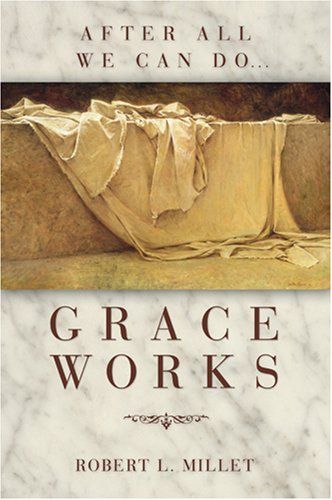
Grace Works, by Robert L. Millet

grace works coverRobert L. Millet is Richard L. Evans Professor of Religious Understanding at Brigham Young University. Although this book isn't an official Latter-day Saint publication, it's published by Deseret Book and approaches the subject from a Mormon perspective. However, the author has read widely and includes many references to non-LDS theologians, including C.S. Lewis and Karl Barth. "After all we can do" in the kicker to the title references 2 Nephi 25:23, but doesn't quite describe the LDS or any scriptural view of God's gracious work of redemption without a tad of explanation, including 2 Nephi 10:24 "after ye are reconciled unto God, that it is only in and through the grace of God that ye are saved." All we humans can do is "be reconciled unto God"—but even that reconciliation also is a gift of grace.

Disclaimer: including front matter, Grace Works is only 150 pages and is printed in a gracious size of graciously leaded type, so don't expect it to be completely comprehensive.

The book focuses around and keeps returning to the author's statement on page 2: "Because the Atonement is central, fundamental, and foundational, it provides meaning and purpose for every other doctrine and every covenant and ordinance. It is the lens through who we view every principle, precept, and practice in the Church." From explaining that Fall and Atonement are kind of like a "package deal," throughout the book Brother Millet provides clear explanations and relevant examples. On page 17 he lines out seven ways scripture uses the word grace: God's favor or acceptance; God's blessing; an outpouring of God's Holy Spirit or of spiritual gifts; a calling to preach the gospel; blessings associated with a person's lineage; strength to overcome and endure; that which conveys salvation and wholeness... on page 18, he tells us from a doctrinal perspective grace is God's mercy, love, condescension, lovingkindness and unmerited favor toward humanity.

Succinctly, born into the fallout of "The Fall" of humanity means "The natural man is an enemy to God in that he or she is operating on an agenda other than God's." [page 35] Natural, fallen and sinful essentially are synonyms. Grace Works is rich in teachings, explanations and especially in its reassurances that as essential as it is to keep the commandments, to love righteousness and do justice whilst walking through a broken, shattered and unreconciled world, none of that is enough because it's humanly impossible. In short, God chooses to remain with us, journey alongside us and enable redemption (salvation, wholeness, reconciliation) because even in us, incarnation, cross, Easter's empty grave and the Pentecostal reign of the Spirit remain God's work and God's glory, not ours.

At the back of the book you can find endnotes, a bibliography, a scripture index separated out into OT, NT, BoM, D&C and Pearl of Great Price along with an extremely thorough subject index.

For sure I'd like more emphasis on the inter-responsibility of community and individual, more explicit mention of our gospel call to help enact justice, healing and liberation to all creation and every segment of society, but what's already there on the pages of Grace Works works well for me and after all, it's barely 150 pages! With Robert Millet's broadly and ecumenically Christian worldview that's anything but exclusively Latter-day Saint, I'll give it a 5-star recommend.

my Amazon review: God's work, God's glory

Friday, July 29, 2011

either/or aka decisions 5

Today Sharon hosts a Friday 5 topic related to an ongoing reality in everyone's life, decisions 5. Part of her intro reads,
Today we play off of one of my favorite and most memorable Friday Fives to blog from: Decisions, Decisions posted by Songbird last July 23. How do you decide? Check out the following pairs and tell which one of each appeals to you most:
1) Sunrise or Sunset—I'm a classic early riser, and love to be up before first light. On the other hand, sunsets can be lovely, esp in the Southwestern USA. Flying Southwest, "The Socialist Airline" into Tucson into the sunset is an unmatchable experience, esp given that Tucson is an astronomical Dark-Sky place. Short answer? Sunrise!

2) To the Mountains or To the Beach—I'm one of those people who likes to know the ocean is nearby, even if I don't go there very often. I spent a summer at Tanglewood in the Berkshires, part of the ancient, venerable, Appalachian Mountain range and I've lived in the Internountain West, with the Wasatch range (a little further east there's a Sawatch range) of the Rocky Mountains always within hailing range. The fabled seven canyons of Salt Lake City were a fabulous place to drive up and down on a free day or slow going afternoon, sometimes to hike, too.

3) Coffee or Tea—neither one hot, both/and iced or chilled... but Tea more often than not.

4) Advent or Lent—equal parts repentance, apocalyptic and hope. I particularly love the Advent lections and hymns, though Christmas Eve and Day always have been difficult times for me. Lent, too, though—first counting the days until Easter Vigil, and then lovin' the Great 50 Days. It's all good and necessary as in sensory word, sacrament, music, visuals and even *other* we recapitulate and relive the history of salvation... short answer on this one? Advent!

5) "Raindrops on Roses" or "Whiskers on Kittens"—although I loathe, detest, despise and abhor The Sound of Music (seems as if people either love it or hate it; there's no neutral ground). I am such a cat-a-holic, and as much as I love flowers, nature and the environment, teh kitttehs win on this one!

BONUS: Tell more about one of the pairs. Why did you choose it? Difficult or easy choice? A story from your own experience?

In the interest of actually posting a semi-finished Friday 5 this week, I'm in major decision time and mode and again I find myself needing to make major life decision all alone, with no one who knows me or my history remotely within reach. Just saying'... so how do I decide? A little prayer, a little time, a backward glance at my own history, a forward look into possibilities and a huge trusting leap! Thanks, Sharon!

Friday, July 01, 2011

wayback 5...

...about the way we blogged: wayback days 5

This time instead of answering Kathryn's suggested questions, I'll write a few paragraphs. Cyber eons ago in July 2002 I made my blogging debut on blogger, which (to my knowledge) along with diaryland and pitas was the only available platform. I'd just finished a year-long Community Economic Development certificate program that hadn't led to the hoped-for employment, so I decided to chill some for the summer as I expected to do the usual rounds of meet 'n' greets and related continuing ed in the fall as a way to connect with potential employers and clients. Before I'd returned to this part of the world sometimes called "Paradise," life had happened and kept on happening with unexpected outcomes; for a while it was adventuresome and almost fun. Even the plasma center, day labor hangout and less-than-minimum wage gigs hadn't discouraged me much, since trials by fire and trials by ongoing disappointments are part of the journey, right? But those weeks that started out like another adventure turned into months, into years and now it's almost two decades, close to twenty years without community, without the mirror of the other to tell me how I'm doing, without places, situations and spaces to which I've become attached and to which I could uniquely contribute.

Leading up to starting my own blog spot, when I got online in the late 1990s I'd gradually gotten involved in an early iteration of the United Church of Christ forums and was delighted to return to more formal theological thinking and writing. I'd also (delightfully, of course!) discovered my opinions were valued and often sought-after! In some of my seminary classes I'd emerged as the class theologian but the years of loneliness and disappointment had polished my theological perspective and insight (in ways only too much loneliness and too many disappointments can).

I've been in social, personal, financial, professional, everything survival mode for most of these too many years. Although I still check the Friday 5 topic almost every week and start a Friday 5 post just about every week, I rarely publish them. A couple months back, when that day's host Singing Owl visited my blog, she commented, "You want to be known and you want to be useful." I unpublished the post and likely won't delete it, but she's mostly correct in that I want a community that seeks to know me and I want to be not only useful but exploited. Do I walk in and announce to everyone within earshot that I am no threat to anyone? That I don't want the pastor's or the church musician's job?

In his "Rollin' Home," songwriter Eric Andersen explains,
Truth, with all its far out schemes,
Lets time decide what it should mean;
It's not the time but just the dreams that die.
There's probably no such situation as zero theological context, but I'm so close to zero I have nothing to blog about. I haven't been teaching, preaching or socializing and long ago stopped trying to bribe people to spend time or have lunch with me. If and when I can find that elusive place of embrace, I expect to begin blogging at least a few times a month—I like developing ideas and seeing the results on the screen! People can start walking on their own quite easily, but I need someone to help me stand and take my first new steps. I also realize there are a lot of non-church places I could look and many many (many) non-church events I could attend, either or both of which likely would result in opps and friendships, but I barely can stand, let alone walk to get there.

Friday, June 24, 2011

faith / culture 3 for friday

faith and culture on the RevGals blog

…in honor of a week of interfaith study and celebration, Terri asks:
1. Have you ever had an experience of a religion other than your own? And, if so, what was it like for you to experience something different? If you haven't, what religion might you like to study, experience, and learn more about?

2. Have you ever studied, travelled, or explored other cultures? What and where, and when?

3. Any stories you wish to share about a person (author, teacher, etc), or a friend or colleague, from another culture or religion, who has impacted you in some capacity?

So, not exactly a five question Friday Five. You can respond in five easy answers, if you wish, or one reflection.
mainly religion and faith

I've lived within quite a few variant expressions of Western Christianity. When my anthro of religion teacher told our class she'd "changed religions" from Roman Catholic to Quaker, I wanted to say, "No, you didn't! They're both Christian," but I sort of get what she meant, since (among other details) the worship styles are different and Quakers don't have formal sacraments, yet at their best both seek to follow Jesus and particularly emphasize just peace (among other details). For that class my term paper/project assignment was to visit and experienced a "religion" other than our own or the one we were most familiar with. I spent some time with a Sufi group and I gotta say, so much of it was so much like mainline protestantism!

I spent a long-ago summer working as an au pair for a Jewish family. Although they attended synagogue and Hebrew School, the parents and kids were basically secular Jews, but the Russian immigrant grandmother was very observant. I loved how she prepared during the day to welcome the Sabbath at Friday sundown and can't ever forget how she lit the candles and especially the loaf of fresh-baked challah.

Without a doubt, various brands of Christianity bring culturally-informed perspectives to the essential gospel of death and resurrection and physical geography in turn has informed each culture; each Christian tradition lives and acts in various degrees of alignment with and opposition to prevailing local culture and customs. Sometimes they seek to use similar = "vernacular" - styles and symbols to attract adherents, sometimes from the get-go they attempt to be seen as different from. Remember early Christianity's subversive use of imperial Rome's practices and assumptions and how they not only had a critique of culture, they were and they lived as a critique of culture while using and sometimes inverting familiar symbols?! We need to contextualize the reality of Jesus Christ to some degree, but what's the point if we're not offering an alternative to the commoditization of everything that invariably leads to death, who cares, if it's not different from and better than? However, how will strangers get it if the church presents itself as so completely "other than" everyone else? In Jesus of Nazareth, the Spirit of the Living God was incarnate and enfleshed, in some ways looked and acted like everyone else and in other ways was very different and highly unlike…

For a while I lived in Salt Lake City, Utah, and moved there because I had a call to serve a local church in one of the protestant mainline traditions. SLC itself is *only* 50% Mormon, but you'd almost never know it! I frequently attended Friday night ward parties and sang from the Mormon Tabernacle choir's seats in the Tabernacle with the grouped choir for Stake Conference. I also became pianist for a Tongan United Methodist congregation. Most weeks I played for choir rehearsal, but the choir sang during worship only once a month. I tend so to emphasize the sacraments and, of course, a sacramental worldview, and though I was so pained that they celebrated communion only 4 times a year, to me, a very unlike-them stranger, they demonstrated hospitality unlike any I'd ever experienced in the church.

There's an Antiochian Orthodox priest on the Ecumenical Council's Faith, Order & Witness Committee I've been serving for a while now. A couple of times he's arranged for committee members to attend the west coast version of the annual Orientale Lumen conference that for many reasons no longer meets locally. I've also attended Divine LIturgy at the church he serves. I find the completely male leadership along with all the gold, jewels and bling almost completely off-putting. Instead of presiding at Eucharist versus populi as the rest of us do, they still preside facing East!

mostly culture

As a wannabe world traveler, I've visited only Western Europe, parts of Canada and Mexico as far south as Mexico City, "Mexico DF, distrito federale." I've lived in different areas of the USA but how striking it is that you need only cross the border from one state to another to experience a surprisingly different style and culture. In New England, Rhode Island and Massachusetts have a vastly different feel (and I'm not even considering the American Puritans booting Roger Williams out of their theocracy…). New Mexico and Arizona are cultures and laws unto themselves; multi-cultural southern California is a different world from the central coast which is different from northern California.

A lot of folks in the West have found originally Eastern disciplines like yoga and tai chi true gifts; a lot of Christians have found a Buddhist type of detachment useful, too. I still remember a comment from the book Water Buffalo Theology (it's ecological theology, liberation theology, theology of the cross and an offering in the Christian-Buddhist dialogue; we discussed it a few UCC forum iterations ago) "this Christian God is a hot God!" A God so passionate about creation to live as part of creation, and remain totally attached - anything but detached - from creation and the entire physical world.

Thanks, Terri! I appreciate getting a topic to blog about today. A blessed, fruitful green and growing Ordinary Time to everyone!

Sunday, June 12, 2011

remembrance, hope...

Remembering a lively past, hoping into a living future...


sign on the highway: San Diego River Watershed: Keep It Clean!

listening to American Pie: "and a voice that came from you and me... the day the music died, the day that I die."

How realistic have I been to expect an occasional oasis of good food, good drink and good conversation? How reasonable had I been to expect to be fully re-integrated into and re-claimed by mainstream society and mainline church?

Theology types engage in a fair amount of margin/center // edges/heart talk, especially considering more edgy, less centered liberation, womanist, cruciform theologies. All that's more marginal? Some people in some quarters consider them so, yet throughout the witness of scripture, God consistently acts is ways that subvert that status quo, in way that are hidden and unapparent until later on, until the principles involved step away and look backwards to where they've been and then are able to discern that's happened and even a little bit of how it's happened. Someone said if you keep looking back you can't see where you've going, but if you don't look back for sure you'll make the same mistakes and take the very same mis-steps.

Right now as another season of summer is almost here, I need to do some faithful remembering of Whose I am and who I am: where I've been, the journey I've taken with the gifts and opps God has given me, the people I've met who've ignored or rejected me and even those few people and places who've been occasions of embrace.

For Paul of Tarsus, the gospel is death and resurrection. Originally the literary form "gospel" referred to the returning Roman conquering general's proclamation of his victory over opposing forces, his announcement of how he'd vanquished the enemies to the nether regions of the dead. For Christians, "gospel" is God's victorious action in vanquishing death, "the last enemy" and initiating the victorious reign of life. Baptized, we live within the gospeled community called to reconciliation yet called out from, set apart from and different from the empires of death and deadly imperialisms in which many reside and toward which others strive.

Referencing the Ephesians pericope for Ascension that pleads for "the eyes of our heart" to be enlightened, PGB suggested one of the emphases of the Feast of the Ascension is the Christ Event becoming an event in the heart of God. Here our physical eyes can see nothing without some ambient light, so our heart-eyes need light too. Long ago at the weekly Monday evening women's bible study that met at my house, JHD (she and I were the group's usual leaders/facilitators) pointed out the eye is the most sensitive part of our physical bodies.

Baptismal River Watershed: Keep It Clean! and how, but how?! Keep the commandments, keep covenant with all creation, stay put in community because in spite of everything, most times staying put is the test of faithfulness because we perceive everything as imperfect...

Wednesday, June 08, 2011

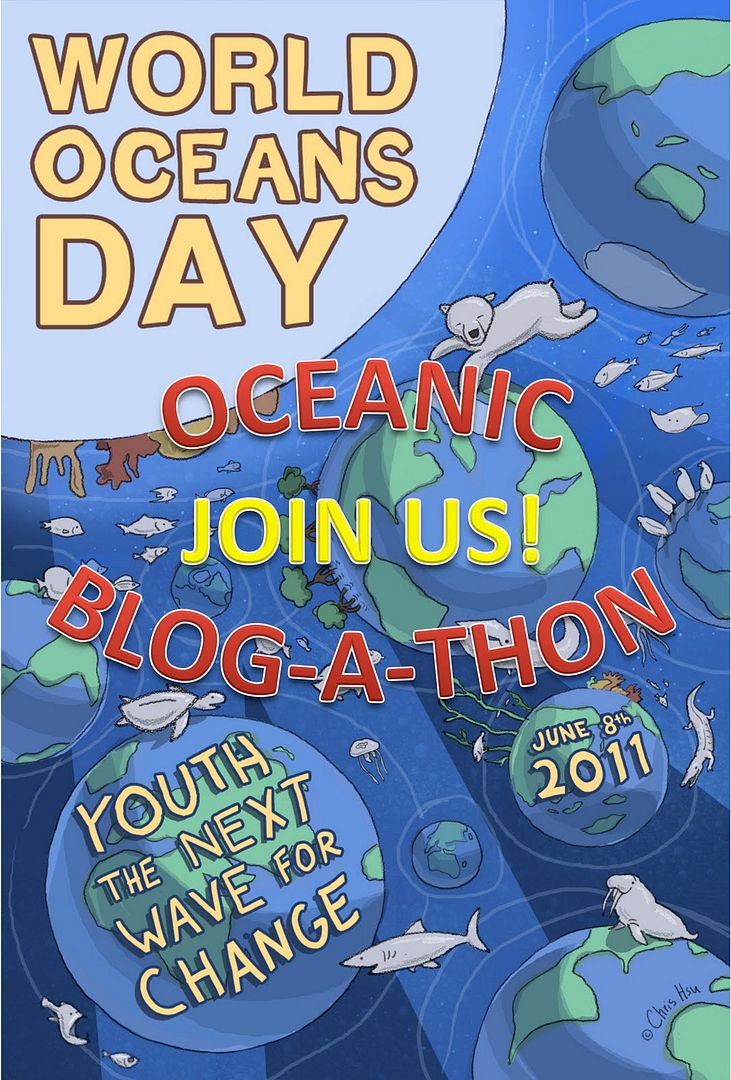
world oceans day 2011

world oceans day banner

WOD Theme for 2011: "Our Oceans: greening our future"

CrazyCris is sponsoring an oceans blog-a-thon; happily I found out about it in time to blog for the official world oceans day, Wednesday, 08 June.

a lot of my life has been another day on the bay


world oceans day 2011I first saw light of day on an ocean bay beside the Gulf of Mexico and ever since then the ocean has been singing to my heart, capturing my longing for freedom and homecoming.

I love the desert and come to think of it, I love the city and the cities. In fact, I love cities and the city so much I minored in urban studies and would have majored in urban studies if I could have. I love the prairies and plains of the heartland but I need to know the ocean, any ocean, is close enough to smell, to visit, to walk alongside, to splash my feet in, to catch a fish taco or fish 'n' chips.

I have early memories of the Atlantic Ocean on Tampa Bay in coastal Florida, later on and later on again of chilly northern Atlantic waters that unquittably hug the vacation peninsula of Cape Cod (there's Cape Cod Bay...), a too-short summer alongside Nahant Bay in Nahant Massachusetts... driving up and down the south shore was a frequent escape when I lived in inner city Boston; during those years I often parked on Atlantic Avenue—"Atlantic," named after the ocean named after the legendary island, of course! There was Boston Harbor, the River Charles and a string of city beaches to visit. For a few years maritime history in the city of Salem surrounded me; during that time, how better to spend a summer Sunday afternoon than by driving up the north shore to the Atlantic fishing villages of Gloucester and Rockport?

In Dorchester, geographically and in population the largest Boston neighborhood, Dorchester Bay reached into a largest, bigger stretch of Atlantic Ocean and carried some heavy social and political history. For only a few days longer than a single month I lived south of Boston in the town of Hull; many late dark November afternoons, I'd stroll over to Hull Bay and wonder what was next.

Then there was and now there is the Pacific Ocean—no wonder they call it Pacific since it's placid most of the time. Oceana Pacifica's extensive length and wide breadth definitely are what "I hope you still feel small when you stand beside the ocean" in the song I Hope You Dance must refer to.

wear blueMost significantly, there's my other central, transformative experience of water that defines my every day—on the bay and everywhere—and every move: my baptism, the cosmic event in my life that replicates the history of this planet and the history of the people of God in every time and every place. On this blog I've written so much about water and oceans, about the rivers that end in oceans and define and create communities and individuals that become part of communities I won't say more at this time.

In Cornhuskers, Carl Sandburg included a poem called "Prairie" that concludes with:
I speak of new cities and new people.
I tell you the past is a bucket of ashes.
I tell you yesterday is a wind gone down,
a sun dropped in the west.
I tell you there is nothing in the world
only an ocean of to-morrows,
a sky of to-morrows.

I am a brother of the cornhuskers who say
at sundown:
To-morrow is a day.
life stuff button
An ocean of tomorrows has to mean all the histories of this planet the oceans have known, experienced, and carry in the ebb and flow of every tide. With vast oceans of tomorrows everything may be possible but just as each of us and every community needs to care for and love its people and its places, we need to steward and take care of every aspect of creation, especially the waters where life originated and without which nothing will be possible and there is no tomorrow of any kind, not another day on any bay, only long-gone by yesterdays.

Thursday, June 02, 2011

summer reruns 5

As Songbird reminds us for reruns Friday 5 on Rev Gal Blog Pals, "...it's the season of reruns. ... In honor of this annual Time Warp, please share five things worth a repeat. These could be books, movies, CDs, recipes, vacations, or even TV shows."

california day light1. the beach—early morning, late afternoon, early evening; sun, sand, surf, picnics, maybe a book, a journal, a radio or iPod and for sure a vista to worlds across the Pacific Ocean and up the California Coast.

2. wearing fewer, lighter clothes—I love short skirts, colorful shirts and flip-flops, and almost always have a warm hoodie sweater or sweatshirt with me in case of cool breezes and because of invariably cooler evenings.

3. almost everywhere I've ever lived I've enjoyed summer concerts, whether seriously symphonic, orchestral pops, talent shows, folk, county or country fair specials, classic rock, solo or duo recitals downtown or anywhere (have I left anything out?). It's esp wonderful alongside the bay and particularly great on fireworks evenings.

4. getting settled into the long liturgical Ordinary Time, a.k.a. "Green Season" and appreciating again how it demonstrates and parallels our own growth in all areas of our life and how the use of green reminds us of our covenant with all creation.

5. more than the other three seasons, summer seems to make redemptively remembering the past and creatively dreaming about the future almost easy... thanks, Songbird!

Friday, May 06, 2011

word association 5

Songbird hosts today's word association Friday 5 on Rev Gal Blog Pals.

First, for each of these five words ... share the first word that comes to mind when you read it.

1) Airport Schiphol

2) Baseball Red Sox

3) Art Creative

4) Chocolate migraine (sorry?! migraine, sometimes, but not always...)

5) Grill Summer

Bonus: Tell us a story that comes to mind based on one of the word pairs.

"it all (or at least mostly) depends on a memory," and I'm looking to reclaim summer as a wonderful season no matter what happens to be happening elsewhere in my life and world, so I'm remembering and trying to transplant days of Red Sox nation coupled with frequent weekday evening feasts on the grill. So that would translate to Padres baseball and seaside picnics. Thanks, Songbird!

Saturday, April 30, 2011

sprout 30: success!

30 days of sprout blogs
As that therapist advised me and as I nearly always (wisely) attempt to do, appreciate the little things: freshly fallen powder; a savory sandwich; surprisingly hearing a fave song being played in the background... and this time it's daily topical blogging for the 2nd time ever, and most of my posts had a degree of substance and none were really contrived in their approach to the topic.

This image was one of the 2 badges I made for the NaBloPoMo site, so it's really small. Next time I'll start with a larger version to feature on my own "I did it!" blog post.

april blogging sprout

Friday, April 29, 2011

sprout 29: royal wedding

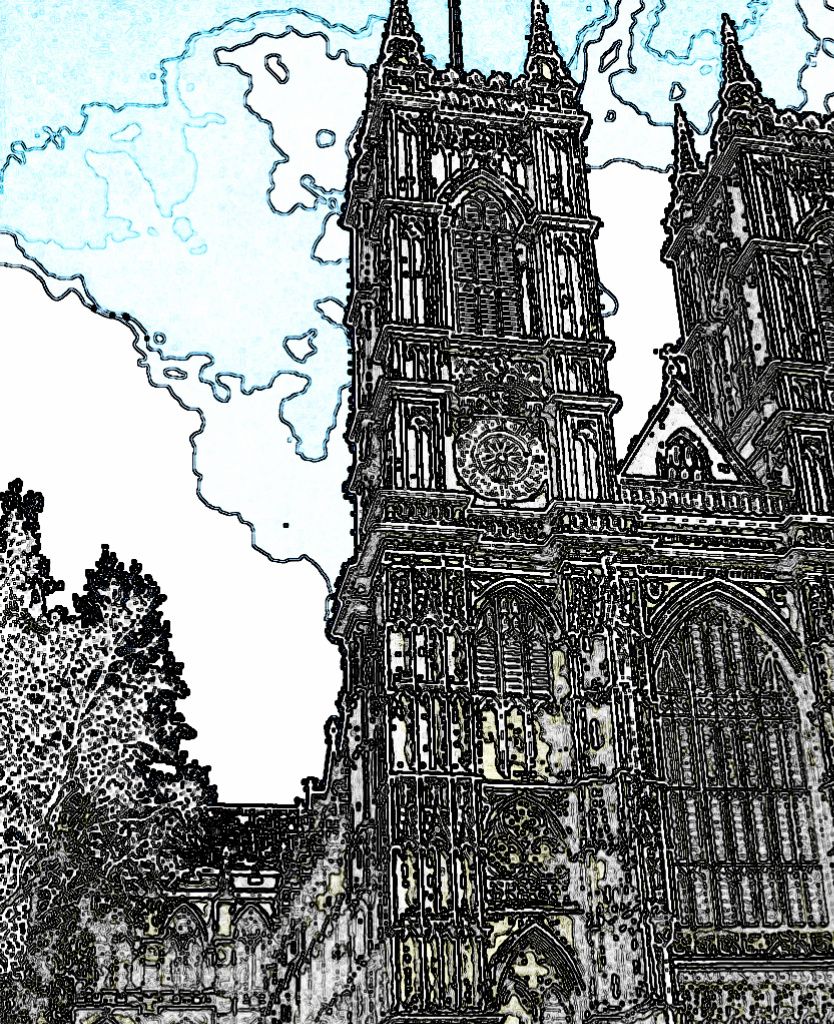
Westminster Abbey
Today Prince William and Catherine Middleton
got married at Westminster Abbey. This is the next to last in my series of daily "sprout" blog posts, so in sprouting terms what can I make of that local event between two people and two families that also watched by as of now an estimated 2,000,000,000 (that's 2 billion with a b) worldwide? I'd guess that for the British Commonwealth of Nations and the United Kingdom it means monarchy and royalty will continue as ceremonial and functional parts of their lives and worlds.

I searched for actual wedding photos with reuse/reuse with or without modification rights but there weren't any – yet – so this picture of Westminster Abbey seemed apt and so does the Bishop of London's wedding sermon (that's no longer online).

april blogging sprout

Thursday, April 28, 2011

sprout 28: homestretching

sprout day 28


moving into the home stretch of 30 consecutive days of blogging... I'd expected to use more of my sprout images than I have thus far; so here's one in a fave color palette hyper-edited with pointillist and other filters.


april blogging sprout

Wednesday, April 27, 2011

sprout 27: freedom!

South African Flag

Happy Freedom Day, South Africa!

Freedom Day commemorates and celebrates the first truly democratic elections held on 27 April 1994, but that date feels so very recent! In line with this month's sprout blog topic, it's about freedom, about enduring hope, about a real, open-ended future...


april blogging sprout

Tuesday, April 26, 2011

sprout 26: origins

Since today, all day, is Tuesday, here's Wikipedia on Tuesday's meaning, origins and history. "Tuesday's child is full of grace!

april blogging sprout