Tuesday, May 29, 2007

Velvet Elvis blog 2

Another from another RevGalBookPals book discussion

My own Velvet Elvis Blog 1

Velvet ElvisMichael Krahn linked me to his Velvet Elvis series... I'm planning to visit soon, and all the RevGals' comments have been thoughtful. I esp appreciate Songbird's observation that Sabbath-keeping is a week-long endeavor. During Lent 2004 I participated in a REAL discussion of Lauren Winner's Mudhouse Sabbath (finally out in paperback! Yay!) Velvet Elvis and the RevGals' thread makes me want to go back and reread it.

ReverendMother blogged,
It’s also a little unfortunate as a title because, as a professor told me in seminary, “Don’t ever give someone a reason not to listen to you.” The hip typeface and panoply of cover designs probably make it more marketable and appealing to people who wouldn’t give two hoots about Calvin’s Institutes...

I’m willing to forgive the kitsch and the hipness, though, because fundamentally, this book wasn’t really written for me. It seems to be written for people outside the church—people who may be intrigued by Jesus a great deal, it’s just “his family” that they have a problem with.
This second blog about the book most properly belongs on my "other" long blog, this far by faith, but 1) I need blog fodder and 2) I'm attempting to risk a little more public self-revelation and openness, so here it is.

In most ways this is a book for outsiders, but my insiderness has become too, too strained and painful; though in the past I've spent a lot of time reading theology (full meal type books, not exactly "snacks"), I'm truly exhausted on every level, and despite acknowledging many people have considered me a threat and have been just plain rude to me, even the ones who have been polite and welcoming have no clue where I live socially, culturally or theologically (hey, even people who've been in bible studies I've facilitated). So for me, it's high time for a sea change, and that means getting beyond concerns of polity, connectedness and ecumenical relatedness to the fundamental fact I'm useless to everyone as long as I'm not getting my own needs (gasp!) met, and my needs include using my gifts, education and skills to a reasonable extent if I'm to be reasonably whole, not to mention finding social opps with people who are aware of who I am and where I've been and who appreciate my uniqueness, whether or not they "get it."

Pastor Rob Bell cites the usual wisdom that one needs to hit the bottom before being able to change, rebuild, whatever...but my current situation isn't about having hit bottom at all. While the Cedar Fires I referenced in my other blog blazed away, as with my neighbors I considered what I'd take with me if we needed to evacuate (besides the obvious cats and some clothes), my choices were my very well-marked RSV (the first bible I ever owned), my academic transcripts and my letters of call.

I'd been so goal oriented, so disciplined, so sure I couldn't lose. For me, it wasn't facing my brokenness nearly as much as it was encountering my fallibility. Like everyone, I'd failed zillions of times, but finally, no matter how many new beginnings I made none of them bore fruit. I've sensed such an overwhelming loss of self; when someone loses a family member or close friend due to physical death or absence, people gather around them and support them. Is there no one for me? In the conventional mainline churches, maybe not.

I'm wondering if I dare blog this publicly, but for some reason I no longer trust myself. Walter Brueggemann says "bright, skilled educated people are valued and sought-after"; he also says there are people sitting in the pews feeling nullified (by life? by the church? by family, spouses, by whomever, I'd imagine). As I insisted some time ago, "These things don't happen in First- and Second-World countries." They happen to everyone occasionally, but what on earth and in the Name of Heaven has this been all about? Does it continue to be about?

Hospitality is God's first call to the people of God and fundamentally defines them. From the beginning, the uniqueness of the nascent church as it moved outward from Jerusalem was 1) its radical inclusivity and 2) "see how they love one another." No one lacked anything; everyone had everything in common, a true common-wealth, as the New England Puritans initially believed they'd be able to live. But it was not only about embrace and provision for the already-insiders; the first Christians embraced and provided for everyone, making no distinctions whatsoever. Just as "God is not partial," they "were not partial." The outsider became incarnate, enfleshed as one of them, becoming an insider. These past years, I went into one church after another, no longer someone called or employed by the church, but as a stranger, an alien, like Abram an Ivri, a Hebrew—one from the other side. One in the image of the Divine, of God from the very other side. In every case, I came bearing gifts, and it stills blows me way out of the water to think one person after another would dare not accept my otherness as a gift. The human insecurity doesn't amaze me in the least, but the blatant chutzah still does.

Back to Velvet Elvis and the mainline church. Sunday was the PCUSA's annual Pentecost Offering for at-risk children and youth. I love the Pentecost Offering and I love the justice and advocacy ministries all the mainline (Prot and RC) are doing. I grew up in a blighted, decaying very inner-city neighborhood, attending a crummy urban high school, and originally intended to become a social worker.

But on my first Velvet Elvis blog, Diane commented, "does the word "mainline" just mean 'boring, non-pentecostal, 9-5, hierarchical, set-in-their-ways', can't discern the wind of the spirit even if it is a hurricane? Maybe we need a new name..."

Finding a new name or not, as we've often observed, the old mainline now longer is the central or most prominent expression of Christianity in this country, and most fortunately, being a mainline protestant no longer is a given part of being American. Unlike the whistle-stop, sideline or spurline, but similar to the railroad passenger mainline of old and paralleling today's AmTrak (sometimes I watch the slick, California AmTrak in its glossiness slide through this town of San Diego, often called "Paradise" by the weather forecasters, and I think, yep, that's mainline). I'd say yes, indeed, maybe in too many ways mainline retains its original connotation of cultural Christianity, both from the old Philadelphia mainline that was exclusively and solely Episcopal and Presbyterian but later embraced other churches that were staid and pretty stoic in style, like Lutheran and UCC...a few months ago I got a possibly true email forward about a seminary professor beginning a lecture on Pneumatology when a student charged into the classroom in ghost-buster regalia, causing the professor to remark, "Typical Presbyterian response: extinguish the Spirit!" Of course—could've been any other polite denomination. During the years I actually served as a [Lutheran] church musician, the Assistant Pastor's wife nursed their baby in one of the front pews most Sundays during the early service. One outspoken woman informed us she was going to begin attending the Episcopal Church, because it was "a dignified church." I wanted to scream, "But was Jesus dignified?!"

Then there's that other use of mainline, to shoot a drug into your veins. Mainline a hit of Jesus straight into your veins, so the blood of Jesus courses through your entire being? Think about it!

End of blog 2.

repainting into a new reformation?—my amazon review

Sunday, May 27, 2007

Velvet Elvis blog

Sunday the Day of Pentecost 2007

This was part of a RevGalBookPals discussion.

Velvet Elvis coverMonday (technically, but they've announced they'll post the discussion this afternoon) will be the third book discussion—this time it's Velvet Elvis: Repainting the Christian Faith by Rob Bell. I said Christianity for the Rest of Us gave me hope; this book gives me a kick in the butt while affirming what I've been trying to tell other people and trying to convince myself for the past few years. I finished reading Velvet Elvis late Thursday afternoon, and for this (maybe first?) blog I'm writing out of my head (literally, most likely) and heart. After reading what the other RevGals have to say, maybe I'll blog again in response.

Rob Bell is founding pastor and current pastor of Mars Hill Church in Grandville, Michigan. A few year later as I edit this post, I've unlinked to the church's Narrative Theology Statement because I don't know what's going on there and finding out does not interest me.

Just as a Velvetized Version of Elvis is an interpretive repainting, repainting the Church into a new look and new vision forms the basic idea behind this book. In Christianity for the Rest of Us I found hope about the Protestant Mainline; Velvet Elvis tells me my hope may be outside mainline confines. On page 11 he mentions the picture the church of Martin Luther's day had been painting and presenting. Regarding these 21st century days, oh, I know a lot about the picture the church has painted of itself and maybe even moreso, the way outsiders to the church have viewed and interpreted that picture. Page 14: "What I do know is that this pursuit of Jesus is leading us backward as much as forward," that evokes the Protestant Reformation of the 16th century, the way the Roman branch of the church says along with us "reformed and always reforming" plus the numerous 19th century Restoration Movements with the plethora of churches and church bodies they spawned.

A few thoughts from pastor/author Rob Bell:
  • Page 10, about artists who don't sign their entire names, "Because when you're this good, you don't even have to write your whole name." Exactly God's situation and position!
  • Page 13: it's not about making (photo?)copies of the same picture over and over again.
  • I love his citing some of my favorite (not!) experiences: the person who is so into scripture yet insists on her own personal Jesus that lives in her heart; the individual who decides to find out "what the Bible really says" after reading a slew of commentaries and interpretations.
  • And I love the way Rob Bell talks about experiences of life coming together when the moment is full and complete—if even for a split second; he calls those times "Holy ground"; I love the way that phrase implies heaven come down to earth raised up to heaven.
  • Rob Bell tells us he doesn't do 9-5 office jobs well, that he is creative. That's my story, too—I can do routine jobs like cleaning, etc., but whatever the content of the office work, it pretty much kills me, although there have been a scant handful of exceptions.
  • I love his discussion of Christian needing always to be a noun rather than an adjective—I read the same in at least one of Robert Farrar Capon's books, and the idea probably isn't original with either of them, but it long has driven me nuts hearing people talk about a Christian this, Christian that or a not-Christian whatever.
  • Maybe more than anything about this book, I love reading the same theological vision and scriptural interpretations as I hold (humility from humble moi) from Rob Bell, someone I'd consider a relative theological conservative.
The book's author cites the usual wisdom that one needs to hit the bottom before being able to change, rebuild, whatever. Yes, but—in my experience, you can't do it alone. As Oprah told a teenage girl on one of her shows I watched two or three years ago, "You know you can't do this [life] by yourself." Jesus asked the guy by the Bethsaida pool, "Do you want to be healed?" The guy answered, "Sir! There is no one to pick me up and put me in the pool after the angel stirs the waters." Exactly!

Recently I've been remembering the devastating, generally extremely destructive Cedar fires we experienced in this general area during fall 2003. "We experienced" because the sky, filled with soot and smoke from relatively far away, turned into a range of unusual colors and the sun became dark. But not all that long after the Cedar Fires finally stopped being a constant topic of local and national news and face-to-face discussion, one of the weather reporters showed us the plants and flowers that were sprouting and growing in the fire's wake; he reminded us some plants can't germinate and won't grow at all unless they're touched, seared and transformed by fire! And doesn't that describe every one of us?

Rob Bell mentions how a garden naturally becomes a city when life goes the way and grows the way God created it to. I hadn't thought of that inevitability! I think of what a weed I've been, too, but that's one reason I've survived and definitely thrived in many cases!

Today is Pentecost Sunday 2007; I know in my head and especially in my heart that I can retain some involvement with the mainline church(es) that had been a gift to me and that had called me a gift, but I also need radical trust that the Reforming, Renewing Pentecostal Spirit of Resurrection will start repainting my life and world really soon. I am so excited about going wherever the Spirit calls me and carries me!

repainting into a new reformation?—my amazon review

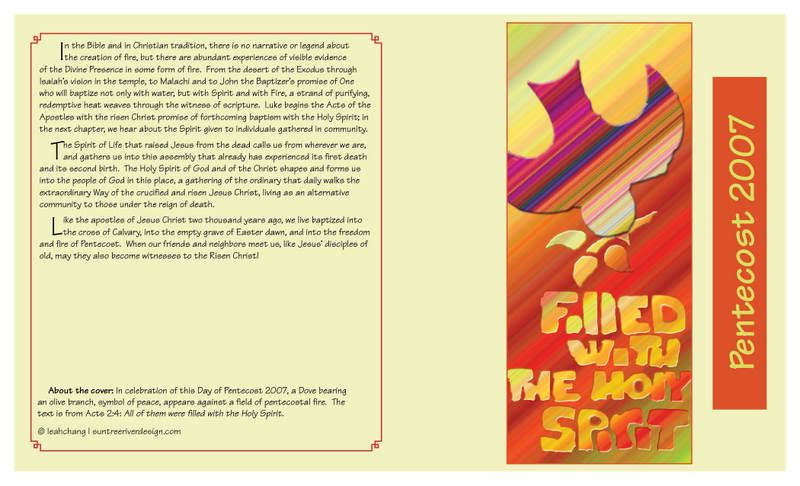
Pentecost Bulletin Back Cover Text

ยช Here's the actual bulletin cover.

Witnesse to his resuccrtion Acts 1:22

In the Bible and in Christian tradition, there is no narrative or legend about the creation of fire, but there are abundant experiences of visible evidence of the Divine Presence in some form of fire. From the desert of the Exodus through Isaiah's vision in the temple, to Malachi and to John the Baptizer's promise of One who will baptize not only with water, but with Spirit and with Fire, a strand of purifying, redemptive heat weaves through the witness of scripture. Luke begins the Acts of the Apostles with the risen Christ promising the apostles' forthcoming baptism with the Holy Spirit; in the next chapter, we hear about the Spirit given to individuals gathered in community.

The Spirit of Life that raised Jesus from the dead calls us from wherever we are, and gathers us into this assembly that already has experienced its first death and its second birth. The Holy Spirit of God and of the Christ shapes and forms us into the people of God in this place, a gathering of the ordinary that daily walks the extraordinary Way of the crucified and risen Jesus Christ, living as an alternative community to those under the reign of death.

Like the apostles of Jesus Christ two thousand years ago, we live baptized into the cross of Calvary, into the empty grave of Easter dawn, and into the freedom and fire of Pentecost. When our friends and neighbors meet us, like Jesus' disciples of old, may they also become witnesses to the Risen Christ!

Tuesday, May 22, 2007

Pentecost Bulletin Cover

Pentecost 2007 bulletin cover


Here's a link to the digitized versions of three of my Pentecost Banners—I based this bulletin cover on the first one.

Sunday, May 20, 2007

Pentecost Banners

Pentecost Dove Pentecost Witnesses Pentecost Prayer

...and here's the 14" x 8.5" bulletin cover I designed for Pentecost—I hope this is my final back cover text!

Thursday, May 17, 2007

Ascension Thursday: He Is Exalted!

Today is Ascension Day; here's Twila Paris' now-famous take on Psalm 47; three months ago on the Feast of Transfiguration I played a wonderful piano setting of this song.

He Is Exalted, by Twila Paris

He is exalted
The King is exalted on high
I will praise Him
He is exalted forever exalted
And I will praise His name

He is the Lord
Forever His truth shall reign
Heaven and earth
Rejoice in His holy name
He is exalted
The King is exalted on high

© 1985 Straightway Music/Mountain Spring Music; adm. by EMI Christian Music Publishing/ASCAP

Monday, May 14, 2007

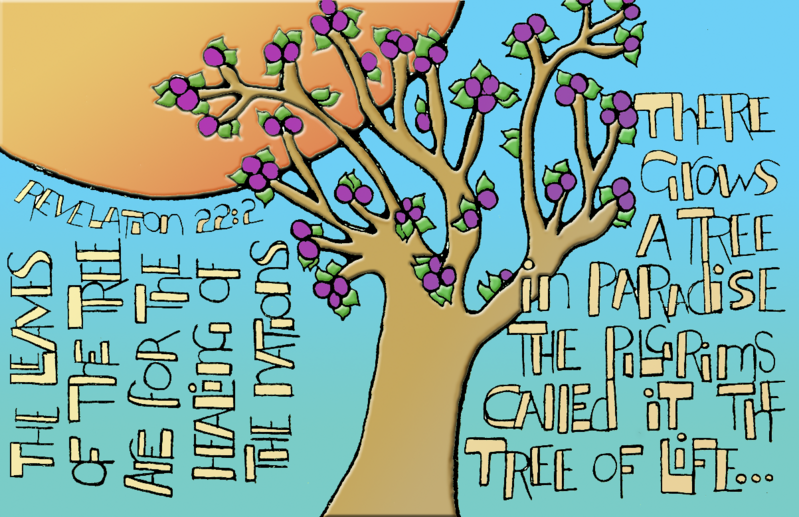
River of Life; Tree of Life

Revelation 22:2
I'm blogging a graphic of Revelation 22:2 I did a while ago and that I just Photoshopped. The 2nd lection for yesterday, Easter 6, was Revelation 21:10 to 22:5 that includes the astonishing passage about the river of life flowing from the Throne of God—from the Cross of Calvary! Our God reigns from a cross...


Revelation 22:1-2

Then the angel showed me the river of the water of life, bright as crystal, flowing from the throne of God and of the Lamb through the middle of the street of the city. On either side of the river is the tree of life with its twelve kinds of fruit, producing its fruit each month; and the leaves of the tree are for the healing of the nations.

Prayer of the Day

Bountiful God, you gather your people into your realm, and you promise us food from your tree of life. Nourish us with your word, that empowered by your Spirit we may love one another and the world you have made, through Jesus Christ, our Savior and Lord, who lives and reign with you and the Holy Spirit, one God, now and forever.

Amen.

Tuesday, May 08, 2007

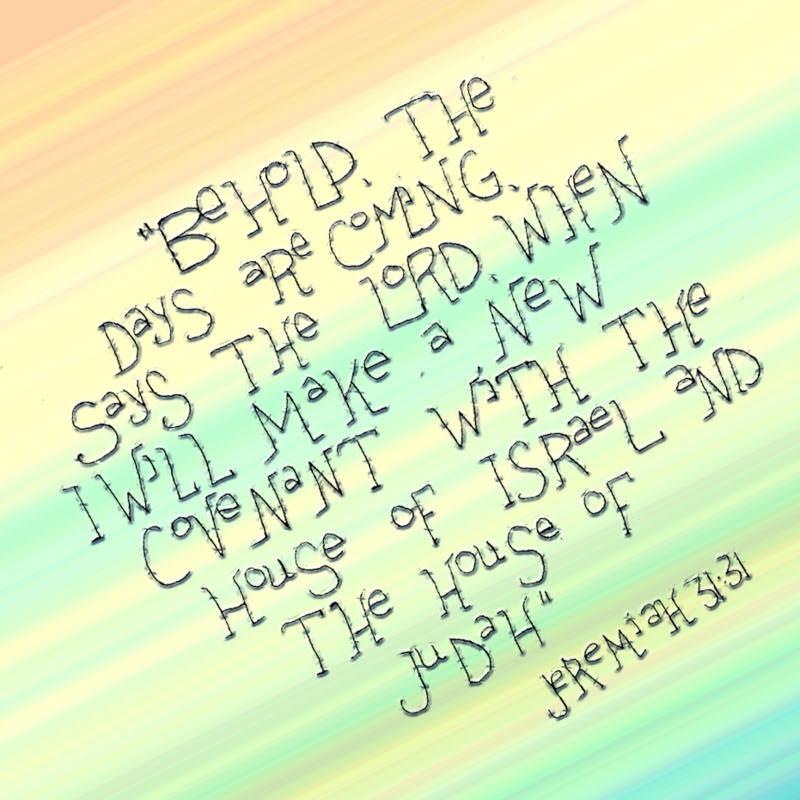
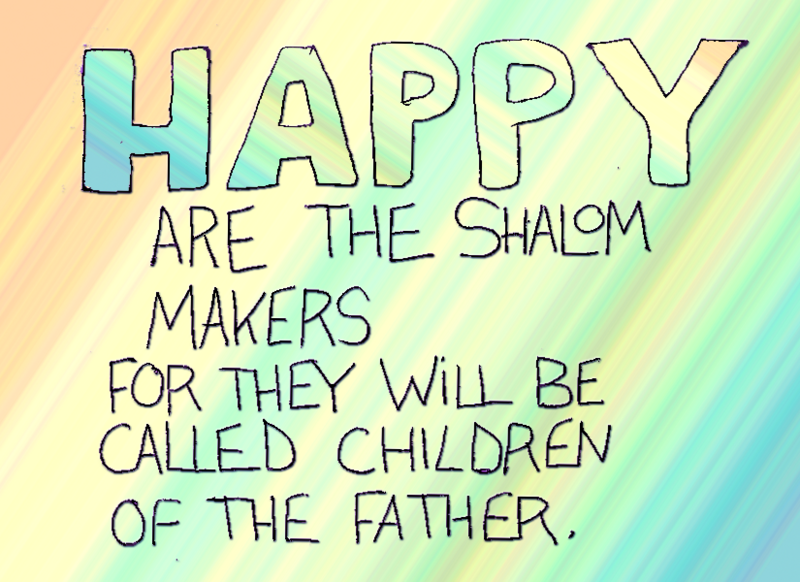
Gradience Scriptures

Here's a very recently Photoshopped group of old drawings; since I discovered it's impossible to save out random gradients, I decided to do the four matching designs in one session, while I still had the gradient that pleased me so on this warm spring morning.

Salt Leaven Light   New Covenant

Earth is the Lord's

Shalom   Shalom Makers

Saturday, April 28, 2007

Christianity for the Rest of Us 3

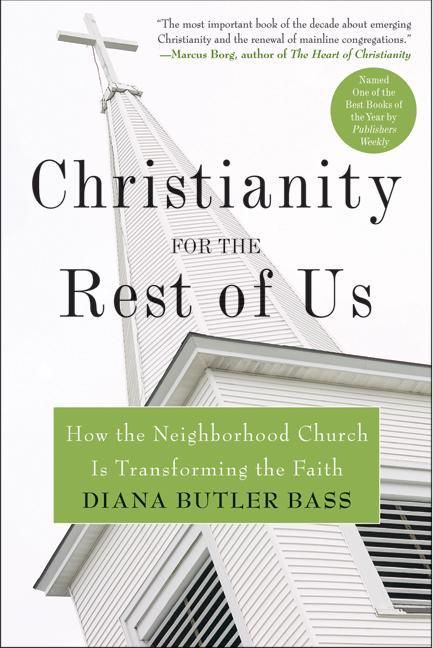
Christianity for the Rest of Us: How the Neighborhood Church Is Transforming the Faith, by Diana Butler Bass.
Christianity for the Rest of Us

Christianity for the Rest of Us Blog 1

Christianity for the Rest of Us Blog 2

As I previously blogged, this subject is close to my heart and central to the needs of most of us in the protestant mainline; this book gives me so much hope! The RevGals' basic consensus was like mine—this book gives all of us hope! I love the RevGals' passion for unity in diversity, too. Just like mine!

A sudden memory inspired this third blog on this book...

Probably within the past ten years, but likely at the far end of that number, one of the national news magazines – Time, Newsweek or U.S. News – had an extensive cover feature on the American Protestant Mainline. It's been a while since I subscribed to any of those (mainline) mags, but I seem to recall purchasing a copy on the newsstand, so maybe I still have it somewhere. They featured the same denominations as Christianity for the Rest of Us, with the addition of Baptists – of which they said "there are many," but I believe most of the Baptist churches in the study were from the liberal American Baptist Convention-USA, headquartered in Valley Forge Pennsylvania. (You can find direct links to the other study denomination links in my Blog 1.) The news mag article(s) described local churches very similar to those DBB describes, and I remember the striking phrase, "Any of these churches is a wonderful place to be!"

Clearly I'm still in lots of pain over the too many times I'd been excluded from participation in churches over the past too many years, but I'm always saying things like, "I'm not claiming any of this remotely is my fault, because no matter how I parse it, people have been just plain rude and just plain considered me a threat." However, my segue to that and similar statements usually is something like, "A huge part of the answer is these have been the wrong kinds of churches." By that I'm not saying any of these mainline or whatever or whichever has been theologically erroneous or otherwise not appropriate, but the social and cultural settings haven't been where reasonably I could expect my abilities and background to be appreciated and exploited. It offends my still sometimes working-class sensibilities, but despite the fact there always would be exceptions, a church in the Harvard Square or UC Berkeley environs would have been very different with a radically differing outcome in terms of their welcoming (and yes, exploiting) my gifts and regular participation.

In my second blog I'd intended to mention how much I loved the concept of people and groups being politically neither Blue nor Red but Purple, and how I love the implications of early Christians adopting the royal color purple for radical, subversive usage and intent in seeking to follow The Way. In that era in that part of the world, only royals were allowed to wear purple; remember Lydia from Thyatira we read about in Acts 16? Lydia's story happens right after Timothy joins up with Paul and Silas and just before Paul and Silas end up in prison; the entire passage is magnificently evocative:
Acts 16

13 On the Sabbath we went outside the city gate to the river, where we expected to find a place of prayer. We sat down and began to speak to the women who had gathered there. 14 One of those listening was a woman named Lydia, a dealer in purple cloth from the city of Thyatira, who was a worshiper of God. The Lord opened her heart to respond to Paul's message. 15 When she and the members of her household were baptized, she invited us to her home. "If you consider me a believer in the Lord," she said, "come and stay at my house." And she persuaded us. NIV
On the Sabbath, expecting to "find a place of prayer" at the river, they also found a place for baptism, where people formally could separate from former allegiances and lords, and officially be baptized into the reign of heaven on earth under the Lordship of the crucified and risen Jesus Christ—a Lord at once both royal and subversive! Lydia, the first European Christian was a woman, and one who "dealt in" clothing for kings but dared publicly sign onto the subversive lifestyle of the followers of Jesus Christ. In that era of the nascent church, Christianity provided a radically alternative perspective: politically to the point of sedition and socially to the extent of welcoming and actually including all comers. Lydia, newly-baptized and a merchant who routinely interacted with high and mighty royalty, knew God called her to hospitality and community.

Here's the 1st Peter scripture from Blog 1:
1 Peter 2:9-10

But you are a chosen, elect people (birthed, descended), a royal priesthood, a holy nation (ethnic), a people (folk) belonging to God, that you may declare the praises of him who called you out of darkness into his wonderful light. Once you were not a people (folk), but now you are the people (folk) of God; once you had not received mercy, but now you have received mercy.
The end of another incomplete blog (what else is new), but here it is, nonetheless.

By Leah, baptized into Jesus Christ and hoping to find a church that's a wonderful place to be.

###

Sunday, April 22, 2007

Earth Day 2007

For this year's Earth Day, here's the postage stamp series I designed last week. The images – all slices from my digitized analog graphics – aren't from my specifically bible-based or liturgical art; they're about our living green everywhere in faithful stewardship of creation. Interesting that we call Sundays in Ordinary Time "GREEN" Sundays!

Stamp 1 Stamp 3

Stamp 2 Stamp 4

These are clickable images so you can look at full size versions, but on sun country living you can get a more direct fuller view.

For Earth Day 2005: John Prine's "Paradise" and "The End of the Innocence" by Don Henley.

From Earth Day 2006, a Eucharistic blog.

Saturday, April 21, 2007

Blacksburg Vigil Candle

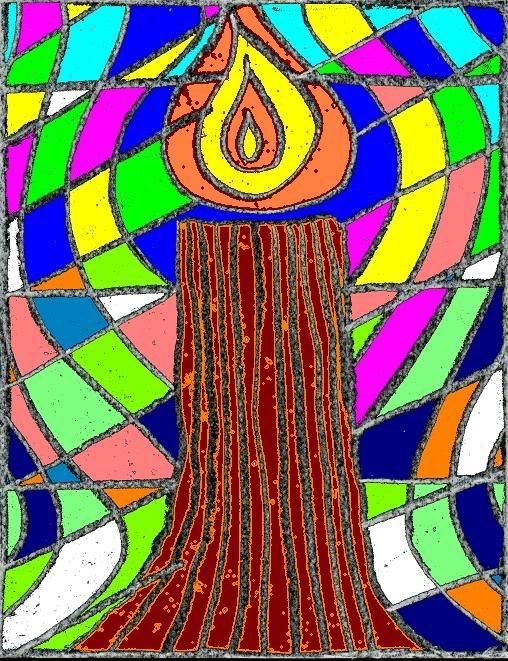
I found this phenomenally beautiful stained glass candle image and accompanying post, Blacksburg Vigil Candle, on the main PC(USA) blog. The colors of the candle are the colors of the Virginia Tech Hokies.

Blacksburg Vigil Candle

Christianity for the Rest of Us 2

Monday, 23 April, update: from a RevGalBookPals discussion!

Blog 1 went through chapter 11; today I'd planned to pick up on 12 through the end, but for this Saturday noon I'm actually blogging just a few more general thoughts.
Christianity for the Rest of Us

Link to the book again: Christianity for the Rest of Us: How the Neighborhood Church Is Transforming the Faith, by Diana Butler Bass.

Previously I'd said this book gives me so much hope. Why? I blogged how Chapter five, "Finding Home," is about returnees, exiles, immigrants, converts and villagers, and how I love the emphasis on pilgrims on a pilgrimage. In many ways I can fit myself into all those categories, at least to some extent. Two quotes form the footer to my testimony blog, this far by faith; the first from the gospel hymn by that title:
We've come this far by faith, leaning on the Lord;
trusting in God's holy Word, God's never failed us yet.
Oh, we can't turn back, we've come this far by faith.
We've come this far by faith.
Coupled with a quote from the poem "Cantares," by Antonio Machado:
Caminante, no hay camino; se hace camino al andar.
Traveler, there is no road; the way is made by walking.
This book gives me hope because it makes me realize there are churches, maybe local to my current street address, that would welcome me and let me participate as fully as I feel called to do without my needing to return to some form of authorized ministry. There are churches that recognize and support the uncertainties of the pilgrim way!

Rowland Croucher of John Mark ministries quotes Kenneth Leach,
The essential difference between orthodox Christianity and the various heretical systems is that orthodoxy is rooted in paradox. ... true faith can only grow and mature if it includes the elements of paradox and creative doubt. Hence the insistence of orthodoxy that God cannot be known by the mind, but is known in the obscurity of faith...
Exactly my position!

Reading through the earlier chapter, it struck me that these churches all did liturgy, devotion and service as they felt called and led, rather than necessarily in a way most typical of others in their denominations or, more broadly, traditions. However, you need to remember whatever "we" (the same as "us") do in the mainline is the Western Church's historical praxis, however its expression may be tweaked. It's those "others" who have changed worship, witness and political action to reflect something quite else.

Every so often I'll spend a little time on the websites of three churches in Cambridge, Massachusetts, imagining them as places and communities that would welcome me. A few months ago an acquaintance looked at some of my graphic design and said, "People should be exploiting you!" Exactly what I thought might be the case; exactly what I long to and for a while need to have happen. I know how greedy I am to learn about others and to learn from them, and it completely boggles my mind and mystifies me that so many people have considered me a threat rather than a gift.

That's all for today; after I read the RevGals' intro to the book and other reflections about it, I'll blog again next week.

Friday, April 20, 2007

Friday 5: Surprised by Joy!

Today is Friday, so it's time for the...

Friday 5: Surprised by Joy

Songbird cites:

Jesus said to them, "Children, you have no fish, have you?" They answered him, "No."
He said to them, "Cast the net to the right side of the boat, and you will find some." So they cast it, and now they were not able to haul it in because there were so many fish. That disciple whom Jesus loved said to Peter, "It is the Lord!" When Simon Peter heard that it was the Lord, he put on some clothes, for he was naked, and jumped into the sea.
(John 21:5-7)
Disciples Fishing

Weeping may linger for the night, but joy comes with the morning. (Psalm 30:5b)

Then Songbird observes:
This week I've been watching parents of the young people slain at Virgina Tech trying to make meaning out of the lives of their lost children, and each one seems to begin by focusing on something joyful about that child. It's a gift that most humans have brains wired to respond in that way. For some of us it can be harder to work our way out of dark places, but I believe joy remains the key. It is the spirit of resurrection.
Tell us about five people, places, or things that have brought surprising, healing joy into your life.

To begin, I'll mention my extreme propensity – maybe gift – for always being able to extract the good, the positive and the hopeful out of any circumstance, situation and person. Sometimes it has slowed me down or kept me stuck, but for the most part, it has saved me; I especially love Songbird's saying, "[Joy] is the spirit of resurrection."
  1. Every time I suddenly remember the first verse of the previous chapter of John always joyfully surprises me again:

    Early on the first day of the week, while it was still dark, Mary Magdalene went to the tomb and saw that the stone had been removed from the entrance. (John 20:1)

  2. For a double play, the Eucharist and being in worship during a baptism.
  3. Savory, tasty food, particularly shared with friends and/or acquaintances and good conversation. Always revives and gives me hope like almost nothing else can!
  4. Cuddling with cats, or just watching them with their sense of style and their knowledge of who they are.
  5. Despite being an ultra urban geek, being outdoors in nature, whether by the ocean, mountains, desert, forest or wherever.
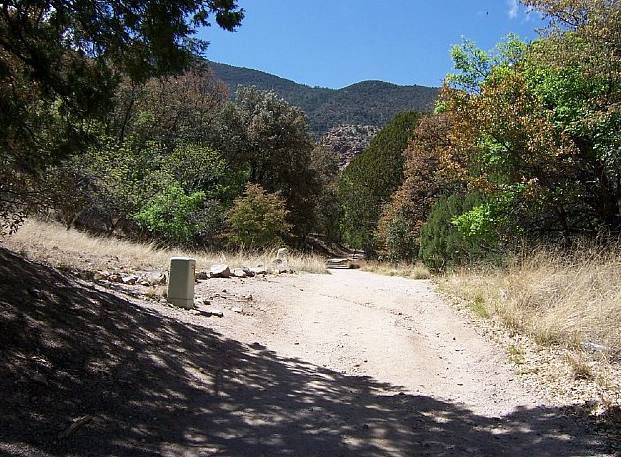
I'm trying to include more pics in my blogs, so here's a pair from my most recent trip to The Nature Conservancy's Ramsey Canyon Preserve:

Ramsey Canyon Preserve 5 Ramsey Canyon Preserve 12