Showing posts with label God among us: incarnational theology. Show all posts

Saturday, January 14, 2023

Five Minute Friday :: Receive

the word receive with five unwrapped holiday gifts
First FMF of this new year!

• Five Minute Friday :: Receive Linkup

From Gian-Carlo Menotti's Ahmal and the Night Visitors:

The child we seek holds the seas and the winds on his palm.
The child we seek has the moon and the stars at his feet.
Before him, the eagle is gentle the lion is meek.

On love, on love alone will he build his kingdom…
His might will not be built on your toil.
Swifter than lightning he will soon walk among us.
He will bring us new life and receive our death.
And the keys to his city belong to the poor.

The Child will bring us new life and receive our death.

People may offer us a gift of a birthday present, a compliment, their presence, a little more time (name yours!), but the gift isn't complete until we receive it. In many cases that means no action on our part; some times to receive a gift is simply not to refuse it, but we frequently need to unwrap it to find out what it is and to use the gift. Humans have been known to say "exchange gifts," but as one of my professors pointed out, an exchange (money for something, bartering this item I have for that one you have, any quid pro quo) is perfectly legitimate and necessary in a developed market economy because we're not hunter-gatherers… but a gift is something else.

The late Richard Farina wrote the song "Pack up your Sorrows."
If somehow you could pack up your sorrows,
And give them all to me,
You would lose them, I know how to use them,
Give them all to me.

In the world of music, Christ-figures are fairly familiar. Think about James Taylor singing "Handyman," "You've Got a Friend," "Shower the People You Love," "Up on the Roof."

Jesus receives our sorrow, disappointment, devastation, and grief as a gift and we receive life in return as a gift from him. How about us? Can we receive another's pain, problems, and troubles as gifts and return new life? Not because we expect to get, but because we love to give?

• Please check out my blog for 15 January / Epiphany 2 for a little more about this.

five minute friday receive
five minute friday button icon logo

Thursday, August 18, 2022

Revised Bibliography

Justice Freedom Redemption book cover

Here are a few additions to my bibliography for [original working title], Justice, Freedom and Redemption: Divine Image and Creation's Glory, first blogged eighteen years ago in July 2004. More to follow!


New! • Bauckham, Richard, The Bible and Ecology: Rediscovering the Community of Creation. Waco: Baylor University Press, 2010.

New! • Dahill, Lisa E.; Jim B. Martin-Schramm, Jim B.; McKibben, Bill., Eco-Reformation: Grace and Hope for a Planet in Peril. Eugene, Oregon: Cascade Books, 2016.

New! • Dickinson, T. Wilson, The Green Good News: Christ's Path to Sustainable and Joyful Life. Eugene, Oregon: Cascade Books, 2019.

New! • Fox, Matthew, Creation Spirituality: Liberating Gifts for the Peoples of the Earth. New York: HarperSanFrancisco, 1991.

New! • Hiebert, Theodore, The Yahwist's Landscape: Nature and Religion in Early Israel. Minneapolis: Fortress Press, 2008.

New! • Lathrop, Gordon, Holy Ground: A Liturgical Cosmology. Minneapolis: Fortress Press, 2009.

New! • Tull, Patricia K. Inhabiting Eden: Christians, the Bible, and the Ecological Crisis. Louisville: Westminster John Knox Press, 2013.


1. Beker, Johan Christiaan, Paul's Apocalyptic Gospel: The Coming triumph of God. Philadelphia: Fortress Press, 1982.

2. Brueggemann, Walter, The Land: Place As Gift, Promise, and Challenge in Biblical Faith. Philadelphia: Fortress Press, 1977.

3. Brueggemann, Walter, The Land: Place As Gift, Promise, and Challenge in Biblical Faith. Second Edition, Minneapolis: AugsburgFortress, 2002.

4. De Waal, Esther, The Celtic Vision: Prayers, Blessings, Songs & Invocations from the Gaelic Traditions. Barnhart, Missouri: Liguori Publications, 2001.

5. Fox, Matthew, Original Blessing: A Primer in Creation Spirituality. New York: Penguin Putnam, Inc., 1983.

6. Fox, Matthew, Wrestling with the Prophets: Essays on Creation Spirituality and Everyday Life. New York: Penguin Group (USA) Inc., 1995.

7. Moltmann, Jürgen, The Spirit of Life: A Universal Affirmation. Minneapolis: Fortress Press, 1992.

8. O'Donohue, John, Anam Cara: A Book of Celtic Wisdom. New York: HarperCollins, 1997.

9. O'Donohue, John, Eternal Echoes: Celtic Reflections on our Yearning to Belong. New York: HarperCollins, 1999.

10. Santmire, H. Paul, How does the liturgy relate to the cosmos and care for the earth? In What are the ethical implications of worship? Minneapolis: AugsburgFortress, 1996.

11. Santmire, H. Paul, Nature Reborn: The Ecological and Cosmic Promise of Christian Theology. Minneapolis: Fortress Press, 2000.

12. Santmire, H. Paul, The Travail of Nature: The Ambiguous Ecological Promise of Christian Theology. Minneapolis: Fortress, 1991.

13. Stendahl, Krister, Paul among Jews and Gentiles and Other Essays. Minneapolis: Fortress Press, 1983.

Friday, October 09, 2015

Greg Fromholz: broken

Broken: Restoring Trust Between the Sacred and the Secular by Greg Fromholz on Amazon.

fromholz broken book coverIn Broken, Greg Fromholz has more to say about the individual micro-level of being church than about the mid- to macro levels that would more closely consider local congregation / parish, then ecclesiastical judicatories, and ultimately the church catholic all over the world. That's relatable, since every one of us spends most of our days at the micro-level.

Greg Fromholz decided to stop "...taking God places and decide to participate in what God was already doing there when I arrived..." [page 11], because everything is and every person is coram Deo—before the face of God. [page 113]

"This book is a journey of trust." [page 54] "trust / relationship" [page 74]

Doing my part to restore "trust between the sacred & the secular" and to participate in what God already was doing there when I got there, I read the last half of Broken in the nearby 24-hour Subway® sandwich shop. Unlike Greg, I didn't grow up in a legalistic home and church setting, but like Greg and like everyone else, I need reminders of the sometimes curious, frequently surprising ways God stays with all creation all along The Way. I need reminders that God's self-reveals at least as much in the broken, the stranger, the other-than-us as in the well put-together (who's that? where are they?), the familiar, the almost exactly like us. Midwestern USA-born and raised Fromholz provides some autobiographical background along with reflections on his current living and ministry setting in Ireland; he also reads his own experiences into some scriptural narratives in a manner that models what we could do as individuals, in a bible study or other group setting.

Intriguing chapter titles each begin with "Trust and..." and continue to details that include Presence, Posture, Peace, Home. Trust. Now that's scary, and it's essential. Trust is what every one of the sixteen chapters in this book Broken is about. "Share your stories, your scars, and begin to trust again." [page 164]

God is active everywhere, already there before we arrived on the scene, yet as the sacraments remind us, rather than *always every single time* being instantly visible and easy to recognize, God often is paradoxically hidden in the strange one, the shattered situation, the scarily unfamiliar. We are the church. To others and to ourselves we can be strange, broken, and so unfamiliar we no longer recognize ourselves. We are the church and we are the only bible many people ever will read. No matter what else is going on, "I must ... continue this story on Me Street." [page 191]

Greg's writing is naturally easygoing and brings the reader along with the author wherever he goes. Remember "participant-observer?" Similar to a half dozen books I've read over the past year or so, Broken: restoring trust between the sacred & the secular could form a template for my own journaling, observations, obsessions, and reflections. This will be a good one to donate to the church library, and probably pick up to reread again later.

my Amazon review: Broken yet Trusting

Tuesday, September 17, 2013

September Synchroblog: Loving Nature - Is God Green?

September's synchroblog Loving Nature: Is God Green? is a near-perfect fit for my own theological propensities, so I'm participating this time!

Our hosts suggested a few ideas:
1. Does God really love creation? If so, what does that mean?
2. How did “green” become synonymous with "pagan pantheist"? Or maybe "Godless liberal"?
3. Should churches be thinking and talking about things like energy usage, divestment of pensions invested in fossil fuel, environmental policy, sustainable food sheds, deforestation?
4. What did Paul mean in Romans 8 when he spoke of a groaning creation?
5. How does our eschatology shape our view of ecotheology?

green beauty with red houseHere on desert spirit's fire, a "festival rejoicing in all creation," I've blogged about this general topic many many times; this time I'll pick up 4 and 5, and make a collage by adding few ideas of my own. If this sounds familiar to readers of this blog, that's because I've kept on keepin' on with the same ideas.

Despite current interest in ecological theology emphasizing the redemption and integrity of all creation – not solely human creatures – a lot of teaching and preaching in the Church still focuses on humanity, which in some ways may not be all that "off," given that so much of the rest of creation is in need of restoration, revitalization, and resurrection from death primarily because of human sin and failure to steward creation.

In Romans 8, the Apostle Paul insists all creation waits for redemption because true children of God, humans who authentically mirror and embody the Divine Image in which they've been created, care for the earth differently, in a manner that reflects their Divine Nature. In the witness of scripture all creation is mutually covenanted and covenanted with heaven; all creation carries within itself breath of the Divine and breathes the Spirit of Life.

Romans 8:19-23, NKJV
For the earnest expectation of the creation eagerly waits for the revealing of the sons of God. For the creation was subjected to futility, not willingly, but because of Him who subjected it in hope; because the creation itself also will be delivered from the bondage of corruption into the glorious liberty of the children of God. For we know that the whole creation groans and labors with birth pangs together until now. Not only that, but we also who have the firstfruits of the Spirit, even we ourselves groan within ourselves, eagerly waiting for the adoption, the redemption of our body.
Scripture tells us the God of heaven and earth chose to make dwelling-place, Shekinah, to pitch a tent, a portable dwelling, to live and journey alongside creation.

John 1:14 MSG
The Word became flesh and blood,
    and moved into the neighborhood.
We saw the glory with our own eyes,
    the one-of-a-kind glory,
    like Father, like Son,
Generous inside and out,
    true from start to finish.
basic house greensChristianity proclaims God's definitive self-revelation in Jesus of Nazareth, in a body formed from the "stuff" of the earth. Jesus the Christ, the one whose body his followers would become... as the God of heaven and earth still chooses to make Shekinah, to live right here in the 'hood.

My particular Reformation theological tradition emphasizes the ongoing Divine presence and God's continued self-giving in the sacraments. Baptism and Holy Communion are lively signs to the world of our seeking and working for justice for all peoples and all the earth everywhere. Sacraments also signify the sacredness of all life as they form a microcosm of the promised time of the fullness of redemption for all creation. Real food comes from the earth, and for celebrating sacramental ordinances we use flowing water, juice or wine from the fruit of the grapevine, and (ideally recently homemade) bread baked from natural ingredients, so we need to be friends of the earth to continue celebrating sacraments.

Revelation, the last book of the bible, foretells the reconciliation of all things, of the lion lying down with the lamb, of people from east and west, from north and south, gathered around the welcome table of the Messianic Feast. The garden of resurrection has grown into a city, where the river of life and the tree of life provide for all creation.

Revelation 22:1-5 NRSV
Then the angel showed me the river of the water of life, bright as crystal, flowing from the throne of God and of the Lamb through the middle of the street of the city. On either side of the river is the tree of life with its twelve kinds of fruit, producing its fruit each month; and the leaves of the tree are for the healing of the nations. Nothing accursed will be found there any more. But the throne of God and of the Lamb will be in it, and his servants will worship him; they will see his face, and his name will be on their foreheads. And there will be no more night; they need no light of lamp or sun, for the Lord God will be their light, and they will reign forever and ever.
God has spoken to church, society, world, and to each of us with many "if - then" cautions, warnings, and promises. If you keep the commandments, if you are faithful, if your actions do justice to others, if you steward creation well, then it will be well with you and with yours, the earth will begin to heal. The greener we become, the greener Planet Earth will be!

Other September Synchrobloggers:

Tuesday, January 22, 2013

God In Our Midst

Daniel R Hyde, God In Our Midst: The Tabernacle and Our Relationship with God on Amazon

God In Our Midst coverWho would disagree with Professor David P Murray telling us in his foreword, "I expect any interpretation to start with the original context and park there for a while." Murray also looks for "...a book that follows Jesus' and His disciples' example in using the New Testament to interpret the Old." And "...the book must connect Old Testament believers with the New Testament church by demonstrating that both Old and New Testament saints were united in being saved by grace alone, through faith alone, in Christ alone, to the glory of God alone."? God In Our Midst maintains that faithfulness and more!

Author Daniel Hyde's introduction by itself provides sufficient material to teach and preach for quite some time, pondering historical, geographical, theological, practical, literary, and Christological aspects of Exodus 15 through Exodus 40. Martin Luther insisted, "what preaches (...drives us to, moves us to) Christ" (was Christum treibet) in scripture has more value to Christians than the rest of the bible; however, despite his canon within the canon, Luther discovered and uncovered types, foreshadowings, hints, and signs of Jesus Christ in *almost* every verse of both Hebrew Bible and New Covenant scriptures. Tabernacle? From pages 3-4:
The tabernacle (Latin, tabernaculum, "tent") was the Lord's temporary dwelling place during the Israelites' forty-year wilderness wandering and their first three hundred-plus years in the land of Canaan. ... It is called "the sanctuary," "the tent of the Lord," the "tent," "the tent of the testimony," "the tent of meeting..."
We recently celebrated God's incarnation in the infant Jesus at Christmas, and we're still in the liturgical season of Epiphany, so what an appropriate time to consider God's presence in the world, amongst all creation from the beginning of recorded time through this second decade of the 21st century! Καὶ ὁ λόγος σὰρξ ἐγένετο καὶ ἐσκήνωσεν ἐν ἡμῖν. // The Word became flesh and pitched a tent among us. John 1:14

Timothy Braun tells us Jesus was totally into Camping

"So when they had come together, they asked him, 'Lord, is this the time when you will restore the kingdom to Israel?' He replied, 'It is not for you to know the times or periods that the Father has set by his own authority. But you will receive power when the Holy Spirit has come upon you; and you will be my witnesses in Jerusalem, in all Judea and Samaria, and to the ends of the earth.'" Acts 1:6-8

We know the constant abiding presence of Jesus Christ in Word, in Sacrament, and in People who, like Jesus, pitch their tents in the world, in the power of the Spirit of Pentecost walk through the world as the presence of the crucified and risen Jesus Christ, as God In Our Midst.

Daniel Hyde is a pastor in the United Reformed Churches in North America, a conservative Reformed church body, but I cannot imagine any Christian – mainline, liberal, progressive, emerging, evangelical, Roman Catholic, orthodox... – not finding abundant treasures here. Preachers and teachers will find helpful ideas in the Appendix: Preaching the Pentateuch – Preach Expositionally [chapter by chapter; verse by verse]; Preach Plainly; Preach Christologically. There are ample endnotes and a substantial bibliography. A scripture index covers a full range of OT and NT; the extensive subject index also could be helpful in teaching and preaching.

I won't begin to enumerate any of the details that will increase your own understanding of God's self-revelation in Jesus Christ, and will increase your comprehension of almost every bit of scripture you encounter. This is a book you need to read for yourself, a book that deserves a rare 5+ stars!

my amazon review: A Rich Resource!

Wednesday, August 22, 2012

Heaven On Earth

Heaven on Earth: Capturing Jonathan Edwards's Vision of Living in Between on Amazon

Heaven on Earth coverWhat a visually light, bright book, and how easy and pleasant it is to read! Author Stephen Nichols is well aware "Sinners in the Hands of an Angry God" is the Jonathan Edwards sermon most people know about, even if they don't know the content; scarily dour, strict, sober, and somber tends to be the image of Puritans in colonial America most people imagine. Nichols completely shatters those imaginings with Edwards' "contagious vision" of a life centered in Jesus Christ fully lived, completely savored, both feet solidly planted on the ground of planet earth. "[Edwards] knew well how to live in between, to live now in all of the realities of heaven and the life to come." (page 84) How some ever, colonial American sermons were very very very (very...) long indeed, sometimes preached in two separate sessions, morning and afternoon, so that's not simply stereotype.

Professor Nichols brings pastor, theologian, (revivalist, evangelist, missionary), and philosopher Jonathan Edwards' historical and geographical setting vividly to life. The place references are a delight, especially given that I've lived in Massachusetts, traveled the Mass Pike from Boston to Stockbridge, enjoyed the Housatonic River and loved its name, yet it still surprised me to learn that when Edwards went west to the frontier only 50 miles from his famous pastorate in Northampton, Stockbridge was that frontier town! I researched and discovered Housatonic probably means "beyond the mountain." Because YouTube videos tend to come and go at a close to ephemeral rate, I won't link to it, but Charles Ives' tone poem, Three Places in New England No. 3 is "The Housatonic at Stockbridge."

"Heaven is a world of love" extracts Nichols' and Edwards' main thesis to easy shorthand. Our primary citizenship is in heaven, basking, being, and laboring in the presence of the Triune God, yet just as Roman citizens during Paul/Saul of Tarsus' earthly journey brought Roman religion, privileges, fashions, and culture to wherever they resided, God in the Spirit calls and enables us to bring heavenly sensibilities of love, justice, compassion, and service wherever we find ourselves. Heaven on Earth speaks more of milk-and-honey happiness than of ecstatic joy; I love the word "happified" on page 96, though Nichols is extremely mistaken when he says it's "a word that only Edwards could invent," since an undergrad classmate and I both frequently used to refer to being happified. Do I recommend this book? Absolutely! Check out some of Stephen J Nichols' other writings, also.

my amazon review: visioning and creating heaven on earth

Friday, April 06, 2012

good friday 2012

After an African-American tradition, every day I wear a silver bangle baptismal bracelet that reminds me that in baptism Jesus Christ's biography becomes our biography, becomes my bio: suffered under Pontius Pilate, crucified dead and buried... on the third day he rose again...

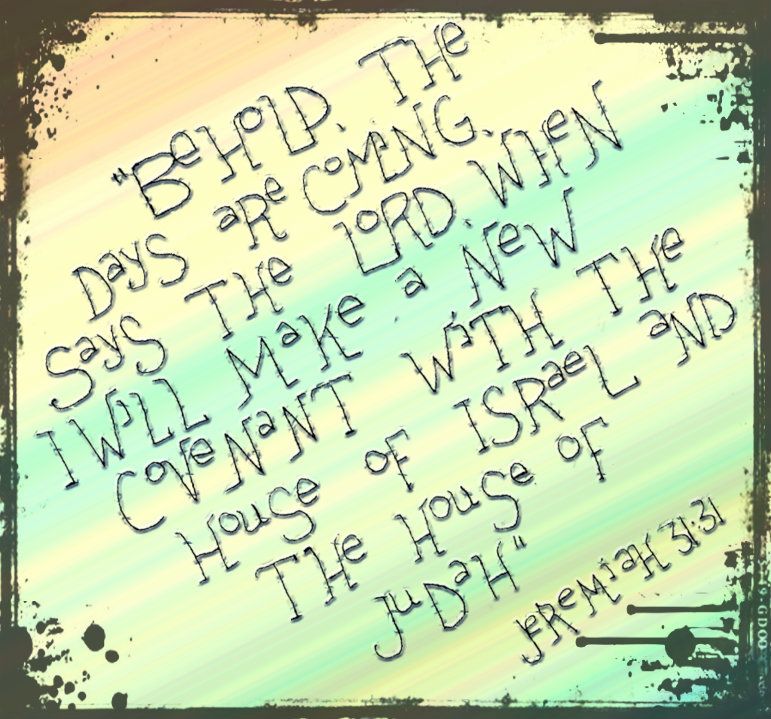
jeremiah 31:31 I've gone grunge on my blog background for a while and last night, Maundy Thursday evening, at church I participated in foot washing that some denominations routinely practice as a sacrament or ordinance. Heidelberg Catechism: "Why is the Son of God called Jesus, meaning 'Savior?'" "Why is the Son of God called Christ, meaning 'anointed?'" "But why are you called a Christian?" "Because by faith I share in Christ's anointing and I am anointed to reign with Christ over all creation for all eternity." When God signed me on for this Living Baptized gig, it was going to be counter-cultural and sometimes subversive. It might have included feeding the hungry, toppling the mighty from their positions of power, friending the needy and afflicted. It had a lot to do with justice, righteousness and making a eucharistic, shalom-filled world for all creation. However, I didn't reach this point of brokenness from working hard almost forever with Mother Teresa's peeps, or spending days on end stirring soup at the homeless shelter, or demonstrating and creating legislation for fair employment conditions for the neglected and underserved. In other words, it's not from visibly bearing the cross in ways that alienated conventionally polite society and the over-dollared Überclass.

My life cries out for resurrection! When you attend a graduation or ordination, the ordinand or graduate always thanks everyone, always explains they could not have gotten there alone and they didn't get there by themselves. In this military town, we frequently observe farewells and homecomings on the news. In those I get the impression people are supposed to get attached to other people, to miss them when they're gone, to long for their return. What about me?

Most likely I heard from Channel 10 the Daily Llama was coming to town, but these days I'm in a radically different world and space than ever I'd anticipated and so much of the past is coming back to bite me. Or is it? End of this paragraph: I didn't go to the Daily Llama event any more than I've been attending or participating in anything else well-educated, supposedly middle-class types occasionally do. But I have been celebrating eucharist and recalling why, at least to the extent a mere, broken human is able.

All of 8 or 9 years ago on the old UCC forums, Marian Conning said to me, "Leah, I think you're the kind of poet-theologian Pastor [Alan] Roxburgh (author of The Missionary Congregation, Leadership, and Liminality—you can search my tags for blogs and an amazon review of the book) is talking about; the church so needs your leadership at this time—thanks for sharing some of it with us." For the sake of the world, the church and for myself, too, I yearn for the life of participation that anyone with my gifts, education, experience and hard work reasonably could expect and anticipate. I've done my part and it cannot happen without an invitation or at least permission.

During Advent 2007 I developed and facilitated a (3 Fridays at one church, 4 Sundays at another) class in incarnational theology; for Advent 2 we talked about God's Presence in liturgy, preaching, and sacraments/ordinances. We concluded the discussion with this reflection for Maundy Thursday by Paul Hammer. Dr. Hammer offered one of the Taking the Bible Seriously talks they posted on the old United Church of Christ site and that's probably still online somewhere—besides a few times on this site.
love one another

Jesus, how common can you get? Foot washing, bread, wine!
If you're going to be religious, at least use something special.
No, my friend, I came not to perform special religious rites
But to touch the daily life of everyone
With God's love in the commonest of things.

O.K., water, bread, wine.
But isn't foot washing a bit ridiculous?
And what about "this is my body"?
And "this cup is the new covenant in my blood"?

Foot washing is the work of the commonest servant—I came to serve.
But it points beyond to the "washing" of the cross—
God's self-giving service in me to cleanse away estrangement
And heal the distortions in people's lives.
The bread points to nourishment in that same self-giving of God
At work in my body, that is in me.
And the cup points to the new community drawn together and nourished
In my blood, that is in God's total self-giving in my death.

Do you mean that this common stuff of water, bread and wine
Becomes in you the very focus of God's love for me and for the world?
That there is no excuse for my not loving my common neighbor?
Because you have shown the depth of God's love for me?

You've got it!
But it isn't a love for special occasions.
It has to be that daily love that's as common as water, bread and wine!

Wednesday, November 10, 2010

to write love on her arms day 2010...

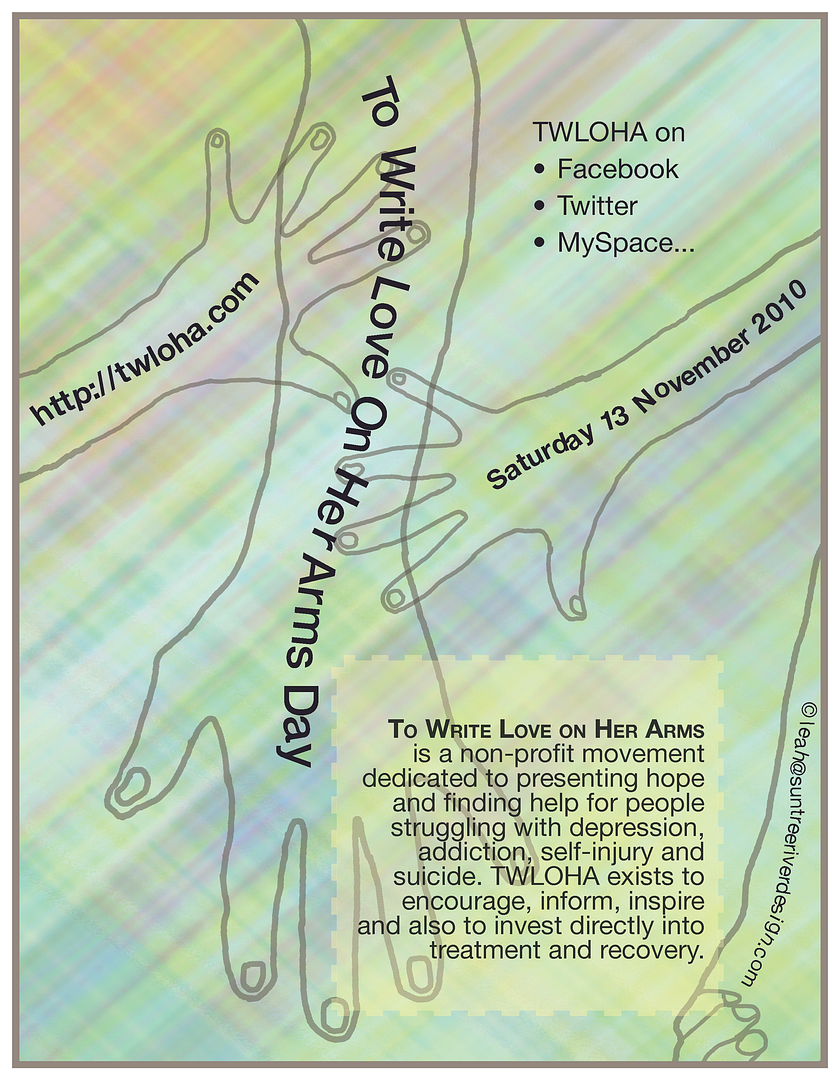
Everywhere you are, Saturday, 13 November 2010 will be To Write Love on Her Arms Day!!!

to write love on her arms day 2010To Write Love on Her Arms—the main site: TWLOHA

To Write Love on Her Arms: Facebook

To Write Love…on Twitter

TWLOHA used to be on MySpace, "where it all started."

I'm basically re-blogging my own backstory from last year:
The subjects of addiction, self-injury and related are very close to me and to my heart. You could say I've been close to it in various forms most of my life; biologically and probably environmentally I've also inherited some of it.

Compulsive, stereotypical, addictive, and similar behaviors frequently seem to defy effective treatment and although there often is an underlying biochemical imbalance or other brain dysfunction that's frequently coupled with negative or sometimes even positive psychosocial experiences, the behaviors themselves quickly carve deep, indelible neurological paths.

For generations the side of my biological family I know something about has been captive to diseases, illnesses – "disorders" – of this type. Despite my dislike of labeling, I know the apostle Paul insisted on order, not disorder and Martin Luther says the Church isn't really there without order, in other words, when it is disordered (theology blog, remember).

telling the story buttonA huge part of reluctance to reveal, discuss, and seek intervention for substance abuse/addiction, compulsivities, self-injury, and panic is their seeming uncontrollability along with the fact insight usually comes quite easily yet barely makes a dent because of brain pathways that have formed. Whether or not they met clinical DSM criteria, most people have experienced an episode that would make them look depressed, but if you haven't been there, done that, from the outside looking in it looks as if the person with OCD or addiction needs to get a little discipline and control though often they're among the most disciplined, productive, and accomplished. In the many creatives who struggle with addictions and compulsions, their creativity and productivity essentially emerge from the same source as the undesired behaviors.

Incarnational theology is one of the labels/tags to this blog post and in all this my prayer for myself and for each of us – addicted, compulsive, mood-disordered, self-injurious, suicidal, simply creatively different and/or differently creative – is a community of embrace that will celebrate our presence and encourage everyone's full participation and that God will allow all of us to become wounded healers, the divine presence of the crucified and risen Christ we were baptized to be.

As I was watching and listening to Patrick Kennedy at Ted Kennedy's funeral, I realized that even for someone in a large, supportive family that also has sufficient resources of every kind, this kind of illness still takes a huge toll and is immeasurably costly to society and to the individual.

for every one of us to write love on each other's, others or others' arms…

Another version of my urban graffiti poster for TWLOHAD 2009: To Write Love on Her Arms Day too

Wednesday, October 13, 2010

from the heart of the earth

Just as Jonah was three days and nights in the belly of the great fish, so shall the Human One be three days and nights in the heart of the earth. Matthew 12:40

As the world at last rejoices in a successful outcome to internationally planned rescue efforts that resulted in one miner and then another being brought to safety and restored to life above ground, I couldn't help but think of the Sign of Jonah—Death and Resurrection!

Flag of ChileBeginning 05 August, a 69-day long drama ensued when a collapse at the San José copper mine in the Atacama desert in Copiapó, Chile sealed off exits for miners who were working underground; the location of 32 Chilean nationals and one Bolivian remained unknown for 17 days and the final outcome wasn't really certain until yesterday evening.

"We have lived a magical night, a night we will remember throughout our lives, a night in which life defeated death," Chilean President Sebastian Pinera announced; later on he said to the 15th miner out, Victor Segvia, "Welcome to life!" In Martin Luther's Easter hymn, «Christ lag in Todesbanden» we sing, "It was a strange and dreadful strife when life and death contended; the victory remained with life, the reign of death was ended..."

All creation lives under conditions of time and space; those of us above ground alternated between high hopes and high anxieties, but the miners themselves must have sensed limitations of space and time with extreme intensity in their confined waiting places and the truly finite interval within which hope would be able to hang suspended. They were in easily measurable chronos time, likely drifting back and forth from memories of deadly mine calamities they'd heard about and the hope of resurrection to new life from 700 meters deep in the heart of the earth.

The miners themselves observed there were not 33 miners—there actually were 34! Christianity teaches and proclaims God's incarnation, enfleshment as a human in a body formed from the stuff of the earth. According to the creation narrative from the scribe we call the "Elohist," God created the proto-human, out of red dirt and named him A-dam, "earthling," from the Hebrew word for earth or ground. Luke the gospel-writer concludes his genealogy with "Adam, son of God!"

As the ordeal concludes, the miners find themselves resurrected into new lives formed out of the stuff of the earth, because of the ground and after more than three days and three nights.

Sunday, June 06, 2010

last days: deepwater horizon take 2

Deepwater horizon, blog take one: oil and water

oil spill day 48: Sunday, 06 June 2010. 31 May completed the biblical number of 40 days…

nature conservancy


The photographs of oil-soaked waterfowl are unbearable to view; they reinforce that without any doubt Obama's presidency will be marked by, possibly solely remembered by, an epic environmental disaster over which he had no control. No one can unwind time, though conventional wisdom and common sense says some of us might be able to consider and examine what has gone wrong, learn from it and use the knowledge to help make a different future that's not an endless recycling of the same behaviors and outcomes. A couple years back someone in a bible study I'd been attending and sometimes facilitated suggested "end times" as a possible study topic. People who hold onto the worldview of conservative evangelicalism typically look forward to the end of this physical earth as we know it. Those final days especially will feature The Rapture in which they confidently expect to be included as in, "in case of rapture this car will be unmanned" / "In case of rapture, can I have your vehicle?" / "In case of rapture, I'm not sure reading this bumper sticker is a top priority for you." Truth to tell, in so-called liberal mainline denominations not only is "end times" in that sense not a viable theological topic, it's not a plausible or possible one. In terms of responsible interpretation of scripture, to consider the faithful in Christ caught up into the air and floating away as the earth is undergoing the most catastrophic event imaginable mocks and negates the gospel call to journey alongside all people and all creation, to be the presence of Jesus Christ in the world, just as it turns upside down scripture's call to love and cherish the earth just as the Creator God cherishes and cares for all creation.

For some millennial (premillennial, amillennial, postmillennial, Darby, Ryrie, Scofield…) dispensationalist basics, check out this site; it explains dispensationalism more concisely than I could or care to:
…a system of Bible teaching or hermeneutics which holds: 1. That the revelation of truth from Adam to Christ was progressive and that none of the Old Testament writers or prophets had or knew all of the truth of God. 2. That through the various ages or periods of time, God revealed special portions of truth to humanity and placed humanity under a particular test regarding this revelation.
But there is an important theological topic of eschatology, or the word about the redemptive consummation of creation's original purpose. Christianity proclaims the birth, life, death, resurrection and ascension of Jesus Christ completed the work of salvation for all creation, yet typically we assert that we actually live in the proleptic or anticipatory realization of the eschaton, rather than in its fulfillment. Throughout its witness, scripture calls humanity to help initiate justice and redemption for all creation and an ultimate vision of the messianic feast to which the entire earth is invited, welcomed, gathered together healthy and restored, living in mutual dependence and covenant. Without water, that dream cannot be realized.

For sure many prophets we know from the Hebrew Bible wrote and preached about a Day of the Lord, which variously was a time of deep darkness, doom and despair, a occasion for immediate repentance followed by redemption or a time of hope. Apocalyptic writing full of metaphor, code, mystery and hidden (apocalypse literally means uncovering, therefore a "revealing") symbolism tends to emerge and flourish in times of political unrest, turmoil and uncertainty; besides the the book of Revelation in the NT, parts of Daniel, Zechariah, Ezekiel, 1st Isaiah, the "Little Apocalypse" of Mark 13, some of the writings of Paul of Tarsus, 2 Peter (probably I've missed some) all include hidden symbolism, dreams, visions, and often dualism.

In my previous blog about the Deepwater Horizon incident I wrote, "Through its witness, scripture brings humanity a call to help initiate justice and redemption for all creation and an ultimate vision of the eschatological feast in which the entire earth is healthy and restored, living in mutual dependence and covenant. Without water, that dream cannot be realized."

Noel Paul Stookey and Peter Yarrow (remember them? from Peter, Paul and Mary) wrote and recorded "Very Last Day"; The Hollies had a version, too. In some ways it's a slice of vernacular apocalyptic, though it contains a huge burden of scriptural, ethical and practical reality.
Chorus:
Everybody gonna pray on the very last day
When they hear that bell a-ring the world away
Everybody gonna pray to the heavens on the judgment day.

Well the law is given and the law is known,
A tale is told and the seed is sown,
From dust we came into dust we'll go,
You the know the Lord once told us so.
Each brother takes his hand,
Heed the meaning of the Lord's command
Get ready, brother, for that day.

published by Neworld Media Music Publishers and Silver Dawn Music
"The law is given (to us) and the law is known (by us) … Heed the meaning of the Lord's command…" God's covenantal decree is nothing like the arbitrary social code self-righteous pharisee types invented and continue to invent in order to separate out people they didn't like with impossible demands and elevate themselves; it is a graciously given way of life that brings sustenance and more life along with it to those who observe it. Over these past eight years I've blogged a fair amount about the Ten Words or Commandments of the Sinai Covenant and the Great Commandment (love God, neighbor and self) and won't repeat what I've previously said, at least not right at this moment. No one knows how much more devastation creation can bear. But there is something we can do, even the majority of us who do not have the kind of money that talks (a high level of financial articulation). Check out the Nature Conservancy link in The Gulf: Ways You Can Help image at the top of this blog and may peace, justice, and righteousness return to the earth of God's creation the earth God calls – and enables us in the Spirit – to help preserve, sustain and re-create!

Friday, May 28, 2010

Bethel

bethel center building

Joel David Trout used to pastor North Park Apostolic Church, where I heard his dynamic exposition of 2 Kings 2. The particular topic of Bethel related well to Maundy Thursday as it eased into extremely early Good Friday when I started this blog post eight weeks back; the tripartite triduum liturgy had begun a few hours prior to then—here's Bethel, extrapolated and interpreted for here and now.

So you've (we've, I've) just been to Gilgal, the place of rolling away doubts, pasts, fears, transgressions, regrets and anything else that's been getting in the way. But now we need (I need, you need) to get to God's House, to Beth-El! During my undergrad years I was involved in a church that was part of an urban homeland mission and we met in a building called Bethel, though the congregation itself had a different name. During January I blogged some reasons for taking your offspring to the services of God's house; they equally apply to everyone, every age and every circumstance. At church we hear, learn and begin living the story and the stories of the covenanted people of God; we start making the old stories our stories and practice telling the stories.

At the services of God's House we celebrate and participate in the Eucharist, God's eschatological feast of justice, reconciliation, forgiveness and inclusion for all creation. This is God's manner of making new beginnings that's also a living sign of God's promised end, the welcome table of "go and do likewise." We learn to be prepared to forgive and to be forgiven... learning to live every moment "wet behind the ears" again with baptismal water, committed again to Good Friday and to Easter, constantly recovering in Walter Brueggemann's words, "...the focal drama of baptism, which is a subversive act of renunciation and embrace summoning us 'From our several enslavements ... to a common, liberated obedience.'" Something expressed so well bears repeating often!

But what else happened at Bethel for me? I began learning how to take care of the neighborhood's people and infrastructure with political action and community organizing. I enjoyed reading some Paul Tillich and Thomas Merton, although Paul of Tarsus and especially Romans overwhelmed me. We worshiped together and studied scripture and theology alongside each other. We shared meals—part of our general economic style included barter and exchange. I did homework on the roof with friends while we listened to the radio and talked; I did some art, some music and a little writing; during the summer I loved driving friends to beaches along the north shore and sometimes down route 3 to the south shore.

leaving bethel
After a season at Bethel, learning the joy and craziness of community along with its shared tasks, frustrations, anxieties and sometimes surprising hope, it's time to move on. After Bethel we need to reach Jericho, the place of radical, unquestioning, liberating obedience that continues preparing us for a together (in more than one sense) future.

(This image of the street alongside the Bethel Center in my old neighborhood shows how it is, as the street curves away from the ethnic, student, yuppy semi-ghetto – remembering "nothing much goes in or out of it that wasn't there the day before" to explain ghetto – toward commercial financial downtown City of History, but back in my days, if you didn't take the underpass walkway between the mainly residential neighborhood and downtown, you'd walk right into the central artery that now is way far gone, the result of an extravagantly expansive and $14,600,000,000 worth of "expensive" public works project, The Big Dig.)

And after Jericho? Going to Jordan... the place of boundaries between old and new, borders between strange and known, stranger and friend, barriers between where we are and where we need to be, what we have and what we want. Going to Jordan, the place of baptism for Jesus and the paradigmatic location of our baptism, too.

From Gilgal to Bethel into Jericho, all of us take along stuff – goods, bads and some indifferents – from previous locations. At Jericho we're in the place of often counter-cultural, counter-intuitive obedience and radical trust to the point of not daring question or ask a "why" out loud. At Jericho we're preparing for Jordan, for "...the focal drama of baptism, which is a subversive act of renunciation and embrace summoning us 'from our several enslavements ... to a common, liberated obedience.'"

From Gilgal to Bethel, to Jericho, to Jordan... and then to?

life stuff button

Thursday, May 20, 2010

oil and water: deepwater horizon

"Water is life," they insist. Digital, print and electronic news media have been filled with more and more devastating reports about the "Deepwater Horizon incident" oil spill that occurred in the Gulf of Mexico on 20 April. BP, the petroleum mega-giant whose equipment failure (malfunction?) caused the disaster has been filling their website with more and more unconvincing explanations and defenses.

In my recent blog, Where Can Red-Winged Blackbirds Live?, I observed
Despite current interest in ecological theology emphasizing the redemption and integrity of all creation – not solely human creatures – a lot of teaching and preaching in the Church still focuses on humanity, which in some ways may not be all that "off," given that so much of the rest of creation is in need of restoration, revitalization and resurrection from death primarily because of human sin and failure to steward creation (which naturally results in failure to take proper care of human needs).
Water, the primordial substance of the world, existed before anything else in creation; in Genesis 1 we read:
1In the beginning when God created the heavens and the earth, 2the earth was a formless void and darkness covered the face of the deep, while a wind from God swept over the face of the waters.
From the New Century Hymnal, a version of the
Thanksgiving and Blessing over the Baptismal Water:

We thank you, God, for the gift of creation called forth by your saving Word.

Before the world had shape and form, your Spirit moved over the waters.
Out of the waters of the deep, you formed the firmament and brought forth earth to sustain life.

In the time of Noah,
you washed the earth with the waters of the flood,
and your ark of salvation bore a new beginning.

In the time of Moses, Aaron, and Miriam,
your people Israel passed through the Red Sea waters
from slavery to freedom and crossed the flowing Jordan
to enter the promised land.

In the fullness of time, you sent Jesus Christ,
who was nurtured in the water of Mary's womb.
Jesus was baptized by John in the water of the Jordan,
became living water to a woman at the Samaritan well,
washed the feet of the disciples,
and sent them forth to baptize all nations by water and the Holy Spirit.

Bless by your Holy Spirit, gracious God, this water.
By your Holy Spirit save those who confess the name of Jesus Christ
that sin may have no power over them.
Create new life in those baptized this day
that they may rise in Christ.
Glory to you, eternal God,
the one who was, and is, and shall always be,
world without end. Amen!
Scripture and Church have made water and the creative word central signs of new birth in baptism and signs of the reign of heaven on earth. Studying the witness and examples in scripture, during the imperial reign of King Solomon, depletion of creation and misuse of natural resources had become the habit and the rule because of human imaginings they were the center of everything and so concomitant desires of the rich and famous for a high-end, unsustainable deluxe lifestyle could be met; that era brought the earliest biblical creation account from the writer we now refer to as the Yahwist: Genesis 2:4-25. In some ways the easy conversational intimacy between human and Creator does reflect the reality of Divine care and concern for all, but the text also exposes human arrogance and a not unusual human trait of attempting to contain, control and domesticate the elusive wildness of the God of the Bible. Remember how Israel's plea for a temple and a king partly was an attempt to become "like other nations" rather than a faithful desire to live in risk and dependence on one another as Yahweh's peculiar people? Toward the end of Solomon's rule, Jeremiah the prophet implores, "O land, land, land, hear the word of the Lord!" (Jeremiah 22:29)

After the fall of Solomon's empire, in the creation account placed first in the biblical canon, the exilic (or possibly post-exilic, since dating is a bit confounded) Priestly Pentateuch source, Genesis 1:1 - 2:3 recognized creation as orderly, the Creator God as one who acts not randomly but systematically and does not place humanity at the center or the apex of the rest of creation, but rather gives human creatures a place within the order and a call to steward, maintain, treasure and support the rest of creation. Yes, one well may argue that part of the purpose of the Priestly scribe was to grant legitimacy to an organized ecclesiastical hierarchy and given that written and orally transmitted texts are cultural artifacts likely that was a factor, but not incidentally the text carries along with it an integrated, sustainable worldview and practice rather than one subject to disintegration. Through its witness, scripture brings humanity a call to help initiate justice and redemption for all creation and an ultimate vision of the eschatological feast in which the entire earth is healthy and restored, living in mutual dependence and covenant. Without water, that dream cannot be realized.

"You choose to be made at one with the earth," sings the activist hymn written by Fred Kaan. The God outside space and outside time, God who created everything from nothing, chose decayable human flesh formed from nature's stuff, the elements of the earth, as the mode of his most decisive self-revelation. God chose to live within the bounded limits of space and time, and still chooses to do so, indwelling all creation – including streams, rivers and oceans (of course!) – with the breath of life and evidence of enduring love. On my Red-Winged Blackbirds blog I asked, "Where can God find a home?"

Back in the olden days, BP was British Petroleum, a name that evokes memories of a worldwide empire of colonies, protectorates, and other entities on which the sun never set, all administered by or somehow connected to the United Kingdom. From scriptures and other sources we recognize word and speech as both source and immanence, with lively power to initiate, suggest, birth, relate and transform. In many cultures, a person's name formally expresses the essence of the person, and it is not a stretch to suggest language carries similar power for us 21st century dwellers.

Those "theys" who remind us water is life also insist oil and water do not mix, cannot form a chemical alliance. The olive tree, giver of one of my favorite fruits, has long culinary, religious, political and liturgical histories and typically lives for a very long time. The forehead of a person being baptized is signed with a cross traced with chrism made from olive oil; just like prophets, priests and kings of Israel, they are "Christed" or chrismated, anointed. The olive tree frequently is considered the Tree of Life referred to in Revelation 22:"1 Then the angel showed me the river of the water of life, bright as crystal, flowing from the throne of God and of the Lamb 2through the middle of the street of the city. On either side of the river is the tree of life with its twelve kinds of fruit, producing its fruit each month; and the leaves of the tree are for the healing of the nations."

The tree depends on the river and the nations, the "people," the ethnos – the plain ole folk – depend on the tree that depends on the river...that depends on human care, covenant and faithfulness.

Deuteronomy 8
6Therefore keep the commandments of the Lord your God, by walking in his ways and by fearing him. 7For the Lord your God is bringing you into a good land, a land with flowing streams, with springs and underground waters welling up in valleys and hills, 8a land of wheat and barley, of vines and fig trees and pomegranates, a land of olive trees and honey, 9a land where you may eat bread without scarcity, where you will lack nothing, a land whose stones are iron and from whose hills you may mine copper. 10You shall eat your fill and bless the Lord your God for the good land that he has given you. 11Take care that you do not forget the Lord your God, by failing to keep his commandments, his ordinances, and his statutes, which I am commanding you today.
After the deluge, Noah released a dove, "And the dove came in to him in the evening; and, lo, in her mouth was an olive leaf plucked off: so Noah knew that the waters were abated from off the earth." Genesis 8:11

But also, with its purported 613 kernels, symbolizing the 613 commandments found in the Hebrew Bible, pomegranate is considered the tree of life: to be saved, whole, redeemed, shalom-full "keep the Commandments," keep covenant with all creation, that we all may live. Did I not blog, "so much of the rest of creation is in need of restoration, revitalization and resurrection from death primarily because of human sin and failure to steward creation (which naturally results in failure to take proper care of human needs)." Okay, BP, listen up!

As Lin C commented on facebook, "The ocean is the Earth's circulatory system. Kill that and we kill the earth." The whole concept of human supremacy and invincibility has been killing the earth for too long. I'm not a scientist, but from what I understand, light is life and this planet *should* survive as long as earth's Sun Star shines and is not extinguished (by human stupidity and greed). On her blog, Yearning for God, Jan linked to some beautiful, hope-filled water blessings. Where can the earth find a home and not be a stranger to itself?

my second blog about the gulf coast oil spill—last days: deepwater horizon take 2

Sunday, December 06, 2009

lessons and carols 2009...

Sunday, 06 December in Founder's Chapel at nearby University of San Diego; again this year I'll describe Lessons & Carols at USD as "an exceptionally worthy piece of preparation for God's birth in our very midst, 'fulfillment beyond all human reckoning,' as one of the worship leaders described it," in my words from 2008.

Angelo Musicante by Melozzo da Forl

Here's
Advent 1 2008 followed by Advent 2, Lessons and Carols @ USD 2008. The lute-playing "Angelo Musicante" by Melozzo da Forl was on the program cover again this year.

Our ecumenical Faith, Order and Witness Committee used to meet at USD quite regularly until it became impossible to schedule a room; the near-elegance and broad, gracious layout of the USD campus always makes me wonder. It's an expensive, church-related school with an overarching emphasis on justice, but like almost all the students I've seen walking around campus and in the dining hall, most of the students in today's program were atypical for San Diego, and as a group not at all characteristic of the tremendous ethnic, racial, cultural and economic diversity that is the San Diego I interact with every day and the San Diego of the condo complex I currently call home.

For the processional we sang "O Come, O Come, Emmanuel." Be with us, God-with-us, ransom your people, pay the price to free them, to liberate all of us from captivity to everything that holds humans and societies cultures in chains.

Comfort ye, my people! Every valley shall be exalted; the mountains and hills made low-- from the exilic Isaiah 40:1-11 and G. F. Handel. Jesus of Nazareth lived The Way that raises deep caverns and valleys, levels mountains and hills, straightens treacherous roads (repairs those potholes, too); that way is life on the edges of conventional society, words and action that subvert conventional political and religious pretensions to power. Doing justly and loving rightly includes advocacy for equity for everyone everywhere, reversing superfluous wealth and unseating corrupt government. The way of the baptized includes speaking truth to power and living as servants to all.

Erin Lovette-Colyer, Director of The Women's Center at USD was homilist. She suggested we put Mary's story into our own story into Mary's story into our own... and told us she'd talked with three "wise women" in her life as part of her preparation to preach at the worship event. Her own mother, diagnosed with terminal cancer; her recently widowed aunt and her brother's wife, her sister-in-law soon to deliver her first child. Erin told us no doubt Gabriel was well prepared to engage Mary in conversation. What teenager wouldn't want to and need to discuss the momentous future she was being asked to enter? I'd never thought of that, but of course Mary had to talk about it, but the main thing is Mary said "Yes."

Erin described so many of us as afraid to die, afraid to live and afraid to give birth and during this Advent 2009 I still find myself in the same almost forever of being afraid to die (not only to past disappointments and human expectations, but lots more, too), afraid to continue living with lack of basic community, with isolation and loneliness and still afraid of giving birth to a new life for myself and the strangers around me. What if, what if, what if not? Seems as if I still think somehow I can do it on my own, which definitely has not worked at all and after all, in baptism I'm already dead, I've already been raised from death to new life. At the end of her talk Erin Lovette-Colyer asked if we would be doing Advent with an attitude of hope rather than anxiety and "being honest with myself" my anxiety level still is far too high for a modicum of comfort, yet I'm doing Advent with hope, too.

Isaiah 11:1-10 was one of the readings ...1A shoot shall come out from the stump of Jesse, and a branch shall grow out of his roots. 4abut with righteousness he shall judge the poor, and decide with equity for the meek of the earth...9bfor the earth will be full of the knowledge of the Lord as the waters cover the sea.

Before the recessional the choir sang last year's recessional song, "The Virgin Mary Had a Baby Boy," an arrangement of a spiritual from the West Indies, proclaiming Mary's Baby Body "came from the glorious kingdom."

Jesus came from the glorious kingdom to make this earth a glorious kingdom, as full of the presence of God "as the waters cover the sea." In the power of the cross and the power of the Spirit, we live as God-with-us, God among us. The feast and the season of Epiphany is not all that far away, so in the words of one of my very young students quite a while ago, to live as the Body of Christ means "that we can be city lights!"

Observing Advent, hoping and longing for the Divine Presence in our midst ultimately is about desiring and longing for the death of death itself, hankering after Easter. Afraid to die? But God can only resurrect the dead! And I'm dead, already--baptized! How do we practice easter in the midst of tombstones? How do we live as if among the artifacts of death? Remember, remember... the straight path, the smooth, level road is the way of the cross, the axis mundi connecting heaven and earth as we live incarnation, resurrection and pentecost together. Celebrate eucharist: taken, blessed, broken and given...

Wednesday, November 25, 2009

poetry party 41

invitation to poetry icon
suntreeriver design

Christine has announced Abbey of the Arts poetry party 41 and book giveaway so I'm participating and she tells us the books from the giveaway all have been given away, yay!
All month long I've been blogging daily thanks for National Blog Month, and I'm delighted to offer a few more reasons for thanksgiving.
I am excited about my Facebook page, suntreeriver design and all my fabulous fans. Since suntreeriver design debuted on Facebook just over six months ago, I've featured galleries of my own design along with ten guest artists so far; two more guests are scheduled for the near future.

Last Sunday we celebrated the reign of the crucified Man of Sorrows and risen King of Glory, and my heart holds immense gratitude for a God Who chose to come to earth in flesh that fails, bones that break, dreams that shatter and plans that implode and that God continues choosing far less than ideal circumstances as the ongoing locale of continuing Self-revelation

A Facebook friend quoted from Shane Claiborne in Jesus for President: Politics for Ordinary Radicals "Christianity is at its best when it is peculiar, marginalized, suffering, and it is at its worst when it is popular, credible, triumphal, and powerful...." Despite my own tremendous ambivalence and pain, in many ways I yet am thankful for all these years of loneliness, marginalization and far less than full participation in church and world. After all, I'm a theologian so I do paradox and ambiguity very very well.

As we move into Advent's call to repentance and hope and then to the Nativity, the birth of the Baby Boy in Bethlehem, how can I not be everlastingly grateful for the Savior "Of Jesse's lineage coming ...amid the cold of winter when half-spent was the night" and for the Good News Jesus still brings, a gospel that fully engages and that calls us to stewardship of all creation.

Friday, November 13, 2009

to write love day

TWLOHAD: Friday 13 November 2009, all over the world!

to write love day

To Write Love On Her Arms describes its mission:

"To Write Love on Her Arms is a non-profit movement dedicated to presenting hope and finding help for people struggling with depression, addiction, self-injury and suicide. TWLOHA exists to encourage, inform, inspire and also to invest directly into treatment and recovery."

more:
To Write Love On Her Arms Day is a day where anyone can write the words love on their arms, to support those who are fighting against depression and those who are trying to recovering. On this day, just write love on your arms, and show it off, other people will ask why you have love written on your arms, and you tell them you are supporting to write love on her arms day, and how its benefiting a non profit organization helping stop depression, and make love the movement ♥

"what will this achieve?" It will achieve the goal of people knowing that there are other people out there with the same problem, and/or people who are supporting them with love."
some of my own backstory

telling the story buttonThe subjects of addiction, self-injury and related are very close to me and to my heart; you could say I've been close to it in various forms most of my life. Biologically and probably environmentally I've inherited some of it.

Compulsive, stereotypical, addictive and similar behaviors frequently seem to defy effective treatment and although there often is an underlying biochemical imbalance or other brain dysfunction that's frequently coupled with negative or sometimes positive psychosocial experiences, the behaviors themselves quickly carve deep, indelible neurological paths.

Bearing in mind this is my theology rather than my (currently semi-inert) testimony blog, the side of my biological family I know something about for generations has been captive to diseases, illnesses – "disorders" – of this type. Despite my dislike of labeling, I know Paul insisted on order, not disorder and Martin Luther says the Church isn't really there without order, in other words, when it is disordered (theology blog, remember).

A huge part of reluctance to reveal, discuss and seek intervention for substance abuse/addiction, compulsivities, self-injury and panic is their seeming uncontrollability and the fact insight usually comes quite easily yet barely makes a dent because of brain pathways that have formed. Whether or not they met clinical DSM criteria, most people have experienced an episode that would make them look depressed, but if you haven't been there, done that, from the outside looking in it looks as if the person with OCD or addiction needs to get a little discipline and control though often they're among the most disciplined, productive and accomplished. In the many creatives who struggle with addictions and compulsions, the creativity and productivity essentially emerge from the same source as the undesired behaviors.

TWLOHAD posters

I've illustrated this blog with one of the pair of posters I designed for this special worldwide TWLOHAD. Amidst a flurry of mostly urban, mostly colorful and coastal beach graffiti the eventful day, the website, the purpose and the promise anchors it all with the hope I describe as "To write love on each other's arms" and now I notice spellcheck doesn't like other's but accepts others and others'±but not to stereotype or label (much), remember, it's urban graffiti!

and now...

"incarnational theology" is one of the labels/tags to this post and in all this my prayer for myself and for each of us – addicted, compulsive, mood-disordered, self-injurious, suicidal, simply creatively different and/or differently creative – is a community of embrace that will celebrate our presence and encourage everyone's full participation and that God will allow all of us to become wounded healers, the divine presence of the crucified and risen Christ we were baptized to be. As I was watching and listening to Patrick Kennedy at Ted Kennedy's funeral, I realized that even for someone in a large, supportive family that also has sufficient resources of every kind, this kind of illness still takes a huge toll and is costly to society and to the individual.

for every one of us to write love on each other's, others or others' arms...♥ ♥ ♥

another version of my design for TWLOHAD 2009: to write love on her arms...

Tuesday, November 03, 2009

Roy DeLeon: Praying with the Body

Praying With the Body: bringing the psalms to life, by Roy DeLeon, OSB, on Amazon

Praying with the bodyI love the 7" x 8.5" dimensions, its easy heft along with the just-right feel of the way it flexes in my hands and I love the turquoise blue cover, a color of the sea and a hue of the desert. Roy's book is in the Active Prayer Series from Paraclete Press, whose about explains:
Although Benedictine spirituality is at the heart of all that we do, we publish books that reflect the Christian experience across many cultures, time periods and houses of worship. We publish books that nourish the vibrant life of the church and its people--books about spiritual practice, formation, history, ideas, and customs.
In his forward, Paulist Father Thomas Ryan says how strange it is that Jews and Christians pretty much check their bodies at the door of synagogue or church, while Muslims, Buddhists and Hindus integrate the whole person into their spiritual practices. Strange indeed, as Fr. Thomas further observes, that despite Christianity's high theology of the body and in spite of the fact that the "great Christian festivals of Christmas, Easter, the Ascension, and Pentecost all make profound and radical statements of faith about God's esteem for our embodied being.. And In Judaism, the body-mind-spirit is a seamless entity named... by a single word..."

Christianity's central kerygma, our primary proclamation is God's incarnation in the human Jesus of Nazareth. I love reminding people that the gospel-writer Luke the physician ends his genealogy with "Adam, son of God." Formed from the substance of the same earth that grows crops to nourish us and other animals that in turn feed and provide for the ground's produce, trees that shade and shelter us, that provide lumber, leaves and reeds to form into dwelling places... And Latter-day Saint theology asserts not only did the Son become embodied and enfleshed; so also did God the Father! Theology of the Holy Spirit insists on human potential to achieve the divine nature we were created to assume. In the garden the tempter told the human A-dam, "You shall be like god," and verily, we shall be! Different Christian traditions use different words but divinization, theosis, sanctification all point toward our ultimately becoming and living both fully human and fully divine, exactly like Jesus Christ, so God becomes re-incarnate and reborn in each one of us, in the community that bears the name of Jesus Christ and in all creation. The indwelling Holy Ghost means the Divine Presence very here and very now and furthermore, in Jesus Christ we all experience the resurrection of the body.

People often refer to Christianity as spiritual, though the way of Jesus is heavily economic, highly political and hardly ascetic in its celebration of gifts from the ground, in its perspective that insists on the interdependence of all life, in its historical affirmation of human sexuality and in its charge to care for all creation, the natural environment that surrounds us, envelopes us and that is not incidental but remains integral to God's action in history. In sacramental theology we speak of the capacity of the finite to contain the infinite, pointing toward interdependence of everything created to a degree no one could or would imagine on their own.

Roy organizes the book into Alleluia, Sanctus and Amen types of prayer sessions. "Alleluias" are about new beginnings. Each includes an introit, a section of a psalm. a Silent Reflection, illustrated suggestions for "Praying with the Body, Heart and Soul," Sitting in the Presence (similar to centering prayer I sometimes practice), a possible way to live your prayer, an original Contemporary Psalm and concluding prayer. At about 2 inches wide, the margins of the books have plenty of space for the participant's own notes and each discrete session features a pullquote from the psalm one might choose to contemplate or concentrate on--or possibly not at any particular time.

Although intended for the middle of the day or mid-endeavor, "Sanctus" prayer sessions could be adapted to any time of day or year. In Roy's words, they bring us "...back to the awareness that whatever is happening in our day, on our project or journeys, God is with us." (page 33)

Somewhat parallel to compline, "Amen" prayer sessions are for the close of day or "at the conclusion of an activity or project, or at a milestone." (page 97) Similar to possibilities of praying the canonical hours, although each office has evolved and developed a specific form for a particular time of day, prayers in Praying with the Body are liturgical forms with content that can be appropriated for other times than specified. Any of these practices could be repeated many many times with variations and there's no solid reason to keep Alleluia prayer sessions solely for the beginning of a day or endeavor, not any particular rationale for being anything but open to Spirit about the whats and whens and wheres for all these prayers. The book includes many line drawings of bodily prayer positions, but those too do not need to be replicated exactly in a person's own practice. Glancing through the illustrations reminds me that sometimes my body is surprisingly bendy and other times decidedly not at all, but like yoga these can be adapted some.

Thank you, Roy!

My Amazon Review: prayer-body connections: bringing prayer to life!

Friday, September 25, 2009

celebrating Ted Kennedy

Edward Moore Kennedy, February 22, 1932 – August 25, 2009

Ted Kennedy served as the senior United States Senator from Massachusetts and came to be known as "The Lion of the Senate."

Mission Church, RoxburyHis funeral was on a rainy Saturday, 27 August 2009 at the Basilica of Our Lady of Perpetual Help, built by German immigrants and "since 1878" a parish church; with geographical designations like parish and ward, churches dare describe themselves as congregations especially for a particular neighborhood. In the Roxbury neighborhood of Boston, Mission Church is situated amidst the have a littles and have nots, creating an apt setting for the remembrance of someone who lived his life in service to often underserved and frequently disregarded populations. I've driven past the church quite a few times, though I don't recall ever being inside.

The celebration, the liturgy, the acknowledgment of Ted Kennedy's achievements and the promise of the inbreaking Reign of Heaven began with a magnificently played and sung entrance hymn:
Holy God, we praise thy name;
Lord of all, we bow before thee;
all on earth thy scepter claim;
all in heaven above adore thee.
Infinite thy vast domain;
everlasting is thy reign.
...words to stanzas 1-4 attributed to Ignaz Franz, circa 1774; translated by Clarence Walworth, 1858 (they processed into the church singing all 8 stanzas).

Scripture readings included Wisdom 3:1-9; Psalm 72 with the recurrent response, "Justice shall flourish in his time in fullness of peace forever"; Romans 8:28-31 – "nothing can separate us from the love of God"; and for the gospel, Matthew 25 – "whatever you did, for one of the least brothers of mine, you did for me."

Beginning with covering the casket in a white pall (technically a baptismal garment), the baptismal imagery was telling and pervasive: baptizing us into the death and resurrection of Jesus Christ, God clothes us in forgiven, sinless righteousness; each of the baptized wears a baptismal calling to a life of justice, a call to a journey to the cross if – "when" – necessary; a call to speak and to act prophetically against the political, economic, social, and cultural establishments. In the Spirit God calls and enables us to talk the talk and walk the walk. Figuring out and discerning a specific career path can be tough, scary, and difficult, but we all receive the same baptismal call to lives of justice and equality, to living the Magnificat...Luke 1:51-55
He has shown strength with his arm;
he has scattered the proud in the thoughts of their hearts.
He has brought down the powerful from their thrones,
and lifted up the lowly;
he has filled the hungry with good things,
and sent the rich away empty.
He has helped his servant Israel, in remembrance of his mercy,
according to the promise he made to our ancestors,
to Abraham and to his descendants forever.
Although the Kennedy clan originated from tribal cultures of ethnic Ireland and religious Rome that back in those days were not welcomed or accepted in elite residential or vacation communities in this country, these days commentators often call them America's Royalty, and they have become essentially a dynasty. In Greg Ferguson's words:
The ground is level at the foot of the cross...
We all are equal in the light of the cross
For the love of God is given freely to all
The ground is level, at the foot of the cross

Men and women, younger and older
Every culture, every color, every tongue
No more labels, no separation
As we stand forgiven at the cross
We all are one ...

Doesn’t matter your social position
Doesn’t matter if you’re rich or if you’re poor
Race or privilege, tribe or tradition
At the cross of Christ it can’t divide us anymore
Baptized into Christ, the Kennedys are God's royalty; the baptismal hymn from 1 Peter 2:9-10 would have been perfect for a reading at the service for Ted Kennedy:
But you are a chosen race, a royal priesthood, a holy nation, God's own people, in order that you may proclaim the mighty acts of him who called you out of darkness into his marvelous light. Once you were not a people, but now you are God's people; once you had not received mercy, but now you have received mercy.
The grandeur and sweep of the memorial service and media coverage were worthy of a head of state—of royalty! Ted Kennedy lived and served in the traditions of liberal, activist politics and liberal, activist, prophetic Christianity. He was a coalition-building, conciliatory politician who initiated and sponsored legislation of the people, from the people and for the people. And during the funeral liturgy, the celebrating of Holy Communion, the Lord's Supper, taken, blessed, broken and given, the Eucharist, a feast of thanksgiving, reconciliation, and life of all creation, for all creation.

Ted Kennedy's schooner Mya provided a wonderful icon of the sometimes rocky and rough, occasionally surprisingly smooth and glassy passages everyone needs to navigate through life. Water is the basic substance of creation, the essence of life: Water Is Life! We live baptized into water, drowned into our first death and raised to second birth of bounded freedom in Christ, and we need to trust God, the One Who really is the Baptizer.

On the Friday before the funeral Ted Kennedy lay in state at the Kennedy Presidential Library, located right next door to the University of Massachusetts at Boston, an urban school for non-traditional students, many of whom go on to help change their part of the world.

Psalm 72:4a insists, "He shall defend the afflicted among the people."

President Barack Obama quoted Ted Kennedy: The work begins anew. The hope rises again. And the dream lives on. Indeed it does, and it will:

Infinite Thy vast domain; everlasting is Thy reign...the dream lives on!

Thursday, August 27, 2009

summer conversation 4

4. A Eucharistic community: the Welcome Table

John 1:1, 3 In the beginning was the Word, and the Word was with God, and the Word was God. All things came into being through him, and without him not one thing came into being.

John 12:24 …unless a grain of wheat falls into the earth and dies, it remains just a single grain; but if it dies, it bears much fruit.

1 Corinthians 11:23-24 …our Lord Jesus on the night when he was betrayed took a loaf of bread, and when he had given thanks, he broke it and said, "This is my body that is for you. Do this in remembrance of me."

And what about "this is my body"?
And "this cup is the new covenant in my blood"?
The bread points to nourishment in that same self-giving of God
At work in my body, that is in me.
And the cup points to the new community drawn together and nourished
In my blood, that is in God's total self-giving in my death.

–Paul L. Hammer–

You choose to be made at one with the earth;
the dark of the grave prepares for your birth.
Your death is your rising, creative your word;
the tree springs to life and our hope is restored…

–Fred Kaan–


In Saxon English, the Lord provided the loaf, the bread, the essentials for sustaining life. We are baptized into the biography of the baby born in Bethlehem, House of Bread. In the Eucharist, we celebrate the ultimate earth day, a feast of justice and reconciliation for all creation, that brings together the ground's fruitful yield along with the labor of farmers, vintners, truckers, grocers, bakers, sellers, weavers and potters, carpenters and contractors.
Revelation 21:1-2a Then I saw a new heaven and a new earth…and I saw the holy city, the new Jerusalem.
Who is this Lord of the Church, this Jesus?

Consider Jesus' lifestyle of justice and inclusion along with Jesus' command "do this!"


Backtracking:

1. A baptized community: Water and the Word
Galatians 3:28 There is no longer Jew or Greek, there is no longer slave or free, there is no longer male and female; for all of you are one in Christ Jesus…
Who is this Lord of the Church, this Jesus?
Consider Jesus' relationship to creation, Jesus' stewardship of all life.


2. Spaces, places, locations…

First, Second, and Third spaces, (Fourth?) places in cyberspace; the liminal, the marginal, and the central; thresholds, edges. and centers; insiders, outsiders, strangers and friends
Romans 13:8 Owe no one anything else except to love one another…
Who is this Lord of the Church, this Jesus?

Consider Jesus' sense of home and geography.


3. Jesus, us, culture, counter culture
Colossians 2:15 Having made hash of the rulers, the powers and the principalities and having been victorious over them, Christ then made a public spectacle of them!
Who is this Lord of the Church, this Jesus?

Consider Jesus' awareness of his own culture and the customs of others.

© Leah Chang