Now that I'm getting around to posting, the subject may be obsolete: the last couple Friday evenings at 10 I turned on the TV and
Daniel was nowhere in sight. Last night someone told me the show's been cancelled, although the NBC link still works...our more conservative brethren and sistern have raised a vociferous hue and cry about
Daniel! Too bad, so sad! Nevertheless, here's my blog.
On Friday, January 6, NBC aired the first episode of
The Book of Daniel. I've checked out a few reviews and won't attempt to place the show into any category, except to say the first week's episode (January 6, Epiphany) was tremendously overdrawn, even beyond caricature, though January 13's was less mannered, more tempered.
Before I say more about
Daniel and Other Reflections, an intriguing note: when one attempts to access the home page of the
Episcopal Church USA and one therefore types "ecusa.org," one can expect to receive a notice reading:
The Episcopal Church in the United States of America is often called ECUSA. Perhaps it is more properly called PECUSA (The Protestant Episcopal Church in the United States of America). If you think that being Episcopalian is about being proper, then you should probably call it the Domestic and Foreign Missionary Society of the Protestant Episcopal Church in the United States of America.
And a couple of observations, which may feel arrogant on the computer screen, but in person I trust I'd be careful to convey them with calmness and compassion:
- liturgical reminder: the Eucharistic portion of the liturgy follows the Service of the Word or ante-communion... the chasuble is the wedding garment of the messianic feast and most properly worn by the celebrant only for eucharist—so in an ideal world you probably wouldn't preach in a chasuble.
- theological observation: the New Testament uses priest in two senses only—for the unique priesthood of Jesus Christ and for the royal, prophetic, priesthood of all the baptized, our essential ordination. So depending on how you view it, technically no one of us is a priest and technically every one of us is a priest!
The Book of Daniel
The
Episcopal Diocese of Washington (D.C., which includes four Maryland counties), used to have a blog about the show. When I checked for living and dead links, I discovered it's gone.
Andrew T. Gerns, [now former] rector of
Trinity Church in the
Episcopal Diocese of Easton, PA has
this blog, including a
post about the TV show. Father Andrew's comments on the Washington's Diocese's blog especially moved me; an excerpt:
The Book of Daniel is not about us. It is a lens into how our culture struggles with issues of faith, morals, ethics and spirituality in an age where we share no common language about how to "be" in the world we are in. If we think of this as a commentary on Christians in general and on the Episcopal Church in particular then we can be nothing but offended or, at least, put off. We would have nothing to do but defend ourselves or ignore it.
There is a third choice. We can listen to what the show is telling us. If we look at this series as what it is, the musings of these writers and producers-who seem to be mainly outside the church-about issues of meaning, spiritual life, and belief at the intersection of ideals and reality, then perhaps we can gain a better understanding of the needs, the pain, the hopes, the dreams and disappointments of our culture today. We Christians should listen to what The Book of Daniel is telling us about the world wishes belief in God and spirituality could do for them. Through the show, the culture is also telling us about where the Church is perceived as having failed them.
Relationship is key. This is a generation that does not find meaning in community but in relationship. Both rugged individualism and group therapy has failed but hope is found in our network of relationships. We are being shown that real strength lies in a kind of networked individualism. All the relationships in The Book of Daniel are broken and people exist in isolation. They are trying to find ways to meet and connect with one another. So the show is telling us that what people are seeking is meaningful connection with one another.
Related to this is the need for real intimacy, which requires trust, honesty and the ability to balance accountability with cutting slack. The most intimate relationship so far in the show is between Webster and Jesus-all the others are demonstrably broken. There are hints that healing can happen, but whether real intimacy happens remains to be seen.
From my own perspective, Friday, January 20 – the show's third episode – had at least a pair of intensely risky and potentially brittle moments (was I getting used to
Daniel, or did my opinion align with a lot of others when I said the premier episode was close to farce?): the moment Daniel discerns that the Italian contractor who is so concerned about appearing gay in his self-presentation actually
is gay and that's why he's so uneasy; and then later, Daniel telling his rebellious(?) son possibly he
should be sent away, but Daniel wants to see his face every morning both were stunningly cinematic and will go down in my own viewer history.
Life Stuff
This being one of the sites where I write, though I wanted to say something about the TV show, I'm now going to blog some about my own life, about my relationship with the Episcopal Church and about my sometimes abject attitude toward Anglicanism in general.
First, long ago and a couple thousand miles away from here, I was baptized in an Episcopal Church. As I've mentioned in my formal faith journey, because of that cosmic event in my life God holds and embraces me—God has done a lot for me; God requires a lot from me. Does not God constantly hug all creation close to His heart? Yes, of course, but my baptism made me a daughter of the church, connecting me vertically and horizontally to the Church in all the ages. Because of my baptism, God makes unique demands on my life and my gifts and entrusts stewardship of my well-being no longer solely to any secular community or association and not only to a pastor or pastors, but to the entire community of my local church and beyond that, the worldwide Church ecumenical.
Why do I sometimes exclaim in near-horror my distress over being baptized in an Episcopal Church? I'll try these on for this evening: stereotypes about the style; the Episcopal Church in this USA sometimes feels as if it's more about England than about Jesus; probably also my lack of experience in the Anglican tradition until recently and my own love and passion for the churches of the Reformation tradition with their vast quantity of biblically-grounded theology. Fact, is, Anglicanism is not a
Sola Scriptura tradition, meaning people in those churches have theological fancies unrooted anywhere I can discern.
In addition, a couple of left-wing fundamentalist theologians, Marcus Borg and John Shelby Spong, neither of whom (remember Bultmann, though?) seem tolerant of one iota of mystery, paradox or ambiguity, all of which are uncomfortably essential if you're walking by faith rather than sight and for me anyway, all of which are essential to the exciting enterprise of being a theologian! Despite all that disquiet and in spite of my wide low church streak, since I hold a high theology of the sacraments, there's no way whatsoever I could justify rebaptism. God's Word given in my – and in your – baptismal event stands forever true and cannot be questioned or second-guessed.
From my adult-life long intense interest in ecumenism, here's the text of
Called to Common Mission.
During my last year or so in Massachusetts (the last time around, that is) I began attending Sunday worship plus Wednesday morning Eucharist (Rite 2), breakfast and discussion at The Episcopal Church in a section of the town where I was living; although I'd gone there to dispel myriad stereotypes – both my own and others – in retrospect, I feel I trespassed upon the most expensive real estate on the East Coast.
I keep reminding myself that both the
UCC and the
PCUSA claim an Anglican heritage, in times past actually treading the Canterbury Trail, while sometimes in devotion, liturgy and theology people from both denoms give a backwards bow in that direction. Besides, the
39 Articles of Anglicanism are very Calvin—would you believe I decided to list 39 blogs on this site's front page because everything I do is theological, and I got the number
39 right from there! John Wesley remained a lifelong Anglican priest; from the Wesleyan movement streamed Christian traditions such as Nazarene and countless pentecostal, charismatic and other whatevers. The Salvation Army sprung from Methodism, meaning Anglicanism is part of that church body's heritage, too.
Father Gerns wrote:
perhaps we can gain a better understanding of the needs, the pain, the hopes, the dreams and disappointments of our culture today. We Christians should listen to what The Book of Daniel is telling us about the world wishes belief in God and spirituality could do for them. Through the show, the culture is also telling us about where the Church is perceived as having failed them.
...needs, pain, hopes, dreams, disappointments...
My observation:
...the culture is also telling us about where the Church [and churches?] is perceived as having failed them. A slick, "we all fail each other and one another all the time" simply does not work to explicate my own and likely others' sense of betrayal. So well I'm aware I am far from alone in that! For many, church is about spirituality and sometimes about that oft-spoken-about hypocrisy and not atypically about unrealistically high expectations without taking into account the human, institutional aspects of ecclesial life. To remind myself, almost as much as the Church is a Divinely birthed and sustained living organism dedicated to creation, it's also a human institution dedicated to God. I need say no more about institutional life and death.
Father Gerns' saying...
We are being shown that real strength lies in a kind of networked individualism. All the relationships in The Book of Daniel are broken and people exist in isolation. They are trying to find ways to meet and connect with one another. So the show is telling us that what people are seeking is meaningful connection with one another.
... moves me so, because that has been my story for these past dozen years.

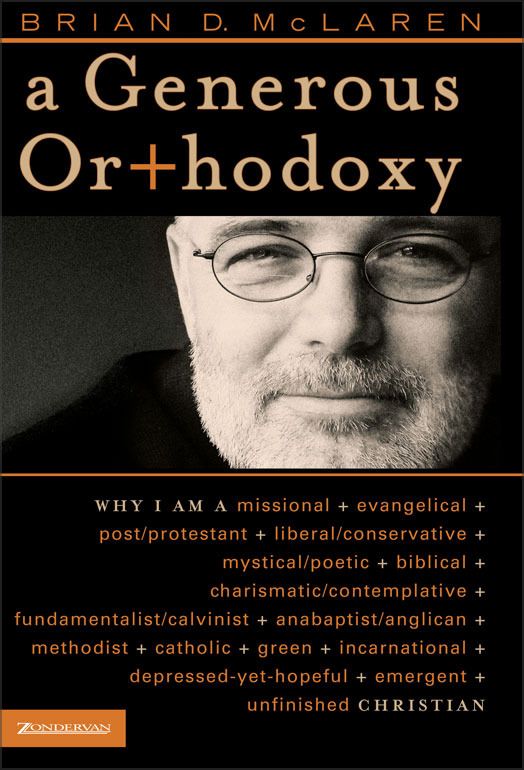 Well, I'm not reading the chapters in order of appearance in the book, but I sort of read chapter 1 of a Generous Orthodoxy where Brian McLaren describes the seven manifestations (varieties?...try "categories"?) of Jesus he has experienced, so it's time for me to blog about some of my experiences of Jesus. Pastor Brian gets his Jesus-types taxonomy from various traditions and expressions of Christianity and does the biblical number seven with his Jesuses, getting specific with labels like Conservative Protestant, Pentecostal/Charismatic, Roman Catholic, Eastern Orthodox, Liberal Protestant, Anabaptist and Jesus of the Oppressed, grouping more according to style or worldview rather than doctrinal, theological or confessional propensities. I'll try matching his number, seven, and probably include some sub-types, but without taking time to flesh them out...incarnate them?! Here goes!


