Showing posts with label a generous orthodoxy. Show all posts

Tuesday, November 21, 2006

Charismatic Contemplative Blog

Here's another essay on another chapter of a Generous Orthodoxy; I'm not sure how many more I'll blog, at least at this time.

A Generous Orthodoxy: Why I am a missional, evangelical, post/protestant, liberal/conservative, mystical/poetic, biblical, charismatic/contemplative,...emergent, unfinished... by Brian McLaren on Amazon

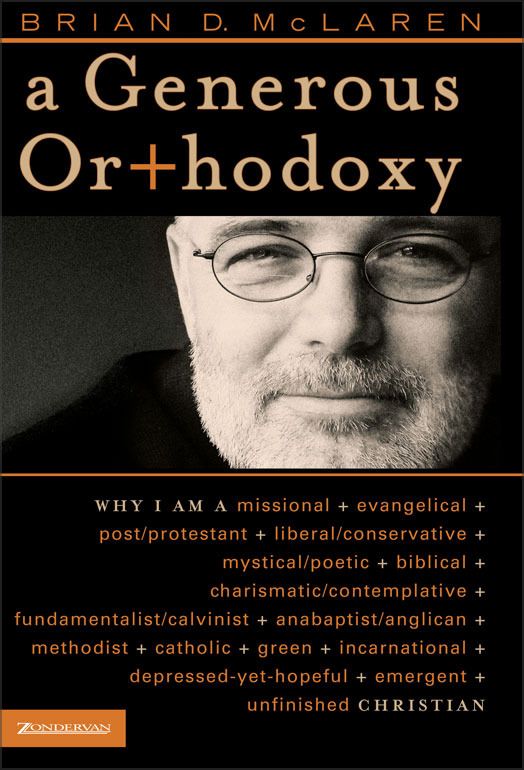
A Generous Orthodoxy coverIn general I'll also go with the softer Charismatic rather than the harder-edged Pentecostal. In the chapter's first paragraph Pastor Brian says his "life was deeply and forever enriched by association with charismatic (or Pentecostal) Christians." I can say the same thing, especially during my most recent sojourn in Massachusetts. The first couple months I was there I worshiped at a mostly Black (African-American and Caribbean) Pentecostal church and later on Cape Cod sometimes attended Sunday evening worship at the Mid-Cape Assembly of God. I also painted a float and did some other stuff for that Dennisport AG's involvement in the annual Cranberry Festival. Pastor Henry Perry's officiating at Heather's dad's funeral was a real personal and theological class act, but after all, he'd been an engineer who heard God's audible voice telling him to become a pastor! That I would learn to listen and to hear...

On page 195, Brian McLaren says, "If charismatics gave me my high school diploma in the ways of the Spirit, it was from Catholic contemplatives that I entered an undergraduate degree in the liberal art of the Spirit." He writes about the RC tradition locating experiences of the HS "in the very center of normalcy" rather than "one step beyond the normal." They've got it! Just like the church we read about in Acts, the same church that moved outward from Jerusalem - all the way to where I am and where you are - led by the Same Pentecostal Spirit!

What you could call Father Thomas Keating's Centering Prayer Movement (though it's not really his at all—he wonderfully helped recover the ages-old practice) has been a gift to me and to the ecumenical church, besides crossing and often almost obliterating differences and distinctions between Christianity and other faith traditions.

That's all for this blog.
###

Saturday, November 04, 2006

Methodist Blog

Brian McLaren writes primarily about the Wesleyan (holiness, too? not in this chapter) movement that started as an Anglican offshoot and its then subsequent offshoots; I'll begin my Methodist Blog with my own experiences within today's American United Methodist Church and its antecedent denoms.

A Generous Orthodoxy: Why I am a missional, evangelical, post/protestant, liberal/conservative, mystical/poetic, biblical, charismatic/contemplative,...emergent, unfinished... by Brian McLaren on Amazon

A Generous Orthodoxy coverAges ago I spent my first undergrad stint at Boston University, nominally Methodist (Methodist hymnals in the chapel pews, and BU 's divinity school, referred to as STH for School of Theology, officially is a UMC-affiliated seminary). However, in reality BU is a large, pretty much secular urban school, despite a lot of students attending on Methodist Scholarships and even aspiring to high degrees of holiness.

When I lived in the Intermountain West, I sort of attended a small local UMC for a while and also became pianist for a Tongan UMC, splintered off from another Tongan UMC that practiced glossolalia. Last winter in my Book of Daniel blog (these days I'm not linking to much of anything, though probably at some point I should go back with live links, esp to books and blogs) I mentioned a few of the large number of church bodies, denoms and groups and factions that once had trod the Canterbury Trail, including, of course, the Wesleyan-Methodist movement. Apparently I had a great- or great-great-uncle who was a circuit rider, so he probably was Methodist, despite his biological relative, my grandfather, insisting on being Southern Presbyterian. BTW though, some of my readers likely know about Henry (Heinrich?) Muhlenberg, a renowned Lutheran circuit rider, quite surprising since denoms of continental European origin were under- to almost non-represented as Protestant Christianity moved westward.

Then again, in Tucson on Christmas Eve 2005 I attended the late in the day liturgy at a UMC and oh, would I ever love the Artist in Residence position the keyboard person at that church holds! From everything I could figure out, the church wasn't especially theologically or liturgically substantial, but that has to be my dream job!

Of course, with my being such a Daughter of the Reformation in so many ways, at times I make the sometimes false Reformed/Arminian distinction. Yes, false. But how some ever, whether one is Roman, Reformed, Free Church, or what some ever, we all possess, know and love all those amazingly wonderful hymns by Susanna's sons! Bottom line?

But this is supposed to be another blog in my series on Brian McLaren's a Generous Orthodoxy and as much as I'm enjoying getting back to reading the book, I want to read a lot of other things, work on some theology projects and also finish and begin some design stuff. After all, graduation was three whole entire weeks ago and I've flaked far long enough! On page 244 Pastor Brian says, "Luther and Calvin created Protestant intellectual systems (a kind of conceptual hierarchy) that replaced the Catholic organizational hierarchy. But nobody created a new system of spiritual formation and nurture to replace the richly developed Catholic system of spirituality that had developed during the Middle Ages...until the Wesleys. People had Protestant doctrine, but they didn't have tracks or pathways or methods to help them put that doctrine into practice." My note: actually, Luther never wrote a systematic theology, he was so busy passionately emoting, but I catch McLaren's drift.

At chapter's end he hopes, believes and prays for "a new methodism" that will recognize the importance of small groups, baptism's essential ordination to ministry, queries that help search one's soul and "discipleship as the process of reaching ahead with one hand to find the hand of a mentor a few steps up the hill, while reaching back with the other to help the next brother or sister in line who is also on the upward path of discipleship."

To me what is so key about that reaching upward and backward is to know and live as if all of us are at different stages in every aspect of our journeys in Christ—spiritual, emotional, intellectual, etc., because every one of us can learn something from someone else who is at a different stage in some part of their own journey.

evangelical Blog

11/4/2006 3:52 PM

A Generous Orthodoxy: Why I am a missional, evangelical, post/protestant, liberal/conservative, mystical/poetic, biblical, charismatic/contemplative,...emergent, unfinished... by Brian McLaren on Amazon

A Generous Orthodoxy coverAgain I'm beginning with some of my own thoughts before reading Brian McLaren's.

Before making the obvious observation that Evangelical in today's USA basically refers to a particular style of politically, doctrinally, socially individual ("I even get my very own personal Savior all for me") Protestant Christian, often associated with the Religious Right, I'll mention the Reformers called themselves Evangelische, meaning Protestant and non-Roman Catholics in Spanish-speaking countries and cultures simply style themselves evangelico/a. As you've likely observed from my blog title, McLaren designates this chapter with a lower-case "e". Ages ago I heard very theologically (and otherwise) liberal Krister Stendahl say, "I hope we are all evangelical!" In other words, he hoped all of us Christians were bearers, speakers and doers of the Gospeled Good News. Are we?

11/4/2006 8:17 PM

Page 128 of a Generous Orthodoxy: "the word Evangelical can have some pretty negative connotations. But it's a word I would rather not abandon, if I can help it. In fact, I am happy and honored to consider myself an evangelical."

Pastor Brian mentioned both negatives (similar to my list) and positives associated with capital-E Evangelicals. But then, on page 130, he says clearly, "When I say I cherish an evangelical identity, I mean something beyond a believe system or doctrinal array or even a practice. I mean an attitude—an attitude toward God and our neighbor and our mission that is passionate." He also admits "...Evangelicals have painted themselves into a lot of corners—theologically, politically, socially. But evangelical passion for spiritual experience, for spiritual understanding, for mission is precious. ...Even though it can't be bottled, it can be acquired because, ultimately, 'it' is the Spirit of Jesus, and Jesus gives himself freely to all who ask. Both Evangelicals and evangelicals know that." I like that a lot, and completely agree!

On the last page of this chapter he refers to Dave Tomlinson's term "post-evangelical," meaning coming from, emerging from, growing from, and emphasizing both continuity and discontinuity. Agreed. I'm gonna get this onto my blog so I can move on with this book and with the rest of my life. Thanks again for the gift of the book, Scott! You know it was on my Amazon Wish List!

Mystical Poetic Blog

Today I'm returning to my blogs about some of the chapters in Brian McLaren's a Generous Orthodoxy.

A Generous Orthodoxy: Why I am a missional, evangelical, post/protestant, liberal/conservative, mystical/poetic, biblical, charismatic/contemplative,...emergent, unfinished... by Brian McLaren on Amazon


A Generous Orthodoxy cover11/3/2006 3:47 PM

Before getting in to the chapter at all, I'm going to comment on the chapter title from my own immediate perspective.

Mystical: of course the medieval Christian mystics instantly come to mind, but I also recall an evangelical (in the current popular American sense of the term) wannabe who really was mainline – a guy I knew ages ago – who kept insisting we wanted nothing whatsoever to do with mystic, because "mystic" implied "unmediated" and left out Jesus Christ.

Poetic: without reading much of anything I noticed McLaren references Walter Brueggemann's book of language for proclamation I read last winter or spring, Finally Comes the Poet. As y'all y'all know, I am a major WB fan! I'm also fondly recalling Marian Conning from the old UCC forums referring to moi as a "poet theologian" at the end of our online discussion of Alan Roxburgh's The Missionary Congregation, Leadership, and Liminality.

11/4/2006 9:57 AM

Having read this chapter, yes, me too: I consider myself mystical and poetic. For me, the most helpful things in this chapter were the quotes from Brueggemann, Chesterton, C.S. Lewis, Barth, et al.

From Walter Brueggemann: "By prose I refer to a world that is organized in settled formulae, so that even pastoral prayers and love letters sound like memos. By poetry, I do not mean rhyme, rhythm, or meter, but language...that breaks open old worlds with surprise, abrasion, and pace."

From Roman Catholic theologian Hans Urs von Balthasar: "God needs prophets in order to make himself known, and all prophets are necessarily artistic. What a prophet has to say can never be said in prose."

On page 165, Brain McLaren observes, "But mystical really is a wonderful word, suggesting ways we partake of mystery, mystery beyond the grasp of reasonable prose."

And then quoting G. K. Chesterton's Orthodoxy: "The poet only asks to get his head into the heavens. It is the logician who seeks to get the heavens into his head. And it is his head that splits..." Then again Pastor Brian reminds the readers of Chesterton's observation that the Greeks made Apollo was patron god both of poetry and of healing.

This is a great chapter, even though I'm quoting rather than doing much thinking of my own. I love C. S. Lewis' Perelandra describing the season of spring as "ancient and young."

Roman Guardini (previously unknown to me—he was John XXIII's chaplain during Vatican II) wrote about the human who tries to speak about the Divine: "In the end he...says apparently wild and senseless things meant to startle the heart into feeling what lies beyond the reaches of the brain."

Kyriacos Markides, author of The Mountain of Silence, gets quoted, too: "Christianity, a Catholic bishop in Maine once told me, has two lungs. One is Western, meaning rational and philosophical, and the other Eastern, meaning mystical and otherworldly. Both, he claimed, are needed for proper breathing."

Monday, September 04, 2006

Contextualized Ministry...and Mission

Very short blog, but too long in the works! Doubtless I'll be writing lots more about this as I make my way through a Generous Orthodoxy.

A Generous Orthodoxy: Why I am a missional, evangelical, post/protestant, liberal/conservative, mystical/poetic, biblical, charismatic/contemplative,...emergent, unfinished... by Brian McLaren on Amazon

A Generous Orthodoxy coverY'all you-all know all about contextualizing ministry and mission; reportedly and reputedly we're currently living not in post-modernism but more like post-post-modernism. So how, then, do we contextualize our worship, teaching, preaching and service to suit a post-post-modern culture and population? As individual(!) Christians, how to we present ourselves to the world? Does the world out there already own a caricatured distortion of the idea of Christian? The reality of Christian? Yes, in many quarters it does.

Albuquerque, Boston, Paris (Maine), Haarlem...

...your neighborhood, my neighborhood, wherever, whenever: Labor Day, Valentine's Day, Easter Day! Contextualized in space and in specific linear time, often in terms of a generic calendar event; frequently in terms of someone's life event. Several times today during the news our local ABC affiliate showed a feature about the hazards of starting kindergarten—that's precisely the kind of happening into which individuals and churches could imagine tons of potential for evangelism, mission and ministry: the parent whose first, or middle or maybe last child no longer will be at home; parents whose other siblings are in school or at home; a parent or parents' changed or modified work and social schedules; teachers, principals and other school personnel returning for another year or beginning their first year in the system. You know! In other words, all these situations easily can become live opps for direct service types of ministry as well as for discerning where the persons or families could fit into existing, emerging and not-yet envisioned church and neighborhood programs. How routine it is for people who have grown up in the church to leave but then return when they think they want their kids to get a moral or religious education or training? Even parents who haven't had their kids blessed or baptized? Even parents whose own parents haven't urged them to do so?

As I stated at the outset, this has been short.

Thursday, August 24, 2006

How Many Jesuses?

A Generous Orthodoxy: Why I am a missional, evangelical, post/protestant, liberal/conservative, mystical/poetic, biblical, charismatic/contemplative,...emergent, unfinished... by Brian McLaren on Amazon

A Generous Orthodoxy coverWell, I'm not reading the chapters in order of appearance in the book, but I sort of read chapter 1 of a Generous Orthodoxy where Brian McLaren describes the seven manifestations (varieties?...try "categories"?) of Jesus he has experienced, so it's time for me to blog about some of my experiences of Jesus. Pastor Brian gets his Jesus-types taxonomy from various traditions and expressions of Christianity and does the biblical number seven with his Jesuses, getting specific with labels like Conservative Protestant, Pentecostal/Charismatic, Roman Catholic, Eastern Orthodox, Liberal Protestant, Anabaptist and Jesus of the Oppressed, grouping more according to style or worldview rather than doctrinal, theological or confessional propensities. I'll try matching his number, seven, and probably include some sub-types, but without taking time to flesh them out...incarnate them?! Here goes!
  1. Activist Jesus: coupled with fond memories of the activist Christian community that first nurtured by faith and practice.
    • Hand in hand with: Prophetic Jesus
    • Closely yoked with: Iconoclast Jesus
  2. Cosmic Christ: how many times have I mentioned how much I particularly love the Cosmic Christ of Colossians, the Pantocratur, the Oriental Potentate?
  3. Friend Jesus? yes; Jesus reveals my best and my worst to me and helps me change and grow. Besides, most importantly, friend Jesus walks alongside me everywhere I go, even when the rest of the world and church forsakes me—I gotta remember that.
    • Pretty much parallels Teacher Jesus, because friends often are our best teachers and our best teachers sometimes become our friends, too.
  4. Christ Jesus who meets us and whom we meet in the sacraments and in the commonest stuff of creation; the Risen and Ascended One who dwells in, with and under all creation.
  5. The Wandering, Marginalized Man of Sorrows who set out for urban and rural public ministry after being baptized by John the Wilderness Guy and temptations in the desert.
  6. Servant Jesus, living among us as one who served and commanding us to serve. Not far distant from McLaren's Jesus of the Oppressed nor from my Man of Sorrows Jesus 5, nor is Servant Jesus more than an eyeblink away from Jesus of Latin American, Asian, African and North American Liberation, Feminist, Womanist Theologies.
    • Another especially paradoxical manifestation of Wholly Holiness
  7. Jesus desiring to be recalled and Jesus worthy of being remembered: "Do this; remember me..." But how? With unforgettable liturgies? Or with memorable acts of compassion and solidarity?
Have I omitted Springtime Jesus? No, not—I do not claim that Jesus, or at least I don't recall ever meeting him! But slowly I have been learning the Crucified One, the Crucified Jesus, Man of Nazareth become the Risen One at Easter Sunday dawn, which without any doubt is a springtime festival!

I'll end with a quote from one of my own blogs, Transfiguration: Until the Day Dawns, from February 6, 2005:
The Sign of Jonah—Death and Resurrection! For two thousand years, theologians and faith communities have struggled to learn and discern what Jesus means to them. We know Jesus as teacher and Jesus as political prophet; doubtless many of us consider Jesus a social activist, too. Jesus as a healer? Probably. But Jesus, the man of Nazareth, who died outside the city on a cross of shame as the Christ of God? At the very heart of the story of Jesus of Nazareth stands the seven days we call Passion Week: a crucified man – but – then an empty grave, a narrative with no easy answers or clear-cut implications, a series of events so far outside the normally credible many of us would like to dismiss it as legend. But today’s lections are not about death and resurrection but about something else altogether—they’re about a spectacular manifestation of God’s Glory on yet another mountaintop.
Of course, I hope that teaser will lead you to read the entire blog! I'm planning to continue blogging about a Generous Orthodoxy and I'm also working on several more blogs for this site.

Sunday, August 13, 2006

Baptist Blog

I'll begin by paraphrasing Luther: Condemned are the Anabaptists, who imagine they can do anything on their own. From Heidelberg Disputation(?)—I'm not sure. I've just finished reading Chapter 13, "Why I am (Ana)Baptist/Anglican" of Brian McLaren's a Generous Orthodoxy, so here's my blog; I'm actually allowing myself latitude about not compulsively linking to and referencing absolutely everything, but you can find a direct link to the book in my Products and Packaging from July 28.

A Generous Orthodoxy: Why I am a missional, evangelical, post/protestant, liberal/conservative, mystical/poetic, biblical, charismatic/contemplative,...emergent, unfinished... by Brian McLaren on Amazon

A Generous Orthodoxy coverAt this moment I don't recall what I was reading by whom at which time, but something I read not too long ago mentioned people in the churches sometimes designated "historic peace churches" are not reluctant to talk about the wrath of God, while mainline-types often hesitate to talk about sin and depravity and many conservative evangelical types are into sweet, friendly Jesus—"springtime Jesus" but not the Crucified One become the Risen Christ at Easter's dawn. So for a while I referenced Mennonite, Brethren and others birthed from the Radical Reformation as "Wrath of God" churches. A while ago I also mentioned that God had (sort of) taken me out of the liberal, activist American Baptist church that shaped my early Christian journey - though in my late teens and early 20's I wasn't all that young - because there aren't many Baptists writing heavy-duty theology. I've long been aware that a huge part of my attraction to the Reformation tradition has been its huge quantity of well-considered theology. McLaren mentions a scarcity of Baptist theologians, too—right on track with my own perception! As I continue research and consideration of my future book about ecological theology...

I love this chapter—esp the Ana/Baptist section, but also the Anglican one. Here's this blog's point of departure for me:

from Afterglow — Sarah McLachlan

"Fallen"

Heaven bend to take my hand and lead me through the fire
Be the long awaited answer to a long and painful fight
Truth be told I tried my best
But somewhere long the way I got caught up in all there was to offer
But the cost was so much more than I could bear
Though I've tried I've fallen I have sunk so low...

Heaven bend to take my hand I've nowhere left to turn
I'm lost to these I thought were friends to everyone I know
...and there doesn't seem a way to be redeemed
Excerpts in my mind from "Way to Go", an autumn 2004 blog on city delights round out this Sunday evening's sentiments.

Although I'm trying to be a little whimsical, I'm also trying hard to say conventional mainline protestant churches have not been working for me, for whatever reason. In addition, as I contemplated returning to the East Coast and scoped out websites for the two churches close to Harvard Square that logically would be my first places of inquiry – First Congregational and University Lutheran – and then checked out Old Cambridge Baptist, everything about OCBC seemed to make it my way to go. Notice the not-oblique reference to my blog quoted supra! By the way, every one of those churches I just mentioned is liberal and activist, so in those terms any differences are negligible. The Theology page on OCBC's website reads,
Some of our visitors marvel . . . "and all this at a Baptist church!" We take our theological bearings from deep within the European and British tradition of anabaptists, which held that the Gospel, rightly interpreted, was the a matter between an individual, his or her community of believers and God.
Before reading Chapter 13, I read Chapter 12, "Fundamentalist/Calvinist." Discussion question #1 asks about "fundamentals of the Christian faith that we're willing to fight for." I'll reply yes, definitely: Solus Christus!

As I fondly reminisce about First Mariner's ABC that nurtured me so, I do realize its very small size was a major part of its effectiveness for me. My youth and shapeability, bendability or whatever you want to call it doubtless was another overwhelming factor! I've told about this in person but haven't blogged many details, but the community was demanding and intense: in order really to belong they expected and pretty much directed you to be at worship, at Bible study, participate in and when asked lead a discussion; we had a close to locally legendary Holy Club that met weekly to discuss a book chapter or sermon, quite apart from Bible study groups. Baptist?! As I've previously mentioned, I was baptized in an Episcopal church as a young child, but when I asked the 1st Mariner's pastor if I needed to be baptized again (ana), he asked why would I!? We routinely took part in both everyday and specific issue-oriented neighborhood goings-on. When local and national political campaigns were on the docket, we were expected to work for the candidate or cause of our choice: no particular position dictated, but you'd better be there and you'd better show you care! A couple of times a group of us ventured out to the countryside on weekend retreat; those times we observed regular periods of silence and prayed the canonical hours, so I got to borrow the office books from the Franciscan Friary a couple doors. That discalced order of brown-robed brothers would traipse around the snowy winter city sidewalks and streets in sandals! One might imagine "Baptist" by default would be liturgically low-church, but we weren't exactly so. BCP worship was not unusual for us, and when a friend expressed an interest in elaborate liturgy, the pastor (who also was executive director of the multi-service agency housed in the same building) sent her around the corner to Old North. The same pastor, observing my interest in theology, suggested I attend Krister Stendahl's Wednesday morning Eucharist at UniLu; those Wednesdays, followed by breakfast and discussion at a local restaurant for anyone with time who was inclined, helped define my future. I'm not at all sure I outgrew the bounds of the now-disbanded First Mariner's Church, but God sent me in other directions.

McLaren distinguishes churches such as the American Baptist, which for the most part claim a British Isles heritage and Anabaptists of continental European origin, but in the blog at hand I'm grouping them together as being different and distinct from Reformation, Methodist (ummm, Arminian, Pentecostals...) and those on the Canterbury Trail. And again, while the person in the pew or on the streets might imagine mode of and age at baptism the primary dissimilarity, that is so not so. In fact, I don't perceive it as counting much at all, and I'm not sure McLaren does, either. I'll quote him from page 229: ...Anabaptists have long understood that what really counts is a fruitful way of life." Omigosh! On page 231 he says, "As outsiders [Anabaptists] learned to function at the margins, and they learned that the gospel functions there just as well as or better than at the centers of power, prestige, wealth and control." Part of my own story, and these days I'm saying it out loud: over the past dozen years I have felt and literally have been pushed to the edges, out from the center of society, of the church and of the human endeavor and in the process, I know I have experienced the heart of God, which is the heart of a stranger who doesn't really belong anywhere. During this time I've actually emerged as a theologian, learning to articulate God's passion and human reality. After all, throughout the witness of the Bible and history's witness, we learn the fullness of divinity and the fullness of humanity are the same, captivatingly revealed in Jesus Christ. Got it? I'm finally getting it! Pages 232-223: "Anabaptists know that community is far more costly than that [the candles, programs and training videos McLaren cites as examples]: one cannot add it to anything, rather one must begin with it in order to enter it, practice it and preserve it." Since Brian McLaren says it so well, here's my final quote, from page 223: "The exchange of treasures around that table can enrich us all, and without the Anabaptists there, the party is hardly worth having." He's talking about Christian – possibly formal ecumenical - conversation, a vital aspect of the eschatological feast of redemption's completeness, but it must go far further, to the Welcome Table of the Eucharist we celebrated this morning; it needs to culminate and then continue with the sanctuary and the healing embrace of the Welcoming Community I long for and finally am admitting in words I need in order to be alive (yes) and even to survive much longer.

Brian McLaren includes four pages about Anglicanism; I've blogged some about my experience with the Episcopal Church, especially last winter when I wrote about the short-lived Book of Daniel TV program, but in a day or two I'll write a few responses to the end of this Chapter 13.

Thursday, July 20, 2006

Products and Packaging

Late October 2007 update: on the PCUSA blog, Stushie recently wrote about picking blackberries.

My original title, since I needed to call is something: Ecclesiology Containers Conveyers Packaging Freedom
Paraphrased from an internet search:
From 1950 to 1975, the now late Container Corporation of America ran an advertising campaign, "Great Ideas of Western Man," in periodical publications such as Time and Fortune. Bauhaus artist Herbert Bayer, who at the time was CCA's Art Director, commissioned eminent illustrators and designers to illustrate quotes from a many-centuries-long continuum of philosophers, writers, scientists, politicians, cultural and religious luminaries. But this is on desert spirit's fire, so clearly it's going to be theology!

Since around Christmas-time I have used up lots of time hankering after blackberries, checking the stores to find out if this week maybe they're on sale at a good price and getting a dozen packages whenever the blackberry acquisition fee has been right. I need to clarify I'm writing about edible consumables and not electronics—but you know that!

Interestingly, blackberries belong to the rose – Rosaceae – family, with thorns on their stems just like both wild and cultivated roses, and producing highly desirable results, just like roses. As they grow, the fruit-bearing older growth of blackberries makes brambles or briar thickets that sometimes seem impenetrable to humans, but serve as great refuge and shelter for some wildlife species. One easily could say the thorns, the brambles and those briars are a stipulation of enjoying the product: succulent berries. In other words, briarpatches are necessary conditions of having blackberry consequences! Yum! Although I enjoy other berries, especially straw and blue, so far as I'm concerned, blackberries wear the Berry Kingdom's crown.

My intro paragraph referenced CCA, and with bounded, boundless, contained, and uncontained I'm thinking sacraments and authority, too. One of the classical descriptions about sacraments cites them as evidence of the capacity, capability – capax – of the finite to contain the infinite. Contain. This is fire season in Southern California, reminding us a contained fire is not an extinguished one, but nonetheless, containment often leads to a beneficial outcome.

Just this past week a friend gave me my own copy of Brian McLaren's A Generous Orthodoxy: Why I am a missional, evangelical, post/protestant, liberal/conservative, mystical/poetic, biblical, charismatic/contemplative,...emergent, unfinished... by Brian McLaren, A Generous Orthodoxy cover which has been on my Amazon wish list since I first heard about it. Without a doubt I'll be blogging about the book, but a few days ago I read at least one thing applicable to this blog I started a few weeks ago. Nothing I shouldn't have thought of, given this blog topic, but it was the word permeable. I'm writing about containers, containment, vessels, thorns, briars, roses, fruit and a long list of acquisitive concepts. Here in Alta California we live constantly aware of the permeability of the borders, the legal boundaries and sometimes the cultural ones between this territory and Baja California, but I want to compare the containers, boundaries and borders of ecclesiastical life with boxes, jars and envelopes where the content doesn't leak or scatter beyond the bounds, but the container exudes heat, or cold, or some kind of aura one can see or smell, maybe even taste. Compare ecclesiastical committees, judicatories and the formal "offices" (job descriptions plus associated buildings, floors and rooms) of denominational officers with briarpatches! At a later time I'll say more again about brokenness, shards, tatters and splinters, ruins and rubble: bread and lives, pottery, vessels, buildings, cities and civilizations, broken yet blessed and distributed ultimately to enable living as a result of that once un-wholeness.

Church buildings, and in many cases we find church complexes (double meaning intended) of not only a building with worship space or sanctuary but what we call a campus, with "country" as a possible connotation. Those buildings in some sense contain and in-clude the Church, the body of Christ, which is called to freely function as a living organism. In teaching and writing, often I refer to the Jerusalem Temple with its containerized deity, so remote from the free, elusive and infinitely faithful to creation Yahweh of the Exodus; frequently I talk about the Jerusalem Temple, so distant from God's self-revelation in Jesus of Nazareth. Jesus Christ shows us the Divine not in formal structures and intricate liturgical rites, but in fully real presence alongside creation and in total response to creation's needs. Roman Catholic ecclesiology tends to focus on more visible, touchable external structures – probably a too vulgar way of saying something from a Traditio Protestantica (Martin Marty's phrase—in any case I got it from him) perspective that doesn't state the reality more than marginally, while Protestant ecclesiology is more about invisible, intrinsic ones.

Containers, etc.: as I observed in conversation a few weeks ago, the UCC, PC(USA) and the ELCA are splintering seriously because "a human institution cannot contain that much diversity!" Of course the flip, the B side is "a human institution can contain only so much diversity." By definition, any institution has limits. However, logically, if something cannot be accessed, in some sense claimed and contained, it's not worth much to us. How about "God-moments" some people talk about? Are there times we can recognize God's presence while we're thick in the experience or situation, or is that acknowledgment possible only in retrospect?

Containers: printed bibles; internet scripture; paper and ink on our more recent ecumenical accords; I'm particularly thinking of the so dear to my heart A Formula of Agreement and of course, the Joint Declaration on Justification by Faith. Containers, packaging: the famous quote from Luther describing the Bible as the cradle in which the Word of God is laid. Luther railed against the way people try to domesticate, to contain God—again, recall the tamed and domesticated God (should be small "g" maybe) of the Jerusalem Temple and the Temple system's outcome in imperial religion? The Religion of Empire--perhaps similar to Dubya's far-flung, carefully-controlled empire. Remember the prophetic voices subsequent to The Temple's establishment: how about us, right here and right now? Do our words and do our actions help dis-establish imperial religion or do we make excuses to further entrench and ensconce it?

Regarding church buildings and their boundedness, a few days ago I told someone despite my feeling tremendously betrayed by the Protestant Mainline (caps?), still I cannot stay long away from the church; "The church is where I find the sacraments," I observed. Someone else mentioned Darrell Guder's in effect saying "God does not limit Godself to the means of grace." But speaking of boundaries, my semi-rejoinder to that needs to be, "Nonetheless, God does bind Godself to the means of grace." Think about it! Bounded freedom has become a familiar theological and psychological idea.

Another observation about Generous Orthodoxy: the author states he doesn't have the kind of formal theological education and credentials we in the mainline churches insist on; until he left in 2006 to pursue writing, McLaren pastored at the nondenominational Cedar Ridge Community Church, and a quote from Karl Barth banners the church's site. McLaren grew up in what he approximately describes as a twig on a branch on a limb of a church in a very conservative church tradition. Despite having been an English major and a professor of English, doubtless by now he's read a whole lot of theology, but he has not laden the first part of the book with heavy God-speak and the accompanying vocabulary we who have attended high-end and other seminaries regularly use to spice our speech.

Brian McLaren's intellectual abilities are what we hope for in our (possessive intended) churches that have a well-articulated, formal and long process for eventually attaining and obtaining (possession again) what we call ordination to Ministry of Word and Sacrament. One of the questions of any candidate for seminary and eventual ordination by a described, delimited ecclesiastical body (presbytery, diocese, conference, synod) remains "Does this person have the intellectual gifts?" Sacraments: by what and whose authority does the presider recount the history of God's faithfulness and invoke the presence of the Holy Spirit upon the gifts of bread and cup? Authority? By what authority are Brian McLaren and the other staff at Cedar Ridge Community Church declared ecclesiastical leaders? Checking them out, I noticed all of them have excellent academic qualifications but no formal theological ones. We talk about authorized ministry, whether commissioned, licensed or ordained; we also insist on a formal call or appointment process. "We" as opposed to "they"? "Us" and "them?" In the mainline Roman Catholic and Protestant and in the more conservative churches, we claim the Holy Spirit as ultimate authority, despite the human(oid?) appearance of those assorted Committees on Ministry and local church Call Committees.
Here's a relatively recent hymn:

God Marked a Line and Told the Sea

  1. God marked a line and told the sea its surging tides and waves were free
    To travel up the sloping strand but not to overtake the land.

  2. God set one limit in the glade where tempting, fruited branches swayed.
    And that first limit stands behind the limits that the law defined.

  3. The line, the limit, and the law are patterns meant to help us draw
    A bound between what life requires and all the things our heart desires.

  4. But discontent with finite powers, we reach to take what is not ours
    And then defend our claim by force and swerve from life's intended course.

  5. We are not free when we're confined to every wish that sweeps the mind.
    But free when freely we accept the sacred bounds that must be kept.

By Thomas Troeger, 1986; © 1989 Oxford University Press, Inc.
Christian marriage is a covenant; Jewish marriage is a contract. We Christians emphasize the covenantal nature of our interrelationships with one another and especially our relationship with the God of the covenants, The One those New Englanders of yore insisted never dealt with, interacted with humanity, with creation in any way other than covenantally. Do we in the churches need to look carefully at the contractual sides of our lives together?

To be continued.