Showing posts with label prophetic imagination conference. Show all posts

Tuesday, May 18, 2010

prophetic imagination 5

Pulling it all Together

...and Walter Brueggemann's book, The Prophetic Imagination, again. In blog 4, I reminded readers the Nurturing the Prophetic Imagination Conference I attended at Point Loma Nazarene University was late during the season of Lent and, as I pointed out when I finally posted the blog about John August Swanson, next Sunday will be The Day of Pentecost, in case an explanation is in order.

Expressing life in-between Friday and Easter as necessarily including "Refusing to be Consoled" was particularly striking related to my own situation of loss that I seem not to be able to explain to anyone and coupled with my sense of needing to experience some Good Grief, the wrenching sorrow that includes regenerative washing with tears and perspective gainable only from ongoing conversation with others who at least sort of "get it." Recently I'd blogged about Brueggemann's insisting a huge amount of our days are sabbatarian, times we spend waiting, almost suspended in the interstitial time between Good Friday afternoon and Easter Sunday dawn. And, of course, that's another liminal, threshold experience, another one that's closely related to baptism.

As again I turned the pages of my copy of The Prophetic Imagination, (it was either the first or second thing by Brueggemann I ever read) the necessity of grief - and, of course, acknowledging that everything is not okay, cities are broken, relationships are fractured, lives are unwhole, the world has crumbled into chaos - that must go ahead of times of grieving jumped off page after page. It hadn't been that obvious to me before; it has to be something about the close relationship between truth and freedom!

Moving a few meters away from my own "place," the constant emphasis on all creation during the conference met me where I live and heartened me immensely.

Someone recently reminded me that the new creation is not pristine, but carries within its very being scars and other reminders of the pain, troubles, devastation and experiences that have brought one to the place of newness and that each of us continues carrying with us, not as unwanted weight but almost as a condition of redemption.
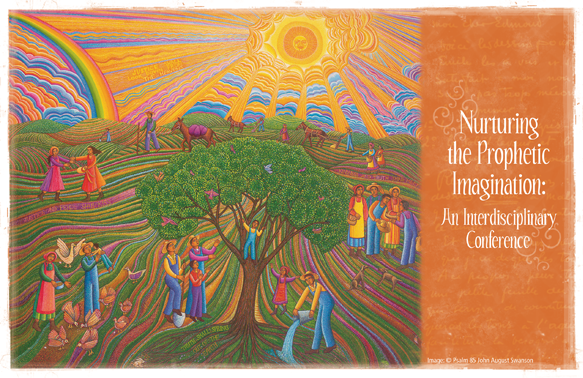
nurturing the prophetic imagination posterIn the conference sessions I attended, they didn't talk much overtly about Divine freedom – or its corollary of God's elusiveness – but the discussion still strongly implied both attributes of God. Like Walter Brueggemann's perspective on scripture, these were no talks about "god sightings" or "god experiences," yet like King Solomon and the Yahwist, each of us longs for a modicum of control over our own destiny and for a god of predictable, programmable behaviors. Scripture, the earlier Church fathers and mothers, the Reformers and a faithful contemporary Church cannot assume miracles, wonders, spectaculars, or petitions to heaven answered in compliance to man formulations or suggestions.

With most of our days on earth being sabbatarian, neither Good Friday afternoon nor Easter Sunday dawn, I'm still waiting and trusting.

prophetic imagination 4

Meeting the artist, "Art, Justice and the Imagination II: The Art of Prophets"

Although the Nurturing the Prophetic Imagination Conference happened during late Lent, I'm only now posting my 4th and 5th blogs, and we're more than halfway through Easter: next Sunday will be The Day of Pentecost.

power to the people john august swanson
John August Swanson's website explains,
"John Swanson studied with Corita Kent at Immaculate Heart College. His unique style is influenced by the imagery of Islamic and medieval miniatures, Russian iconography, the color of Latin American folk art, and the tradition of Mexican muralists."
As each person entered the room, they received gifts of three full-color, high-quality reproductions of John Swanson's best-known art. For the actual presentation, the artist narrated a slide show depicting his own artistic journey through what has become an extremely sophisticated artistic style and an involved process for producing limited edition serigraphs. What an open, gracious, humble guy! At the end, supposedly to reward us for staying through the hour plus, he gave everyone a poster-sized copy of Power to the People, one of his best-known, most detailed pieces that illustrates this blog post.

I was especially excited to meet John August because he specializes in illustrating theological subjects and because a few years ago someone told me some of my Isaiah interpretations reminded me of John Swanson's. I'm still a tad disappointed that I got to only part of the 2-2/2 day conference, but the richness and wealth of my experiences there – including the surprise of connecting with an artist I admire – as well as discovering the beautiful, dreamlike PLNU campus made it more than worthwhile.

Friday, April 09, 2010

prophetic imagination conference 3

power to the power john august poster
The next Thursday session I attended began with Artful Imagining from Andrew Hendrixson, who teaches studio art at the University of Florida, as the first presenter in an excellent, varied group of three. The last presenter in the trilogy was Teri Marcos from not far away from San Diego Azusa Pacific University. In an outstanding presentation, Jesus and the Disinherited she emphasized some aspects of Howard Thurman's life and teaching. Thurman was Preacher to Boston University a while before I attended, but his name and even his presence on campus still was legendary.

and then

In Farmer Wendell Berry's A Call to Agrarian Leadership slide presentation with commentary by Paul Kaak (also from Azusa Pacific) particularly emphasized "placed stewardship" of the church. Careful placed stewardship leads us to be concerned with where God has planted us as wherever we are, wherever the church is reminds us of what we've forgotten about the organic church and that we've forgotten and neglected it.

Paul Kaak paralleled farm with parish—after all, both concepts are geographical; he also told us Eugene Peterson (remember him? The pastor-scholar who did The Message version of the Bible) considers Wendell Berry the best pastoral theologian in the USA! Someone I knew in another life told me when he observed some people who serve in a pastoral capacity, he frequently remembered that pastoral means "rural." Moving along from C. Wright Mills Sociological Imagination to Walter Brueggemann's Prophetic Imagination... I especially love observations about agrarianism as a synoptic worldview, as comprehensive vision uniting land—agri-culture and human culture, or ways of being and acting. And oh, yes, too often the Church is all at once 1) not worldly enough; 2) too worldly and 3) needing to be whole, healthy and holy. John 17, Jesus, us and God's glory on earth, where God has "placed" us and placed, planted The Church, calling and enabling it to live as the Presence of Jesus Christ in the world.

Communications media and the individuals, communities and organizational entities of many types we observe and encounter almost daily have been returning to less toxic, simpler behaviors, as have almost all of us. In my own life it's been slow and gradual, yet I can reflect on two or three years back or more dramatically, ten or twelve years ago and even from this close a perspective I can notice small lifestyle changes that have added up to less physical and mental clutter around me and better stewardship of the places – household, neighborhood, city, county, state and world – in which I live.

Paul Kaak more than suggested contemporary industrial economies were founded on "the breaking of all ten commandments" and said the economy, the household law/stewardship of the church has behaved in the same way, also violating all of the commandments. "The organized Church makes peace with a destructive economy" though how can it make peace with the "empires of illusion" scripture forbids? Ephesians 4:18-24 Wendell Berry loves the metaphor of marriage as a model for husbandry of the land - we need to get out of passive consumption modalities and being embodying, incarnating, our own "better" stories.

Thursday, April 01, 2010

prophetic imagination conference 2

Feminist Pedagogy as Acts of Prophetic Imagination

prophetic imagination book cover
I was unable to attend the morning sessions of the Nurturing the Prophetic Imagination Conference, but I'll write a few notes and observations about the afternoon events I chose from amongst those that sadly but necessarily ran concurrently.

"Feminist Pedagogy" featured a panel of five women faculty from Point Loma. Predictably they presented, discussed and responded to audience comments and concerns about feminist perspectives regarding power, privilege, powerlessness and (often) pain. Although in most ways the content was familiar to me as much of the conversation almost replicated many classes and a few one-on-ones from undergrad years, hearing it again assured me my perception and interpretations regarding too much of what has been happening over the past couple decades have not been mistaken in the least.

They explained ways refusing to be consoled ultimately can be part of a new creation emerging from the ruins and chaos of an old, dead one. Refusing to be consoled means willingness to spend substantial time without the glib assurances, explanations and rationalizations people in the Church and maybe especially women have gotten to be adept at bringing into any situation whatsoever. Of course the world does not revolve around me, I'm not first cause of anything, God calls all of us to live as servants in the image of the Servant God but of course, also as stewards of our lives, but don't be aggressive, do not presume to impinge on anyone else's prerogative... etc., etc.. this hardly could have been more timely for me.

Someone said to me a while ago, "I am so tired of that 'cultural' excuse," yet at every moment we're backed up and face-to-face with others' culture and with our own. Despite my oftentimes insisting there is no unique human experience, I'm getting that I've been up against walls and roadblocks in my near-countless attempts to have my own experiences understood and validated. I'm getting close to nowhere, and as both writer and talker I'm a pretty good wordsmith, too. But without any doubt whatsoever having the experience, a lively walking in the shoes of another along the exact same road is leveling and brings insight no amount of conversation with the other or reading about them can bring. Observing the prophets and Jesus (the prophet) Walter Brueggemann insists acknowledging, feeling and living with and through sorrow and loss, becoming "acquainted with grief" is an essential precondition for newness - for resurrection?!

A few Thursdays ago, the weekly Ask The Matriarch advice column in the Rev Gal Blog Pals blogring and intentional online community I belong to in many ways was about that same subject. I found the initial blog post and especially the comments about peer and not-peer, collegial relationships and those between those who hold structural and assumed power in any setting or organization highly illuminating. More than anything in the world, more than adequate employment, more than regular opportunities to serve using my gifts, skills and education, I find myself seeking, yearning for and needing a place and a community of recognition, acknowledgment and embrace.

Back to the feminist pedagogy panel: someone suggested that when someone else asks what is wrong with saying "mankind" to subsume all humanity (except these days it sounds so anachronistic) to suggest, "try womankind in its place" and see how well that goes down. Even when a person hasn't been there, done that, they've all heard folks asking but why cannot that person who is - fill in the blanks with almost any fairly common yet not quite universal experience - keep on keepin' on like the rest of us have been doing?

Regarding my own situation, yes, there is no truly one-of-a-kind experience, yet I'm realizing people readily "get" events like divorce, serious illness of self or of another, firings, not getting the longed-for situation or position or opportunities, but no one hears what I'm saying about years without basic social context, without any real "remember whens" loneliness and isolation I've been unable to break into and have found impossible to transcend. And backtracking to structural power, race and/or gender-related authority, those who have it typically to not recognize the fact and frequently do not wield it well or yield graciously to the needs of those around them.

Someone said when you're no longer one of the pastors and you're looking to participate in ministry, another person gatekeeps your access to those opps. On a somewhat parallel note, I will not order from a catalog or website if all the people picture are all White (usually young, thin, gorgeous and affluent-looking). But for the most part the companies selling the stuff and producing the catalogs have not even thought about diversity.

Wednesday, March 31, 2010

prophetic imagination conference 1

the setting and the setting

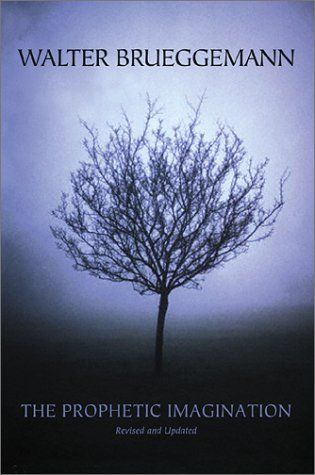
A few decades ago, Fortress Press published The Prophetic Imagination by Hebrew Bible scholar Walter Brueggemann. Whether The Prophetic Imagination or The Land was the very first ever writing of Brueggemann's I read I cannot recall, but throughout all these years both books have kept places of honor and prominence on my bookshelves, in my heart, in (and out of) my mind. Last week from Wednesday, 24 March through Saturday, 27 March Point Loma Nazarene University sponsored a conference focusing on a range of possible ways of Nurturing the Prophetic Imagination.

Psalm 85, with its assurance of justice, an essential for a shalom-filled world and its assurance of health in the land, framed the conference:
You once favored, LORD, your land, restored the good fortune of Jacob.
You forgave the guilt of your people, pardoned all their sins. Selah
You withdrew all your wrath, turned back your burning anger.

Restore us once more, God our savior; abandon your wrath against us.
Will you be angry with us forever, drag out your anger for all generations?
Please give us life again, that your people may rejoice in you.
Show us, LORD, your love; grant us your salvation.

I will listen for the word of God; surely the LORD will proclaim peace To his people, to the faithful, to those who trust in him.
Near indeed is salvation for the loyal; prosperity will fill our land.
Love and truth will meet; justice and peace will kiss.
Truth will spring from the earth; justice will look down from heaven.
The LORD will surely grant abundance; our land will yield its increase.
Prosperity will march before the Lord, and good fortune will follow behind.

...and John August Swanson's vibrant depiction of Psalm 85 illustrated the focus of the Nurturing the Prophetic Imagination Conferencenurturing the prophetic imagination poster. Closely in accord with Brueggemann's book and in alignment with much of the writing he has published since then, conference goals included: helping all of us in the church and as the church learn to critique dominant culture and society through a lens of God's call for just, righteous and holy living; acknowledging our share of responsibility for and complicity with the currently less-than pristine condition of the natural and the humanly built environments; an ultimately life-enabling "refusing to be consoled" by glib, easy observations and rationalizations as in a scripturally informed lifestyle grief becomes a precondition of joy; finally, daily living as a eucharistic people, as the presence of the crucified and risen Jesus Christ amidst all creation.

I'll be blogging a few more short ones about the Nurturing the Prophetic Imagination Conference, so please stay tuned to this blog spot.