Showing posts with label #SpeakeasyTheologyFromExile. Show all posts

Thursday, June 05, 2014

Theology from Exile: Luke

Legal note - "Disclosure of Material Connection: I received this product for free from The Speakeasy in hope that I would mention it on my blog, with no requirement to write a positive review. I am disclosing this in accordance with Federal Trade Commission's 16 CFR. Part 255: 'Guides Concerning the Use of Endorsements and Testimonials in Advertising.'"

Theology from Exile: Commentary on the Revised Common Lectionary for an Emerging Christianity on Amazon

Gaia Rising, Sea Raven's blog
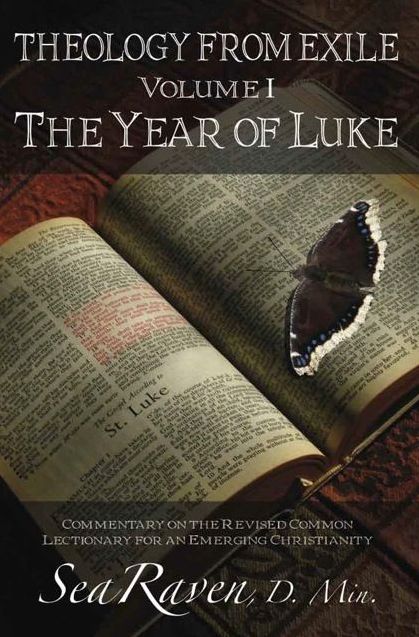
Many of my remarks about Sea Raven's commentary for RCL Year A, Matthew, also apply to this book about Luke's gospel.

About Exile in the book title:
Who are the exiles from the Church of Jesus Christ today? Those who have left the interventionist God of childhood far behind, who have set down roots in a latter-day Babylon, where new understandings about who Jesus was and what Jesus said reconstruct and transform the faith. These exiles ... find salvation in the awesome nature of the cosmos, and divinity revealed in all acts of compassionate justice.... [pp. 12-13 in the digital pdf edition]

On page 19: "Postmodern, post-enlightenment people cannot reconcile a changing, developing, evolving postmodern, post-enlightenment cosmology with traditional religious belief." Oh. I didn't realize that. I'm totally cool with a 3-layered universe (but what's a firmament?). Reminding myself and my readers that the Way of Jesus is comprehensive: political; economic; social; spiritual―and translatable, transferrable to any culture, because as did everything about all lives everywhere, it began incarnate in a particular culture. As SR observes [page 46], "The organizers of Christian tradition were masters of the appropriation of local cultural myth and metaphor."

Sea Raven frames her thoughts on the RCL texts by presenting the God of the bible as nonviolent, inclusive, oriented to distributive (rather than retributive) justice, and to deliverance. Sometimes I love the author's energetic explanations because so many of hers agree with mine, but then she apparently needs to let us know she is right because her theology is on the left, and her more "fundamentalist" siblings in Christ have it mostly wrong. Not left. This is the year 2014, and I'm definitely post-enlightenment and post-modern, but I also do mystery, paradox, ambiguity, and all those less than-logical, not-intellectual, non-physical dimensions of life and divinity and humanity quite well. But then again, at one point in the text, she acknowledges the ability to live with ambiguity and irresolution is a mark of spiritual and human maturity. But in her Trinity Sunday chapter, on page 117] she has it so correct that in this postmodern world, "Somehow the concept of 'grace' (charis – 'free gift') has become anything but 'free.'"

Luke is far and away my favorite of the four canonical gospels, so I approached this book with a more open heart and mind than I did the parallel Matthew volume. Of course Sea Raven "cherry-picks" her interpretations the same way the Revised Common Lectionary "elves" (name taken from Tolkien) choose their texts. And it's important to remember this series does not pretend or aspire to be of the same scope as (for example) Anchor or Interpreter's Bibles. Although I've participated in churches of differing traditions, all have been (progressive, liberal, etc.) relatively activist types who regularly reach out to their neighbors nearby and beyond, so I don't know for sure if Sea Raven's suggestions about more fundamental / conservative / evangelical scriptural interpretation are exaggerated, facetious, or not. Or what. Unlike in her Matthew, Raven includes propers for Reformation Day / Sunday in the main body of the book; she writes about Monday through Saturday of Holy Week in Appendix Two. In both Sea Raven's Matthew and Luke, I truly appreciated being able to read through and consider micro-commentaries on the entire church year by turning a couple hundred pages. I love that she included at least three passages describing the Eucharist from creationist Matthew Fox. She includes nice baptismal and eucharistic liturgies, as well; you easily could use them as-is, though In my own tradition I'd want to expand those somewhat. The conclusion to my review of SR's Matthew also applies to her Luke: "...Theology from Exile still is a useful, insight-filled resource; it's a keeper for my library!"

my amazon review: Sea Raven on Luke

Saturday, May 24, 2014

Theology from Exile: Matthew

Legal note - "Disclosure of Material Connection: I received this product for free from The Speakeasy in hope that I would mention it on my blog, with no requirement to write a positive review. I am disclosing this in accordance with Federal Trade Commission's 16 CFR. Part 255: 'Guides Concerning the Use of Endorsements and Testimonials in Advertising.'"

Theology from Exile on amazon.

on good reads

Gaia Rising, Sea Raven's blog

theology from exile cover I'll begin by stating a few years ago I'd sometimes make a theological observation and then add, "the Jesus seminar notwithstanding." Author Sea Raven has Jesus Seminar connections, but I'll leave it at that because I found so very much to like about this book, and I'll use it as a reference whenever Lectionary Year A, aka "Matthew's Year," rolls around.

Her constantly referring to the 1992 lectionary compilers as the Elves (she told us where she found that idea), and her endless comments about their "Cherry Picking" texts and portions of texts began annoying me by the 101th or so instance. With a quick search I couldn't find a synonym for cherry picking, and though I'd heard the term, I still needed a definition:

Wikipedia: "...suppressing evidence, or the fallacy of incomplete evidence is the act of pointing to individual cases or data that seem to confirm a particular position, while ignoring a significant portion of related cases or data that may contradict that position."

Merriam-Webster: "to decide to accept (someone or something) from a group of possibilities."

Like Sea Raven, I've been distressed when the RCL's gathering of texts seem to imply or at least point toward supersessionism. I've been at least annoyed when they've broken up a key text between a couple of Sundays. It irritates me almost no end when they've grouped texts together in a way that implicitly support our more theologically conservative brethren and sistern in Christ.

Sea Raven frames her thoughts on the RCL texts by presenting the God of the bible as nonviolent, inclusive, oriented to distributive (rather than retributive) justice, and to deliverance. But she seems to insist on only a single style of scriptural interpretation that apparently excludes mystery and paradox! Jesus' way is comprehensive, and though my theology tends toward the confessional traditions of the Reformation, I have almost no disagreement with the content of Theology from Exile, only long for at least some acknowledgment of the mysterious, paradoxical, humanly unexplainable ways in which God frequently self-reveals and acts in the world.

The omission of texts for Holy Week seemed like the big thing it really was, but the Speakeasy sent me a copy of Sea Raven's parallel Theology from Exile volume on the gospel of Luke that does include Holy Week; I plan to blog and review that book, too.

The mostly 3 or 4 pages long, relatively lightweight commentaries on each Sunday's RCL readings all incline to highlight ways that particular Sunday's texts come together―or sometimes don't cohere. Although like probably many of Sea Raven's readers, I attended a mainline (liberal, progressive... what terminology does one use these days?) seminary, and received instruction in twentieth century theological trends, that doesn't mean my entire theological perspective remains thus. Or ever was entirely grounded in what some folks have referred to as fundamentalism of the left―the type of apologetics that suddenly discovers or discerns the way scripture recorded an event is possible after all, because (after all) modern science has deemed it possible. But Theology from Exile still is a useful, insight-filled resource; it's a keeper for my library!

my amazon review: Theology from Exile: Matthew