Showing posts with label green team talk. Show all posts

Monday, November 19, 2018

green team talk :: bulbs roots beauty

• The Lord is with you!
• And also with you.

crocusThe church's year of grace will conclude nine days from now, and then we start another season of Advent anticipation. We count each day as we look forward to winter solstice and to the birth of the Son of Light we know as light of the world a few days later. People who follow the practical and spiritual way of the wheel of the year also yearn for light and excitedly anticipate the winter solstice; their celebration of the festival of Yule coincides with our festival of Noël.

For several years I've been following the 2-year standalone daily lectionary that's separate from the Revised Common lectionary. Specifically, I've been enjoying the Presbyterian Church (USA)'s daily office app that draws upon the daily lectionary for its scripture readings; this is the week of the prophet Joel. Most likely Joel wrote after the Babylonian exile. God's people already had escaped bondage and slavery to empires of Egypt and Babylon; now yet another empire, Persia, impinged on people's lives and freedom. Whether nation-state or trans-national industry, empires appear to be here to stay, so we need to learn ways to counter them.

21Do not fear, O soil; be glad and rejoice, for the Lord has done great things! 22Do not fear, you animals of the field, for the pastures of the wilderness are green; the tree bears its fruit, the fig tree and vine give their full yield. Joel 2:21-22

In Joel 2:21 we hear the constant biblical admonition, do not fear, don't be afraid! This time Joel addresses what the NRSV interprets as "soil." The Hebrew language uses the same word for earth, land, soil, dirt, ground; which one it refers to depends upon context. In Genesis God gives earth to humans as a gift and as a charge.The earth of Genesis becomes the land of Deuteronomy. The land of Deuteronomy becomes the heaven under our feet of well-tended, carefully stewarded turf in promised land Canaan, and in our cities and towns, as well. Joel assures the land and the residents upon the land prairies will be green again, trees will flower, vines will yield abundance.

Maybe especially as days become shorter, nights get longer, we long for light that brings life, for beauty that's evidence of life. Did you know flower bulbs including daffodils, amaryllis, jonquils, tulips. crocuses, hyacinth, grape hyacinth {a green team member added iris, and then there's narcissus}, carry anticipation of new, eastered life within them? Those bulbs contain everything necessary for new life! That is, they contain almost all the essentials for new life. Everything except winter. We can provide winter for spring bulbs by placing them in a cold place for six or eight weeks. In the LA coastal basin or one of our inland climates, a fridge probably is the best option, though if you're in mountains or desert, the garage or an unheated basement might get chilly enough long enough. crocusHushed, quiet, still, chill of winter is essential to make roots that literally give the bulbs power to make flowers; winter temps allow bulbs to grow long, deep roots. When bulbs spend enough time in the cold, they think they've experienced winter, and they grow life-giving roots. Empires and struggles are here to stay; surrounding ourselves with beauty is one way to counter them.

In scripture, well-cared-for land becomes a heaven under our feet and produces food for human and critter consumption, flowers and trees for beauty and overall planetary health. Especially in the wake of out of our control disasters like the recent night club shooting and state-wide forest fires, we need beauty to keep going on with our lives. I'm going to chill some crocus bulbs so I can anticipate and enjoy eastered new life before the season of winter's technically even over. What's your plan?

To God alone be glory; amen!

Friday 16 November 2018 • Glendale

Thursday, September 20, 2018

Porch Story :: Green Team Talk

porch story 18 May Green Team Talk

porch story 18 May Green Team Talk

Porch Stories host Kristin's younger daughter Rachel is three years old! Happy Birthday, Rachel!

Intro

September and October typically are our hottest months in southern California. Two more days until Saturday and the autumnal equinox. Water year begins 01 October, the rainfall year—01 July; both are at historic southern California lows. Meanwhile, Florence has sent floods, devastation, and grief along the Eastern seaboard and she's become another hurricane name that will be retired forever. Today, September 20th, I'm finally blogging my Green Team talk from May 18th, Friday of Easter 7, the 48th day of Easter, two days before the Festival of Pentecost. Although I kept my six pages of notes, I'm reconstructing what I said from my single page outline.

Green Team Talk

Today is the forty-eighth day of Easter!
Alleluia! Christ is Risen!
response: Christ is risen indeed; Alleluia!

Today is the forty-eighth day of Easter! In a couple of days the church's year of grace will cycle into the green and growing liturgical season of Pentecost, and we'll begin counting Sundays after Pentecost. Even Trinity Sunday can be called the first Sunday after Pentecost, or the octave of Pentecost. The church long has celebrated important events in octaves of eight days...

During this season of the Spirit, time of the Church, we act upon and celebrate the reality of the Holy Spirit of life, the Spirit of resurrection from the dead that fills all creation and that we specifically receive as a gift of our baptism.

A month after the Day of Pentecost, the wheel of the year will welcome another summer solstice; summer's unfolding parallels the early part of the Sundays after Pentecost. Long ago the band Spirit sang, "I've Got a Line on You" because "the summer, she's coming on strong." Spirit! Just listen to that name! During the great fifty days of Easter, the lectionary gospel texts have showed us quite a few misunderstandings of Jesus' call to serve, and by extension, confusion regarding our baptismal call to life as God's servant people in Christ Jesus.

I love reminding my adult Sunday School class Romans 8 reminds us all creation waits for us to be revealed {to all creation} as true offspring of God, as people who authentically reflect and embody God's image as careful stewards of all the earth, all creation just as Jesus would. In fact, that passage is the appointed second reading or epistle for Trinity Sunday in this lectionary year B:

Romans 8

19For the creation waits with eager longing for the revealing of the children of God...
20for the creation was subjected to futility, not of its own will but by the will of the one who subjected it, in hope
21that the creation itself will be set free from its bondage to decay and will obtain the freedom of the glory of the children of God.

I love reminding my class when we claim our divine image in the Spirit, creation itself will be set free from death and decay and enjoy the same bounded freedom we humans do as God's presence on earth. I frequently point out the same Spanish word – esperar, espero, and cognates – means hope, wait, and expect.

The days and the nights of summer convey a sense of lush, full, completeness. Spring's yellow-green has turned richer and darker; seeds have displayed their once-hidden promise in fruits, veggies, berries, and blooms.

The late James Agee {A Death in the Family; Knoxville, Summer of 1915} wrote about summer with a poem later set to music for a solo vocalist by Samuel Barber, for mixed choir by Morten Lauridsen:
Sure on this shining night
Of star made shadows round,
Kindness must watch for me
This side the ground.
The late year lies down the north.
All is healed, all is health.
High summer holds the earth.
Hearts all whole.
Sure on this shining night I weep for wonder wand'ring far
alone
Of shadows on the stars.

I've been enjoying the PCUSA's Daily Office app that follows a 2-year, standalone {not related to the Revised Standard Lectionary} daily lectionary. This morning's psalms were 96 and 148; both psalms are appointed for all the Christmas/Nativity liturgies in all three lectionary years!!! Psalm 96 charges humans and "all the earth" to sing a new song to the Lord, with happy skies, singing trees, rejoicing prairies, roaring waters. Psalm 148 demands sun, moon, stars, mountains, fruit trees, cedars—and people, too praise the Creator, Redeemer, Sustainer God.

During this season of the Spirit, time of the Church, we act upon and celebrate the reality of the Holy Spirit of life, the Spirit of resurrection from the dead that fills all creation and that we specifically receive as a gift of our baptism.

This denomination emphasizes God's Work, Our Hands. Does everyone have a chrome orange slogan t-shirt? {I have two: one from one of my churches in Previous City, one from my church in Current City.} In the SS class I facilitate, we've talked a lot about neighborology—the word about the neighbor. Especially during these great fifty days of Easter, particularly in John's gospel and Luke's Acts of the Apostles we've considered the shape, form, and function of the servant church God calls and enables us to be. Now we're moving into another Season of the Spirit, Time of the Church.

Now we're moving into another Season of the Spirit, Time of the Church. God's promises in the Spirit through Paul of Tarsus' letter to the church at Rome, the psalmist's word imagery of creation fully alive look exactly like the realization of God's work done by our hands, voices, hearts, and feet. Like the band Spirit, in the power of the Spirit of Life, we've got a line on all creation.

Amen? Amen!

Outro

This typescript of my page of sparse notes probably is close to what I actually said four months ago; like most people, I tend to say the same things over and over. When I assembled this talk, summer with its long, sun-filled days officially was four weeks on the horizon, only ten days out in the popular sense. As I blog on this September Thursday evening, late summer's shadows, shortening daylight, and a settled sense of completeness rivals James Agee's whole hearts of earth in the grasp of high summer.

Recently admitting I'm doing less with my gifts and education, participating less in church and world, even earning less in my design endeavor than during my last bleak year in Previous City has made me weary and thoughtful. Like someone in a small town with declining population and departing industry, I relocated north to Current City because I'd mined all possible opps where I was. Like Mary Chapin Carpenter's sibling in "Only A Dream," I departed Previous City leaving no sign of someone who expects to be back, though I left the bed in the old condo, gave the desk to the son of a good friend.

Please tell me all this was only a dream and I'll wake up to something new?

porch stories button

Friday, November 17, 2017

Green Team Talk :: Berries

blackberries design

Welcome to November! We're almost ready to move into meteorological winter.

All the psalmists loved and appreciated the glories of God's natural creation. The composer of Psalm 74 reminds God:
16You own the day; you own the night.
You splashed the stars, moon, and sun across the sky—the greater lights and the lesser lights.
17You stretched out the earth, determined its boundaries, settled its corners.
You created the seasons: summer, winter, autumn, and spring.

We're in the season of autumn or fall, the time of falling temperatures, falling amounts of daylight {and increasing hours of darkness}. In some sections of the northern hemisphere leaves fall off trees; in fact, we have some deciduous trees here in southern California. Most people's moods fall a little during the cooler months, even if they have no history of clinical depression. As weather gets cooler, most of us fall into a more serious work and production schedule. I've already done that this year!

For the past six months I've been loving blueberries and blackberries every morning on my cereal; I wake up thinking about breakfast! My Dominican east coast landlady introduced me to Special K—because she worked at the church food pantry, not because she was from the Dominican Republic. Over this half year, my fabulous berries have been local – from northern Mexico or southern California – and very affordable. But those days are over for a while.

Backtracking to when I first was out on my own and shopping for myself, I'd get very excited whenever the store had out of season produce like berries and tomatoes in midwinter. Because they'd been engineered(!) to travel and they'd been trucked quite some distance, they always were expensive. My grandmother the farmer who could grow anything kept telling me "No! Don't buy that stuff! Always go for seasonal and locally grown!"

It's true my half year of affordable local blueberries and blackberries is over, but recently I've been seeing berries from further south than northern Mexico. Right now prices aren't bad at all, but Chile is too far to be considered local, too far for healthy fruit, so as much as I'd love more fresh blueberries and blackberries, I'm not buying any.

What does scripture tell us about all of this? God told Abraham to go to the place God would show him. We know imperial Egypt was not the place God promised Abraham. With everything all administrated up, counted to fractions of units, stored and stockpiled to create artificial shortages and planned obsolescence, Egypt very definitely could not be the place. The exodus desert with its hot, dry, shifting sands {what can you plant in the sand?} wasn't the land of promise, either {though we've learned how much life teems underneath the surface of the desertscape}. Yet the desert provided opportunities to trust God for life-giving water, to enjoy food in this moment, not to keep it around since it wouldn't last in an edible state.

As it turned out, the place God promised to Abraham was Canaan, with its foreign gods. That place of promise also brought the heaven underfoot of land to seed, nurture, and harvest. Crops watered by streams cascading down the surrounding mountains—not by treated water running through pipes from somewhere a thousand miles away. Soil warmed by the great light of the sun in the sky above, not by artificial illumination plugged into a grid originating several states away—Arizona? Colorado?

What does this biblical model say to us? It essentially counsels us to grow our own food if possible, and what we can't grow, to buy fresh and locally grown. What do we lose? Contributing to climate change, creating even more pollution. What do we gain? A lot of flavor and savor. We also gain fruits, berries, and veggies that don't keep well because they haven't been modified to withstand hauling and storing. That fact tells us we need to enjoy our food now and not try to keep it around; it suggests whenever we have too much for ourselves and our families, we need to give any leftovers or surplus to others so everyone gets fed.

To God alone be glory—amen!

We discussed how we know what we're getting; I admitted there's often an element of risk concerning labor and other production factors we may not be able to figure out.

Friday, May 05, 2017

Green Team Talk: Ezekiel

Here's an approximation of my talk this morning to open our Judicatory Green Faith Team meeting; I paraphrased the Ezekiel text rather than reading it, though I've included actuals here.

Since we'd scheduled a meeting Friday after Lent 5 and I often default to lectionary because I appreciate both the discipline and the ease, I'd planned to reflect on the first reading for Lent 5A, Ezekiel 37:1-14. When we rescheduled for Friday after Easter 3, I decided to keep the Ezekiel passage. The RCL appoints it for Lent 5 of this lectionary year A and for the Day of Pentecost in year B. As one of our primary resurrection pericopes and also majorly about the gift of the Holy Spirit, it's the eighth reading for the Easter Vigil in all three years A, B, and C.

God called Ezekiel to the office of prophet when Ezekiel was in exile in Babylon; you know how it goes!
Ezekiel 37:1-14

1The hand of the Lord came upon me, and he brought me out by the spirit of the Lord and set me down in the middle of a valley; it was full of bones. 2He led me all around them; there were very many lying in the valley, and they were very dry. 3He said to me, "Mortal, can these bones live?" I answered, "O Lord God, you know."

4Then he said to me, "Prophesy to these bones, and say to them: O dry bones, hear the word of the Lord. 5Thus says the Lord God to these bones: I will cause breath to enter you, and you shall live. 6I will lay sinews on you, and will cause flesh to come upon you, and cover you with skin, and put breath in you, and you shall live; and you shall know that I am the Lord." 7So I prophesied as I had been commanded; and as I prophesied, suddenly there was a noise, a rattling, and the bones came together, bone to its bone. 8I looked, and there were sinews on them, and flesh had come upon them, and skin had covered them; but there was no breath in them.

9Then he said to me, "Prophesy to the breath, prophesy, mortal, and say to the breath: Thus says the Lord God: Come from the four winds, O breath, and breathe upon these slain, that they may live." 10I prophesied as he commanded me, and the breath came into them, and they lived, and stood on their feet, a vast multitude.

11Then he said to me, "Mortal, these bones are the whole house of Israel. They say, "Our bones are dried up, and our hope is lost; we are cut off completely.' 12Therefore prophesy, and say to them, Thus says the Lord God: I am going to open your graves, and bring you up from your graves, O my people; and I will bring you back to the land of Israel. 13And you shall know that I am the Lord, when I open your graves, and bring you up from your graves, O my people. 14I will put my spirit within you, and you shall live, and I will place you on your own soil; then you shall know that I, the Lord, have spoken and will act, says the Lord."
The New Heart / New Spirit

Ezekiel 18:31The book of Ezekiel is long, influential, and dense; it probably didn't get written-down and readable until after the exile ended, likely around the time of rediscovery of the books of Moses that we read about in Ezra and Nehemiah when Israel / the Jews became a people of the book, so in what order Ezekiel and cohorts originally recorded everything is up for grabs. Earlier than chapter 37 I just cited we find three new heart – new spirit passages. God tells the people to get renewed hearts and resolve; God also promises to provide that newness. And why? Primarily for covenantal obedience. Not in order to get the gift, but in response to the gift, to put God first, to keep covenant with and care for all creation.

I will give them one heart, and put a new spirit within them; I will remove the heart of stone from their flesh and give them a heart of flesh, so that they may follow my statutes and keep my ordinances and obey them. Then they shall be my people, and I will be their God.
–Ezekiel 11:19-20

Cast away from you all your transgressions, whereby ye have transgressed; and make you a new heart and a new spirit: for why will ye die, O house of Israel?
–Ezekiel 18:31

A new heart I will give you, and a new spirit I will put within you; and I will remove from your body the heart of stone and give you a heart of flesh. I will put my spirit within you, and make you follow my statutes and be careful to observe my ordinances. Then you shall live in the land that I gave to your ancestors; and you shall be my people, and I will be your God.
–Ezekiel 36:26-28
The Valleys

We know agricultural valleys as fertile places of great richness. We also know how everything trickles down the mountain into the valley: the beneficial and helpful, the not so good, sometimes the toxic. When an ecosystem is in proper balance, bugs, aquatic life, and other factors help keep it healthy. God showed Ezekiel a vision of literal dead bodies. At least as much as the reality of those physical deaths, Judah felt the death of being cut off from their God in the strange land of Babylon. They also had a sense of death because they no longer were in the Promised Land where valleys had yielded bounty as streams and rivers flowed down the hills. Judah knew Yahweh as a fertility god, but they didn't yet realize Yahweh was not a place god, a deity confined to and connected only with a particular location.

The New Creation

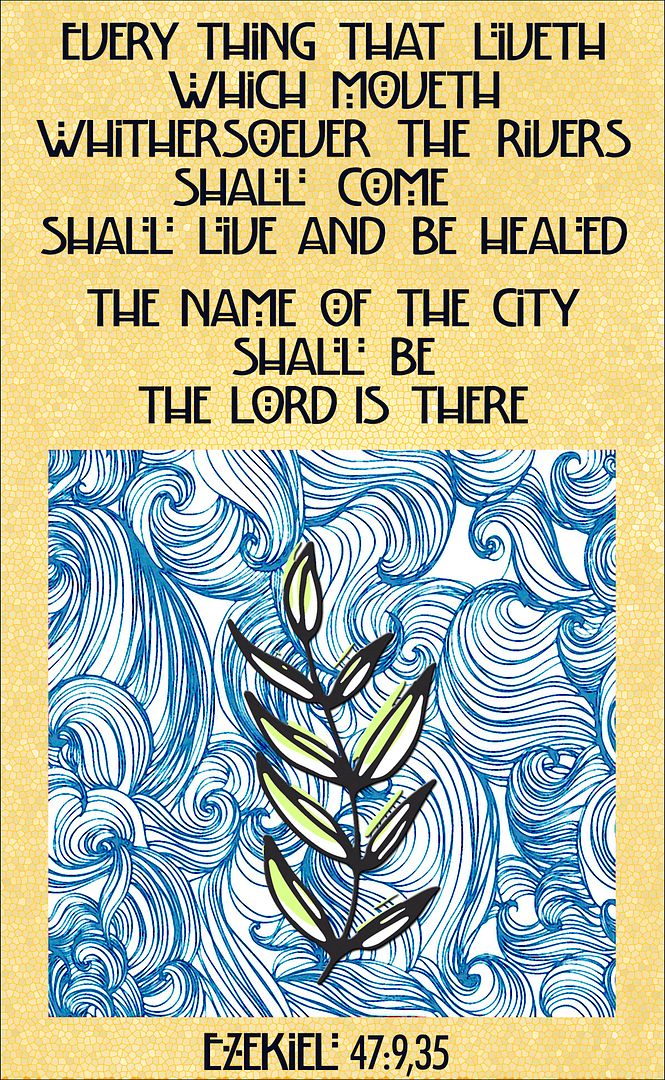
Ezekiel 47:35Near the end of his writings, Ezekiel shows us the Land of Promise reapportioned amongst the tribes of Israel. Ezekiel was a priest in the holiness tradition of the Jerusalem Temple, the tradition of "You shall be holy, for I, your God am holy!" We sometimes use water as metaphor for the Holy Spirit. Ezekiel brings us a vision of the river of life flowing from the throne of God, into the valley and the desert, out to the sea. He tells us everything whithersoever the river flows shall live, shall be healed. His vision includes trees for food and for healing on the riverbanks. Everything in the path of this river lives because people with the new hearts and new spirits have cared well for the river as part of their keeping covenant with creation. Ezekiel concludes by telling us the name of this city is "The Lord Is There!"

God commanded Ezekiel, "the human one" to speak a word of life to the dead bones; to evoke the presence of the Holy Spirit, to summon the Spirit of life! How about us? Does the human gathering of the church speak a word of life? How does the church speak a word of life? When people look at creation, will they see it so healthy and green they'll be able to say The Lord Is There?!

The Prayer

Holy God, thank you for these days of May Gray and the June Gloom we anticipate, too, as they help nourish creation. You amazingly claim and call us by water, spirit, and word. May we hear, heed, and obey your charge to speak words of life that help revive the dead in our midst! Thank you for calling us together as your Green Faith Team; please help us complete the agenda for this meeting and offer useful resources at Synod Assembly. In the name of the One Crucified and Risen for the life of the world, for the resurrection of all creation. Amen!

Tuesday, November 08, 2016

Green Team Talk – Reformation/All Saints

Here's the devotional talk I gave last Thursday for the Green Faith Team meeting.

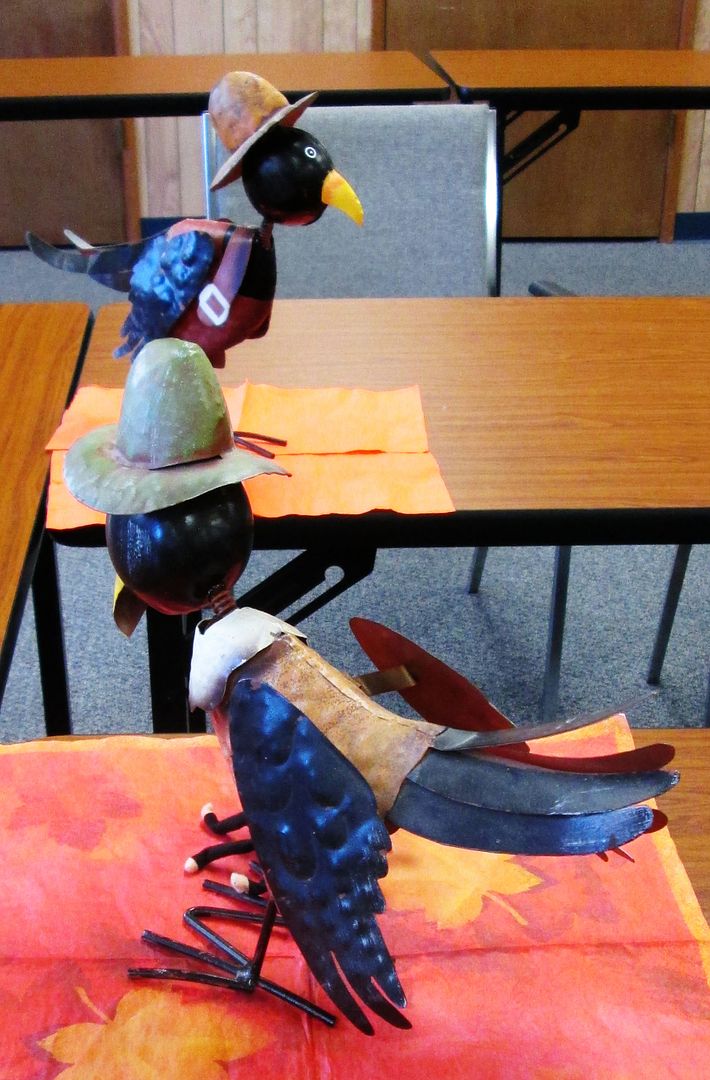
Congress of Two Crows• This week brings a confluence – a literal flowing together as rivers and streams of water do – of Reformation and All Saints. We celebrated Reformation last Sunday, recalling changes in the church the Holy Spirit made through human agency and also anticipating a church that never remains stagnant, always is alive. Next Sunday will be All Saints, when we especially remember those who have passed into the Church Triumphant, but All Saints is our day, as well. These actually are back-to-back festivals on 31 October and 01 November, but most churches celebrate both Reformation and All Saints on Sundays, since few people will attend weekday or weeknight services.

• Reformation is a major festival of the Holy Spirit when we "wear red," as we always do on the Day of Pentecost. The reading from Ephesians [1:13-14] for All Saints reminds us each of us in baptism carries the sign and seal of the Holy Spirit. All Saints is another festival of the Spirit!

• Pretty much from necessity, the Reformers particularly emphasized theology of redemption, of God's grace freely poured out, offered to all, given to all, through the birth, life, death, resurrection and ascension of Jesus Christ.

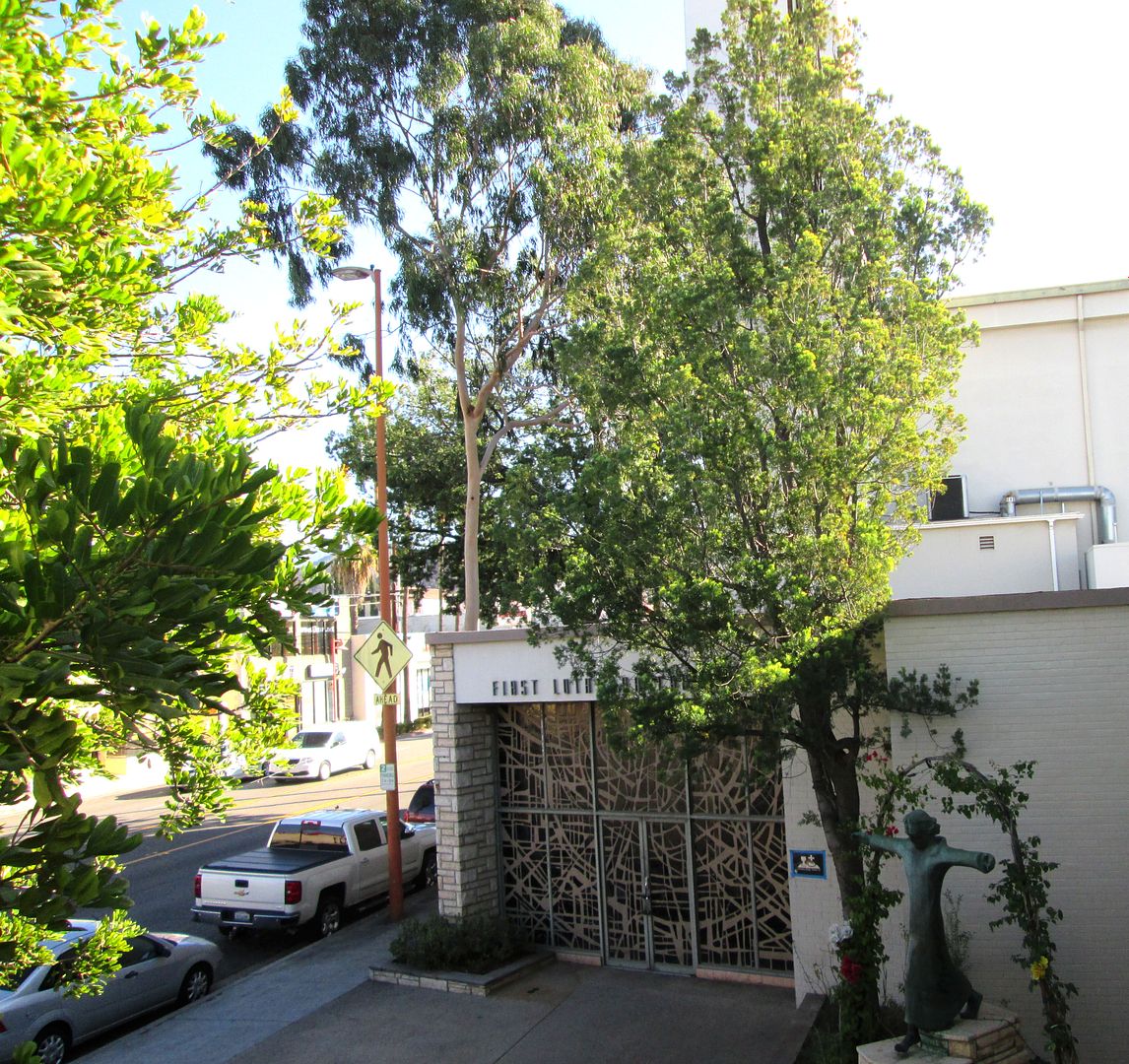
• The reformer Martin Luther got his theology from Galatians and from Romans, 1st Lutheran Glendale CAbut the psalms gave Luther his passion! Everyone knows the hymn he wrote based on Psalm 46; Pastor Eugene Peterson's version tells us the city streets are safe because God lives in the city; the city is safe because God bans war and breaks weapons. The city is a delight because God plants trees and flowers!

• We celebrate Pentecost and Reformation as major festivals of the presence of God in the Holy Spirit. But there is more! The priestly scribes who brought us the latest Pentateuch source [designated P] wrote late in the Babylonian exile or possibly after the exile, since dating is a bit confounded. They received a revelation that the destruction, the end of the Jerusalem Temple wasn't such a huge deal, after all. Imagine the crazy idea of a real God beyond space and time contained in a mini-replica of the earth and the heavens—that's what temples were! In Genesis 1 the priestly scribes show us all of the living structure of planet earth, the whole panorama of creation as God's dwelling place, the temple of the Divine. Genesis 1 also bring us the spoken Word that creates, orders, tames – redeems, renews, and reforms. And of course, we know Jesus Christ supremely as the Word of God.

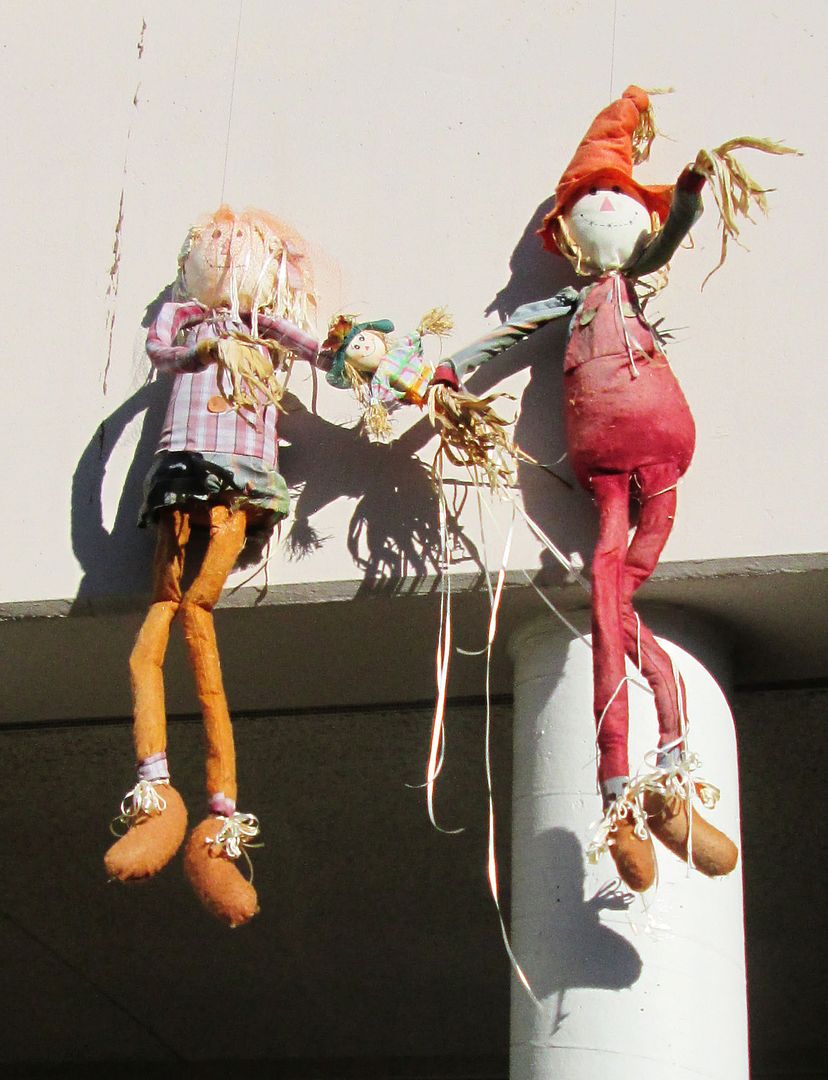
• But there is still more! The Reformers – especially magisterial reformers John Calvin and Martin Luther – mostly concentrated on theology of God's grace-filled redemption of human creatures through the reconciling Christ Event. Halloween peopleHowever, John Calvin brings us a rich theology of creation revealing God's providence, of God's grace and providence revealed for all creation, not solely human creatures. Martin Luther brings us the insight of the Divine presence in, with, and under all creation. Beyond that, Luther affirms the ubiquity – the everywhere-ness – of the risen and ascended Jesus Christ. Can you say sacraments?

• The lectionary reading from Ephesians for All Saints reminds us baptism marks and seals us with the Holy Spirit. In the power and presence of the Holy Spirit, like all of planet earth, each of us is a dwelling place of God! Along with Reformation, All Saints is a festival of the Spirit; besides commemorating those in the Church triumphant, All Saints is a day for those of us still on planet earth, as well. How exciting to have the confluence of those major festivals this time of the year!

• And now? We need to trust, we can trust, the bounty of life in the Holy Spirit, the imagination of all creation, the reign of grace.

To God Alone Be glory; Amen!

Judicatory offices share the campus with First Lutheran Glendale Church and School.

Friday, September 23, 2016

Green Team Talk: Friday of Pentecost 18

January 2017: I've tried to reconstruct my talk from my scant notes that were all I needed at the time... and I'm publishing this on the actual Friday of Pentecost 18 date.

Isaiah 25:6-9

6On this mountain shall the Lord of hosts
make unto all peoples
a feast of fat things
a feast of vines on the lees
of fat things full of marrow
of vines on the lees well refined

7God will swallow up the covering that hovers over everyone
the veil stretched over all nations

8God will swallow up death forever
God will wipe away all tears
God will remove the remove the reproach of the people from the earth
For the Lord has spoken

9On that day we will say,
"This is our God we've waited for
so he could save us.
"This is the Lord we've waited for.
"Let's rejoice in God's salvation."
feast of fat thingsThis passage the canon places in First Isaiah is the appointed text for Easter Evening RCL years A, B and C. We find it amidst writings mostly from Isaiah of Jerusalem, yet it's probably at least a century afterwards—with its sense of optimism, probably exilic or later. This is the Hebrew scripture reading for Easter evening, but six months have gone by since we celebrated the Day of Resurrection, over four months since the Great Fifty Days concluded.

Here in the northern hemisphere the wheel of the year has been in meteorological autumn for close to a month; in a couple days we'll be in astronomical fall. Ripening root crops, leaves falling from trees then decaying on the ground, shorter days, longer nights, all remind us of God's gift of the agricultural cycle, God's gift of land. These natural events in the browning time of autumn anticipate the arrival of the apparently quiet, still, and silent season of winter that in many respects is similar to the stillness and quiet near-silence of the surface of the desertscape.

These imaginative words we find in First Isaiah remind us the God of Israel is God of all people, God on the side of everyone. They promise God will swallow up death and the shroud of death – a veil that hides the light of life, anything that lessens our joy – into God's own being. God will obliterate tears of grief; God will prepare and serve an amazing spread of a covenant meal shared by God and people. That eschatological feast – as we called our extravagant potlucks in divinity school – will be God's sign that death and dying are no more!

But six months have gone by since we celebrated the Day of Resurrection 2016, over four months since the conclusion of the Great Fifty Days. We look around us and still see, still experience hatred, poverty and injustice. Illness, death, and dying. Grief. Tears. We know the agricultural seasons' periods of tilling, planting, growing, and harvest keep cycling continuously, yet our theology tells us how Easter, the event of Jesus Christ's resurrection, that eighth day that's also the first day of the new creation, marked the end of death and dying, concluded ongoing cycles of poverty, illness, injustice.

These promises we find in First Isaiah describe God's action of new birth from death, the start of the new creation. Despite the dawn of the new creation on the day of resurrection two thousand years ago, that renewed, restored natural creation and righteous society has only begun, still waits for us to help finish it as God's hands doing God's work. Theology of the cross emphasizes Saturday, the interstitial time of winter-like quiet when apparently nothing happens yet everything happens, yet God calls us to live as people of the cross who now are fully alive, resurrected, and redeemed. The third day aligns and unites nature and history; filled with the Spirit of the Day of Pentecost, the fiftieth day of Easter, we become God's hands, God's voices, agents of God's justice, inclusion and freedom for all! Let's all follow Jesus into the resurrection, into the next six months!

Can I get an "Amen"?!

god's work our hands tshirt design