Showing posts with label ezekiel. Show all posts

Wednesday, March 25, 2026

Lent 5 Sermon

Typing up a sermon afterwards always feels so last Sunday, March 22nd, but I had a couple of requests for a copy and I need blog content (or fodder, maybe), so here it is, more or less. By the way, it preached better than it reads.

Leafy Cross

• Ezekiel 37:1-14


I really liked my opening prayer:

From all the ends of the earth, come to us, breath of God.
Breathing life of the Divine, embrace your people and your land.
Let us live again.
In the name of the One Spirit-sent for the life of the world.
Amen.


Two days ago on Friday we celebrated the Spring equinox, a verdant greening time as days get longer. And now we celebrate the Persian New Year with our friends—thirteen festive days of rejoicing in creation!

We're two-thirds through Lent, as Jesus and his followers draw closer to the holy city Jerusalem. They draw closer to Jesus' trial, conviction, crucifixion, death, and burial. Nearer to the day of resurrection, Easter Sunday.

Throughout scripture, hints and types and realities of resurrection foreshadow Jesus' resurrection. New life out of ashes, ruins, destruction, devastation. New life out of the death of the old.

Less than two weeks from the Friday called Good, the lectionary that gives us our scripture readings pairs Ezekiel's provocative and pictorial dialogue with God as Ezekiel raises dry bones from death to life, with the seventh and last of Jesus' "I Am" statements from John's gospel. After Jesus' raises Lazarus back to life from death (he really was dead, already buried in the tomb), Jesus declares "I Am the Resurrection and the life." John 11:25

* * *

Ezekiel was a priest in the holiness tradition of the Jerusalem Temple. About 600 years before Jesus, during the last years of Jerusalem and the Temple before the exile to Babylon, Ezekiel ministered with words from God and words of God. Deep into the long book that bears his name, chapter 37 happens when Ezekiel's proclamation moved from discouragement and lament to hope and a vision of the future.

This is pivotal because it came about when news of the destruction of Jerusalem and of the Temple reached the exiles.

"These people" somehow had developed bad theology that located God in a special way in the heart of the temple, accessible only once a year, only to the high priest under certain circumstances.

Had they forgotten the God who liberated them from slavery in Egypt? The God of the Exodus who journeyed alongside them and ahead of them throughout those forty years in the wilderness? God who provided gifts like water from the rock and manna from the sky? The Ten Words or Commandments of the Sinai Covenant that showed them how to honor God by living together faithfully honoring their neighbors?

Since the temple was gone, did that mean God was dead? They were away from the land of promise that yielded such agricultural bounty. Did that mean all of God's promises were null and void?

* * *

We don't know if Ezekiel's conversation in the Spirit with God was a physical event, a sleeping dream, or a waking vision. We do know his experience of God's initiative and the subsequent call and response as Ezekiel spoke words in the Spirit from God and words of God convinced him there was a future.

Although the human Ezekiel spoke words from God and words of God and raised dead bones to new life, we often consider new life and resurrection primarily God's thing.

But wait! In the second reading for today (that we didn't hear), the apostle Paul tells us:

If [since, because] the Spirit of the one who raised Jesus from the dead dwells in you, God who raised Christ Jesus from the dead will also give life to your mortal bodies through the same Spirit that dwells in you. Romans 8:11

Earlier on, in his first letter to the church at Corinth, we hear from Paul regarding us as the gathered body of Christ – the church, the assembly of the faithful – and us as individuals:

Do you not know that you are God's temple and that God's Spirit dwells in you? 1 Corinthian 3:16

Do you not know that your body is a temple of the Holy Spirit who is in you, which you have from God, and that you are not your own? ! Corinthians 6:19

So we've moved from bad theology of God being contained (God in a box?) in the Jerusalem Temple, to biblical theology of God indwelling us, making a home with us. We are temples of God, filled with the Holy Spirit, moving, walking, and talking alongside the people.

* * *

Ezekiel's words from God in the Spirit revitalized people who had been reduced to bones.

What dry bones of loss, death, disappointment is God calling you to resurrect with Words in the Spirit? Words from God? Words of God?

* * *

Today Jesus again invites us to the table of grace, the feast of new beginnings.

In the Lord's Supper, the Eucharist, we reenact and remember the history of the world's salvation that also belongs to us.

God remembers that we forget.

Jesus welcome everyone. You are welcome. I am welcome. We are welcome!

To God alone be glory.

Amen!
Lent 5 Judica

Saturday, February 07, 2026

Pentecost 4B Creation Care

creation care box
Sometimes people want to hear what they already know.

Scriptures

• Ezekiel 47:9

Wherever the river goes, every living creature that swarms will live, and there will be very many fish once these waters reach there. It will become fresh, and everything will live where the river goes.

• Ezekiel 47:12

On the banks, on both sides of the river, there will grow all kinds of trees for food. Their leaves will not wither nor their fruit fail, but they will bear fresh fruit every month, because the water for them flows from the sanctuary. Their fruit will be for food and their leaves for healing.

• 2 Corinthians 5:17

So if anyone is in Christ, there is a new creation: everything old has passed away; look, everything has become new!

• Mark 4:26-34

26 Jesus also said, "The kingdom of God is as if someone would scatter seed on the ground 27 and would sleep and rise night and day, and the seed would sprout and grow, he does not know how. 28 The earth produces of itself first the stalk, then the head, then the full grain in the head. 29 But when the grain is ripe, at once he goes in with his sickle because the harvest has come."

30 He also said, "With what can we compare the kingdom of God, or what parable will we use for it? 31 It is like a mustard seed, which, when sown upon the ground, is the smallest of all the seeds on earth, 32 yet when it is sown it grows up and becomes the greatest of all shrubs and puts forth large branches, so that the birds of the air can make nests in its shade."

33 With many such parables Jesus spoke the word to them as they were able to hear it; 34 he did not speak to them except in parables, but he explained everything in private to his disciples.
blueberries blackberries raspberries
Creation Care Outline

Where are we now in the church's year of grace? One month ago we celebrated the Day of Pentecost, the fiftieth day of Easter. We recollected when a large group of Jesus' first followers gathered in Jerusalem for the Jewish Pentecost. They remembered and affirmed God giving the Ten Words or Commandments through Moses, that way of obedience you could call the Working Papers for our lives together. And they celebrated the wheat harvest, God's gift from the ground that sustains our bodies every day.

Here in the church we recently started the six month long green and growing season of Pentecost; during this stretch of time we emphasize all creation as God's planting,. You know the story of God and God's people and the land from Genesis through Revelation.

Today's scriptures offer agricultural images. We hear from the prophet Ezekiel, and we hear two parables from Mark's gospel: scattered seeds and the famous mustard seed! The gospels of Luke and Matthew also include the mustard seed parable, so that may mean it's especially important.

A month ago we celebrated the Christian Day of Pentecost, or the fiftieth day of Easter. Christians have been celebrating Easter for two thousand years! Our formal theology tells us Jesus Christ's death and resurrection ended endless cycles of death, violence, and everything contrary to God's intention, but we look around and still see war, climate chaos, sorrow, sickness, death—none of that is over and done with yet.

Even though Jesus Christ has died, is risen from the grave, and ascended to reign from the right hand of God, even though we identify as Easter people… what's going on?

Jesus' original followers wondered, too.

After Jesus' resurrection and before his Ascension, in Luke's book of the Acts of the Apostles, his friends and followers asked if now he finally would "restore the kingdom" to the world. Jesus informed them the question was wrong. He told them to stay and wait right there in Jerusalem. and they would be his witnesses, they would testify to new life. In the power of the Holy Spirit of Pentecost, they would be Jesus' presence in the world.

In Romans 8:19-21 the Apostle Paul tells us all creation waits, hopes, and longs to discover us as God's authentic offspring, as people who embody, reflect, and act in God's image to help redeem all creation. Like Jesus!

The agricultural parables in the Good News of Jesus Christ, Son of God, according to Mark, align well with today's song, "God, Whose Farm Is All Creation." All creation. Not only prairie and heartland. But also crowded, overbuilt cities and suburbs. Remote rural wide spots in the road. Deserts. All creation is God's garden. God's land. God's farm.

God whose farm is all Creation,
take the gratitude we give,
take the finest of our harvest,
crops we grow that all may live.

Take our ploughing, seeding, reaping,
hopes and fears of sun and rain,
all our thinking, planning, waiting,
ripening into fruit and grain.

All our labor, all our watching,
all our calendar of care,
in these crops of your creation,
take, O God; they are our prayer.

Author: John Arlott

Romans reminds us creation hopes to discover that we'll treat oceans, wetlands, savannas, and cities in ways that help them heal. Creation watches us and waits for us to become good caretakers of waterways, trees, animals, insects. Of our own backyards and window boxes!

The new creation began 2000 years ago. That eighth day of the week, was the first day of a new reality. The new creation is not finished. The old creation still waits and hopes for us to be green people.

What's a biblical creation care model? We need to learn about plants, about seeds and soils, climates and seasons. It's also a great idea to act locally!

In the bible's promised land we see:

Crops watered by cascades down mountains into valleys and not by water shipped thousands of miles Gardens warmed by the great light of the sun and not by plugged in grids

Scripture shows us act locally. You know some of the ways:

• farmers markets
• street vendors
• community gardens
• backyard plots
• kitchen windowsill herb gardens
• composts

School and community gardens can help cancel food deserts
Besides, living local adds savor and flavor
Although we lose some long term keeper food
When that happens?!
Share the extras!
Trust the mystery!

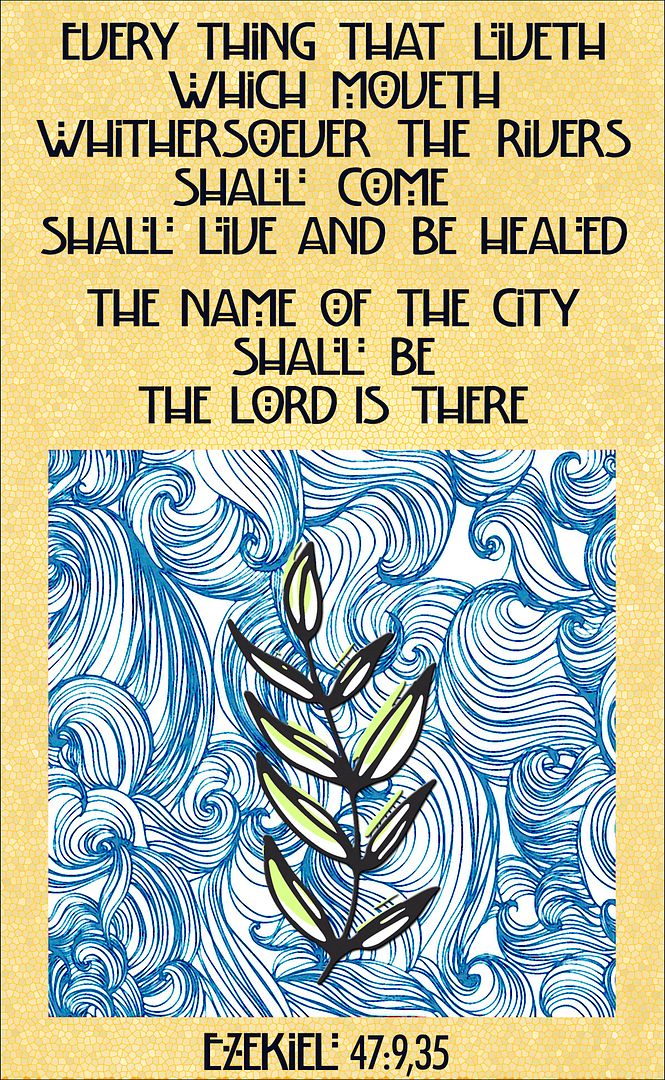
In Ezekiel we hear about rivers flowing from the temple and healing everything the waters touch. Because everything those waters reach becomes healthy and well, the name of the city then becomes The Lord Is Here.

Today Jesus invites us to his table of grace. This eucharistic festival of thanksgiving is a taste, a token, a sign, a promise of creation completely redeemed.

Christ is raised and dies no more.
By water and the word
we share his death
his Eastered life

The new creation comes to life and grows
Everywhere we go!
Alleluia.
Amen!

Thanks be to God.
Amen.
creation care

Tuesday, March 24, 2020

Friday, May 05, 2017

Green Team Talk: Ezekiel

Here's an approximation of my talk this morning to open our Judicatory Green Faith Team meeting; I paraphrased the Ezekiel text rather than reading it, though I've included actuals here.

Since we'd scheduled a meeting Friday after Lent 5 and I often default to lectionary because I appreciate both the discipline and the ease, I'd planned to reflect on the first reading for Lent 5A, Ezekiel 37:1-14. When we rescheduled for Friday after Easter 3, I decided to keep the Ezekiel passage. The RCL appoints it for Lent 5 of this lectionary year A and for the Day of Pentecost in year B. As one of our primary resurrection pericopes and also majorly about the gift of the Holy Spirit, it's the eighth reading for the Easter Vigil in all three years A, B, and C.

God called Ezekiel to the office of prophet when Ezekiel was in exile in Babylon; you know how it goes!
Ezekiel 37:1-14

1The hand of the Lord came upon me, and he brought me out by the spirit of the Lord and set me down in the middle of a valley; it was full of bones. 2He led me all around them; there were very many lying in the valley, and they were very dry. 3He said to me, "Mortal, can these bones live?" I answered, "O Lord God, you know."

4Then he said to me, "Prophesy to these bones, and say to them: O dry bones, hear the word of the Lord. 5Thus says the Lord God to these bones: I will cause breath to enter you, and you shall live. 6I will lay sinews on you, and will cause flesh to come upon you, and cover you with skin, and put breath in you, and you shall live; and you shall know that I am the Lord." 7So I prophesied as I had been commanded; and as I prophesied, suddenly there was a noise, a rattling, and the bones came together, bone to its bone. 8I looked, and there were sinews on them, and flesh had come upon them, and skin had covered them; but there was no breath in them.

9Then he said to me, "Prophesy to the breath, prophesy, mortal, and say to the breath: Thus says the Lord God: Come from the four winds, O breath, and breathe upon these slain, that they may live." 10I prophesied as he commanded me, and the breath came into them, and they lived, and stood on their feet, a vast multitude.

11Then he said to me, "Mortal, these bones are the whole house of Israel. They say, "Our bones are dried up, and our hope is lost; we are cut off completely.' 12Therefore prophesy, and say to them, Thus says the Lord God: I am going to open your graves, and bring you up from your graves, O my people; and I will bring you back to the land of Israel. 13And you shall know that I am the Lord, when I open your graves, and bring you up from your graves, O my people. 14I will put my spirit within you, and you shall live, and I will place you on your own soil; then you shall know that I, the Lord, have spoken and will act, says the Lord."
The New Heart / New Spirit

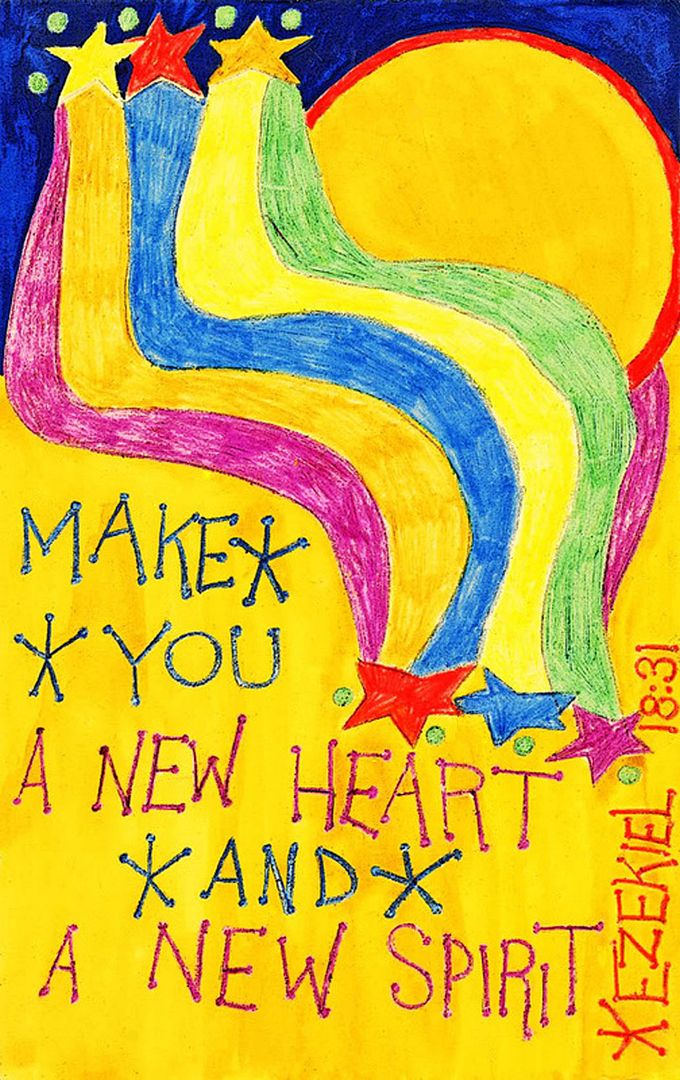
Ezekiel 18:31The book of Ezekiel is long, influential, and dense; it probably didn't get written-down and readable until after the exile ended, likely around the time of rediscovery of the books of Moses that we read about in Ezra and Nehemiah when Israel / the Jews became a people of the book, so in what order Ezekiel and cohorts originally recorded everything is up for grabs. Earlier than chapter 37 I just cited we find three new heart – new spirit passages. God tells the people to get renewed hearts and resolve; God also promises to provide that newness. And why? Primarily for covenantal obedience. Not in order to get the gift, but in response to the gift, to put God first, to keep covenant with and care for all creation.

I will give them one heart, and put a new spirit within them; I will remove the heart of stone from their flesh and give them a heart of flesh, so that they may follow my statutes and keep my ordinances and obey them. Then they shall be my people, and I will be their God.
–Ezekiel 11:19-20

Cast away from you all your transgressions, whereby ye have transgressed; and make you a new heart and a new spirit: for why will ye die, O house of Israel?
–Ezekiel 18:31

A new heart I will give you, and a new spirit I will put within you; and I will remove from your body the heart of stone and give you a heart of flesh. I will put my spirit within you, and make you follow my statutes and be careful to observe my ordinances. Then you shall live in the land that I gave to your ancestors; and you shall be my people, and I will be your God.
–Ezekiel 36:26-28
The Valleys

We know agricultural valleys as fertile places of great richness. We also know how everything trickles down the mountain into the valley: the beneficial and helpful, the not so good, sometimes the toxic. When an ecosystem is in proper balance, bugs, aquatic life, and other factors help keep it healthy. God showed Ezekiel a vision of literal dead bodies. At least as much as the reality of those physical deaths, Judah felt the death of being cut off from their God in the strange land of Babylon. They also had a sense of death because they no longer were in the Promised Land where valleys had yielded bounty as streams and rivers flowed down the hills. Judah knew Yahweh as a fertility god, but they didn't yet realize Yahweh was not a place god, a deity confined to and connected only with a particular location.

The New Creation

Ezekiel 47:35Near the end of his writings, Ezekiel shows us the Land of Promise reapportioned amongst the tribes of Israel. Ezekiel was a priest in the holiness tradition of the Jerusalem Temple, the tradition of "You shall be holy, for I, your God am holy!" We sometimes use water as metaphor for the Holy Spirit. Ezekiel brings us a vision of the river of life flowing from the throne of God, into the valley and the desert, out to the sea. He tells us everything whithersoever the river flows shall live, shall be healed. His vision includes trees for food and for healing on the riverbanks. Everything in the path of this river lives because people with the new hearts and new spirits have cared well for the river as part of their keeping covenant with creation. Ezekiel concludes by telling us the name of this city is "The Lord Is There!"

God commanded Ezekiel, "the human one" to speak a word of life to the dead bones; to evoke the presence of the Holy Spirit, to summon the Spirit of life! How about us? Does the human gathering of the church speak a word of life? How does the church speak a word of life? When people look at creation, will they see it so healthy and green they'll be able to say The Lord Is There?!

The Prayer

Holy God, thank you for these days of May Gray and the June Gloom we anticipate, too, as they help nourish creation. You amazingly claim and call us by water, spirit, and word. May we hear, heed, and obey your charge to speak words of life that help revive the dead in our midst! Thank you for calling us together as your Green Faith Team; please help us complete the agenda for this meeting and offer useful resources at Synod Assembly. In the name of the One Crucified and Risen for the life of the world, for the resurrection of all creation. Amen!

Wednesday, May 03, 2017

Porch Stories: Hardened Ways Pardoned

In her Porch Story testimony to God's faithfulness, Kristin reminds us that in Jesus Christ our Hardened Ways are Pardoned, and tells us: "when we got to our church later that morning, we sang a song I hadn't heard in years and I knew that one paragraph was for me."
"Take this bread, drink this cup
Know this price has pardoned you
From all that's hardened you
But it's going to take some trust"

–From "Trust" by Smalltown Poets

desert spirit's fire porch stories – pardoned

I'd say that particular paragraph is for all of us! Interesting juxtaposition this week, because I've been working on a talk mostly based on Ezekiel 37:1-14 that's a central resurrection text; it's also one of scripture's primary proclamations of the Spirit of Life that fills creation that we celebrate in the most extravagant manner on the Day of Pentecost as the third of our major trinitarian festivals. Here's beginning and end of that passage:
Ezekiel 37:1-3, 11-14

1The hand of the Lord came upon me, and he brought me out by the spirit of the Lord and set me down in the middle of a valley; it was full of bones. 2He led me all around them; there were very many lying in the valley, and they were very dry. 3He said to me, "Mortal, can these bones live?" I answered, "O Lord God, you know."

11Then he said to me, "Mortal, these bones are the whole house of Israel. They say, "Our bones are dried up, and our hope is lost; we are cut off completely.' 12Therefore prophesy, and say to them, Thus says the Lord God: I am going to open your graves, and bring you up from your graves, O my people; and I will bring you back to the land of Israel. 13And you shall know that I am the Lord, when I open your graves, and bring you up from your graves, O my people. 14I will put my spirit within you, and you shall live, and I will place you on your own soil; then you shall know that I, the Lord, have spoken and will act, says the Lord."

I also plan to mention a trio of passages earlier in the book of Ezekiel related to the need for our frequently too stubborn, stony, self-willed human hearts to be softened and sensitized. Sometimes hard and stubborn, but at times humans don't have the energy or the will to obey because their hearts have been broken too many times and need mending. Those people need new hearts without too much scar tissue!
I will give them one heart, and put a new spirit within them; I will remove the heart of stone from their flesh and give them a heart of flesh, so that they may follow my statutes and keep my ordinances and obey them. Then they shall be my people, and I will be their God. –Ezekiel 11:19-20

Cast away from you all your transgressions, whereby ye have transgressed; and make you a new heart and a new spirit: for why will ye die, O house of Israel? –Ezekiel 18:31

A new heart I will give you, and a new spirit I will put within you; and I will remove from your body the heart of stone and give you a heart of flesh. I will put my spirit within you, and make you follow my statutes and be careful to observe my ordinances. Then you shall live in the land that I gave to your ancestors; and you shall be my people, and I will be your God. –Ezekiel 36:26-28

Ezekiel 18:31 charges us to get new hearts and new spirits, but what our modern bibles know as Ezekiel chapters 11 and 36 both tell us God will gift us with this softer, more compliant heart – or will, since in Hebrew biology the heart mainly is the seat of will and determination rather than of emotions as we tend to think of heart. And then? Our renewed human hearts and spirits help shape us for greater obedience to God's "statutes and ordinances" – God's decrees and commandments that provide safety and freedom as we live in community with each other, as we carefully steward all creation. Hebrew Bible scholar Walter Brueggemann describes the commandments as Working Papers for our lives together: in family, in church, at work, anywhere God sends us, even those random places we wander without a sense of being sent.

Smalltown Poets paraphrases a whole lot of scripture and tells us God already has done this new heart thing for us, yet it's still going to take some trust on our part. Is this covenantal obedience in order to gain or possess? Never ever! Obedience responds to God's giving and grace, but never to fear, because just like our renewed spirits and fresh hearts, faith or trust in the ways of God also are gifts of the Holy Spirit of Life that sanctifies creation and fills us, too.

I'll sign off by quoting from another song that's been a standard part of the church's hymnody for a long time; hymnary dot org tells us we can find this in 144 hymnals, and they well may have missed a few, especially if they haven't recently searched:
Praise, my soul, the King of Heaven;
To His feet thy tribute bring.
Ransomed, healed, restored, forgiven,
Evermore His praises sing:
Praise Him, praise Him, alleluia!
Praise the everlasting King.

Angels, help us to adore Him,
Ye behold Him face to face;
Sun and moon, bow down before Him;
Dwellers all in time and space,
Praise Him, praise Him, alleluia!
Praise with us the God of grace.

Henry F Lyte, 1834

End Note:

The ecumenical Revised Common Lectionary appoints Ezekiel 37:1-14 for the Easter Vigil in all three RCL years, and in year B for the Day of Pentecost when we most spectacularly celebrate the reign of the gift of the Spirit. Only incidental that it's the eighth reading for the Easter Vigil? Maybe so, but still, Easter Sunday, the day of resurrection, as first day of the week is a day of creation; it's also the eighth day, making it the day of a new creation. The church observes the first week of the great fifty days of Easter as Bright Week and considers that entire week the eighth day of the new creation.

porch stories button