Showing posts with label galatians. Show all posts

Thursday, September 10, 2026

Five Minute Friday :: Approve

bright poppies
• Five Minute Friday :: Approve Linkup

This prompt fits a classic Pauline trope that directs us to the source of grace and the proper place to seek approval:

"Am I now seeking human approval or God's approval? Or am I trying to please people? If I were still pleasing people, I wouldn't be a servant of Christ." Galatians 1:10

Like many others, I can be quite a people pleaser. (And quite the iconoclast.) The reasons are complicated. Part of it is I've worked hard to achieve high levels of skill, and I don't want anyone to question my expertise, especially if they have no knowledge of that field of endeavor.

But doing something in public for the public like a piano performance, a design project, a Sunday sermon, are more distant and almost abstract than some other areas where a person seeks approval.

Consider when someone gives you a job or a task, whether or not it's part of your paid employment, whether or not it's for public consumption—and public approval. When someone tasks you, either you already have a relationship with them, or you may aspire to relate to them or their company. It could be a boss, a client (also a kind of boss because they'll be paying you if all turns out well), a job interviewer asking you to demonstrate your abilities in software X or solve sample problem Y. It could be a spouse or a sibling or another relative. In sum, any time you're doing anything that propels you into approval-seeking mode, it's not simply about you. It's about them, too. And my wanting approval is about a possible fracture in a current relationship, or maybe it's about a new relationship that won't happen if my performance isn't the best ever.

My scripture from Galatians directs us outside of and beyond all those humans whose approval we think we need. It sends us to the source of the gifts, to the Spirit that inspires our actions and our expertise. The Spirit that gathers the community and relates us to the people we believe are worth pleasing. The apostle Paul asks if we want "God's approval." And what does he tell us about pleasing people?

Think about that.

# # #
golden poppies
Sylvia ice cream
FMF approve
FMF logo

Thursday, June 18, 2026

Five Minute Friday :: Vibe

Mexico flag
ceramnesic cross and sto
• Five Minute Friday Vibe :: Linkup

As someone who's never watched a soccer match – or an American football game – I still had to experience the vibe I could hear from outside, so a few minutes ago I came back from a stroll to observe and to feel some other Los Angeles denizens alive with the vibe of South Korea vs Mexico in World Cup 2026.

In my current "between lives" circumstances, I live and work in the Koreatown community of LA. Many of my neighbors citywide (and this city rocks a very wide swath) are Mexican immigrants or otherwise ethnic Mexican, to such an extent most signage everywhere is bilingual.

A few years back as I reminisced with a now former friend I'd met when we both lived in the same Koreatown hostel, she observed, "Koreatown has a nice vibe." Although maybe the part of Koreatown on the other side of Wilshire where we first met does, I'm not sure about this south of Wilshire section. But today's World Cup vibe isn't "nice" or tame—it's competitive yet neighborly yet still wanting my side to win.


But our citizenship is in heaven, and it is from there that we are expecting a Savior, Jesus Christ.
Philippians 3:20


There is no longer Jew or Greek;
there is no longer slave or free;
there is no longer male and female,
for all of you are one in Christ Jesus.

Galatians 3:28


And yes, Thomas Friedman! Because the world keeps getting flatter every day, why would we want to emphasize our own tribe, our own ethnicity, culture, or brand? Maybe because it has so much to offer the world, just as your tribe, your perspective, your ways of being could enhance my world and broaden my vision. And let's all celebrate and live into the reality that the ground is level at the foot of the cross.

As I'm finishing this FMF, I can feel the roaring crowd that's gone way beyond a chill vibe. Mexico won! Enjoy the moment!

What's your vibe today?

# # #
korea world cup banner
Korea flag
Sylvia ice cream
five minute friday vibe
five minute friday logo

Friday, April 24, 2026

Five Minute Friday :: Timing

june 2020 poppies many colors
My header poppies are from 22 June 2020 – two days after the solstice –
because the timing of the seasons always is just right.
The peaches square comes from 12 June 2022.


• Five Minute Friday :: Timing Linkup

Theology blog here, right? Greek distinguishes between chronos (ordinary everyday time we usually measure on a clock or calendar, as in "chronology"), and kairos (extraordinary one of a kind time that marks a specific event we may have been awaiting or that happens unexpectedly).

It's super ironic and surprising that the Apostle Paul writes his only birth narrative about chronos and not kairos time. Given that it's one of the most poignant verses in the New Testament, who'd of thunk it?

But when the fullness of time had come, God sent his son, born of a woman, born under the law. Galatians 4:4

Which of these timing renderings in English from that verse feels best?

proper time – time came to completion – fulfillment of the time – appointed time – time was right – right time – time had fully come – appropriate time – chosen time – set time had fully come – fulfilling of the time

I'm often grateful I didn't send an email or make a phone call when I'd planned it, and my lack of preparation or another circumstance delayed it. When I finally made the call or sent the email, the timing often felt providential, close to "kairos" even for something relatively small. Then there have been a few times I ended up not contacting the person or organization at all. Has that happened to you?

When I place larger events in the chronology of my life and my relationships with other people, the ways right timing makes seemingly disparate events and people come together often astonishes me. Every time it happens!

There have been times I've instinctively known other people's suggested timings were wrong. Then there were a handful of instances i refused to follow another person's suggested timing and regretted it.

This has been a somewhat abstract five minutes. Is timing an abstract concept? Not usually. Timing most often is about the important stuff and when events that move life forward just happen to happen. And timing is about joys in life that become disappointments when we don't consider the whole timeline—like Kate's hydrangeas.

# # #
peaches june 2022
Sylvia ice cream
hydrangeas
FMF logo

Friday, February 17, 2023

Five Minute Friday :: Many

bread and cup 1 corinthians 12:12
Even as the body is one and yet has many members,
and all the members of the body,
though they are many,
are one body, so also is Christ.
1 Corinthians 12:12

• Five Minute Friday :: Many Linkup

12 For even as the body is one and yet has many members, and all the members of the body, though they are many, are one body, so also is Christ. 13 For by one Spirit we were all baptized into one body, whether Jews or Greeks, whether slaves or free, and we were all made to drink of one Spirit. … 20 But now there are many members, but one body. 1 Corinthians 12

26 for in Christ Jesus you are all children of God through faith. 27 As many of you as were baptized into Christ have clothed yourselves with Christ. 28 There is no longer Jew or Greek; there is no longer slave or free; there is no longer male and female, for all of you are one in Christ Jesus. Galatians 3

I've thought a lot – had many thoughts – about the role, calling, function, and interrelatedness of each individual member of the body of Christ related to the whole. I've pondered each one's own sense of purpose and call that admittedly changes, expands, and at times even contracts for a while. Related to the whole means the local called-out, gathered-in assembly as well as the global church with its many many traditions, styles, denominations, disagreements, and convergences.

In scripture, the Pauline and especially the deutero-Pauline movement is not from a solitary, isolated atomized individual into an undifferentiated [blob?!] Body of Christ; it's from solitary, disconnected individuality to uniqueness and particularity within the local church, the wider council or judicatory, the global Church.

As individuals who interrelate as the one body in the Spirit with many discrete members, each of us assumes and ministers in one of many positions appropriate to our gifts and experience. It's a lively and life-giving process that often happens with some planning, that many times occurs organically without planning.

Whatever we wear, wherever we reside, whatever our age or education, whatever our culinary and entertainment preferences, we respond to God's grace-filled call and invitation as we bring practical, spiritual, intellectual, creative, and many other gifts.

What are some of your many gifts? How have you participated in the past? What are your dreams for your future, for the church's future?

# # #
Fice Minute Friday Many
Five Minute friday icon

Friday, June 24, 2022

Five Minute Friday :: Aware

new country house
• Five Minute Friday :: Aware Linkup

Every one of you who have been baptized into Christ have clothed yourselves with Christ. There is no longer Jew or Gentile, there is no longer slave or free, there is no longer male and female; because all of you are one in Christ Jesus. Galatians 3:27-28

Lightly edited for around five minutes from observations I made about three years ago.

Neither Jew nor Gentile, male nor female, slave nor free, because Jesus Christ has gathered and unified us all. The ground is level at the foot of the cross. But this doesn't obliterate distinctions and wonders of each one's gifts and contributions. It doesn't at all mean it's not very good and necessary for us to be very aware of differences.

The community at Galatia was the first ethnic church, not in the sense of Jewish–gentile ethnicity, but of geography and culture. But as gentiles, they also were ethnos! Despite populations being relatively small, communication not as swift as it is in these days of widespread internet reach, everyone was highly aware of their own identities and therefore cautious about including anyone different from them. Scripture helps us become aware of Jesus' examples and instructions to us in the four gospels; the Acts of the Apostles provides an excellent overview of ways to include differences.

Every church body in this country began as an immigrant church—among them were non-English speaking Lutheran and Reformed along with very English-speaking Anglican, Presbyterian, Methodist, and Congregational. American Christianity has come full-circle with substantial numbers whose first language wasn't English, and quite a few who still may not know much English. In addition to protestant churches, the Roman Catholic presence in this country began with immigrants. As people from Poland, Germany, Ireland, and Italy filled midwestern and northeastern cities, most newcomers tried to do everything like in the old country. After all, "That's what they knew" and no one can survive too many changes at once.

"Woke" has become a buzzword for ultra-awareness of our surroundings and of general cultural trends, though it's impossible not to notice someone who speaks English with a marked accent, to be unaware of a family arrayed in colorfully hand-blocked African fabric. But what demands do we make of newcomers?

Do we insist they start to look like us, talk like us, love our favorite foods, because that's what we know and it's worked well for us? Like an anthropologist doing field work, conversing and interacting with others helps us become more aware of our own biases and preferences.

People who first settled in other parts of the USA brought everything with them to California—hot dish casseroles and nativity observances; they also built churches with steeply pitched roofs. Most ethnic food is grounded in what grew well in the old country and then in the plains of the new country. Architecture happens because of locally available materials and weather patterns. Snow isn't a current concern in southern California, but that's what they knew! More recently, church buildings for those one-time ethnic Presbyterian, Lutheran, Wesleyan, and Catholic Christians have followed west coast mid-twentieth century and later trends. That's what they've learned from experience, so it's become what they know now.

We need to be aware of gifts Asian and Latiné, African, and Caribbean traditions bring to our churches and into our wider neighborhoods. As the Reformers insisted, wherever you find Word and Sacrament you find the church. No Word and Sacrament? No church. No requirement for everyone to look, act, talk, think, feel, and lunch the same as everyone else. But I'll add Jesus does want his followers to be aware of differences so we can welcome and celebrate those who are different from us.

# # #
five minute friday aware greenery
five minute friday icon

Tuesday, November 08, 2016

Green Team Talk – Reformation/All Saints

Here's the devotional talk I gave last Thursday for the Green Faith Team meeting.

Congress of Two Crows• This week brings a confluence – a literal flowing together as rivers and streams of water do – of Reformation and All Saints. We celebrated Reformation last Sunday, recalling changes in the church the Holy Spirit made through human agency and also anticipating a church that never remains stagnant, always is alive. Next Sunday will be All Saints, when we especially remember those who have passed into the Church Triumphant, but All Saints is our day, as well. These actually are back-to-back festivals on 31 October and 01 November, but most churches celebrate both Reformation and All Saints on Sundays, since few people will attend weekday or weeknight services.

• Reformation is a major festival of the Holy Spirit when we "wear red," as we always do on the Day of Pentecost. The reading from Ephesians [1:13-14] for All Saints reminds us each of us in baptism carries the sign and seal of the Holy Spirit. All Saints is another festival of the Spirit!

• Pretty much from necessity, the Reformers particularly emphasized theology of redemption, of God's grace freely poured out, offered to all, given to all, through the birth, life, death, resurrection and ascension of Jesus Christ.

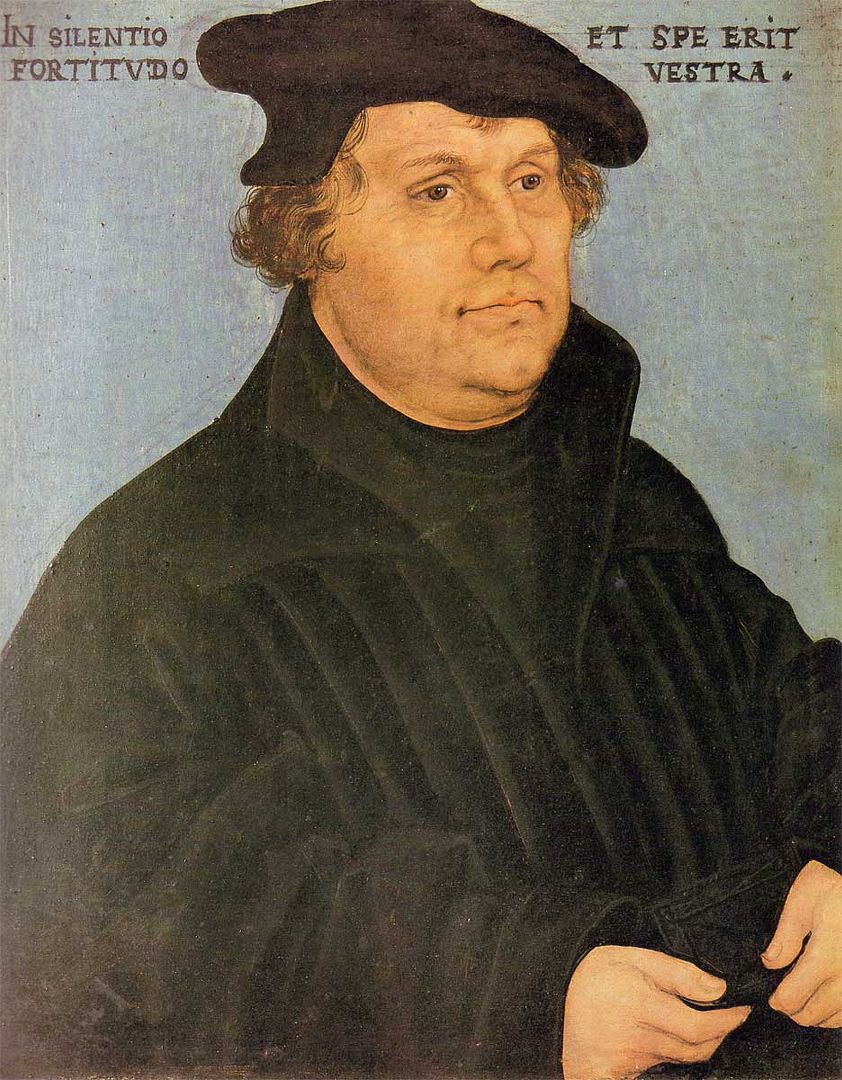
• The reformer Martin Luther got his theology from Galatians and from Romans, 1st Lutheran Glendale CAbut the psalms gave Luther his passion! Everyone knows the hymn he wrote based on Psalm 46; Pastor Eugene Peterson's version tells us the city streets are safe because God lives in the city; the city is safe because God bans war and breaks weapons. The city is a delight because God plants trees and flowers!

• We celebrate Pentecost and Reformation as major festivals of the presence of God in the Holy Spirit. But there is more! The priestly scribes who brought us the latest Pentateuch source [designated P] wrote late in the Babylonian exile or possibly after the exile, since dating is a bit confounded. They received a revelation that the destruction, the end of the Jerusalem Temple wasn't such a huge deal, after all. Imagine the crazy idea of a real God beyond space and time contained in a mini-replica of the earth and the heavens—that's what temples were! In Genesis 1 the priestly scribes show us all of the living structure of planet earth, the whole panorama of creation as God's dwelling place, the temple of the Divine. Genesis 1 also bring us the spoken Word that creates, orders, tames – redeems, renews, and reforms. And of course, we know Jesus Christ supremely as the Word of God.

• But there is still more! The Reformers – especially magisterial reformers John Calvin and Martin Luther – mostly concentrated on theology of God's grace-filled redemption of human creatures through the reconciling Christ Event. Halloween peopleHowever, John Calvin brings us a rich theology of creation revealing God's providence, of God's grace and providence revealed for all creation, not solely human creatures. Martin Luther brings us the insight of the Divine presence in, with, and under all creation. Beyond that, Luther affirms the ubiquity – the everywhere-ness – of the risen and ascended Jesus Christ. Can you say sacraments?

• The lectionary reading from Ephesians for All Saints reminds us baptism marks and seals us with the Holy Spirit. In the power and presence of the Holy Spirit, like all of planet earth, each of us is a dwelling place of God! Along with Reformation, All Saints is a festival of the Spirit; besides commemorating those in the Church triumphant, All Saints is a day for those of us still on planet earth, as well. How exciting to have the confluence of those major festivals this time of the year!

• And now? We need to trust, we can trust, the bounty of life in the Holy Spirit, the imagination of all creation, the reign of grace.

To God Alone Be glory; Amen!

Judicatory offices share the campus with First Lutheran Glendale Church and School.

Saturday, June 25, 2016

Three Word Wednesday: Joy in Freedom

Galatians 5:1
background photo from Kasia Górska; graphic design by me as suntreeriverdesign

Kristin Hill Taylor's Three Word Wednesday for this week features Joy in Freedom. I teach the mostly lectionary-based adult Sunday School class at my church, and the RCL has been reading Galatians sequentially—in fact, Galatians 5:1 of my header illustration opens the second reading for this coming Sunday, Pentecost 6 (Proper 8, Ordinary Time 13 for its other designations).

Joy in freedom is joy in the bounded freedom of obedience. The Ten Commandments of the Sinai Covenant offer us guidelines for every aspect of our lives in community and in the world. In Christ Jesus we know the fullness of freedom, yet Jesus came not to abolish the commandments – the law – but to fulfill it. To simplify, possibly? Not sure about that, but Jesus does assure us of unconditional forgiveness when we break a commandment and then repent, and that has to equal liberty!

Joy in Freedom! The EKD in Germany brings us a recent Foundational Text anticipating Reformation 500 in 2017: Justification and Freedom.

Tomorrow morning with my class I plan to reflect on some ideas related to freedom and joy.

For the past few weeks we've been doing a continuous reading of Galatians with its emphasis on the gospel of death and resurrection, its central theme of freedom. In Galatians the apostle Paul cautions about human-made laws such as sacrifice, ceremony, keeping kosher, and circumcision; last week in Galatians 3:23-29 Paul finally talks about law in the sense of the ten commandments of the Sinai covenant as he juxtaposes law and gospel. We mentioned the three uses of the law that theologians in the traditions of the Reformation sometimes opine about. In all of his letters, Paul makes a huge deal of our organic incorporation into Christ that happens in baptism, of our essential identity in Christ, who as our mediator between earth and heaven embodies the law and the prophets, who shows us the way to the Father, in whom we discover the freedom of obedience and the joy of grace.

The appointed Psalm 16 for Pentecost 6 connects especially well with Galatians. It centers on monotheism (acknowledgment and worship of only one God), and on the joy of obedience. Psalm 16:7 and 16:9 mention the human heart that in Hebrew biology mainly is the seat of the will rather than of the emotions as modern Westerners think of the heart. The human heart that wills to obey God, to love, nurture, and protect all creation, to seek the highest good for all.

Psalm 16:11 tells us God shows us the path of life, the way of obedience to the commandments, and the way of Christ that is death and resurrection. In God's presence we find "fullness of joy." In God's right hand (God's sovereignty) we discover "pleasures forevermore." Joyful pleasures abound when we live in the freedom we find in Jesus Christ

three word wednesday button

Friday, June 17, 2016

Five Minute Friday: Lose

Today's Five Minute Friday at Kate's place features the word lose.

Galatians 3:28-29

take five [minutes]

For the past few weeks in the Sunday morning adult class I facilitate we've been discussing the RCL readings from Galatians, the Apostle Paul's letter that's sometimes called "the epistle of Christian freedom." As I've explained to the class, Galatians was and still is Reformation Central; this coming Sunday for Pentecost 5 we'll talk about Galatians 3 that includes:

27As many of you as were baptized into Christ have clothed yourselves with Christ. 28There is no longer Jew or Greek, there is no longer slave or free, there is no longer male and female; for all of you are one in Christ Jesus. 29And if you belong to Christ, then you are Abraham's offspring, heirs according to the promise

Let's not lose the heritage of the Reformation that began with Martin Luther's acknowledging human enslavement to sin, our total inability to redeem ourselves; let's not lose sight of the sovereignty of grace that the Reformers proclaimed with joy! Let's not imagine losing our claim on our liberty in Christ. Please do not lose the freedom of life in the sufficiency of Christ! Let's not lose behaving as if our unity in Christ does not lead to homogenized sameness but means diverse gifts, perspectives, and personalities—because it does! Galatians was the first ethnic church—ethnic not in the typical Pauline dichotomy of Jews-Gentiles, but ethnic in terms of culture and geography

During this liturgically green season in the church's year of grace, we'll especially be talking about welcoming all comers – which the church I attend already does extremely well – and imagining the possibility of a church with no boundaries of interest, vocation, educational achievement, gender identity, economic sector, sexual orientation. Let's not lose the realization even if we can't become a community that formally includes persons from every sector of every stratum, we still don't need to lose the extravagant welcome we offer everyone.

five minute friday lose five minute friday button

Monday, February 18, 2013

The Message and the Kingdom

The Message and the Kingdom: How Jesus and Paul Ignited a Revolution and Transformed the Ancient World, by Richard A Horsley and Neil Asher Silberman on Amazon.

Some of us who inhabit the world of the church distinguish between "Jesus Christians" (frequently Roman Catholics, people in "just peace" churches, other activist Jesus emulators), who follow the Jesus of the synoptic gospels and the Didache, and "Pauline Christians" (usually stereotyped as Protestants in church bodies of continental European Reformation heritage), who love to theologize the Pauline and deutero-Pauline epistles.

Scholars Horsley and Silberman offer economic, political, social, cultural, and sometimes religious considerations of Jesus of Nazareth's influences in a turbulent Ancient Near East during his time on earth and after his death; they also bring an overview of Paul/Saul of Tarsus' varied influences on early Jesus-followers. They caution us popular assumptions and shorthands aren't always so!

It wasn't all about peasant revolts, rural poverty, urban exploitation, or even oppressive empire, but for most groups, following Jesus or The Way of Jesus began as a hopeful attempt to regain some control over an existence slammed by dehumanizing religious and/or imperial injustices. The authors describe the why and the where of texts and trajectories of Mark, Matthew, John, and Luke-Acts; they remind us St Paul was far from a "this is how it needs to be / one size fits every group" teacher and missionary. (We don't need another proof-text...) "Within seventy-five years of the crucifixion of Jesus in Jerusalem, the signs of the Kingdom were unmistakable wherever the assemblies of the saints gathered. The most important rituals of every Christian's life―baptism, Lord's Supper, and collections―seemed to gird the assemblies scattered through the eastern Mediterranean..." [page 224] Sacraments and works of mercy are central to today's church assemblies, also.

The Message and the Kingdom is solidly scholarly, yet reads like listening to an interesting lecture series that respects those with an academic bent, doesn't confuse or demean those without. I love the multicolored perspectives woven through the chapters! "Jesus Christians" tend to emphasize Jesus the teacher, healer, transformer of society, and prophet; "Pauline Christians" love to dig into theology, Christology, eschatology, sin, death, and redemption. This book works well for both groups, and though neither the ecclesiastical nor the spiritual dominates the book, Silberman and Horsley don't exclude them, either! End matter includes narrative bibliographical notes on each chapter, a big bibliography, and an index.

my amazon review: many perspectives on Jesus and Paul

Thursday, October 15, 2009

blog action day | climate change

blog action day 2009

Although I knew I had to blog about climate change on Blog Action Day, I'm well aware even people who are devoting their lives to the topic don't yet know enough and there are almost limitless resources online and in print. Instead of making an attempt to say something about a subject I know far too little about, I'm linking to a couple of my own blogs, to a pair of excellent sites about aspects of climate change that especially interest me and to a handful of the many relevant Bible passages and some quotes (all scriptures NRSV).

desert spirit's fire! is a theology blog and typically I assume readers have at least a smidgen of biblical knowledge and theological vocabulary. However, with more than 9,363 bloggers registered worldwide to participate [update: 31,000 blog posts, and a few people probably will blog later] in this special Blog Action Day for climate change, I'm trying to be a little more explicit than usual about some theological concepts. And here I'll comment the way some Christians and many assorted others have tended to concentrate on human creatures almost to the exclusion of the rest of God's creation has been infinitely sad and highly unbiblical.

Church and synagogue consider the biblical scriptures an ancient witness to the Presence of God in world and creation and to God's saving acts in history, yet despite its antiquity, the bible is very clear about the interwoven interrelatedness and interdependence of all creation and about God's call to humanity for responsible caretaking and stewardship of the earth. In the creation stories in the Hebrew bible book of Genesis, God's forms, "births" the proto human A-dam from the dust of the earth; in the New Testament scriptures, gospel-writer Luke concludes his genealogy with, "A-dam, son of God." Humanity created in the image of the Creator God, a reflection of Divinity shaped out of the dirt of the ground? Indeed, yes!

As lifestyle and worldview, although they acknowledge the essential integrity of spirit and body, the biblical religions are Spirit-filled yet earthbound, for the most part lived out amidst the world. In fact, Christianity's central proclamation is God's incarnation in the human Jesus of Nazareth, the Divine enfleshed in a finite human body entering history in a most conventional manner, "born of a woman, born under the law" [Galatians 4:4b], then marking days, seasons and years whilst requiring sustaining food and drink, protective shelter, and like all of creation – animal and plant – producing waste matter and ultimately returning to the ground of its origin. God in Christ Jesus needed a sustainable earth and environment in balance with itself and so does every single facet and molecule of creation.

In the New Testament book of Acts, probably authored by the same Dr. Luke as the gospel, as people were gathered in Jerusalem, at that time considered the center of the world, on the Day of Pentecost (a Jewish feast commemorating the Sinai Covenant, "The Law" or Ten Commandments), rushing wind and blazes of fire physically signified the Spirit of Life indwelling all creation with a new, more universal pervasiveness, yet in continuity with the Wind that breathed upon and ordered the chaos at creation's dawn.

Martin Luther, the magisterial Reformer (try "meta-Reformer") spoke of the ubiquity of the Risen and Ascended Jesus Christ. What is more, in the Church's sacraments God Self-reveals in creation's commonest stuff, in water, grain and grape, grown, nurtured, sprung and harvested from the heart of the earth.

From the UK, here's an excellent article on rainforests and climate change.

Almost daily we hear about the devastating effects of climate change on polar bears; you can follow World Wildlife Fund's Canon Polar Bear tracker.

The Holy One we know as God of Abraham, Isaac and Jacob, God of the Prophets, God and Father of Jesus the Christ has experienced the same need for clean water, plentiful produce, fresh air and stable climate as the rainforests and the polar bears.

On my blog for Earth Day 2006 I said a lot I could repeat here for Climate Change Day, including paraphrasing Walter Brueggemann, who says essentially, "Of course the trees clap their hands--no more clear-cutting! Why wouldn't the seas and everything in them roar? No more pollution!"

During early September 2008 for Musical Musings on RevGalBlogPals, I celebrated the relatively recent liturgical Season of Creation emphasis.

The Genesis 9 account of God covenanting not only with human creatures but with all creation describes how God disarms, hanging a bow high in the sky as a recurrent symbol of the covenant of grace and provision.

Genesis 9:8-10
Then God said to Noah and to his sons with him, "As for me, I am establishing my covenant with you and your descendants after you, and with every living creature that is with you, the birds, the domestic animals, and every animal of the earth with you, as many as came out of the ark."
Genesis 9:12-13
God said, "This is the sign of the covenant that I make between me and you and every living creature that is with you, for all future generations: I have set my bow in the clouds, and it shall be a sign of the covenant between me and the earth."
Job 12:7-10
But ask the animals, and they will teach you; the birds of the air, and they will tell you; ask the plants of the earth, and they will teach you; and the fish of the sea will declare to you. Who among all these does not know that the hand of the Lord has done this? In his hand is the life of every living thing and the breath of every human being.
check out Job 39

and Jeremiah 8

Psalm 104 as well...and concluding Blog Action Day 2009 with a hopeful reminder, a portion of Psalm 104:10-19
You make springs gush forth in the valleys; they flow between the hills,
giving drink to every wild animal; the wild asses quench their thirst.
By the streams the birds of the air have their habitation; they sing among the branches.
From your lofty abode you water the mountains; the earth is satisfied with the fruit of your work.
You cause the grass to grow for the cattle, and plants for people to use, to bring forth food from the earth,
and wine to gladden the human heart, oil to make the face shine, and bread to strengthen the human heart.
The trees of the Lord are watered abundantly, the cedars of Lebanon that he planted.
In them the birds build their nests; the stork has its home in the fir trees.
The high mountains are for the wild goats; the rocks are a refuge for the coneys.
You have made the moon to mark the seasons; the sun knows its time for setting.

Thursday, August 27, 2009

summer conversation 4

4. A Eucharistic community: the Welcome Table

John 1:1, 3 In the beginning was the Word, and the Word was with God, and the Word was God. All things came into being through him, and without him not one thing came into being.

John 12:24 …unless a grain of wheat falls into the earth and dies, it remains just a single grain; but if it dies, it bears much fruit.

1 Corinthians 11:23-24 …our Lord Jesus on the night when he was betrayed took a loaf of bread, and when he had given thanks, he broke it and said, "This is my body that is for you. Do this in remembrance of me."

And what about "this is my body"?
And "this cup is the new covenant in my blood"?
The bread points to nourishment in that same self-giving of God
At work in my body, that is in me.
And the cup points to the new community drawn together and nourished
In my blood, that is in God's total self-giving in my death.

–Paul L. Hammer–

You choose to be made at one with the earth;
the dark of the grave prepares for your birth.
Your death is your rising, creative your word;
the tree springs to life and our hope is restored…

–Fred Kaan–


In Saxon English, the Lord provided the loaf, the bread, the essentials for sustaining life. We are baptized into the biography of the baby born in Bethlehem, House of Bread. In the Eucharist, we celebrate the ultimate earth day, a feast of justice and reconciliation for all creation, that brings together the ground's fruitful yield along with the labor of farmers, vintners, truckers, grocers, bakers, sellers, weavers and potters, carpenters and contractors.
Revelation 21:1-2a Then I saw a new heaven and a new earth…and I saw the holy city, the new Jerusalem.
Who is this Lord of the Church, this Jesus?

Consider Jesus' lifestyle of justice and inclusion along with Jesus' command "do this!"


Backtracking:

1. A baptized community: Water and the Word
Galatians 3:28 There is no longer Jew or Greek, there is no longer slave or free, there is no longer male and female; for all of you are one in Christ Jesus…
Who is this Lord of the Church, this Jesus?
Consider Jesus' relationship to creation, Jesus' stewardship of all life.


2. Spaces, places, locations…

First, Second, and Third spaces, (Fourth?) places in cyberspace; the liminal, the marginal, and the central; thresholds, edges. and centers; insiders, outsiders, strangers and friends
Romans 13:8 Owe no one anything else except to love one another…
Who is this Lord of the Church, this Jesus?

Consider Jesus' sense of home and geography.


3. Jesus, us, culture, counter culture
Colossians 2:15 Having made hash of the rulers, the powers and the principalities and having been victorious over them, Christ then made a public spectacle of them!
Who is this Lord of the Church, this Jesus?

Consider Jesus' awareness of his own culture and the customs of others.

© Leah Chang

Thursday, August 06, 2009

summer conversation 1

1. A baptized community: Water and the Word

Consciously connecting ourselves with all creation, recognizing and celebrating our interdependence. Recognizing the countless ways in which time and space are essential conditions in which all creation lives.
Genesis 1:1-2 In the beginning when God created the heavens and the earth, the earth was a formless void and darkness covered the face of the deep, while a wind from God swept over the face of the waters.
Water is the primordial substance of being, the womb of all creation, the fundamental stuff of our rebirth and continued aliveness. Water is the physical substance of our baptism.

Baptized into the Christ Event of God's supreme self-revelation in measurable, definable space and time, we become prophet, priests and sovereigns, in stewardship of creation and of all life. Baptism engulfs us in God's creative power of death and resurrection, identifying us with this planet's history and with Jesus Christ.

Consider our relationship to the elements of air, earth and fire…
Galatians 3:28 There is no longer Jew or Greek, there is no longer slave or free, there is no longer male and female; for all of you are one in Christ Jesus…
The waters of baptism form a border and boundary between our old, disconnected, alienated existence and our new life in the community that is the Body of the Crucified and Risen Christ.

We are the body, the corpus, of Christ! Corporate Identity [package]: our logo, our résumé, our curriculum vitae, where we've been, what we've learned, what we live for and die for…who are we? Baptism transforms us from lone, solitary individuals into a position of particularity within the gathered body of Christ. Each of us brings a special history along with unique gifts and perspectives for contribution and service within church and world.

Who is this Lord of the Church, this Jesus? Consider Jesus' relationship to creation, Jesus' stewardship of all life.

Next week:

2. Spaces, places, locations…


Where is home for you? Geographical origins, a more recent physical place or town, an emotional place, treasured people and activities of belonging? How do your experiences in various locations contribute to your understanding of yourselves, of others, of the world? 1st, 2nd, and 3rd spaces, (4th?) places in cyberspace; the liminal, the marginal and the central; thresholds, edges and centers. Insiders, outsiders, strangers and friends. …in Jerusalem, in all Judea and Samaria, and to the ends of the earth!

© leahchang

Thursday, April 03, 2008

Time of the Spirit - Season of the Church

Adult Study Proposal | Early Summer 2008

In a special emphasis on the Pentecostal reign of the Spirit, in 3 class sessions we'll investigate selected texts from Galatians; Acts, Ephesians and Colossians, particularly in terms of our identity as a people uniquely constituted by Jesus' death and resurrection. We'll explore concepts of gracism and inclusion and consider a Christus Victor atonement model of Jesus' triumph over the pretense, dehumanization and violence of Roman imperial rule.

The congregation at Galatia was the first ethnic church; we need to become more aware of our own conscious and unconscious cultural and other attachments that lead to our living and proclaiming either more than our less than the gospel. As Martin Luther insists, worship and hymn-singing in the vernacular is a mark of the true Church; we also need to contextualize, cast into local vernacular (but there's not just one!) our outreach to our neighbors. How can we fully bring others into our congregation's life of worship, witness and service and also graciously receive their gifts of hospitality when they invite us closer to the centers of their worlds?

In his books Multicultural Ministry: finding your church's unique rhythm and Gracism: The Art of Inclusion, David A. Anderson, pastor of Bridgeway Community Church in Baltimore writes about Gracism, a word comprised of "racism" preceded by the letter "g" for God. "Gracism" encourages people to extend favor to others based on their unique class, culture, ability, color or other distinctions, and to make that preference visible and apparent. How can we become gracists with each other and with newcomers?

The synoptic gospels, the undisputed epistles of Paul and deutero-Paul ring with language of Roman imperialism and domination. What deathly economic, political and cultural forces control and determine our contemporary situation? Can we live and proclaim a Christianity as explicitly anti-imperial as that of the early churches, when to be ekklesia still was primarily political rather than religious or theological? What Word of Life does the cross of Calvary and the empty tomb of Easter dawn speak and enact here in this corner of Paradise in 2008? As we live in Christ, does our theology become our biography to a sufficient degree to liberate and redeem our neighbors from their false allegiances? Can we grasp the stories of Jesus' birth, life, death, resurrection and ascension in ways that challenge our understanding of society and our fundamental loyalties?

Monday, February 11, 2008

Lent 1: Matthew 4:1-11

1Then Jesus was led up by the Spirit into the wilderness to be tempted by the devil. 2He fasted forty days and forty nights, and afterwards he was famished. 3The tempter came and said to him, “If you are the Son of God, command these stones to become loaves of bread.” 4But he answered, “It is written, ‘One does not live by bread alone, but by every word that comes from the mouth of God.’” 5Then the devil took him to the holy city and placed him on the pinnacle of the temple, 6saying to him, “If you are the Son of God, throw yourself down; for it is written, ‘He will command his angels concerning you,’ and ‘On their hands they will bear you up, so that you will not dash your foot against a stone.’” 7Jesus said to him, “Again it is written, ‘Do not put the Lord your God to the test.’” 8Again, the devil took him to a very high mountain and showed him all the kingdoms of the world and their splendor; 9and he said to him, “All these I will give you, if you will fall down and worship me.” 10Jesus said to him, “Away with you, Satan! for it is written, ‘Worship the Lord your God, and serve only him.’” 11Then the devil left him, and suddenly angels came and waited on him. NRSV
In this classic gospel pericope for Lent 1, the devil first tempts Spirited into the wilderness Jesus to be oh, so relevant by turning unconsumable stones into useful bread...but not only is Jesus himself bread, he is far more than basic survival food, Jesus is The Stuff of ultimate revival, a.k.a. Living Bread, nutritious grain that won't rot or mold or decay! Challenging Jesus to be ultra-spectacular by jumping off the iconic Jerusalem Temple? But we know Jesus is the temple; in fact Jesus is more than the temple. Would the Son of Heaven yield to promises of power so extensive and extreme as possession of all the empires of the world? But in Christ Jesus all the world possesses the cross of Calvary, power of life over the death-dealing, life-negating pretenses of too many earthly governments and *other* assorted administrations. Jesus provides and Jesus is Eternal Supply; Jesus is Lord over and against the insufficiency of temple sacrifice, the pretense, dehumanization and violence of Roman imperial rule. Food, worship, lordship. How do we, why do we trust decayables and consumables and symbols of our own cultural realities rather than the Word of Life and the Spirit of Life?

Leading up to the day of Pentecost I hope to be teaching a 4-class series on Galatians; in tandem with Paul's text we'll explore our own and maybe even imagine our neighbors' conscious and apparent ethnicities, assorted "people hoods" and typical expressions of those traits and persuasions and try to discern why and what forms of worship (teaching, fellowship, outreach, etc.) appeal to us and discern ways to honor Galatians 3:28 without becoming an undifferentiated blob. Where was Galatia? Galatia had shifting boundaries; Galatia was the first ethnic church! A Roman province, Galatia was largely an immigrant community that hadn't originally been Jewish before becoming Christian; Gaul denotes Gaelic or Welsh or Celtic ethnicity, peoplehood. In Galatia practices that were more than and less than the gospel were transpiring: where are we? do we happen to live in Galatia? In 1 Corinthians 15 Paul reminds us:
Now I would remind you, brothers and sisters, of the good news that I proclaimed to you, which you in turn received, in which also you stand, through which also you are being saved, if you hold firmly to the message that I proclaimed to you—unless you have come to believe in vain. For I handed on to you as of first importance what I in turn had received: that Christ died for our sins in accordance with the scriptures, and that he was buried, and that he was raised on the third day in accordance with the scriptures...
Quintessentially Paul, the gospel is death and resurrection, and throughout the letter to the church at Galatia Paul writes about the freedom and bondage of the gospel...bound by faith to the cross and the empty grave, chained to liberty in Christ with freedom to be and freedom for service.

As the Spirit of Life drives us into and leads us through our post-baptismal desert and seductively suggests we meet people's demands for appropriately relevant programing, to become the blingiest, dazzlingest building on this mesa or *even* in the tri-mesa area and to aspire to mega-amounts of income (you know about the measurable values of financial articulation) and overflowing church sanctuaries...will we be ready to respond with words of scripture, Words of Life, and more than anything, will we be a Living Word on our neighbors' lives, a reality that demonstrates the death of death and the victory of life? Will we live as the presence of the crucified and risen Christ?? In the power of the Spirit of Life, I trust we will—God being our help!

Saturday, January 05, 2008

church prayer rug 2008

My response to this household's 2nd reception of a C(hurch) P(rayer) R(ug), which providentially occurred during Lent 2005 explained a lot of particulars of the CPR's theology of glory:
In my mailbox this week I found what may become an Lenten annual: another blatant example of idolatry, another human attempt to create a god in its image, another slot-machine divinity of jumbo payoffs, a deity completely congruent with one of contemporary American society's most brazenly unsubtle gods—consumerism. From a skinny envelope I unpacked purportedly a face of Jesus, sketchily represented crowned with a thorny tiara; four-color printing is the graphics industry standard, but this is a two-color likeness! In addition, nowhere in the mailing could I find either a web address nor an email address—in this year 2005?!?!?!
During Lent 2006 I received another CPR, but that year's blog was more tempered, less sarcastic, more formally theological and conceptually broader: Remembering and Belonging; to quote briefly from that post:
The Tithe: who owns us? To what Lord do we answer? Of whose property and assets are we stewards? It's about caring for the gifts we have, about sharing and using them in service to others--Church Prayer Rug and its ethos notwithstanding, the way of the prophets and the way of Jesus of Nazareth is not exactly about petitioning heaven and getting a windfall in investment capital, real estate or social position! Yahweh of Shalom sufficiency is the God of Jubilee Justice, Lord of commonwealth, not a deity of superfluous particular wealth. Jesus' God is the One who gifts with extravagant mercy and boundless love and whose Spirit draws us together in Pentecostal fire. Now really, does that sound like the tawdry emptiness of the Church Prayer Rug god's casino-style payoffs?
Last year, in 2007, I didn't take time to reflect on the CPR, but the opened envelope still is in the diminishing stack of papers, etc. atop the rosewood table in the living room because I thought I might need something to blog about, never imagining so very early this year I'd receive my very own Church Prayer Rug right in time for Epiphany! A giant plus: this letter clearly was meant especially for me, since the street address read:
Resident - to a Friend, #### Xxxx St Paradise XX #####-####
Now I have new information and revelations! Besides the same pair of pieces as in the previous mailings, this year they included two more: a letter headed Sunday, January 2008 and in ALL CAPS, "PROPHETIC WORD GIVEN FOR YOUR SPIRITUAL EDIFICATION." And hear this message:
A SIGN FROM THE LORD ABOUT YOUR FUTURE

IMPORTANT - Only break open this sealed prophecy after you have put this Church Prayer Rug and your prayer requests back in the mail [by the way, on the section that features a full-color likeness of Jesus ascending on a cloud, it tells me I need to return the prayer rug and prayer page "before sunset tomorrow or the next day to this 57-year-old church ministry"].

If for any reason you are not going to return this Church Prayer Rug, then this sacred prophecy must be destroyed, unopened and unread,
[but I've already opened and read it and have no intentions whatsoever of destroying this valuable cultural and ecclesiastical(?) artifact] because this is a sacred, spiritual prophecy, sealed word, concerning you and your future. Remember, the Bible says,

"Let your requests be made known unto God." Philippians 4:6
However, the two websites (finally!) were the true revelation, because they helped me discover this St. Matthew's entity is sort of what we in the mainline would consider a denomination (denominated "St. Matthews") or a church body (there sure are lots of member branches (hundreds), and the about PrayerRequests site informed me, "You who attend one of Saint Matthew’s Churches know who we are, from our church’s free literature that you receive from us." I guess that's not me, or maybe it is, since this is the 5th time I've been a recipient of their free lit! I'll describe St. Matthew's as a church chain or chain of churches, possibly patterned after a retail chain store model, but the folks of St. Matt's expect a pay-off rather than to be paying-in according to a standard, conventional consumer model.

From the "About" site you can:

Open the Door to a New Tomorrow;

About St. Matthew's Churches;

read a lot about it, get phone numbers and general info;

After all, for a fact, Old time Bible prayer really does change things;

and a resource for Daily Prayer.

This Bible ministry of prayer was established in 1951. ©

Most of the website pages are images I assume are copyrighted, so I'm not displaying any of them here, but you can follow the links and check them out for yourself.

To continue, I'll include a few prayer request suggestions from on the mail-back-to Prayer Box 21210, Tulsa, OK 74121 page, all of them solid: do you need, do I need St. Matthews' to Pray for my family and me for...My Soul; A Closer Walk With Jesus; Confusion In My Home; My Children; A New Car...[to reliably get to work, appointments and church]? ooops! I was supposed to read my "faith, Holy Ghost instructions on the enclosed, sealed prophecy, only after [mailing] this Prayer Rug back to the church." Then maybe it won't work for me, after all. In addition, I was supposed to "Use this unusual, important, Church Prayer Rug for tonight only."

To conclude on this Eve of Epiphany, this year I'm again tempering and softening my words about the CPR...

Most of the protestant mainline and to a lesser extent some of the churches and church bodies that are further from the center and closer to the edge and that historically have been on the edge (at this moment I'm thinking of Mennonite and Brethren Churches, as well as of the Moravian Church that has been one of the ELCA's full communion partners for the past few years) have been considering the nature and mission of the church, especially in terms of the how to be missional and incarnational, since our corporate "we" has read out of scripture missional and incarnational as the way (probably) to be authentic and effective (yes)! followers of the Way of the Crucified and Risen One. A few days ago in my layout for 2008 on this far by faith, I described how I'd be
developing a 3- or 4-class series for both of *my* congregations, basically based on Reform Jewish scholar Mark D. Nanos' The Irony of Galatians: Paul's Letter in First-Century Context. ... Galatians was the first ethnic church, and in both [congregations] we need to acknowledge our own, sometimes unconscious ethnicities and learn realistically to contextualize our outreach and proclamation authentically yet inoffensively within our neighbor's identities...imagining surprising ways to contextualize its witness and proclamation to nearby neighbors.
On this Epiphany Eve I'll acknowledge St. Matthews' entities are right-on about our needing to pray, about God's faithful, abundant response to prayer, and about our need for basics like "enough", shalom-full food and housing, good relationships and decently-built vehicles that don't break down in the process of getting us where we need to go. In his Small Catechism, Martin Luther explains:
What is meant by daily bread?

"Everything required to satisfy our bodily needs, such as food and clothing, house and home, fields and flocks, money and property; a pious spouse and good children, trustworthy servants, godly and faithful rulers, good government; seasonable weather, peace and health, order and honor; true friends, faithful neighbors, and the like."

Regarding the CPR, for this year once again I'm asking "where is the cross?" in all this printed material, though I'll admit they (sort of implicitly) acknowledge Jesus' sovereignty by including an ascension pic. But from my own, basically mainliner side, as I jump into researching demographics and funding sources while doing some numbers-crunching and anticipating preparing more teaching and worship materials I hope and trust will bless and enrich others' lives, I know all too often my prayers in preparation for my own work and ministry too frequently are perfunctory to the point of "Of course I need to get God in on this endeavor" and I still trust myself and my own efforts far too much. IOW, I'm almost reluctant to raise my own needs, desires, heart and efforts to heaven. Then has the CPR taught me something, have I learned and grown from this series of mailings, despite it all? I hope so!

from the High Weirdness Project!

Friday, March 23, 2007

Theology of the Cross 5

Theology of the Cross 5 | Lent 5 | 25 March 2007

Theology of the Cross:
what does this mean for the Church’s and especially for this congregation’s life and mission?

A Tree on Your Back

1. We meet you, O Christ, in many a guise,
your image we see in simple and wise.
You live in a palace, exist in a shack;
we see you the gardener, a tree on your back.

2. In millions alive, away and abroad;
involved in our life, you live down the road.
Imprisoned in systems, you long to be free;
we see you, Lord Jesus, still bearing your tree.

3. We hear you, O man, in agony cry;
for freedom you march, in riots you die.
Your face in the papers we read and we see.
The tree must be planted by human decree.

4. You choose to be made at one with the earth;
the dark of the grave prepares for your birth.
Your death is your rising, creative your word;
the tree springs to life and our hope is restored..

–Fred Kaan, 1966

The cross of Calvary forms the ultimate type and reality of God’s characteristically hidden and paradoxical, sacramental presence in the commonest things, situations and people. Interpreting scripture, sacraments, everything in our lives and in the world with "What preaches Christ."
  • Last week we talked some about God’s action and presence in the sacraments – considered a “means of grace” in this tradition – and began imagining ways we can be a means of grace in the world around us.

  • It’s impossible to separate out today’s discussion topics, so I’ve suggested some texts and ideas to get us started.

A Theology of Baptism

Galatians 3:26-29; Titus 3:5-8; 1 Corinthians 12:12-13; Romans 6:1-14; Ephesians 4:4-6; Mark 1:4-11; Matthew 3:11-17; Luke 3:15-22

Theologian Jürgen Moltmann describes baptism as “sign, witness, representation and illumination of the Christ Event”; we can claim the same about the Eucharist. We know Jesus Christ as sovereign, prophet and priest; alive in Christ, we participate in that royal, prophetic priesthood. Especially in regard to those roles, how can our lives signify, witness to, represent and illuminate the birth, life, death, resurrection and ascension of Jesus Christ?

Contextualizing Baptism

We are baptized for events like 9/11; we are baptized to be the Christ alongside our friends, relatives and neighbors; we are baptized to not be an exclusive community, but to risk reaching out to image and model Jesus Christ to the world – including those who are culturally, ethnically, chronologically, occupationally, educationally different from us; to recognize Jesus Christ in others and to be the presence of the crucified and risen Jesus Christ in their lives.

A Theology of the Eucharist

1 Corinthians 10:16-17; 1 Corinthians 11:23-26; Mark 14:22-25; Matthew 26:26-29; Luke 22:14-20; Luke 24:30-31; John 6:33; John 6:51; John 6:56

Jesus said, “Do this!” Do this liturgical action?

Contextualizing Eucharist

Jesus says, “I am the Bread of Life; I am the Vine!” In every culture, grain products form a substantial nutritional base; the grain may be rice, wheat, corn, wheat, barley...the fruit of the vine is a potent and pervasive biblical symbol, and beyond there and then, lately we’ve been learning a lot about grape’s benefits! In the power of the Holy Spirit, God calls the church—
  • As the body of the risen Christ, the Bread of Life, to nourish the world, especially the stranger, the outcast and the ‘other’

  • Like the Eucharist, to reveal Jesus’ crucified body in its redeeming brokenness

  • To reveal Christ’s risen body in its liberating wholeness

  • As branches of Jesus, the Vine, to pour out our lives to those around us

9. What does the cross mean for each of us as individuals?

Galatians 3:1-5; 2 Corinthians 5:16-21; Ephesians 1:17-23; Matthew 28:16-20; Luke 24: 44-49; Acts 1:6-8; 2 Timothy 2:8-13; 1 Peter 2:9-10

10. What does the cross mean for this church community?

From Water Buffalo Theology: Suffering because we’re involved with others, involved with the other; participating in the “glory of the crucified Lord”. My note: the same Paul of Tarsus also talks about “the glory of the children of God!” And isn’t our glory as God’s offspring also a crucified glory and a risen glory?

11. What does all of this mean for our nearby neighbors?

When I was on staff at the church in City of History, I wrote their Mission Statement:
We are the people of God, forgiven and set free by the death and resurrection of Jesus Christ; by the power of the Holy Spirit we are called together and sent into the world as witnesses to his resurrection. God calls us, a servant people, to proclaim in word and action the presence of the risen Lord to all those whom our lives touch, especially in this community.
The author of Water Buffalo Theology talks about “neighborology”—the word about the neighbor! The Bible and Jesus Christ reveal God’s attachment to the world of creation to the point of learning and knowing us so completely as to walk in our sandals (Tevas, or flip-flops or boots or snow boots...) and to die a physical death, just as all of us inevitably will. Especially in the shadow of the cross, how can we practice neighborology?

© Leah Chang 2007

Tuesday, November 08, 2005

The Joint Declaration on the Doctrine of Justification

joint declaration on the doctrine of justification by faith
Close to a year ago, in December 2004, I began this post and planned to write more (which I've done, but as notes for discussion rather than formal presentation); now 10-months-and-counting later, my intended ideas remain in an outline and I've been thinking and writing about other things, but the Joint Declaration is so important and I am so into being an ecumenist, I needed to post something about it here. Here's the gist of my original post:

Next month—January 2005—at Faith, Order and Witness, again we'll discuss the Joint Declaration; I had made a few notes about some points in the text of the Joint Declaration and about the Annex, and at some point I'd wanted to compile them into at least somewhat coherent form so they could go on this site and possibly I could distribute them...

...at that long-past January meeting, but I got so involved with my usual endeavors of reading theology and writing theology my ideas never made it further than our live discussion at the meeting. Nonetheless, I've included parts of the text we discussed, and here's an overview, resources, and links to the complete document in four languages: The Joint Declaration on the Doctrine of Justification from the World Communion of Reformed Churches.


Preamble

1. The doctrine of justification was of central importance for the Lutheran Reformation of the sixteenth century. It was held to be the "first and chief article"1 [footnote 1 The Smalcald Articles, II,1; Book of Concord, 292.] and at the same time the "ruler and judge over all other Christian doctrines."2 [footnote: 2 "Rector et judex super omnia genera doctrinarum," Weimar Edition of Luther's Works (WA), 39, I, 205.] The doctrine of justification was particularly asserted and defended in its Reformation shape and special valuation over against the Roman Catholic Church and theology of that time, which in turn asserted and defended a doctrine of justification of a different character. From the Reformation perspective, justification was the crux of all the disputes. ...

2. For the Lutheran tradition, the doctrine of justification has retained its special status. Consequently it has also from the beginning occupied an important place in the official Lutheran-Roman Catholic dialogue.

5. The present Joint Declaration has this intention: namely, to show that on the basis of their dialogue the subscribing Lutheran churches and the Roman Catholic Church9 [footnote: 9 The word, "church" is used in this Declaration to reflect the self-understandings of the participating churches, without intending to resolve all the ecclesiological issues related to this term.] are now able to articulate a common understanding of our justification by God's grace through faith in Christ. It does not cover all that either church teaches about justification; it does encompass a consensus on basic truths of the doctrine of justification and shows that the remaining differences in its explication are no longer the occasion for doctrinal condemnations.

1. Biblical Message of Justification

9. In the New Testament diverse treatments of "righteousness" and "justification" are found in the writings of Matthew (5:10; 6:33; 21:32), John (16:8-11), Hebrews (5:3; 10:37f), and James (2:14-26).10 In Paul's letters also, the gift of salvation is described in various ways, among others: "for freedom Christ has set us free" (Gal 5:1-13; cf. Rom 6:7), "reconciled to God" (2 Cor 5:18-21; cf. Rom 5:11), "peace with God" (Rom 5:1), "new creation" (2 Cor 5:17), "alive to God in Christ Jesus" (Rom 6:11,23), or "sanctified in Christ Jesus" (cf. 1 Cor 1:2; 1:30; 2 Cor 1:1). Chief among these is the "justification" of sinful human beings by God's grace through faith (Rom 3:23-25), which came into particular prominence in the Reformation period.

11. Justification is the forgiveness of sins (cf. Rom 3:23-25; Acts 13:39; Lk 18:14), liberation from the dominating power of sin and death (Rom 5:12-21) and from the curse of the law (Gal 3:10-14). It is acceptance into communion with God: already now, but then fully in God's coming kingdom (Rom 5:1f). It unites with Christ and with his death and resurrection (Rom 6:5). It occurs in the reception of the Holy Spirit in baptism and incorporation into the one body (Rom 8:1f, 9f; I Cor 12:12f). All this is from God alone, for Christ's sake, by grace, through faith in "the gospel of God's Son" (Rom 1:1-3).

13. Opposing interpretations and applications of the biblical message of justification were in the sixteenth century a principal cause of the division of the Western church and led as well to doctrinal condemnations. A common understanding of justification is therefore fundamental and indispensable to overcoming that division. ...

3. The Common Understanding of Justification

14. The Lutheran churches and the Roman Catholic Church have together listened to the good news proclaimed in Holy Scripture. This common listening, together with the theological conversations of recent years, has led to a shared understanding of justification. ...

15. In faith we together hold the conviction that justification is the work of the triune God. The Father sent his Son into the world to save sinners. The foundation and presupposition of justification is the incarnation, death, and resurrection of Christ. Justification thus means that Christ himself is our righteousness, in which we share through the Holy Spirit in accord with the will of the Father. Together we confess: By grace alone, in faith in Christ's saving work and not because of any merit on our part, we are accepted by God and receive the Holy Spirit, who renews our hearts while equipping and calling us to good works.11

18. Therefore the doctrine of justification, which takes up this message and explicates it, is more than just one part of Christian doctrine. It stands in an essential relation to all truths of faith, which are to be seen as internally related to each other. It is an indispensable criterion which constantly serves to orient all the teaching and practice of our churches to Christ. When Lutherans emphasize the unique significance of this criterion, they do not deny the interrelation and significance of all truths of faith.

4.5 Law and Gospel

31. We confess together that persons are justified by faith in the gospel "apart from works prescribed by the law" (Rom 3:28). Christ has fulfilled the law and by his death and resurrection has overcome it as a way to salvation. We also confess that God's commandments retain their validity for the justified and that Christ has by his teaching and example expressed God's will which is a standard for the conduct of the justified also.

32. Lutherans state that the distinction and right ordering of law and gospel is essential for the understanding of justification. In its theological use, the law is demand and accusation. Throughout their lives, all persons, Christians also, in that they are sinners, stand under this accusation which uncovers their sin so that, in faith in the gospel, they will turn unreservedly to the mercy of God in Christ, which alone justifies them.

4.6 Assurance of Salvation

34. We confess together that the faithful can rely on the mercy and promises of God. In spite of their own weakness and the manifold threats to their faith, on the strength of Christ's death and resurrection they can build on the effective promise of God's grace in Word and Sacrament and so be sure of this grace.

35. This was emphasized in a particular way by the Reformers: in the midst of temptation, believers should not look to themselves but look solely to Christ and trust only him. In trust in God's promise they are assured of their salvation, but are never secure looking at themselves.

36. Catholics can share the concern of the Reformers to ground faith in the objective reality of Christ's promise, to look away from one's own experience, and to trust in Christ's forgiving word alone (cf. Mt 16:19; 18:18). With the Second Vatican Council, Catholics state: to have faith is to entrust oneself totally to God19, who liberates us from the darkness of sin and death and awakens us to eternal life20. ...

4.7 The Good Works of the Justified

38. According to Catholic understanding, good works, made possible by grace and the working of the Holy Spirit, contribute to growth in grace, so that the righteousness that comes from God is preserved and communion with Christ is deepened. When Catholics affirm the "meritorious" character of good works, they wish to say that, according to the biblical witness, a reward in heaven is promised to these works. Their intention is to emphasize the responsibility of persons for their actions, not to contest the character of those works as gifts, or far less to deny that justification always remains the unmerited gift of grace.

39. The concept of a preservation of grace and a growth in grace and faith is also held by Lutherans. They do emphasize that righteousness as acceptance by God and sharing in the righteousness of Christ is always complete. ...


From The Joint Declaration on the Doctrine of Justification Annex

... 2. Together we confess: "By grace alone, in faith in Christ's saving work and not because of any merit on our part, we are accepted by God and receive the Holy Spirit, who renews our hearts while equipping and calling us to good works"(JD 15). ...

D. Grace as fellowship of the justified with God in faith, hope and love is always received from the salvific and creative work of God (cf. JD 27). But it is nevertheless the responsibility of the justified not to waste this grace but to live in it. The exhortation to do good works is the exhortation to practice the faith (cf. BSLK 197,45). "The good works of the justified should be done in order to confirm their call, that is, lest they fall from their call by sinning again" (Apol. XX,13, BSLK 316,18-24; with reference to 2 Pet. 1:10. Cf. also FC SD IV,33; BSLK 948,9-23). In this sense Lutherans and Catholics can understand together what is said about "the preservation of grace" in JD 38 and 39. Certainly, whatever in the justified precedes or follows the free gift of faith is neither the basis of justification nor merits it" (JD 25).

E. By justification we are unconditionally brought into communion with God. This includes the promise of eternal life; "If we have been united with him in a death like his, we will certainly be united with him in a resurrection like his" (Rom 6:5, cf. Jn 3:36, Rom 8:17). In the final judgment, the justified will be judged also on their works (cf. Mt 16:27; 25:31-46; Rom 2:16; 14:12; 1 Cor 3:8; 2 Cor 5:10 etc.). We face a judgment in which God's gracious sentence will approve anything in our life and action that corresponds to his will. ...Any reward is a reward of grace, on which we have no claim.

3. The doctrine of justification is measure or touchstone for the Christian faith. No teaching may contradict this criterion. In this sense, the doctrine of justification "...is an indispensable criterion which constantly serves to orient all the teaching and practice of our churches to Christ." (JD l8)

Saturday, July 23, 2005

Deliverance, Homecoming, Shame and Grace

Another topic big enough for a book, but here's a beginning! To introduce this article, I'll quote parts of a pair of posts from early 2003; you can read my whole entire February 2003 here.
Tuesday, February 11, 2003

Synagogue and Basilica are meeting places—Church is People

...Liberation theology categories bring us back to God's self revelation in scripture and in the Christ Event. Mary's Magnificat is a central liberation theology concept and text:

"He has pulled down princes from their thrones and exalted the lowly, the hungry he has filled with good things, the rich sent empty away." –Luke 1:52-53

These words are grounded! Aren't those happenings demonstrated by Jesus' life and kerygma, Jesus' proclamation? I also like the liberation theology theme of the obliteration of shame: middle-class mainline U.S. Christianity often emphasizes annihilation of individual sin and guilt ...as devastating and as paralyzing as sin and guilt can be, shame is a far more cosmic category, visited upon individuals, cultures and societies by forces outside of themselves, forces over which they have no control—Paul's apocalyptic "powers and principalities." ...although the historical roots of deutero-Paul's exposition of and concern with the powers and principalities was somewhat "other than" what I've been writing about.

To paraphrase Johan Christiaan Beker in Paul's Apocalyptic Gospel: The Coming Triumph of God, the Church is the sign of the dawn of the new age and of the powers of life over and against the powers of death, and God calls the Church to active engagement with the world in order to fulfill its redemptive mission in the world. As I'd express it, God calls the Church, the Body of the Risen Christ, to be an instrument of grace to the world.

As an aside, although Paul may have been calling "on the Name of the Lord" on the fabled Damascus Road, I'm not completely convinced, since often grace and salvation break unbidden into life...into this world.

this relates, as well (also from February 2003):

Monday, February 17, 2003

Power and Sovereignty

Martin LutherAs Christians our ultimate model of power is our God of glory, majesty and sovereignty willingly abrogating that power and becoming "small for us in Christ"—as Martin Luther expressed it: small enough to die. For us! From Christmas and the vulnerability of the manger we go to Good Friday and the vulnerability and absolute defenselessness of the cross. As Christians we confess we find the height of God's sovereignty in the vulnerability and weakness – in the hiddenness – of a human dying on the scandal of a tree.

We discover and recognize the fullness of the Shekinah Glory—the glory of the presence of God—in the weakness of Jesus, "The Human One," who dies without defense. And that powerlessness proved enough to annihilate the powers and principalities; it was sufficient to effect the death of the old order of death itself; Jesus' dying on the tree of death that paradoxically becomes the Tree of Life.

Our Good Friday/East Sunday proclamation is the end of the supremacy of death and the birth, the ascendancy of the primacy of life—the eschatological reign of the Power of God, most eloquently uncovered and found in the Lordship of Jesus of Nazareth, the crucified and risen One both Human and Divine, who shared our common lot and in whose birth, life, death, resurrection and ascension we know and affirm the definitive manifestation of the God beyond time and beyond space. ...

Now to today's topic: deliverance, homecoming, shame and grace.

Vis-à-vis Good Friday's cross and the empty grave of Easter Sunday's dawn, Christianity has developed an intricate theology of deliverance from slavery, redemption from bondage and homecoming from exile, but for Jews, shame was the cultural piece about the cross! However, when you assess any of those dimensions of salvation and wholeness, they're actually all about freedom.
Deuteronomy 21
22 If a man has committed a sin deserving of death, and he is put to death, and you hang him on a tree, 23 his body shall not remain overnight on the tree, but you shall surely bury him that day, so that you do not defile the land which the LORD your God is giving you as an inheritance; for he who is hanged is accursed of God.

Galatians 3
13 Christ has redeemed us from the curse of the law, having become a curse for us (for it is written, "Cursed is everyone who hangs on a tree," 14 that the blessing of Abraham might come upon the Gentiles in Christ Jesus, that we might receive the promise of the Spirit through faith.

Hebrews 12
1 Therefore we also, since we are surrounded by so great a cloud of witnesses, let us lay aside every weight, and the sin that so easily ensnares us, and let us run with endurance the race that is set before us, 2 looking unto Jesus, the author and finisher of our faith, who for the joy that was set before Him endured the cross, despising the shame, and has sat down at the right hand of the throne of God.
Clearly shame is cosmic and embraces every aspect of a person, but if it's possible to place it more in one category than in others, shame is more cultural than it is psychological or spiritual. Exactly the same way the cultural piece about the cross was shame, for us also, shame as an aspect of culture invades our total lives and affects ourselves and our (lacking a better word) total performances. For all of us and any of us, the situations, events and various miscellanea that cause us shame also tend to constitute the unspeakable we cannot permit ourselves to articulate!

Not only was death from hanging on a tree in itself a major curse under Old Covenant law—there's a ton of ritual and religious freight connected to that; in Jesus' case, dying outside the city gates located him outside humanity. For eons, city and civilization essentially have been synonymous; from days of old, cities have been places of population density, high-end commerce, and focal points of religious leadership and authority (hmmmm...thinking about Canterbury, Rome, Chicago, Louisville, Cleveland in this context?); typically cities have served as crossroads on the way to other places and historically, cities have been communication hubs, with news coming in and being broadcast out in various ways. As cities evolved, despite some barter and mutual exchange of goods still happening today (even now in the more-developed economies of the 21st Century First World), for a multitude of reasons, very early on a cash economy emerged and evolved. It's still emerging and still evolving, though these days credit and subsequent non-payment is becoming a habit for some.

But God chose to be born into humanity, into our life style and our longings, not at the local Cedar Mount Sinai or Presbyterian Hospital equivalent; and the society – and culture – chose to put God to death not according to contemporary antisepsis. Is there an antiseptic death? Well, yes. In Christ Jesus, God entered humanity and socialized with society at every level, but ultimately chose to identify most completely with the least of humanity, the cast-out, cast-off and cast-always. Over on my testimony blog, this far by faith, recently I posted this passage from John's gospel:
8:31 Then Jesus said to those Jews who believed Him, "If you abide in My word, you are My disciples indeed. 32 And you shall know the truth, and the truth shall make you free."
33 They answered Him, "We are Abraham's descendants, and have never been in bondage to anyone. How can You say, 'You will be made free'?"
34 Jesus answered them, "Most assuredly, I say to you, whoever commits sin is a slave of sin. 35 And a slave does not abide in the house forever, but a son abides forever. 36 Therefore if the Son makes you free, you shall be free indeed."
And from Romans 8, where Paul uses the same word as John uses for free —eleutheria:
18 For I consider that the sufferings of this present time are not worthy to be compared with the glory that shall be revealed in us. 19 For the earnest expectation of the creation eagerly waits for the revealing of the offspring of God. 20 For the creation was subjected to futility, not willingly, but because of Him who subjected it in hope; 21 because the creation itself also will be delivered from the bondage of corruption into the glorious liberty of the children of God.
Also on this far by faith, two days ago, July 19, 2005, regarding Holy Shelter I wrote,

And there I will meet with you, and I will speak with you from above the mercy seat...Exodus 25:22a

God promises to meet us at the throne of sovereign mercy and grace; God meets us at the cross of Mount Calvary...

...after all, isn’t homecoming the ultimate thanksgiving?

Christianity has developed a complex theology of deliverance from slavery, redemption from bondage and homecoming from exile, but for Jews, shame was the cultural piece about the cross; when you assess any of those dimensions of salvation and wholeness, they're actually all about freedom! Clearly shame is cosmic and embraces every facet of a person; shame as judgment from our culture invades our total selves.

God promises to meet us at the throne of sovereign mercy and grace; God meets us at the cross of Mount Calvary... shame invades our total selves, but in the Divine Sovereignty and provision of the Cross of Jesus Christ, in mercy and grace God meets us, take all of our shame upon Himself and, at Resurrection dawn, transforms our entire selves into a homecoming of freedom without shame!

But always and for all times it hasn't been about signs and wonders—remember, even the gods of the Egyptians could do the fireworks! For the God of Abraham, Isaac and Jacob, the God of the prophets, the God and Father of Jesus Christ, all ways and every time it has been about constant, unmediated, unevoked and surprising Presence. For today I'm finished thinking about this, so I'll conclude with a handful of promise-texts:
Exodus 3
10 Come now, therefore, and I will send you to Pharaoh that you may bring My people, the children of Israel, out of Egypt."

11 But Moses said to God, "Who am I that I should go to Pharaoh, and that I should bring the children of Israel out of Egypt?"

12 So He said, "I will certainly be with you. And this shall be a sign to you that I have sent you: When you have brought the people out of Egypt, you shall serve God on this mountain."

13 Then Moses said to God, "Indeed, when I come to the children of Israel and say to them, "The God of your fathers has sent me to you,' and they say to me, "What is His name?' what shall I say to them?"

14 And God said to Moses, "I AM WHO I AM." And He said, "Thus you shall say to the children of Israel, "I AM has sent me to you."' 15 Moreover God said to Moses, "Thus you shall say to the children of Israel: "The LORD God of your fathers, the God of Abraham, the God of Isaac, and the God of Jacob, has sent me to you. This is My name forever, and this is My memorial to all generations.' 16 Go and gather the elders of Israel together, and say to them, "The LORD God of your fathers, the God of Abraham, of Isaac, and of Jacob, appeared to me, saying, "I have surely visited you and seen what is done to you in Egypt; 17 and I have said I will bring you up out of the affliction of Egypt to the land of the Canaanites and the Hittites and the Amorites and the Perizzites and the Hivites and the Jebusites, to a land flowing with milk and honey."'

Joshua 1
5 No man shall be able to stand before you all the days of your life; as I was with Moses, so I will be with you. I will not leave you nor forsake you. 6 Be strong and of good courage, for to this people you shall divide as an inheritance the land which I swore to their fathers to give them. 7 Only be strong and very courageous, that you may observe to do according to all the law which Moses My servant commanded you; do not turn from it to the right hand or to the left, that you may prosper wherever you go. 8 This Book of the Law shall not depart from your mouth, but you shall meditate in it day and night, that you may observe to do according to all that is written in it. For then you will make your way prosperous, and then you will have good success. 9 Have I not commanded you? Be strong and of good courage; do not be afraid, nor be dismayed, for the LORD your God is with you wherever you go."

Deuteronomy 1
32 Yet, for all that, you did not believe the LORD your God, 33 who went in the way before you to search out a place for you to pitch your tents, to show you the way you should go, in the fire by night and in the cloud by day.

Deuteronomy 2
7 "For the LORD your God has blessed you in all the work of your hand. He knows your trudging through this great wilderness. These forty years the LORD your God has been with you; you have lacked nothing."'

Matthew 28
18 And Jesus came and spoke to them, saying, "All authority has been given to Me in heaven and on earth. 19 Go therefore and make disciples of all the nations, baptizing them in the name of the Father and of the Son and of the Holy Spirit, 20 teaching them to observe all things that I have commanded you; and lo, I am with you always, even to the end of the age."