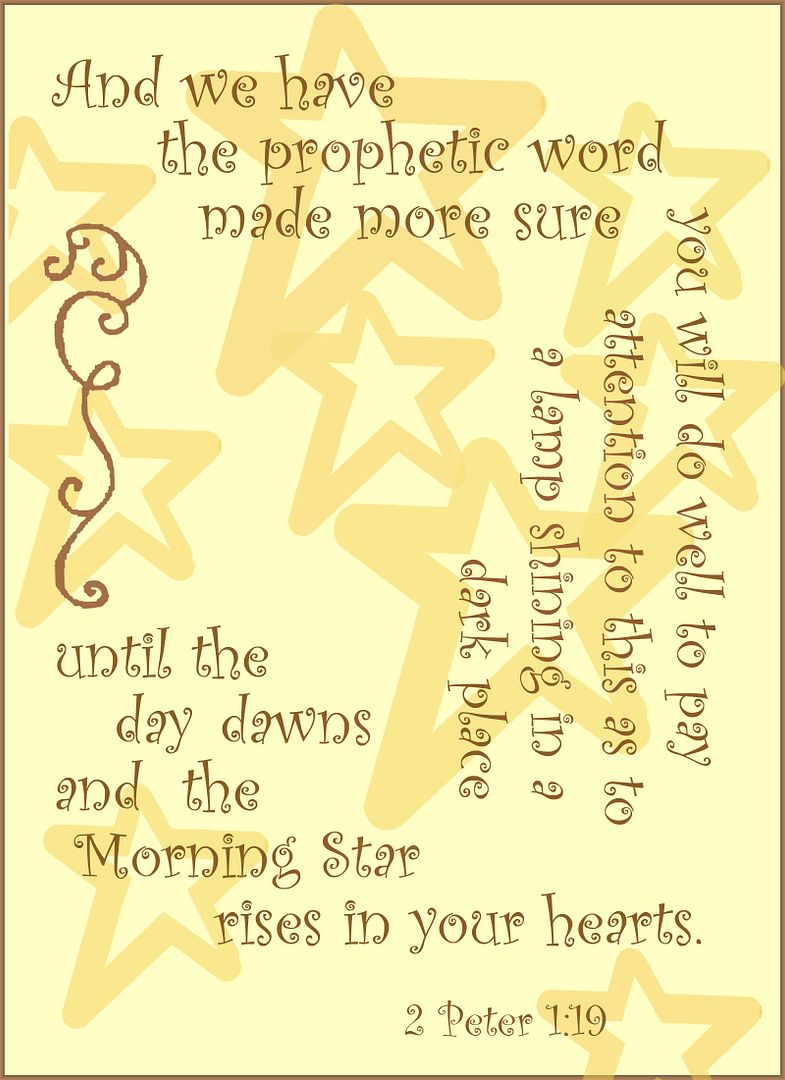
2 Peter 1:19
Showing posts with label 2 Peter. Show all posts
Friday, January 24, 2025
2 Peter 1:19
2 Peter 1:19
Friday, March 01, 2024
Five Minute Friday :: Suffer
1 Peter 1:8
• Five Minute Friday :: Suffer Linkup
To suffer is to bear, hold up, let, allow, permit. You may have heard the translation of Jesus' plea recorded in Matthew 19:14, "Suffer the little children come to me, and do not forbid them, for of such is the kingdom of heaven."
Common parlance has translated suffering into pain, trials, and anguish, which isn't an extreme stretch, because in a sense we do allow unpleasant events to prevail for a while, though many times we have no choice.
Our FMF host Kate explained she chose the word suffer because she loves the reminder in 1 Peter that any suffering is only for a finite length of time. Kate quoted the NIV, "…you believe in him and are filled with an inexpressible and glorious joy.
Several years ago I illustrated an 8-part series of verses from 1 Peter and 2 Peter. It was unusual because the pieces all were different sizes and different styles. Typically overall style, color palette – or minimally size – ties together a group of designs produced under the same heading, but this was different. Today's prompt prompted me to use my illustration from 1 Peter 1:8 to head today's post. The RSV I used tells us we "rejoice with unutterable and exalted joy."
A few verses earlier 1 Peter 1:3 reminds us God has given us new birth into a living hope through Jesus Christ's resurrection from the dead. Some translations says we have been "reborn."
Churches that observe Lent are at the halfway point to Holy Week when we remember Jesus arrest, trial, conviction, and crucifixion. We listen to the passion narrative about the literal pain and suffering Jesus allowed. But we need to remember when Jesus himself predicts his suffering and death, he also includes his resurrection, his rising. To be raised from death? You first must die. For the apostle Paul, the gospel is death and resurrection.
Whether we ponder and endure our own sore trials, consider the cost and outcome of those Jesus experienced, or look with sorrow-filled horror on atrocities in our own countries or places like Ukraine, it truly helps our endurance and patience to remember pain and death is not God's final answer.
1 Peter opens by addressing God's people who live as strangers, those who are resident aliens wherever they may be. NRSV says "exiles of the dispersion." That language is marked, pointed, and precise.
The pair of letters 1 Peter and 2 Peter were written to the church in diaspora that lived weekdays amidst ethnic, cultural, often linguistic and culinary strangeness; on Sundays they gathered as permanent citizens of the Kingdom of Heaven. 1 Peter and 2 Peter remind us the church always is in exile, always has at least a hint of strangeness and stranger-ness vis-à-vis those around them, even when they themselves are voting citizens in that place, under that government.
At the heart of the story of Jesus of Nazareth stands the seven days we call Holy Week: a crucified man – but – then an empty grave. As we continue in Lent, as we anticipate Holy Week and suffer through Jesus' passion alongside him, we know the Day of Resurrection will be here.
tags, topics
1 Peter,
2 Peter,
Five Minute Friday,
holy week
Saturday, June 03, 2023
Five Minute Friday :: Quick
• Five Minute Friday :: Quick Linkup
Header Phrases
• Follow your heart
• There is a place
• In the quick of existence
• Where the mind sees more than the eye
• Peace
• Friends
• 3
• Go Slo
• We, according to his promise,
Look for new heavens and a new earth
[where righteousness dwells]. 2 Peter 3:13
Quick
"Quick" in this passage from Revelation sometimes gets translated soon; the Greek supports both. My most frequent connotation of quick is without much delay. Though not necessarily the yesterday we often wish for, quick isn't lightning fast, definitely not at the speed of light.
Quick bread comes to mind. You need to get the recipe and the ingredients. Recipe may already be in your file box or folder, or you may need to search online for one with the best pictures so you can know what'll come out of your oven. Do you have ingredients in pantry and fridge or do they mean a trip to the store? This won't be slow bread, but it's not done yet because you need to mix them up.
Put it all in the oven and wait a short eternity for your so far fairly quick bread to bake. You probably need to let it cool some before enjoying a slice or two with butter or cream cheese and a friendly companion. Yet that procedure is short and quick compared to yeast bread that needs to rise a while, sometimes a very long while; it approaches instantaneous compared to acquiring sourdough starter.
I like the percussive sounds of Jesus promising a quick arrival in contrast to meeting him "soon." We still need to wait longer than our heart's yearning, yet when we seek Jesus he'll be in our midst, fulfilling his coveted promise of new heavens, a new earth. Amen? Amen!
The grace of our Lord Jesus Christ be with you all. Amen! Revelation 22:21
• Zucchini basil quick bread by Tiny Banquet Committee on Flickr
# # #
Header Phrases
• Follow your heart
• There is a place
• In the quick of existence
• Where the mind sees more than the eye
• Peace
• Friends
• 3
• Go Slo
• We, according to his promise,
Look for new heavens and a new earth
[where righteousness dwells]. 2 Peter 3:13
Quick
And behold, I am coming quickly, and my reward is with me, to give to every one according to his work. I am the Alpha and the Omega, the Beginning and the End, the First and the Last. He who testifies to these things says, "Surely I am coming quickly." Amen. Even so, come, Lord Jesus! Revelation 22:12, 13, 20
"Quick" in this passage from Revelation sometimes gets translated soon; the Greek supports both. My most frequent connotation of quick is without much delay. Though not necessarily the yesterday we often wish for, quick isn't lightning fast, definitely not at the speed of light.
Quick bread comes to mind. You need to get the recipe and the ingredients. Recipe may already be in your file box or folder, or you may need to search online for one with the best pictures so you can know what'll come out of your oven. Do you have ingredients in pantry and fridge or do they mean a trip to the store? This won't be slow bread, but it's not done yet because you need to mix them up.
Put it all in the oven and wait a short eternity for your so far fairly quick bread to bake. You probably need to let it cool some before enjoying a slice or two with butter or cream cheese and a friendly companion. Yet that procedure is short and quick compared to yeast bread that needs to rise a while, sometimes a very long while; it approaches instantaneous compared to acquiring sourdough starter.
I like the percussive sounds of Jesus promising a quick arrival in contrast to meeting him "soon." We still need to wait longer than our heart's yearning, yet when we seek Jesus he'll be in our midst, fulfilling his coveted promise of new heavens, a new earth. Amen? Amen!
The grace of our Lord Jesus Christ be with you all. Amen! Revelation 22:21
• Zucchini basil quick bread by Tiny Banquet Committee on Flickr
tags, topics
2 Peter,
Five Minute Friday,
new creation,
revelation
Friday, May 13, 2022
Five Minute Friday :: Vision
• Five Minute Friday :: Vision Linkup
Like a vision board packed with pictures of the future you dream of, the not here right now you expect will manifest and you'll then testify to, scripture reveals God's visions for creation's wellbeing and provides ideas we can follow to partner with God to create heaven on earth. In my focus passage from the book of Revelation that concludes the bible, John the Revelator describes the vision God gave him.
"Sea no more" is far from ecological disaster, but picks up the code word sea or ocean that in scripture frequently denotes untamed chaos, as when Genesis 1 tells us about the dawn of creation when the Spirit of God hovered over the formless empty deep darkness. Oh, yes, the new creation does have a river with life-giving water—"enough" clear clean water along with all we need of everything else.
God's vision of the reign of the Spirit is "shalom" justice and bountiful sufficiency. Reading and studying scripture gives us plenty of practice in learning God's ways. Enough food, safe shelter, healthy community. Good work for good pay in good conditions. Abundant mercy and love. No sorrow or dying or pain. The end of war and violence. Scripture sings in the language of geography and space, because we are embodied humans solidly situated on land.
The God who calls us into new creation partnership is Jeremiah's God so near with laws so just. Along with 2 Peter, we proclaim and claim, "According to God's promise we look for new heavens and a new earth in which righteousness dwells." [2 Peter 3:13] That's quite a vision!
# # #
Then I saw a new heaven and a new earth; for the first heaven and the first earth had passed away, and the sea was no more. And I saw the holy city, the new Jerusalem, coming down out of heaven from God, prepared as a bride adorned for her husband.
And I heard a loud voice from the throne saying, "See, the home of God is among mortals. God will dwell with them as their God; they will be God's peoples, and God will be with them; God will wipe every tear from their eyes. Death will be no more; mourning and crying and pain will be no more, for the first things have passed away." Revelation 21:1-4
Like a vision board packed with pictures of the future you dream of, the not here right now you expect will manifest and you'll then testify to, scripture reveals God's visions for creation's wellbeing and provides ideas we can follow to partner with God to create heaven on earth. In my focus passage from the book of Revelation that concludes the bible, John the Revelator describes the vision God gave him.
"Sea no more" is far from ecological disaster, but picks up the code word sea or ocean that in scripture frequently denotes untamed chaos, as when Genesis 1 tells us about the dawn of creation when the Spirit of God hovered over the formless empty deep darkness. Oh, yes, the new creation does have a river with life-giving water—"enough" clear clean water along with all we need of everything else.
God's vision of the reign of the Spirit is "shalom" justice and bountiful sufficiency. Reading and studying scripture gives us plenty of practice in learning God's ways. Enough food, safe shelter, healthy community. Good work for good pay in good conditions. Abundant mercy and love. No sorrow or dying or pain. The end of war and violence. Scripture sings in the language of geography and space, because we are embodied humans solidly situated on land.
The God who calls us into new creation partnership is Jeremiah's God so near with laws so just. Along with 2 Peter, we proclaim and claim, "According to God's promise we look for new heavens and a new earth in which righteousness dwells." [2 Peter 3:13] That's quite a vision!
tags, topics
2 Peter,
Five Minute Friday,
genesis,
jeremiah,
new creation,
revelation,
water
Monday, March 16, 2020
16 March • Found

• Where the mind sees more than the eye
• Follow your heart
• In the quick of existence
• There is a place
• Friends
• Peace
• We, according to his promise, look for new Heavens and a new Earth. 2 Peter 3:13

tags, topics
#LentenSnapshots2020,
2 Peter
Tuesday, November 08, 2005
The Joint Declaration on the Doctrine of Justification
Close to a year ago, in December 2004, I began this post and planned to write more (which I've done, but as notes for discussion rather than formal presentation); now 10-months-and-counting later, my intended ideas remain in an outline and I've been thinking and writing about other things, but the Joint Declaration is so important and I am so into being an ecumenist, I needed to post something about it here. Here's the gist of my original post:
Preamble
1. The doctrine of justification was of central importance for the Lutheran Reformation of the sixteenth century. It was held to be the "first and chief article"1 [footnote 1 The Smalcald Articles, II,1; Book of Concord, 292.] and at the same time the "ruler and judge over all other Christian doctrines."2 [footnote: 2 "Rector et judex super omnia genera doctrinarum," Weimar Edition of Luther's Works (WA), 39, I, 205.] The doctrine of justification was particularly asserted and defended in its Reformation shape and special valuation over against the Roman Catholic Church and theology of that time, which in turn asserted and defended a doctrine of justification of a different character. From the Reformation perspective, justification was the crux of all the disputes. ...
2. For the Lutheran tradition, the doctrine of justification has retained its special status. Consequently it has also from the beginning occupied an important place in the official Lutheran-Roman Catholic dialogue.
5. The present Joint Declaration has this intention: namely, to show that on the basis of their dialogue the subscribing Lutheran churches and the Roman Catholic Church9 [footnote: 9 The word, "church" is used in this Declaration to reflect the self-understandings of the participating churches, without intending to resolve all the ecclesiological issues related to this term.] are now able to articulate a common understanding of our justification by God's grace through faith in Christ. It does not cover all that either church teaches about justification; it does encompass a consensus on basic truths of the doctrine of justification and shows that the remaining differences in its explication are no longer the occasion for doctrinal condemnations.
1. Biblical Message of Justification
9. In the New Testament diverse treatments of "righteousness" and "justification" are found in the writings of Matthew (5:10; 6:33; 21:32), John (16:8-11), Hebrews (5:3; 10:37f), and James (2:14-26).10 In Paul's letters also, the gift of salvation is described in various ways, among others: "for freedom Christ has set us free" (Gal 5:1-13; cf. Rom 6:7), "reconciled to God" (2 Cor 5:18-21; cf. Rom 5:11), "peace with God" (Rom 5:1), "new creation" (2 Cor 5:17), "alive to God in Christ Jesus" (Rom 6:11,23), or "sanctified in Christ Jesus" (cf. 1 Cor 1:2; 1:30; 2 Cor 1:1). Chief among these is the "justification" of sinful human beings by God's grace through faith (Rom 3:23-25), which came into particular prominence in the Reformation period.
11. Justification is the forgiveness of sins (cf. Rom 3:23-25; Acts 13:39; Lk 18:14), liberation from the dominating power of sin and death (Rom 5:12-21) and from the curse of the law (Gal 3:10-14). It is acceptance into communion with God: already now, but then fully in God's coming kingdom (Rom 5:1f). It unites with Christ and with his death and resurrection (Rom 6:5). It occurs in the reception of the Holy Spirit in baptism and incorporation into the one body (Rom 8:1f, 9f; I Cor 12:12f). All this is from God alone, for Christ's sake, by grace, through faith in "the gospel of God's Son" (Rom 1:1-3).
13. Opposing interpretations and applications of the biblical message of justification were in the sixteenth century a principal cause of the division of the Western church and led as well to doctrinal condemnations. A common understanding of justification is therefore fundamental and indispensable to overcoming that division. ...
3. The Common Understanding of Justification
14. The Lutheran churches and the Roman Catholic Church have together listened to the good news proclaimed in Holy Scripture. This common listening, together with the theological conversations of recent years, has led to a shared understanding of justification. ...
15. In faith we together hold the conviction that justification is the work of the triune God. The Father sent his Son into the world to save sinners. The foundation and presupposition of justification is the incarnation, death, and resurrection of Christ. Justification thus means that Christ himself is our righteousness, in which we share through the Holy Spirit in accord with the will of the Father. Together we confess: By grace alone, in faith in Christ's saving work and not because of any merit on our part, we are accepted by God and receive the Holy Spirit, who renews our hearts while equipping and calling us to good works.11
18. Therefore the doctrine of justification, which takes up this message and explicates it, is more than just one part of Christian doctrine. It stands in an essential relation to all truths of faith, which are to be seen as internally related to each other. It is an indispensable criterion which constantly serves to orient all the teaching and practice of our churches to Christ. When Lutherans emphasize the unique significance of this criterion, they do not deny the interrelation and significance of all truths of faith.
4.5 Law and Gospel
31. We confess together that persons are justified by faith in the gospel "apart from works prescribed by the law" (Rom 3:28). Christ has fulfilled the law and by his death and resurrection has overcome it as a way to salvation. We also confess that God's commandments retain their validity for the justified and that Christ has by his teaching and example expressed God's will which is a standard for the conduct of the justified also.
32. Lutherans state that the distinction and right ordering of law and gospel is essential for the understanding of justification. In its theological use, the law is demand and accusation. Throughout their lives, all persons, Christians also, in that they are sinners, stand under this accusation which uncovers their sin so that, in faith in the gospel, they will turn unreservedly to the mercy of God in Christ, which alone justifies them.
4.6 Assurance of Salvation
34. We confess together that the faithful can rely on the mercy and promises of God. In spite of their own weakness and the manifold threats to their faith, on the strength of Christ's death and resurrection they can build on the effective promise of God's grace in Word and Sacrament and so be sure of this grace.
35. This was emphasized in a particular way by the Reformers: in the midst of temptation, believers should not look to themselves but look solely to Christ and trust only him. In trust in God's promise they are assured of their salvation, but are never secure looking at themselves.
36. Catholics can share the concern of the Reformers to ground faith in the objective reality of Christ's promise, to look away from one's own experience, and to trust in Christ's forgiving word alone (cf. Mt 16:19; 18:18). With the Second Vatican Council, Catholics state: to have faith is to entrust oneself totally to God19, who liberates us from the darkness of sin and death and awakens us to eternal life20. ...
4.7 The Good Works of the Justified
38. According to Catholic understanding, good works, made possible by grace and the working of the Holy Spirit, contribute to growth in grace, so that the righteousness that comes from God is preserved and communion with Christ is deepened. When Catholics affirm the "meritorious" character of good works, they wish to say that, according to the biblical witness, a reward in heaven is promised to these works. Their intention is to emphasize the responsibility of persons for their actions, not to contest the character of those works as gifts, or far less to deny that justification always remains the unmerited gift of grace.
39. The concept of a preservation of grace and a growth in grace and faith is also held by Lutherans. They do emphasize that righteousness as acceptance by God and sharing in the righteousness of Christ is always complete. ...
From The Joint Declaration on the Doctrine of Justification Annex
... 2. Together we confess: "By grace alone, in faith in Christ's saving work and not because of any merit on our part, we are accepted by God and receive the Holy Spirit, who renews our hearts while equipping and calling us to good works"(JD 15). ...
D. Grace as fellowship of the justified with God in faith, hope and love is always received from the salvific and creative work of God (cf. JD 27). But it is nevertheless the responsibility of the justified not to waste this grace but to live in it. The exhortation to do good works is the exhortation to practice the faith (cf. BSLK 197,45). "The good works of the justified should be done in order to confirm their call, that is, lest they fall from their call by sinning again" (Apol. XX,13, BSLK 316,18-24; with reference to 2 Pet. 1:10. Cf. also FC SD IV,33; BSLK 948,9-23). In this sense Lutherans and Catholics can understand together what is said about "the preservation of grace" in JD 38 and 39. Certainly, whatever in the justified precedes or follows the free gift of faith is neither the basis of justification nor merits it" (JD 25).
E. By justification we are unconditionally brought into communion with God. This includes the promise of eternal life; "If we have been united with him in a death like his, we will certainly be united with him in a resurrection like his" (Rom 6:5, cf. Jn 3:36, Rom 8:17). In the final judgment, the justified will be judged also on their works (cf. Mt 16:27; 25:31-46; Rom 2:16; 14:12; 1 Cor 3:8; 2 Cor 5:10 etc.). We face a judgment in which God's gracious sentence will approve anything in our life and action that corresponds to his will. ...Any reward is a reward of grace, on which we have no claim.
3. The doctrine of justification is measure or touchstone for the Christian faith. No teaching may contradict this criterion. In this sense, the doctrine of justification "...is an indispensable criterion which constantly serves to orient all the teaching and practice of our churches to Christ." (JD l8)
Next month—January 2005—at Faith, Order and Witness, again we'll discuss the Joint Declaration; I had made a few notes about some points in the text of the Joint Declaration and about the Annex, and at some point I'd wanted to compile them into at least somewhat coherent form so they could go on this site and possibly I could distribute them...
...at that long-past January meeting, but I got so involved with my usual endeavors of reading theology and writing theology my ideas never made it further than our live discussion at the meeting. Nonetheless, I've included parts of the text we discussed, and here's an overview, resources, and links to the complete document in four languages: The Joint Declaration on the Doctrine of Justification from the World Communion of Reformed Churches.
Preamble
1. The doctrine of justification was of central importance for the Lutheran Reformation of the sixteenth century. It was held to be the "first and chief article"1 [footnote 1 The Smalcald Articles, II,1; Book of Concord, 292.] and at the same time the "ruler and judge over all other Christian doctrines."2 [footnote: 2 "Rector et judex super omnia genera doctrinarum," Weimar Edition of Luther's Works (WA), 39, I, 205.] The doctrine of justification was particularly asserted and defended in its Reformation shape and special valuation over against the Roman Catholic Church and theology of that time, which in turn asserted and defended a doctrine of justification of a different character. From the Reformation perspective, justification was the crux of all the disputes. ...
2. For the Lutheran tradition, the doctrine of justification has retained its special status. Consequently it has also from the beginning occupied an important place in the official Lutheran-Roman Catholic dialogue.
5. The present Joint Declaration has this intention: namely, to show that on the basis of their dialogue the subscribing Lutheran churches and the Roman Catholic Church9 [footnote: 9 The word, "church" is used in this Declaration to reflect the self-understandings of the participating churches, without intending to resolve all the ecclesiological issues related to this term.] are now able to articulate a common understanding of our justification by God's grace through faith in Christ. It does not cover all that either church teaches about justification; it does encompass a consensus on basic truths of the doctrine of justification and shows that the remaining differences in its explication are no longer the occasion for doctrinal condemnations.
1. Biblical Message of Justification
9. In the New Testament diverse treatments of "righteousness" and "justification" are found in the writings of Matthew (5:10; 6:33; 21:32), John (16:8-11), Hebrews (5:3; 10:37f), and James (2:14-26).10 In Paul's letters also, the gift of salvation is described in various ways, among others: "for freedom Christ has set us free" (Gal 5:1-13; cf. Rom 6:7), "reconciled to God" (2 Cor 5:18-21; cf. Rom 5:11), "peace with God" (Rom 5:1), "new creation" (2 Cor 5:17), "alive to God in Christ Jesus" (Rom 6:11,23), or "sanctified in Christ Jesus" (cf. 1 Cor 1:2; 1:30; 2 Cor 1:1). Chief among these is the "justification" of sinful human beings by God's grace through faith (Rom 3:23-25), which came into particular prominence in the Reformation period.
11. Justification is the forgiveness of sins (cf. Rom 3:23-25; Acts 13:39; Lk 18:14), liberation from the dominating power of sin and death (Rom 5:12-21) and from the curse of the law (Gal 3:10-14). It is acceptance into communion with God: already now, but then fully in God's coming kingdom (Rom 5:1f). It unites with Christ and with his death and resurrection (Rom 6:5). It occurs in the reception of the Holy Spirit in baptism and incorporation into the one body (Rom 8:1f, 9f; I Cor 12:12f). All this is from God alone, for Christ's sake, by grace, through faith in "the gospel of God's Son" (Rom 1:1-3).
13. Opposing interpretations and applications of the biblical message of justification were in the sixteenth century a principal cause of the division of the Western church and led as well to doctrinal condemnations. A common understanding of justification is therefore fundamental and indispensable to overcoming that division. ...
3. The Common Understanding of Justification
14. The Lutheran churches and the Roman Catholic Church have together listened to the good news proclaimed in Holy Scripture. This common listening, together with the theological conversations of recent years, has led to a shared understanding of justification. ...
15. In faith we together hold the conviction that justification is the work of the triune God. The Father sent his Son into the world to save sinners. The foundation and presupposition of justification is the incarnation, death, and resurrection of Christ. Justification thus means that Christ himself is our righteousness, in which we share through the Holy Spirit in accord with the will of the Father. Together we confess: By grace alone, in faith in Christ's saving work and not because of any merit on our part, we are accepted by God and receive the Holy Spirit, who renews our hearts while equipping and calling us to good works.11
18. Therefore the doctrine of justification, which takes up this message and explicates it, is more than just one part of Christian doctrine. It stands in an essential relation to all truths of faith, which are to be seen as internally related to each other. It is an indispensable criterion which constantly serves to orient all the teaching and practice of our churches to Christ. When Lutherans emphasize the unique significance of this criterion, they do not deny the interrelation and significance of all truths of faith.
4.5 Law and Gospel
31. We confess together that persons are justified by faith in the gospel "apart from works prescribed by the law" (Rom 3:28). Christ has fulfilled the law and by his death and resurrection has overcome it as a way to salvation. We also confess that God's commandments retain their validity for the justified and that Christ has by his teaching and example expressed God's will which is a standard for the conduct of the justified also.
32. Lutherans state that the distinction and right ordering of law and gospel is essential for the understanding of justification. In its theological use, the law is demand and accusation. Throughout their lives, all persons, Christians also, in that they are sinners, stand under this accusation which uncovers their sin so that, in faith in the gospel, they will turn unreservedly to the mercy of God in Christ, which alone justifies them.
4.6 Assurance of Salvation
34. We confess together that the faithful can rely on the mercy and promises of God. In spite of their own weakness and the manifold threats to their faith, on the strength of Christ's death and resurrection they can build on the effective promise of God's grace in Word and Sacrament and so be sure of this grace.
35. This was emphasized in a particular way by the Reformers: in the midst of temptation, believers should not look to themselves but look solely to Christ and trust only him. In trust in God's promise they are assured of their salvation, but are never secure looking at themselves.
36. Catholics can share the concern of the Reformers to ground faith in the objective reality of Christ's promise, to look away from one's own experience, and to trust in Christ's forgiving word alone (cf. Mt 16:19; 18:18). With the Second Vatican Council, Catholics state: to have faith is to entrust oneself totally to God19, who liberates us from the darkness of sin and death and awakens us to eternal life20. ...
4.7 The Good Works of the Justified
38. According to Catholic understanding, good works, made possible by grace and the working of the Holy Spirit, contribute to growth in grace, so that the righteousness that comes from God is preserved and communion with Christ is deepened. When Catholics affirm the "meritorious" character of good works, they wish to say that, according to the biblical witness, a reward in heaven is promised to these works. Their intention is to emphasize the responsibility of persons for their actions, not to contest the character of those works as gifts, or far less to deny that justification always remains the unmerited gift of grace.
39. The concept of a preservation of grace and a growth in grace and faith is also held by Lutherans. They do emphasize that righteousness as acceptance by God and sharing in the righteousness of Christ is always complete. ...
From The Joint Declaration on the Doctrine of Justification Annex
... 2. Together we confess: "By grace alone, in faith in Christ's saving work and not because of any merit on our part, we are accepted by God and receive the Holy Spirit, who renews our hearts while equipping and calling us to good works"(JD 15). ...
D. Grace as fellowship of the justified with God in faith, hope and love is always received from the salvific and creative work of God (cf. JD 27). But it is nevertheless the responsibility of the justified not to waste this grace but to live in it. The exhortation to do good works is the exhortation to practice the faith (cf. BSLK 197,45). "The good works of the justified should be done in order to confirm their call, that is, lest they fall from their call by sinning again" (Apol. XX,13, BSLK 316,18-24; with reference to 2 Pet. 1:10. Cf. also FC SD IV,33; BSLK 948,9-23). In this sense Lutherans and Catholics can understand together what is said about "the preservation of grace" in JD 38 and 39. Certainly, whatever in the justified precedes or follows the free gift of faith is neither the basis of justification nor merits it" (JD 25).
E. By justification we are unconditionally brought into communion with God. This includes the promise of eternal life; "If we have been united with him in a death like his, we will certainly be united with him in a resurrection like his" (Rom 6:5, cf. Jn 3:36, Rom 8:17). In the final judgment, the justified will be judged also on their works (cf. Mt 16:27; 25:31-46; Rom 2:16; 14:12; 1 Cor 3:8; 2 Cor 5:10 etc.). We face a judgment in which God's gracious sentence will approve anything in our life and action that corresponds to his will. ...Any reward is a reward of grace, on which we have no claim.
3. The doctrine of justification is measure or touchstone for the Christian faith. No teaching may contradict this criterion. In this sense, the doctrine of justification "...is an indispensable criterion which constantly serves to orient all the teaching and practice of our churches to Christ." (JD l8)
Friday, September 30, 2005
BEaCh HoUsE bLoG
Very Dry Day bringing shoreline dreams alive
Santa Ana winds racing somewhat north of here again
Natural Energies, with Beach House taunts arcane
Get your shovels ready and turn up the heat!
Bring along a Vintage willow Cottage Shabby Chic
Couple it with several pairs of Country Bear ice cream Sets
DoUble FaultS, seashore, sunshine over Shiloh gets
Claim NEW 3 NEW claim 5, let's
Listening Garden Rooms four Nautical transform
Black Church's Cadence song preaching up a storm...!
Turn on the AC 'cuz it's gonna be a blizzard?
Only rhyme I know for that is rainbow-painted lizard
Blogging more for Desert Fire, theology, remember?
this list-blog growing longer just by citing one from earlier...
Wondering where I got my quotes, here's twenty-ninth of June
Posted on that day's time not quite yet afternoon
this far by faith's Theology Rap
Coupled with Transfiguration Dawning Day on tap
Streams in the deserts restoring us to life
Impelled by the Spirit reclaiming our strife
Cityside America safari from the past
Tennessee Walkers strolling totally grassed
Cannabis sativa? I believe so not
Simply something different from our usually plot
Bread sent from heaven and fruit of the vine
Community's nurturing right down the line
Shenandoah prairieland's burritos really fine
Charge into the world make another new try
Instead of just settling reaching for the sky
Challenging this planet to listen now and hear
Everything I offer it experience held dear
I'm giving my sorrow and all of my pain
To God the Almighty, Lover not vain
Expecting just mercy and grace in the rain
Falling from heaven embracing the earth
God's glory incarnate declaring our worth
Holy Spirit's Seasons moving forth to Reformation!
Church's Pentecostal witness blazing with elation!
Somewhat strained my verses are whatever though they thrive
Off again tomorrow's morning hope will raise us back alive
The End for Now, Amen. Amen. And amen again!
tags, topics
2 Peter,
design,
holy ghost,
holy spirit,
reformation,
San Diego,
transfiguration
Sunday, February 06, 2005
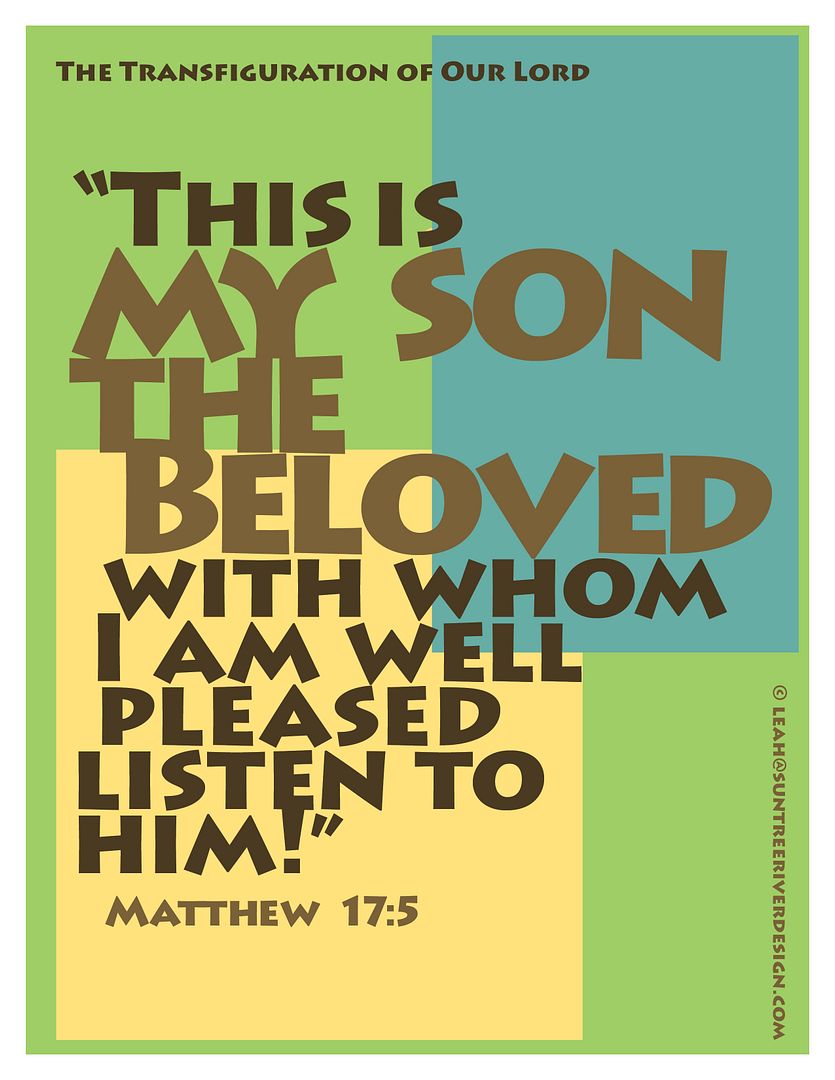
Transfiguration: Until the Day Dawns
Texts – NKJV
Matthew 17:1-9
1 Now after six days Jesus took Peter, James, and John his brother, led them up on a high mountain by themselves; 2 and He was transfigured before them. His face shone like the sun, and His clothes became as white as the light. 3 And behold, Moses and Elijah appeared to them, talking with Him. 4 Then Peter answered and said to Jesus, "Lord, it is good for us to be here; if You wish, I will make here three tabernacles: one for You, one for Moses, and one for Elijah."
… 9 Now as they came down from the mountain, Jesus commanded them, saying, "Tell the vision to no one until the Son of Man is risen from the dead."
2 Peter 1:16-19
16 For we did not follow cunningly devised fables when we made known to you the power and coming of our Lord Jesus Christ, ...but were eyewitnesses of His majesty. 17 For He received from God the Father honor and glory when such a voice came to Him from the Excellent Glory: "This is My beloved Son, in whom I am well pleased." 18 And we heard this voice which came from heaven when we were with Him on the holy mountain.
19 We also have the more sure prophetic word, which you do well to heed as a light that shines in a dark place, until the day dawns and the morning star rises in your hearts…
Until the Day Dawns
"Tell the vision to no one until the Son of Man – the Human One – is risen from the dead!"
Also in some of Jesus’ words recorded by the gospel-writer Matthew, we hear: [12:40] An evil and perverse generation seeks signs, but no sign will be given it except the Sign of Jonah: for just as Jonah was three days and three nights in the belly of the great fish, so will the Human One – the Son of Man – be three days and three nights in the heart of the earth!
In the Good News according to Luke:[11:29] And while the crowds were thickly gathered together, Jesus began to say, "This is an evil generation. It seeks a sign, and no sign will be given to it except the sign of Jonah the prophet."
The Sign of Jonah—Death and Resurrection! For two thousand years, theologians and faith communities have struggled to learn and discern what Jesus means to them. We know Jesus as teacher and Jesus as political prophet; doubtless many of us consider Jesus a social activist, too. Jesus as a healer? Probably. But Jesus, the man of Nazareth, who died outside the city on a cross of shame as the Christ of God?
At the very heart of the story of Jesus of Nazareth stands the seven days we call Passion Week: a crucified man – but – then an empty grave, a narrative with no easy answers or clear-cut implications, a series of events so far outside the normally credible many of us would like to dismiss it as legend. But today's lections are not about death and resurrection but about something else altogether—they're about a spectacular manifestation of God's Glory on yet another mountaintop.
"We were eyewitness. We saw...with our own eyes." There on the mountain of the event called Transfiguration were Moses and Elijah and there was that voice...and there were Peter, James and John who saw, who eye-witnessed the meeting of earth and heaven, the holiness of everything created. Within Judaism, clouds, mountains and other expressions of nature were traditional signs of God's presence—you remember the cloud that went before Israel as a sign of God's presence in the Exodus story, and the mountain Moses climbed to receive the law, the Sinai Covenant? In telling about the Transfiguration,
Matthew, the gospel writer and Peter, the author of the epistle describe a meeting between heaven and earth, of the reconciliation of life, spelling God-with-us—of course, then there's the reciprocal of God's presence to us: our presence to God! Heaven comes down to earth countless times throughout the biblical witness, just as heaven and earth meet countless times in this world in which we live.
Jesus cautioned the Mount of Transfiguration Trio – Peter, James and John – to tell no one about the experience with Moses and Elijah, the law and the prophets, until he, the Son of Man, the Human One, had been raised from death. Tell no one until Easter! "Just as Jonah spent three days and three nights in the belly of the great fish..."
Another Jonah, Simon bar Jonah, son of Jonah – the fisher of men renamed Peter or "Rocky" by Jesus himself – experienced the vision of Jesus transfigured and for Peter, we know the later reality of resurrection could not remain forgotten or untold! Over and over in the book of Acts and then in the later letter called 2 Peter we keep hearing Peter proclaiming the Risen Christ!
Often we recount stories about gutless Peter, almost rejoicing because he and we are similar in too many ways, but after the events of Easter and Pentecost, when preaching Christ even meant risking life itself, Peter could not help but do so.
Because of the stories of Peter's sometimes reluctance during the time he spent ministering alongside Jesus in the years prior to the crucifixion – especially the triple betrayal – I think if Peter had his human preference, he would rather not have stood up before those institutional religious leaders and assorted "others. But the word of the Risen One was not a philosophical theoretical idea out there but rather it was a word within Peter's heart, from his real-life experience walking and living with a friend who unconditionally loved him even in his weakest moments of total failure, that One he had seen crucified...
"We were eyewitnesses...with our eyes." The eye is the most sensitive part of the body; to be an eyewitness suggests vision and perception. On the Mount of Transfiguration Peter saw Jesus, Elijah and Moses; later Peter eyewitnessed Christ crucified; then he saw and experienced Christ Risen! In the life, death and resurrection of Jesus, Peter witnessed the love of God, and how could Peter be silent? Everything his teacher and companion Jesus spoke about had happened, everything – including death and resurrection, the fabled Sign of Jonah – and those events birthed hope in Rocky-Peter, so he began believing, living and proclaiming the hope of resurrection to the world.
Tell the vision to no one until the Human One is risen from the dead. A long time has passed since Jesus, James, John and Peter stood with Moses and Elijah on the Mountain of Transfiguration; a long time has passed since Peter told about seeing with his own eyes the transfigured Man of Nazareth and the glory of the Crucified and Risen Christ. In the centuries since then, far too much other than the boundless and unqualified love of God has been connected with Jesus and laid on the name of Jesus; Peter didn’t need to explain slave ships from Africa, or the Crusades, or the Salem witch trials or the decimation of villages in South America and Central America by unjust church politics; in those days of the nascent church, people hadn't yet suffered under the illegitimate authority of over-formed ecclesiastical clout.
So these days and in our own communities we can hear voices asking why we still proclaim the Crucified and Risen Lord of All!? Still today?! Like Peter? Because we too have witnessed Christ crucified in every life that falls at the hand of hatred, every heart broken by betrayal, every community brutalized by the powerful, every person left for dead; in those situations and far too many like them our eyes have witnessed Christ crucified.
And though many times we may run away like Simon bar Jonah also called "Peter," in the wake of the Day of Crucifixion we have seen and met the Risen One on Resurrection morn! Jesus promises us the Sign of Jonah—death and resurrection; Jesus charges us to "Tell no one until the Human One is risen from the dead!"
Just as the Spirit sent Peter, James and John to the Transfiguration site, the Holy Spirit takes us to places where God meets us, the contemporary people of God; the Spirit send us to places where we witness meetings between heaven and earth and see evidence of God's life-restoring and reconciling presence to us, while the Spirit enables us to be present to God, living in full response to the power of Easter within our once-devastated lives.
Together with Peter, we have been eyewitnesses of Christ's crucifixion but we also know the experience of the paradoxical power of new life born from death; those events birth hope in us—how can we be silent? Now we can believe, live and proclaim the hope of resurrection to the world!
As we prepare to enter the coming weeks of Lent, let us continue living as signs of the meeting of heaven and earth, people ready for Good Friday and eyewitness of Easter Sunday's glorious dawn!
The Word of Life,
Amen!
Matthew 17:1-9
1 Now after six days Jesus took Peter, James, and John his brother, led them up on a high mountain by themselves; 2 and He was transfigured before them. His face shone like the sun, and His clothes became as white as the light. 3 And behold, Moses and Elijah appeared to them, talking with Him. 4 Then Peter answered and said to Jesus, "Lord, it is good for us to be here; if You wish, I will make here three tabernacles: one for You, one for Moses, and one for Elijah."
… 9 Now as they came down from the mountain, Jesus commanded them, saying, "Tell the vision to no one until the Son of Man is risen from the dead."
2 Peter 1:16-19
16 For we did not follow cunningly devised fables when we made known to you the power and coming of our Lord Jesus Christ, ...but were eyewitnesses of His majesty. 17 For He received from God the Father honor and glory when such a voice came to Him from the Excellent Glory: "This is My beloved Son, in whom I am well pleased." 18 And we heard this voice which came from heaven when we were with Him on the holy mountain. 19 We also have the more sure prophetic word, which you do well to heed as a light that shines in a dark place, until the day dawns and the morning star rises in your hearts…
Until the Day Dawns
Son of the Excellent Glory, Whose birth and life among us sanctifies all creation, Creator of the Cosmic Dance and Hope Everlasting: as we celebrate another spectacular vision of your Sonship, may we relentlessly live as signs of the reconciliation of heaven and earth, in service to one another and the world. Amen!
"Tell the vision to no one until the Son of Man – the Human One – is risen from the dead!"
Also in some of Jesus’ words recorded by the gospel-writer Matthew, we hear: [12:40] An evil and perverse generation seeks signs, but no sign will be given it except the Sign of Jonah: for just as Jonah was three days and three nights in the belly of the great fish, so will the Human One – the Son of Man – be three days and three nights in the heart of the earth!
In the Good News according to Luke:[11:29] And while the crowds were thickly gathered together, Jesus began to say, "This is an evil generation. It seeks a sign, and no sign will be given to it except the sign of Jonah the prophet."
The Sign of Jonah—Death and Resurrection! For two thousand years, theologians and faith communities have struggled to learn and discern what Jesus means to them. We know Jesus as teacher and Jesus as political prophet; doubtless many of us consider Jesus a social activist, too. Jesus as a healer? Probably. But Jesus, the man of Nazareth, who died outside the city on a cross of shame as the Christ of God?
At the very heart of the story of Jesus of Nazareth stands the seven days we call Passion Week: a crucified man – but – then an empty grave, a narrative with no easy answers or clear-cut implications, a series of events so far outside the normally credible many of us would like to dismiss it as legend. But today's lections are not about death and resurrection but about something else altogether—they're about a spectacular manifestation of God's Glory on yet another mountaintop.
"We were eyewitness. We saw...with our own eyes." There on the mountain of the event called Transfiguration were Moses and Elijah and there was that voice...and there were Peter, James and John who saw, who eye-witnessed the meeting of earth and heaven, the holiness of everything created. Within Judaism, clouds, mountains and other expressions of nature were traditional signs of God's presence—you remember the cloud that went before Israel as a sign of God's presence in the Exodus story, and the mountain Moses climbed to receive the law, the Sinai Covenant? In telling about the Transfiguration,
Matthew, the gospel writer and Peter, the author of the epistle describe a meeting between heaven and earth, of the reconciliation of life, spelling God-with-us—of course, then there's the reciprocal of God's presence to us: our presence to God! Heaven comes down to earth countless times throughout the biblical witness, just as heaven and earth meet countless times in this world in which we live.
Jesus cautioned the Mount of Transfiguration Trio – Peter, James and John – to tell no one about the experience with Moses and Elijah, the law and the prophets, until he, the Son of Man, the Human One, had been raised from death. Tell no one until Easter! "Just as Jonah spent three days and three nights in the belly of the great fish..."
Another Jonah, Simon bar Jonah, son of Jonah – the fisher of men renamed Peter or "Rocky" by Jesus himself – experienced the vision of Jesus transfigured and for Peter, we know the later reality of resurrection could not remain forgotten or untold! Over and over in the book of Acts and then in the later letter called 2 Peter we keep hearing Peter proclaiming the Risen Christ!
Often we recount stories about gutless Peter, almost rejoicing because he and we are similar in too many ways, but after the events of Easter and Pentecost, when preaching Christ even meant risking life itself, Peter could not help but do so.
Because of the stories of Peter's sometimes reluctance during the time he spent ministering alongside Jesus in the years prior to the crucifixion – especially the triple betrayal – I think if Peter had his human preference, he would rather not have stood up before those institutional religious leaders and assorted "others. But the word of the Risen One was not a philosophical theoretical idea out there but rather it was a word within Peter's heart, from his real-life experience walking and living with a friend who unconditionally loved him even in his weakest moments of total failure, that One he had seen crucified...
"We were eyewitnesses...with our eyes." The eye is the most sensitive part of the body; to be an eyewitness suggests vision and perception. On the Mount of Transfiguration Peter saw Jesus, Elijah and Moses; later Peter eyewitnessed Christ crucified; then he saw and experienced Christ Risen! In the life, death and resurrection of Jesus, Peter witnessed the love of God, and how could Peter be silent? Everything his teacher and companion Jesus spoke about had happened, everything – including death and resurrection, the fabled Sign of Jonah – and those events birthed hope in Rocky-Peter, so he began believing, living and proclaiming the hope of resurrection to the world.
Tell the vision to no one until the Human One is risen from the dead. A long time has passed since Jesus, James, John and Peter stood with Moses and Elijah on the Mountain of Transfiguration; a long time has passed since Peter told about seeing with his own eyes the transfigured Man of Nazareth and the glory of the Crucified and Risen Christ. In the centuries since then, far too much other than the boundless and unqualified love of God has been connected with Jesus and laid on the name of Jesus; Peter didn’t need to explain slave ships from Africa, or the Crusades, or the Salem witch trials or the decimation of villages in South America and Central America by unjust church politics; in those days of the nascent church, people hadn't yet suffered under the illegitimate authority of over-formed ecclesiastical clout.
So these days and in our own communities we can hear voices asking why we still proclaim the Crucified and Risen Lord of All!? Still today?! Like Peter? Because we too have witnessed Christ crucified in every life that falls at the hand of hatred, every heart broken by betrayal, every community brutalized by the powerful, every person left for dead; in those situations and far too many like them our eyes have witnessed Christ crucified.
And though many times we may run away like Simon bar Jonah also called "Peter," in the wake of the Day of Crucifixion we have seen and met the Risen One on Resurrection morn! Jesus promises us the Sign of Jonah—death and resurrection; Jesus charges us to "Tell no one until the Human One is risen from the dead!"
Just as the Spirit sent Peter, James and John to the Transfiguration site, the Holy Spirit takes us to places where God meets us, the contemporary people of God; the Spirit send us to places where we witness meetings between heaven and earth and see evidence of God's life-restoring and reconciling presence to us, while the Spirit enables us to be present to God, living in full response to the power of Easter within our once-devastated lives.
Together with Peter, we have been eyewitnesses of Christ's crucifixion but we also know the experience of the paradoxical power of new life born from death; those events birth hope in us—how can we be silent? Now we can believe, live and proclaim the hope of resurrection to the world!
As we prepare to enter the coming weeks of Lent, let us continue living as signs of the meeting of heaven and earth, people ready for Good Friday and eyewitness of Easter Sunday's glorious dawn!
The Word of Life,
Amen!
Friday, March 05, 2004
12 Steps for the Recovering Pharisee 4
12 Steps for the Recovering Pharisee (like me): Finding Grace to Live Unmasked by John Fischer on Amazon
Step 4: "We have decided that we don't want to get what we deserve after all, and we don't want anyone else to either,"
A few notes on the text: "just [full-of-justice] mercy" and "just [simply] mercy"! Mercy, compassion, graciousness, patience, chesed, abundant love: freedom to the captives, good news to the poor enacted "this day!" We know that as the familiar text about Jesus' entry into public ministry, but these days we're the body of Christ, so we need to be and do all of those image-of-God characteristics today, "this day!"
John Fischer refers to Jonah, the prophet reluctant to include everyone – all creation, but especially those skuzzy not-like-righteous-Jonah others – in God's love, mercy and reconciliation. Then we had Peter bar Jonah, another one disinclined to extend the inclusiveness of Gospeled community to those not like him. Us? From my own standpoint, I've written a little about it in Steps 1, 2 and 3. On to the questions!
1. In what way can a parent showing mercy to a child be more effective than by showing justice? Who are the child's primary reflection of God's nature and character?
I like the example our author gave about his dad and the justice/mercy pair. My guess is the author wants us to answer "parents" as the primary reflection of God in kids' lives, but more often it seems to be people outside the home, like teachers, neighbors folks at church or even pastors!
2. What is your natural response to "common grace"? Why do Christians in general have a hard time accepting that non Christians enjoy good things?
Like most of God's people, I've got Jonah and Peter streaks; however, long, long ago I learned to try talking to, having a conversation with anyone who turned me off in any way, and that's gone a long, long way toward making me far more understanding than otherwise I would've been: getting a clue as to what walking in their shoes might be about.
3. This is the day of salvation. What does that change for us? What perspectives, attitudes, and goals are affected as we seek to be vessels of God's grace?
Today, this day! That's Pauline, isn't it? What does it change? I need constantly to be aware of my being both dead and alive in Christ, constantly aware of my baptism – and, that also means daily repentance, as Luther wisely insisted.
4. If we are going to be the light of Christ in this world today, what is our calling according to Romans 2:1-5; 2 Corinthians 6:2; and 2 Peter 3:9, 15?
Romans 2 includes verse 4: "Or do you show contempt for the riches of his kindness, tolerance and patience, not realizing that God's kindness leads you toward repentance?" Hmmm . . . chapter 2 is from what's called the "prosecution" section of Romans! 2 Corinthians 6a: "In the time of my favor I heard you, and in the day of salvation I helped you." I'm going to [maybe] do a little eisegesis and say for God, every moment becomes a kairos one, an opportunity for "salvation," for greater wholeness and holiness – for becoming and being more like God. The verses from 2 Peter are about God's patience! So we need to become more patient with others, just as God is patient, and more patient with ourselves. I'll add more responsive to the reign of the HS in our lives and in the rest of the world (that means those others that Jonah and Peter would rather not have had included in God's grace filled reign). The church as the provisional demonstration of what God intends for humankind? The church????? That's us!!!!!
5. How does not showing mercy to others reveal that we are not leaning on God's mercy for our own salvation?
More than anything not being merciful or (horrors!) actually being unmerciful to others means I don't have a whole lot of awareness of my shortcomings nor much intention of repenting of them.
6. Who are your "enemies"? Is it more common for you to think of and pray for their salvation or their judgment?
I've gotten into the habit of praying for people who've offended me, and these past years have been an extremely hard row to hoe. For the most part, I find after I've prayed for them for a few days or weeks, their actions that have so displeased me almost never continue bothering me.
Step 4: "We have decided that we don't want to get what we deserve after all, and we don't want anyone else to either,"
A few notes on the text: "just [full-of-justice] mercy" and "just [simply] mercy"! Mercy, compassion, graciousness, patience, chesed, abundant love: freedom to the captives, good news to the poor enacted "this day!" We know that as the familiar text about Jesus' entry into public ministry, but these days we're the body of Christ, so we need to be and do all of those image-of-God characteristics today, "this day!"
John Fischer refers to Jonah, the prophet reluctant to include everyone – all creation, but especially those skuzzy not-like-righteous-Jonah others – in God's love, mercy and reconciliation. Then we had Peter bar Jonah, another one disinclined to extend the inclusiveness of Gospeled community to those not like him. Us? From my own standpoint, I've written a little about it in Steps 1, 2 and 3. On to the questions!
1. In what way can a parent showing mercy to a child be more effective than by showing justice? Who are the child's primary reflection of God's nature and character?
2. What is your natural response to "common grace"? Why do Christians in general have a hard time accepting that non Christians enjoy good things?
Like most of God's people, I've got Jonah and Peter streaks; however, long, long ago I learned to try talking to, having a conversation with anyone who turned me off in any way, and that's gone a long, long way toward making me far more understanding than otherwise I would've been: getting a clue as to what walking in their shoes might be about.
3. This is the day of salvation. What does that change for us? What perspectives, attitudes, and goals are affected as we seek to be vessels of God's grace?
Today, this day! That's Pauline, isn't it? What does it change? I need constantly to be aware of my being both dead and alive in Christ, constantly aware of my baptism – and, that also means daily repentance, as Luther wisely insisted.
4. If we are going to be the light of Christ in this world today, what is our calling according to Romans 2:1-5; 2 Corinthians 6:2; and 2 Peter 3:9, 15?
Romans 2 includes verse 4: "Or do you show contempt for the riches of his kindness, tolerance and patience, not realizing that God's kindness leads you toward repentance?" Hmmm . . . chapter 2 is from what's called the "prosecution" section of Romans! 2 Corinthians 6a: "In the time of my favor I heard you, and in the day of salvation I helped you." I'm going to [maybe] do a little eisegesis and say for God, every moment becomes a kairos one, an opportunity for "salvation," for greater wholeness and holiness – for becoming and being more like God. The verses from 2 Peter are about God's patience! So we need to become more patient with others, just as God is patient, and more patient with ourselves. I'll add more responsive to the reign of the HS in our lives and in the rest of the world (that means those others that Jonah and Peter would rather not have had included in God's grace filled reign). The church as the provisional demonstration of what God intends for humankind? The church????? That's us!!!!!
5. How does not showing mercy to others reveal that we are not leaning on God's mercy for our own salvation?
More than anything not being merciful or (horrors!) actually being unmerciful to others means I don't have a whole lot of awareness of my shortcomings nor much intention of repenting of them.
6. Who are your "enemies"? Is it more common for you to think of and pray for their salvation or their judgment?
I've gotten into the habit of praying for people who've offended me, and these past years have been an extremely hard row to hoe. For the most part, I find after I've prayed for them for a few days or weeks, their actions that have so displeased me almost never continue bothering me.
tags, topics
2 Peter,
corinthians,
recovering pharisee,
romans
Thursday, July 25, 2002
Animals in the Bible
You know I'm not prooftexting! I'll begin with some Bible verses that tell about God's passion for all creation:
Genesis 1 God's Word creates everything.
Genesis 1:20-22 God creates sea creatures and birds.
Genesis 1:24-25 God creates all animals.
Genesis 1:26-30 God gives humans dominion over and stewardship of creation; there is plenty of food for everyone.
Genesis 2:19-20 Animals are God’s creation; humans have safekeeping of and naming of animals and birds.
Genesis 7:1-3 At God’s command, Noah takes animals and birds into the ark, which he built at God’s command.
Genesis 8:1 God remembers Noah and all the birds and animals
Genesis 9:8-17 God makes a covenant of grace with "every living creature…birds, cattle, and every beast of the earth."
Psalm 8:7-8 Praise for God’s giving us dominion over creation: flocks, herds, beasts, birds, fish, and sea creatures.
Psalm 36:6c God redeems both humans and animals.
Psalm 50:10-11 God, "The Mighty One," knows and possesses all animals, cattle, birds, field creatures…
Psalm 104:11-12. 14, 17-18, 20-21, 26 The entire psalm celebrates God’s care for all creation and its creatures: light, heavens, clouds, winds, fire, earth, water, thunder, mountains, valleys, springs, ravines, beasts of the field, wild donkeys, birds of the air, cattle, food, wine, oil, bread, trees, cedars, storks, crags, moon, sun, darkness, beasts of the forest, lions, sea, sea creatures, leviathan…by the Spirit all are created and renewed!
Psalm 148:7-10 A charge for all creation to praise its Creator! In other words, for all creation to engage in our "chief and highest end to glorify God and fully to enjoy him forever." (Westminster Catechism)
Isaiah 11:6-9 The Eschaton, "Messianic time" of "new heavens and a new earth": the Peaceable Kingdom: The wolf will lie down with the lamb, the leopard will lie down with the goat, the calf and the lion and the yearling together; and a little child will lead them. The cow will feed with the bear, their young will lie down together, and the lion will eat straw like the ox…for the earth will be full of the knowledge of the LORD as the waters cover the sea.
Isaiah 41:18 I will make rivers flow on barren heights, and fountains in the midst of the valleys; I will make the wilderness pools of water, and the parched land into springs.
Isaiah 41:19 In the desert I will put the cedar, the acacia, the myrtle and the olive; I will set pines in the wasteland, the fir and the cypress together.
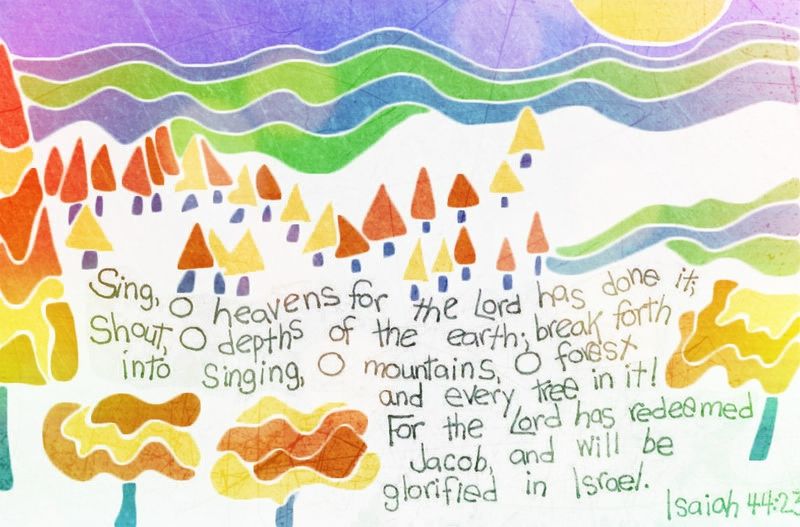
Isaiah 43:23 Sing for joy, O heavens, for the LORD has done this; shout aloud, O earth beneath. Burst into song, O mountains, you forests and all your trees, for the LORD has redeemed Jacob, he displays his glory in Israel.
Isaiah 49:13 Shout for joy, O heavens; rejoice, O earth; burst into song, O mountains! For the LORD comforts his people and will have compassion on his afflicted ones.
Isaiah 51:3 The LORD will surely comfort Zion and will look with compassion on all her ruins; he will make her deserts like Eden, her wastelands like the garden of the LORD. Joy and gladness will be found in her, thanksgiving and the sound of singing.
Isaiah 65:17, 25 New heavens and a new earth; the wolf, the lamb, and the lion…
Matthew 6:26 …God feeds the birds of the air…
Luke 12:24 God feeds the ravens…
2 Peter 3:13 …new heavens and a new earth…
Several theological concepts and images appear in both the Hebrew Scriptures and in the New Covenant Scriptures of the New Testament I’ve referenced. First comes the act of “creation.” After evoking the first light of earthly time, by His dynamic, creative Word, this free, transcendent, almighty and omnipresent Creator wills to form not only humans, but also every aspect of earthly substance, including “animals,” which carry a creative life force in themselves!
Then, "dominion" and "stewardship" and "naming": Dominion means Lordship. To be a steward means to care for one’s charge; in the Bible, to name anything or anyone means to bestow an identity upon that being or thing. Any being’s name – including God’s – reveals or manifests what and who that being is. To know a creature’s name implies both intimacy and relationship; the Word speaks to and redeems all creation into relationship and intimacy, drawing all creation out from anonymity and estrangement in order to be known by its Creator and by every other creature.
Next, God remembers not only Noah, but also all the birds and animals. In the biblical witness, history and the memory of history are closely and inextricably linked together. The God of Abraham, Isaac and Jacob, the God of the Sinai Covenant, God of the prophets, God of Jesus the Christ, reveals himself as a God who acts in human history, as God whose primary passion is the humanity of his creation and that humanity’s needs.
And covenant. There’s no more central concept in the entire Bible! Covenant is about creation, grace, redemption, renewal; it’s about the primacy of life over death; it’s about the God who initiates and does whatever is necessary to maintain responsive and responsible relationship. In Genesis 9, God’s covenant with "every living creature" is a covenant of grace or one of free gift – in other words, the "coming together" of relationship is given and unconditional, rather than being an "if – then" one that depends upon the condition of the giftee’s performance! God makes this covenant; God performs it.
Throughout the witness of the Word of God runs a constant theme of a new and renewed earth, of a new and renewed creation, right here in this physical, material world. The God of the Bible is a God whose supreme self-revelation is in the course of human history, "in, with and under" (Luther) the material stuff of creation. God revealed again and again in water, bread and wine; in humans and in all of creation – including animals, of course! I’ve quoted just a couple of the many, many new creation verses – these essentially are Resurrection texts.
In both testaments there are images of the Lion of God and of the Lamb of God. In New Testament theology, Christ Jesus, the image of the transcendent, invisible God beyond time and beyond space, becomes and is both "Lion and Lamb."
A few more notes: Christianity's – and the Bible's – central proclamation is the Mighty God of All Creation's self-revelation in the powerless, weak and vulnerable – in "the least of these." In Christ Jesus, God became and lived as one of the least of these, in innocence and vulnerability: vulnerability to the point of death. Although the separate and distinctness of Creator and creature is an essential biblical tenet, just as essential is the conviction God indwells all creation as Holy Spirit! Therefore, the Holy Spirit of God indwells animals, just as it lives in humans. Jesus’ charge to humanity is to be responsible to "the least of these." Jesus says any kindness we pay to these innocents is as if that kindness was done to him…and therefore, as if it was done to God, as Jesus is the image and essence of the Holy God beyond time and beyond space.
The God of the Bible calls us into covenant/relationship/response with our Creator and with all creation. God addresses us as covenant partners; God speaks to each of us as those who are called to hear, to receive, and to do his Word. That Word calls us to justice and righteousness; as God’s servants and agents we’re summoned to allow and bring about the restoration and reconciliation of all creation, proclaiming in word and in action, the freedom of the year of Jubilee. Our God, as Holy Spirit, makes Shekinah, "dwelling place" with us, making possible our response to creation’s needs. Especially in the Isaiah verses I’ve quoted, all creation rejoices in its redemption! And if the mountains and hills, deserts and streams celebrate, how much more so the animals!
Genesis 1 God's Word creates everything.
Genesis 1:20-22 God creates sea creatures and birds.
Genesis 1:24-25 God creates all animals.
Genesis 1:26-30 God gives humans dominion over and stewardship of creation; there is plenty of food for everyone.
Genesis 2:19-20 Animals are God’s creation; humans have safekeeping of and naming of animals and birds.
Genesis 8:1 God remembers Noah and all the birds and animals
Genesis 9:8-17 God makes a covenant of grace with "every living creature…birds, cattle, and every beast of the earth."
Psalm 8:7-8 Praise for God’s giving us dominion over creation: flocks, herds, beasts, birds, fish, and sea creatures.
Psalm 36:6c God redeems both humans and animals.
Psalm 50:10-11 God, "The Mighty One," knows and possesses all animals, cattle, birds, field creatures…
Psalm 104:11-12. 14, 17-18, 20-21, 26 The entire psalm celebrates God’s care for all creation and its creatures: light, heavens, clouds, winds, fire, earth, water, thunder, mountains, valleys, springs, ravines, beasts of the field, wild donkeys, birds of the air, cattle, food, wine, oil, bread, trees, cedars, storks, crags, moon, sun, darkness, beasts of the forest, lions, sea, sea creatures, leviathan…by the Spirit all are created and renewed!
Psalm 148:7-10 A charge for all creation to praise its Creator! In other words, for all creation to engage in our "chief and highest end to glorify God and fully to enjoy him forever." (Westminster Catechism)
Isaiah 11:6-9 The Eschaton, "Messianic time" of "new heavens and a new earth": the Peaceable Kingdom: The wolf will lie down with the lamb, the leopard will lie down with the goat, the calf and the lion and the yearling together; and a little child will lead them. The cow will feed with the bear, their young will lie down together, and the lion will eat straw like the ox…for the earth will be full of the knowledge of the LORD as the waters cover the sea.
Isaiah 41:18 I will make rivers flow on barren heights, and fountains in the midst of the valleys; I will make the wilderness pools of water, and the parched land into springs.
Isaiah 41:19 In the desert I will put the cedar, the acacia, the myrtle and the olive; I will set pines in the wasteland, the fir and the cypress together.
Isaiah 43:23 Sing for joy, O heavens, for the LORD has done this; shout aloud, O earth beneath. Burst into song, O mountains, you forests and all your trees, for the LORD has redeemed Jacob, he displays his glory in Israel.
Isaiah 49:13 Shout for joy, O heavens; rejoice, O earth; burst into song, O mountains! For the LORD comforts his people and will have compassion on his afflicted ones.
Isaiah 51:3 The LORD will surely comfort Zion and will look with compassion on all her ruins; he will make her deserts like Eden, her wastelands like the garden of the LORD. Joy and gladness will be found in her, thanksgiving and the sound of singing.
Isaiah 65:17, 25 New heavens and a new earth; the wolf, the lamb, and the lion…
Matthew 6:26 …God feeds the birds of the air…
Luke 12:24 God feeds the ravens…
2 Peter 3:13 …new heavens and a new earth…
Several theological concepts and images appear in both the Hebrew Scriptures and in the New Covenant Scriptures of the New Testament I’ve referenced. First comes the act of “creation.” After evoking the first light of earthly time, by His dynamic, creative Word, this free, transcendent, almighty and omnipresent Creator wills to form not only humans, but also every aspect of earthly substance, including “animals,” which carry a creative life force in themselves!
Then, "dominion" and "stewardship" and "naming": Dominion means Lordship. To be a steward means to care for one’s charge; in the Bible, to name anything or anyone means to bestow an identity upon that being or thing. Any being’s name – including God’s – reveals or manifests what and who that being is. To know a creature’s name implies both intimacy and relationship; the Word speaks to and redeems all creation into relationship and intimacy, drawing all creation out from anonymity and estrangement in order to be known by its Creator and by every other creature.
Next, God remembers not only Noah, but also all the birds and animals. In the biblical witness, history and the memory of history are closely and inextricably linked together. The God of Abraham, Isaac and Jacob, the God of the Sinai Covenant, God of the prophets, God of Jesus the Christ, reveals himself as a God who acts in human history, as God whose primary passion is the humanity of his creation and that humanity’s needs.
And covenant. There’s no more central concept in the entire Bible! Covenant is about creation, grace, redemption, renewal; it’s about the primacy of life over death; it’s about the God who initiates and does whatever is necessary to maintain responsive and responsible relationship. In Genesis 9, God’s covenant with "every living creature" is a covenant of grace or one of free gift – in other words, the "coming together" of relationship is given and unconditional, rather than being an "if – then" one that depends upon the condition of the giftee’s performance! God makes this covenant; God performs it.
Throughout the witness of the Word of God runs a constant theme of a new and renewed earth, of a new and renewed creation, right here in this physical, material world. The God of the Bible is a God whose supreme self-revelation is in the course of human history, "in, with and under" (Luther) the material stuff of creation. God revealed again and again in water, bread and wine; in humans and in all of creation – including animals, of course! I’ve quoted just a couple of the many, many new creation verses – these essentially are Resurrection texts.
In both testaments there are images of the Lion of God and of the Lamb of God. In New Testament theology, Christ Jesus, the image of the transcendent, invisible God beyond time and beyond space, becomes and is both "Lion and Lamb."
A few more notes: Christianity's – and the Bible's – central proclamation is the Mighty God of All Creation's self-revelation in the powerless, weak and vulnerable – in "the least of these." In Christ Jesus, God became and lived as one of the least of these, in innocence and vulnerability: vulnerability to the point of death. Although the separate and distinctness of Creator and creature is an essential biblical tenet, just as essential is the conviction God indwells all creation as Holy Spirit! Therefore, the Holy Spirit of God indwells animals, just as it lives in humans. Jesus’ charge to humanity is to be responsible to "the least of these." Jesus says any kindness we pay to these innocents is as if that kindness was done to him…and therefore, as if it was done to God, as Jesus is the image and essence of the Holy God beyond time and beyond space.
The God of the Bible calls us into covenant/relationship/response with our Creator and with all creation. God addresses us as covenant partners; God speaks to each of us as those who are called to hear, to receive, and to do his Word. That Word calls us to justice and righteousness; as God’s servants and agents we’re summoned to allow and bring about the restoration and reconciliation of all creation, proclaiming in word and in action, the freedom of the year of Jubilee. Our God, as Holy Spirit, makes Shekinah, "dwelling place" with us, making possible our response to creation’s needs. Especially in the Isaiah verses I’ve quoted, all creation rejoices in its redemption! And if the mountains and hills, deserts and streams celebrate, how much more so the animals!
Subscribe to:
Posts (Atom)