Showing posts with label prophecy. Show all posts

Wednesday, March 25, 2026

Lent 5 Sermon

Typing up a sermon afterwards always feels so last Sunday, March 22nd, but I had a couple of requests for a copy and I need blog content (or fodder, maybe), so here it is, more or less. By the way, it preached better than it reads.

Leafy Cross

• Ezekiel 37:1-14


I really liked my opening prayer:

From all the ends of the earth, come to us, breath of God.
Breathing life of the Divine, embrace your people and your land.
Let us live again.
In the name of the One Spirit-sent for the life of the world.
Amen.


Two days ago on Friday we celebrated the Spring equinox, a verdant greening time as days get longer. And now we celebrate the Persian New Year with our friends—thirteen festive days of rejoicing in creation!

We're two-thirds through Lent, as Jesus and his followers draw closer to the holy city Jerusalem. They draw closer to Jesus' trial, conviction, crucifixion, death, and burial. Nearer to the day of resurrection, Easter Sunday.

Throughout scripture, hints and types and realities of resurrection foreshadow Jesus' resurrection. New life out of ashes, ruins, destruction, devastation. New life out of the death of the old.

Less than two weeks from the Friday called Good, the lectionary that gives us our scripture readings pairs Ezekiel's provocative and pictorial dialogue with God as Ezekiel raises dry bones from death to life, with the seventh and last of Jesus' "I Am" statements from John's gospel. After Jesus' raises Lazarus back to life from death (he really was dead, already buried in the tomb), Jesus declares "I Am the Resurrection and the life." John 11:25

* * *

Ezekiel was a priest in the holiness tradition of the Jerusalem Temple. About 600 years before Jesus, during the last years of Jerusalem and the Temple before the exile to Babylon, Ezekiel ministered with words from God and words of God. Deep into the long book that bears his name, chapter 37 happens when Ezekiel's proclamation moved from discouragement and lament to hope and a vision of the future.

This is pivotal because it came about when news of the destruction of Jerusalem and of the Temple reached the exiles.

"These people" somehow had developed bad theology that located God in a special way in the heart of the temple, accessible only once a year, only to the high priest under certain circumstances.

Had they forgotten the God who liberated them from slavery in Egypt? The God of the Exodus who journeyed alongside them and ahead of them throughout those forty years in the wilderness? God who provided gifts like water from the rock and manna from the sky? The Ten Words or Commandments of the Sinai Covenant that showed them how to honor God by living together faithfully honoring their neighbors?

Since the temple was gone, did that mean God was dead? They were away from the land of promise that yielded such agricultural bounty. Did that mean all of God's promises were null and void?

* * *

We don't know if Ezekiel's conversation in the Spirit with God was a physical event, a sleeping dream, or a waking vision. We do know his experience of God's initiative and the subsequent call and response as Ezekiel spoke words in the Spirit from God and words of God convinced him there was a future.

Although the human Ezekiel spoke words from God and words of God and raised dead bones to new life, we often consider new life and resurrection primarily God's thing.

But wait! In the second reading for today (that we didn't hear), the apostle Paul tells us:

If [since, because] the Spirit of the one who raised Jesus from the dead dwells in you, God who raised Christ Jesus from the dead will also give life to your mortal bodies through the same Spirit that dwells in you. Romans 8:11

Earlier on, in his first letter to the church at Corinth, we hear from Paul regarding us as the gathered body of Christ – the church, the assembly of the faithful – and us as individuals:

Do you not know that you are God's temple and that God's Spirit dwells in you? 1 Corinthian 3:16

Do you not know that your body is a temple of the Holy Spirit who is in you, which you have from God, and that you are not your own? ! Corinthians 6:19

So we've moved from bad theology of God being contained (God in a box?) in the Jerusalem Temple, to biblical theology of God indwelling us, making a home with us. We are temples of God, filled with the Holy Spirit, moving, walking, and talking alongside the people.

* * *

Ezekiel's words from God in the Spirit revitalized people who had been reduced to bones.

What dry bones of loss, death, disappointment is God calling you to resurrect with Words in the Spirit? Words from God? Words of God?

* * *

Today Jesus again invites us to the table of grace, the feast of new beginnings.

In the Lord's Supper, the Eucharist, we reenact and remember the history of the world's salvation that also belongs to us.

God remembers that we forget.

Jesus welcome everyone. You are welcome. I am welcome. We are welcome!

To God alone be glory.

Amen!
Lent 5 Judica

Friday, May 27, 2022

Five Minute Friday :: Heal

five minute friday heal header
• Five Minute Friday :: Heal Linkup

But unto you that fear my name shall the Sun of righteousness arise with healing in his wings, and ye shall go forth and skip about like colts frisky and frolicking. And you'll trample the wicked … on the day when I act, says the Lord of hosts. Malachi 4:2-3

Healing into health. Who and what needs it? How can we ourselves heal, how can others become healthy?

On top of the Russian Federation's – no, President Putin's – illegal, infrastructure-leveling, humanity-destroying war in the sovereign state of Ukraine, the USA recently has experienced too many especially devastating incidents of human violence using guns: Uvalde. Laguna Woods. Buffalo. And in addition, those of us who attend to church-related news haven't been as surprised as we'd wish about the Southern Baptist Convention's recent revelations. And now, right now, the National Rifle Association is holding its annual meeting in Houston, not canceling or rescheduling it because, as you know, money talks and there's something incredibly articulate about guns and ammunition.

Magisterial Reformer John Calvin was beyond correct about total depravity—not that depravity is the sole or overwhelming characteristic of people and institutions, but there's something misshapen, awry, sinful, and broken about every individual, every single organization, family, congregation, school, government. Each entity of every type. Something about everyone and everything needs to heal. But how?

In his letter to the Philippian [2:13] church, the apostle Paul reminds us God already is working in us, making it possible for us "to will and to work for God's good pleasure." Scripture and Jesus show us God's passion always is the wellbeing, integrity, and healing of creation. In the end, grace wins. Love triumphs. Amen!

# # #
five minute friday heal illustration
five minute friday icon

Wednesday, May 03, 2017

Porch Stories: Hardened Ways Pardoned

In her Porch Story testimony to God's faithfulness, Kristin reminds us that in Jesus Christ our Hardened Ways are Pardoned, and tells us: "when we got to our church later that morning, we sang a song I hadn't heard in years and I knew that one paragraph was for me."
"Take this bread, drink this cup
Know this price has pardoned you
From all that's hardened you
But it's going to take some trust"

–From "Trust" by Smalltown Poets

desert spirit's fire porch stories – pardoned

I'd say that particular paragraph is for all of us! Interesting juxtaposition this week, because I've been working on a talk mostly based on Ezekiel 37:1-14 that's a central resurrection text; it's also one of scripture's primary proclamations of the Spirit of Life that fills creation that we celebrate in the most extravagant manner on the Day of Pentecost as the third of our major trinitarian festivals. Here's beginning and end of that passage:
Ezekiel 37:1-3, 11-14

1The hand of the Lord came upon me, and he brought me out by the spirit of the Lord and set me down in the middle of a valley; it was full of bones. 2He led me all around them; there were very many lying in the valley, and they were very dry. 3He said to me, "Mortal, can these bones live?" I answered, "O Lord God, you know."

11Then he said to me, "Mortal, these bones are the whole house of Israel. They say, "Our bones are dried up, and our hope is lost; we are cut off completely.' 12Therefore prophesy, and say to them, Thus says the Lord God: I am going to open your graves, and bring you up from your graves, O my people; and I will bring you back to the land of Israel. 13And you shall know that I am the Lord, when I open your graves, and bring you up from your graves, O my people. 14I will put my spirit within you, and you shall live, and I will place you on your own soil; then you shall know that I, the Lord, have spoken and will act, says the Lord."

I also plan to mention a trio of passages earlier in the book of Ezekiel related to the need for our frequently too stubborn, stony, self-willed human hearts to be softened and sensitized. Sometimes hard and stubborn, but at times humans don't have the energy or the will to obey because their hearts have been broken too many times and need mending. Those people need new hearts without too much scar tissue!
I will give them one heart, and put a new spirit within them; I will remove the heart of stone from their flesh and give them a heart of flesh, so that they may follow my statutes and keep my ordinances and obey them. Then they shall be my people, and I will be their God. –Ezekiel 11:19-20

Cast away from you all your transgressions, whereby ye have transgressed; and make you a new heart and a new spirit: for why will ye die, O house of Israel? –Ezekiel 18:31

A new heart I will give you, and a new spirit I will put within you; and I will remove from your body the heart of stone and give you a heart of flesh. I will put my spirit within you, and make you follow my statutes and be careful to observe my ordinances. Then you shall live in the land that I gave to your ancestors; and you shall be my people, and I will be your God. –Ezekiel 36:26-28

Ezekiel 18:31 charges us to get new hearts and new spirits, but what our modern bibles know as Ezekiel chapters 11 and 36 both tell us God will gift us with this softer, more compliant heart – or will, since in Hebrew biology the heart mainly is the seat of will and determination rather than of emotions as we tend to think of heart. And then? Our renewed human hearts and spirits help shape us for greater obedience to God's "statutes and ordinances" – God's decrees and commandments that provide safety and freedom as we live in community with each other, as we carefully steward all creation. Hebrew Bible scholar Walter Brueggemann describes the commandments as Working Papers for our lives together: in family, in church, at work, anywhere God sends us, even those random places we wander without a sense of being sent.

Smalltown Poets paraphrases a whole lot of scripture and tells us God already has done this new heart thing for us, yet it's still going to take some trust on our part. Is this covenantal obedience in order to gain or possess? Never ever! Obedience responds to God's giving and grace, but never to fear, because just like our renewed spirits and fresh hearts, faith or trust in the ways of God also are gifts of the Holy Spirit of Life that sanctifies creation and fills us, too.

I'll sign off by quoting from another song that's been a standard part of the church's hymnody for a long time; hymnary dot org tells us we can find this in 144 hymnals, and they well may have missed a few, especially if they haven't recently searched:
Praise, my soul, the King of Heaven;
To His feet thy tribute bring.
Ransomed, healed, restored, forgiven,
Evermore His praises sing:
Praise Him, praise Him, alleluia!
Praise the everlasting King.

Angels, help us to adore Him,
Ye behold Him face to face;
Sun and moon, bow down before Him;
Dwellers all in time and space,
Praise Him, praise Him, alleluia!
Praise with us the God of grace.

Henry F Lyte, 1834

End Note:

The ecumenical Revised Common Lectionary appoints Ezekiel 37:1-14 for the Easter Vigil in all three RCL years, and in year B for the Day of Pentecost when we most spectacularly celebrate the reign of the gift of the Spirit. Only incidental that it's the eighth reading for the Easter Vigil? Maybe so, but still, Easter Sunday, the day of resurrection, as first day of the week is a day of creation; it's also the eighth day, making it the day of a new creation. The church observes the first week of the great fifty days of Easter as Bright Week and considers that entire week the eighth day of the new creation.

porch stories button

Saturday, December 10, 2016

Advent 3 • Gaudete

Isaiah 35:1-10

1The wilderness and the dry land shall be glad, the desert shall rejoice and blossom; like the crocus 2it shall blossom abundantly, and rejoice with joy and singing. The glory of Lebanon shall be given to it, the majesty of Carmel and Sharon. They shall see the glory of the Lord, the majesty of our God. 3Strengthen the weak hands, and make firm the feeble knees. 4Say to those who are of a fearful heart, "Be strong, do not fear! Here is your God. He will come with vengeance, with terrible recompense. He will come and save you." 5Then the eyes of the blind shall be opened, and the ears of the deaf unstopped; 6then the lame shall leap like a deer, and the tongue of the speechless sing for joy. For waters shall break forth in the wilderness, and streams in the desert; 7the burning sand shall become a pool, and the thirsty ground springs of water; the haunt of jackals shall become a swamp, the grass shall become reeds and rushes. 8A highway shall be there, and it shall be called the Holy Way; the unclean shall not travel on it, but it shall be for God's people; no traveler, not even fools, shall go astray. 9No lion shall be there, nor shall any ravenous beast come up on it; they shall not be found there, but the redeemed shall walk there. 10And the ransomed of the Lord shall return, and come to Zion with singing; everlasting joy shall be upon their heads; they shall obtain joy and gladness, and sorrow and sighing shall flee away.

Thursday, October 15, 2015

blog action day 2015: #RaiseYourVoice

blog action day | Friday, 16 October 2015

BAD tags for this year are:

#BAD2015 | #RaiseYourVoice | #Oct16 | #BAD15 | #Blogaction15 | #FreeToWrite | #JustABlogger

The BAD organizers explain:
Why we picked ‪#‎RaiseYourVoice‬ as the theme for Blog Action Day 2015:

We have the power to create the world we want to see when we raise our voice to promote positive change and expose unjust actions. This Blog Action Day we will celebrate those heroes who raise their voice when faced with censorship, threats and even violence. We will overcome silence with our words and actions.
blog action day white on blue
#RaiseYourVoice is good theology, first-rate activism, and an excellent fit for this blog. As scripture demonstrates, in God's reign of heaven on earth, the priest – the ritual mediator between heaven and earth – is not the one who holds true power and authority. The prophet speaks truth to unjust power, raises their voice, brings a word from heaven to earth, counters and protests the death-dealing voices of empire. The prophet carries true power and authority. Raising a voice that challenges? Yes, of course. That exposes? Indeed agreed.

The prophet becomes the voice of God; the prophet also becomes a voice for, the voice of, the broken, needy and vulnerable. The prophet brings God's call to us to partner with heaven in re-creating justice and righteousness in a broken world.

Who are these speakers of the word? Among many others, scripture brings us a couple of women who sing of a world very different from the same old, same old—a world and a way of life so different it inverts and subverts the old.

Scott Ward Magnificat

Mary's Magnificat
:
Luke 1:46-55

And Mary said, "My soul magnifies the Lord, and my spirit rejoices in God my Savior ... He has shown strength with his arm; he has scattered the proud in the thoughts of their hearts. He has brought down the powerful from their thrones, and lifted up the lowly; he has filled the hungry with good things, and sent the rich away empty."

Marian icon by Scott Ward

Mary must have heard and probably even memorized Hannah's Song:
1 Samuel 2

Hannah prayed and said, "My heart exults in the Lord; my strength is exalted in my God. My mouth derides my enemies, because I rejoice in my victory. ...The bows of the mighty are broken, but the feeble gird on strength. Those who were full have hired themselves out for bread, but those who were hungry are fat with spoil. The barren has borne seven, but she who has many children is forlorn. The Lord kills and brings to life; he brings down to Sheol and raises up...

Sometimes God in the Spirit raises up prophets from amidst a particular gathered people—Moses. They've been known to arrive on the scene from very elsewhere: farmers like Amos! The last century heard prophetic voices like Dietrich Bonhoeffer and Martin Luther King, Jr. Because the world heard them and heeded them, their words helped create a different world. Only a couple years ago, Pakistani teen Malala got shot for advocating literacy for girls. Her voice resounded all around the world, and resulted in a lot of action, lots of change. You get the idea from my super-short list.

"Power to create the world we want to see" by raising our voices? Would any of us speak words of justice and life? Raise your voice? My voice? Someone might hear, might even listen? We know Moses and Amos made a difference; so did Hannah and Jesus and Malala.

Jesus of Nazareth became a living word from heaven, moved into the neighborhood (as Eugene Peterson's Message version of the bible puts it), spoke justice, acted justly, embodied God's authority. Jesus was and Jesus is the word that Martin Buber tells us is "incomprehensible, irregular, surprising, overwhelming, sovereign." Buber adds, "Therefore it is the virtue of this word, and of this alone, to lead, that is to say, to show the way."

How about us? Last Sunday's readings from the Revised Common Lectionary again reminded us about The Way of Jesus, the Way of the Cross. Luke's New Testament book of Acts call Jesus' people followers of The Way—a way of living and being so different it inverts and subverts the old.

time flies album cover

Huey Lewis & the News
Everything's gonna clear up
And the sun will shine
Everybody's gonna cheer up
'Cause it's redemption time

Don't you worry 'bout a thing
'Cause you know that
Things are gonna change
When the time has come

Walls are gonna crumble
And fall into the sea
Oh, all men will be humble
That's a guarantee

When the time has come

Scripture distinguishes between chronos that's the measurable, countable time on our clocks, devices, and schedules, and then kairos, the right and ripe fullness of time that's wholeness, redemption, and shalom. Huey Lewis & The News mean kairos, and they promise it seriously. This "redemption time" is what the prophets yearn for, sing about. This redemption time is what God through the prophets calls and charges us to help enact. This redemption time is the very un-ordinary dawn of the new day of kairos time.

So we had Amos a sheepherder, MLK a pastor with a PhD, Malala, a female teenager in a culture that devalues girls. Where else can we go to hear pleas for justice and equality? Simon & Garfunkel tell us about somewhere a lot of us urbanites have been: "The words of the prophets are written on the subway walls and tenement halls, and whispered in the sounds of silence."

Overcoming silence with our words and actions? This kairos time is God's thing? Something God enacts? Remember God's dialogue with Moses: "Moses, your people!" "No, God, these are your people!" "Your people, Moses..." so it's always both/and.

Bob Dylan
Come writers and critics who prophesize with your pen
And keep your eyes wide; the chance won't come again
And don't speak too soon, for the wheel's still in spin
And there's no tellin' who that it's namin',
for the loser now will be later to win
For the times they are a-changin'

The line it is drawn; the curse it is cast
The slow one now will later be fast
As the present now will later be past
The order is rapidly fadin'
And the first one now will later be last
For the times they are a-changin'.

Moses! Hannah! Jesus! MLK! Us!

Along with celebrating those other heroes who raise their voice, let's all raise our voices to overcome silence with our words and our actions, too.

Raise Your Voice

Since 2007, Blog Action Day has inspired bloggers from different countries, interests and languages to blog about a single important global topic on the same day. Past topics have included Water, Climate Change, Poverty, Food, Power of We and Human Rights.

Saturday, December 20, 2014

advent 4: rorate coeli

Advent 4 – Rorate Coeli

advent 4 candles

Rain down, you heavens, from above,
And let the skies pour down righteousness!
Let the earth open,
let them bring forth salvation–
And let righteousness
spring up together.
Isaiah 45:8a

Friday, December 05, 2014

Advent 2: populus zion

Advent 2 – Populus Zion

Advent 2

Say to the daughter of Zion, "Behold, your salvation comes."
The Lord will cause his majestic voice to be heard,
and you shall have gladness of heart.
Isaiah 62:11b; 30:30, 29

Saturday, April 19, 2014

Easter 2014

easter banner

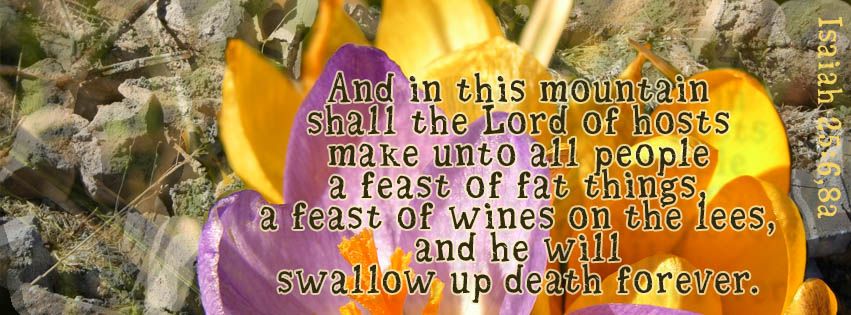
And in this mountain
shall the Lord of hosts
make unto all people
a feast of fat things,
a feast of wines on the lees,
and he will swallow up death forever.
Isaiah 25:6, 8a

Friday, April 18, 2014

Good Friday 2014

good friday banner

He was wounded for our transgressions;
He was crushed for our iniquities;
the chastisement for our peace was upon him,
and by his stripes we are healed.
Isaiah 53:5

Sunday, March 02, 2014

transfiguration 2014

It's been close to forever since I've blogged much in the way of theological reflections, but I liked my own notes in response to an online friend's transfiguration Sunday sermon, so here's a very slightly edited version of them along with a few additional considerations.

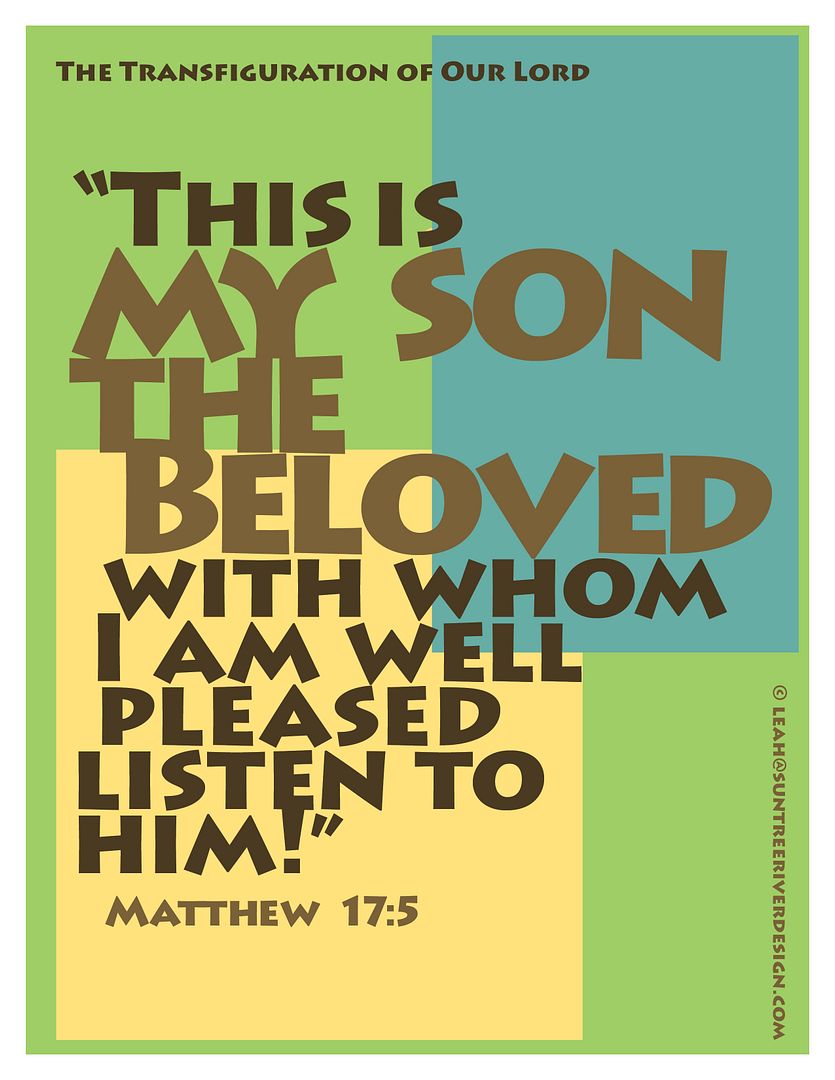
Matthew 17:1-9

Transfiguration 2014My friend ran with that all too common biblical and contemporary experience of fear, which I do not perceive as at all central in the texts. My response included:

Fear... we all (most of us, anyway) have too much of it, and need lots of reminders not to fear. But I believe beginning a T-Fig sermon with fear misses the point of the event and obscures the wisdom of the lectionary compilers' placing this event right before we begin lent, before the church zooms in on the journey to Jerusalem, to the cross, to the empty tomb.

The gospel-writer records this mountaintop happening as "six days later" than Jesus' telling his disciples to follow him means to take up *their* cross, lose their lives... and Jesus then will model the ultimate example of gaining new life for the whole world by giving up his own earthly life.

The words of this passage demonstrate God's historical faithfulness in speaking via both law and prophets; Elijah's presence harkens back to a related trinitarian theophany we experienced once again this year only a few weeks ago at the baptism of Jesus by John—remember, Elijah had to return, but as Jesus tells us, for him, John was Elijah!

Probably most important, a few days prior to Ash Wednesday, Jesus tells us he will be raised from the dead.

I don't know if you regularly read the first (typically Hebrew bible) lection during worship, but Exodus 24:12-18 is Moses, God, [Mount] Sinai covenant, 40 days and 40 nights, all of which tie in perfectly with this T-Fig narrative and the forty days of Lent the church is about to enter. Also, in 2 Peter 1:16-21, we find no hint of fear, but rather divine self-revelation in vision, word, and spirit.

I told my friend I loved her next-to-last paragraph reminding us about down to earth Jesus using touch and speech to calm us down. As she observed in her final paragraph, God never leaves us or forsakes us, and we need that reminder. However, I added how I believe retaining "fear does not have the last word," (as true as it is), obscures the focus on the world-transforming (and transfiguring!) crucifixion and resurrection events to come.

In other words, despite Peter's typical not-getting-it again here, fear simply is not central, but rather, so peripheral I probably would mention it only in passing, if at all.

"Listen to him!" Jesus ordered them, "Tell no one about the vision until The Human One has been raised from the dead." Listen to him—It's about death and resurrection! We charge the baptismal sponsors to "place the scriptures in their hands; bring them to the services of God's house...." so they can "Listen to him!"

Saturday, February 22, 2014

The Land: Brueggemann

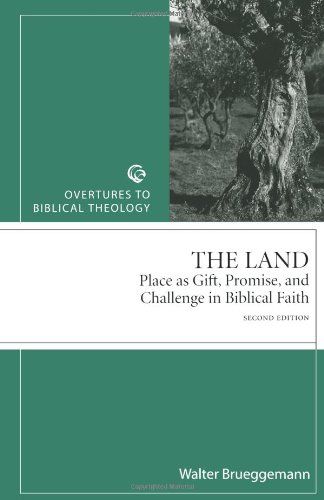
Because I read this edition from 1977, my blog may not completely apply to this 2002 revision: The Land:Place as Gift, Promise, and Challenge in Biblical Faith – Overtures to Biblical Theology

the land cover Wherever you are on this planet, actual earthly turf lies under your feet, forms the foundation of your house, your workplace, of everywhere you venture. For every one of us, "land" carries heavy literal and symbolic connotations that include dirt, soil, ground, territory, settled, belonging, rooted, secure. In this second decade of the twenty-first century we've recently experienced a major economic crash followed by far lower reevaluation of residential – and other – real estate, precipitated by people who imagined inalienable land could be "owned" as property and turn big profits. Families still get relocated by governmental and other entities from storied places into historyless spaces. We've been agonizing over seemingly endless, unstoppable atrocities against the land committed by Monsanto as well as by other huge agribusiness and manufacturing conglomerates. Especially considering those events, you need to read and take to heart this book by Hebrew Bible scholar Walter Brueggemann as he helps clarify and untangle law, gospel, history and hope!

If you've studied scripture even minimally, you know Egypt "...is not the place!" The Exodus wilderness on the way to the land of promise was not "the place," either. Unlike with those managed, controlled, counted bricks and bread under Pharaoh, in the wasteland of Israel's Sinai wanderings, human administration and management of anything (let alone land and its harvests) was impossible, so with manna and quail from the sky, with water from the rock, Moses' people experienced wildness as a life-giving, life-sustaining gift from Yahweh. For Israel, land would remain gift if they would continue trustfully obeying. Likewise for us, land will become gift if we will obey and trust.

In the Hebrew Bible there is no timeless space and no spaceless time; it all is "storied place." Brueggemann reminds us as "fructifier of the land" Yahweh is a fertility god who fully participates in the agricultural cycles with earth, farmers, vintners, and crops that typically we experience as the [almost] endless recycling of the same events. Yahweh also is Lord of history―not one who protects and assures continuities in our lives, but instead works the brand-newness of political, historical, social, and individual resurrection out of sometimes unimaginably radical discontinuities. Yahweh is Lord of the Lands and Lord of the Commands―a God who keeps covenant forever, who calls us to covenant-making, and covenant-keeping. A God who calls prophets to be a voice for the land and for the people.

Although The Land relates mostly the topic of turf and dirt, gift, obedience, and community in the Old Testament scriptures, the author also brings some possible Christological interpretations of the OT texts along with land-focused insights from NT gospels and Pauline epistles (particularly Romans 4 and Galatians 3 and 4). Remember, you simply cannot empty Abraham of land! Just as in Hebrew Bible times, during the earthly ministries of Jesus of Nazareth and of the early church, we need to be about the covenantal inter-responsibility of speaking and answering, call and response, amongst Yahweh, people, and land. "Listen to the voice and the claim of the land." WB reminds us scripture emphasizes not emancipation but rootage (you already know Paul of Tarsus' eleutheria / freedom ain't no emancipation proclamation!), not meaning but belonging―we live baptized into Christ, into the people of God in every time and place.

Blogger note: the inevitable outcome of living as covenantal, creation-care people is that we'll become an inclusive, welcoming, justice-filled Eucharistic community that displays the exhibition of the reign of God to the world.

my amazon review: land as gift, promise, and hope

Saturday, November 02, 2013

The Prophetic Imagination

The Prophetic Imagination on amazon

prophetic imagination book cover
We need to quit imagining prophets as only foretellers or social / political protesters, because "Most of all, [prophets] understood the distinctive power of language, the capacity to speak in ways that evoke newness 'fresh from the word.'" Newness that springs from trustfully covenanting rather than frantically consuming. An alternative way of being that emerges from being satisfied with relative scarcity that's actually shalom-full "enough" for everyone in the community.

If this easily readable, "slim volume" has an ongoing theme, it's that only when we acknowledge people, possibilities, and opportunities are forever gone, and begin grieving their loss, will the paradoxical possibility of new life from death arise. In fact, in Yahweh's terms, history – newness that marks the end of uninterrupted forevers in the manner any imperial (political, economic, educational, religious) establishment measures and regulates time [chronos] – always begins with barrenness and bereavement. Read and trust the scriptural witness!

This is radical stuff about newness from the ground up, "life in the shape of death" in the final no to sin, exploitation, empire, consumerism from the Calvary cross that at dawn on the day of resurrection becomes yes to life! Just as in his later writings, in this vintage book Brueggemann reminds us we experience that newness in baptism, then relive it in the eucharist. The Prophetic Imagination is vintage Brueggemann, and it still doesn't get any better than this.

my amazon review: Classic Brueggemann

Sunday, March 31, 2013

easter evening; day 47, alive!

I'm using this marvelous text from 1st Isaiah as a prompt for day 47, "alive" of the Lenten photo-a-day challenge on rethink church.

Isaiah 25:6-8

"On this mountain the Lord of hosts will make for all peoples a feast of rich food, a feast of well-aged wines, of rich food filled with marrow, of well-aged wines strained clear. And he will destroy on this mountain the shroud that is cast over all peoples, the sheet that is spread over all nations; he will swallow up death forever. Then the Lord God will wipe away the tears from all faces, and the disgrace of his people he will take away from all the earth, for the Lord has spoken."

Tuesday, March 19, 2013

day 35, dream

For day 35 of the Lenten photo-a-day challenge on rethink church, I don't have a photograph, but I do have an illustration of Acts 2:17

day 35, "dream."
visions, dreams


"In the last days it will be, God declares, that I will pour out my Spirit upon all flesh, and your sons and your daughters shall prophesy, and your young men shall see visions, and your old men shall dream dreams." Acts 2:17

Friday, April 06, 2012

good friday 2012

After an African-American tradition, every day I wear a silver bangle baptismal bracelet that reminds me that in baptism Jesus Christ's biography becomes our biography, becomes my bio: suffered under Pontius Pilate, crucified dead and buried... on the third day he rose again...

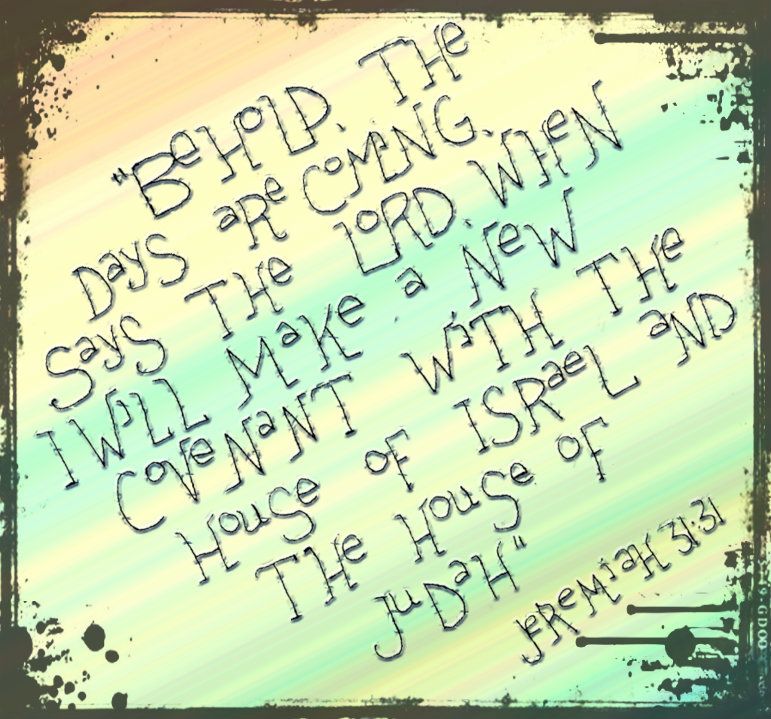
jeremiah 31:31 I've gone grunge on my blog background for a while and last night, Maundy Thursday evening, at church I participated in foot washing that some denominations routinely practice as a sacrament or ordinance. Heidelberg Catechism: "Why is the Son of God called Jesus, meaning 'Savior?'" "Why is the Son of God called Christ, meaning 'anointed?'" "But why are you called a Christian?" "Because by faith I share in Christ's anointing and I am anointed to reign with Christ over all creation for all eternity." When God signed me on for this Living Baptized gig, it was going to be counter-cultural and sometimes subversive. It might have included feeding the hungry, toppling the mighty from their positions of power, friending the needy and afflicted. It had a lot to do with justice, righteousness and making a eucharistic, shalom-filled world for all creation. However, I didn't reach this point of brokenness from working hard almost forever with Mother Teresa's peeps, or spending days on end stirring soup at the homeless shelter, or demonstrating and creating legislation for fair employment conditions for the neglected and underserved. In other words, it's not from visibly bearing the cross in ways that alienated conventionally polite society and the over-dollared Überclass.

My life cries out for resurrection! When you attend a graduation or ordination, the ordinand or graduate always thanks everyone, always explains they could not have gotten there alone and they didn't get there by themselves. In this military town, we frequently observe farewells and homecomings on the news. In those I get the impression people are supposed to get attached to other people, to miss them when they're gone, to long for their return. What about me?

Most likely I heard from Channel 10 the Daily Llama was coming to town, but these days I'm in a radically different world and space than ever I'd anticipated and so much of the past is coming back to bite me. Or is it? End of this paragraph: I didn't go to the Daily Llama event any more than I've been attending or participating in anything else well-educated, supposedly middle-class types occasionally do. But I have been celebrating eucharist and recalling why, at least to the extent a mere, broken human is able.

All of 8 or 9 years ago on the old UCC forums, Marian Conning said to me, "Leah, I think you're the kind of poet-theologian Pastor [Alan] Roxburgh (author of The Missionary Congregation, Leadership, and Liminality—you can search my tags for blogs and an amazon review of the book) is talking about; the church so needs your leadership at this time—thanks for sharing some of it with us." For the sake of the world, the church and for myself, too, I yearn for the life of participation that anyone with my gifts, education, experience and hard work reasonably could expect and anticipate. I've done my part and it cannot happen without an invitation or at least permission.

During Advent 2007 I developed and facilitated a (3 Fridays at one church, 4 Sundays at another) class in incarnational theology; for Advent 2 we talked about God's Presence in liturgy, preaching, and sacraments/ordinances. We concluded the discussion with this reflection for Maundy Thursday by Paul Hammer. Dr. Hammer offered one of the Taking the Bible Seriously talks they posted on the old United Church of Christ site and that's probably still online somewhere—besides a few times on this site.
love one another

Jesus, how common can you get? Foot washing, bread, wine!
If you're going to be religious, at least use something special.
No, my friend, I came not to perform special religious rites
But to touch the daily life of everyone
With God's love in the commonest of things.

O.K., water, bread, wine.
But isn't foot washing a bit ridiculous?
And what about "this is my body"?
And "this cup is the new covenant in my blood"?

Foot washing is the work of the commonest servant—I came to serve.
But it points beyond to the "washing" of the cross—
God's self-giving service in me to cleanse away estrangement
And heal the distortions in people's lives.
The bread points to nourishment in that same self-giving of God
At work in my body, that is in me.
And the cup points to the new community drawn together and nourished
In my blood, that is in God's total self-giving in my death.

Do you mean that this common stuff of water, bread and wine
Becomes in you the very focus of God's love for me and for the world?
That there is no excuse for my not loving my common neighbor?
Because you have shown the depth of God's love for me?

You've got it!
But it isn't a love for special occasions.
It has to be that daily love that's as common as water, bread and wine!

Sunday, November 06, 2011

All Saints' Images

I realize these 1st and 2nd lections aren't the RCL texts, but they are Lutheran Book of Worship and that sometimes differs a little.

Isaiah 26:1-4; 8-9; 12-13; 19-21

Isaiah 26:9

Revelation 21:9-11; 22-27; (22:1-5)

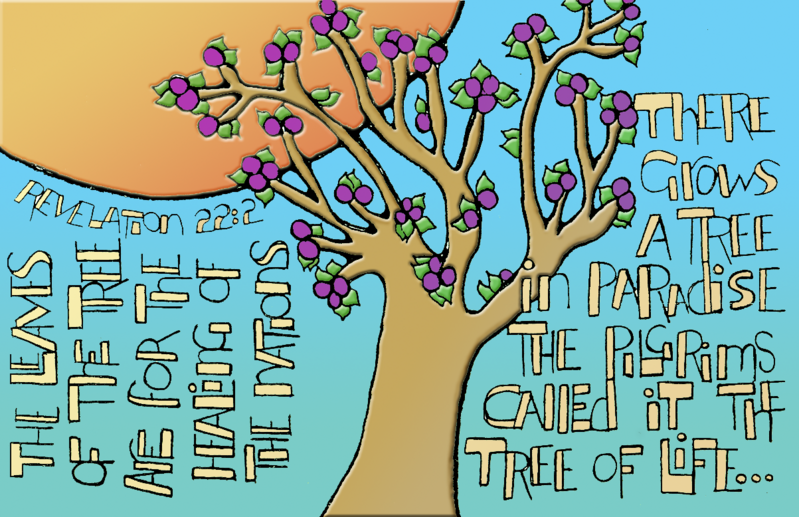
Revelation 22:2

Matthew 25:1-12

Matthew 5 beatitudes

Saturday, January 30, 2010

biblical perspectives on evangelism

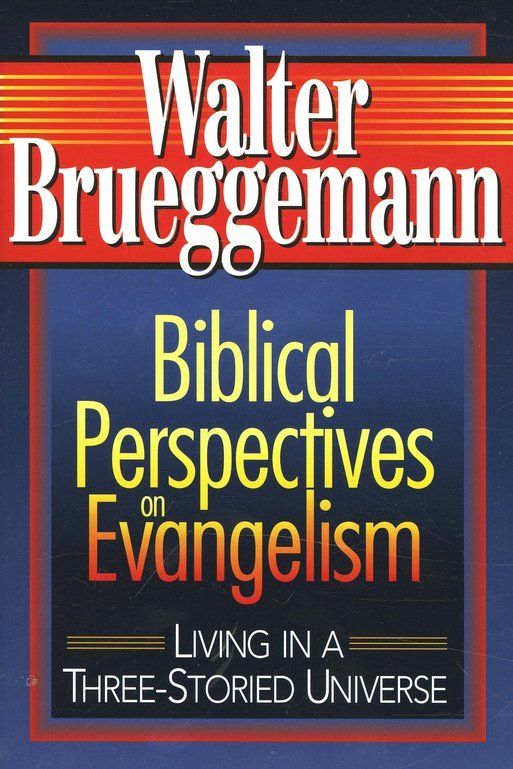
by Walter Brueggemann, Biblical Perspectives on Evangelism: Living in a Three-Storied Universe on Amazon.
biblical perspectives coverAfter my recent 4th reading of this tightly focused book, I knew it was time for a blog. Did you know the colonial Americans - some of the antecedents of today's United Church of Christ insisted God acts in history only by covenanting? In scripture we can trace a series of significant covenants from Adam through Jesus, but was not the Divine passion for relationship that engendered creation in itself a covenantal act? Throughout the author emphasizes obedience along with explaining why we need to remember... after all, when we forget the possibility of a free future is all over. (Therefore, I'm making a conscious attempt to remember more clearly, even to revisit the past I've often almost choked on in order to start claiming a freer future for myself and those around me, too.)

Rooted firmly in the Hebrew Bible, in God's loving grace and the possibility of human response, reminding us about ways to be and ways to live as the people of God (=as the Church), just as in many of his other books, Walter Brueggemann emphasizes the importance of the commandments. On page 31 he describes the ten commandments as "the working documents for covenanted community..." on page 68 "covenant is ... a relation which frees each in vulnerability to receive life from the other, to be postured in mutual dependence." The commandments are "...boundaries and limits which define the horizon of covenantal humanity." On page 115: just as earthly parents teach their offspring that which concerns them most, our heavenly parents do exactly the same. "I do suggest, however, that the ten commands turn out to be God's most 'cared for matters.'" And he includes references to his other two non-negotiables: the tithe and the sabbath.

The world is about a multi-faceted "3-stories" of architectural floors or tiers and narrative tales about the lives of people: long-time insiders to the gospel, typical outsiders, and the next generation coming up. In addition, there are three central narrative stories in the salvation story (Heilsgeschichte) that in turn opens us to 3 scenes to the evangelism drama:
  1. God's victory over chaos and death
  2. the announcement of that victory—"gospel"
  3. its appropriation by those who hear the announcement
3 stories are focal and normative and definitive:
  1. the promise made to the [Israel's] ancestors
  2. deliverance from slavery
  3. the gift of the land
WB offers a pair of concrete definitions of evangelism, an activity impacting every aspect of life—personal, public, economic, political... first on page 10 "Evangelism ... is the invitation to re-imagine our lives in these narrative modes." And last, in the conclusion on page 129 "Evangelism ... is an activity of transformed consciousness that results in an altered perception of world, neighbor and self, and an authorization to live differently in that world."

WB brings us a trilogy to illustrate the 3 stories:

1. Joshua 24 "a meeting at Shechem whereby outsiders become insiders"

2. in Nehemiah 8 forgetful at least one-time insider members are "re-tented into the passionate vision of risk and vulnerability that is decisive for the community."

3. ongoing conversation with the offspring of believers/insiders = "children becoming adults." In this [hopefully] dialogue, [page 55]"It is always 'them' and it is always 'us,' always then and now, always there and here, concerning all of this community of telling and listening through time."

That continuing, continuous conversation is because "...in Jesus Christ, God has overcome the power, threat, and attraction of the power of death" and [pages 37-38]"...the continued re-enaction of this dangerous [page 38] news ... is the definitional account of [the church's] life in the world." But what news, news for what? [page 43] "...news for alternative obedience in the world" as we [page 46] "...recover the focal drama of baptism, which is a subversive act of renunciation and embrace" and are summoned [page 47] "From our several enslavements ... to a common, liberated obedience."

Regarding our ongoing need to live faithfully in the twenty-first century, yet possibly concerned that the texts we rely on were transmitted and recorded thousands of years ago, WB reminds us "...all through the Bible the gospel has been exactly and precisely concerned with social relations related to power, goods, and access. Indeed, there is almost no aspect of the biblical presentation of the gospel that is otherwise." [pages 40-41] "The victory of God in our time over this deathly idolatry is hidden from us. ... It is hidden in the cross where it is always hidden, and in all subsequent manifestations of the power of the cross." In his marvelous book The Land, WB explains how the Church has concentrated on covenant to the near-exclusion of the centrality of land in the biblical witness and, without a doubt, in current twenty-first century politics and economics.

Some reasons for us to remember, remember, remember...include
page 78 "If Israel, birthed in liberation [Exodus] and situated in covenant [Sinai], forgets these memories, it will very soon start playing the old power games of Egypt, and start practicing brick quotas again in order to get ahead by the standards of the empire."

page 78 "Everything depends on a live memory. Everything is jeopardized by careless forgetting. Everything ride on remembering and forgetting."

page 79 Jeremiah 2:1-13 Israel did not say, did not proclaim, announce or confess their history with the God who liberated them because they had forgotten the story, the history...

page 82 parallels Deuteronomy 8 || Jeremiah 2

page 82 "And when they forget, they forget the past, they forget Yahweh, they forget themselves, their history, their identity, their faith, their vocation, their raison d'etre."

page 83 "... the Bible is constant in asserting that this terrible ending ... is rooted in the loss of [torah] memory."

page 84 "Remembering is the hard choosing of an alternative present, authorized by a subversive past. When that subversive past is given up, an alternative present is rendered completely unavailable."

page 72: by the time of Nehemiah 8, Israel is a "people of the book." But in the re-texting of Israel in the Festival of Booths "Israel must bodily re-experience and re-enact the memory, recovering its vulnerability in bodily exposure."

parallel to his words on page 75, "This old [torah] text of Israel's memory never exists as authoritative for the community without imaginative interpretation." "people of the interpreted book", on page 97 WB tells us conversation with youth "in a context of unconditional advocacy ... that mediates free grace." [page 98] "The conversation with our young must be persistently interpretive."
Closely related to the near-plethora of existential and situation insecurities in which almost everyone currently finds themselves, I love WB explaining [page 87] how in Nehemiah 8:13-18 "olive, wild olive, myrtle, palm and other leafy trees" make the temporary shelters for Succoth, the Festival of Booths or Tabernacles, granting participants both "exposed homelessness" and "true homefulness". Interesting too, was the experience of the newly-borning people of God with a God who traveled alongside them in a tabernacle, a portable shelter and gospel-writer John (1:14) tells us how incarnate in Jesus of Nazareth, God pitches a tent, a tabernacle.

Amidst all this talk about following and keeping the commandments in gracious response to the God Who in Jesus Christ calls us, saves us and sanctifies us by grace, [page 114] Martin Luther begins his Small Catechism, traditional preparation for First Communion with the Ten Commandments, "...for the one with whom the church communes is Lord of the commands. Finally it comes down to that, but it does not come down to that quickly or simply."

The church charges parents and sponsors of a child or children to be baptized to teach them the Lord's Prayer, the Creed and the Commandments; to bring them to the Services of God's House and Place the Scriptures in their hands. Why? These are some of the ways they can learn, hear and live the story and the stories, make them their stories and remember the stories of the covenanted people of God as they learn the place of their own individual story in the journey of the community. At the services of God's House they celebrate and participate in the Eucharist, God's feast of justice, reconciliation, forgiveness and inclusion for all creation. This is God's manner of making new beginnings that's also a living sign of God's promised end, the eschatological feast of justice and equality, the table of "go and do likewise." They learn to be prepared to forgive and to be forgiven... learning to live every moment "wet behind the ears" again with baptismal water, committed again to Good Friday and to Easter, constantly recovering "...the focal drama of baptism, which is a subversive act of renunciation and embrace" summoning us [page 47] "From our several enslavements ... to a common, liberated obedience."

In his conclusion, WB insists evangelism isn't an ecclesial, a church thing, nor a church agenda—"It is rather an offer that we might be on the receiving end of 'all things new.'"


my amazon review: grace, memory, faithfulness and life

Sunday, December 06, 2009

lessons and carols 2009...

Sunday, 06 December in Founder's Chapel at nearby University of San Diego; again this year I'll describe Lessons & Carols at USD as "an exceptionally worthy piece of preparation for God's birth in our very midst, 'fulfillment beyond all human reckoning,' as one of the worship leaders described it," in my words from 2008.

Angelo Musicante by Melozzo da Forl

Here's
Advent 1 2008 followed by Advent 2, Lessons and Carols @ USD 2008. The lute-playing "Angelo Musicante" by Melozzo da Forl was on the program cover again this year.

Our ecumenical Faith, Order and Witness Committee used to meet at USD quite regularly until it became impossible to schedule a room; the near-elegance and broad, gracious layout of the USD campus always makes me wonder. It's an expensive, church-related school with an overarching emphasis on justice, but like almost all the students I've seen walking around campus and in the dining hall, most of the students in today's program were atypical for San Diego, and as a group not at all characteristic of the tremendous ethnic, racial, cultural and economic diversity that is the San Diego I interact with every day and the San Diego of the condo complex I currently call home.

For the processional we sang "O Come, O Come, Emmanuel." Be with us, God-with-us, ransom your people, pay the price to free them, to liberate all of us from captivity to everything that holds humans and societies cultures in chains.

Comfort ye, my people! Every valley shall be exalted; the mountains and hills made low-- from the exilic Isaiah 40:1-11 and G. F. Handel. Jesus of Nazareth lived The Way that raises deep caverns and valleys, levels mountains and hills, straightens treacherous roads (repairs those potholes, too); that way is life on the edges of conventional society, words and action that subvert conventional political and religious pretensions to power. Doing justly and loving rightly includes advocacy for equity for everyone everywhere, reversing superfluous wealth and unseating corrupt government. The way of the baptized includes speaking truth to power and living as servants to all.

Erin Lovette-Colyer, Director of The Women's Center at USD was homilist. She suggested we put Mary's story into our own story into Mary's story into our own... and told us she'd talked with three "wise women" in her life as part of her preparation to preach at the worship event. Her own mother, diagnosed with terminal cancer; her recently widowed aunt and her brother's wife, her sister-in-law soon to deliver her first child. Erin told us no doubt Gabriel was well prepared to engage Mary in conversation. What teenager wouldn't want to and need to discuss the momentous future she was being asked to enter? I'd never thought of that, but of course Mary had to talk about it, but the main thing is Mary said "Yes."

Erin described so many of us as afraid to die, afraid to live and afraid to give birth and during this Advent 2009 I still find myself in the same almost forever of being afraid to die (not only to past disappointments and human expectations, but lots more, too), afraid to continue living with lack of basic community, with isolation and loneliness and still afraid of giving birth to a new life for myself and the strangers around me. What if, what if, what if not? Seems as if I still think somehow I can do it on my own, which definitely has not worked at all and after all, in baptism I'm already dead, I've already been raised from death to new life. At the end of her talk Erin Lovette-Colyer asked if we would be doing Advent with an attitude of hope rather than anxiety and "being honest with myself" my anxiety level still is far too high for a modicum of comfort, yet I'm doing Advent with hope, too.

Isaiah 11:1-10 was one of the readings ...1A shoot shall come out from the stump of Jesse, and a branch shall grow out of his roots. 4abut with righteousness he shall judge the poor, and decide with equity for the meek of the earth...9bfor the earth will be full of the knowledge of the Lord as the waters cover the sea.

Before the recessional the choir sang last year's recessional song, "The Virgin Mary Had a Baby Boy," an arrangement of a spiritual from the West Indies, proclaiming Mary's Baby Body "came from the glorious kingdom."

Jesus came from the glorious kingdom to make this earth a glorious kingdom, as full of the presence of God "as the waters cover the sea." In the power of the cross and the power of the Spirit, we live as God-with-us, God among us. The feast and the season of Epiphany is not all that far away, so in the words of one of my very young students quite a while ago, to live as the Body of Christ means "that we can be city lights!"

Observing Advent, hoping and longing for the Divine Presence in our midst ultimately is about desiring and longing for the death of death itself, hankering after Easter. Afraid to die? But God can only resurrect the dead! And I'm dead, already--baptized! How do we practice easter in the midst of tombstones? How do we live as if among the artifacts of death? Remember, remember... the straight path, the smooth, level road is the way of the cross, the axis mundi connecting heaven and earth as we live incarnation, resurrection and pentecost together. Celebrate eucharist: taken, blessed, broken and given...