Showing posts with label Ephesians. Show all posts

Thursday, July 30, 2026

Five Minute Friday :: Afford

farmers market 2018
• Five Minute Friday :: Afford Linkup

It feels as if everyone except the ultra-affluent is mired in an affordability crisis. Cities like New York, London, and San Francisco aside, who can afford housing, transportation, groceries, almost anywhere? Can anyone afford an out of town vacation? To quit their job and take time to find another that in the long run will be a better fit and pay more? Can you afford to start your own business? What kind of entertainment can you afford?

With more and more conventional goods becoming luxuries, what now?

Most of us who write to these prompts knew life in the previous century. Even if we started using technology early on, most Five Minute Friday writers aren't digital natives. Can you sense where I'm headed? Maybe you're already there?!

Step back a couple of decades to a backyard garden. Rent a community garden plot. Check out the farmer's market or a sidewalk vendor. Their fare may be more affordable, it's probably fresher, and you can benefit the nearby economy. Besides, can you really afford to pay Big Ag and all the supply chain intermediaries?

Step back from streaming and try hard to remember days of board games and analog puzzles together. Preparing dinner together. How's your memory? Try to recapture some of the free or inexpensive entertainment that probably included conversation and a major bonus of getting to know each other better.

What shape does your everyday take? Can you afford your current arrangement? It would be surprising to find someone who hasn't considered those concerns.

Whatever the economy does, laying the foundation of the days, the weeks, the future hopes, how about following the admonition of scripture to…

Be kind to one another, tenderhearted, forgiving one another as God in Christ has forgiven you. Ephesians 4:32

Can you afford forgiveness? How can we not afford to forgive? Please remember: it's aways possible to forgive, yet sometimes it's impossible and/or unwise to reconcile.

# # #
radishes
Sylvia ice cream
>
FMF afford
FMF

Saturday, July 01, 2023

Five Minute Friday :: Music

Psalm 63L7
Thou hast been my help
and in the shadow of thy wings
I sing for joy.
Psalm 63:7


• Five Minute Friday :: Music Linkup

When it comes to music, who on earth wouldn't have countless ideas to write about—and to sing about? Although for many reasons I've never made music a more or less full time pursuit, I have an extensive classical music repertoire, I love to perform in public and lead music in worship. I even have a

• Music Blog

and a

• Music Website.

• Ephesians 5:18b-20a …be filled with the Spirit, speaking to one another in psalms and hymns and spiritual songs, singing and making melody with [in, from] your heart to the Lord; giving thanks always for all things…

For only five minutes? I'll remind you it's easier to memorize by singing than by speaking. I don't know if it's a case of "I'm so old that…" yet at least back in the day, kids unforgettably learned the English alphabet to a folk tune. The psalter was the hymnal of the temple and later of the synagogue. Although chapters labeled psalm are far from the only songs in the bible, for many centuries scripture's 150 psalms or songs made rounds during festivals and sabbath assemblies by being sung and thereby committed to indelible memory.

Not until some of the exiles returned from Babylon to rebuild Jerusalem city and a new temple structure, to revitalize human essentials of agriculture, commerce, trade, community, and worship did the psalms get written down and assembled into somewhat of the canonical collection we're familiar with. The psalter was the hymnal of John Calvin's Geneva Reform. Open any denominational or free church hymnal and you'll have trouble counting how many hymns are metrical or florid psalm settings or sometimes textual paraphrases.

In addition to sung psalms, music is an enormous part of Christian worship. Almost countless forms of vocal and insrumental styles!

What are your best and favorite hymns or praise songs? Do you tend toward more traditional or contemporary stylings? How many can you sing from memory? I wouldn't dare make even a long list of faves, but I particularly resonate with Joachim Neander's "Praise to the Lord, the Almighty, the King of Creation" (tune: Lobe den Herren) and Marty Haugen's more recent "Here in this Place" (tune: Gather Us In). For a psalm setting I'll go with Psalm 100, "All People that on Earth do Dwell" (tune: Old 100th or Old Hundredth) and refer you to Ralph Vaughn Williams' choral version that's accessible even to a small pickup choir, and that many festal celebrations in Westminster Abbey have proclaimed with very large mixed choir and very full symphonic orchestra.

# # #
five minute friday music
five minute friday icon

Friday, September 02, 2022

Five Minute Friday :: Root

Five Minute Friday Root Radishes
• Five Minute Friday :: Root Linkup

"… that Christ may dwell in your hearts through faith, as you are being rooted and grounded in love … you may have the power to comprehend, with all the saints, what is the breadth and length and height and depth and to know the love of Christ that surpasses knowledge, so that you may be filled with all the fullness of God." Ephesians 3:17-19

The apostle Paul's successor or colleague who wrote to the Ephesus church prayed intently for that community to possess the essential of love.

In September 2003, I wrote about radishes—that grows up from the ground, pull up from the ground root vegetable whose name is about root. Whether idea, action, hope, or outcome, anything radical relates to the root, the ground level (or lower!) basis of whatever it is. Root veggies such as beets, potatoes, carrots, turnips, and onions are excellent winter keepers. However chilly – or maybe not – winters become where you live, root vegetables can be prepared near-countless ways as they nourish and sustain us through the cold, take us into the spring.

We talk about radical ideas, radical Christianity. People have a habit of separating out styles of Christianity into categories like conservative, progressive, liberal, radical… but all Christians live rooted and grounded in love, and love is a radical reality anywhere. Besides, God created humans out of the ground—rooted us in the land. Just as for planet earth, water is the womb of our creation. As we enjoy an aquascape's plants rooted in water, let's imagine human parallels.

Different church traditions may have interpretive, sacramental, and liturgical histories and preferences; they may read various styles of polity or church governance out of scripture. Those of us in the mainline have public theology in our DNA; others tend to emphasize individual holiness more, yet each person, each community needs some of everything, and all of it creates a mosaic with all of us together grounded and rooted in Jesus Christ.

I couldn't quickly find any pictures I'd taken of onions, potatoes, carrots, beets, parsnips, or turnips, but I had radish captures from the Farmers Market. On my header photo I especially love how the veggie vendors left a lovely patina of just plain dirt, and, of course, the green tops that cook up nicely and season well.

I happily recall tenant and friend Mary in A Former City where I managed rental properties reminding me as I dug up front lawn dandelions, "That's hard work! You need to get to the tap root!"

It's not unusual for us to desire a return to our roots, whether that means home town, original cuisine, First Church Small Town (or Large City), or simply a simpler lifestyle anyone can rock anywhere. For many humans in this world where few stay in a single city, dwelling place, or employment center very long, going back to our roots literally can mean tap roots that support all the other roots that grow outward from it.

# # #
five minute friday root
five minute friday icon

Saturday, December 02, 2017

Five Minute Friday • Near

I've been playing and working catch-up, but I had to Five Minute Friday this week because Kate Motaung's near prompt aligns with my preparation for introducing the Gospel according to Mark on Sunday. Everyone already knows Mark's gospel quite well, but with the start of a new Revised Common Lectionary year B that's Mark's year, I needed to create a quick overview. I'm also Friday Fiving because of the beautiful illustration Kate provided; I took the liberty of decorating her banner photo for my header.

five minute friday near

A few minutes ago on urban wilderness I blogged a short overview of the Gospel According to Mark I'll use to open my adult SS class session tomorrow. Similar to many people today, back in those days of the Ancient Near East (love that ANE terminology!) people tended to think of God far away, unapproachable, distant, and uninvolved. Or if they believed God was a little closer, they imagined God contained and protected in a space or place like the Jerusalem temple they'd worked so hard to build.

Particularly as we've studied a pericope or selection from one of the four gospels each week, we've been discovering and uncovering a God who's anything but distant and far away, anything but unapproachable and uninvolved in creation—and in our own sometimes difficult lives and pressing concerns, in our joys and everyday routines! Especially as God self-reveals in Jesus of Nazareth, God has drawn near to earth, to creation. So near that God has chosen to live as one of us, as a human, in a body formed from stuff of the earth. But paradoxically, God-with-us, close-to-us still is the God of the Hebrew scriptures who fills heaven and earth, who remains free, elusive, and can't remotely be contained in space or in time. But you already knew that!

Given that humans tend to be more mimetic than thoughtful, the temple concept partly imitated gods of other ANE religions that mostly were gods for a certain place. Not only Mark but all the gospels reveal God so near that in Jesus God becomes and lives as part of creation—yet we find actual "near" vocabulary more in the deutero-Pauline theology of Ephesians and Colossians than elsewhere in scripture. In any case, as another Advent dawns, literally breaks open this week, let's remember God's abiding passion for all of us. God incarnate as a baby in the Bethlehem manger. God embodied in each of us so we can live as God's presence very near to our neighbors, friends – and enemies.

disclaimer: I wrote this very quickly in a little less than five minutes, but unlike most weeks, I found too many discrepancies and discontinuities, and In the interest of overall coherence, I edited so it would make sense, so this represents closer to fifteen minutes than to five.

five minute friday near five minute friday new button

Tuesday, November 08, 2016

Green Team Talk – Reformation/All Saints

Here's the devotional talk I gave last Thursday for the Green Faith Team meeting.

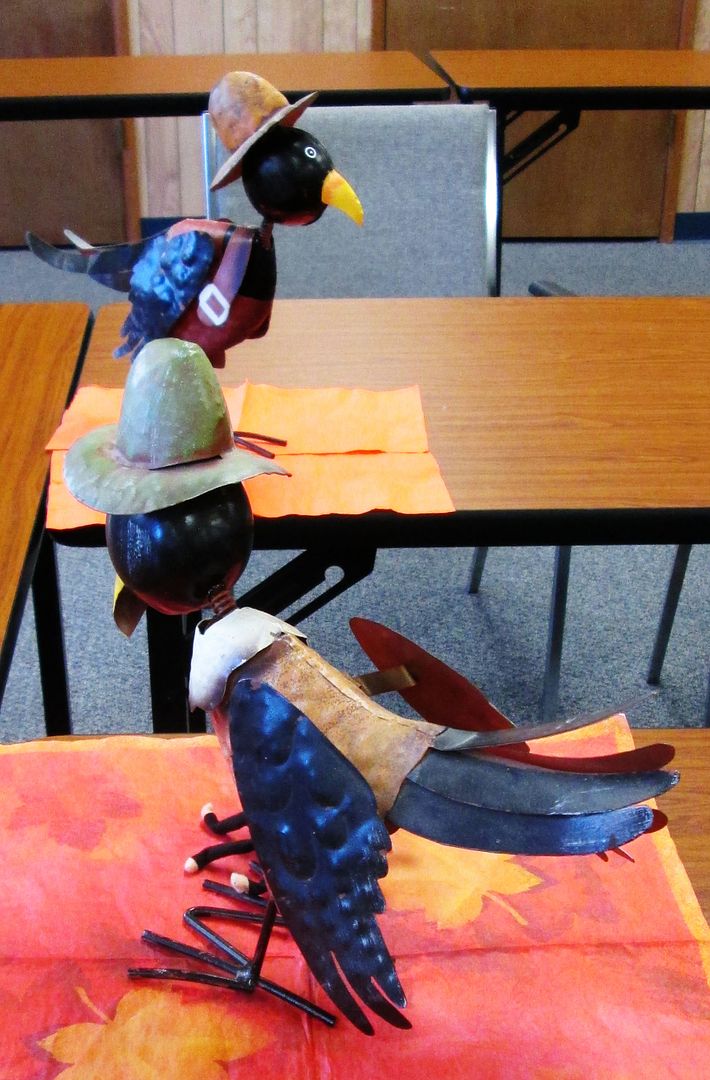
Congress of Two Crows• This week brings a confluence – a literal flowing together as rivers and streams of water do – of Reformation and All Saints. We celebrated Reformation last Sunday, recalling changes in the church the Holy Spirit made through human agency and also anticipating a church that never remains stagnant, always is alive. Next Sunday will be All Saints, when we especially remember those who have passed into the Church Triumphant, but All Saints is our day, as well. These actually are back-to-back festivals on 31 October and 01 November, but most churches celebrate both Reformation and All Saints on Sundays, since few people will attend weekday or weeknight services.

• Reformation is a major festival of the Holy Spirit when we "wear red," as we always do on the Day of Pentecost. The reading from Ephesians [1:13-14] for All Saints reminds us each of us in baptism carries the sign and seal of the Holy Spirit. All Saints is another festival of the Spirit!

• Pretty much from necessity, the Reformers particularly emphasized theology of redemption, of God's grace freely poured out, offered to all, given to all, through the birth, life, death, resurrection and ascension of Jesus Christ.

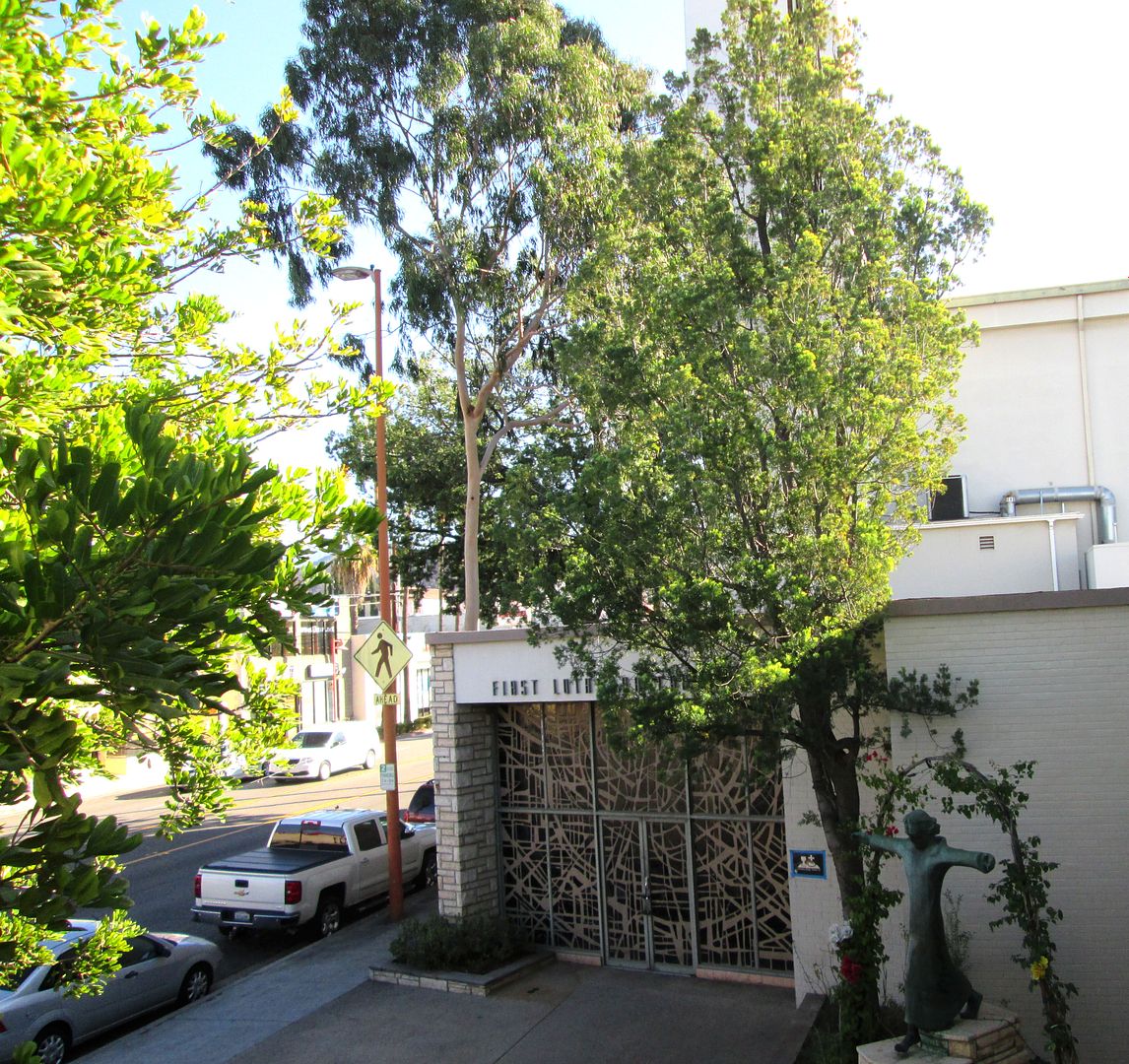
• The reformer Martin Luther got his theology from Galatians and from Romans, 1st Lutheran Glendale CAbut the psalms gave Luther his passion! Everyone knows the hymn he wrote based on Psalm 46; Pastor Eugene Peterson's version tells us the city streets are safe because God lives in the city; the city is safe because God bans war and breaks weapons. The city is a delight because God plants trees and flowers!

• We celebrate Pentecost and Reformation as major festivals of the presence of God in the Holy Spirit. But there is more! The priestly scribes who brought us the latest Pentateuch source [designated P] wrote late in the Babylonian exile or possibly after the exile, since dating is a bit confounded. They received a revelation that the destruction, the end of the Jerusalem Temple wasn't such a huge deal, after all. Imagine the crazy idea of a real God beyond space and time contained in a mini-replica of the earth and the heavens—that's what temples were! In Genesis 1 the priestly scribes show us all of the living structure of planet earth, the whole panorama of creation as God's dwelling place, the temple of the Divine. Genesis 1 also bring us the spoken Word that creates, orders, tames – redeems, renews, and reforms. And of course, we know Jesus Christ supremely as the Word of God.

• But there is still more! The Reformers – especially magisterial reformers John Calvin and Martin Luther – mostly concentrated on theology of God's grace-filled redemption of human creatures through the reconciling Christ Event. Halloween peopleHowever, John Calvin brings us a rich theology of creation revealing God's providence, of God's grace and providence revealed for all creation, not solely human creatures. Martin Luther brings us the insight of the Divine presence in, with, and under all creation. Beyond that, Luther affirms the ubiquity – the everywhere-ness – of the risen and ascended Jesus Christ. Can you say sacraments?

• The lectionary reading from Ephesians for All Saints reminds us baptism marks and seals us with the Holy Spirit. In the power and presence of the Holy Spirit, like all of planet earth, each of us is a dwelling place of God! Along with Reformation, All Saints is a festival of the Spirit; besides commemorating those in the Church triumphant, All Saints is a day for those of us still on planet earth, as well. How exciting to have the confluence of those major festivals this time of the year!

• And now? We need to trust, we can trust, the bounty of life in the Holy Spirit, the imagination of all creation, the reign of grace.

To God Alone Be glory; Amen!

Judicatory offices share the campus with First Lutheran Glendale Church and School.

Thursday, June 02, 2016

Five Minute Friday: Haven

Five Minute Friday host Kate's word for today is haven.

morning train

FMF: haven

"take 5" – minutes, that is.

A haven is a place of respite, of safety, of homecoming—a slice of heaven on earth. A few weeks ago in the adult SS class I lead we talked about God as a home-maker. I mentioned you don't buy or rent a home; you buy or rent a house or an apartment, and then you move in and create a home. Last Sunday I described the church at Galatia as the first ethnic church—ethnicity not in terns of Jews /gentiles as scripture typically uses the word ethnos for non-Jews, but in consideration of geographical and cultural differences. I suggested we can't require people to become like us to become members of the church; however they are, God calls us to the hospitality of welcoming everyone so that the church becomes heaven on earth, a haven for all comers. For next Sunday we'll discuss the Ephesians text that tells us in Christ we become members of the household of God. God the home-maker! Shelter, welcome, embrace, and safety sound pretty much like a heavenly haven to me. How about to you?


Header painting is my interpretation of a song from the American south. Words speak for themselves and also include:
Sister Mary wore three links of chain
On each link was my Jesus' name
All my sins been taken away, taken away
I'm on my way to the freedom land

five minute friday expect five minute friday button

Tuesday, December 08, 2015

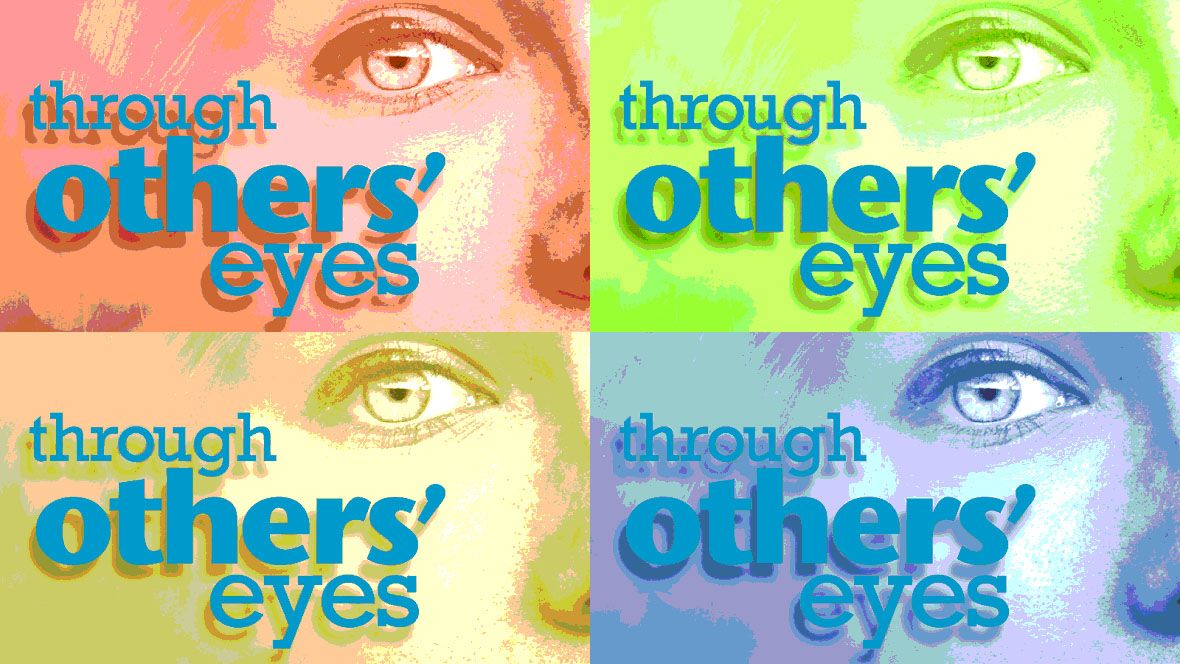
through others' eyes: december synchroblog

through others' eyes

The final synchroblog of 2015 also is the second inning of the new synchroblog group and page. Liz Dyer suggested the topic; K. W. Leslie hosts again:
Of course there are all sorts of directions you can go with this. How do you see through the eyes of other people? How do they see through yours? How do you sympathize with Christ, Christ sympathize with you, Christ sympathizes with other people, other people sympathize with Christ... yeah, I guess I covered all the permutations. Wait! How does Christ see through the eyes of other Christians when they see through your eyes? Oh yeah, we can go wild with this one.

Every time I think of eyes and scripture, I remember J in Monday evening women's bible study reminding us "the eyes are the most sensitive part of our bodies, so the eyes of our hearts would mean exquisite sensitivity to the situations and needs of others." Ephesians 1:18 was J's reference, though I don't recall our study topic. Some versions of the Greek give us eyes of the mind (thought, understanding, comprehension) – διανοίας – rather than heart – καρδίας – but all the Greek texts include eyes, the body part that along with our brain (mind!) creates our physical vision, our actual view of the world. By the way, in Hebrew biology the heart primarily is the seat of the will rather than of the emotions.

Scripture and eyes also evokes Psalm 145:15-16 as an invitation to offer thanks before a meal: "The eyes of all wait upon thee; and thou givest them their meat in due season. Thou openest thine hand, and satisfiest the desire of every living thing."

Seeing, visioning, perceiving, and acting with another's eyes (as K.W. suggests) ideally turns around at least a few degrees so others begin to see situations and people as you perceive them. But this mostly is about walking in the other person's sandals, learning some of their experiences, comprehending with your mind and even feeling with your heart (and soul) the why of their actions, the what of their dreams. The gospel accounts of Jesus' highly relational, always appropriately responsive interactions with other humans from all types of situations, classes, and aspirations are the models for our own behaviors. However, in the midst of many of those stories, we hear about Jesus' followers and his disciples often less than sensitive, frequently even inappropriate reactions to people and situations. Our blog prompt asks "how we can (are able to) see through the eyes of other people." Jesus' disciples had the living walking breathing talking Jesus from Nazareth as their example, and they still didn't get it right all the time. Just like them, we need to get our heads and our hearts (our wills, emotions, intentions) synced! I Photoshopped the eye image KW provided to portray different people viewing the same thing, but besides making all the eyes different, maybe I needed to change the color, size, skew, and other aspects of the words?

How can I view the world through the eyes of others, and how do they see through my eyes? I've been making an ongoing effort to talk more about myself—my history, experiences, likes, preferences, dreams, dislikes, and disgusts. People know only what they literally can see, which they then filter through their own history, experiences, dislikes, and disappointments. It's tough for me, because I've encountered too many people whose only topic of discourse is themselves. I know very well I'm far far away from that, yet still hesitate to make myself more than an incidental subject of what we're talking about at this time. However, that's still a major way I can be a factor in how friends, strangers, acquaintances, and random others view me and interact with me. Similar to when we reach a certain age – which I hope is by late teens or early twenties at the latest – and begin to have a clue where our parents and their parents have been, what has made them who they are, how they are. All in all, I have no concrete solution for this month's synchroblog question, but I pray and hope:
18so that, with the eyes of your heart enlightened, you may know what is the hope to which he has called you, what are the riches of his glorious inheritance among the saints, 19and what is the immeasurable greatness of his power for us who believe, according to the working of his great power. 20God put this power to work in Christ when he raised him from the dead and seated him at his right hand in the heavenly places, 21far above all rule and authority and power and dominion, and above every name that is named, not only in this age but also in the age to come. 22And he has put all things under his feet and has made him the head over all things for the church, 23which is his body, the fullness of him who fills all in all. Ephesians 1 NRSV
As the Church, we are the body of the crucified and risen Christ. That body includes our eyes, our vision, our mind, and our perception. Waiting upon God, and satisfying the desires and needs of every living thing, because we've learned to see and perceive who they are and what they need.

eyes icon December synchroblog

Tuesday, June 04, 2013

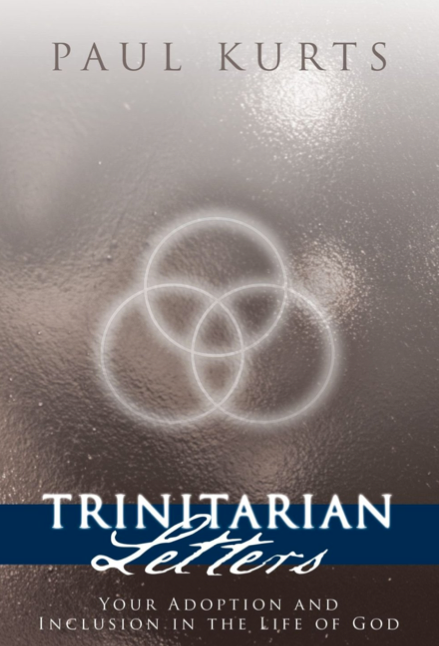
Trinitarian Letters

Trinitarian Letters:Your Adoption and Inclusion in the Life of God by Paul Kurts on Amazon

Trinitarian Letters, the site.

Trinitarian Letters on Facebook

trinitarian letters cover I read Trinitarian Letters with echoes of the lectionary texts for Trinity Sunday 2013 still in my head and heart! In 150 letter-length articles, here's the proof-texting grandpa sitting on the front porch lining out some scriptural connections, real or imagined, explaining in casual conversational manner how each of us participates in the perichoretic life of the Triune God. Or in simpler terms, the godhead comprised of Father, Son, Holy Ghost. Author Paul Kurts self-published this book through Thomas Nelson's WestBow Press, and why not? Many folks publish their own books these days. However, he needed a better editor (or an editor, period); he needed to know enough not to type so many sentences in all-caps... even the 4-page table of contents is all-caps! It doesn't take serious theological propensities to realize auto-correct and spell check are not big on theological terminology, but really, Armenianism? Armenian theology? Here's an article about it (the original article on Armenian theology is gone; I updated to one about the Armenian Church). He meant Arminian, and in the end finally got it right.

pages 93, 141, 152: After reading for the third time that the Reformation happened in the 1600s, it finally dawned on me he might not realize "The Reformation of the 16th Century" refers to "The Reformation in the 1500s." Then again, what church- or history-oriented person does not know the date of 31 October 1517?

"Comparisons are odious" (according to Recovery International?) and it is plain mean of me even to mention how the subtitle immediately evoked the first of Miroslav Volf's books of free church ecclesiology, After Our Likeness: The Church as the Image of the Trinity. But I can fairly say the lack of theological and grammatical coherence in most of this book would have earned me a D or an F in almost any class in almost any school I attended.

Nonetheless, despite its near-complete lack of organization and clarity, it could be helpful to read Trinitarian Letters as a book of devotions, by thoughtfully pondering the many positively reassuring and familiar passages of scripture Paul Kurts quotes—he especially likes Romans, Colossians, Ephesians, and the Gospel of John. Human adoption into and participation in the relational life of the Trinity is all about experiencing God's love, mercy, grace, and inclusion.

Legal note – "Disclosure of Material Connection: I received this product for free from The Speakeasy in hope that I would mention it on my blog, with no requirement to write a positive review. I am disclosing this in accordance with Federal Trade Commission's 16 CFR. Part 255: 'Guides Concerning the Use of Endorsements and Testimonials in Advertising.'"

my amazon review: disappointing

Thursday, December 13, 2012

God Is a Gift

Another welcome offering from The Speakeasy!... if you're interested, go on over and join!

A sampling of God Is a Gift's online presence:

God is a Gift by Doug Reed on Amazon | | God Is a Gift website | | Thorncrown Chapel, Eureka, Arkansas | | Thorncrown Chapel on Facebook | | God Is a Gift on Facebook

God is a Gift book coverGod Is a Gift grew on me as I read! I started out with, "yes, these are basics," but as the author continued essentially telling us it's not about our works, our strivings, our desires, achievements, or accomplishments, but about God's grace – esp as manifested in the Cross of Calvary – I realized, "this bears reading, re-reading, lending out, and remembering." Does it need all 200 pages? Yes, because every one of us needs to be reminded over and over again!

Doug Reed tells us it's about knowing God in a Johannine/Pauline sense of gnosis—familiarity to such an extent we actually participate in the life of the Crucified and Risen Christ. Yes. Instantly I thought of "Knowing You," the song Graham Kendrick based on Philippians 3:7-11:
All I once held dear, built my life upon,
all this world reveres and wars to own,
all I once thought gain I have counted loss,
spent and worthless now compared to this.

Knowing You, Jesus, knowing You.
There is no greater thing.
You're my all, You're the best, You're my joy,
my righteousness; and I love You, Lord.

Now my heart's desire is to know You more,
to be found in You and known as Yours,
to possess by faith what I could not earn,
all surpassing gift of righteousness.

Oh, to know the pow'r of Your risen life,
and to know You in Your suffering,
to become like You in Your death,
My Lord, so with You to live and never die.
Although his book isn't full of his own stories and testimony, like many of us, Pastor Reed loves the intellectual, cognitive work of doing scripture study and theology, tells enough about his own attempts to create himself with diligent study, unceasing prayer, and works of service that most of us easily can identify as he rejoices in: "To possess by faith, what I could not earn."

Obedience, grace, law, gospel? Reed solidly grounds everything he writes in both Old and New Covenant scriptures, and demonstrates considerable knowledge of Jewish ceremonial practices. In addition, without referring to it as such, he does a great job explaining what we in the Reformation Churches refer to as the first and second uses of the law. Anticipating Christmas, during a class in November or December, one of my professors exclaimed, "Exchange gifts!!! Are you talking about a gift or about an economic transaction? You cannot have it both ways!" Paul of Tarsus reminds us, "the free gift is not like the trespass, offense, sin, transgression..." but by definition, is a gift not without cost to the recipient? Ultimately, it's all about Jesus, all about God's free, unearned and unearnable gift of grace.

Thorncrown chapel Author Doug Reed casually referring to the Apostle Paul as author of Ephesians and Hebrews bothers me some (esp after he explains his passion for the more formal theological enterprise); I hope that was a matter of convenience. No surprise that I hankered for references to sacraments/ordinances of baptism and holy communion, but I realize he's from a free church rather than a liturgical mainline background. Being introduced to the natural magnificence of Thorncrown Chapel in Eureka, Arkansas, and learning its history was a side benefit of this book! I also enjoyed discovering some of Pastor Reed's own theological reflections in Thorncrown Journal. Altogether this is an outstanding book I plan to keep, possibly loan out, and definitely re-read more than once.

my amazon review: simply outstanding!

Sunday, June 12, 2011

remembrance, hope...

Remembering a lively past, hoping into a living future...


sign on the highway: San Diego River Watershed: Keep It Clean!

listening to American Pie: "and a voice that came from you and me... the day the music died, the day that I die."

How realistic have I been to expect an occasional oasis of good food, good drink and good conversation? How reasonable had I been to expect to be fully re-integrated into and re-claimed by mainstream society and mainline church?

Theology types engage in a fair amount of margin/center // edges/heart talk, especially considering more edgy, less centered liberation, womanist, cruciform theologies. All that's more marginal? Some people in some quarters consider them so, yet throughout the witness of scripture, God consistently acts is ways that subvert that status quo, in way that are hidden and unapparent until later on, until the principles involved step away and look backwards to where they've been and then are able to discern that's happened and even a little bit of how it's happened. Someone said if you keep looking back you can't see where you've going, but if you don't look back for sure you'll make the same mistakes and take the very same mis-steps.

Right now as another season of summer is almost here, I need to do some faithful remembering of Whose I am and who I am: where I've been, the journey I've taken with the gifts and opps God has given me, the people I've met who've ignored or rejected me and even those few people and places who've been occasions of embrace.

For Paul of Tarsus, the gospel is death and resurrection. Originally the literary form "gospel" referred to the returning Roman conquering general's proclamation of his victory over opposing forces, his announcement of how he'd vanquished the enemies to the nether regions of the dead. For Christians, "gospel" is God's victorious action in vanquishing death, "the last enemy" and initiating the victorious reign of life. Baptized, we live within the gospeled community called to reconciliation yet called out from, set apart from and different from the empires of death and deadly imperialisms in which many reside and toward which others strive.

Referencing the Ephesians pericope for Ascension that pleads for "the eyes of our heart" to be enlightened, PGB suggested one of the emphases of the Feast of the Ascension is the Christ Event becoming an event in the heart of God. Here our physical eyes can see nothing without some ambient light, so our heart-eyes need light too. Long ago at the weekly Monday evening women's bible study that met at my house, JHD (she and I were the group's usual leaders/facilitators) pointed out the eye is the most sensitive part of our physical bodies.

Baptismal River Watershed: Keep It Clean! and how, but how?! Keep the commandments, keep covenant with all creation, stay put in community because in spite of everything, most times staying put is the test of faithfulness because we perceive everything as imperfect...

Monday, August 30, 2010

season of creation 1c: Ocean Sunday

The Season of Creation is a recent emphasis for liturgical observation as late summer cycles into fall in the northern hemisphere, winter into spring in the southern. The site explains
What Is the Season of Creation?

For four Sundays in September, prior to St Francis of Assisi Day, we join in celebrating with Christ the wonders of creation. In the liturgy, we follow the lead of the psalm writers and celebrate with creation — with the forests, the rivers and the fields, which praise the Creator in their own way. Bible readings focus especially on the story of Earth, which complements the story of God and the story of humanity in the Scriptures. We commit ourselves to a ministry of healing Earth, with Christ and creation as our partners.
Norman Habel gives us part of the history; here's an excerpt:
The season of Creation begins as an Australian story. I, like many in our Lutheran Church in Australia, grew up in the bush. I climbed every tree within miles. I felt close to creation: the soil, the streams and the sounds of the bush. Celebrating the creation I love has long been one of my dreams.

season of creation 1c: Ocean Sunday
Needless to say, this is very in process and well may be different within a couple days; if you use these prayers, please make your own changes and additions as freely as you like.

Call to Worship

leader: As we gather for worship today in the name of the Father and of the Son, and of the Holy Spirit, let us bless the Lord for the bounty of creation, the mercy of redemption and the hope of a new creation.

response: We bless you Lord God, for the wonder and majesty of sun, moon, stars and seas, for all of earth's abundance, for the love of Jesus Christ and for the gift of the Spirit in our midst.

ocean sundayleader: Today on Ocean Sunday we especially remember your provision of water ranging from deeps of the primal creation, to rivers that flowed from Eden, through streets of the new Jerusalem. On this Ocean Sunday we also acknowledge and repent of ways we have squandered and spoiled gifts you called us to care for.

response: We admit our sin and wrongfulness in behaviors that have harmed the waters, that have hurt creatures who live in the oceans and rivers and have broken the lives of humans who depend on water for income, nutrition, sustenance and health. We especially repent of the complicity, ignorance and greed that led to the recent disaster in the Gulf Coast region of the United States of America. We ask for your forgiveness as we resolve to start over with new awareness and sensitivity, that we might live as bringers of the new creation.

leader: In gratitude and in hope we remember, retell and reappropriate stories of gifts of water that carried Noah's ark to salvation, that splashed from the rock in the exodus desert, that became the boundary of promised land freedom, that in baptism is the tomb of our death and womb of our new life in Jesus Christ.

Collect

God of glorious love, your Word calls forth the mystery and magnificence of creation! We ask that you would make us faithful stewards and caretakers of your gifts, especially brooks, creeks, seas, and glaciers, that all might be redeemed, live and thrive to give life to others, through Jesus Christ, who was baptized in the waters of the River Jordan, became living water to the world and sends us forth to baptize by water, Word and Spirit. Amen!

Eucharistic Prayer
The Lord be with you.
And also with you.
Lift up your hearts.
We lift them to the Lord.
Let us give thanks to God.
It is joy to offer thanks and praise!
This is a day of hope! This is a time to celebrate the gift of water, to recall and reclaim the redemption of everything there is!

Lord God, you laid the foundation of the earth and set firm its cornerstone;
You were there when the morning stars sang together;
You commanded the morning, and showed dawn its time of awakening;
Your word formed the springs of the seas and spread out the expanse of the earth with all that grows from it.
You gave a portion of your Spirit to all creation,
and charged humanity with stewardship of the works of your hands.

By water and Word you claimed and baptized us as your people;
You have given us water and bread and fruit of the vine as signs of your presence among us;
You call us and send us to proclaim your gospel of love and justice to all the world.

And so with the company of heaven and with all creation in every time and every place we sing:
Holy are you, God of mercy, glory and love, and blessed is Jesus your son, who lived among us in a body made from stuff of the earth.
Jesus died for the redemption of all creation,
and was raised from death for the life of the world.
He ascended to reign in justice and righteousness over everything his Word had created.
With the Church in all the ages we proclaim the mystery of faith:
Dying you destroyed our death;
Rising you restored our life;
Lord Jesus, come in glory!
bread and cupOn the night of betrayal and desertion, our Lord Jesus took bread; when he had given thanks, he broke it and said,
"This is my body, broken for you. Do this in remembrance of me."
In the same way after supper, he also took the cup, saying,
"This cup is the new covenant in my blood. Do this, as often as you drink it, in remembrance of me."
As often as you eat this bread and drink this cup, you proclaim the Lord's death until he comes again in glory.
Come, Spirit of Holiness; come upon all creation everywhere and upon this assembly of saints;
Come, Holy Spirit; sanctify these gifts of grain and grape uniting us with all creation in every time and every place;
Come, Spirit of Life and bless our feasting at this table of reconciliation and renewal,
That baptized into the death and resurrection of Jesus Christ,
in the power of the Spirit we may daily live as the gracious presence of the crucified and risen Jesus Christ.

Glory and thanks
wisdom, acclaim
dominion and righteousness be to God,
Father, Son and Holy Spirit,
endlessly throughout eternity,
Amen!


© leah chang 2010

Friday, April 09, 2010

prophetic imagination conference 3

power to the power john august poster
The next Thursday session I attended began with Artful Imagining from Andrew Hendrixson, who teaches studio art at the University of Florida, as the first presenter in an excellent, varied group of three. The last presenter in the trilogy was Teri Marcos from not far away from San Diego Azusa Pacific University. In an outstanding presentation, Jesus and the Disinherited she emphasized some aspects of Howard Thurman's life and teaching. Thurman was Preacher to Boston University a while before I attended, but his name and even his presence on campus still was legendary.

and then

In Farmer Wendell Berry's A Call to Agrarian Leadership slide presentation with commentary by Paul Kaak (also from Azusa Pacific) particularly emphasized "placed stewardship" of the church. Careful placed stewardship leads us to be concerned with where God has planted us as wherever we are, wherever the church is reminds us of what we've forgotten about the organic church and that we've forgotten and neglected it.

Paul Kaak paralleled farm with parish—after all, both concepts are geographical; he also told us Eugene Peterson (remember him? The pastor-scholar who did The Message version of the Bible) considers Wendell Berry the best pastoral theologian in the USA! Someone I knew in another life told me when he observed some people who serve in a pastoral capacity, he frequently remembered that pastoral means "rural." Moving along from C. Wright Mills Sociological Imagination to Walter Brueggemann's Prophetic Imagination... I especially love observations about agrarianism as a synoptic worldview, as comprehensive vision uniting land—agri-culture and human culture, or ways of being and acting. And oh, yes, too often the Church is all at once 1) not worldly enough; 2) too worldly and 3) needing to be whole, healthy and holy. John 17, Jesus, us and God's glory on earth, where God has "placed" us and placed, planted The Church, calling and enabling it to live as the Presence of Jesus Christ in the world.

Communications media and the individuals, communities and organizational entities of many types we observe and encounter almost daily have been returning to less toxic, simpler behaviors, as have almost all of us. In my own life it's been slow and gradual, yet I can reflect on two or three years back or more dramatically, ten or twelve years ago and even from this close a perspective I can notice small lifestyle changes that have added up to less physical and mental clutter around me and better stewardship of the places – household, neighborhood, city, county, state and world – in which I live.

Paul Kaak more than suggested contemporary industrial economies were founded on "the breaking of all ten commandments" and said the economy, the household law/stewardship of the church has behaved in the same way, also violating all of the commandments. "The organized Church makes peace with a destructive economy" though how can it make peace with the "empires of illusion" scripture forbids? Ephesians 4:18-24 Wendell Berry loves the metaphor of marriage as a model for husbandry of the land - we need to get out of passive consumption modalities and being embodying, incarnating, our own "better" stories.

Thursday, April 03, 2008

Time of the Spirit - Season of the Church

Adult Study Proposal | Early Summer 2008

In a special emphasis on the Pentecostal reign of the Spirit, in 3 class sessions we'll investigate selected texts from Galatians; Acts, Ephesians and Colossians, particularly in terms of our identity as a people uniquely constituted by Jesus' death and resurrection. We'll explore concepts of gracism and inclusion and consider a Christus Victor atonement model of Jesus' triumph over the pretense, dehumanization and violence of Roman imperial rule.

The congregation at Galatia was the first ethnic church; we need to become more aware of our own conscious and unconscious cultural and other attachments that lead to our living and proclaiming either more than our less than the gospel. As Martin Luther insists, worship and hymn-singing in the vernacular is a mark of the true Church; we also need to contextualize, cast into local vernacular (but there's not just one!) our outreach to our neighbors. How can we fully bring others into our congregation's life of worship, witness and service and also graciously receive their gifts of hospitality when they invite us closer to the centers of their worlds?

In his books Multicultural Ministry: finding your church's unique rhythm and Gracism: The Art of Inclusion, David A. Anderson, pastor of Bridgeway Community Church in Baltimore writes about Gracism, a word comprised of "racism" preceded by the letter "g" for God. "Gracism" encourages people to extend favor to others based on their unique class, culture, ability, color or other distinctions, and to make that preference visible and apparent. How can we become gracists with each other and with newcomers?

The synoptic gospels, the undisputed epistles of Paul and deutero-Paul ring with language of Roman imperialism and domination. What deathly economic, political and cultural forces control and determine our contemporary situation? Can we live and proclaim a Christianity as explicitly anti-imperial as that of the early churches, when to be ekklesia still was primarily political rather than religious or theological? What Word of Life does the cross of Calvary and the empty tomb of Easter dawn speak and enact here in this corner of Paradise in 2008? As we live in Christ, does our theology become our biography to a sufficient degree to liberate and redeem our neighbors from their false allegiances? Can we grasp the stories of Jesus' birth, life, death, resurrection and ascension in ways that challenge our understanding of society and our fundamental loyalties?

Sunday, August 19, 2007

The Resolved Church,

Seriously edited on Monday 24 August 2015
Resolved San Diego city

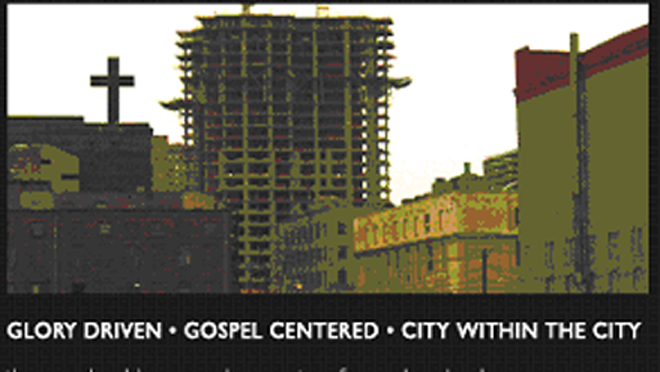
a new church plant in San Diego, is part of The Resurgence, "a movement that resources multiple generations to live for Jesus so that they can effectively reach their cities with the gospel by staying culturally accessible and Biblically faithful." As my intro admits, I thoroughly edited this post eight later, and I know The Resurgence site was online recently because the last time I looked for it, I found it—probably within the past two or three months. The Resurgence is first Christian, then both evangelical and missional. And very conservative Reformed.

This morning @ 11:00 I worshiped with The Resolved in its current space at the Musicians Union Hall on Morena Blvd in the approximate Bay Park/USD vicinity. Edit: since then they've moved to a larger, more settled location on Napa Street, San Diego. resolved city The Resolved Church self-describes as Glory Driven, Gospel Centered, City within the City. Each week the newsletter features one of Jonathan Edwards' resolveds, but there's more to being Resolved than the Northampton Preacher—later in this blog I quote Pastor Duane Smets, "We are The Resolved Church. In 1 Corinthians 2:2, Paul said, 'I resolved to know nothing among you except Jesus Christ and him crucified.' We need to be a resolved people. Resolved to have the gospel take root. Resolved to have the gospel change us. Resolved to repent. Resolved to follow Jesus and to plant his church in this city."

A little about the website: visually it's attractive and somewhat sophisticated without being obnoxiously slick, but the pale gray text against black is far too difficult to read; on some pages I couldn't select the text to get a more readable view and then figured out the text portions actually were images—how irritating! When I checked out the (edited eight years later: no longer live) designer's site, DMS Design Theory turned out to be Pastor D(uane) M(.) S(mets), who began college as a design major. By the way, I've long loved the convention of using lots of lower-case, though I understand it can be hard to read, and although sometimes I'm inconsistent regarding the Reformed convention of capitalizing adjectives and articles that reference God, I always capitalize the nouns God, Lord, etc., so I found the footer on the newsletter page, "much love to you all & soli deo gloria!" a little disconcerting. To continue, here's part of Duane's bio:
Pastor Duane's educational background includes a B.A. in Religion from Point Loma Nazarene University, a B.Th. from LIFE Bible College and an M.A. in Theology from Talbot School of Theology.

Duane's ministerial background began in 1998 and since then he has served as a youth pastor, college pastor, evangelist and in 2005 planted The Resolved Church. His writings have appeared in Relevant Magazine, Kaleo Publications, and his Master's thesis, "The New Testament Evangelist" can be found both online and in libraries connected with Biola University. Duane is a gifted and passionate preacher who treasures Christ, his family and Jesus' church.
The Doctrinal Statement explains "Neither papists nor hyper-Calvinists!" ¶ 1 under The Church reads:
We believe the Church is the invisible spiritual body of believers in Jesus throughout all time (Ephesians 5:4-16). We believe the Church has many local expressions and is not a business or a building but a viceroy of the kingdom of God (Revelation 1:4-6). We believe in the autonomy of local churches and in a government of male plurality for the leadership of local churches (Acts 20:28; 1 Peter 5:1-5; 1 Timothy 3:2). Thus, we are not ecumenicists, egalitarians, or mono-episcopists. "...government of male plurality for the leadership..."
The authors page (no longer where it used to be, and I didn't try to find a current list) listed twenty all told—that's 20 guys, all white, mostly dead! To be fair, this is simply a small selection from The Resolved's broader theological tradition, but I'd like to see a few women and greater 20th and 21st-century representation.

Some exciting chunks of Duane's sermons I found online:
We are The Resolved Church. In 1 Corinthians 2:2, Paul said, "I resolved to know nothing among you except Jesus Christ and him crucified." We need to be a resolved people. Resolved to have the gospel take root. Resolved to have the gospel change us. Resolved to repent. Resolved to follow Jesus and to plant his church in this city.

Cultural Incarnation & Transformation—A City within the City

How does that work? How does that play itself out? What the heck are you talking about? Let’s talk about culture, "Cultural Incarnation & Transformation - A City within the City." This is how God’s mission, of bringing glory to himself by drawing everyone to him through Jesus all the time, this is how that happens.

So we hold the message dear. But we partner with the city and live lives within it. Non-christians need to see you dying and living for the gospel. ... Non-Christians need to see Christians who inhabit their city but they are different. They need to see people who are radically like them but also radically different.
Almost everything on the website looked and sounded exciting, and this morning's worship proved a wonderful experience. The music in the churches I've been visiting always interests me, but today at the start of worship they announced that Michael, their music leader, was stuck in Jamaica waiting out Hurricane Dean. However, during holy communion they played an amazingly beautiful accompanied choral version of "There is a Fountain filled with Blood," from a CD recorded by one of the churches they're connected to (you probably could say in covenant with) so even these seemingly independent congregations aren't at all unaffiliated—they're just not part of what we in the mainline technically would consider a denomination or church body.

I've been trying to make the blogs about the churches I've been visiting about my own faith journey, too; a while ago, when I told the North Park senior pastor I'd felt "deeply betrayed by the church" and he responded with, "what church is this?" I answered, "the protestant mainline—the only church I've ever known!" As I venture outside of the physical and jurisdictional confines of the American Protestant Mainline, I'm finding myself curious, refreshed and reflective, so this is becoming a Good Journey!

The physical feeling alone of worshiping in that space would be enough to make me resolve to return to The Resolved! There were about three dozen worshipers, mostly adults, in a large room; both front and back doors were open, with a fan blowing for added ventilation. Four electric torchière lamps and ten candles on the black-cloth-covered communion table provided the only ambient lighting (light from the projection screen, too, of course), and in some ways the room was dim, especially since the mostly black and gray palette of the website carried over into almost everything except the already-painted walls, but it was restfully peaceful rather than being remotely oppressive.

Unlike in some whereabouts, all of worship was on the same physical level, and above the stage we didn't use they'd hung a long version of the banner I posted at the top of this blog with its city skyline and the words a glory driven - gospel centered - city within the city. (By the way, please notice I didn't even attempt to approximate any measurement of anything.) I got the impression that worship usually begins with singing, which in Michael's absence didn't happen today, so a guy (deacon or other church officer, maybe?) opened with two readings about God, explained how a huge part of who we are and how we live has to do with what we think and believe about God, followed with prayer, and then Duane preached. "Two If's and a Walk Stronger than Death," was today's title—the first of a pair of sermons on Romans 8:9-13, part of a longer The Walking According to the Spirit Series. I'd describe Duane's preaching as apologetics-driven, but he has a degree in apologetics and this community attempts to link, interconnect and to theologically integrate heart and head, so that approach was appropriate, as well as being something I try to do in my own preaching and teaching.

Post-sermon we celebrated the Eucharist, explicated on the screen as, "Thanksgiving - Holy Communion - Lord's Supper - Mass." My appreciation of their celebrating the sacrament weekly goes without saying; they introduced it with what I'd call a "means of grace" theological perspective. In my usual churches we always make a point of serving each other communion, whether it's passed in the pews, we gather around the communion table or process single-file to the front, so it felt (and it was) unfamiliar for people to wait in their seats until they felt ready and then walk to the Table at the front to break off a piece of the (tasty round) bread and dip it in the chalice. In fact, we so insist on serving each other, I have happy memories of my former next-door neighbor SaraLyn holding her then maybe 2-year old son plus other stuff in her lap and going through some awkward motions to offer the cup to me to show Christ's hospitality; last winter or so the North Park senior pastor was doing something and I said something about his behavior being related to "serving yourself communion." He replied, "I wouldn't be that heretical!" I'm gaining new outlooks all-around.

Around noontime, after the word "Liturgy" appeared on the screen, we heard a gospel portion from John 6:60-69 (not today's RCL gospel) and recited a responsive Psalm 34:2-3, 16-22, "Taste and See." After a couple of announcements about the coming week's activities, we could consider ourselves dismissed, though without a formal benediction or "Go in peace; serve the Lord."

When I first entered the room before worship began, I approached the guy I thought was the pastor (hey, I'd been to the site) and later a couple other people came over and talked to me, but nothing hard-sell or off-putting. Lately I've been considering my own self-presentation a lot (for example, outgoing, open friendliness usually works great when you're interviewing and candidating for a church staff position, but the exact same attitude and behavior may impress routine folks and lay leaders as assertive or overtaking in a church where you're trying to get involved in ministry), so it was fun hearing Pastor Duane's telling us he'd worn his "suit and glasses" for a meeting with the folks the church rents from. On my way out I chatted with Amy, Duane's spouse (they're expecting a baby girl, their first child, in November). Again, just casual and cordial. By the way, Duane has a left armful of beautiful, elegant tattoos! These days at least one pierced ear has become almost commonplace for guy pastors, but most of them seem to keep any additional body art hidden.

In closing, this is a church plant, and y'all y'all know plants need deep roots, and a thriving plant branches out far enough to help heal, nourish, and keep its environment (its habitat, its city!) sustainable. Altogether this was excellent; I'll be going back.

The Resolved Church San Diego banner
The Resolved San Diego

Monday, July 16, 2007

Vistas on a Visit to Horizon

Horizon Christian Fellowship San Diego

Yesterday I had another unscheduled Sunday, so again took advantage of the opportunity to visit and worship with a church in a tradition other than mainline. Though I've set my own horizons on finding a congregation within the emerging church category - given that my relatively liberal theological worldview precludes much of anything else - this time I chose Horizon Christian Fellowship, San Diego. Besides a copyright notice, street address and contact info, the footer on each page of the website says, "God Bless America." As do congregations in the Calvary Chapel movement that has become extensive enough to be considered close to what we'd call a denomination, Horizon terms itself a fellowship. Predictably, on the Horizon campus, during worship and checking out the website, I found myself applying Reformation criteria of Word and Sacrament to my experiences.

When I arrived at the church complex, I went into the nearest building, the auditorium, where the first of a series of three "Essentials for Life" – A Win, Disciple, Send Equipping Course – classes was just beginning. Since I hadn't read the website carefully enough I hadn't planned on going to a class, but in a friendly manner they gave me a participant's guide to the course to keep; I picked up some collateral materials and then made my way to the far-away gymnasium for worship. The design of the printed materials is contemporary, clean and attractive without being slick (a lot of it's on coated paper, so I needed to say without being conceptually excessively slick), in colors I'd call "bright naturals."

In the worship arena, there was a raised platform with lectern, some sound equipment plus 1) no communion table and 2) no baptismal font. On the website I found evidence of a sign of grace rather than a means of grace or effective sign of grace theology, but clicking around as I edited this post eight years later I found nothing related to sacraments or ordinances. My original blog post included this note from the website back then: "The first weekend of every month, we celebrate the Lord's supper/communion as part of the weekend services. Please join us in honoring Jesus' death and resurrection."

"For as often as you eat this bread and drink this cup, you proclaim the Lord's death till He comes." (1 Corinthians 11:26)

At worship, continued
: led by guitar and a female vocalist, we sang several songs unfamiliar to me, and then one of my all-time faves, which for a while formed part of my blogger profile—" Mountains bow down and the seas will roar at the sound of Your name!" I still remember singing "Shout to the Lord" a few winters ago at the PC(USA)'s Synod of Southern California and Hawaii mission event at Bel Air Pres ... a very different setting, a radically differing theological perspective ... Pastor Phillip MacIntosh, the charmingly engaging son of Pastor Mike MacIntosh, who was out of town, was the speaker/teacher and did a practical, well thought-out application of Ephesians 4:17-32. During the message Pastor Phillip said you can't just pop into church just to get your $3.00 lunch and expect to become a changed person, so post-worship, I checked out the lunch place. The breakfast buffet I selected from was $4.50, the lunch spread $5.00, but we've had a degree of $$$ inflation. Very tasty food, so good I'll write a restaurant review when I find a few minutes.

Locally, Mike MacIntosh's biography of a journey through drug addiction to founding pastor of an institution that has grown to help God change a multitude of lives is fairly well-known, even in mainline circles. In a way I was heartened that I had difficulty finding a page with a greeting, photo or message from Pastor Mike, who is currently HCF's senior pastor, but on the other hand, I always want to read a greeting from or bio of the church's pastors, and there was one, on a Know God? page that's no longer there.

The Horizon timeline and history is gone from the website, but it chronicled a journey from home study groups at the home of Mike MacIntosh, then director of Maranatha! Music to the current Horizon Affiliates of over 100 churches and para-church organizations that have grown out of Horizon in San Diego--some are affiliated both with Horizon and Calvary chapel. There are international campuses in Mexico, Russia and Japan. In the mainline, especially around in here in Southern California, we refer to church "campuses," too! Like like most conservative, evangelical churches, the pastoral leadership is exclusively male and the statement of faith contains the "biblical inerrancy" phrase. HCF-affiliated schools include an on-campus preschool, elementary, a junior/senior high, Horizon College and Horizon School of Evangelism. We watched a short video featuring local youth and a husband-wife missionary team currently serving in Japan. One of the young women commented on her joy at visiting Japan and being with part of "the universal church we hear so much about."

Bible studies, home fellowships, a comprehensive, accredited educational system, Sunday meals, instruction in Christian living...is Horizon Christian Fellowship functioning something like a total institution or is it an organization simply seeking to give its friends and members total provision? For sure, Jesus Christ in the Spirit calls us to conform to the Imago Dei in which we were created, but does HCF seek to re-shape, re-form and re-generate its members into another image, that of a stereotypical contemporary conservative Christian? Once you're in, is it easy or hard to get out? Do you want to leave? Are there rites of passage beyond baptism? How about charismatic leaders, other than the Crucified and Risen One?

A few months ago I wrote,
The colors, texts, textures and music marking the events in the liturgical calendar were more real to me than any of my own individual history ever had been and had shaped my life into deep, indelible patterns and designs that of late seem completely irretrievable. The church was my literal life...the ministry I did was the fruit of my labor and the fruit of my heart.

The rhythms, pace and pulse of local church ministry with its alternating consistency and surprising interventions shaped my days and literally outlined my identity. How can a broken heart keep beating? And to what avail? Although I definitely consider myself a wordsmith, it has taken the words of others to describe my situation and feelings.
In other words, the protestant mainline for me was something close to what Horizon is attempting to be for its constituency.

HCF is doing a wonderful ministry for a lot of people, and equipping them to serve well, too. Although I didn't attempt a detailed demographic survey, offhand I'd say it was mostly White, with quite a few Asian-Americans, a lot of Latino/as and some Blacks, probably mainly African-American, with all ages well-represented. An extensive architectural renovation is in progress and will lead to a handsome, useful, multi-purpose physical plant. Of course I compared this with my visit to La Jolla Community Church (now Grace City), clearly a mainline spinoff, so tomorrow or Wednesday I'll finish and post my blog about LJCC.

Friday, March 23, 2007

Theology of the Cross 5

Theology of the Cross 5 | Lent 5 | 25 March 2007

Theology of the Cross:
what does this mean for the Church’s and especially for this congregation’s life and mission?

A Tree on Your Back

1. We meet you, O Christ, in many a guise,
your image we see in simple and wise.
You live in a palace, exist in a shack;
we see you the gardener, a tree on your back.

2. In millions alive, away and abroad;
involved in our life, you live down the road.
Imprisoned in systems, you long to be free;
we see you, Lord Jesus, still bearing your tree.

3. We hear you, O man, in agony cry;
for freedom you march, in riots you die.
Your face in the papers we read and we see.
The tree must be planted by human decree.

4. You choose to be made at one with the earth;
the dark of the grave prepares for your birth.
Your death is your rising, creative your word;
the tree springs to life and our hope is restored..

–Fred Kaan, 1966

The cross of Calvary forms the ultimate type and reality of God’s characteristically hidden and paradoxical, sacramental presence in the commonest things, situations and people. Interpreting scripture, sacraments, everything in our lives and in the world with "What preaches Christ."
  • Last week we talked some about God’s action and presence in the sacraments – considered a “means of grace” in this tradition – and began imagining ways we can be a means of grace in the world around us.

  • It’s impossible to separate out today’s discussion topics, so I’ve suggested some texts and ideas to get us started.

A Theology of Baptism

Galatians 3:26-29; Titus 3:5-8; 1 Corinthians 12:12-13; Romans 6:1-14; Ephesians 4:4-6; Mark 1:4-11; Matthew 3:11-17; Luke 3:15-22

Theologian Jürgen Moltmann describes baptism as “sign, witness, representation and illumination of the Christ Event”; we can claim the same about the Eucharist. We know Jesus Christ as sovereign, prophet and priest; alive in Christ, we participate in that royal, prophetic priesthood. Especially in regard to those roles, how can our lives signify, witness to, represent and illuminate the birth, life, death, resurrection and ascension of Jesus Christ?

Contextualizing Baptism

We are baptized for events like 9/11; we are baptized to be the Christ alongside our friends, relatives and neighbors; we are baptized to not be an exclusive community, but to risk reaching out to image and model Jesus Christ to the world – including those who are culturally, ethnically, chronologically, occupationally, educationally different from us; to recognize Jesus Christ in others and to be the presence of the crucified and risen Jesus Christ in their lives.

A Theology of the Eucharist

1 Corinthians 10:16-17; 1 Corinthians 11:23-26; Mark 14:22-25; Matthew 26:26-29; Luke 22:14-20; Luke 24:30-31; John 6:33; John 6:51; John 6:56

Jesus said, “Do this!” Do this liturgical action?

Contextualizing Eucharist

Jesus says, “I am the Bread of Life; I am the Vine!” In every culture, grain products form a substantial nutritional base; the grain may be rice, wheat, corn, wheat, barley...the fruit of the vine is a potent and pervasive biblical symbol, and beyond there and then, lately we’ve been learning a lot about grape’s benefits! In the power of the Holy Spirit, God calls the church—
  • As the body of the risen Christ, the Bread of Life, to nourish the world, especially the stranger, the outcast and the ‘other’

  • Like the Eucharist, to reveal Jesus’ crucified body in its redeeming brokenness

  • To reveal Christ’s risen body in its liberating wholeness

  • As branches of Jesus, the Vine, to pour out our lives to those around us

9. What does the cross mean for each of us as individuals?

Galatians 3:1-5; 2 Corinthians 5:16-21; Ephesians 1:17-23; Matthew 28:16-20; Luke 24: 44-49; Acts 1:6-8; 2 Timothy 2:8-13; 1 Peter 2:9-10

10. What does the cross mean for this church community?

From Water Buffalo Theology: Suffering because we’re involved with others, involved with the other; participating in the “glory of the crucified Lord”. My note: the same Paul of Tarsus also talks about “the glory of the children of God!” And isn’t our glory as God’s offspring also a crucified glory and a risen glory?

11. What does all of this mean for our nearby neighbors?

When I was on staff at the church in City of History, I wrote their Mission Statement:
We are the people of God, forgiven and set free by the death and resurrection of Jesus Christ; by the power of the Holy Spirit we are called together and sent into the world as witnesses to his resurrection. God calls us, a servant people, to proclaim in word and action the presence of the risen Lord to all those whom our lives touch, especially in this community.
The author of Water Buffalo Theology talks about “neighborology”—the word about the neighbor! The Bible and Jesus Christ reveal God’s attachment to the world of creation to the point of learning and knowing us so completely as to walk in our sandals (Tevas, or flip-flops or boots or snow boots...) and to die a physical death, just as all of us inevitably will. Especially in the shadow of the cross, how can we practice neighborology?

© Leah Chang 2007

Friday, March 16, 2007

Theology of the Cross 4

The class also will get a 2-page handout with some Heidelberg Catechism and some Q&A from the 1998 Study Catechism of the PC(USA); I chose those two because Luther's Small and the Shorter Westminster probably are more familiar in this country.

Theology of the Cross: what does this mean for the Church’s and especially for this congregation’s life and mission?
Here we will take the wine and the water;
here we will take the bread of new birth,
here you shall call your sons and your daughters,
call us anew to be salt for the earth.

Give us to drink the wine of compassion;
give us to eat the bread that is you;
nourish us well, and teach us to fashion
lives that are holy and hearts that are true.

Marty Haugen, Here in This Place/Gather Us In, © 1982 GIA Publications, Inc.

I, the Lord of font and cup,
covenant to lift you up.
Splash the water, break the bread; pour out your lives.
Faithfully my love you’ll show,
so their hearts will always know,
They are mine eternally...

© Linda LeBron, 2002
Theology of glory vs. theology of the cross: Theologians of the cross build their theology in the light of God’s own revelation of himself, particularly God’s self-revelation in Christ crucified. The cross of Calvary forms a paradigm and model for God’s characteristically hidden and paradoxical, sacramental presence in the commonest things, situations and people.

•Interpreting scripture, sacraments and everything in our lives and in the world with “What preaches Christ.” Especially look for God’s hidden yet apparent presence and for “Types of Christ.” Imagine the classic attributes of God through the lens of the cross!

8. The Cross and the Sacraments

Study Catechism of the Presbyterian Church (USA), 1998

Question 70. What is the main difference between baptism and the Lord’s Supper?

While I receive baptism only once, I receive the Lord’s Supper again and again. Being unrepeatable, baptism indicates not only that Christ died for our sins once and for all, but that by grace we are also united with him once and for all through faith. Being repeatable, the Lord’s Supper indicates that as we turn unfilled to him again and again, our Lord continually meets us in the power of the Holy Spirit to renew and deepen our faith.

a. A Theology of Baptism

Galatians 3:26-29; Titus 3:5-8; 1 Corinthians 12:12-13; Romans 6:1-14; Ephesians 4:4-6; Mark 1:4-11; Matthew 3:11-17; Luke 3:15-22

Theologian Jürgen Moltmann describes baptism as “sign, witness, representation and illumination of the Christ Event.” We can claim the same about the Eucharist.
In baptism, God and the church claim us in covenant...baptized, we live reborn in the water of Jesus’ birth and alive in the fire of his death—the transforming, rebirthing power of the cross. As a baptized people, we no longer live under the reign of death, its idols and its artifacts, but in the alternative community countering the individualisms of covetousness, greed, commoditization, consumption, superfluity, satiation, and (ultimately) despair.

b. A Theology of the Eucharist

1 Corinthians 10:16-17; 1 Corinthians 11:23-26; Mark 14:22-25; Matthew 26:26-29 ; Luke 24:30-31; John 6:33; John 6:51; John 6:56

Jesus said, "Do this!" Do this liturgical action? In the Eucharist, the entire church and all creation in every age and time comes together; this is an action of the whole, entire church! Farmers, vintners, truckers, weavers, potters, storekeepers, builders, bakers, more... Moltmann said Christ’s invitation is prevenient. William Stringfellow says (paraphrased, from An Ethic for Christians and Other Aliens in a Strange Land) the Bread and Cup are “tokens of the Resurrection” and these “tokens...are discerned as the Word of God indwelling all creation and transfiguring human history.” Martin Luther: the ubiquity of the risen and ascended Christ.
  • Recall Israel and desert manna, enabling God’s people to live precariously in the wilderness
  • Bread = nourishing = body that is broken unto death and raised to new life
  • Christ’s body = revealed in the breaking of bread / body
  • Church = Body of the risen Christ = nourishing the world, especially the stranger, the outcast and the ‘other’
  • Church / reveals Jesus’ crucified body in its redeeming brokenness
  • Church / reveals Christ’s risen body in its liberating wholeness


Heidelberg Catechism, 1563

Question 76. What is it then to eat the crucified body, and drink the shed blood of Christ?

It is not only to embrace with believing heart all the sufferings and death of Christ and thereby to obtain the pardon of sin, and life eternal; but also, besides that, to become more and more united to his sacred body, by the Holy Ghost, who dwells both in Christ and in us; so that we, though Christ is in heaven and we on earth, are notwithstanding “flesh of his flesh and bone of his bone” and that we live, and are governed forever by one spirit, as members of the same body are by one soul.

The Holy Supper...but it means more. Through the Holy Spirit, who lives both in Christ and in us, we are united more and more to Christ’s blessed body. And so, although he is in heaven and we are on earth, we are flesh of his flesh and bone of his bone. And we forever live on and are governed by one Spirit, as members of our body are by one soul.

© Leah Chang 2007

Wednesday, June 08, 2005

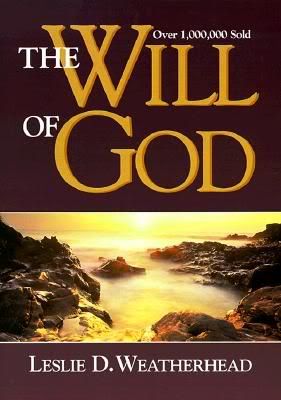
Leslie Weatherhead: The Will of God 3

Leslie D. Weatherhead, The Will of God © 1944; © renewed, 1972

Chapter 3: God’s Ultimate Will—part 1

Will of God coverThe discussion moderator began:
Weatherhead begins by rehashing the three divisions of God"s will, as in chapters 1 and 2. Yet he offers an interesting perspective of our ability to choose and free will. How does this mesh with your view of choice and free will?
Then he asked,
Do you believe in a Devil as an actual being? Or do you believe in a metaphorical Satan--a personal adversary that can combine with other personal adversaries to create a greater, collective evil that we've seen repeatedly throughout history?
Actually, I don’t know, but I do believe in spirits of evil in the way Walter Wink talks about them in his Powers trilogy, as he draws upon deuteroPaul of Colossians and Ephesians as well as discussing the Spirits (the "Angels") of the Seven Churches in Revelation. And personally, some (most?) of us do what feels like near-constant battle with demons of various kinds, many of which very definitely live independent lives of their own--lives that seem to be ego-dystonic, something completely outside of us that inflicts themselves upon us. Not being an expert on knowledge of the bodily existence of - or the embodiment of - evil, I do think there's a real sense in which the sum of the parts frequently is greater than any of the elements of the parts: in plain English, "synergistic!"

Tuesday, May 17, 2005

Mission and Evangelism, again:

After posting this morning, I realized including a couple more things would be a good idea; first, here's the entire Article 7 from the Augsburg Confession:

Article VII: Of the Church.
Also they teach that one holy Church is to continue forever. The Church is the congregation of saints, in which the Gospel is rightly taught and the Sacraments are rightly administered.

And to the true unity of the Church it is enough to agree concerning the doctrine of the Gospel and the administration of the Sacraments. Nor is it necessary that human traditions, that is, rites or ceremonies, instituted by men, should be everywhere alike. As Paul says: One faith, one Baptism, one God and Father of all, etc. Ephesians 4, 5. 6.
Then, here's a paraphrase of a scary incident about evangelism and mission shared by a colleague at April's Faith, Order and Witness meeting:

The close to incredible success of the Presbyterian branch of the Church in their evangelical efforts in Korea generally is well-known; however...a Presbyterian from Korea essentially maintained to an American, "We wish you could have brought us the flower of the Gospel without the flowerpot, which we definitely did not need!" As Augustana 7 insists, "Nor is it necessary that human traditions, that is, rites or ceremonies, instituted by men, should be everywhere alike." From here I'll say not only not necessary but definitely not remotely desirable, either!

Sunday, August 29, 2004

God, Strangers and Saints part 3

God, Strangers and Saints
part 3

But how does this gospel requirement of strange living align with our need for belonging, our need for being at home, and particularly with the gospel assertion that in Christ we no longer are strangers, in Christ we've come home to a circumstance and even to a place where we truly belong?!

Throughout the Hebrew Scripture's witness God keeps addressing (though not always immediately meeting!) the people's need to live on the land, to work on the land and thrive on the land, their absolute requirement for physical provision, as well as for spiritual sustenance. Scope out this New Testament text, too:
Ephesians 2

19 Now, therefore, you are no longer strangers and foreigners, but fellow citizens with the saints and members of the household of God, 20 having been built on the foundation of the apostles and prophets, Jesus Christ Himself being the chief cornerstone, 21 in whom the whole building, being fitted together, grows into a holy temple in the Lord, 22 in whom you also are being built together for a dwelling place of God in the Spirit.


some words from a haunting song (you need to scroll way down the page for the complete lyrics) sung by Linda and Robin Williams:

Don't Let me Come Home a Stranger

As I walked out one evening to breathe the air and soothe my mind
I thought of friends and the home I had and all the things I left behind

CHORUS:
Will there come a time when the memories fade
And pass on with the long, long years?
When the ties no longer bind, Lord save me from this darkest fear:
Don't Let me Come Home a Stranger
I couldn't stand to be a stranger

In this place so far from home, they know my name but they don't know me
They hear my voice, they see my face; but they can lay no claim on me

© Robin Williams, J. Clark


more later. about strangeness and being strangers.