Monday, July 30, 2012

early reader's bible

Early Reader's Bible by F Gilbert Beers, illustrations by Terri Steiger on Amazon

early reader's bible coverIntended for very young kids, this version of the Good Book includes several dozen well-known Old Testament and New Testament stories. The NT ones mostly are from the synoptics and from Acts, along with Jesus cleansing the temple in John 2 (way to go, the basis of Jesus' Ministry!) and from John 20, the risen Christ appearing to Mary Magdalene (basic apostleship!); there's also a single Philemon pericope. The Early Reader's Bible has basic words and new words vocabulary lists, scripture references, with end of chapter questions and activities to help review the story—what we'd call applications in a bible for older readers. "Words to know" in a box at the start of each story also can serve as keywords.

Terri Steiger's illustrations are bright and fun without being exclusively those basic red, blue, yellow, and green spectrum colors many kids' toy manufacturers seem to think are the only hues that attract kids. One reviewer mentioned all the people in the stories are Caucasian; they're all "basic humanity" Mediterranean-looking, and for sure I'd have drawn a far greater variety of ethnicities and abilities, but their appearances do reflect the actual characters in the actual scriptural events. Answering the questions and doing the activities can help readers insert themselves into the narratives.

Besides young people just learning to read, this fat, board-bound book would be a great resource for folks of any age just learning English or for older adults learning to read, as well. I haven't been researching or comparing versions of scripture for young readers, but this seems like an excellent choice for home, church, or Sunday School libraries.

my amazon review: a good version of the good book

Friday, July 27, 2012

minimalist 5

Sally is moving house and does that usual wondering where all the stuff came from; thus, today's minimalist 5. She introduces with:
So bearing in mind you are allowed the Bible, a bed + linen, a functioning kitchen, and a comfy chair, clothes within reason (no dragging last centuries wardrobe in case), and probably essential today a lap-top OR computer choose one from each of the following as your luxuries:
Sally provided the cute moving kitteh pic!

minimalist kitteh1. A book? Assuming sets are allowed, all 4 volumes of The Gospel In Solentimane. It's way long outta print and though it's not technically my fave gospel commentary, it's right up there and impossible to find online.

2. A piece of music (albums/ sets allowed) ... rather than music to listen to, I'll take (literal scores of) music to perform, and it's gotta be (oh, such a tough one) the Beethoven Piano Sonatas.

life stuff button3. Sally didn't list phone as essential, but likely it's a default inclusion, so my electronic/tech equipment will be a CD player/radio boombox, because sometimes I want to be away from the puter and it actually would be more all-purpose than an iPod, but maybe iPod was included, too?!

4. luxury item of clothing: it ain't real luxury, and it is from the last year of the last century: I'll take the wonderful tan corduroy with dark red quilted lining winter vest (no hood, sorry) I got for $1.00 on sale at the church thrift store. I did need to have it dry-cleaned in order to make it wearable, so the total price was a little more.

5. One item of your choice—it can be as normal or as weird as you like. Art supplies, another multiple that easily packages up into a zipper case.

Monday, July 23, 2012

hometown prophet

Hometown Prophet on Amazon

Hometown Prophet, the website

Recently I joined SpeakEasy, a new reader/reviewer bureau with promises of "Subversive Reading. Great ideas." Hometown Prophet is my first blog and review for them.

hometown prophet book coverScripture distinguishes between the (fore)seer of future events, and the prophet, one who speaks "truth to power." Hometown Prophet Peter Quill operates mostly in the former category, accurately predicting events that will occur (admittedly because individuals, agencies, and organizations have not acted with justice and righteousness), though towards the close of the narrative he gets into some heavy-duty laying out of "if - then" alternatives. If you didn't already guess it, "Hometown" in the title is about home as in the place a person basically grew up; for personal and economic reasons, Protagonist Peter has returned home when he starts prophesying.

Author Jeff Fulmer sets the fictional story in heart of the Bible Belt Nashville, Tennessee, with church portions all centered in congregations that emphasize the more demonstratively eschatological gifts of the Spirit, practices those of us in the mainline typically don't give a thought - let alone a nod - to from day-to-day. Although "any similarities to actual persons is purely coincidental" prevails, the text references actual places and events that happened in some of those locales.

Hometown Prophet wasn't difficult to read, but I longed for more colorful descriptions, less predictable sentence structure, and [pages 218 and 264] I hope future editions will spell "publically" correctly... it's publicly!

The release of Hometown Prophet especially encourages me because I imagine a lot of conservative, evangelical (in the popular sense of "evangelical"), and pentecostal Christians will buy this book because the central character is one of them. When they reach the best part of the book they'll probably be surprised when (page 301) Peter acknowledges he is gay, he is Muslim, he is unemployed, a migrant worker, homeless, hungry, he is planet earth in distress, and more! In this Pentecostal time of the Church, the Holy Spirit of Life, Renewal, and Reform calls all of us who follow Jesus to live and act in solidarity with the broken, the outcast, the underclass, and the unwanted. To become Hometown Prophets? Maybe so!

my amazon review: a call to all of us?

The Gathas of Zarathushtra

The Gathas of Zarathushtra: Hymns in Praise of Wisdom by Piloo Nanavutty

Gathas cover Historical and cultural background, commentary, images, notes, and explanations make this an eminently approachable resource for anyone interested in Zoroastrianism. I'm very much a newbie to the study of this world religion, yet very much aware of ways its dualism, apocalypticism, and high ethics have influenced post-exilic Judaism (though by definition "Judaism" is post-exilic...) and Christianity—especially Mark's gospel, the epistles of Paul and the deutero-Pauline canon. From a neophyte's view, this book seems like an excellent introductory view into sacred texts of a people, words that define and describe their interactions with the divine, with one another, and with all creation.

Back matter includes glossary, index, and brief bibliography for those of us who need to know more. The only shortcoming I discovered is not wanting to write my own marginalia into this beautifully formatted and produced edition! Since it isn't about the Hebrew Bible or New Covenant Scriptures I don't have the credentials to assess this book's contents, but whether you're a student of world religions, of culture, of anthropology, or love literature in general, I'll still suggest you consider adding this edition of the Gathas to your library.

my amazon review: an excellent intro to Zoroastrianism

Friday, July 20, 2012

next 5 months friday 5

Today Jan hosts a prospective and reflective 5 about the remaining months of 2012 and wonders:
What do you look forward to in the next five months; or what is scheduled? What is meaningful for you in each of these months? Or memories you have of these months? You decide what to write about for each month!
sprouts againI've illustrated this post with one of my own fave paintings of sprouts, trusting the visual metaphor will becomes actualized. Here's my quick, late, abbreviated play:
1. August
I'm planning to synchroblog—it's early for August or maybe that's "late for July," since we usually play Tuesday during the 2nd week of the month. And a memory: Sunday afternoon trips to the beach way back when I was an undergrad. I still can smell the classic sea 'n' ski and how fun it was to bring along some of my neighbors. Needless to say, Sunday evening showers and getting ready for another week always followed; those also are great memories. In prospective terms, something similar could happen again, but not unless I can find some way to connect with community.

2. September
I hope, expect to have housing and survivable income all figured out. A September memory? Starting school again, which most years post-HS was fun, exciting, and full of expectation. Buying 25 70-page, wide ruled notebooks was essential!

3. October
Maybe I'll enter the local St Mark's digital art show again? Memories: simply entering the fall digital and the spring all-media show at St Marks most of the years I've been back in this geographical area.

4. November
Considering how wonderful it is that I've learned to appreciate the shorter, cooler, days and longer nights that start visibly rolling in by mid-October. Memories? Near-countless Thanksgiving Day feasts with friends and neighbors followed by an astonishing number of lonely ones in isolation. You get to the point you no longer can do the community service...

5. December
Advent again! And once again it will be Luke's year, lectionary year C. Memorable? Planning Advent music, advent preaching, advent activities.

Friday, July 13, 2012

2nd friday random 5

Today is the 3rd Friday the 13th of 2012 and revkjarla hosts another 2nd Friday random 5 that seems perfect for helping to lighten my current almost über-serious modality:

life stuff button1. If a spaceship landed in your back yard, and three very cute little aliens knocked on your door and asked you to show them around Earth, where would you take them? (Remember, you have superpowers from last month's Second Friday Five, so if you need to use them for transportation, feel free to do so.)

When I checked out my 5 for the 2nd Friday in June, the only superpower I noticed was having all the ingredients on hand for a super sandwich, so maybe the pleasure and energy I'd get from enjoying that sandwich would help transport the VCL Aliens to a few of my fave venues: a desert, any desert, but why not the local Anza-Borrego? A big city, so I'll make that The City of Angels a little north of here; a beach, too: how about La Jolla Shores? Yep, only those three for now, and several more for later. BTW, I know the VCL Aliens would like the earth sandwich, too.

2. What is making you grumpy these days?

After far too long, still trying to figure out how to find community that welcomes me and celebrates my participation instead of casting me aside with stupid excuses. And yes, I've finally learned to leave after waiting a reasonable time.

3. O.K., so now that you got the grumps out, what is one thing today that will be sheerly joyful for you?

I have another organ supply gig for Sunday and I'm excited about practicing hymns and liturgy on the new organ at that church later today. Since this one was a surprise, I'm waiting for the pastor to email me the hymns so I can have the pleasure of choosing related prelude and postlude. I'm also excited about this blog's 10-year blogoversary that's coming up Monday; I want to figure out something wonderful to post within the octave of that date.

4. I am pitifully, once again, trying to grow a garden. Last year I only harvested one cucumber. This year, I have zucchini, cucumbers and tiny tomato plants. Everything is abloom, but the jury is out whether there will be any yield. So, do YOU have a garden? What are you growing? If you don't, what is your favorite fresh summertime vegetable/fruit/flower?

No fruit, berry, veggie, or flower garden here, but my fave summer bounty includes berries and tomatoes and I tend to go crazy with the wide local supply from Mexico and California. It took me a long time, but I've finally learned not to buy produce that's been shipped any distance for the multitude of familiar reasons.

5. If the aforementioned aliens suddenly demanded all the contents of your closet, OR ELSE (as in clothing, shoes, etc.) but kindly said you could keep three items, what would they be?

As much as I adore the really truly vintage Jessica's Gunnies skirt I got on eBay a while ago, it's also kinda fragile (I wear it as little as possible and have patched it discretely with iron-on from the back in several places), but I love skirts and dresses in general and since in the warm weather I wear them as much as possible my three would be my just below the knees lightweight embroidered corduroy skirt, a white cotton shirt to go with it, and one of my three tan safari dresses. I'll choose the one with longest sleeves so I won't get too chilly: every inch of sleeve helps lots.

Friday, July 06, 2012

grateful! gratitude! gratitudinous! 5

kathrynzj hosts over on the revgals…

Getting out of denial, rationalization and excessive defenses is the hard part; thankfulness comes easily. Nonetheless, here's my list for today:

1. The incessant rhythms of nature's seasons and the seasons of the liturgical year that vertically and horizontally embed me in all creation, in the history of this planet.

2. Colour, line, pattern, light, dark, contrast, splash, spot, design, art!!!

3. The desert and the city. The desert is necessary condition for knowledge of self and trust of God; the desert is the primary constitutive and re-constitutive location for individuals and for the community. In many ways today's deserts remain fairly close to their pristine state. Although the city is a built, "constructed" human work, ultimately the city becomes the place of community, necessary condition of our lives together and the location of the new creation, where rivers of the water of life flow from the cross.

4. The sacraments.

5. The beach—possibly counter to the desert, and we find beaches everywhere except the desert: in urban, suburban, rural and everywhere areas.

Friday, June 29, 2012

summery 6

Today MaryBeth hosts what I really really like about the current season and asks: "What are five things that you REALLY REALLY REALLY like about the current season where you live?"

summer weedsWe're enjoying summer, so here's my quick summery five:

1. more excuses to go to the beach any day of the week at any time of the day.

2. longer days with (usually but not yet this year) increased creativity and productivity.

3. hot (or at least warmer) weather!

4. seasonal fruits and berries and veggies!

5. longing memories of summer activities with too many now former friends; those remembrances give me hopeful hints of what might happen again.

mount olympus

and, for a bonus:

"Something you are looking forward to about another season?"
I'll choose winter as that "another season." I'm finally learning to appreciate gifts of shorter days, longer nights, light in the dark.

PS I took the summer photograph at Malibu East beach, a small inner city strip beach in City of History on the east coast; winter features my photograph of Mount Olympus near A Former City.

Friday, June 22, 2012

Where God Was Born

Where God Was Born coverWhere God Was Born: A Journey by Land to the Roots of Religion—this is one of many listings on Amazon.

Whilst reading the stories along the way, author Bruce Feiler retraces Hebrew Bible narratives in their original locales. As his own faith deepens and broadens, Feiler provides historical, cultural, archeological, and biblical perspectives on how and where the eternal, universal, ubiquitous God of Judaism, Islam, and Christianity began self-revealing to humanity and entered into covenant relationship with creation. Feiler's journey though bible lands is both ecumenical and interfaith; I especially appreciate his articulating some the typically overlooked and ignored fact of the immense influence Zoroastrianism has had on Judaism and Christianity (hey, people in classes I've taught, how many times have I tried to explain that?!).

I bought this book several years ago when an eBay seller didn't ship another book I'd bought and for a very long time also didn't respond to my emails. In the end I bought the other book locally because I needed it in time for a discussion I was leading and when the seller finally answered my emails and expressed many regrets, I chose Where God Was Born from his current offerings and I'm happy I did. It since has been issued in paperback, so I posted my amazon review under the paperback listing though I've linked to the hardcover I own. At first I was disappointed, since a total of about 100 pages near the beginning are the kind of "I went there; he said this; I went to another place; they said that" narrative of encounters a person remembers with warmth and that provide backstory for the entire experience, but that for anyone who wasn't there are better shortened into about a tenth of the space. I remember thinking, "despite my interest in the subject, this is going to be a 3-star review" but when I got into Feiler's substantial theological and historical observations, I discovered I'd been very mistaken.

Yes, Yahweh promised the Exodus wanderers a place and a space, promised to accompany them "into the land," but as Feiler points out, ultimately their identity as the people of God living in a covenant of grace, love, hospitality, and peace depended not upon geography or temple, but meant obediently keeping Torah. Wherever you were, wherever you wandered, any place you were sent, whether in Jerusalem or in diaspora at the furthest ends of the earth – unlike with those assorted place gods of the rest of the ancient near east – Yahweh was there. Page 194: "Wandering is holy, too. God is not exclusively a figure of the land; he's also a figure of the wilderness. He's a figure of all lands." On page 196, "With no access to sacred sites, sacred text becomes Israel's lifeline to its past." And the people of the God of history become people with a story.

I love the author's emphasis on the power of prophecy along with God's call to us to partner with heaven in re-creating justice and righteousness in a broken world. As Martin Buber pointed out, it is not the priest but the prophet who holds true power and authority. Through Yahweh's word spoken by prophets, scripture becomes a voice for and the voice of the broken, needy, and vulnerable. Created in the divine image, imago dei, humans also speak and live a creative, redemptive, reconciling word.

Where God Was Born includes an informal bibliography of additional resources and a comprehensive index. If any aspect of Bruce Feiler's journey interests you, I trust you'll enjoy and benefit from this book.

my amazon review: radical monotheism and the creative word

friday 5: sustenance

Sally hosts today's Friday 5 and asks:

1. What brings you light in the dark places?
All these dark years… yep, you know about that. A couple of things: getting out of bed about a half hour before first light and watching as another new day invariably and gracefully make its way onto the world. Remembering my situation hasn't always been like this, and trying to relocate myself in more illuminating settings from my past. Can I replicate some form of those here and now? Also realizing despite everything, I've still been hitting quite a few balls out of the park. Re-membering: bringing back together; again forming a whole from scattered parts.

2. How do you connect/reconnect with God, and where do you find him/her holding you?
One of my best techniques is praying for people from my past; it is very settling and calming.

3. Is there a prayer/poem/piece of liturgy that speaks life/sustains you?
At Sunday Eucharist during the offerings of bread, wine, and tithes, as they set the table we sing from Psalm 116 (it's the appointed psalm for Maundy Thursday): "What shall I render to the Lord for all his benefits to me? I will offer the sacrifice of thanksgiving and will call on the name of the Lord. I will take the cup of salvation and call on the name of the Lord. I will pay my vows to the Lord now in the presence of all his people, in the courts of the Lord's house, in the midst of you, O Jerusalem." God invites me and everyone to the feast! "Jesus Christ, the bread of life; Jesus Christ, the cup of salvation!"

4. Is there a piece of music that lifts your heart? (share it or a link to it)
There are so very many, but since this is a theology blog for now try Edwin Hawkins' "Jesus, Lover of my Soul!" and Jeffrey Ames' "Let Everything that hath Breath" from Psalm 150 by the Northwest Missouri State Tower Choir. I love how this music gets me out of my own funk and reconnects me with creation and with a future purpose. Can you tell the African-American church has influenced me? There's also something especially revitalizing about well-sung choral or vocal music.
sun  country house again5. Is there a place you run to (even in your imagination?
The beach when I can get there (it's about 3 miles away); the beach in my mind and memories when I can't be there physically.

Bonus: Add pictures to any /all of these :-)
Instead of illustrating my answers, I'm posting a separate pic. I love working with colour, line, pattern, and light and I often draw houses. This is from my "sun country house" series that I originally quickly drew to help illustrate concepts for a colour theory class. I've drawn it in close to a dozen colourways; this light, bright palette seems especially appropriate for early summer in the northern hemisphere.

PS Because of YT vids coming and going, I've been deleting links but keeping music titles.

Wednesday, June 20, 2012

Building a Relationship: UMC-ELCA

Since 2009 the ELCA and UMC have been full communion partners; read about it here!

Our local Faith, Order & Witness Committee has started to study Best Practices - A booklet for starting grass-roots conversation, helping "pave the way for the relationship of interim Eucharistic sharing and even full communion between the Evangelical Lutheran Church in America (ELCA) and the United Methodist Church (UMC)." I offered to facilitate our first discussion, and of course I need to blog about it, too.

United Methodist Church logoThis very slim discussion guide is designed for people in the pew, many of whom I've discovered don't even recognize the word "ecumenism." With 15 pages of actual content, topics and Study Questions include Living a World of Differences; Living as Christian Disciples; Living into an Ecumenical Future; Living our Christian Mission and Witness; Living in Relationship; Conclusion.

The intro explains, "Diplomatic ecumenism ... answers the 'why' of our many interpretations of Christianity," and comments how typically a visitor to a new to them congregation or denomination first observes 1) how and what everyone is doing and then asks 2) why. They tend to be seeking relative comfort and familiarity, a style that works for them. I also know they want somewhere the air isn't so thick with toxic irresolution and dispute you can feel it, breathe it and cut it.

The intro contrasts moving forward at the denominational level when pastors, lay leaders, and judicatory officials are formally involved and at the level of the local church (parish, congregation), that expression of the church everyone knows and that for most, is their most familiar expression of the church. If a person visits a congregation of another denom, esp for worship, initially they'll observe differences that may be generic for that denomination or specific to that particular First Church Any City; they'll notice if people dress in Sunday best or "[almost] anything goes" casual; they'll notice the style of music and hymnody before they identify the style or content of the preaching. I like the text noting that both UMC and ELCA affirm the "same fundamentals" with "different emphases."

Discussion Questions, "Best Practice #1: Challenge your own perceptions" at the end of section 1, "Living in a World of Differences" are excellent: 1) what you like most about your own church or denomination and what difference you particularly liked when you visited another church; 2) how do your own family's Christmas and Easter celebrations reflect religion, ethnicity/culture, or a unique family tradition; 3) given that we seek unity, how can respecting diversity be difficult?

Evangelical Lutheran Church in America logoEthnically and culturally, the United Methodist Church is an extremely diverse denomination scattered throughout planet earth. Worldwide there are many many church bodies or denominations that style themselves "Lutheran," with theology ranging from very conservative to the liberal mainline ELCA itself, a quarter-century young denomination physically located in the United States of America. Episcopal polity is a well-known feature of Methodism, whereas Lutheran polity worldwide ranges from local, a.k.a. "congregational" through episcopal. In addition, Lutheranism represents one of the great confessional, or formally theologically-based ways of being Christian; at ordination Lutherans agree to preach and teach according to the Lutheran Confessions contained in the Book of Concord, or Concordia, while the Book of Discipline orders UMC polity. Unlike Lutheranism, Anglicanism is not a sola scriptura theological tradition, so I'm assuming Methodism isn't, either.

Not all Lutherans in the USA are ELCA Lutherans and not all USA Methodists belong to the UMC. Many if not most Lutheran churches as well as the denominations that formally united to form the Lutheran Church in America and American Lutheran Church (antecedent denominations of today's ELCA) were self-consciously ethnic, attempting to carry and maintain traditions and languages of Finnish, Swedish, Latvian, Norwegian or other old world immigrants into the new world. Even today, there are people in the ELCA who strongly identify with those ethnic origins. My own experiences in the UMC have included a couple of basic middle-class, American issue local churches and a very ethnic Tongan UMC that worshiped and fellowshipped in the Tongan language; they had an Tongan branch of the judicatory, and this was in the Intermountain West of the USA.

Lutheran church bodies are of continental European origin; Methodists, British Isles. Lutherans and Methodists both convey a popular image of being working-class denominations, though both are socially and politically extremely diverse, with members from inner-city and rural underclasses to University (and seminary!) professors and high-ranking government officials. Methodist beginnings as John Wesley sought to establish a movement with the established Anglican Church rather than a separatist one are well known; Martin Luther never intended a new denomination, either, but wanted to reform the Roman Catholic Church of his day. John Wesley never renounced his Anglican orders and eventually Rome excommunicated Luther, rather than Luther or those in his reform movement breaking off from Rome on their own. In the contemporary USA, UMC and ELCA are among the church bodies considered socially, politically, and ecclesiastically part of the Protestant mainline, churches that in general tend toward the more liberal or open end of the political, social, and theological spectrum.

This booklet is about ecumenism on the local level; for the most part pastors, lay staff and lay leaders aren't involved in more formal ecumenical discussions and interactions, so this would be an excellent resource for them. As the text more than suggests, tell your stories and listen to theirs!

Tuesday, June 19, 2012

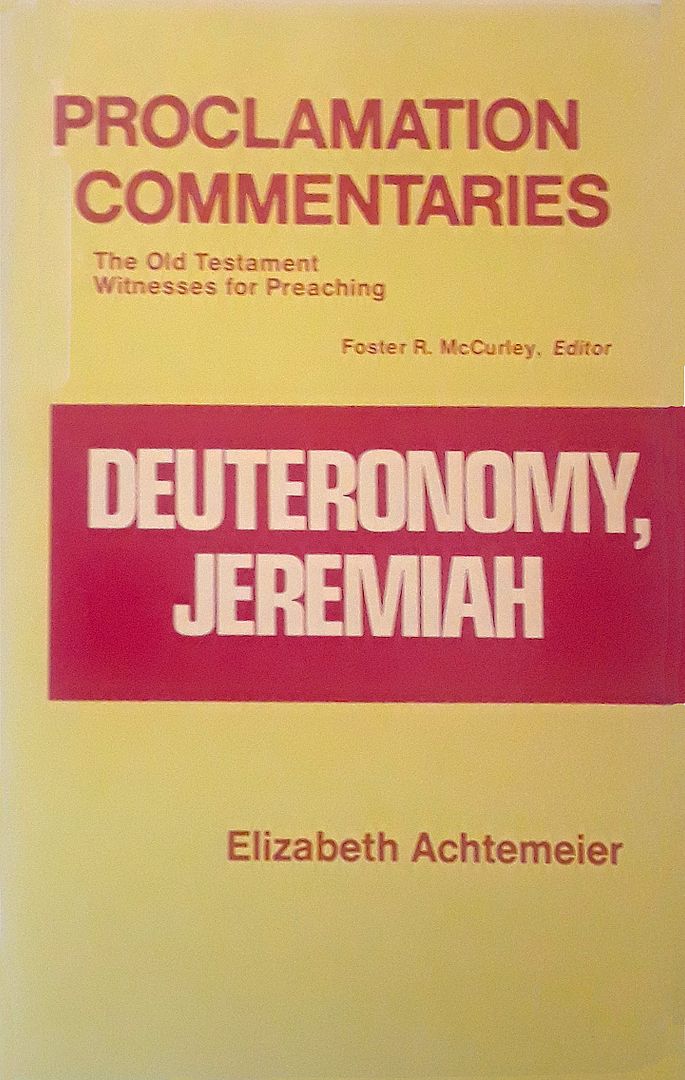
Deuteronomy / Jeremiah

Proclamation Commentaries: The Old Testament Witnesses for Preaching—Deuteronomy, Jeremiah on Amazon

JeremiahAs part of the Fortress Press (now Augsburg/Fortress) Proclamation commentary series specially designed for preaching and teaching in the local church, Hebrew bible scholar Elizabeth Achtemeier presents some historical background along with textual, contextual, and thematic similarities between Deuteronomy and Jeremiah; both books essentially emerged from the same time period and from related political, cultural, and religious concerns. The short commentary is less than 100 pages, so you can read Deuteronomy, Jeremiah in one sitting and gain a sense of Yahweh's loving, covenantal purposes with Israel and also an appreciation of the many ways realities during the time both books were recorded and redacted apply to us in the Church as covenant people under the sovereignty of Jesus Christ. Proclamation Commentaries Deuteronomy Jeremiah Elizabeth AchtemeierClearly you'd need additional resources to prepare an adequate sermon or study on these passages, but what an illuminating overview for those of us with some knowledge of the texts who want to begin pulling it all together! Although the book is copyright 1978, much of the Selected Bibliography at the end still is current and could serve as part of those additional resources.

Edited on Friday 12 June 2014:

Regarding parallels and similarities between the texts of Jeremiah and Deuteronomy, Walter Brueggemann recently explained, "The older view was that Jeremiah was a 'scissors and paste' editorial job to intrude Deuteronomy belatedly into Jeremiah. More recent work suggest that the relationship is an integral one, and Jeremiah is schooled in and reflective of the older covenantal tradition.'" Out of Babylon, page 75

my amazon review: consonance between Deuteronomy and Jeremiah

Illustration features a detail from Jeremiah by Michelangelo, 1511. Fresco currently in Sistine Chapel.

Friday, June 15, 2012

friday 5: dreams

For today's Friday 5 about dreams, Jan hosts and tells us: "I have just started studying Jung and dreams with a group of friends. I am hearing about lucid dreaming and imagining, which have opened me up to wondering about dreams in general. So how about wondering with me?"

1. Everyone dreams: Do you remember your dreams? How often?

life stuff buttonWhenever I wake up out of a dream full of symbolism I usually try to be quiet for a few minutes and assess what it might have been about, though it's been several years since I tried writing down and pondering the meaning of whatever I'd recently dreamt.

2. Did you or do you have a recurring dream? Share it, if you'd like.

As an adult I haven't, but as a little kid I had a visually interesting dream that featured what looked like a board game full of textured black squares I had to move through from start to finish. It always was easy, with almost no roadblocks, but it always took a while to get to the end.

3. Have you ever had recurring themes or images in dreams? Examples?

One basic type of recurring dream features players currently on the periphery or who have been on the outskirts of my life for a short time in roles and situations where now former friends and acquaintances used to be; I'd call those thematic images and they're always people rather than objects.

4. Do you day dream? About what?

As part of living as if and practicing resurrection, I try to daydream often, imagining a here and now, a place, space, and a people that welcome me, do not consider me a threat or a curiosity and are willing to help resurrect me from this death. I envision a scenario where I've found a geographically local, a "parish" church where I can design some posters and bulletin covers, teach on a regular basis, preach now and then, help plan worship, be the regular supply musician or possibly the musician for one of the worship events.

5. What are your dreams/hopes/goals for the future?

Please refer to (4), and to emphasize, I dream of a place where I have a future, where my many years of education, my gifts, skills, and abilities will be exploited and celebrated. Internet options can enhance and enrich life tremendously, but like sacraments, real life is local. Like sacraments, real life is sensory: you can touch and feel, taste and smell, see, hear and celebrate it. The sad reality of someone with my level of education, skills, and experience running around town and around the internet, sending emails, making phone calls and cold calls trying to explain my background and begging folks to let me do something, (sometimes to go to lunch with me!) is plain pathetic. Walter Brueggemann says "bright, skilled, educated people are valued and sought-after"; he also speaks of people being nullified.

What is life? Community, friends, family if you have one, participation and parties, good food, good drink, opportunities for "meaningful" service; for me it needs to include a setting safe enough that I can recover the reasonably full emotional responses that are essential to being human. Real life evolves organically, and isn't something you can manufacture as I've been trying to do. That's my hope for me as an individual, but more broadly, I dream of that kind of setting for everyone. In short, a total environment that helps transform the world and especially the neighborhood (remember, life is local!) into something closer to the Reign of Heaven on Earth. Community, friends, hopes, dreams and participation in the thick of things make us human; they make life and they make life worth living.

PS I loved reading Jung when I was in school and maybe need to check him out again!

Wednesday, June 13, 2012

poetry party 58, Shine!

invitation to poetry icon
This is an offering in Abbey of the Arts'
poetry party 58, "Shine!"

night stars

shiny hopes

under my feet
a quilt of jasmine stars
over my head
a spangle of sky stars
summer breezes
surround me and
send hope shimmering
send despair scurrying away

star jasmine