Showing posts with label Katrina. Show all posts

Friday, February 23, 2024

Five Minute Friday :: Respite

rain on window and Leviticus 26
3 If you follow my statutes and my commandments
and observe them faithfully,
4 I will send you rains in their seasons,
and the ground shall yield its crops,
and the trees of the field shall yield their fruit.
11 I will place my dwelling in your midst
12 I will be your God and your shall be my people
13 I am the Lord your God who brought you out of the land of Egypt…
Leviticus 26


Five Minute Friday :: Respite Linkup


Respite from the storm. From that noise. From whatever bothers you, any overwhelm, including the (actually satisfying) tiredness Kate wrote about. My header photo illustrates rain on a window.

Here in the desert – albeit a coastal one – waking up to rain on the window often means relief because now we have at least brief respite from ongoing drought. Rain on the window and slick roads (remember to Turn Around – Don't Drown when you're out there) signal respite and restored life for crops, for the Los Angeles River with its wildlife, aquatic animals and organisms, with its verdant, recently restored banks.

Weather peeps measure rainfall from October through September, and by grace we've recently had enough water from the sky. But with even the River that carved the Canyon in crisis, we need to continue practicing the careful stewardship God calls us to. God promises rain, yet God's promises usually carry the condition of human obedience.

It feels as if most scripture passages about rain are about water as gift because after all, water is life! However, too much water in the wrong place can flood can destroy. Hurricanes can wreck crops, economies, hopes, and futures. Earlier in the oughts I blogged several times about Katrina. Yet scripture mostly does speak about rain as respite, a refreshment from parched earth, a life-restoring gift. I started by mentioning respite "from any overwhelm" and isn't historical drought overwhelming all creation?

The opening Leviticus passage promises rain that's essential for the land to yield, for trees to bud, blossom, and fruit. God sends rain to give us respite from hunger.

I am the Lord your God who brought you out of the land of Egypt. The God of liberation is a fertility God!

# # #
sky sun flowers rocks
five minute friday respite
five minute friday icon button logo

Monday, October 12, 2015

12 October: Storm

31 days of free writes oct 12, storm

Day 12 of Kate Motaung's October 2015 edition of 31 days of free writes.

Monday 12 October: Storm

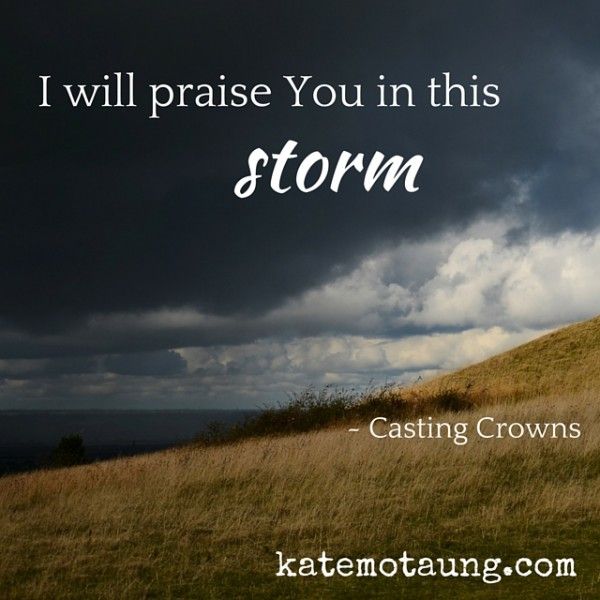
As usual, I thought about what I might write about storm in 5 minutes; then when I logged in and discovered Kate's button for Storm with Casting Crowns' elegantly expressive, "Praise Him in this Storm," I remembered the first time ever I heard that song, sung by a talent show participant at the church I attended when I returned to the left coast. Does that mean I'm writing about the storms of life, or the many storms God has brought me through? Not this time.

I'm thinking of hurricane season in the northeast, where we've had power outages at least a couple days long. I re-collected memories of mega-hurricane Katrina that devastated the Gulf Coast ten years ago in 2005, esp as Katrina impacted the City of New Orleans. I've experienced brief, violent squalls along west coast and east coast beaches; those storms have uprooted and scattered trees, debris, shrubs. weeds, and other unanchored objects. At the conclusion of any of nature's storms we get overarching calm, clear skies, bright sunshine, and a sense of well-being. Nope, not going to suggest any parallel in our own emotional, psychological or spiritual storms.

It rarely rains in southern California, and when it rains it often pours. A few weeks ago the overnight rain sounded like a rock tumbler! To answer a recent question, we do have storm drains. And we close the beaches after it rains.

October 2015 31 days of free writes

Sunday, September 19, 2010

Season of Creation 3c: Storm Sunday

19 September 2010

Today is Storm Sunday, the third for this year's Season of Creation liturgical emphasis. With Ocean Sunday, we pondered and celebrated the earth's circulatory system. Fauna Sunday was a time to consider critters of all kinds that depend on humans for their sustenance and health, just as trees, rivers, forests and prairies do—animals are a major aspect of our interdependent world! Next Sunday, the twelfth and last will be Cosmos Sunday. Paralleling the Revised Common Lectionary, the Season of Creation includes a year for Matthew, one for Mark, and then Luke.

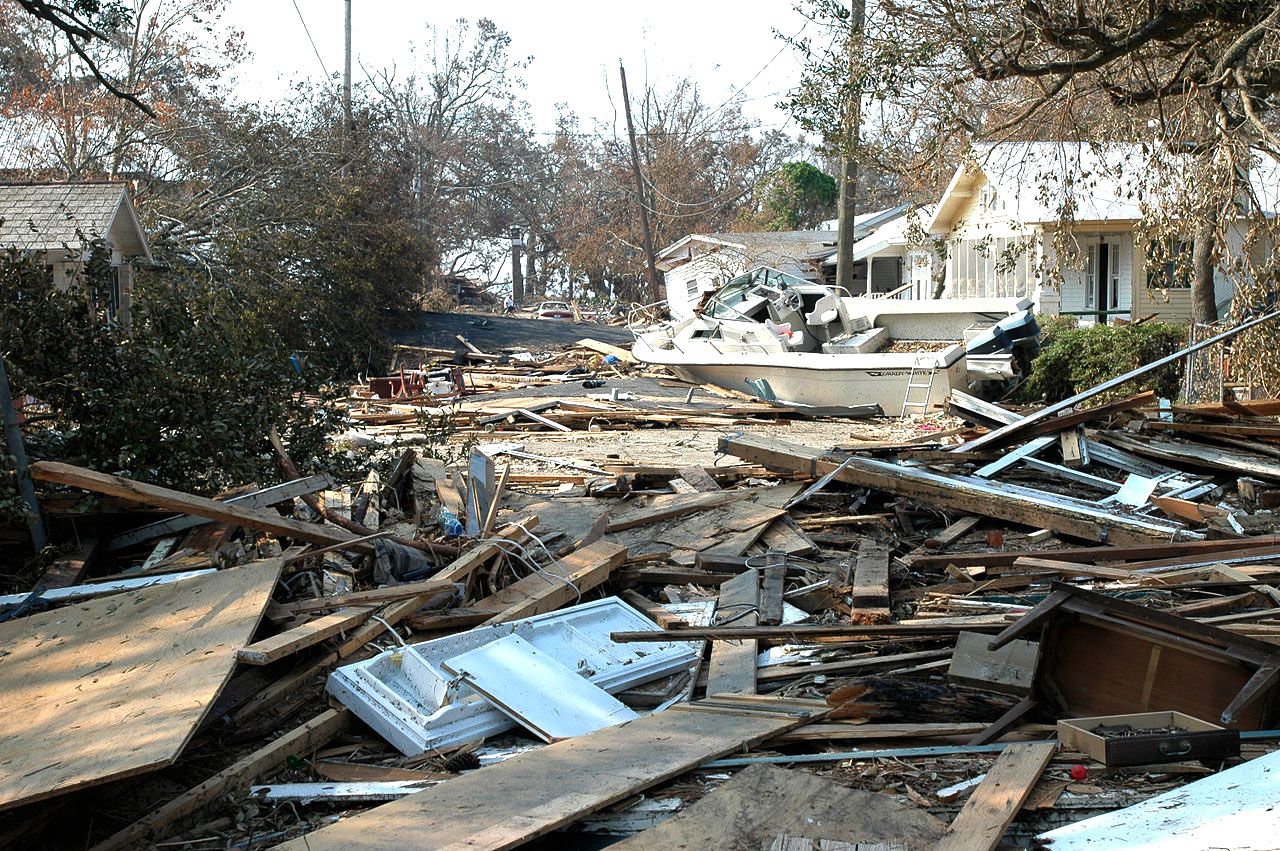
Hurricane Katrina - Biloxi, Mississippi

It feels as if especially during the five years since Katrina turned the world's eyes and hearts to the city of New Orleans and to the ineptitude of the federal government's response, every time there's a natural disaster media outlets overwhelm us with constant updates about the most recent hurricane, earthquake, oil spill, tornado or assorted "other" weather phenomena that disrupt the sometimes routine days of our lives.

In the reading from the Hebrew Bible, Job [28:21-22] inquires about wisdom, responding with words about some not readily apparent ways of being wise: “Where then does wisdom come from? And where is the place of understanding? It is hidden from the eyes of all living, and concealed from the birds of the air."

Paul's first letter to the Corinthian Church forms the second pericope or scripture selection for Storm Sunday. At first glance its relevance may seem a stretch, since Paul again is all about the cross of Calvary and again Paul recognizes the paradoxical power of weakness, vulnerability and death, along with servant wisdom found in the cross. Paul trusts the invincibility of life in the overwhelming power of resurrection. In fact, you could say that for Paul the Gospel is death and resurrection!

23we proclaim Christ crucified, a stumbling block to Jews and foolishness to Gentiles, 24but to those who are the called, both Jews and Greeks, Christ the power of God and the wisdom of God. 25For God’s foolishness is wiser than human wisdom, and God’s weakness is stronger than human strength.

Major seismic and atmospheric events can cause widespread destruction of all kinds, more often than not disproportionately impacting lives and surroundings of folks with fewer financial and other resources. It's well-known that people living in neighborhoods with more up-to-date infrastructure have better schools and get better coverage from police, fire and politicians. At 7.2 the Easter Day Sierra El Mayor geological event that shook, rattled and rolled Northern Mexico and Southern California was higher on the Richter scale than the 7.0 Haiti quake on 12 January. Alta and Baja California regions still are getting substantial aftershocks, but they warrant no more than a "did you feel that one?" while Haiti remains in chaotic disrepair and there probably never will be an accurate death count or reckoning of total costs. According to today's famous passage from Luke, the disciples "...were afraid and amazed, and said to one another, 'Who then is this, that he commands even the winds and the water, and they obey him?'

"Who is this? Even the winds and the waves obey him." Hebrew and Christian worldviews emerged from God's self-revelation within religious contexts in which people believed that far away, distant, unapproachable gods caused natural disasters and disturbances out of their anger and displeasure with humans, along with more-or-less predictably cycles and recycles of the same events. The experience of God's nascent people Israel and later those of the early Church – I'd hope our experience as 21st century Christians, too – with the God who is Creator and Lord of the waves and the winds (the desert, the savanna and the outback, and Lord of history, too...) was distinctly different! This was not a remote deity requiring sacrifice and placation, but a God so in love with creation that in Jesus of Nazareth God chose to live as a human creature. Not only has the endless recurrence of the very same thing stopped in its tracks, this God promises and provides a hope, a future and the reality of resurrection from the dead.

Job asks about wisdom; the apostle Paul tells us about God's wisdom. When the very young John Calvin pondered compiling a systematic theology, he wondered whether to begin with Divinity or with Humanity but finally decided it made no difference, since the outcome of either would be identical. Back in the days of Jesus the Nazarene it was not unusual to be talking with someone who was half mortal, half divine—the offspring of a human and a god. In Jesus Christ we find something more: a Savior, a Lord both completely mortal and completely divine; in Christ Jesus we discover that the fullness of humanity and the fullness of divinity are one and the same! Baptized into his death and resurrection and walking with Jesus in trust, we participate in his humanity and claim his divinity. Martin Franzmann's poetry sings, "Thy strong Word bespeaks us righteous, bright with Thine Own Holiness."

A blizzard or flood, tsunami or environmental accident originating oceans and continents away from where we live or a block away from home will affect all of us wherever we are. Because of our intertwined lives, last January's earthquake in Haiti wounded and broke all of us. Each of us can be counted among Deepwater Horizon's victims and survivors.

Will major meteorological events keep on happening? Without a doubt they will. "Who is this? Even the winds and the waves obey him."

Who are we, the people of God? We live baptized into Jesus Christ, so do the oceans and the breakers obey us? God calls us to be co-creators and faithful stewards of all creation, to live as agents of justice, renewal, restoration and mercy for all, in those ways and probably many others, also, to be the presence of Jesus Christ...

Saturday, September 10, 2005

Katrina again

hurricane katrina biloxi mississippi
Last Saturday I posted Boundless Community intertwined with some thoughts on Katrina; here are some reflections about a couple of the RCL texts from last Sunday—a sabbath-day majorly in Katrina's wake:
Matthew 18:15-20

15 "And if your brother sins against you, go and reprove him, just between the two of you. If he hears you, you have gained your brother. 16 But if he will not hear, take with you one or two more, that 'by the mouth of two or three witnesses every word may be established.' [Deuteronomy 19:15] 17 And if he refuses to hear them, tell it to the church. But if he refuses to hear even the church, let him be to you like a gentile and a tax collector.

18 "Truly I say to you, whatever you bind on earth will have been bound in heaven, and whatever you abolish on earth will have been abolished in heaven.

19 "Again truly I say to you, if two of you agree on earth concerning anything that they ask, it will be done for them by my Father in heaven. 20 For where two or three are gathered together in my name, I am there in the midst of them."

Romans 13:8-14

8 Owe no one anything else except to love one another, for anyone who loves another has fulfilled the law. 9 For the commandments, "You shall not commit adultery," "You shall not murder," "You shall not steal," "You shall not covet," [Exodus 20:13-15, 17; Deuteronomy 5:17-19, 21] and if there is any other commandment, are all summed up in this word, "You shall love your neighbor as yourself." [Leviticus 19:18] 10 Love does no evil to a neighbor; therefore love fulfills the law.

14 But put on the Lord Jesus Christ, and give no thoughts to gratifying the aimless desires of your flesh.
Put on the Lord Jesus Christ! From Paul himself we know our baptismal clothing is Jesus' death and Christ's resurrection, leading to the demise of our false, unconnected selves and subsequent living in the reconciled community that in Christ Jesus is born, lives, breathes and keeps on dying and rising for the life of others—both in our own nearby communities (church, neighborhood, family, school, workplace) and those others geographically distant and/or culturally faraway from wherever we are, others we've never met and possibly never will meet.

Paul insists we owe, we "ought" the love of Christ to every one another; the extravagantly unbounded love for us God demonstrated in Christ Jesus obliges us to return that love to every person we encounter and to all creation. Within the church community and in our imagined more-private interactions, love becomes the energetic power flowing through our community and keeping us joined together in the Spirit—maybe especially in times of discord and disagreement.

Paul compares love for others to a debt - an ought that we owe them - and summarizes all the commandments into one single directive: Love does no harm to a neighbor; therefore love is the fulfillment of the law. To understand the obligatory nature of a debt and the ensuing fallout when we don't attend to repaying that obligation, a person does not need to have reached anything resembling chronological maturity. In the Bible's economy and worldview, sin and debt essentially are synonymous.

Via Matthew, God calls upon us (the church, yep, we are the church!) carefully to care for one another radically and graciously, even vis-à-vis—especially in the face of—sin, offense or disagreement; Matthew tells us, the church, to begin by privately addressing the person with whom they are in conflict, next to seek impartial mediators [probably members of the church's governing board] to help resolve the situation, and then, it sounds as if the entire congregation needs to intervene.

Matthew quotes Jesus' pledge that his gracious, loving presence will be the power reconciling and uniting the two, the three - or the many - gathered together. The Matthean text disparagingly mentions "gentiles and tax collectors," but that reference probably did not come from Jesus of Nazareth; most likely it's Matthew the former tax-collector's gloss regarding interactions and conflicts within his own local church. By the way, Matthew is the only gospel-writer who uses the term "church," or ecclesia!

Both of these passages are about maintaining the fragile-appearing web of connectivity among church members, and I'd definitely carry it through to the entire world (right now in particular I'm thinking of New Orleans, Mississippi, Alabama and the entire Gulf Coast region), since our Father-God, Christ Jesus the Son and our brother, in the dynamic power of the Holy Spirit connect, reconcile and enable our interresponsibility for one another and for all creation. But for us - particularly in the churches of the Reformation, who tend to live as intellectual people of the Enlightenment, too often acting and thinking as "individuals" more than we do as members of community - what about the inevitable strain between perceived individual rights and necessary local and global community solidarity?

The dialogue partners in The Gospel in Solentiname, my favorite gospel commentary, propose regarding this text,
  • "The publicans or tax collectors were the ones who collaborated with the Roman occupation, and the religious Jews considered them excluded from the Jewish community just like the pagans. But here Jesus isn't concerned with religious questions. He's saying that if somebody does evil and doesn't reform he ought to be excommunicated from the community. The unjust person (and not the person of another religion), that's the one that ought to be considered by us as 'pagan' or 'publican.'"

  • "Which is like saying the oppressor or the collaborator of the oppressor. ...He has removed himself from the community. He's outside, but we have to fight to get him back in."

  • "For Christ the ones who don't believe in God are the ones who don't love their neighbor, the ones who don't want to live in harmony with their companions."

  • ..."You mustn't accuse anyone to the police judge in San Carlos. It's the community that must judge."

I tell you the truth; what you tie in this world will be tied also in heaven, and what you untie in this world will be untied in heaven."

  • "This means that everything the community decides will be ratified by God. ...all of us here are in agreement, God's also in agreement with us. ... You could almost say they're like the three Divine Persons. And the three Divine Persons are like a single true God. And the three persons who are in agreement would be three who are united with God." ...

    "The people's verdict is the verdict of God, says Christ."

    "...And Christ is there with them even though they don't realize it."

Because wherever two or three are gathered in my name, there am I in the midst of them.
  • "...in the language of the Bible 'name' doesn't mean the name of a person but the person himself, or also what we now call the character of a person. When Christ speaks of gathering in his name he doesn't mean that they're going to be mentioning his name but that they'll be gathered in his spirit, in agreement with his teachings and his message. That community will have such great power because he will be in the midst of them."

  • from The Gospel in Solentiname, volume 3, pages 152-158
Back to Katrina for a moment: within our own local churches, sometimes the air is so thick with irresolution and conflict, newcomers and visitors actually can feel the tension, so they drop out very quickly. The last section in the post I linked to at the beginning of this one includes:
God mightily acts to overcome the division between our old, solitary, disconnected existence and our new lives in the fullness of community. Baptism obliterates the boundaries and the unimportant distinctions between us and God and between us and every other facet of creation, human and not.

...because of our irrevocably entwined lives, Katrina's wounded and broken are all of us, and the responsibility of every one of us, but especially those of us who live in Jesus Christ as The Church, who every day live aware we are the Kingdom of Heaven on earth. God calls us, and in the Spirit God empowers us, to be a crucified and resurrected presence among all people and all creation. As the Church and the churches, may we be, live and act as God calls us and the Spirit enables us: to be his presence, to live in trust and to act in compassion!
Long, long ago, I read, reread and then read over again, I and Thou by Martin Buber. I don't know if the words are from that book, or maybe they were on a poster I once owned or noticed in a gallery, but the quote is from Buber:

Love is the responsibility of an I for a thou.

Speaking of posters, maybe some of my readers know about the Benedictine Conception Abbey's Printery House? At once point in time I owned a bunch of them, but most poignantly a couple remain stuck in my memory: the first, with a quote from Harvey Cox, "Not to decide is to decide"—that one hung on the wall in my kitchen in Boston's North End, and when a mini-flood trickled down the wall from the kitchen above mine, it kind of like soaked the poster, which I decided wasn't in sufficiently optimal condition to take with me to my next sojourn in time and space. I have no clue what happened to the other, which featured a train whirring through the night on its way to wherever; that one read, "Life is a journey, not a destination." So much for asides!

Continuing about Katrina: I cannot say more than endlessly to reiterate that all of us form a single created and redeemed community and to wonder at the non-humanness of the Federal government's leadership and also wonder if part of it is not sheer ignorance? When I heard folks locally and on TV ask why the literally left-behind in the city - transformed from site of civilization into situation of devastation - by Katrina's wrath did not heed counsel to get out of town, I had to believe the people who asked that question were by no means uncompassionate or generally ignorant but they did not realize that too many Americans cannot jump into their SUV or related trophy vehicle, gas up and flee from the path of whatever physical or metaphorical storm that's about to hurtle into their territory because they lack the financial, psychological or whatever resources to do so.

Love is the responsibility of an I for a thou.

This blog began about last Sunday's lectionary texts...how can it be possible for any of us to bear and live out our responsibilities for each- and one-another? For all of us to live in community, thriving as citizens of a planet increasingly interconnected but also more and more fragmented in close to every imaginable way, we all must learn to perceive others' situations and needs as they really are. Is it possible for any of us to move beyond stereotypes and assumptions? You shall love your neighbor as yourself.

Saturday, September 03, 2005

Boundless Community... Katrina

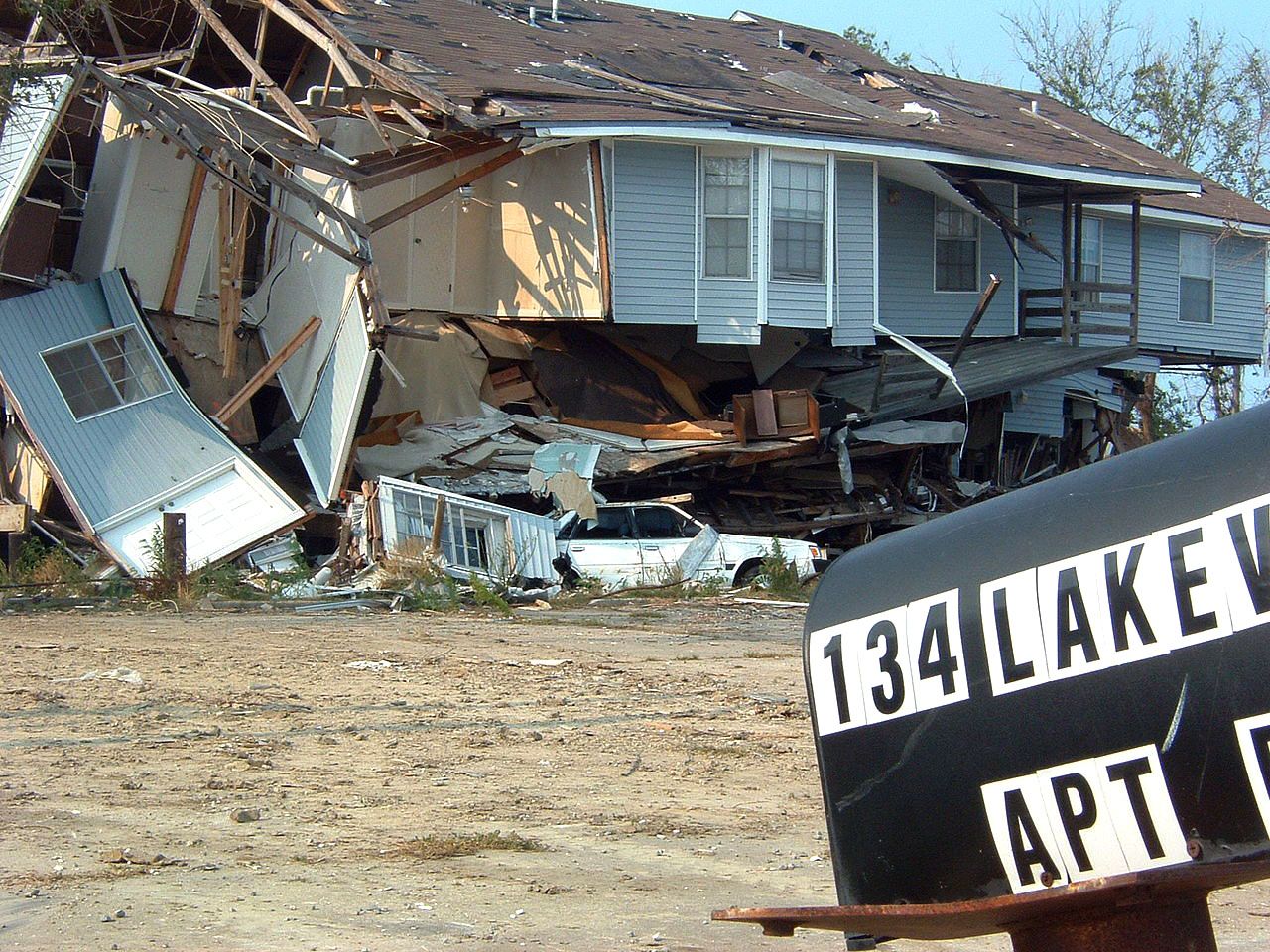
Hurricane Katrina, Slidell, LA

Boundless Community intertwined with some thoughts on Katrina

Introduction

A few weeks ago I reposted my old blogs with titles so the recent posts code I added to the template actually would work throughout the blog, and in the process of doing so I came across one of many of my felicitous phrases: boundless community! As I do so often, I was writing about baptism when I wrote boundless community. As I do so routinely, I grabbed onto some words and began writing about them.

One of my excuses to myself for not finishing this earlier was the unusually hot and sultry weather here in paradise San Diego, and again we're having a lot of humidity, making the weather feel like Summers in the City I experienced living in Boston... in the course of not developing "Boundless Community" into publishable form I wrote some others for this far by faith, my testimony blog and I've left a couple things here on Desert Spirit's Fire, but since today is Saturday, September 3, it's more than high time I finished what I began on Sunday evening, July 24.

But first, I want to mention that this weblog, Desert Spirit's Fire, is aging! Here's my kick-off, Welcome from way back three summers and more than three dozen moons ago, July 16, 2002. Since then I've done close to a ton of customizing to the template (it fits the content well, so I probably won't switch to another one any time soon) in order to align it with most of the niceties most present-day blog templates come with by default.

Paradoxical Presence: Sacraments and Church

As closely as it relates to this blog I won't repost it here, but for more of what I've written about the Boundless baptismal/eucharistic Community, check this out from April 7, 2004: Sovereignty, Eucharist and Ascendancy. Okay, I will cite a bit of what I wrote, though it's extreme theological shorthand (almost to the point of crudeness!) with a hint of Luther and a scrap of Zwingli:
...the person presiding at eucharist holds the totality, entirety and completeness of the redeemed and restored cosmos in her or his hands in the person of the risen, ascended One Who also is now descended, once again "incarnate," among and within the gathered and transformed Eucharistic community...
However, it seems well-nigh providential that I returned to this blog for maybe the dozenth time since beginning it, because when today I consider Boundless Community, I cannot help but agonize over the devastating toll hurricane Katrina has been taking in the excruciating suffering of all God's sentient beings - 2-legged, 4-legged and multi-legged - as well as the cost to the terrain and the waterways (far beyond the technical confines of Lake Pontchartrain and the Mighty Mississipp) and to the total infrastructure. Katrina has been a substantial jolt out of the surreality in which we amble and drift far too much of the time, and if repair, rebuilding, revitalization and the life-giving essential of the renewal of hope gets left to merely human devices and human power, possibly the damage and destruction will be beyond repair?

This past Wednesday evening I posted some Katrina-related scripture: "Who is this? Even the winds and the sea obey him!" from Mark 4, followed by the Pantocratur ascription from Revelation 11:17, and concluding with Revelation 21's New Heaven, New Earth, New Jerusalem-City of God, proclaiming to all:
"Now God pitches his tent and lives among all humanity, and God will travel alongside all the people wherever they may go. They will be God's people, and God himself will dwell with them and be their God. And God will wipe their tears from their eyes. No more will they know death or grief or sorrow or pain, because the old order of things has gone away."
I pulled the passages out of my head (well, out of my experiences and theology) and left them without even minimal commentary or exegesis, because when I ponder the responsibility God gives us, the Church and the churches--the responsibility of being his presence, specifically the Presence of the crucified and risen Christ in the world, the exhibition of the Kingdom of Heaven to the world, it is scary awe-full and also reassuring, because God believes in us that much, God trusts that in the power of the Holy Spirit we can be his ambassadors and envoys, his healing, hope-restoring, life-renewing, transforming, mysterious, humanly illogical Eastered power!

Recognizing the Risen One

Boundless Community: didn't Paul insist we discern the body, recognizing and acknowledging the Risen Christ's hidden presence in the church and in the world—discerning the body particularly as we prepare to partake of the eschatological feast of the eucharist? ...although we need that admonition absolutely everywhere, all the time. The Body of the Risen Christ, also known as The Church and the churches supremely are a single body, one common community, eternally linked vertically and horizontally; admitting and living with those dimensions can make a person very uncomfortable.

Boundaries of any kind are time-limited and space-demarked human constructions, but because God knows and understands our human condition and its accompanying propensities so thoroughly, in Jesus of Nazareth God became one of us and lived a fully human life, in order to wipe out all of the barriers between earth and heaven, because in God's Sovereignty no such limitations can exist. Since Jesus Christ' birth, life, death, resurrection and ascension obliterated them forever by reconciling us to one another and to God, why do we still live and act as if this were the old order of the reign of death rather than the new order of the dominion of life?

Once more I need to recall the beginning of the First Lesson from Advent 1 in lectionary year B: Isaiah 64:1 O that you would tear open the heavens and come down, so that the mountains would quake at your presence...That's about a permanent breaking, a truly irreparable ripping apart and keeping apart forever of the obstacles and obstructions between heaven and earth. ...I've blogged on that text at least twice in this site, and since this coming-up Advent 2005 we'll begin RCL year B again, I'll probably theologize about it again.

In God's Sovereignty there are no limitations of time or space, of person, culture or creed, no distinctions of young, old, class or race, education or ethnicity. Today, Paul of Tarsus still tells us to discern the body, and Martin Luther's theology of the ubiquity of the Risen and Ascended Christ insists the Risen Christ is everywhere, not solely in the formally configured and institutionally recognized and authorized entity known as church.

Newness of Life

We teach and proclaim resurrection (is our central kerygma God's Self-revelation in Jesus of Nazareth or, indeed, is resurrection our primary hermeneutic?), but too much of the time we exist between death and life in a kind of no-person's land that's neither God's nor the devil's realm: we stay stuck in the three days and three nights in the Belly of the Great Fish, also known as three days and three nights in the Heart of the Earth. Nonetheless, with its nurturing, nutrient-rich, cushioning, fluid environment the Great Fish's Gut becomes a womb-like ambiance of safety and preparation for (re)-birth; the Earth's Heart reminds us of our origins in dust coupled with assurance of our ultimate return not to the dust but to a new re-borning to the fullness of resurrection.

Whether Belly of the Great Fish or Heart of the Earth, it's still about baptism, endlessly about baptism, meaning wherever we are and however we are (primarily to remind myself, it's fact, not feeling), it's about community and about our unbreakable connectedness to one another and to all creation, past, present and future. God mightily acts to overcome the division between our old, solitary, disconnected existence and our new lives in the fullness of community. Baptism obliterates the boundaries and the unimportant distinctions between us and God and between us and every other facet of creation, human and not.

Katrina the Hurricane's destruction affects each of us individually and each of our communities, whether church, neighborhood, city or any other group; because of our irrevocably entwined lives, Katrina's wounded and broken are all of us, and the responsibility of every one of us, but especially those of us who live in Jesus Christ as The Church, who every day live aware we are the Kingdom of Heaven on earth. God calls us, and in the Spirit God empowers us, to be a crucified and resurrected presence among all people and all creation. As the Church and the churches, may we be, live and act as God calls us and the Spirit enables us: to be his presence, to live in trust and to act in compassion!

Wednesday, August 31, 2005

Katrina | 31 August 2005

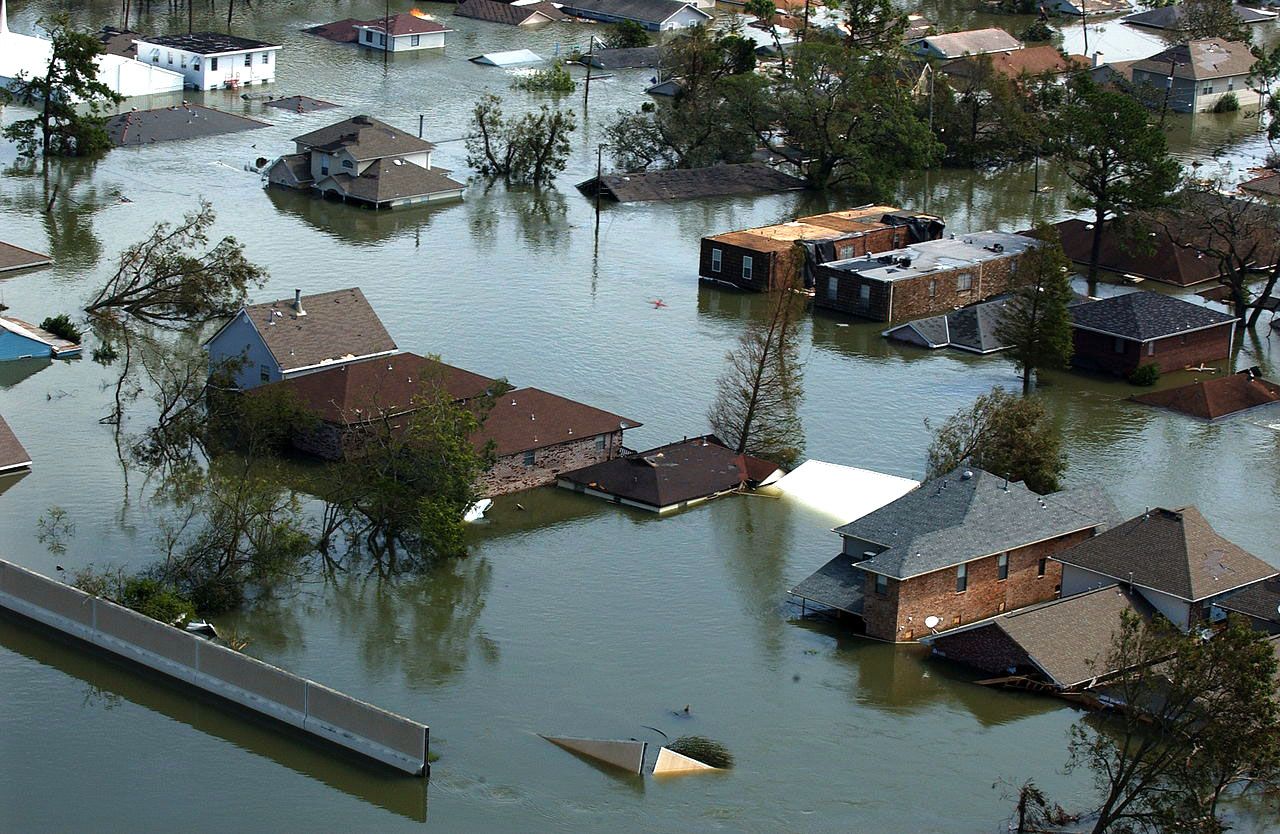
Hurricane Katrina, 30 August 2005

Mark 4

35 On that same day when evening came, Jesus said to his disciples, "Let us go over to the other side." 36 And leaving the crowd behind, they took Jesus along in the boat, just as he was—there were some other boats, as well. 37 A tremendous storm came up, and the waves broke against the boat, almost overwhelming it. 38 Jesus was in the stern, asleep on a cushion. The disciples woke him and said to him, "Teacher, don't you care if we drown?"

39 Jesus got up, admonished the wind and spoke to the sea: "Quiet! Be still!" Then the wind died down and there was a tremendous calm.

40 Jesus asked his disciples, "Why all the fear? Do you still have no faith?"

41 They were tremendously fearful and asked each other, "Who is this? Even the wind and the sea obey him!"

Revelation 11

15 And the seventh angel sounded his trumpet, and there were tremendous voices in heaven, saying:

"The kingdom of the world has become the kingdom of our Lord and of his Christ, and he will reign forever and ever." 16 And the twenty-four elders, seated on their thrones before God, fell on their faces and worshiped God, 17 saying:
"We give thanks to you, Lord God All-Powerful,
the One who is and who was,
because you have taken your tremendous power
and have begun to reign."

Revelation 21

1 And I saw a new heaven and a new earth, for the first heaven and the first earth had passed away, and no longer was there any sea. 2 And I saw the holy city, New Jerusalem, descending out of heaven from God, dressed as a bride adorned for her husband. 3 And I heard a tremendous voice from the throne saying,
"Now God pitches his tent and lives among all humanity, and God will travel alongside all the people wherever they may go. They will be God's people, and God himself will dwell with them and be their God. 4 And God will wipe their tears from their eyes. No more will they know death or grief or sorrow or pain, because the old order of things has gone away."
5 He who was seated on the throne said, "Behold! I now make all things new!" Then he said, "Write this down, for these words are faithful and true."

6 He said to me: "It is done. I am the Alpha and the Omega, the Source and the Destination. To anyone who thirsts I will give – without any cost – abundant cascades of the waters of life."

22 I saw no temple in the city, because the Lord God All-Powerful and the Lamb are its temple. 23 And the city has no need of the light of the sun or the moon, for the glory of God gives light to the city, and the Lamb is the city's lamp. 24 All the peoples everywhere will walk by its light, and the rulers of the earth will bring their glory into the holy city.