Although I read these chapters, I didn't think about them long enough or seriously enough to write any notes, but I've kept the discussion questions and maybe I'll reread both chapters so I can consider and answer the questions within the next few weeks.
Showing posts with label the will of god. Show all posts
Thursday, June 09, 2005
Leslie Weatherhead: The Will of God 4, 5
Leslie D. Weatherhead, The Will of God © 1944; © renewed, 1972
Chapter 4: Discerning God's Will and Chapter 5: In His Will is our Peace
Although I read these chapters, I didn't think about them long enough or seriously enough to write any notes, but I've kept the discussion questions and maybe I'll reread both chapters so I can consider and answer the questions within the next few weeks.
tags, topics
the will of god
Wednesday, June 08, 2005
Leslie Weatherhead: The Will of God 3
Leslie D. Weatherhead, The Will of God © 1944; © renewed, 1972
Chapter 3: God’s Ultimate Will—part 1
The discussion moderator began:
Chapter 3: God’s Ultimate Will—part 1
Weatherhead begins by rehashing the three divisions of God"s will, as in chapters 1 and 2. Yet he offers an interesting perspective of our ability to choose and free will. How does this mesh with your view of choice and free will?Then he asked,
Do you believe in a Devil as an actual being? Or do you believe in a metaphorical Satan--a personal adversary that can combine with other personal adversaries to create a greater, collective evil that we've seen repeatedly throughout history?Actually, I don’t know, but I do believe in spirits of evil in the way Walter Wink talks about them in his Powers trilogy, as he draws upon deuteroPaul of Colossians and Ephesians as well as discussing the Spirits (the "Angels") of the Seven Churches in Revelation. And personally, some (most?) of us do what feels like near-constant battle with demons of various kinds, many of which very definitely live independent lives of their own--lives that seem to be ego-dystonic, something completely outside of us that inflicts themselves upon us. Not being an expert on knowledge of the bodily existence of - or the embodiment of - evil, I do think there's a real sense in which the sum of the parts frequently is greater than any of the elements of the parts: in plain English, "synergistic!"
tags, topics
Ephesians,
the will of god
Tuesday, June 07, 2005
Leslie Weatherhead: The Will of God 2
Leslie D. Weatherhead, The Will of God © 1944; © renewed, 1972
Chapter 2: God's Circumstantial Will
Chapter 2, part 1:
This chapter deals with God's plan within certain circumstances; Weatherhead uses the image of the cross to better explain how circumstantial will works. Reading and connecting to this chapter, I keep finding myself full of gratitude for quite a few totally unintended circumstances I've found myself in--and, of course, particularly thankful for the people who've helped carry me through those times that weren't easy in any sense of the word. Here’s a little on the first part of chapter 2:
Regarding the Cross: given the circumstances of evil, the crucifixion became God's will. Dr. Weatherhead says, "The laws of the universe, which are themselves an expression of God's will, were not set aside for Jesus, the beloved Son." That fact relates to God's preference for acting in incarnational ways! Also, as our moderator observed, there are both natural and spiritual elements within God's circumstantial will.
But continuing: so, like, "every woman" has a maternal instinct...though possibly "repressed into unconsciousness?!" "...a home and husband and babies..." are a women's "primary raison d’être"?!?!?!?! This book is © 1944 and the copyright renewed in 1972. Oh, his definitive solution here is sublimation...no comment.
Chapter 2, part 2:
Whether (or not) an event is the will of God? Get our thinking straight, because the answer is both Yes and No! Once again, natural laws vis-à-vis God's [spiritual] ultimate will. "The Christian minister...he..." OK, this book was written quite some time ago...God would not allow an event to occur if of itself it had the power to defeat Godself. Dr. Weatherhead is correct that in the Bible we don't hear people explaining away diseases, etc. as "the will of God," but this has happened, or currently is happening "that God might be glorified!" He's got it right about the kingdom of evil – in deutero-Pauline terms, "powers and principalities" and their sometimes temporary sway or even what appears as their momentary rule over the Kingdom of Heaven. God's perspective is different...yes! Jesus overcoming the world rather than explaining the world!
Chapter 2: God's Circumstantial Will
Chapter 2, part 1:
Regarding the Cross: given the circumstances of evil, the crucifixion became God's will. Dr. Weatherhead says, "The laws of the universe, which are themselves an expression of God's will, were not set aside for Jesus, the beloved Son." That fact relates to God's preference for acting in incarnational ways! Also, as our moderator observed, there are both natural and spiritual elements within God's circumstantial will.
But continuing: so, like, "every woman" has a maternal instinct...though possibly "repressed into unconsciousness?!" "...a home and husband and babies..." are a women's "primary raison d’être"?!?!?!?! This book is © 1944 and the copyright renewed in 1972. Oh, his definitive solution here is sublimation...no comment.
Chapter 2, part 2:
Whether (or not) an event is the will of God? Get our thinking straight, because the answer is both Yes and No! Once again, natural laws vis-à-vis God's [spiritual] ultimate will. "The Christian minister...he..." OK, this book was written quite some time ago...God would not allow an event to occur if of itself it had the power to defeat Godself. Dr. Weatherhead is correct that in the Bible we don't hear people explaining away diseases, etc. as "the will of God," but this has happened, or currently is happening "that God might be glorified!" He's got it right about the kingdom of evil – in deutero-Pauline terms, "powers and principalities" and their sometimes temporary sway or even what appears as their momentary rule over the Kingdom of Heaven. God's perspective is different...yes! Jesus overcoming the world rather than explaining the world!
My notes from later in this chapter:...indeed the biblical writers were "trying to give God the credit or blame for everything that happens, even the bad stuff!" Because that's the way the people who were beholden to all those other gods were used to thinking - you remember, the temperamental nature gods and place gods that demanded tribute, propitiation, sacrifice and protection? Whatever happened, it simply had to be because of some volatile divinity's anger, pleasure, rage or approval! For a fact the Bible reveals a constantly developing, growing and evolving understanding on the people's part of Who God is and how God acts--and of God's real requirements for the people of God, coupled with increasing awareness of the gracious gifts of God that enable the people's response and fulfillment of God's holy and just demands. Of course I'll refer you to the God of love and mercy - the God of righteousness and holiness - the God Who in Jesus of Nazareth "shared our common lot." With Martin Luther I believe there's a real sense in which all scripture is not equal; like Luther, I'd definitely assign a higher position to those passages that "show forth Christ" most fully.
tags, topics
the will of god
Monday, June 06, 2005
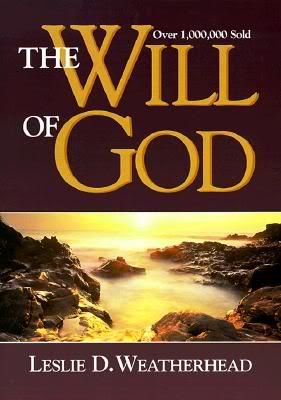
Leslie Weatherhead: The Will of God 1
Leslie D. Weatherhead, The Will of God © 1944; © renewed, 1972
Following the trilogy of books about mission, during the autumnal time of 2003 (that long ago!) I took part in another online book discussion; the book this time it was The Will of God. Leslie Dixon Weatherhead, the book's author, preached at City Temple in London. One site describes City Temple as "...an historic Nonconformist Congregation founded circa 1640, whose first minister was the Rev. Thomas Goodwin (chaplain to Oliver Cromwell). Today it's a cosmopolitan international church ministering in the City of London."
Since I've posted notes from at least four of our other book discussions and given the fact I don't have anything really original to put on this site at the moment, here are some my notes, mainly in response to our moderator's questions and comments. On Amazon-dot-com I found the acronym SIP and when I looked it up I discovered it meant Statistically Improbable Phrases in Amazon-speak (but likely not elsewhere). Related to this book, as SIPs Amazon listed circumstantial will, intentional will, ultimate will and evil circumstances. On to the book!
Chapter 1: God's Intentional Will—part 1
As Dr. Leslie Weatherhead points out, polar opposite outcomes cannot possibly equally be the "will of God."
? on the whole it does agree – I often differentiate only between God's "perfect will" and God's "permissive will," but I like these further, more defined and refined divisions.
2) Do you also try to explain a death or other tragedy as "God’s will"?
? only in the sense of acknowledging that in sovereignty God allowed the event to happen, but not is the sense of that horrific monster sometimes known as "God’s-willa."
3) If God and his ultimate will cannot be defeated, are human efforts to combat evil in the world in vain?
? Not at all – for this I'll give that stock theological buzz-answer and say God calls us to be and to act in the image of our God who is justice, love, compassion and mercy – and in the image of our God whose name is a verb rather than a noun!
4) A participant asked, "how individual is God's will for each of us? Does God will something different for you than for me?" I responded:
? Indeed, yes - much of God's desires for us have to do with our particular circumstances and our special gifts.
Since I've posted notes from at least four of our other book discussions and given the fact I don't have anything really original to put on this site at the moment, here are some my notes, mainly in response to our moderator's questions and comments. On Amazon-dot-com I found the acronym SIP and when I looked it up I discovered it meant Statistically Improbable Phrases in Amazon-speak (but likely not elsewhere). Related to this book, as SIPs Amazon listed circumstantial will, intentional will, ultimate will and evil circumstances. On to the book!
Chapter 1: God's Intentional Will—part 1
As Dr. Leslie Weatherhead points out, polar opposite outcomes cannot possibly equally be the "will of God."
- God's intentional will - maybe we need to reserve "God's will" for this
- God’s circumstantial will - in those particular circumstances
- God's ultimate will - in spite of evil and even through evil. As our discussion moderator mentioned, the cross achieved God's will not only in spite of but actually through.
Here are our moderator's questions, followed by my responses:1) How does your concept of God's will agree or disagree with Weatherhead’s?
? on the whole it does agree – I often differentiate only between God's "perfect will" and God's "permissive will," but I like these further, more defined and refined divisions.
2) Do you also try to explain a death or other tragedy as "God’s will"?
? only in the sense of acknowledging that in sovereignty God allowed the event to happen, but not is the sense of that horrific monster sometimes known as "God’s-willa."
3) If God and his ultimate will cannot be defeated, are human efforts to combat evil in the world in vain?
? Not at all – for this I'll give that stock theological buzz-answer and say God calls us to be and to act in the image of our God who is justice, love, compassion and mercy – and in the image of our God whose name is a verb rather than a noun!
4) A participant asked, "how individual is God's will for each of us? Does God will something different for you than for me?" I responded:
? Indeed, yes - much of God's desires for us have to do with our particular circumstances and our special gifts.
tags, topics
the will of god
Subscribe to:
Posts (Atom)