Showing posts with label synchroblog. Show all posts

Tuesday, December 08, 2015

through others' eyes: december synchroblog

through others' eyes

The final synchroblog of 2015 also is the second inning of the new synchroblog group and page. Liz Dyer suggested the topic; K. W. Leslie hosts again:
Of course there are all sorts of directions you can go with this. How do you see through the eyes of other people? How do they see through yours? How do you sympathize with Christ, Christ sympathize with you, Christ sympathizes with other people, other people sympathize with Christ... yeah, I guess I covered all the permutations. Wait! How does Christ see through the eyes of other Christians when they see through your eyes? Oh yeah, we can go wild with this one.

Every time I think of eyes and scripture, I remember J in Monday evening women's bible study reminding us "the eyes are the most sensitive part of our bodies, so the eyes of our hearts would mean exquisite sensitivity to the situations and needs of others." Ephesians 1:18 was J's reference, though I don't recall our study topic. Some versions of the Greek give us eyes of the mind (thought, understanding, comprehension) – διανοίας – rather than heart – καρδίας – but all the Greek texts include eyes, the body part that along with our brain (mind!) creates our physical vision, our actual view of the world. By the way, in Hebrew biology the heart primarily is the seat of the will rather than of the emotions.

Scripture and eyes also evokes Psalm 145:15-16 as an invitation to offer thanks before a meal: "The eyes of all wait upon thee; and thou givest them their meat in due season. Thou openest thine hand, and satisfiest the desire of every living thing."

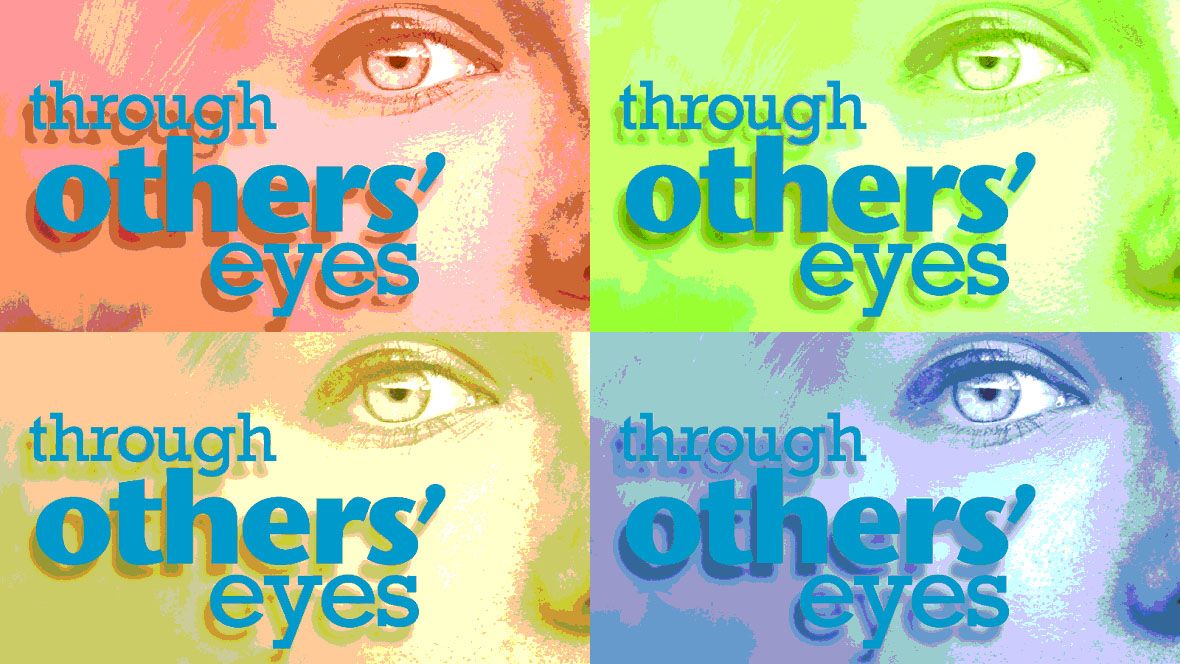
Seeing, visioning, perceiving, and acting with another's eyes (as K.W. suggests) ideally turns around at least a few degrees so others begin to see situations and people as you perceive them. But this mostly is about walking in the other person's sandals, learning some of their experiences, comprehending with your mind and even feeling with your heart (and soul) the why of their actions, the what of their dreams. The gospel accounts of Jesus' highly relational, always appropriately responsive interactions with other humans from all types of situations, classes, and aspirations are the models for our own behaviors. However, in the midst of many of those stories, we hear about Jesus' followers and his disciples often less than sensitive, frequently even inappropriate reactions to people and situations. Our blog prompt asks "how we can (are able to) see through the eyes of other people." Jesus' disciples had the living walking breathing talking Jesus from Nazareth as their example, and they still didn't get it right all the time. Just like them, we need to get our heads and our hearts (our wills, emotions, intentions) synced! I Photoshopped the eye image KW provided to portray different people viewing the same thing, but besides making all the eyes different, maybe I needed to change the color, size, skew, and other aspects of the words?

How can I view the world through the eyes of others, and how do they see through my eyes? I've been making an ongoing effort to talk more about myself—my history, experiences, likes, preferences, dreams, dislikes, and disgusts. People know only what they literally can see, which they then filter through their own history, experiences, dislikes, and disappointments. It's tough for me, because I've encountered too many people whose only topic of discourse is themselves. I know very well I'm far far away from that, yet still hesitate to make myself more than an incidental subject of what we're talking about at this time. However, that's still a major way I can be a factor in how friends, strangers, acquaintances, and random others view me and interact with me. Similar to when we reach a certain age – which I hope is by late teens or early twenties at the latest – and begin to have a clue where our parents and their parents have been, what has made them who they are, how they are. All in all, I have no concrete solution for this month's synchroblog question, but I pray and hope:
18so that, with the eyes of your heart enlightened, you may know what is the hope to which he has called you, what are the riches of his glorious inheritance among the saints, 19and what is the immeasurable greatness of his power for us who believe, according to the working of his great power. 20God put this power to work in Christ when he raised him from the dead and seated him at his right hand in the heavenly places, 21far above all rule and authority and power and dominion, and above every name that is named, not only in this age but also in the age to come. 22And he has put all things under his feet and has made him the head over all things for the church, 23which is his body, the fullness of him who fills all in all. Ephesians 1 NRSV
As the Church, we are the body of the crucified and risen Christ. That body includes our eyes, our vision, our mind, and our perception. Waiting upon God, and satisfying the desires and needs of every living thing, because we've learned to see and perceive who they are and what they need.
eyes icon December synchroblog

Tuesday, November 10, 2015

November Synchroblog: Grace!

november synchroblog grace

The original synchroblog group disbanded last month, but one of the regular participants picked it up without missing a beat, so this month's topic is grace! K.W. Leslie's our host; he suggests:
Of course there are all sorts of directions you can go with this. You can bring up grace in the November holidays. (In the United States that'd be Veterans Day and Thanksgiving.) You can bring up grace in the Christian's relationship with God, with family, with fellow Christians, with non-Christians, with work, with whatever.

You can avoid talking about yourself altogether, by getting all theological. And we'll let you! 'Cause grace.

A blog pal gifted me with grace as my star word for 2015, so what better way than this synchroblog to sum up a year of moving house, meeting new people, leaving Previous City behind (notice the order of these events?), other random shifts and transitions, a year trying to focus on my star word grace, and the very soon to be conclusion of another liturgical year of grace.

Especially for Christians in the traditions of the Reformation with our emphasis on the Apostle Paul's theology, grace is a huge, truly overarching, theological concept. In Paul's world, grace and favor was a secular commonplace—particularly in the patron-client relationship. In this twenty-first century world where commercial transactions, payments, debts, and reciprocity rule, almost everyone has difficulty accepting a gift, simply basking in that occasional reality of receiving anything unmerited, unearned, not paid for—and not paid back. It's tough for most of us to contextualize a theology of grace because we have so little parallel experience in this culture, in this economy.

For many people, the month of November in the USA means a special offering of daily blog posts or Facebook updates about thankfulness. I didn't attempt formal daily online thanks this year, yet I need to express my thankfulness that I've come this far by faith and by grace!

I'd intended to blog more details about this past year of my life along with my rich grace-filled experiences during this past liturgical year, which, of course, has been a major part "of my life." I'm extremely tired on emotional and psychological levels, and writing here on my more formal theology blog makes me hesitate to say much, though in the past I've blogged a fair amount of self-revelation.

Short summary: the Sunday morning hour that's always good no matter what has kept sustaining me. No matter what, no matter with whom, no matter where, every week it re-minds and re-immerses me in my own history with God and with the people of God. I'm thank-filled and excited about beginning the church's new year of grace less than three weeks from now; what's not to love about the hope and renewal Advent brings amidst the darkest days of the year? In addition to every Sunday Word and Sacrament, relocating to a different city has given me near-boundless hope for a free and full future.

Again this year I welcome the gift of shorter days, longer nights, the all-around slowing down they bring. It's almost time to start counting the days until the winter solstice, and then by grace, the amazement of longer days, shorter nights, new life, and another summer.

Grace, mercy, and hope to you!

grace year

Monday, October 19, 2015

synchroblog: creation—one more time

Link to the last ever synchroblog at wordpress synchroblog central

What's happening? Since September 2011 I've participated in the monthly synchroblog event; this is my 25th and final post in the series because the organizers announced...
October 2015 will be our last Synchroblog theme. It's been a lot of fun, we've met some amazing people and have learned so much through this process of sharing our ideas and thoughts through blogging. Our final synchroblog theme will be: "If this was my last blog post, here's what I would say..."

truro house for last synchroblog

Here's my last call to do my blogging at the last... synchroblog! Creation has been one of my ongoing blogging themes, so here's one more time. Not getting über-theological with this one, but I'll tag it with creation so you easily can read some of my other writing on the subject.

Please. Love the earth. Care for the land. Treasure the waterways. Keep the air clean. Live locally. Remember your neighbor. Keep covenant with all creation. Thank you.

Deuteronomy 8

6Therefore keep the commandments of the Lord your God, by walking in his ways and by fearing him. 7For the Lord your God is bringing you into a good land, a land with flowing streams, with springs and underground waters welling up in valleys and hills, 8a land of wheat and barley, of vines and fig trees and pomegranates, a land of olive trees and honey, 9a land where you may eat bread without scarcity, where you will lack nothing, a land whose stones are iron and from whose hills you may mine copper. 10You shall eat your fill and bless the Lord your God for the good land that he has given you. NRSV

Other October 2015 Synchrobloggers:

• K.W. Leslie – Synchrobloggery

• Glenn Hager – Parting Shot

• Clara Mbamalu – What is love?

• Carol Kuniholm – A Final Synchroblog

• Peggy Brown – Abi and The Last Synchroblog

• Leah Sophia – Synchroblog: Creation One More Time

• Jeremy Myers – If this were my only blog post, I would invite you to do one thing

• J. A. Carter – Last Words

• Tony Ijeh – Sharing Jesus

• Liz Dyer – Last words about love

• Loveday Anyim Snr – If this was my last Synchroblog Post, I will be Unhappy to let go

Thursday, July 23, 2015

marriage equality again: july synchroblog

cupcakes

photograph with legal reuse rights from greekgod on rgb stock

This month I'm synchro-blogging again! The topic for July is Gay Marriage.

I posted the original version of this a month ago as (why not) marriage notes after the Supreme Court of the United States ruled in favor of marriage equality on Friday, 26 June in Obergefell v Hodges. For this synchroblog post I've made a few changes and additions.

Synopsis: Please, no marriage anywhere for anyone any more.

News and social media outlets recently announced the United States Supreme Court's approval of same-sex marriage―marriage equality. You realize "same-sex" isn't necessarily GLBTQ marriage, just as opposite sex marriage isn't necessarily not-GLBTQ? Social media resounded with sights and sounds of celebration; not much jubilation from me, though. But why not?

The whole structure of marriage and legal commitment must change. After all, it's been evolving for millennia, anyway! It was so wonderful and freeing when a lot of people started committing to significant otherships rather than legal marriage! There needs to be some way of reliably indicating your desire for hospital visitation, etc. as well as protection for kids, but the legal (pertaining to, under the formal regulations of the states of the USA, the feds, or of other *legally* constituted governments) apparatus of marriage? I feel marriage is pretty much an anachronism, though as long as the legal institution exists and subsists, everyone who's not already legally married needs the right to get married. But then again, as long as govt involves itself (governments involve themselves) in this yoking up biz, why not guidelines and allowances for plural marriage? Why not? You know that's a form of biblical marriage!

Genesis 2:21-24 that some cite as proof God mandated and blesses a certain spousal configuration dates from the era of King Solomon's monarchy—only about 3,000 years ago! This text is from the Yahwist or "J" Pentateuch source; the Yahwist was King Solomon's theologian.

21So the LORD God caused a deep sleep to fall upon the man, and he slept; then he took one of his ribs and closed up its place with flesh. 22And the rib that the LORD God had taken from the man he made into a woman and brought her to the man. 23Then the man said, "This at last is bone of my bones and flesh of my flesh; this one shall be called Woman, for out of Man this one was taken." 24Therefore a man leaves his father and his mother and clings to his wife, and they become one flesh.

How many wives did Solomon own? According to some tallies, 700 wives and 300 concubines [1 Kings 11:03]. I know very little of its long and complex history, but maybe someone else can tell me, how long has this marriage notion been about love? Seems to me it mainly used to be about joining and uniting families, fortunes, dynasties, kingdom /queendoms and protecting land rights. You know that's still the case! And sometimes about diluting the too inbred gene pool of particular royal families.

Side note: How about ditching the antediluvian terms wife for female spouse, and husband for male spouse? Along with every living language, English retains fragments of many ancient words, but spouse, life partner, lifelong companion would be more up to date.

Besides finding some effective mode of protection for vulnerable children and others, I also want to be clear that I very very very much support publicly committing to (hopefully) a lifelong, (hopefully) an exclusive relationship with a significant other, but please do not involve or include legalities. If you're religious, how about during the Saturday or Sunday liturgy? If you're not religious or have other preferences, how about gathering at the beach, in the mountains, or in a lovely garden? During a chilly winter, someone's home that's large enough to hold your guests, or maybe a restaurant or other function room? You gotta have good eats, of course! I've provided bright contemporary cupcakes as a possibility for the sweets portion of the feast.

End notes: 1. BTW, this perspective has almost nothing to do with my libertarian spirit or my classical liberal heart.

2. It's a different topic for another day, but while we're referencing scripture and marriage, why make the church and other religious entities agents of the government?

3. Thursday, 30th July: it simply amazes me that partly because I've posted on select pages and walls a couple dozen times, I've tweeted both no marriage posts at least two or three times each, and contrary to my typical single digits I've actually gotten a LOT of readers, the sole comment related to my observation about government and plural marriage. Am I on a different planet?

other July synchroblog participants:

Monday, June 22, 2015

welcoming one another: june synchroblog

Welcome one another, just as Christ has welcomed you, for the glory of God. // Wherefore receive ye one another, as Christ also received us to the glory of God. Romans 15:7

This blog post is part of the June Synchroblog that invites us to consider Hospitality. To jump start our inspiration, they suggested some ideas. Although I'm mostly drawing on my own experiences and on scripture, I'll also address their first question: Is hospitality an essential element of imitating Christ?

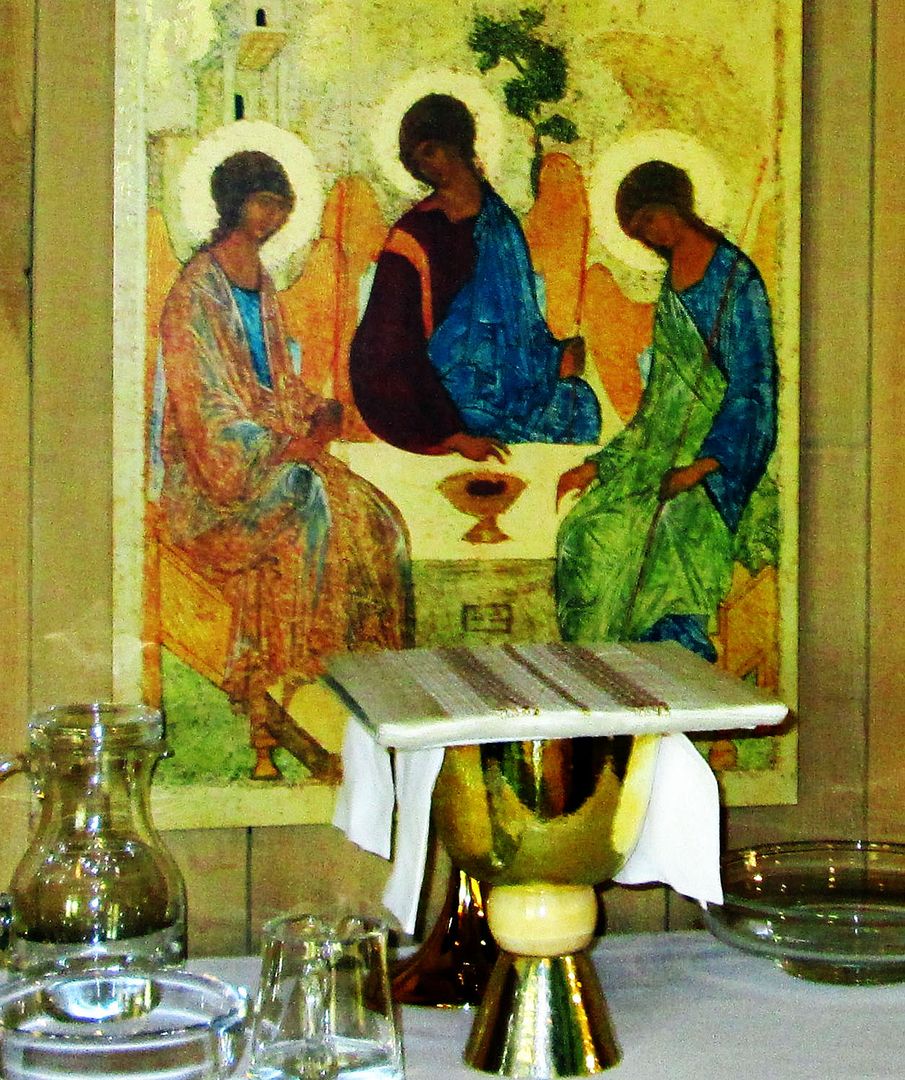
Rublev Trinity icon

I'm synchroblogging again! Hospitality long has been a hot button topic for me; I've blogged about it at least a couple dozen times, so why not one more time? Hospitality is a central biblical theme; in scripture we learn about Israel's and the Church's essential call to welcome the stranger, to make a place for the passerby and passersby, for the sojourner (remember, "resident alien?") in our midst.

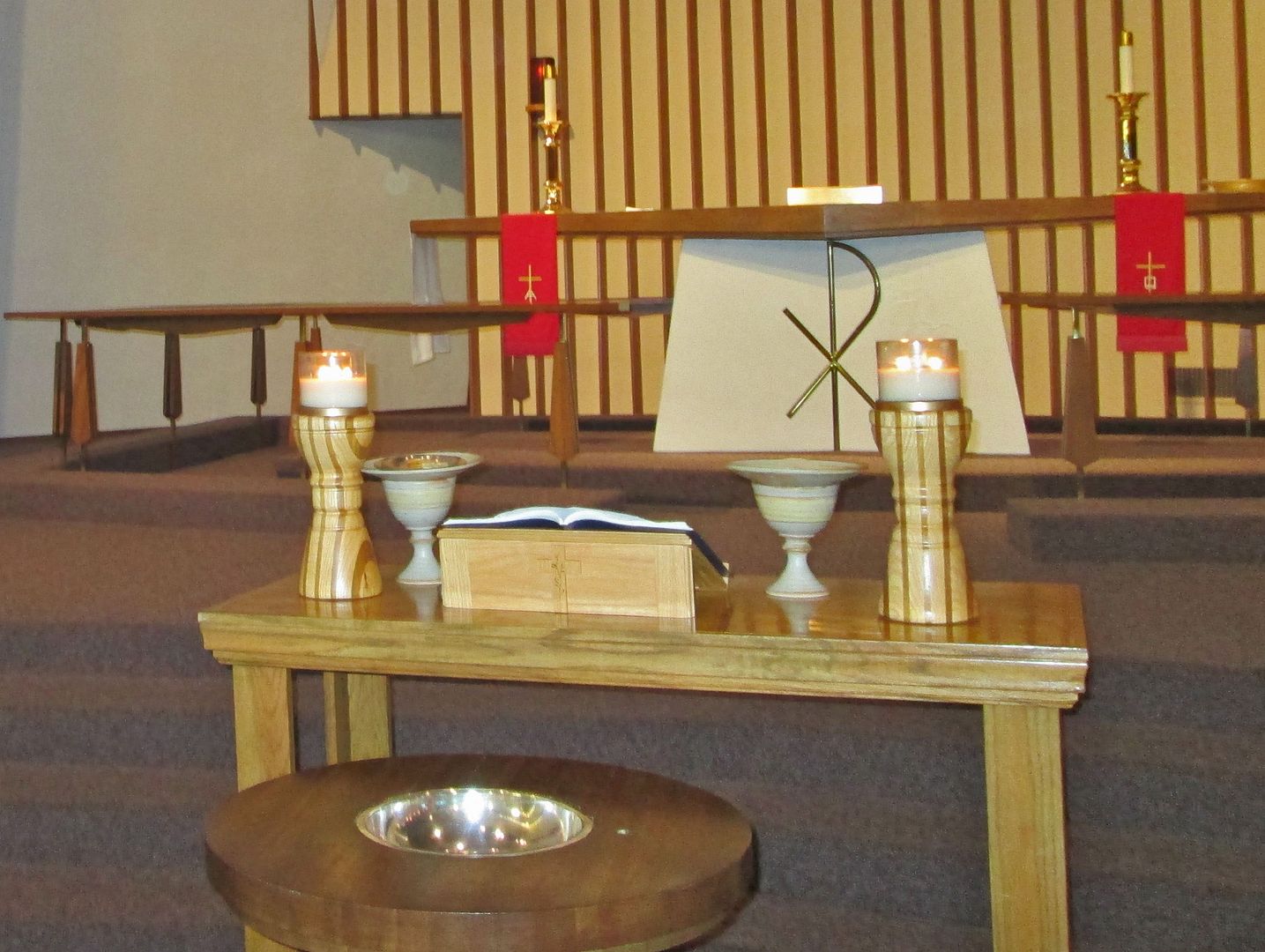
My header image for this topic is the credence table at one of the churches I often attend; the painting is a trinitarian icon, the Hospitality of Abraham by Andrei Rublev. It illustrates the account of Abraham’s three visitors in Genesis 18:1-15. The artist drew this icon with the side of the table closest to us wide open: a place for each of us at God's Table of grace.

The history of God's people Israel and the New Testament stories of Jesus demonstrate how God's presence often is literally embodied in the stranger, in the other-than-us. At the same time, that visitor often experiences God's grace in our welcoming hospitality. I have a story to tell! For the past few years I've sometimes helped prepare, usually helped serve Thursday evening community dinners at Church Around the Corner. We call these free of charge meals (donations happily accepted) family dinners, yet to expect anyone to interact with strangers or even with new, grafted-on family (in-laws, far-flung cousins, adoptees) as they do with biological family and other lifelong or longtime intimates is far removed from everyone's reality and most people's capabilities. Any kindergartener realizes people who are new to us can be threatening, dangerous, and challenging on physical, emotional, and spiritual levels.

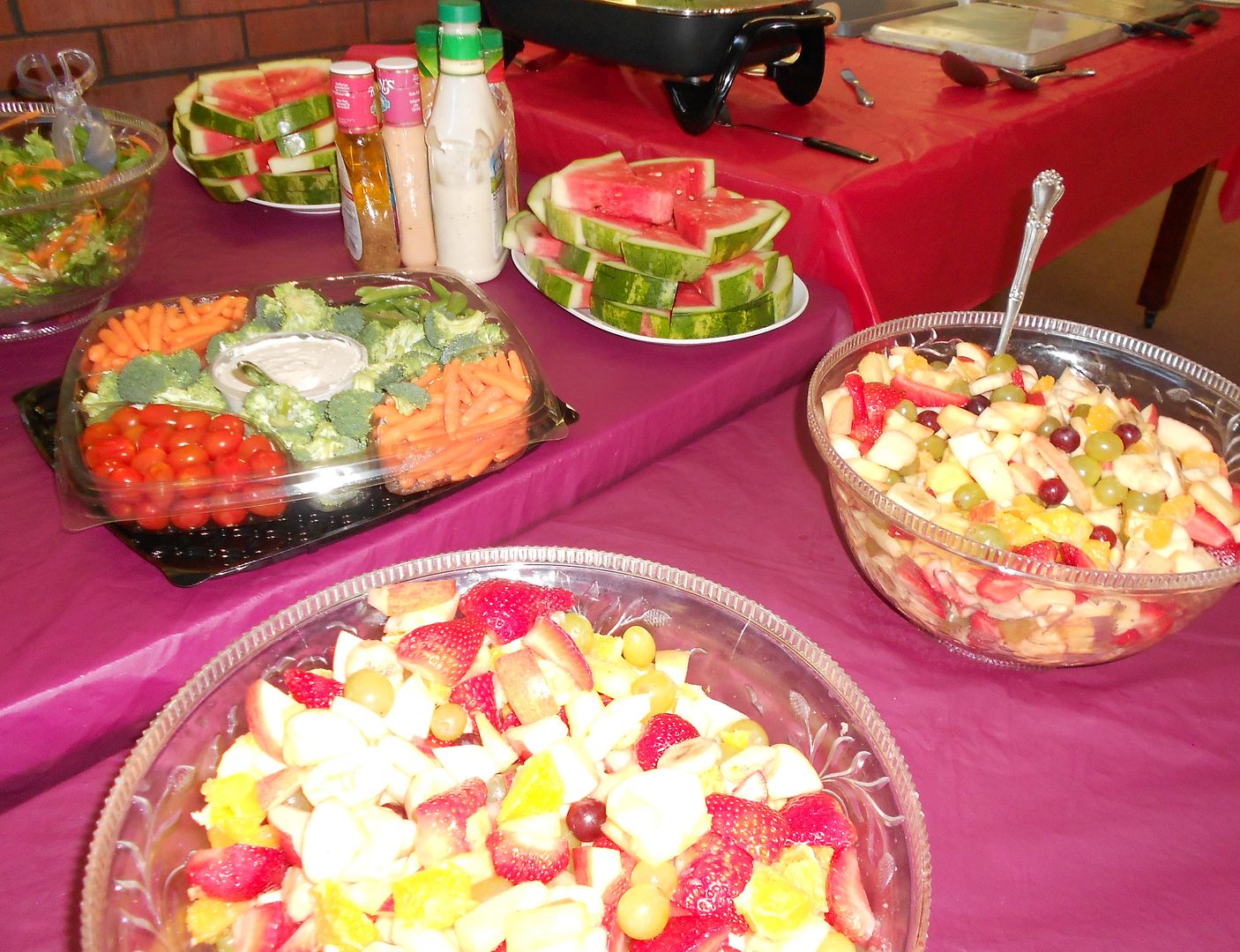
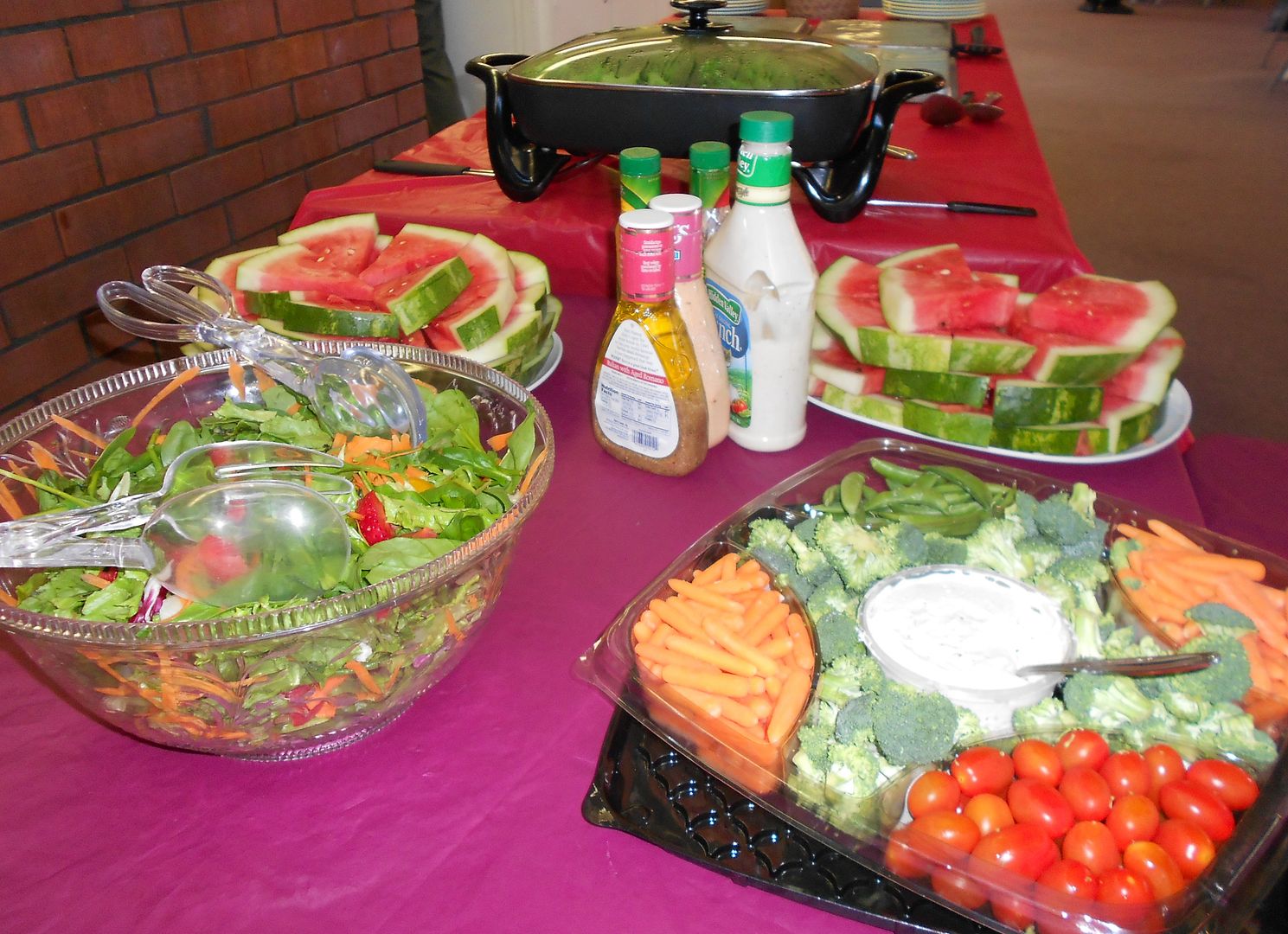
condiments and food condiments and food

Ritual, repeated, structured, actions can help bind people together, can begin to create community among unlikes and unequals. However, even fairly simple worship services and liturgical practices can seem strange (possibly threatening?!) to church newcomers. Walter Brueggemann reminds us, "justice is important, but food is essential." Thursday evening diners typically consist of members of that particular congregation, close friends of that congregation (like me), parents and kids from the church choir programs that meet late Thursday afternoon, low income and other nearby residents, a few folks who mostly live under the bridge. Structured, ritualized Thursday evening activity starts out with everyone gathering in a circle for prayer at 5:30; 6 or 8 of us donning gloves and standing behind the serving table; everyone else getting in line in order to be served, then returning to the seat they've staked out at one of the round tables that each seats 8, or finding a seat with someone they already know or never have met. Sometimes checking the serving table for seconds. Always traveling to the dessert table for two or three ice cream flavors, chocolate syrup, whipped cream, cookies and/or cake. Busing your dishes to the station near the kitchen. Along with the leveling experience of sharing food, these weekly, repeated, actions have been creating community among people who are somewhat like one another, somewhat different from, similar in education or interests, different in income and experience. What a wonderful, safe, essential ministry by, for, and to everyone involved! Side note: after necessarily banning a couple of people, we finally posted a list of behavioral and self-presentation guidelines for participants.

pentecost Sunday 2015Anyone who knows me knows I'm everyone's Best Friend Forever, yet scripture's vision for hospitality is far removed from the social and psychological intimacy of Best Friends Forever—it's closer to welcoming without questioning, including without reservation. So honestly, even though I may be (and you know I am) everyone's BFF. there still are people out there and closer at hand that I don't want much to do with. Yet I know – in the church we all know and have experienced – God's promised presence in the Lord's Supper, in literal Holy Communion, where God is our host and offers unquestioned, inclusive hospitality at the Table of grace and reconciliation.

Does our everyday practice of inclusion (or of suspicious questioning, possibly of exclusion) align with the model for hospitality we know at the Lord's table? Does our practice of Holy Communion create a model for our every day of the week grace-filled hospitality? In Rublev's trinitarian icon, the side of the table closest to us is open: a place for each us at the heavenly banquet. How about us? Do we leave an open place at the table and a comfortable chair for others? Is hospitality an essential element of imitating Christ?

Welcome one another, just as Christ has welcomed you, for the glory of God. // Wherefore receive ye one another, as Christ also received us to the glory of God. Romans 15:7

Other June Synchroblog Participants:

A Sacred Rebel – Hospitality

Carol Kuniholme – Violent Unwelcome. Holy Embrace.

Glen Hager – Aunt Berthie

Leah Sophia – welcoming one another

Mary – The Space of Hospitality

Jeremy Myers – Why I Let a “Murderer” Live in My House

Loveday Anyim – Is Christian Hospitality a Dead Way of Life?

Tony Ijeh – Is Hospitality Still a Vital Part of Christianity Today?

Clara Ogwuazor Mbamalu – Have we replaced Hospitality with Hostility?

Liz Dyer – Prayer For The Week – Let us be God’s hospitality in the world

K.W. Leslie – Christian Hospitality

Christine Sine – True Hospitality – What Does It Look Like?

Tuesday, April 21, 2015

april synchroblog: stewardship trilogy

Bearing Fruit is this year's April Synchroblog topic! Is it not incredibly comforting, reassuring and freeing that we discover bearing fruit in the scriptural context of Jesus' vine and branches discourse?! I believe it is! Bearing fruit is an especially fitting theme for Earth Day; although April 22 (tomorrow, Wednesday this year) is the official, formal Earth Day date, many individuals, organizations, cities, counties, and towns celebrate with festivities on the nearest weekend. My synchroblog contribution is a trio of stewardship designs I created a while back, and re-imagined for this event.

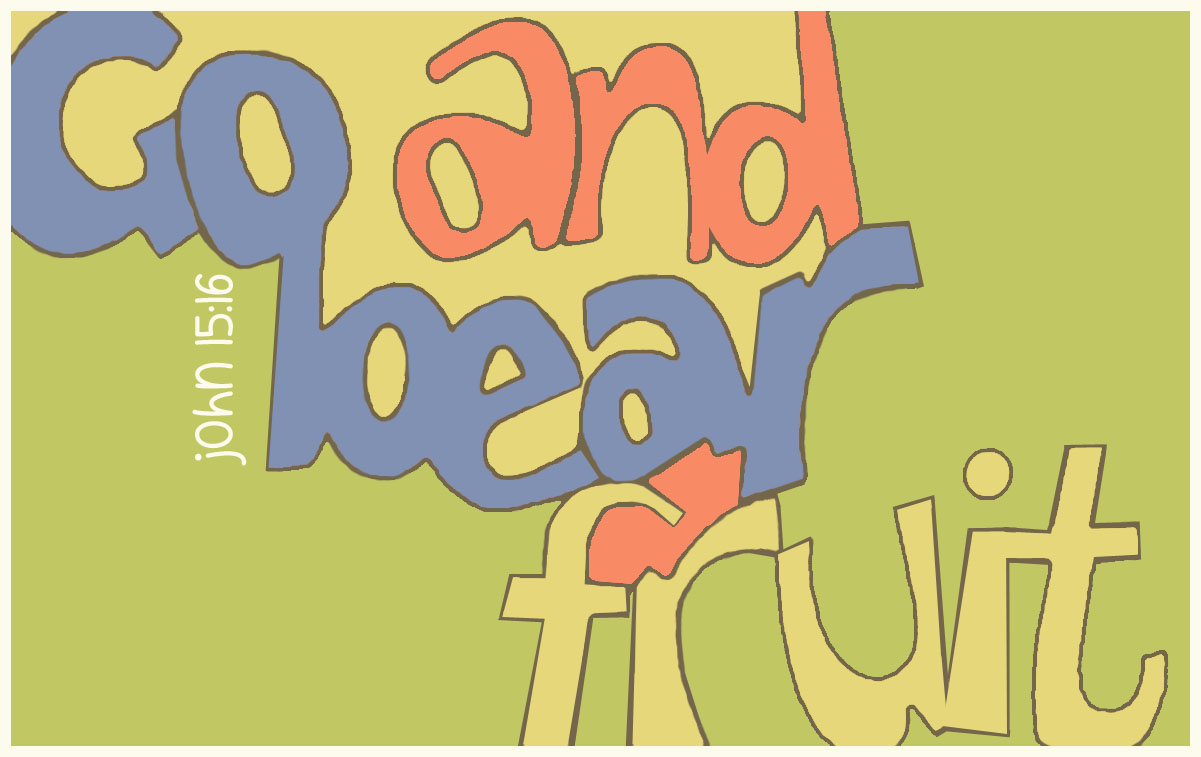
Go and Bear Fruit—John 15:16

16You did not choose me, but I chose you and appointed you that you might go and bear fruit, and that your fruit would remain, that whatever you ask the Father in my name he may give you. 17These things I command you, that you love one another. John 15

go and bear fruit

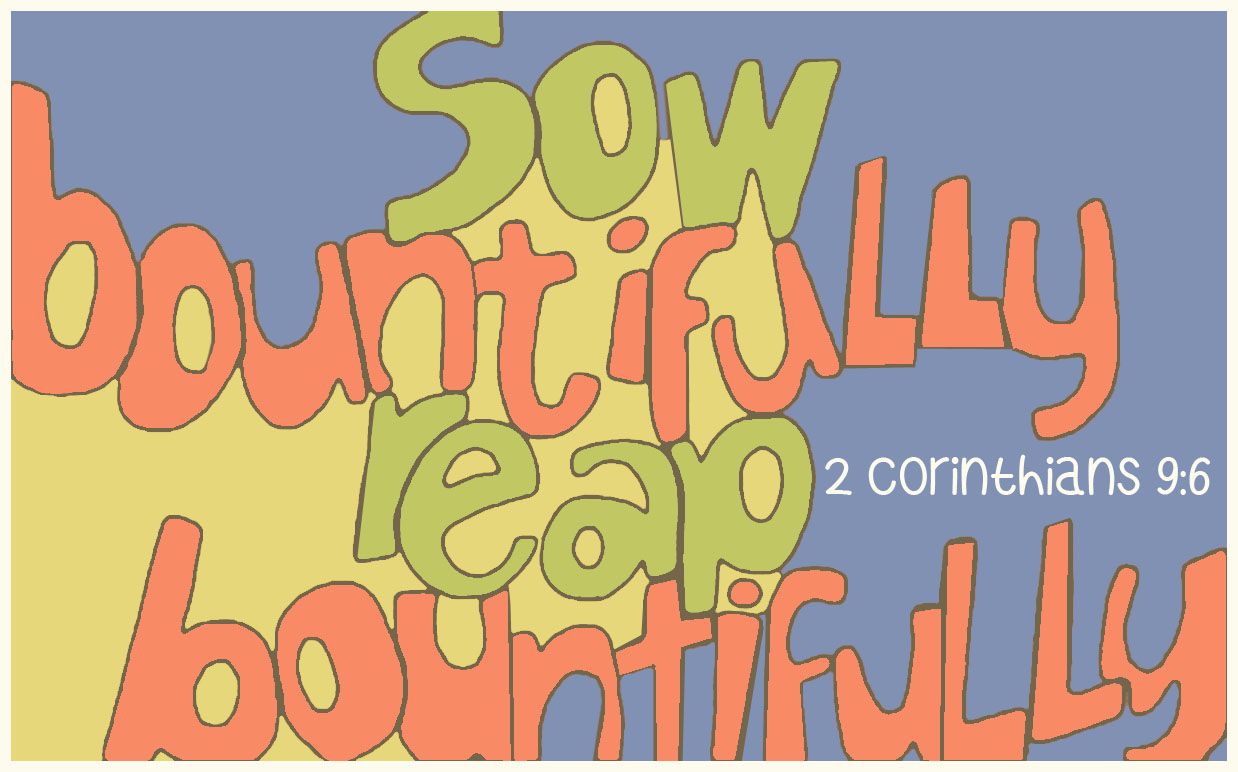
Sow Bountifully; Reap Bountifully—2 Corinthians 9:6

6But this I say: He who sows sparingly will also reap sparingly, and he who sows bountifully will also reap bountifully. 7So let each one give as he purposes in his heart, not grudgingly or of necessity; for God loves a cheerful giver. 8And God is able to make all grace abound toward you, that you, always having all sufficiency in all things, may have an abundance for every good work. 9As it is written:
“He has dispersed abroad,
He has given to the poor;
His righteousness endures forever.” Psalm 112:9
10Now may he who supplies seed to the sower, and bread for food, supply and multiply the seed you have sown and increase the fruits of your righteousness, 11while you are enriched in everything for all liberality, which causes thanksgiving through us to God. 2 Corinthians 9

sow bountifully, reap bountifully

Servants and Stewards—1 Corinthians 4:1

1Consider us in this way, as servants of Christ and stewards of the mysteries of God. 1 Corinthians 4

servants and stewards

Other April Synchroblog Participants:


Tuesday, March 17, 2015

land, sun, community, crops: synchroblog!

What I appreciate about other religions on Synchroblog Central.

This month I'm bouncing parts of my post off a synchroblog from 2012 that gave us an opportunity to consider what religion other than our current one we might decide to try: choosing another way.

creation squareI resonate deeply with heathen, pagan, celtic spiritualities, with their earth-focused ways of being and living with and within nature. Whether in city, suburb, or countryside, they integrate (astronomical/meteorological) seasonal rhythms into every day routines and remembrances. Spiritual ways that particularly honor land, ocean, sky, sun, and crops have deep roots in earth and sky, similar to those of the church's liturgical year of grace and the Jewish festivals. As they intentionally reflect solstice, equinox, planting, harvesting, fallowing, or cross-quarter, they involve every one of each individual's five senses.

In ways not unlike Judaism and Christianity, earthen spiritualities provide liturgical rituals for marking individual, earth, and community transitions and milestones. In my Reformation brand of Christianity, sacraments are central, and in order to celebrate sacraments we need to be friends of the earth!

Final note: although celtic, pagan, and other earth-centric practices affirm cycles of death and resurrection, unlike Christianity's eighth day new creation theology of the death of death itself and the ultimate triumph of life, their cycles are endlessly unchanging.

Other Synchroblog Participants for March:

What I Appreciate about [Other Religions].

Sunday, March 01, 2015

week of grace 15

Listing up some small yet significant happenings from the past week.

1. Participating in synchroblog for the first time in a while. I hope it will become one of my regular things again.

2. I've continued sorting, packing, and deciding what to "delete" before relocating. Three big trash bags and a big laundry basket full of misc ready to go to the critter thrift store!

soup with flower
3. First Wednesday evening soup supper of Lent 2015 and afterwards serving as organist for Compline at Church on (the) Hill. Would it be a good idea to make that two line items, esp since I don't have a long list this week?

Lent cross
4. First Holden Evening Prayer of 2015 at Church Around (the) Corner. Not only did we have a lot of guests for family dinner, several people who hadn't known we have prayer/worship rather than bible study after dinner during Lent joined us in the chapel and said they loved it! Two line items again?

5. During his evening prayer meditation/homily, related to his mentioning how enriching diverse experiences can be, Pastor J gave my teaching a shoutout!

clairemont lutheran social hall
6. I've been enjoying reading through the daily lectionary on PCUSA.org—it's a freestanding two-year cycle that does not parallel the Revised Common Lectionary. After only a little more than a week, I'm so appreciating its logic and continuity; I've been writing some verses into my lenten journal.

7. Somehow I've managed to journal something every day in Lent so far.

blackberries
8. Blackberries again! 12 ounces for $4! last time they were 6 ounces for $2.99, $1 less than $4 the previous time, so they're getting more seasonal with prices correspondingly lower.

9. It's raining! We're still officially drought-stricken, but any precipitation is a major gift and also a big surprise.

Tuesday, February 24, 2015

synchroblog – renewal!

February's synchroblog topic is Renewal.

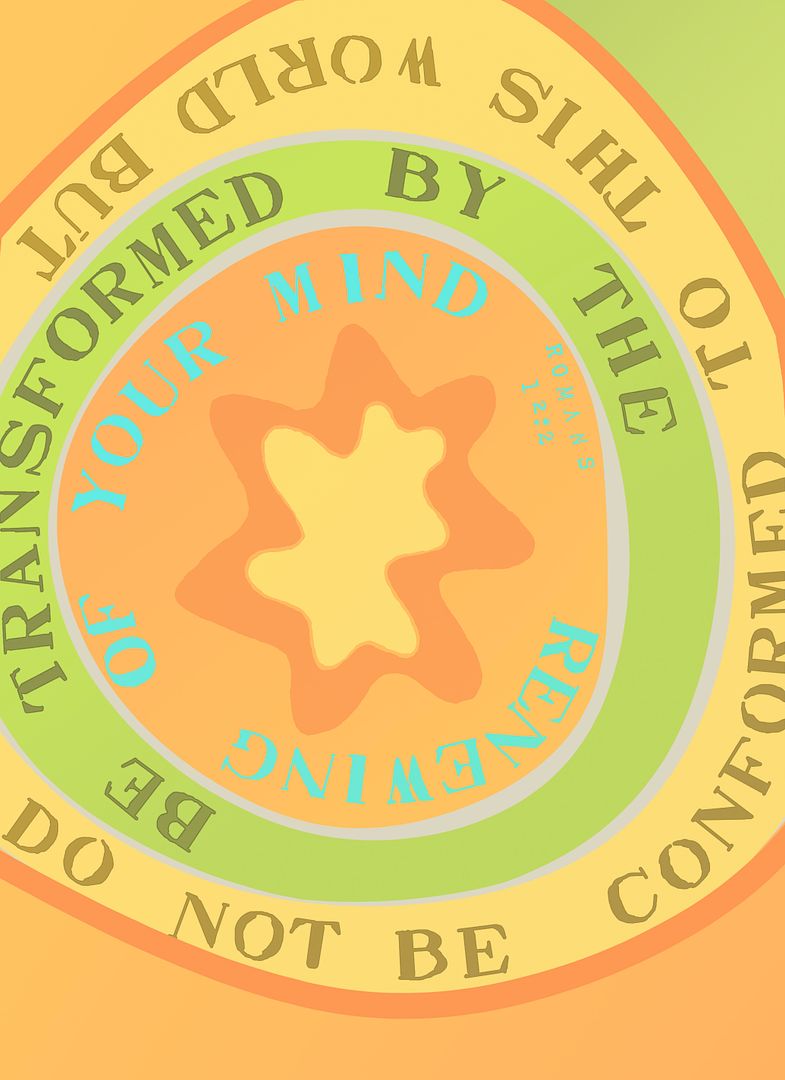
For this February during Lent, here's my interpretation of Romans 12:2—Do not be conformed to this world, but be transformed by the renewing of your mind. World in this passage is "eon" rather than "cosmos." Peace, joy, and renewal to all!

Romans 12:2


This month's suggestions would make several more good blog topics for this season of Lent; here they are to remind myself:
Write something informative, tell a story, share a poem or piece of art, reveal a desire or dream, ask a question, explore something from scripture, tell us what renews you, review a book, incorporate the season of Lent in your post, as Lent is often referred to as a time of renewal, get personal and write about your own need for renewal ... the theme is wide open.


Other February synchroblog participants:

Abbie Waters – It is Well with My Soul

Done With Religion – Renewal

Mark Votova – 30 Ways the Church Can Find Renewal

Jeremy Myers – I am Dying … (So I Can Live Again)

Phil Lancaster – The Parable of the Classic Car

Susan Schiller – Renewal by Design

Glenn Hager – Repurposed

Wesley Rostoll – Why I no longer pray for revival

Clara Ogwuazor-Mbamalu – Renewal of the Spirit

K. W. Leslie – Those who wait on the Lord

Lisa Brown – Momma’s Kick Off Your Shoes and Stay For A While!

Jenom Makama – …Like An Antivirus

Leah – Renewal!

Peggy – Abi and the February 2015 Synchroblog – Renewal

Loveday Anyim Snr – Stop Right here and Renew Your Mind!

Monday, October 06, 2014

synchroblog: mental illness/health awareness

October synchroblog on synchroblog central

This month:
To commemorate the launch of Sarah Griffith Lund‘s new book ― Blessed Are The Crazy: Breaking the Silence About Mental Illness, Family, and Church ― and to participate in National Mental Illness Awareness Week (Oct. 5-11), we invite you to join in a Synchroblog on mental illness, family, and church.

Break the silence by sharing your personal story of how you’ve been impacted by mental illness in your family and/or in your faith community.
mental illness awareness week
October 5-11 is National Mental Illness Awareness Week; you can learn more on the NAMI MIAW page.

October 7 is the National Day of Prayer for Mental Illness Recovery and Understanding.

"Break the silence by sharing your story..." My final post for a while in my tellingthestory label last spring. Socially, professionally, and financially that story I'm trying to tell has been costly beyond anything I could have imagined.

Intro

For starters, the side of my family of origin I know something about has a multi-generational history of severe clinical depression, suicide, bipolar I, panic disorder, agoraphobia... Since my early teen years I've battled "something OCD-ish", panic disorder, and claustrophobia; I also have migraine disorder―as opposed to an occasional discrete migraine episode. Evidence shows those illnesses are closely related. Psychiatry deals with brain function, neurology with brain structure, though you can't separate them! Most medical centers of any size will have a neuropsychiatrist or psychoneurologist (someone boarded in both specialties) on staff. Doctors sometimes prescribe anticonvulsants – technically neurological drugs – to treat depression and mania that formally are psychiatric diagnoses. Sometimes physicians prescribe antidepressants (psych meds) to alleviate neurologically-based migraines and other headaches. Clinicians insist it can be difficult to discern the flat mood of depression from that of psychosis; sometimes you need to wait and see. I'll add there's also the flat affect of some brain injuries.

I try to understand the countless times I've heard or read passionate pleas please to interact with and act toward people with mental/psychiatric illnesses just as you do people with any other physical malady, because, after all, disorders of mood and thought are whole-body diseases. However, for some reason most people seem to miss or evade the fact those illnesses strike at the very heart of a person's humanity, since they profoundly affect thinking and feeling. In other words, in presentation and in social cost, they're anything but simply "another illness." In addition, most people will have an episode that makes them look clinically depressed at some point in their lives.

My Friend C

After pancakes and festivities, last Shrove Tuesday I signed a covenant with a friend: we both promised to keep stayin' alive in the blues. Six weeks plus later, we sat together at the Easter Vigil; at the end of that three-day long Triduum liturgy, after (finally!) the first Eucharist of Easter, I excitedly went to the back of the church sanctuary and rang the bell seven times to proclaim death and resurrection to the surrounding neighborhood! Together at Easter Vigil. C died less than two weeks later. Her blues almost definitely had been the clinical depression she'd told people she was being treated for; you could call my case of the blues "existential depression" due to one thing after another, including fallout from the physical fall and subsequent losses I referenced in my "tellingthestory" posts.

desert spirit's fire! truly is mostly a theology blog rather than reflections on my daily or weekly activities. (Why not a hat tip to my seminary professors who assumed I'd get a ThD or PhD and teach in seminary? They've got one!) You know none of us is faithful—no, not one! At C's funeral, the pastor assured us C was with Jesus and with her parents who had predeceased her. I just noticed the last sentence I typed! Had Jesus the Christ predeceased her? Yes. The preacher assured us C was with her family and with Jesus because of Jesus' infinite faithfulness. Afterwards at lunch in the social hall, C's baptismal certificate was at the top of the display of items associated with her. God irrevocably claimed C in baptism. God keeps covenant. God kept covenant.

Other October Synchroblog Participants:

Tuesday, August 19, 2014

touch of life: August Synchroblog

August Synchroblog on wordpress

august synchroblog connectionA single word prompt and an image!

Connection immediately triggered "It's not what you know or who you know―it's who knows you" that determines your success out there in the world. But as I enjoyed the illustrations of various kinds of human connections, I remembered social and professional connections aren't the only kind. However, they're the type of connection I still obsess about a lot.

Recent internet quote: "Everybody needs community and loving friendship and a place where they belong." I've blogged what I've been able about my too many experiences of losing friendships and connections with too many people I believed I'd grow older with. Even more perplexing, I've been unable to reweave anything remotely resembling the personal friendships and professional colleagues an individual person needs to keep on keepin' on. Back then, it seemed simple. I'd invite an acquaintance to join me for lunch or for a snack or another activity. We'd start talking, get together again, and soon I'd be connected to, touching others I'd meet through that very first new connection. But it has not been that simple. I still need what I describe as a "community of recognition, acknowledgment, and participation." I still need a place of belonging minus the rude remarks and exclusive behavior that have become too common. It's one thing to sneak around, pretend I don't have the background I have, because in at least some of those cases, quite a few people have been willing to meet me where they think I am. But presenting myself that way is a type of false witness to my own realities! Troubles and exclusion ensue when I do admit my background, needs, losses, and desires to participate and contribute. All that internet connecting most of us have been up to is fine as far as it goes, but like the examples in the picture prompt, I need to touch and be touched again with a hug, a knowing glance, a smile. The gospel is physical—something you can feel, smell, taste, hear, and see. I need someone to connect to, to bring me back to life.

Enough said for now. I'm tagging his post with #synchroblog and with #life stuff, hoping (against hope?) someone will look through a few of my other "life stuff" posts.

life stuff button
other August synchrobloggers:

Jerry Wirtley – Connection
Sara Quezada – Can You Really Know Someone In A Different Language?
Ford – Interindependence
Michael Donahoe – Connection
Minnow – Our Dis-Connect
Justin Steckbauer – Connection in Love, it’s what Life is all about!
Carol Kuniholm – Disengagement and Connection
Wesley Rostoll – Finding Jesus In Different Places
Doreen A Mannion – A bunny, a fawn and some geese walk into a bar …
Leah Sophia – Touch of Life
Karen “Charity” Aldrich – Wuv True Wuv
Abbie Watters – Connection – Addicted to the Buzz
Liz Dyer – Human Connection and the Power of Empathy
Loveday Anyim – Why Get Connected to God when He can’t be there for Me?

Tuesday, July 22, 2014

free to be: July synchroblog

July Synchroblog: Liberty on the WordPress blog

synchroblog clothesline
This month's synchroblog header pic is via the Facebook group; the prompt for this month reads:
"July is here and I always associate that with Independence Day. I suspect that’s not terribly strange. For this month we’re working with one word: Liberty. You can write whatever you want about that word ... what feelings does it evoke? How do you define it? Do you think you live it? Or not? Those are just some ways you could look at it. You could write a poem, or a story, or a more traditional blog post. Just use the word, 'liberty' as your starting place and see where you go."

In school and out of school, I've participated in discussions of liberty and freedom, and I even found an article that describes both, particularly in terms of Thomas Jefferson's use of the term:
One should distinguish between the terms "freedom" and "liberty." Speaking generally, Freedom usually means to be free from something, whereas Liberty usually means to be free to do something, although both refer to the quality or state of being free. Jefferson's use of the terms almost always reflected those meanings. Thus, he never spoke of freedom as a right, though liberty is listed in the Declaration as one of our inalienable rights. It is safe to say that whenever Jefferson spoke of freedom, he referred to that state that is free from despotic oppression.

Especially in his epistles to the churches at Rome, Galatia, and Corinth, the Apostle Paul frequently proclaims and counsels eleutheria, typically translated into English as "freedom," the kind of easygoing, grace-filled living devoid of fear and anxiety, that lack of attachment to sin we know in Christ Jesus. And truly experience with our entire beings all too rarely. That particular freedom also is the bounded liberty (=liberation) of the children of God―free in Christ, but also keeping our own freedom along with that of our friends and neighbors whole by obeying the commandments. With its neither Jew nor gentile, slave nor free, male nor female, Galatians 3:28 ain't no emancipation proclamation! However, the Apostle Paul's, "but I was born free!" quoted in Acts 22:28 is not eleutheria-liberty at all, but indicates his being well-born as a Roman citizen, and therefore already "emancipated." Emancipated in terms of not being a subject of or potentially subject to slavery, bondage, ownership or control by any other individual or entity. For us in this century, living as citizens of a first- or second-world country with relatively open, transparent, and accountable government structures is one type of freedom, for sure.

According to Nobel Poet Laureate Joseph Brodsky: "Freedom is when you forget the spelling of the tyrant's name." I like to counsel myself and others, "Don't let people wag you! Don't let them rent space in your head!" Be your own person.

Although any synchroblog is pretty much a free-choice response, I especially love this month's suggestion simply to start with "freedom" and then go wherever it takes you. So a couple more things for now. One of my favorite contemporary Christian songs by Don Moen insists "There is therefore now no condemnation for those who are in Christ Jesus" as it quotes the opening of Romans 8:1-25

July in the northern hemisphere and in southern California is very very summer; by then most schools are out, though there are some year-round elementary schools in these here parts, and of course, for all ages, there's summer school, which I've always loved. By late July we're well into fun activities like picnics, parties, potlucks—vacation bible school will be here soon! Until a few years ago, summer always had been true freedom time for me. By "true freedom time" I mean nothing much bothered me, I didn't obsess about why someone said what they did, why someone else acted how they had—no matter what might have been going on during the previous months, whatever still stood in my way despite its being summer, and even considering what the upcoming autumn schedule looked like. For this almost over July 2014 and for the upcoming months, I'll do whatever's possible to make liberty about being free to be myself. Again. Just as it used to be.

July Synchroblog Participants so far:

Tuesday, October 22, 2013

justice is important; food is essential

October Synchroblog


October synchroblog
October synchroblog: what is social justice, really? Really, what is social justice?

Defining terms, I'll take "social" to be all or most of the people in a given geographical area or population cohort. Such as? Everyone in Current City, since for the most part, people are most interested in local concerns. I'll run with "justice" mostly as distribution of goods and services (implying also bads and disservices) in terms of who gets what, when, how, why... however, at least this time, I'm not equating justice with equality.

Hebrew bible scholar Walter Brueggemann tells us, "Justice is important, but food is essential." How powerful it is that we celebrate the fullness of redemption with a literal "Holy Communion," coming together around a table that's a festival of thanksgiving, a Eucharistic meal, a foretaste of the "Messianic Feast"? A time and a place where the land has been healed, crops are healthy (non-GMO), everyone contributes in some way to the food on the table, and everyone enjoys the feast. The gospel accounts – especially Luke's – tell about Jesus eating and celebrating with friends, disciples, strangers, and outcasts. And about giving his body for the life of the world.

Basic human needs include food, potable water, sleep, breathable air, and community. For the past year I've been participating in an ongoing weekly Thursday evening story about food freely offered to all comers at Church Around the Corner. Some of us arrive early to help set the table, make lemonade, slice, dice, sauté, bake, and grill. Lately we've been serving rather than having guests serve themselves. For a couple of hours, non-church neighborhood folks, usually some from one or more of the nearby homeless enclaves, regular church participants, and anyone else who stops in becomes part of this "family meal," as the sign in front of the church building describes it. Most everyone already has access to safe water, some place to sleep, air that's not actually toxic, and sometimes a ready supply of good food (although sometimes not so ready and not so good). Each Thursday we also offer that essential of community, a place of safety and belonging—if only briefly.

Who gets what, when, how, and why? Anyone who stops by gets a multi-course meal, conversation if they want to talk, an invitation to return, even questions about why we're doing this answered. We let them know they are so very welcome at Sunday worship, also! Why is Church Around the Corner providing good food for everyone? Partly to follow the example of Jesus, as part of their desire to live a Eucharistic lifestyle beyond weekly Sunday morning liturgy, partly because their position in that neighborhood mandates they reach out and serve their neighbors—all or most of the people in that particular neighborhood.

Justice is important, but food is necessary. Social justice is about getting a little more than those essentials, but making basics easily available helps begin freeing people to seek, to be open to opportunities for other aspects of justice.

Other October Synchroblog Participants:

Tuesday, September 17, 2013

September Synchroblog: Loving Nature - Is God Green?

September's synchroblog Loving Nature: Is God Green? is a near-perfect fit for my own theological propensities, so I'm participating this time!

Our hosts suggested a few ideas:
1. Does God really love creation? If so, what does that mean?
2. How did “green” become synonymous with "pagan pantheist"? Or maybe "Godless liberal"?
3. Should churches be thinking and talking about things like energy usage, divestment of pensions invested in fossil fuel, environmental policy, sustainable food sheds, deforestation?
4. What did Paul mean in Romans 8 when he spoke of a groaning creation?
5. How does our eschatology shape our view of ecotheology?

green beauty with red houseHere on desert spirit's fire, a "festival rejoicing in all creation," I've blogged about this general topic many many times; this time I'll pick up 4 and 5, and make a collage by adding few ideas of my own. If this sounds familiar to readers of this blog, that's because I've kept on keepin' on with the same ideas.

Despite current interest in ecological theology emphasizing the redemption and integrity of all creation – not solely human creatures – a lot of teaching and preaching in the Church still focuses on humanity, which in some ways may not be all that "off," given that so much of the rest of creation is in need of restoration, revitalization, and resurrection from death primarily because of human sin and failure to steward creation.

In Romans 8, the Apostle Paul insists all creation waits for redemption because true children of God, humans who authentically mirror and embody the Divine Image in which they've been created, care for the earth differently, in a manner that reflects their Divine Nature. In the witness of scripture all creation is mutually covenanted and covenanted with heaven; all creation carries within itself breath of the Divine and breathes the Spirit of Life.

Romans 8:19-23, NKJV
For the earnest expectation of the creation eagerly waits for the revealing of the sons of God. For the creation was subjected to futility, not willingly, but because of Him who subjected it in hope; because the creation itself also will be delivered from the bondage of corruption into the glorious liberty of the children of God. For we know that the whole creation groans and labors with birth pangs together until now. Not only that, but we also who have the firstfruits of the Spirit, even we ourselves groan within ourselves, eagerly waiting for the adoption, the redemption of our body.
Scripture tells us the God of heaven and earth chose to make dwelling-place, Shekinah, to pitch a tent, a portable dwelling, to live and journey alongside creation.

John 1:14 MSG
The Word became flesh and blood,
    and moved into the neighborhood.
We saw the glory with our own eyes,
    the one-of-a-kind glory,
    like Father, like Son,
Generous inside and out,
    true from start to finish.
basic house greensChristianity proclaims God's definitive self-revelation in Jesus of Nazareth, in a body formed from the "stuff" of the earth. Jesus the Christ, the one whose body his followers would become... as the God of heaven and earth still chooses to make Shekinah, to live right here in the 'hood.

My particular Reformation theological tradition emphasizes the ongoing Divine presence and God's continued self-giving in the sacraments. Baptism and Holy Communion are lively signs to the world of our seeking and working for justice for all peoples and all the earth everywhere. Sacraments also signify the sacredness of all life as they form a microcosm of the promised time of the fullness of redemption for all creation. Real food comes from the earth, and for celebrating sacramental ordinances we use flowing water, juice or wine from the fruit of the grapevine, and (ideally recently homemade) bread baked from natural ingredients, so we need to be friends of the earth to continue celebrating sacraments.

Revelation, the last book of the bible, foretells the reconciliation of all things, of the lion lying down with the lamb, of people from east and west, from north and south, gathered around the welcome table of the Messianic Feast. The garden of resurrection has grown into a city, where the river of life and the tree of life provide for all creation.

Revelation 22:1-5 NRSV
Then the angel showed me the river of the water of life, bright as crystal, flowing from the throne of God and of the Lamb through the middle of the street of the city. On either side of the river is the tree of life with its twelve kinds of fruit, producing its fruit each month; and the leaves of the tree are for the healing of the nations. Nothing accursed will be found there any more. But the throne of God and of the Lamb will be in it, and his servants will worship him; they will see his face, and his name will be on their foreheads. And there will be no more night; they need no light of lamp or sun, for the Lord God will be their light, and they will reign forever and ever.
God has spoken to church, society, world, and to each of us with many "if - then" cautions, warnings, and promises. If you keep the commandments, if you are faithful, if your actions do justice to others, if you steward creation well, then it will be well with you and with yours, the earth will begin to heal. The greener we become, the greener Planet Earth will be!

Other September Synchrobloggers:

Tuesday, December 11, 2012

planting hope: advent synchroblog

You can find this year's Advent synchroblog on WordPress synchroblog headquarters.
We find a lot of comfort in the story of Christmas, as we should. Advent is that time each year when we slowly make our way through the journey of that wonderful birth so long ago. Very often we, as the larger community of Christ, consider this season from the perspective of expectant waiting. But Advent is about much, much more ... it’s about the harbingers of Jesus’ ministry on earth ... hope, and love, and joy, and peace. What are your stories of hope, love, joy and peace? How do you remember them and pass them on to your family or your neighbors? Can you see the shadows of Jesus in them? Since it’s Christmas, won’t you please tell us all a story about Advent in your everyday life.
Our lives are about story. Stories create themselves from our presence in each others lives, in our interactions – of every type, style, length, uncertainly, and distinction – with others. Most of my writing and even much of my thinking has become abstract, lacking the flesh, spirit, and messiness of real-life relationships and exchanges. I'm constantly remembering pasts that may model a real future of life gradually reweaving itself again, but often almost despair of what I can do to help it happen.

Although I'm on Facebook sabbatical until the Feast of the Nativity – or maybe until the Feast of the Epiphany – before starting my break, I joined the Slow Advent Facebook event; what does that mean?
"As Slow Food is to Fast Food – so Slow Advent is to most people's 'Season of Advent.'

"The Slow Food Movement’s goal is "to counter the rise of fast food and fast life, the disappearance of local food traditions and people's dwindling interest in the food they eat, where it comes from, how it tastes and how our food choices affect the rest of the world.

"Slow Advent is to counter the rise of materialism and consumerism that bombards us this time of year, the disappearance of a focus on the traditions of the season and people's dwindling interest in preparing for that for which they wait, how preparation feels and how the way we prepare impacts the rest of the world..."
I have quite a few Facebook friends from Australia and New Zealand, several from Singapore, too. I'm trying to imagine how it would be to observe Advent, celebrate Christmas and Epiphany in a geographical place experiencing the brightest, lightest, longest days of the year rather than the darkest, dimmest, shortest ones.

In all three lectionary years, Advent begins with a splash of apocalyptic, signaling the end of the world as we've known it. I'm aching for the end of the world of death, defeat and disappointment I've inhabited most of the last two decades. I don't need to ask how Advent would feel in a part of the world just beginning the meteorological (and soon the astronomical) season of summer, rather than winter, because this human condition of darkness and devastation is the same wherever it happens.

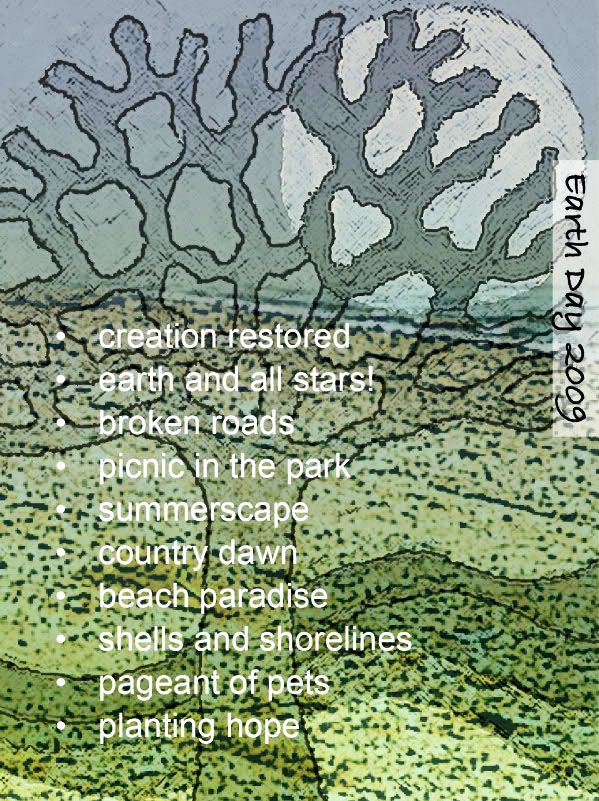
spring 2009 playlistIn 2012, as it long has done, with prophetic words of judgment and hope, Advent initiates seasons of waiting and watching, living, dying and rebirth, that connect us to the entire people of God in every place and time and helps us connect to sun, sky, sea and soil. But that "rebirth" is not a conventional, inevitable outcome; it's something else altogether—it is resurrection from death! I've been updating my virtual presence as a designer, and as I looked up some work from a few years ago, I found this playlist I imagined for the back of a CD case design for Earth Day 2009. I especially enjoyed how I'd included "creation restored, broken roads, and planting hope," all of which relate well to the general mood of Advent. Because we're familiar with the stories in scripture, we've become adept at recounting the narratives of salvation history (remember Heilsgeschichte?), so we always imagine we know the rest of the story... but we really don't know. My life cries out to begin living a story again! My life cries out for resurrection!

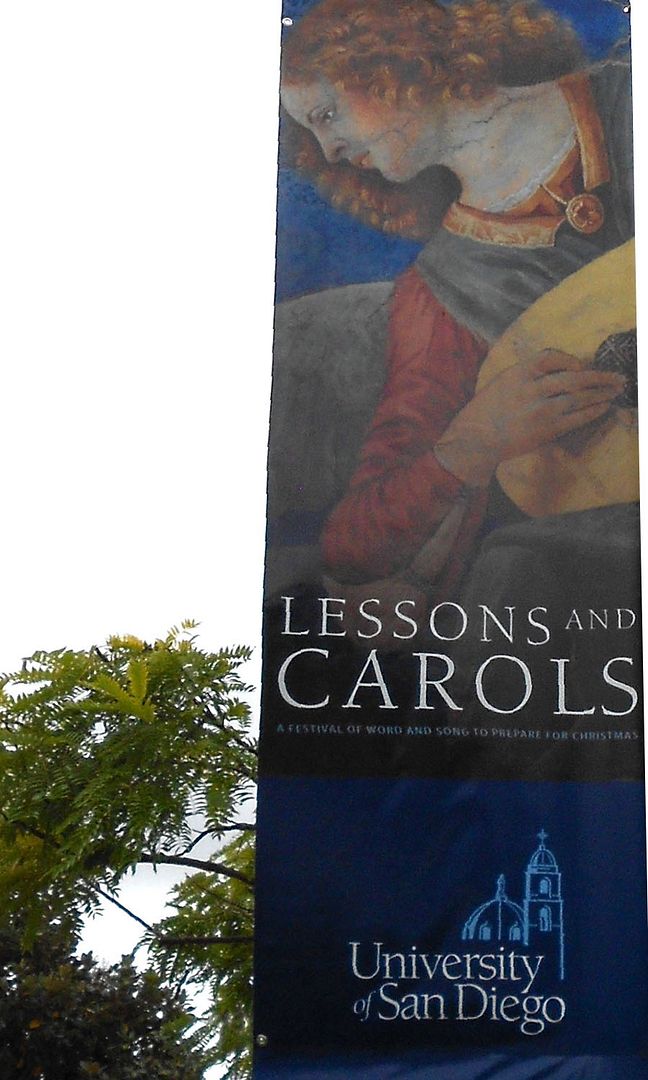
To plant some hope in my own life, I've been continuing my attempts to connect with people. I've been helping prepare the (slow food) Thursday evening church / community family dinners at church around the corner. I love working in the kitchen (don't mind cleaning up afterwards, either); it seems like a great way to connect with Jesus and start re-connecting with people, too. On Advent 1 and again the following Friday evening (it was that good!), I attended Lessons and USD lessons & carols angel bannerCarols at Church-Related University and had an encouraging conversation with the person next to me, so we exchanged contact info 10 days later she hasn't contacted me, so who knows. (Lessons & Carols banner features "Angelo Musicante" by Melozzo da Forlí, as does the printed program every year.)

A couple Tuesday mornings ago I met a friend from Yet Another Former Church for coffee; last Sunday I spent a couple hours with a friend I originally met during a bible study series during summer 2008 and since then have commented back and forth with on fb. He explained how he'd lived in intentional community several times, but since that's no option in this city, he's intentionally forming his own community with regular getting-togethers like last Sunday's. I'm attempting to become a presence in other's lives, doing what I can to invite them into mine. Compared to the rich friendships and always-available community I used to enjoy, these may sound like tiny endeavors, but they're ways in the Spirit I'm starting to plant hope for the end of the world I've been inhabiting for the past couple of decades.

PS my friendly attempts are nothing new; ever since being recalled (=fired) from Church in Semi-Affluent Suburbia, I've made a campaign of inviting people to lunch, coffee, snacks, activities. It slowed down lots, though, and with this new phase I'm expecting different results for the same behaviors.

other December synchroblog contributors for this month are:

• Carol Kuniholm writing at Words Half Heard

• Jeremy Myers tells us about Santa Clausette

• Liz Dyer celebrates Dreams Do Come True

• Leah Sophia digs in with Planting Hope

• Glen Hager reveals a story of Christmas Surgery

• Kathy Escobar wrestles with holiday expectations

• Wendy McCaig ponders storytelling in Once Upon A Time

Tuesday, November 13, 2012

living thanks: november synchroblog

November synchroblog on WordPress
Intro: It's easy during the month of November to think about thankfulness. A lot of us will probably in some way, shape or form, say "I’m thankful for…" this month. But gratitude is much more than a feeling or something we talk about around the holidays. Gratitude can also be a powerful spiritual practice that opens our hearts to the rhythm of giving and receiving that is the heartbeat of life itself.
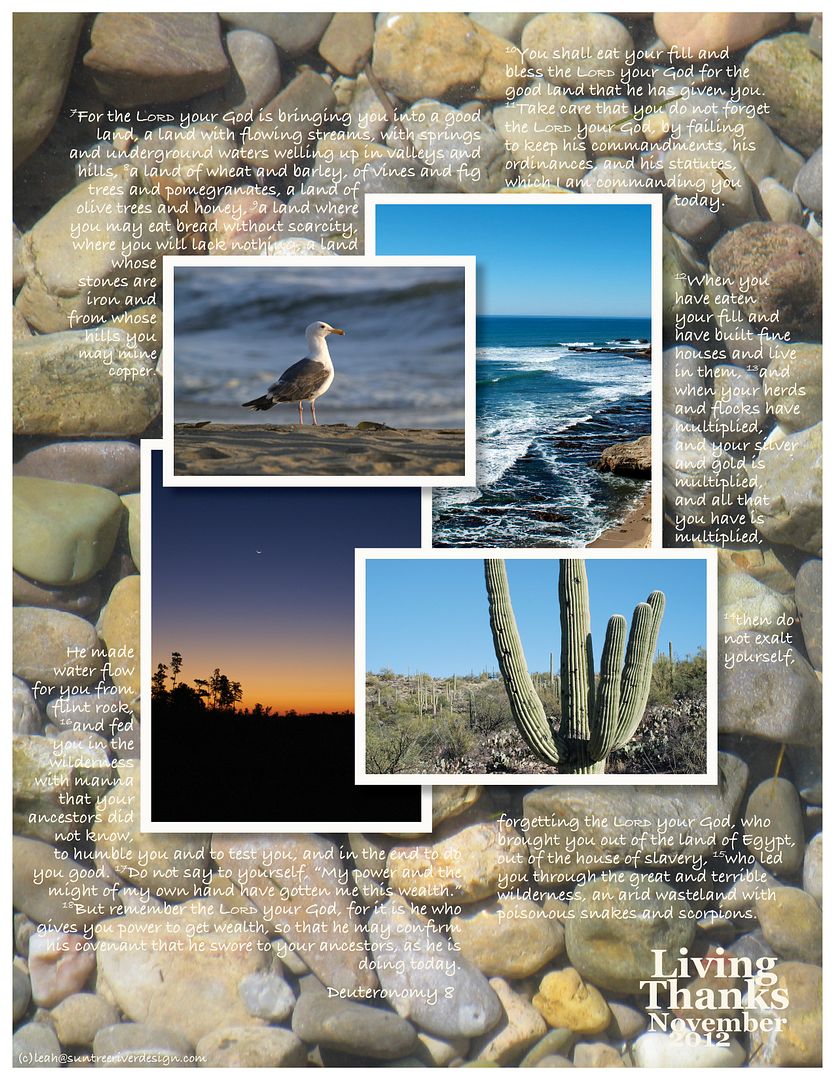
living thanks 2012My response:
"For the Lord your God is bringing you into a good land, a land with flowing streams, with springs and underground waters welling up in valleys and hills, a land of wheat and barley, of vines and fig trees and pomegranates, a land of olive trees and honey ... Take care that you do not forget the Lord your God, by failing to keep his commandments, his ordinances, and his statutes, which I am commanding you today. The Lord your God [who] brought you out of the land of Egypt, out of the house of slavery ... remember the Lord your God." –Deuteronomy 8

It's relatively easy for me to affirm what's gone right, what could be worse, to compare my own situation to others (typically a bad idea), to discern how far I've traveled and how much I've grown spiritually. Like many women and like a lot of Christians, for me the glass always is at least half full, frequently close to overflowing. My challenge is to get out of rationalization and denial, to confront my own behaviors toward myself, others, and the earth, that are less than the best they could and should be. I also have difficulty acknowledging that some people's actions toward me have been toxic, hurtful, and hateful, since I always seem to get caught up in trying to appreciate their history and their lack of understanding and ability to act in more loving, encouraging ways.

This month I've illustrated my post with a collage I made of places in nature I love to visit, that every time I'm there give me perspective and enable me to start seeing myself and others more clearly. All those rocks in the background? We discover them everywhere, find ourselves navigating rocky roads almost wherever we go! Rocks are evidence of the great geological age of this planet, and they remind of us many transformative, defining events recorded in scripture and in our own lives. A few years ago during Lent the pastor gave us an opportunity to take home as many "baptismal rocks" (smallish pebbles and stones of many different colors and kinds) as we desired. Referring to the passage from Deuteronomy I quoted, obedience to God's commandments, ordinances, and statutes is a huge part of our baptismal covenant; of making our daily walk a living remembrance of God's acts of liberation and resurrection in our own lives.

Every day begins with a new sunrise; I love to wake up and get out of bed at least 30 minutes before new light begins to wash over the city. (I love evening twilight, too, but there's something truly magical about first light of a brand new day.) Standing on the shore of beaches, oceans, rivers, and bays, reminds me God who created such vastness also created me and the immediate world I inhabit; God even charges me with stewardship of the immense sweep of creation! The deserts of the Southwestern USA – Utah, New Mexico, Arizona, and California – are the best places for God to help strip me clear down to bare essentials. I love remembering how much life teems just beneath the apparently barren surface of the sand; I love experiencing the glory of desert flowers in bloom, as they remind me of the vivid contrast between Good Friday's deathly desolation and the glory of Resurrection. This is a practice for autumn months with their shorter, cooler days, and longer, chillier nights, and an excellent way to live thankfully all year round!

Other November synchrobloggers:

Wednesday, October 10, 2012

october synchroblog: faith and the public square

In this Pentecostal reign of the Spirit, God is constantly at work in individuals, groups, institutions, and in the church. In plain theology, nothing is outside the sovereignty of Jesus Christ; there are no checks and balances. The Constitution of the USA says religion shall not be established nor the free exercise thereof interfered with, and along with many others, this country has a long history of institutional separation with functional interaction between church and government.

As soon as humans moved from hunter-gathering into settlements, they became political creatures. People gradually discovered more-or-less organized ways to engage together to define local and national boundaries, regulate trade, make laws for commerce, and provide for citizen safety. You get the idea!

We're blogging specifically about "faith and the public square." A theocracy? Probably not a good idea for many many reasons, though we know they originally modeled and still hold New England Town Meetings after the biblical model of the summoned assembly, the ecclesia. But a king like the rulers of those other nations? That's also a bad idea. In elementary school we heard about taxation without representation being tyranny and learned to recognize good government as government for the people, by the people.

Baptized into the death and resurrection of Jesus Christ, we renounce sin, death, evil, hatred, and the devil; we embrace God's values of love, justice, freedom, truth, and resurrection. We begin a lifetime of living in the world and for the world as the prophets called us, as Jesus showed us. Living justly and acting rightly includes protecting and providing for society's most vulnerable, creating good overall working conditions, feeding the hungry (not with leftovers, but with good stuff), stewarding creation well, campaigning to depose bad guys from crooked leadership and elect better ones. In some cases a lone individual can make a real difference; at other times, a group or more intentionally political effort yields better results. Beyond voting on election day, anyone's direct engagement with governmental processes varies tremendously in terms of how, when, where, with whom.

Whatever any individual Christian's involvement in bringing their faith, values, and voices to the "public square" concerning commerce, trade, immigration, education, or other concerns, almost everyone celebrates Holy Communion together.1 The Lord's Supper, the Eucharist, is God's sign of the new covenant of love, justice, and reconciliation in Jesus' blood; it is Passover, Exodus, Jubilee, and more. We celebrate the Lord's Supper on behalf of all the world, which (of course!) includes individuals, groups, institutions, agencies, and other entities. Jesus commanded us, "Do this!" This religious ritual? Yes. In doing so we create a microcosm of a redeemed world, of the new creation. "Do this?" Pour out our lives as Jesus did, break bread to feed a hungry world, break our bodies open to mend a broken creation. As we keep celebrating the sacred togetherness of Holy Communion in more-or-less organized ways to help heal the planet and heal ourselves, we make a serious religious and political statement, whether or not we frequent that "public square" to assert our theological and political claims.

1 The Religious Society of Friends - "Quakers" - and The Salvation Army are the two denominations I'm aware of that have no formal ordinances/sacraments.

Other October synchroblog participants include:

We The People by Wendy McCaig

Pulpit Freedom, Public Faith by Carol Kuniholm

Plumbers and Politicians by Glenn Hager

Conflating Faith and Politics by Maurice Broaddus

You Cannot Serve Two Masters by Sonja Andrews

Would Jesus Vote by Jeremy Myers

I am a Christian and I am a Democrat by Liz Dyer

5 ways to make it through the election and still keep your friends by Kathy Escobar

God’s Politics? by Andrew Carmichael

Why There’s No Such Thing As The Christian Vote by Marta Layton