Showing posts with label The Speakeasy. Show all posts

Thursday, March 22, 2018

Wisdom Walking :: Gil Stafford

Wisdom Walking: Pilgrimage as a Way of Life by Gil Stafford on Amazon

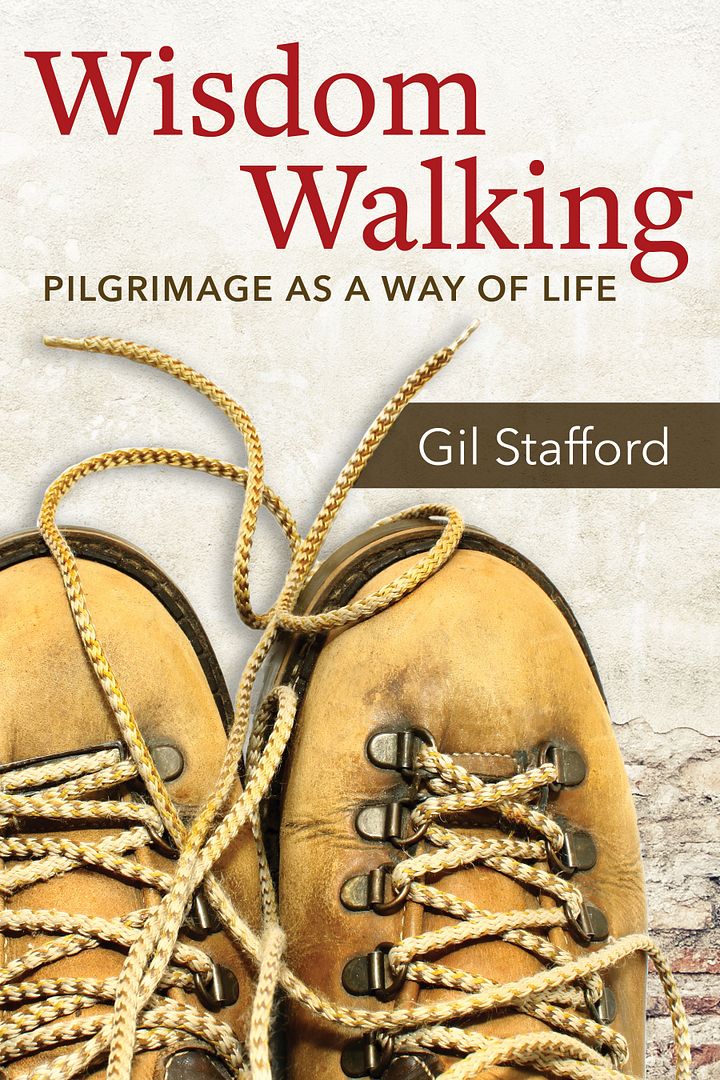
Wisdom Walking by Gil Stafford book coverWell-worn hiking boots filling over half the front cover enticed me to order Wisdom Walking. I've long resonated with the concept of life as pilgrimage or peregrination, so the title also helped. From the start I knew I'd love to meet author Gil Stafford, converse over lunch with him and a few other kindred pilgrims. However, when I realized how much of the content focused on actual walking pilgrimages of days or weeks over vast distances, I knew that wasn't for me and wondered how useful the book would be. I'm more into trekking up an easy urban hill, exploring a nearby canyon, spending an afternoon along an ocean shore.

But I had enough wisdom to think beyond other aspects of the book I couldn't relate to:

(1) Stafford frequently refers to Paulo Coelho's The Alchemist that has become somewhat of a cult book in a positive way. At the strong suggestion of one of my first ever online friends I met long before Facebook was a reality in any format, I read The Alchemist, didn't get its message at all, and donated it to the library book sale.

(2) Gil references James Hillman many times. When I returned to the east coast at the end of the last century and temporarily was staying in extremely sparse circumstances, an acquaintance stopped by with a copy of one of Hillman's books so I'd have something to do. I read whatever book it was slowly and thoughtfully, didn't get what it said, and returned it to the owner with polite thanks.

(3) Carl Jung is a third author who's influenced Gil Stafford. I'm only barely familiar with his work, though I have a slight claim to fame with a paper I wrote on a chapter from Jung's The Tower for my school's version of a Varieties of Religious Experience course. The instructor liked my paper a (whole) lot, commented I hadn't developed a couple of points well enough, but then admitted I'd had a limit of "only 15 pages," since she'd specified maximum length in order to deal with many undergrads going on endlessly and aimlessly while in the end saying nothing at all.

The central idea of Wisdom Walking is similar to an alchemist's literal trials to convert base metal into gold; each person's trials, disappointments, struggles, and surprises during their years walking this earth help transmute more base, unhelpful characteristics into refined, polished, traits in service to all creation. I know I complained about the chapters including so much about people's experiences on their own formal pilgrimages, yet a reader can learn how trudging through nature alone or with a group transformed those individuals.

Gil Stafford is an Episcopal priest and therefore Christian. Like many in the general tradition of Anglicanism, he's far from doctrinally orthodox, but open, enquiring, and convinced no single spiritual or religious tradition or practice has the corner of every possible way to connect with the divine. Although I describe my theology as "reformational," I easily relate to paganism, Celtic spirituality, and other ways of being and living that at first glance appear to be more earth-oriented than Christianity does (at first glance). Yet Christianity envisions the possibility and the hope that encourage us to live as co-creators of a new creation. Martin Luther insisted the Divine Presence was everywhere—in, with, and under every blade of grass, each drop of water, grain of sand. I've been informed neither ubiquity nor panentheism quite describes Luther's position, but human words always have limits, and they're probably close enough.

Of necessity the 16th century Reformers emphasized redemption of human creatures, but in time probably would have moved on to emphasizing the integrity of all creation, as many within mainline Christianity now are doing in an urgent attempt to revitalize, reclaim, and resurrect planet earth, not for its utility to humanity, but to celebrate its inherent worthiness and worth. In baptism we participate in the first birth and the rebirth of creation; the Eucharist is a microcosm of all creation fully restored, completely redeemed.

Blog only note: Stafford more than suggests our daily lives need four anchors: prayer; exercise (not necessarily a major workout—walking is excellent); a spiritual companion. That makes three. The fourth might be a practice of yoga, kabbalah, tarot reading, herbs, essential oils... Why four and not the biblical number three? Four compass directions. Four earthly elements. Four arms of the cross. Four gates of the mandala.

My Wisdom Walking ratings: for relevance to where I find myself today, 3 stars. For possibilities I discovered after I got over my initial disappointment and opened my eyes, 5 stars. Average: 4 stars.

You might enjoy Gil Stafford's blog, Peregrini: for those on life's pilgrimage.

Notice of material connection: I received a copy of this book from The Speakeasy with no obligation to write a positive review. As always, my opinions are my very own and I wouldn't have it any other way.

My Amazon review: Living as Pilgrims

Friday, January 19, 2018

Meg Salter :: Mind Your Life

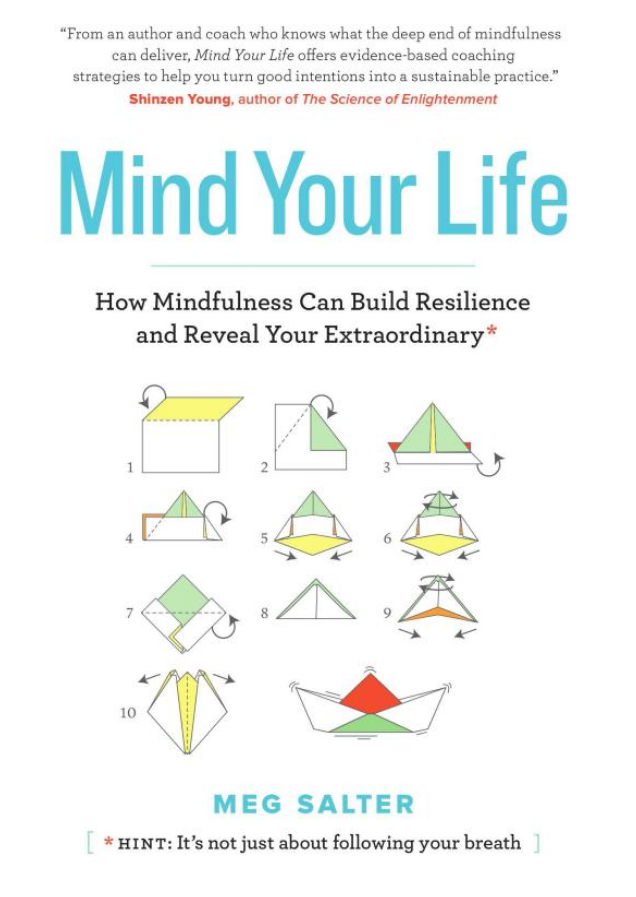
Mind Your LIfe book coverBy Meg Salter, Mind Your Life: How Mindfulness Can Build Resilience and Reveal Your Extraordinary on Amazon

For over a dozen years I've been practicing mindfulness meditation on and off and on again. Since relocating to Current City over two years ago, I've practiced more regularly and intentionally because I serendipitously discovered a weekly meditation group. As one of our regular facilitators describes it, mindfulness is "showing up for your own life!" Given my interest, I was more than pleased to acquire Meg Salter's new and fairly comprehensive guidebook that explains some of the history, details varied mindfulness practices, and includes vignettes of regular people whose lives have benefited from practicing mindfulness. You notice I said "practice"—although disciplines such as sports and music include both preliminary practice and an actual exhibition or performance, others – such as prayer and meditation – always are in process and being practiced rather than finished. Mindfulness entails greater awareness of all of a person's emotions, body, and mind in a way that makes the entire person wholly present in that moment rather than lost in a past that's over or lost in a future that hasn't yet arrived.

Besides her engaging explanations of various aspects of mindfulness, Salter suggests actual exercises a person can try out. She assures us achieving more awareness and less anxiety doesn't happen instantly, and she makes achieving moment to moment mindfulness seem entirely possible. One of my facilitators mentioned how some elementary schools now offer mindfulness to the kids—what a great idea!

Page 190 summarizes Mind Your Life: "Congratulations! If you've made it this far, you have all the tools you need to develop your own sustainable mindfulness practice."

Notice of material connection: I received a copy of this book from The Speakeasy with no requirement to write a positive review. As always everywhere, opinions are my own.

my amazon review: excellent resource

Friday, January 12, 2018

Together: Community as a Means of Grace :: Larry Duggins

Notice of material connection: I received a copy of this book from The Speakeasy in exchange for an unbiased review. As always everywhere, my opinions are my very own.

Larry Duggins, Together: Community as a Means of Grace on Amazon.

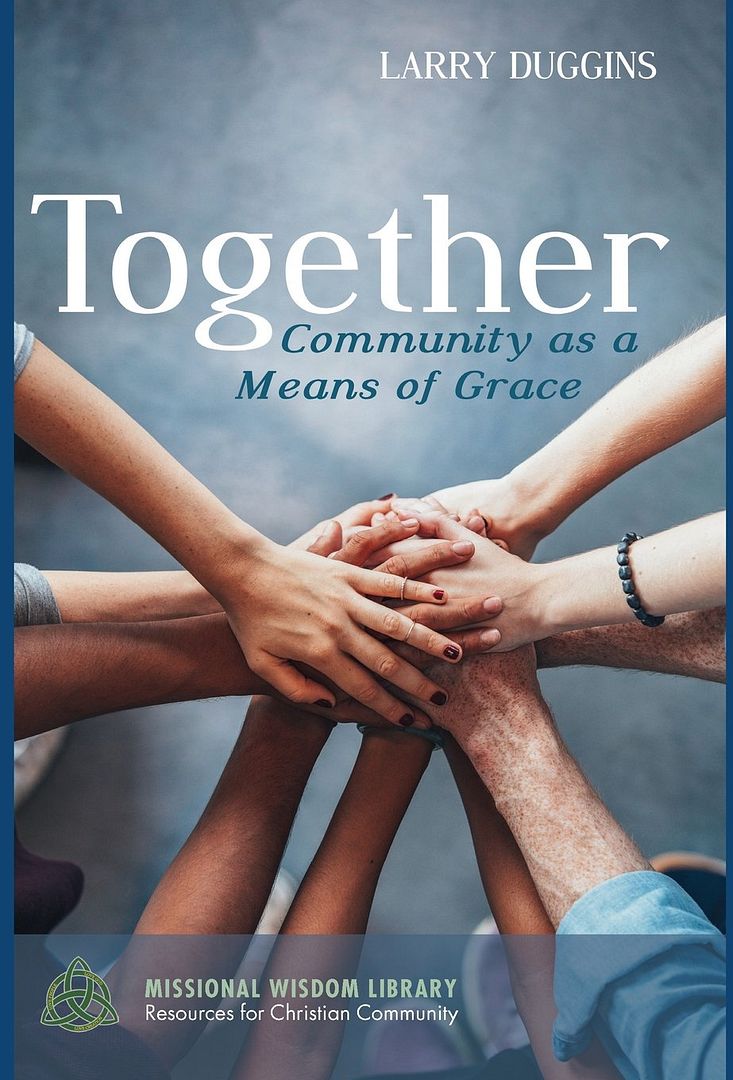
Larry Duggins, Together book coverAuthor Larry Duggins is co-founder and Executive Director of the Missional Wisdom Foundation. Missional wisdom?! Missio / mittere = send. In the power of the Holy Spirit of Pentecost, God sends all of us out into the world to proclaim the gospeled good news. Wisdom = knowledge, discernment, insight. Everyone may be sent, but is everyone wise?

In the church we affirm God's grace frequently comes to us through tangible, earthbound, physical "means" rather than nebulous, free-floating spiritual currents. In the Reformation traditions we refer to (Preaching (and reading) of the) Word and Sacraments as ordinary means of grace. The Westminster Catechism describes sacraments as "sensible," or accessible via our five physical senses. Duggins writes Together from a Wesleyan perspective that distinguishes instituted and prudential means of grace. Instituted would refer to the dominical sacraments or ordinances of baptism and the Lord's Supper we celebrate because Jesus commanded or instituted them them; in addition, they employ stuff of creation, and are available to all people. John Wesley being the well-ordered, methodical guy he was, thought through and more-or-less codified many aspects of life you might call sacramental if not technically a sacrament—not far at all from Martin Luther's insistence we find God hidden yet apparent in, with, and under the commonest, most mundane activities and things that became a means or a vehicle of grace. From page 22: "...prudential means of grace includes activities and actions that lead to interactions with God's grace that are not directly attributable to examples from the life of Jesus." In the church we confess grace came to earth in a unique way through God's embodiment or incarnation in the human Jesus of Nazareth. By definition, Christianity is incarnational, celebrating God's presence on earth, in a body, in Jesus of Nazareth and also in the church he founded that bears his name.

Together leads to community that leads to God's presence and action in unique ways that otherwise would not happen. Community: "a group of people gathered together under some unifying principle or for some particular purpose" (page 28). The book's basic premise is look around, use your imagination and you'll discover ways grace, hope, and life are making inroads into previously unhappy and unpromising settings. Use your imagination! Your church, school, or other organization may be able to renovate and restore an unused room or space that in its turn and time will help restore and renovate lives. But as important as a place to meet can be, it's not only about physical locations. It's about wisely perceiving the needs to receive and needs to contribute of people in your midst. You get the idea! Together the book is packed with real-life ideas and examples the author knows have worked. It's short and not theologically overwhelming, so it even could help a church outsider realize how down to earth and real-world Christians and Christianity can be.

I often explain sacraments as models that help us recognize God's everyday activity in everyday lives and events. In the power of the Spirit of Pentecost, ideas in Larry Duggins' small book can help all of us – wise or not – become a part of community whose everyday, ordinary body together becomes holy in the world, for the world. That's incarnation! That's God with us!

My Amazon Review: Ordinary Holiness Everywhere

Wednesday, November 15, 2017

A Bigger Table :: John Pavlovitz

A Bigger Table: Building Messy, Authentic, and Hopeful Spiritual Community by John Pavlovitz on Amazon

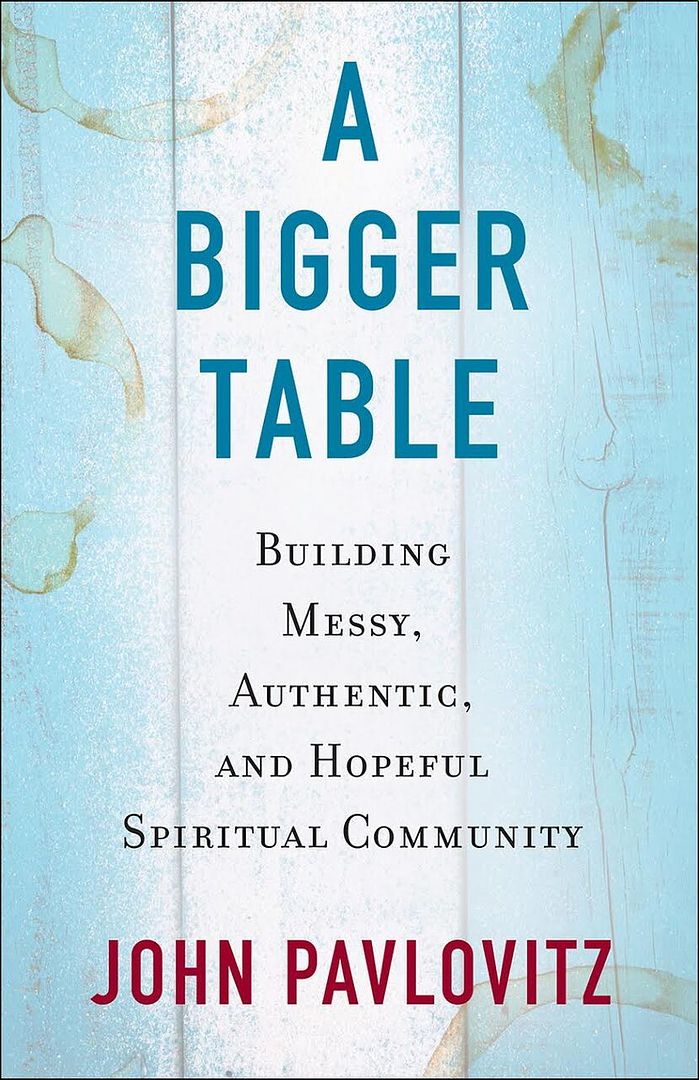
A Bigger Table book coverFrom Mark 14, "While Jesus was at Bethany in the house of Simon the leper, as he sat at the table..." Pavlovitz observes, "Chances are you know what it's like to be made the leper in the gathering of God's people. You've been pushed to the periphery because of some portion of your truth. You've been penalized for a season of your story. Or perhaps you've disconnected from those you deem unclean or unworthy or beyond redemption. Either side of this separation is equally damaging."

Ready for the upcoming major dinner celebrations of Thanksgiving Day USA and Christmas all over the world, maybe {hopefully} just in the nick of time for a planet that's becoming increasingly divided by institutional and individual politics, by ethnicity, class, culture, and fear, John Pavlovitz testifies to his own ever-expanding awareness of human diversity, his conviction God calls us to make a place at our table for all comers. His story begins in New York state where almost everyone looked the same, acted the same, ate the same food. Art school in Philadelphia and other experiences in the City of Brotherly Love opened the author's eyes and his heart to ways diversity of every kind celebrates God's presence and creativity—I'd strongly guess his parents' expansive love was the starting point. Pastor John tells stories of his encounters with differences, his occasional attempts to compromise maybe a little too much in order to stay employed.

It's commonplace that school in a different city or even in a different section of the same city can be a broadening experience for young people. Spending a year of school or service (Peace Corps, church mission, etc.) abroad in a different county and culture can change humans of any age! I've long been convinced making people aware of different styles of people, different ways of doing everything, different foods, and different music is one of the true gifts of a still growing internet. As long as you have a phone or a nearby library with computers, you'll see more and learn things you otherwise wouldn't have. Books always have been there (of course), but too many people never even open a book after HS graduation! A Bigger Table? Haven't you noticed how sharing a meal usually becomes a leveling experience that blurs what you thought were important differences? You know how people often open up about what's been happening as soon as their stomachs start to fill up? Because humans require food for survival—and almost as much, they need the belongingness and safe haven of community. Not simply for health, but for plain survival, too. So please move over a little, set another place, pull up a stair or share your chair!

Along your way, why not claim Pavlovitz' dream that everyone in the church and outside the church have the sublime experience of "Doing Church" as Jesus of Nazareth did: inviting, including, feeding, and celebrating all passerby, so everyone inside, and on the outside of the church will know how it feels to welcome and to be welcomed into a messy, hope-filled community.

Eating alone is a disappointment,
but not eating matters more,
is hollow and green, has thorns
like a chain of fish hooks
trailing from the heart, clawing at your insides.

Hunger feels like pincers,
like the bite of crabs,
it burns, burns, and has no fire.
Hunger is a cold fire. Let us sit down soon to eat
with all those who haven't eaten;
let us spread great tablecloths,
put salt in lakes of the world,
set up planetary bakeries, tables with strawberries in snow,
and a plate like the moon itself from which we can all eat.

For now I ask no more
than the justice of eating. Pablo Neruda

John's site, Stuff that Needs to be Said

my Amazon review: Set Another Place!

Disclosure of material connection: I received a copy of this book from The Speakeasy with no requirement to write a positive review. As always, all opinions are my very own.

Friday, July 17, 2015

Brian Kaylor: Sacramental Politics

Sacramental Politics: Religious Worship as Political Action (Frontiers in Political Communication) by Brian Kaylor on Amazon

Notice of material connection: I received this book for free from The Speakeasy, with no requirement to write a positive review. I am disclosing this to comply with the Federal Trade Commission's 16 CFR Part 255.

Interesting, uneven, and thought-provoking—also essential, if you dare!

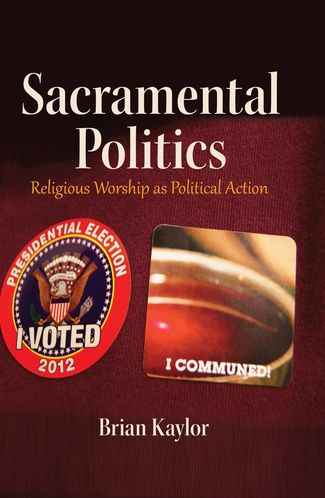
Sacramental politics coverSuch an important book! Everyone in the USA and elsewhere who sometimes attends church and/or calls themselves Christian could benefit from reading and considering Sacramental Politics. Unlike some other countries, USA never officially has possessed an established church or religion, yet author Brian Kaylor mostly reflects upon and analyzes politically-oriented religious behaviors in the contemporary USA, though he delves a bit into this country's political past, mentions the Confessing Church in Germany with its Barmen Declaration, and also discusses this country's most active branch of the Anglican Communion, The Episcopal Church USA. How fascinating that with our institutional separation, functional interaction of religion and politics in this country, they routinely have prayer rooms at the party connections. I think I knew that, but...

Overall, author Kaylor's perspective is not what some of us might observe and reflect upon regarding the dominical sacraments / ordinances of baptism and holy communion being politically, socially, and culturally subversive. In fact, he never quite gets there, possibly because of his anabaptist background, but he offers so much else. It's impossible to highlight all the rich highlights in a review or even in a basic book report, so I'll mention only a few.

The seven chapters includes (the biblical number) seven categories; to entice you to start reading, they're about Religious Worship as ...

(1) Political Rhetoric
(2) Partisan Politics
(3) Public Policy Promotion
(4) Political Messaging
(5) Political Space
(6) Inherent Political Action
(7) Politics

So many aspects of our lives as Christians to consider! Whenever someone complains about "politics" in the church in a club, or anywhere, I remind them "to be human is to be political." At least that's been the case since humans moved away and grew their affiliation groups larger than Abraham of Ur's nuclear family. Are our public prayers as pastors, as lay people, as politicians, or as office holders directed only to Divinity, or are they news bulletins and hortatory speeches primarily intended for the human audience? Is God's political party red, blue, purple, or other? Does God even "do" politics? Given that Jesus died from the actions of imperial powers, God clearly has been majorly involved not only in religious practices, but also in political, cultural, and general human endeavors of every kind.

When we interpret scripture, have we gotten into the irresponsible habit of imposing our perspectives and predilections onto the scriptural texts―eisegesis? Or do we at least attempt faithfully to extract and apply scripture's perspectives onto our decisions and into our daily lives―exegesis? It can be close to impossible to separate out our social, cultural, and political experiences from the witness of scripture. Faithfully contextualizing texts that come from a very different culture and that variously are between 4,000 and 2,000 years old always is difficult and dangerous. They didn't have parliamentary government, the great republic's imperium in imperio, internet fund-raisers, or corporate lobbying, and it's truly impossible to overlay a lot of scripture injunctions onto our current ways of being and living. A king like the other nations? The parliament that appears so effective for that country in the other hemisphere that also has a much smaller, far less diverse population?

The book's early chapters that dissect and analyze the content of praying, preaching, campaigns, etc. became confusing, mind-boggling, dull and repetitious. A lot of that information would be more clearly presented as a chart or in a table. My favorite chapter and probably the best-written and most clearly expressed is chapter 5, "Religious Worship as Political Space." Partly because public and liturgical space is a favorite topic of mine, partly because I know about Friendship Park and ongoing concerns about the international border between USA and Mexico. I've participated in the annual Posada sin Fronteras at least twice, but that was before the feds put up yet another barrier wall to interfere even more with interactions between the two countries.
election day communion buttonProbably due to my being in several states of disarray at the time, despite being online a lot, I'd missed out hearing out and participating in Election Day Communion on Election Day Night in 2012, but I'll be looking for one in 2016!

Brian Kaylor's vision and resulting content of Sacramental Politics is important for anyone, but the entire book needs a thorough, tight, no-holds-barred editing. Many paragraphs are long and unclear, and Sacramental Politics probably wins the prize for total number of parenthetical remarks and observations. Most of those could be eliminated and their content expressed in other ways. Many probably aren't even necessary! I noticed several misspellings that an editor probably would have caught and changed, and it's Agnus Dei – not Angus Dei – something autocorrect most likely didn't know. Also, despite the literary convention of sometimes using a noun as an adjective and that I like a lot, "Episcopalian" is the noun, "episcopal" the descriptive adjective. It may feel like another minor quibble, but it would be good if Kaylor would indicate United Methodist if that's the church body he's referring to, and in a similar way ELCA/ Evangelical Lutheran Church in America or PC(USA) Presbyterian Church USA if those are his referents. Because there also are more conservative – rather than progressive mainline – denominations with the names "methodist, lutheran, and presbyterian," it's important to specify which. Also, I found almost every one of the quotes from other documents or sources extremely interesting, so why not format them in the same easily-readable type size as the rest of the text, yet still indent it in blockquote style?

If the author edits and updates this book, it would be wise for him to run the content past people actively involved in each Christian tradition. For example, some Lutherans and other protestants offer an option for the private, individual confession that Roman Catholics nowadays call the sacrament of reconciliation, but like most other protestants, Lutherans claim only two actual sacraments: baptism and holy communion—confession and Absolution/Penance lacks a physical, sensible, earthly "sign." Although Latter-day Saints often refer to their main weekly worship service that features the bread and cup of Holy Communion as "Sacrament Meeting," they use the terminology of ordinance rather than sacrament, so no, the LDS church does not have only one sacrament, but quite a few ordinances. The first church of my involvement was American Baptist-USA, but I'm not acquainted with current liberal baptist practices and even if I were involved in a community of baptists, with their truly local polity my experience might be far different from most others. Martin Luther's Two Kingdoms theology confuses even those from a solid confessional Lutheran background, but briefly, none of the Reformers could imagine any aspect of life being outside God's divine sovereignty.

If any congregations, pastors, judicatories or even lone solitary individuals would dare, they need to read and consider this book! Because Sacramental Politics focuses almost exclusively on the USA, they'll discover God never has been a Democrat of any era or any variety, a Republican from any place or space, a Libertarian, a Communist or a member of the Green party, or even a declared Independent. But you know, God still is passionately political!

The book includes scores of useful references and an index.

my amazon review: interesting, uneven, and thought-provoking—also essential, if you dare!

Thursday, June 26, 2014

Resurrection City

Resurrection City: A Theology of Improvisation on Amazon by Peter Goodwin Heltzel

Disclosure of Material Connection: I received this book free through The Speakeasy and I was not required to write a positive review; the opinions in this review are my own. I am disclosing this in accordance with the Federal Trade Commission's 16 CFR Part 255.

resurrection city cover"Resurrection City offers a Christian prophetic vision for justice... in "the style of improvisation players of jazz offer." After all, "...traditional theology has most often been written in the style of Western classical music." ...the style of Western classical music? Despite the Christian scriptures not originating in the contemporary western world, until recently, most theologians have originated in the contemporary western hemisphere, so how else are they going to express themselves? Yet still I appreciate "classical music" in the sentence, since jazz also is a musical genre, and in this case, comparisons can be valid.

Resurrection City moves along at the approximate pace of the biblical book of Acts, and like Acts, brings us stories of discipleship, exploitation, inclusion, injustice, healing, conflict, resolution, and resurrection from death. Like Acts, Resurrection City tells us of the eschatological reign of the Spirit that raised Jesus Christ from the dead. According to the author, Resurrection City has [at least] a double meaning: new life for the poor, heaven in the biblical book of Revelation, "an ethical goal and future destination for world Christianity." Although the book title refers to many locations and ways of being, most specifically Resurrection City is the Beloved Community that gathered and grew in Washington, D.C., beginning in spring 1968 after the assassination of Martin Luther King, Jr.

Out of a thoroughly orthodox Theological (Christological, Pneumatological) perspective, author Peter Goodwin Heltzel chronicles triumphs that have occurred because of faith-filled prayer, discernment, direct, and less-than-direct action. Heltzel outlines possibilities for a more inclusive, more justice-oriented future for the entire planet. You could describe much of Resurrection City as scripturally-based instructions and encouragements of ways to "practice resurrection" until the real, enduring experience of God doing a New Thing happens in the power of the Holy Spirit. The blues are a state of mind, blues often signal it's time to start reaching for change, sometimes a case of the blues is a place to rest and reflect for a while. In Peter Heltzel's Resurrection City, blues and jazz are all of the above. Very very highly recommend!

my amazon review: improvisation into resurrection

Monday, July 15, 2013

The Coming Interspiritual Age

Legal note - "Disclosure of Material Connection: I received this product for free from The Speakeasy in hope that I would mention it on my blog, and was not required to write a positive review. I am disclosing this in accordance with Federal Trade Commission's 16 CFR. Part 255: 'Guides Concerning the Use of Endorsements and Testimonials in Advertising.'"

Link Love:
The Coming Interspiritual Age by Kurt Johnson and David Robert Ord on amazon

website

on Facebook
The Coming Interspiritual Age coverWhat a wealth of information about secular history, about anthropology, about world and indigenous religions, about individuality, and about our common humanity this book contains! It includes enough material for a lifetime of study and learning, and as you read, you might find yourself remembering certain books, classes, and professors, or you might find yourself suddenly interested in a new-to-you concept or era. To help navigate, and to assist your future topical study, useful End Matter (don't you love that term?) includes:

• Appendix I, Synopsis of the Developmental Periods
• Appendix II, Magic-Mythic and Apocalyptic Views of 2012
• Appendix III, Interspiritual Multiplex Resource Website (please note: no "www")
• Bibliography of "Books and articles consulted or referred to in The Coming Interspiritual Age"

Authors Johnson and Ord tell us "Generally, the expression 'spiritual world' refers to the entire dimension of consciousness, including the 'spirit realm' or 'astral realm' referred to in virtually every religious tradition." [chapter 14] They remind us some religious styles and traditions are closer to "revealed';" others could better be described as "consciousness" religions, though each has elements of the other; both types are important and complement each other. The late Brother Wayne Teasdale insisted, "Everyone is a mystic." Everyone participates on some level in the mysteries of this world and worlds unknown. Beyond this planet earth, within this globe, in some wholly other ethereal realm? Maybe all of those.

From the start, the authors remind us of the ultimate non-dualism of the interdependence of all creation, despite most of us operating most of the time detached from the other than us. Ultimately, it's about our "primary interspirituality, shared consciousness and heart, right here, right now." [chapter 28] That fact partly explains why, to quote Ari Ariyaratne, "We who have been born Buddhist, Hindu, Christian, Muslim, or any other faith can be very comfortable in each other's temples."[chapter 10] However, please be warned, interspirituality is not syncretism, not a blend or a blended religion. [chapter 18]

The Coming Interspiritual Age... "coming age?" That era is both here and now, and yet to come, very much in the sense of Jesus of Nazareth's earthly ministry and the eschatological lifestyle to which the Spirit summons and enables the present-day Church of Jesus Christ. We're moving into "...the collective―the world of 'We,' including all that's transcultural, transnational, trans-traditional, and world-centric." [chapter 23] Consider this book for a study group, as the basis of a university, community college, or continuing education course, possibly as a discussion document for an ecumenical or interfaith group. Outstanding!

my amazon review: Interdependent Spirituality

Tuesday, June 04, 2013

Trinitarian Letters

Trinitarian Letters:Your Adoption and Inclusion in the Life of God by Paul Kurts on Amazon

Trinitarian Letters, the site.

Trinitarian Letters on Facebook

trinitarian letters cover I read Trinitarian Letters with echoes of the lectionary texts for Trinity Sunday 2013 still in my head and heart! In 150 letter-length articles, here's the proof-texting grandpa sitting on the front porch lining out some scriptural connections, real or imagined, explaining in casual conversational manner how each of us participates in the perichoretic life of the Triune God. Or in simpler terms, the godhead comprised of Father, Son, Holy Ghost. Author Paul Kurts self-published this book through Thomas Nelson's WestBow Press, and why not? Many folks publish their own books these days. However, he needed a better editor (or an editor, period); he needed to know enough not to type so many sentences in all-caps... even the 4-page table of contents is all-caps! It doesn't take serious theological propensities to realize auto-correct and spell check are not big on theological terminology, but really, Armenianism? Armenian theology? Here's an article about it (the original article on Armenian theology is gone; I updated to one about the Armenian Church). He meant Arminian, and in the end finally got it right.

pages 93, 141, 152: After reading for the third time that the Reformation happened in the 1600s, it finally dawned on me he might not realize "The Reformation of the 16th Century" refers to "The Reformation in the 1500s." Then again, what church- or history-oriented person does not know the date of 31 October 1517?

"Comparisons are odious" (according to Recovery International?) and it is plain mean of me even to mention how the subtitle immediately evoked the first of Miroslav Volf's books of free church ecclesiology, After Our Likeness: The Church as the Image of the Trinity. But I can fairly say the lack of theological and grammatical coherence in most of this book would have earned me a D or an F in almost any class in almost any school I attended.

Nonetheless, despite its near-complete lack of organization and clarity, it could be helpful to read Trinitarian Letters as a book of devotions, by thoughtfully pondering the many positively reassuring and familiar passages of scripture Paul Kurts quotes—he especially likes Romans, Colossians, Ephesians, and the Gospel of John. Human adoption into and participation in the relational life of the Trinity is all about experiencing God's love, mercy, grace, and inclusion.

Legal note – "Disclosure of Material Connection: I received this product for free from The Speakeasy in hope that I would mention it on my blog, with no requirement to write a positive review. I am disclosing this in accordance with Federal Trade Commission's 16 CFR. Part 255: 'Guides Concerning the Use of Endorsements and Testimonials in Advertising.'"

my amazon review: disappointing

Tuesday, April 30, 2013

Evolution's Purpose

Author Steve McIntosh's site; Evolution's Purpose: An Integral Interpretation of the Scientific Story of Our Origins on amazon

evolution's purpose book coverAs I began trying to read this book, I wondered why I opted for it from The Speakeasy; I generally can make my way around fairly dense theology, but this is more speculative and suggestive philosophy that may have taken more words than necessary to explain, but then again, possibly not. The author defines Integral Philosophy as "essentially a philosophy of evolution that emphasizes the evolution of consciousness as a central factor in the process of evolution overall; ... it demonstrates the connection between the personal development of each person's values and character and the larger development of human history." On xxix we read, "evolution is an [unrolling, as in a parchment scroll] overarching process of becoming, partly due to choices consciously made by creation itself (thus, evolution's - or the evolving creatures' - own "purpose") that shapes physical, cultural, conscious, social, and every imaginable aspect of life imaginable.

From that perspective of integral philosophy, the book discusses values, human agency, freedom of choice, beauty, truth, and goodness. Humanity, creation, nature... I wouldn't necessarily describe Evolution's Purpose as densely written, but it does seem to ramble on without much purposeful direction. The book is at least semi-scientific, and somewhat spiritual; to me it's also not very engaging. However, it might be more interesting and more accessible to someone trained in the physical and biological sciences than in theology.

"not exactly in my field of endeavor," my amazon review

Wednesday, April 24, 2013

Juxtaposed

Juxtaposed: Finding Sanctuary on the Outside on Amazon

Daisy Rain Martin's site... includes resources and hope for revealing and healing from abuse.

As we walk through this world – and as we engage scripture – we discover countless juxtapositions of seemingly polar opposites: sin and grace; evil and good; brokenness and redemption; oldness and newness. Daisy Rain Martin reminds us, "The universe is random. This is Earth where sad things happen. And God wastes none of it."

Juxtaposed book coverDaisy spent her earlier years "between the sanctified and the insane," ultimately becoming humanly whole in spite of the horrific direct sexual, emotional, and physical abuse she endured from her mother's husband, the silent and tacit abuse she suffered because of her mother's complacency. From cradle on, Martin lived in patriarchal, secretive, self-righteous, Pentecostal Christian setting that mightily contributed to her attempts to hide and to justify the abuse as it happened to her. The first part of her first-person narrative moves at breakneck speed through stories of her childhood, then onto her college years at what's now Vanguard University. It slows down some to offer long and closeup views of her life today with her son and husband; finally at the end of the book, Daisy describes the type of redemption her once-devastated life now offers the inner-city youth she teaches. "A Daisy Flower with a Rain of Hope" sets possibilities and alternatives before those kids, challenges them to grasp newness and a future in their hands. She exclaims about what hope can do for a kid, for any one!

I loved listening to her recount stories of the ultra-conservative, highly legalistic church experiences of her youth; learning about her and her husband's (in the end) negative times with a new church start that appeared to begin in a positive manner heartened me, too. As the author points out, people have survived and thrived beyond far worse than she has; comparison's typically are a bad idea, though placing yourself, your past, present, and possible future into the story is a big part of the value of a biographical book. As I read, I wondered how much of my own past I still needed to shed in order to testify as Daisy does, "I enjoy a life of abundance and hope and freedom beyond anything I could have ever thought or imagined because I have let go of my past. Literally. That includes people." That's a tough one: not only deciding to spend less time with a particular person, more time with people who are healthier influences, but zapping people completely out of your life? I feel that's what most of the people who were part of my former life did to me, yet despite my behaviors and attitudes never achieving perfection, I still cannot fathom how and why I was so not okay to them.

Despite the literal atrocities Daisy experienced, the biological heritage from her birth father definitely contributed to her ability to endure, as did her apparent ability to view goings-on with some detachment. I love her description of finally getting beyond denial, raging at God, and opening a path to start healing. Snippets of this story could be almost anyone's, and God wastes none of what happens to us―none of what we sometimes cause to happen to others, either.

I read the digital version of Juxtaposed, but we'd call this book a page-turner if it were analog. "Raw!" and "powerful!" are book review clichés, but Juxtaposed is those and more. I want to meet and talk with Daisy Rain; I'm waiting for her to come to a town near mine. Soon.

my amazon review: the history and the hope

Tuesday, April 23, 2013

Answering the Contemplative Call

Another wonderful discovery via The Speakeasy! Answering the Contemplative Call on Amazon

You also can find author Carl McColman on Facebook, and on his blog.

Answering the Contemplative Call is a primer, a guide for first encounters, a kind of Contemplative Practice 101 textbook, so it's not comprehensive. Like most introductory texts, the book covers a lot of territory, and attempts to define and describe a lot of concepts.

answering the contemplative call cover Basics:
Recognize the call
Prepare for the journey
Embark on the adventure .... of

"...the mystical path [which] is the path of love between you and God." (page 10)

Straightaway author Carl McColman cautions us how the lifelong practice the mystical journey, of engaging the mysteries of God, the mysteries of our lives, is more of a spiral than a straight line. The text of this book spirals around a lot, too, but that's part of what makes it engaging and fairly easy to read.

I won't attempt to list the many historical and more contemporary lovers of God the author cites, but they include Thomas Aquinas, Thomas Merton, Evelyn Underhill, Julian of Norwich, the desert fathers and mothers, English and Spanish mystics, Augustine of Hippo, Hildegard of Bingen, Teresa of Avila, C.S. Lewis. We can place ourselves in their company!

At the beginning, on page 6, McColman insists thinking about God or having spiritual thoughts is not the first step along the way. In fact, I never ever would have guessed or imagined his root concept―it is "beholding." He lines out the initial sequence again:
God calls us
The call makes us restless
we wake up (respond) to the call
we behold the mystery
"and only then―do we start thinking about it."

On page 38: "To behold implies a profound engagement with that which you see. It implies paying attention and truly being present. It implies not merely seeing, but holding―in your mind, in your heart, in your soul―that which you see. ...We have to be awake in order to behold. But we also have to be silent and present. It’s not something that a distracted heart or an anxious mind can easily embrace."

As everyone who has walked alongside Jesus of Nazareth for any length of days realizes that in some ways the journey is solitary, but you still need to find companions, people to break bread with along the way. (page 65) A Spiritual director? Maybe. But also reach out and serve others in various ways. Related to those other people we need, on pages 80-81, McColman reminds us, "social / external /activist" dimension of anyone's relationships with Jesus Christ is essential.

Essential for myself and also for most thoughtful, educated, activist, urban people in this 21st century, the "Befriend Silence" chapter (page 89) begins by saying we need to make a home for silence in our hearts. Silencing that incessant inner noise, blocking out cacophony from streets and peeps. I love that he says on page 94, contemplative silence "gives us the space to find wonder..."

For sure I would like far more emphasis on scripture itself, but two-thirds of the way through we read, (page 117):
Christian meditation is not about letting images or thoughts go; rather, like other forms of kataphatic spirituality, it is all about immersing ourselves in the Word of God. "In the beginning was the Word," begins the Gospel of John. And ever since the apostles wrote the New Testament epistles and the evangelists wrote the Gospels, the Christian wisdom tradition has been associated with the mysteries of language. ... To use language is an essential part of being human, and so the exploration of Christian wisdom includes a strong focus on the words of the first Christian teachers, as well as of the great saints and mystics throughout history.
Finally, where does this twisty, turning, roundabout path of God's call to us, our awakening, beholding, and response to that call in contemplation lead? It's all about bringing heaven to earth, helping transform the world by being, demonstrating, and living the love of God. Answering the Contemplative Call is a smorgasbord of ideas and possibilities, one that could be an excellent gift for yourself, for a friend or an acquaintance.

my amazon review: God's Call

Monday, December 31, 2012

rants to revelations

Rants to Revelations: Unabashedly Honest Reflections on Life, Spirituality, and the Meaning of God, by Ogun R Holder; illustrations by David Hayward, "Naked Pastor'!

rants and revelations coverOgun Holder is a Unity Minister who grew up in a more centrist-style church on the small Caribbean island of Barbados. My only personal experience with Unity Christianity was receiving their excellent devotional booklet, "Daily Word" for several years; a step removed from that, a few years ago an acquaintance told me most Sundays she attended both the mainline PCUSA church because it told her "what," and the Unity Church, because it told her "how." Chapter 8, "I Survived Lent and All I Got Was This Lousy Enlightenment" begins with, "If I'm grateful to Unity for anything, it's the metaphysical spin (I mean 'interpretation') that it applies to traditional Christian theology." [page 67] I'm reviewing a particular book, not giving an overview of a religion; if you're interested in knowing more about Unity, their website can tell you far better than I can.

I'd like to have author Ogun Holder in my small group―if I'm ever part of a small group again. Why? The risk-taking, imaginative ways he does life, in the process becoming transformed personally, spiritually and in self-awareness. In many ways, he is telling us "how!" So far as I'm aware, all branches of Christianity teach and trust the Holy Spirit-led process of sanctification (theosis, holiness, divinization, deification) in each individual life. We take the name of Jesus Christ upon ourselves (more accurately, Spirit bestows that Name), promise to follow the fully human, fully divine Lord of Chalcedon, trusting we'll gradually become like him: fully human and fully divine. But a lot of us in churches with more "standard" theology that often tends to emphasize sin, brokenness, and depravity more than God's grace-filled redemption through Jesus Christ, could use at least a daily dose of Unity's emphasis on the divine side of Jesus Christ's and humanity's dual nature.

Unlike me (I love to teach anything—music, art, design, bible, theology, the most recent thing someone else taught me... anything), gifted musician Ogun Holder did not enjoy teaching, but before entering full time ministry, he found a perfect vocational fit as a music therapist: "Music therapy was about regaining life through music." [page 17] I've no desire on intention to work as a career or volunteer music therapist, but I'm very interested in regaining [lost aspects of] my own life through music, probably in a less formal way than attending a music therapy group or consulting with a licensed music therapist.

Visually, Rants to Revelations was very difficult to read because it's set in spindly sans-serif type. Some books include production notes—this one didn't, but for sure this is a typeface to avoid! I opted for a hard copy of this book because of David Hayward's cover illustration, and was excited to discover 18 more drawings by naked pastor, one to open each chapter!

Rants to Revelations is part daily logbook, part observations of others, and includes memories. But it's not quite the memoir Holder sort of threatened to write. Maybe that'll happen later? This is a good choice to pass along to someone who's feeling negative or fearful. This is another great book from The Speakeasy readers and reviewers bureau. Are you ready to sign up?

my amazon review: try this one!

Thursday, December 13, 2012

God Is a Gift

Another welcome offering from The Speakeasy!... if you're interested, go on over and join!

A sampling of God Is a Gift's online presence:

God is a Gift by Doug Reed on Amazon | | God Is a Gift website | | Thorncrown Chapel, Eureka, Arkansas | | Thorncrown Chapel on Facebook | | God Is a Gift on Facebook

God is a Gift book coverGod Is a Gift grew on me as I read! I started out with, "yes, these are basics," but as the author continued essentially telling us it's not about our works, our strivings, our desires, achievements, or accomplishments, but about God's grace – esp as manifested in the Cross of Calvary – I realized, "this bears reading, re-reading, lending out, and remembering." Does it need all 200 pages? Yes, because every one of us needs to be reminded over and over again!

Doug Reed tells us it's about knowing God in a Johannine/Pauline sense of gnosis—familiarity to such an extent we actually participate in the life of the Crucified and Risen Christ. Yes. Instantly I thought of "Knowing You," the song Graham Kendrick based on Philippians 3:7-11:
All I once held dear, built my life upon,
all this world reveres and wars to own,
all I once thought gain I have counted loss,
spent and worthless now compared to this.

Knowing You, Jesus, knowing You.
There is no greater thing.
You're my all, You're the best, You're my joy,
my righteousness; and I love You, Lord.

Now my heart's desire is to know You more,
to be found in You and known as Yours,
to possess by faith what I could not earn,
all surpassing gift of righteousness.

Oh, to know the pow'r of Your risen life,
and to know You in Your suffering,
to become like You in Your death,
My Lord, so with You to live and never die.
Although his book isn't full of his own stories and testimony, like many of us, Pastor Reed loves the intellectual, cognitive work of doing scripture study and theology, tells enough about his own attempts to create himself with diligent study, unceasing prayer, and works of service that most of us easily can identify as he rejoices in: "To possess by faith, what I could not earn."

Obedience, grace, law, gospel? Reed solidly grounds everything he writes in both Old and New Covenant scriptures, and demonstrates considerable knowledge of Jewish ceremonial practices. In addition, without referring to it as such, he does a great job explaining what we in the Reformation Churches refer to as the first and second uses of the law. Anticipating Christmas, during a class in November or December, one of my professors exclaimed, "Exchange gifts!!! Are you talking about a gift or about an economic transaction? You cannot have it both ways!" Paul of Tarsus reminds us, "the free gift is not like the trespass, offense, sin, transgression..." but by definition, is a gift not without cost to the recipient? Ultimately, it's all about Jesus, all about God's free, unearned and unearnable gift of grace.

Thorncrown chapel Author Doug Reed casually referring to the Apostle Paul as author of Ephesians and Hebrews bothers me some (esp after he explains his passion for the more formal theological enterprise); I hope that was a matter of convenience. No surprise that I hankered for references to sacraments/ordinances of baptism and holy communion, but I realize he's from a free church rather than a liturgical mainline background. Being introduced to the natural magnificence of Thorncrown Chapel in Eureka, Arkansas, and learning its history was a side benefit of this book! I also enjoyed discovering some of Pastor Reed's own theological reflections in Thorncrown Journal. Altogether this is an outstanding book I plan to keep, possibly loan out, and definitely re-read more than once.

my amazon review: simply outstanding!

Monday, November 19, 2012

water from an ancient well

Water from an Ancient Well: Celtic Spirituality for Modern Life by Kenneth McIntosh on Amazon

water from an ancient well coverFor quite some time the ancient and more contemporary insights of Celtic spirituality have interested me. I've done some reading that's specifically in the field, and perused other books that reference and apply those understandings. However, Kenneth McIntosh's Water from an Ancient Well is a kind of mini-encyclopedia or maybe a survey that provides stories, theology, and applications in each chapter, as well as an excellent sense of the earthbound, heaven-oriented way of living together (and occasionally in solitude) that continues developing and spreading. One thinks of England, Ireland, Scotland, and Wales, but Celtic geography has ranged much further to France, Spain, Switzerland and Germany; the author reminded me how I've explained to more than one of my classes the Galatian church the Apostle Paul addressed was an ethnic church, a gathering of Celts or Gauls in diaspora. What a beautifully, and fully integrated way of life this can be, with little or no separation between divine and mundane, sacred and secular!

Celtic Saints' heartfelt devotion to Jesus of Nazareth has been passionately recorded in their poetry and prose; in return, some people, especially Roman Catholic, have their own devotion to a particular saint: Patrick and Brigid are popular choices. A draught from this "Ancient Well" is a drink of trinitarian Christianity, but no way does it exclude incorporating other viewpoints and perspectives. There are Celtic knots, tapestries and intricately ornate metal jewelry, all of which are familiar in this 21st century. How many churches have – how few churches do not display? – a Celtic cross that superimposes the cruciform symbol of the Incarnate Son upon a radiant disk of the created sun? Similar to Eastern Church bodies, Celtic theology interprets Jesus Christ's atonement with a Christus Victor model, rather than one of other possibilities Western Christians have read into scripture.

Titles of the fifteen chapters:
1. Seeking Ancient Wells: The Celts and Their World
2. The Spiritual Romance: In Love with Christ
3. Be Thou My Vision: God in the Everyday
4. The Crux of Life: The Meanings of the Cross
5. Streams in the Desert: The Divine Presence in Solitude
6. Green Martyrs: Spiritual Fitness
7. Every Bush Aflame: God Revealed in Nature
8. Furred and Feathered Neighbors: Creatures of Grace
9. Water into Wine: Signs and Wonders
10. Beings of Light and Darkness: Angels and Demons
11. Circles of Strength: Community
12. Living Words: Scripture
13. Gifts of the Imagination: The Arts
14. Christ in Neighbor and Stranger: Hospitality
15. Uncharted Seas: Life’s Pilgrimage

McIntosh writes in an easy-going, conversational style, as if we were sitting around a warm fire listening to him talk about these topics. Approximately a dozen finely executed black and white line drawings help illustrate the author's narrative; endnotes reference the chapter as well as providing a wealth of further reading. Fourteen 2-column pages of index topics help demonstrate how complete this book is. I did say it amounts to a mini-encyclopedia, or it could be introductory Celtic Spirituality 101; even if you're already very familiar with the subject, this would be an excellent book to keep on your bookshelf.

my amazon review: celtic spirituality survey

Tuesday, September 18, 2012

Steeple Envy

Steeple Envy: Losing My Religion and Rediscovering Jesus by Victor Cuccia on Amazon

I got to read and enjoy this book as another offering from The Speakeasy reader and reviewers bureau; you can follow the link to sign up and become part of the fun!

These Steeple Envy-related links might interest you:

Steeple Envy booksite

Steeple Envy on Facebook

Pastor Vic Cuccia's on Twitter, too

• ...and he pastors Emmaus (formerly Journey) Church in Jacksonville

The header description of Pastor Vic's blog, Christ, Community and Culture, pretty much describes the content of Steeple Envy:
What does it mean to live as a Christ follower in today's world? His message is relevant even when we aren't. He lived in community even though most of us don't. He engaged culture and many of us work hard to create our own sheltered subculture. Together let's rethink what it means to be the church.
steeple envy coverPastor Vic's energy, immediacy, and urgency comes across as if he's talking straight at ya about his concerns, dreams, and plans for the church; he says lots of what almost all of us inside the confines of the church who long to bring church into world and world into church think all too often. I'm thinking in real life he'd also be asking me questions and giving me time to respond. So is the book's content unique? Not really. I've been hanging around and participating in this kind of live and virtual conversation almost forever, but I particularly appreciate Steeple Envy being a quick, engaging book you want to keep on reading to the end. Nothing in its vocabulary is too theologically technical or otherwise off-putting to the average person, and I can't envision any seminary-educated leader feeling talked-down to, either. The author grounds the book in scripture, though a lot of the chapters are about his own negative and positive experiences with the church, especially as a pastoral leader. "In church?" He points out how perplexed Jesus and Jesus' first followers would have been to hear anyone talk about going to church, asking when "church starts or ends," because especially going by accounts of the newly-born church in the book of Acts, we learn we always are church, rather than church being something we do in chronological time that starts and ends.

What's the "Steeple Envy" idea? You could describe it as being about counting the numbers of people attending/ doing worship, the size of the physical plant or campus, budget $$$, pastors' salaries and perqs, charting how quickly all those quantifiables (hopefully) skyrocket. A person in a pew or a pastor glances at churches down the street or across town and maybe wishes they could be like those others that have bigger attendance, buildings, budgets...

Vic Cuccia refers to 1700 years of an institutionalized church, counting only those centuries Jesus of Nazareth's Way has been a type of establishment, even when not exactly officially governmentally established. Over and over again he references the description of the nascent church in Acts 2:42-47:
They devoted themselves to the apostles' teaching and fellowship, to the breaking of bread and the prayers. Awe came upon everyone, because many wonders and signs were being done by the apostles. All who believed were together and had all things in common; they would sell their possessions and goods and distribute the proceeds to all, as any had need. Day by day, as they spent much time together in the temple, they broke bread at home and ate their food with glad and generous hearts, praising God and having the goodwill of all the people. And day by day the Lord added to their number those who were being saved.
Vic Cuccia works and writes from a context that's evangelical in the current popular sense of that word, but everything he says also applies to the often more socially, politically, culturally, and theologically liberal Protestant and Roman Catholic mainline. He emphasizes not the past 1700 centuries of the Eastern Church, of the Western Church, and church bodies in the wake of the Reformation, but earliest accounts of being church. From scripture we know the church first ordained not pastors/bishops/overseers, not elders to help with governing the local church; they first set apart and laid hands on deacons, those servants who represent church to world, who show the world what church is supposed to be. Especially in Acts, we notice people doing a lot of more-or-less extemporaneous Spirit-driven, scripturally-inspired preaching. We also know earliest presiders at the Lord's Supper simply were worthy, mature individuals chosen from the local community. Mainline types have what at least externally appear to be structural concerns related to valid orders, apostolic succession, types of polity, ecumenical relations—Cuccia doesn't address any of that, although he does say church can be baptist, catholic, presbyterian, charismatic, etc., and I'd guess he'd recognize those structural concerns as part of a need to maintain order (and some decency, too).

Pastor Vic doesn't specify details for the church with the people you know in the neighborhood where you live; he admits your community needs a gathering place, whether someone's apartment, a structure built or renovated to be Church in this Town, or possibly something else. He discusses the financial and moral and theological accountability to which scripture and Spirit call the people of God as he reminds us corporate American and generically Western models of success and compensation don't at all align with the worldview of scripture. As Cuccia points out, Jesus spoke very often about attachment to wealth, money, possessions. Throughout, Steeple Envy seeks to convert people, not in a static, one-time sense, but to bring people into the way of the Gospel that transforms lives, redeems neighborhoods, and engenders hope, so lives become part of the reality of the new creation. Close to the end of the book, Cuccia reminds us: Love looks like Jesus. The church should look like Jesus as well. We are the Church. In the power of the Spirit, let's give the church back to Jesus!

my amazon review: being church according to scripture

Monday, July 23, 2012

hometown prophet

Hometown Prophet on Amazon

Hometown Prophet, the website

Recently I joined SpeakEasy, a new reader/reviewer bureau with promises of "Subversive Reading. Great ideas." Hometown Prophet is my first blog and review for them.

hometown prophet book coverScripture distinguishes between the (fore)seer of future events, and the prophet, one who speaks "truth to power." Hometown Prophet Peter Quill operates mostly in the former category, accurately predicting events that will occur (admittedly because individuals, agencies, and organizations have not acted with justice and righteousness), though towards the close of the narrative he gets into some heavy-duty laying out of "if - then" alternatives. If you didn't already guess it, "Hometown" in the title is about home as in the place a person basically grew up; for personal and economic reasons, Protagonist Peter has returned home when he starts prophesying.

Author Jeff Fulmer sets the fictional story in heart of the Bible Belt Nashville, Tennessee, with church portions all centered in congregations that emphasize the more demonstratively eschatological gifts of the Spirit, practices those of us in the mainline typically don't give a thought - let alone a nod - to from day-to-day. Although "any similarities to actual persons is purely coincidental" prevails, the text references actual places and events that happened in some of those locales.

Hometown Prophet wasn't difficult to read, but I longed for more colorful descriptions, less predictable sentence structure, and [pages 218 and 264] I hope future editions will spell "publically" correctly... it's publicly!

The release of Hometown Prophet especially encourages me because I imagine a lot of conservative, evangelical (in the popular sense of "evangelical"), and pentecostal Christians will buy this book because the central character is one of them. When they reach the best part of the book they'll probably be surprised when (page 301) Peter acknowledges he is gay, he is Muslim, he is unemployed, a migrant worker, homeless, hungry, he is planet earth in distress, and more! In this Pentecostal time of the Church, the Holy Spirit of Life, Renewal, and Reform calls all of us who follow Jesus to live and act in solidarity with the broken, the outcast, the underclass, and the unwanted. To become Hometown Prophets? Maybe so!

my amazon review: a call to all of us?