Showing posts with label milk and honey. Show all posts

Friday, August 05, 2016

Five Minute Friday: Happy

This time we get to write for five minutes to Kate's happy prompt.

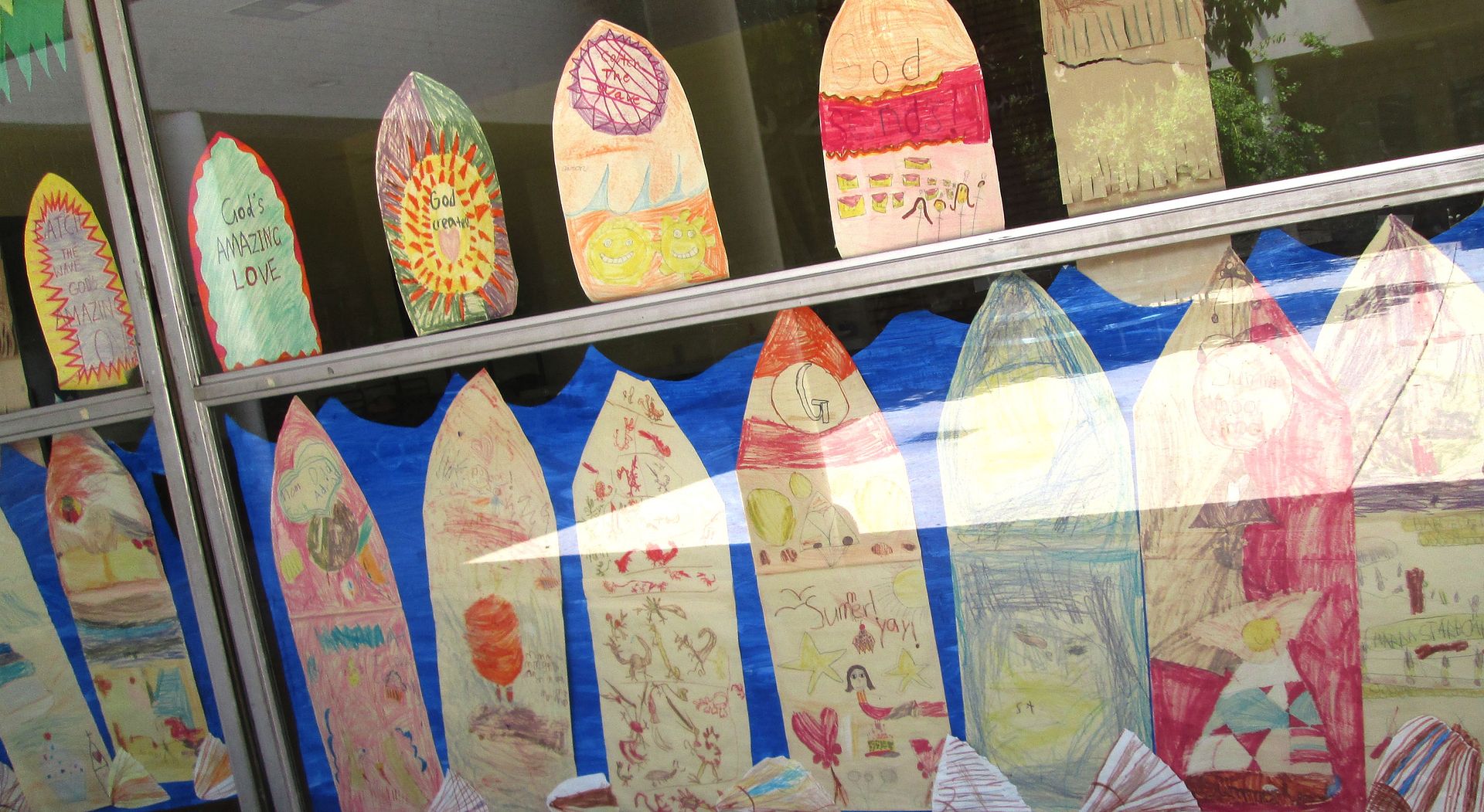
surfboards stacked
under the sea

Scripture reminds us, commands us, encourages us to rejoice. The God who inspired the Scriptures claims us with joy! A few years ago on the old online theology forums someone mentioned that despite joy permeating the text of scripture, happiness is more grounded, more "milk and honey" more everyday life achievable and... enjoyable, too. Latter-day Saints sometimes talk about God's Plan of Happiness. That sounds mundane and ordinary, but isn't day by day by week by year the entire idea of gospel-centered living?

The promised land of milk and honey means streams and rivers to water the grass so cattle can feed, cows produce milk, people make cheese. Bees mean fertilized crops; bees mean jars of sweet honey on the shelf, drizzles of honey on your home-baked bread. Desert streams mean irrigation for olives, figs, pomegranates, vineyards, barley and wheat. All that vitally inter-related good eatin' outta the good earth leads to conversing and connecting around the table. Happy you're here for me, I'm here for you, happy all of us are here together for each other. Happy is plain, everyday, just for today, one step at a time. Happy is a life you "don't need a vacation from," as Kate's button states.

# # #


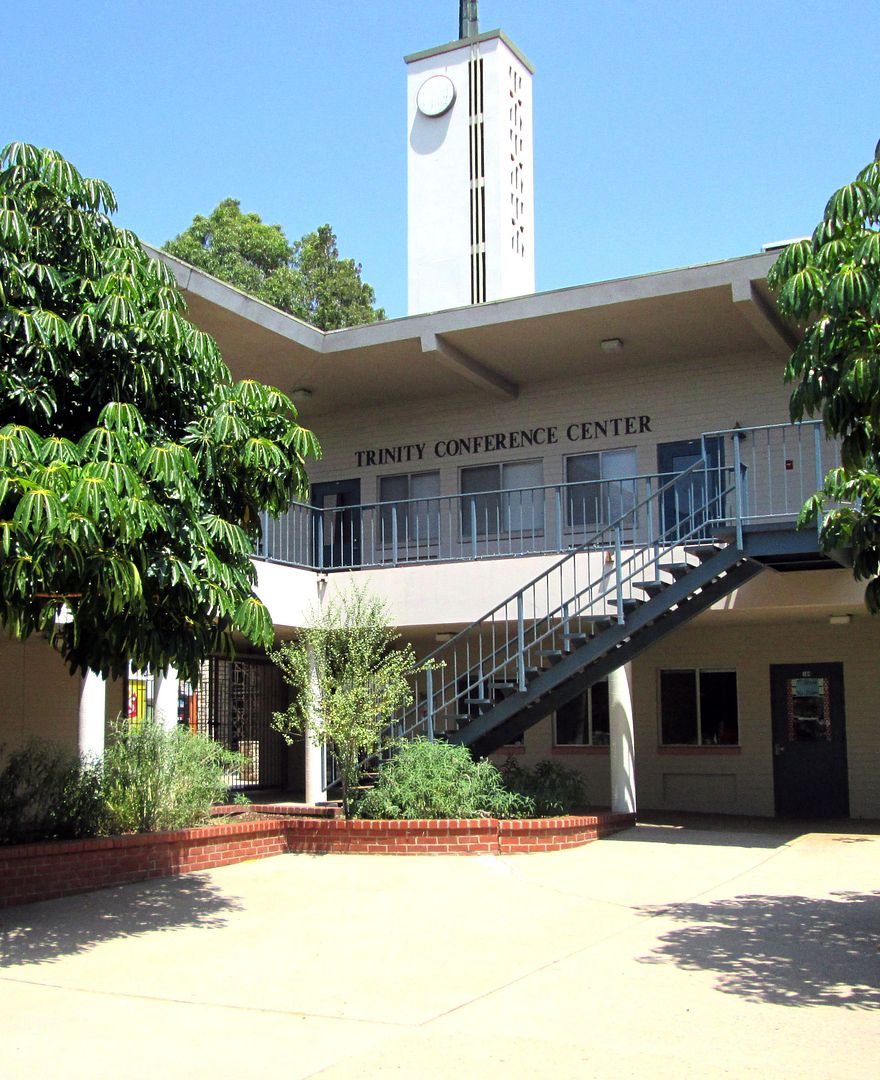
PS: Happy also means living in the moment // living in the moment often leads to happiness. Earlier today when I was at the judicatory offices for a meeting, the surfboards and fishes in my header images made me happy and convinced me to Five Minute Friday.

PPS: These 5 minutes writes are supposed to be unedited, but happily I took the liberty of changing my original land of milk and honey description from past to present tense.

southwest california synod offices five minute friday happy
five minute friday button

Wednesday, August 22, 2012

Heaven On Earth

Heaven on Earth: Capturing Jonathan Edwards's Vision of Living in Between on Amazon

Heaven on Earth coverWhat a visually light, bright book, and how easy and pleasant it is to read! Author Stephen Nichols is well aware "Sinners in the Hands of an Angry God" is the Jonathan Edwards sermon most people know about, even if they don't know the content; scarily dour, strict, sober, and somber tends to be the image of Puritans in colonial America most people imagine. Nichols completely shatters those imaginings with Edwards' "contagious vision" of a life centered in Jesus Christ fully lived, completely savored, both feet solidly planted on the ground of planet earth. "[Edwards] knew well how to live in between, to live now in all of the realities of heaven and the life to come." (page 84) How some ever, colonial American sermons were very very very (very...) long indeed, sometimes preached in two separate sessions, morning and afternoon, so that's not simply stereotype.

Professor Nichols brings pastor, theologian, (revivalist, evangelist, missionary), and philosopher Jonathan Edwards' historical and geographical setting vividly to life. The place references are a delight, especially given that I've lived in Massachusetts, traveled the Mass Pike from Boston to Stockbridge, enjoyed the Housatonic River and loved its name, yet it still surprised me to learn that when Edwards went west to the frontier only 50 miles from his famous pastorate in Northampton, Stockbridge was that frontier town! I researched and discovered Housatonic probably means "beyond the mountain." Because YouTube videos tend to come and go at a close to ephemeral rate, I won't link to it, but Charles Ives' tone poem, Three Places in New England No. 3 is "The Housatonic at Stockbridge."

"Heaven is a world of love" extracts Nichols' and Edwards' main thesis to easy shorthand. Our primary citizenship is in heaven, basking, being, and laboring in the presence of the Triune God, yet just as Roman citizens during Paul/Saul of Tarsus' earthly journey brought Roman religion, privileges, fashions, and culture to wherever they resided, God in the Spirit calls and enables us to bring heavenly sensibilities of love, justice, compassion, and service wherever we find ourselves. Heaven on Earth speaks more of milk-and-honey happiness than of ecstatic joy; I love the word "happified" on page 96, though Nichols is extremely mistaken when he says it's "a word that only Edwards could invent," since an undergrad classmate and I both frequently used to refer to being happified. Do I recommend this book? Absolutely! Check out some of Stephen J Nichols' other writings, also.

my amazon review: visioning and creating heaven on earth

Saturday, October 15, 2011

blog action day 2011 | food!

Action Network sponsors Blog Action Day this year and it happens on World Food Day. I'm doing some terra firma theology for the event. In scripture, terra firma on which we and other land creatures spend most of our earthbound lives and where our food is grown by ourselves or by others also is tierra santa—holy land. For this post I easily could draw upon a lot of posts from this blog, since most of my theology is theology of creation, theology of the land, the God and the people who live physically, emotionally and conceptually attached to the gift of land.

blog action day 2011

Last year for the topic of water I wrote, "As Christians we are People of the Book that begins with waters of the first creation and ends with rivers of the new, a book in which water is a persistent image." In the Hebrew scriptures the journey into the land...into the land...into the land forms an incessant theme; the garden of the first creation ultimately becomes the city of the new creation that begins in the garden of resurrection. From the earliest Pentateuch source we read about God forming the first human from the dirt of the ground and naming him A-dam, after that dirt. Later on the New Testament shows us the new Adam, Jesus of Nazareth, who reveals the divine to us most fully and completely, and like the first Adam is born out of the stuff of the earth.

In the book of Genesis in the Old Covenant scriptures, we read about Joseph's brothers betraying him and selling him into Egypt. After he spends time in prison, Joseph becomes a community leader and sits in authority at the right hand of the Egyptian pharaoh; from that position he helps distribute life-restoring grain to a hungry people. In the gospel accounts in the New Covenant Scriptures, we read about Jesus of Nazareth, who like Joseph is sold and betrayed into the ultimate prison, the ultimate bondage of death and is resurrected to new life before ascending to sovereignty at the "right hand" of God. From there, like Joseph, through his followers he has charged to be his continued presence on earth Jesus distributes life-giving grain to a starving world.

Water was the subject of last year's Blog Action Day and this year it's food! The faith and practice tradition I follow celebrates both water and bread as central to our understanding of God's gracious actions and presence in the world.

Early in the pages of scripture, God gives plants and trees and seeds for food and commands the people to care for and steward the land and the rest of creation. Central to the formation of Israel is the divine promise of deliverance from slavery and that the people would be led to a land "flowing with milk and honey," a place with pomegranates, figs, olives, vineyards, a land they would cultivate and steward in freedom rather than in grueling slavery. Scripture gives human creatures a place within the created order and a call to steward, maintain, treasure and support the rest of creation; the commandments that relate human creatures one to another and to all creation are critical for the planet's survival. The Creator God covenants with all creation, and as creatures in God's image, so do the people of God.

Therefore keep the commandments of the Lord your God, by walking in his ways and by fearing him. For the Lord your God is bringing you into a good land, a land with flowing streams, with springs and underground waters welling up in valleys and hills, a land of wheat and barley, of vines and fig trees and pomegranates, a land of olive trees and honey, a land where you may eat bread without scarcity, where you will lack nothing, a land whose stones are iron and from whose hills you may mine copper.

You shall eat your fill and bless the Lord your God for the good land that he has given you. Take care that you do not forget the Lord your God, by failing to keep his commandments, his ordinances, and his statutes, which I am commanding you today. Deuteronomy 8:6-11

The Gospel of Jesus Christ has no national or cultural boundaries; it is "good news" of victory of life over death for all creation, yet the good news must becomes incarnate, embodied and enfleshed within particular local cultures. In the church eating events are commonplace and have achieved close to a level of caricature. Potlucks, Christmas Teas, Ice Cream Socials, Barbecues on the Bay, monthly Friday evening parties or potlucks...

Through its witness, scripture brings humanity a call to help initiate justice and redemption for all creation and an ultimate vision of the eschatological feast in which the entire earth is healthy and restored, living in mutual covenantal dependence. The Lord's Supper, Holy Communion, the Eucharist – sometimes simply referred to as "the sacrament" – is the proleptic, preliminary yet full realization of the time of redemption of all creation. It's a vernacular meal and a nutritious one! The eucharist is slow food, it's cooperatively grown and produced food, it is nourishing and it is memorable. Just as waters and rivers become holy water in baptism, in the Lord's Supper, Holy Communion, solid earth, terra firma, becomes holy land, tierra santa.

Scripture moves from the waters of the old creation to the rivers of the new; the narrative of scripture moves from the garden of the first creation to the city of the new creation. That "end time" of the no more of cycles of war, violence, famine, hatred, deceit and deprivation will be a time of the fullness of redemption for all creation, not solely human creatures. The eschatological, "final things" feast of the Eucharist is sign, symbol, realization and reality of "will you at this time restore the Kingdom to Israel?" When the disciples asked Jesus that question, he told them to wait right there in Jerusalem (the center of the known world at the time) until the Spirit engulfed and engaged them with his power to enact redemption on earth. [Acts 1:6-8]

The pre-exilic writer who's sometimes referred to as 1st Isaiah, Proto-Isaiah or Isaiah of Jerusalem brought a necessary vision for whole food and covenantal living:
In days to come the mountain of the Lord's house shall be established as the highest of the mountains, and shall be raised above the hills; all the nations shall stream to it. Many peoples shall come and say, "Come, let us go up to the mountain of the Lord, to the house of the God of Jacob; that he may teach us his ways and that we may walk in his paths." For out of Zion shall go forth instruction, and the word of the Lord from Jerusalem. He shall judge between the nations, and shall arbitrate for many peoples; they shall beat their swords into plowshares, and their spears into pruning hooks; nation shall not lift up sword against nation, neither shall they learn war any more. Isaiah 2:2-4
Body of Christ, Amen!!!

twitter hash tags: #BAD11; #food

Monday, April 04, 2011

sprout day 4: brussels

brussels sproutsPeople seem to feel very strongly about cabbage, brussels sprouts, broccoli and other cruciferous veggies; I love them all! Continuing with daily sprout blogging, here's a typical recipe:
  • steam or microwave sprouts but be sure not to overdo it so they fall apart (unless that's your goal;
    top with
  • fresh creamery butter for a touch of the Land of Milk and Honey;
  • grated or super-thin slices of Swiss, Monterey Jack or Münster Cheese for another hint of healthy, productive dairy;
  • freshly squeezed lemon juice because citrus is a specialty of Mediterranean climates like Jerusalem and San Diego.


I'm gonna sit at the welcome table
I'm gonna sit at the welcome table, one of these days
I'm gonna eat at the welcome table, one of these days!
I'm gonna eat at the welcome table,
I'm gonna feast on milk and honey,
I'm gonna feast on milk and honey, one of these days!

I'm going to eat at the welcome table
Oh, yes, we did! And we will again!
april blogging sprout

Sunday, October 24, 2010

blog action day 2010: water!

9 days late...water and milk and honey!!!

blog action day 2010 world

Change dot org sponsors Blog Action Day again this year.

For this year's topic of water, first I considered "what do I know?" I know theology, so now I'm considering the biblical promised land of milk and honey.

Water is the womb of creation.
Genesis 1

1 "In the beginning when God created the heavens and the earth, 2 the earth was a formless void and darkness covered the face of the deep, while a wind from God swept over the face of the waters."

And water is the womb of our first birth and of our re-birth, our re-creation. In baptism, we enter the state of this earth when it was yet unborn; we are submerged in the substance from which first life emerged. God's creative power engulfs us as we identify with this planet's history and with Jesus of Nazareth, who was baptized in the River Jordan.

In the story of the Exodus from slavery, the Hebrew scriptures bring us a well-known account of a 40-year long wandering through an inhospitably arid, apparently barren desert, across a river and then into a place already inhabited by "others."

Remember this? Exodus 3

Exodus 33

3a "Go up to a land flowing with milk and honey..."

Milk and honey is a sign of the fullness of God's reign in justice and righteousness. Flowing honey and surging milk begin with fertile land and rivers of usable water. Ample milk means abundant cattle grazing on luxuriant grass, bovines that bear healthy calves--and that fertilize the ground. Bees make honey; bees pollinate fruits and flowers. Dairy, beef, honey and harvest mean nourishment for farmers, families and community, with overflowing everything to sell at market or barter and trade in order to get whatever you cannot grow.

The story of creation and of the people of God begins with water, continues with almost countless water-related experiences, including a great flood followed by God's covenant with Noah and with all creation, with Abram/Abraham and later Jacob's passage by the Jabbok River... water's scarcity in the exodus desert is central, since the desert became the place where the people learned to recognize and acknowledge water as gift rather than as taken for granted. In the desert's sparse economy, with surprises like water from the rock and manna from the sky, they also learned the kind of trust in God's provision that would enable them later to live in covenant with each other and with all creation.

Exodus 17

1From the wilderness of Sin the whole congregation of the Israelites journeyed by stages, as the Lord commanded. They camped at Rephidim, but there was no water for the people to drink. 2The people quarreled with Moses, and said, "Give us water to drink." Moses said to them, "Why do you quarrel with me? Why do you test the Lord?" 3But the people thirsted there for water; and the people complained against Moses and said, "Why did you bring us out of Egypt, to kill us and our children and livestock with thirst?"

Numbers 20

1The Israelites, the whole congregation, came into the wilderness of Zin in the first month, and the people stayed in Kadesh. Miriam died there, and was buried there. 2Now there was no water for the congregation; so they gathered together against Moses and against Aaron. 3The people quarreled with Moses and said, "Would that we had died when our kindred died before the Lord! 4Why have you brought the assembly of the Lord into this wilderness for us and our livestock to die here? 5Why have you brought us up out of Egypt, to bring us to this wretched place? It is no place for grain, or figs, or vines, or pomegranates; and there is no water to drink."

After they left the geographic, phenomenological Egypt, the people reached into the desert of Shur, where Elim, with its twelve springs of fresh water and seventy palm trees was one of their first stops. Palm trees and fresh springs provided shade and shelter, yet Marah, "bitter waters" was the name of the gateway to Elim's sanctuary, safety and protection.

Exodus 15

22Then Moses ordered Israel to set out from the Red Sea, and they went into the wilderness of Shur. They went three days in the wilderness and found no water. 23When they came to Marah, they could not drink the water of Marah because it was bitter. That is why it was called Marah. 24And the people complained against Moses, saying, "What shall we drink?" 25He cried out to the Lord; and the Lord showed him a piece of wood; he threw it into the water, and the water became sweet. ... 27Then they came to Elim, where there were twelve springs of water and seventy palm trees; and they camped there by the water.

Toward the last part of the texts placed last in the biblical canon there's a rich vision of rivers, trees, wholeness and integrity:

Revelation 22

1Then the angel showed me the river of the water of life, bright as crystal, flowing from the throne of God and of the Lamb through the middle of the street of the city. 2On either side of the river is the tree of life with its twelve kinds of fruit, producing its fruit each month; and the leaves of the tree are for the healing of the nations.

For God's newly constituted, post-exodus people a new phase begins with the body of water that's threshold between past and future and for the Church, waters and rivers - especially The Jordan River - remain icons of baptism, the event in which God irrevocably claims us and calls us to live in trust and in covenant with all creation. For us, baptism is a liminal, a threshold event that divides a disconnected past from new life in covenant with the church in every time and every place and with all creation.

As Christians we are People of the Book that begins with waters of the first creation and ends with rivers of the new, a book in which water is a persistent image. We people of the book also are people of the journey, a faith-filled, trusting trek that is bordered, boundaried and largely defined by the gift of water and our stewardship thereof, a kind of fluid wandering during which we're never still back there but also never have quite reached what we imagined to be our destination. You know I love Carly Simon's
Let the River Run

We're coming to the edge,
Running on the water,
Coming through the fog,
Your sons and daughters.

Let the river run,
Let all the dreamers
Wake the nation.
Come, the New Jerusalem!

Water is the womb of creation and the geographic, landed location of milk and honey cannot happen without pure, "living" water that keeps on birthing and re-birthing everything on earth. Milk and honey requires fertile ground and rivers that flow—rivers that won't catch on fire! That kind of land grows plump grains in well-stewarded prairies, juicy grapes on heavy-laden vines. Milk and honey is a lively sign of well-nourished people, animals, families and communities, of the sufficiency of shalom for everyone with neither too much nor not enough for anyone!

Only when milk and honey abounds can we offer back to heaven the feast of eucharist that gathers and welcomes all creation and all people, excluding no one (except those who exclude themselves). This "foretaste of the feast to come," as the liturgy expresses it, is the sign and realization of all creation's reconciliation, an emblem of justice and integrity of all and for all, a celebration that depends on the river that depends on the humans that depend on the river, the banquet that cannot happen without... water!

Carl Sagan observes, "If you want to make an apple pie from scratch, you must first create the universe." It's a given that we cannot create the universe, but if we want to make apple pies, we must help steward the universe's re-creation and we need to take care of the water, live in covenant with the water, with each other and with all creation.

Blog Action Day 2010: water!!!

Saturday, March 29, 2008

culture bound: spring 2008

my earlier culture bound blog.

introductory thoughts

As Pastor Martin [Luther] insisted, worship and hymn-singing in the vernacular is a mark of the true Church. We've been praying and talking, studying and working together to contextualize, cast into our local vernacular (but there's not just one!), not only our worship and preaching but especially our evangelism and outreach to our nearby neighbors. I really am in the process of writing a short proposal that'll lead to an outline that in turn will lead to actual course material related to multicultural and other decidedly relevant neighborhood ministry...slow as the process has been, and a few questions we'll be asking include: according to us, who are we? According to scripture - and especially according to Jesus - who are we? What do we consider our calling? According to scripture - and especially according to Jesus - what is God's call to us as individuals, as a local church and as the ecumenical church?

Models for [especially local church] Ministry

resurrection witnessesHere's the mission statement I wrote for the church I served in City of History; I'm quoting it again [because the deployed staff guy from the national church declared it "a model" and asked permission to show it to other congregations? - no, not] because all these years time later I agree it is finely succinct and every bit as relevant to the congregations I'm involved with on this coast as it was to that one on the other coast.
We are the people of God, forgiven and set free by the death and resurrection of Jesus Christ; by the power of the Holy Spirit we are called together and sent into the world as witnesses to his resurrection. God calls us, a servant people, to proclaim in word and action the presence of the risen Lord to all those whom our lives touch, especially in this community.

past ecclesiastical blasts include...

basic business model

Up until a few decades ago the now recently departed dad of a friend worked for the UCC's national church; the family lived in New Jersey, and the dad took the commuter train into New York City, to 475 Riverside Drive by Riverside Church, where in those days the national offices of most mainline church bodies hung out. Due to financial and other constraints, the UCC eventually moved to Cleveland, the PC(USA) to Louisville and the ELCA to Chicago, though those cities' names still more than suggest Basic North American style and sensibilities, diverse as this continent has become—but at least they're geographically and otherwise a little decentralized. Even as theologians and pastors, we often casually call ourselves and our churches the "mainline" that in the beginning was more of a sociological designation than an ecclesiastical one. Given that at its start during the 1880s the Main Line railroad relocated the city of Philadelphia's social, political and business elite, effectively creating some extremely affluent new sub-urbs, is that what we in today's protestant mainline aspire to be and seek to live? It's only terminology? Words can carry so very much power and impact! Words can create worlds! Words do create worlds and words destroy worlds (as well as people and communities).

During my tenure at the above-referenced congregation, I was attending seminary and serving in the very inner city, so in the cold winter months I typically wore corduroy levis and sweaters to work and school; denim and khaki skirts with polo shirts were my usual summer attire. At least once senior pastor said, "The Church must emulate business, and business...wears dark and formal suits and shoes, etc." Talk about non-vernacular! In that ultra-urban setting (not all that different from where I currently live) as in others, already each one of us is unique though not immediately apparently so, but why attempt to make unnecessary distinctions that can lead to further divisions rather than essential unity? In real life, I definitely wasn't dressing or behaving all that much like most of my neighbors, but I attempted a semblance of approachability, and given the results, I believe I succeeded.

European model

Riverside Church in New York City is far from the only church building in this country designed after a western or northern European cathedral model. Built by financial and railway tycoon John D. Rockefeller, Riverside physically presents as a Gothic cathedral, but taking history into consideration, we need to remember the Christianity first experienced by colonial America and later on by the new republic featured imported doctrine and liturgy, with protestantisms from continental Europe and the British Isles, Roman Catholicism from Germany, Italy and central Europe. Gradually church structures imitating local rather than foreign architecture came about—Spanish Mission adobe being a still prevalent popular style.

biblical model
They devoted themselves to the apostles’ teaching and fellowship, to the breaking of bread and the prayers. Awe came upon everyone, because many wonders and signs were being done by the apostles. All who believed were together and had all things in common; they would sell their possessions and goods and distribute the proceeds to all, as any had need. Day by day, as they spent much time together in the temple, they broke bread at home and ate their food with glad and generous hearts, praising God and having the goodwill of all the people. And day by day the Lord added to their number those who were being saved. Acts 2:42-47, NRSV

current contemporary

Again I'm agonizingly wondering if we've been designing our worship, modifying the bible's theology and editing our lifestyles to appear non-threateningly culturally congruent; do we present the gospel of Jesus Christ as another slick spiritual smörgåsbord (browser spell check added the diacriticals) selection rather than a tremendous offense, a scandal, a stumbling block in almost every sense? Mercy driven, grace given, world-transforming? Is it even possible to tamely articulate the reality of the cross and resurrection? Or maybe worse, do we offend humanity and blaspheme God with some kind of unbiblical folk religion? Is Jesus basically another guy like us or is Jesus of Nazareth The Wildest of the Wild? It seems as if I talk and write and blog the same stuff over and over again, but far too much of what I've been seeing and hearing and feeling sure ain't nothing I can imagine living for, let alone dying for.

It looks as if right alongside the mega- and related churches those of us in the mainline who really really need to discover all kinds of newer models for ministry and to recover a sense of our own worth have become just as similar to popular culture and society as the earlier European and business models. But the gospel is not an extension or an expression of popular culture, not a separate compartment of some folks' existence, hardly an optional selection in God's solution to all creation's quest for the fullness of redemption, for dwelling within the milk and honey of the sovereignty of heaven. God calls and by grace enables us to live baptized into Christ each moment every day; we are the community that in Jesus Christ, in baptism, already has experienced its first death and its second birth!

In subtle and insidious ways, artifacts and habits of consumerism and overall general superfluity make inroads into the lives of people who never intended it, just as political, economic and religious imperialisms often far exceed the sum of their discrete parts. You know Colossians specifically describes powers and principalities, while other biblical writers more than hint at them. In one of his sermons Paul Tillich says most of us insist they don't do the really big sins, but rather fall prey to smaller ones; in exactly the same manner, we often claim we don't subscribe to super bling, ultra sex or super-excessive consumerism (though of course we like nice things and lovely clothes...) Besides, "a little can't do any harm." Do we appear, talk and act just like our nearby neighbors who have no conscious knowledge or awareness of Jesus or do we live and walk with Christ in ways our neighbors can see, touch, hear, taste and hope for more of?

Thursday, April 13, 2006

Yahweh, Exodus, Amos; Maundy Thursday 2006

Lining out Yahweh's universalism in chapter 7 - "Exodus in the Plural" - of Texts That Linger, Words That Explode, Walter Brueggemann cites Amos 9:7.
"Are you not like the people of Ethiopia to Me,
O children of Israel?" says the LORD.
"Did I not bring up Israel from the land of Egypt,
The Philistines from Caphtor,
And the Syrians from Kir?" [NKJV]

9:7 "Are ye not as children of the Ethiopians unto me, O children of Israel? saith the LORD. Have not I brought up Israel out of the land of Egypt? and the Philistines from Caphtor, and the Syrians from Kir?" [KJV]

9:7 Are ye not as the children of the Ethiopians unto Me, O children of Israel? saith HaShem. Have not I brought up Israel out of the land of Egypt, and the Philistines from Caphtor, and Aram from Kir? [JPS Tanakh]
Universalism, as contrasted with possible (possible? More like frequent!) particularism in the situations of both Israel and the Church. Exegeting 9:7 and Amos' entire enterprise, rather than a unique God (Yahweh) of a unique people (Israel), Brueggemann suggests the God Self-revealed as Yahweh to the people who became Israel had, has and will have parallel histories with other, foreign(!) peoples. Amos specifically mentions African and Middle-Eastern people, who can serve as symbols for other non-synagogue, non-church populations. After all, because this ever-living God without physical or any other particular genealogy creates humanity in his own image, necessarily he will relate to and liberate not just a single ethnically distinct group, but many diverse others, too. Because Yahweh-Elohim longingly, passionately reaches out (to run with another dimension of the familiar spatial imagery: down!?) to encounter individuals into personhood and community, why would Yahweh not self-reveal with a name meaningful to and expressible by non-Semitic speakers?

God's initiative... remember, Moses' people had no knowledge of the Genesis narratives about Abraham, Isaac, Jacob and their God, so they could not help but be clueless about Yahwism; in addition, raised as a Prince of Egypt, Moses had no knowledge of and therefore no way of proclaiming any other small-g god or gods to his charges. In plain language (English, this time), Yahweh is the God who answers prayer no matter what, not solely particular kinds of prayers of particular persons.

As the ultimate first responder, God always Self-reveals first; despite the people of his creation imagining they could ascend to heaven, God always descends to bring them up to heaven. In response to any cry of enslavement, addiction, desperation and pain, God declares any oppressed person, individual or people "My people!" In simple (economic again!) terms, God possesses, owns, owes, "oughts" obligates Godself to broken creation, actually to all creation, shattered or whole... God places Godself in a position of indebtedness and then more than repays those debts, (financial!) obligations.

A thread of the literally vital necessity of forgiveness (debt repayment) runs through many biblical texts, as we learn about our obligation to forgive each other and about God's all-merciful forgiving nature and attitude toward us. The Tanakh lays out the complex sacrificial requirements for appeasing heaven to gain forgiveness—or, in biblical terms, not for us to gain forgiveness but for heaven to grant it! Throughout the bible's witness, debt and sin essentially are synonymous.

Yahweh's name is Liberator; this Yahweh's activity is liberation. In the New Covenant scriptures we meet Jesus/Joshua named Savior. I love quoting WB—"this baby name Save!" Jesus of Nazareth, who excludes no one from his Welcome Table. After all, the feast could not be truly eschatological without all creation present, could it?! Leading to...

Maundy Thursday, April 13, 2006

This week every day at noon, some of us have been gathering around Word and Sacrament. The journey to the cross has felt real—starting Monday, with the palms from last Sunday's triumphal entry beginning to rot and stink, through each day's increasingly solemn music and preaching. Then finally, this evening we celebrated what for me is the year's liturgical highlight. Back in inner-city Boston, we'd sometimes sing:

I'm gonna sit at the welcome table
I'm gonna sit at the welcome table, one of these days
I'm gonna eat at the welcome table, one of these days!
I'm gonna eat at the welcome table,
I'm gonna feast on milk and honey,
I'm gonna feast on milk and honey, one of these days!

I'm going to eat at the welcome table
Oh, yes, we did! And we will again!

Graham Kendrick, Knowing You:
"To be found my Lord, in a death like yours—so to live with you and never die..."
From the Magi's story in the Birth trilogy of The Magnificent Defeat by Frederick Buechner:
"And now, friends, I will ask you a terrible question, and, God knows, I ask it of myself as well.

"Is the truth beyond all truths—beyond the stars—just this: That to live without Him is the real death; that to die with Him is the only Life?"

Wednesday, February 22, 2006

Belonging and Remembering

Don't let me come home a stranger! This blog from August 29, 2004 was Part 3 of a series of short "God, Strangers and Saints" blogs. Eight days earlier, August 21, 2004, proportional to this current belonging and remembering topic, I wrote Culture Bound, with the subtitle, Culture, identity, home, belonging, etc...

The "ing" gerund form of the verb indicates ongoing action. Reading some of what I've written in the past frequently amazes and impresses (!) me—I need to remember and heed my own counsel. I also realize that for the most part I've been reasonably wise but often not quite intelligent! One aspect of re-membering means putting together again the biblical texts in a plain and simple manner, making the words and their meanings literally members - belonging, in the same sense as church or club or family membership - of my daily ministry and life: re-membering my walk with the Lord of Life by binding the texts between my eyes (brain stuff) and wearing them on my body (trust stuff). You accurately can claim the Reformation began in a burst of emotional despondence, but at least as accurately you can assert it started in a burst of exegesis. Truth is, God says I do belong, you belong and we belong; each of us is a part despite often feeling apart; God's Word can be trusted. It's that precarious state of both belonging and not belonging at the same time--and of course, it's yet another paradox, and you know how I love paradox. Though I'm not going to wade through his sermons to find the exact location, Paul Tillich had elegant words about it, as essentially he said we are "separated and yet bound." By creation, by baptism and by the Holy Spirit's pervasive, persuasive power in the world and in my life, I cannot unbelong myself from the church or from the family of creation.

Several times I've posted [here's another one I found with a quick search], "I, the Lord of font and cup, covenant to lift you up; splash the water, break the bread, pour out your life..." In baptism, God gives us and we take upon us Jesus Christ's name and identity (even unto suffered under Pontius Pilate, crucified, dead and buried! One of Graham Kendrick's songs includes, "To be found, my Lord, in a death like yours, so to live with you and never die"), but we also retain and get to explore, celebrate and share our unique gifts within the community and out there in the world. One of the outrageous scandals of biblical faith and sacramental theology is that we find the Divine Presence apparent (uncovered!) yet hidden (concealed!) in the commonest things—we're not talkin' hallucinogens, entheogens, fantastically elaborately esotericisms. Therefore? We need to gather around Word and Sacrament as often as possible? This is most certainly certainly true.

I began the God, Strangers and Saints 3 piece with,
But how does this gospel requirement of strange living align with our need for belonging, our need for being at home, and particularly with the gospel assertion that in Christ we no longer are strangers, in Christ we've come home to a circumstance and even to a place where we truly belong?!
Extensively I've blogged about the call to gracious hospitality God always has given the people of God; Romans 16:7, "Welcome on another as God in Christ has welcomed you." The friendship, collegiality and respect I've been feeling and getting at design school is resurrection! Maybe my readers are noticing I'm writing on my theology site the kind of thing I typically reserve for this far by faith? In ages past, for me the church not only was the exhibition of the kingdom of heaven: it literally was the kingdom of heaven incarnate--exactly what the Church is supposed to be! How some ever - as sometimes we'd say back in Boston - in the Interactive Media Certificate Program I'm experiencing what I knew I'd find in church.

Last August 14 on this far by faith, I talked more about my story and quoted a blog I'd done on this site a month earlier. Citing myself again for a necessary reminder:
I was a Daughter of the Church, daughter of the churches. Drowned, then raised to new life in the waters of baptism, sustained by the Word of Life and the Bread of Life.

Here's a passage from one of my July blogs on Desert Spirit's Fire—and here's the entire post:

However, Israel became Israel, receiving the identifying name, not in the Promised Land flowing with milk and honey but in the desert of the trek toward that promised-landed freedom. In the desert's sparse economy, with surprising gifts like water from the rock and manna from the sky, Israel and Yahweh encountered each other into the kind of relationship that later would enable God's people to recognize God's paradoxical self-revelation in the preached Word and proffered sacraments...

Now and here, like Christ Jesus, face-to-face with the world, the church is the incarnation of the fullness of the time of salvation, the era of the Reign of Life; as persons of the ekklesia, of the church, our sacramental liturgies and lifestyles replay God's paradoxical self-revelation in the exodus desert, recognizing and celebrating God's sustaining presence in, with and under creation's commonest stuff, the utmost essentials for life produced from the heart of the earth.
The theological truth remains we are baptized into the vertical and horizontal life of the Church at the same time we are baptized into Jesus Christ's birth, life, death and resurrection.

Monday, January 16, 2006

MLK Day 2006

For this year's MLK Day, I'm quoting from his Mountaintop speech; I'm including some Deuteronomy, too, plus a few remarks of my own.

Memphis, Tennessee, on April 3, 1968, the eve of his assassination
...I remember in Birmingham, Alabama ... Bull Connor next would say, "Turn the fire hoses on." And as I said to you the other night, Bull Connor didn't know history. He knew a kind of physics that somehow didn't relate to the transphysics that we knew about. And that was the fact that there was a certain kind of fire that no water could put out. And we went before the fire hoses; we had known water. If we were Baptist or some other denomination, we had been immersed. If we were Methodist, and some others, we had been sprinkled, but we knew water.

That couldn't stop us. And we just went on before the dogs and we would look at them; and we'd go on before the water hoses and we would look at it, and we'd just go on singing. "Over my head I see freedom in the air." ...

It's alright to talk about "long white robes over yonder," in all of its symbolism. But ultimately people want some suits and dresses and shoes to wear down here. It's alright to talk about "streets flowing with milk and honey," but God has commanded us to be concerned about the slums down here, and his children who can't eat three square meals a day. It's alright to talk about the new Jerusalem, but one day, God's preacher must talk about the New York, the new Atlanta, the new Philadelphia, the new Los Angeles, the new Memphis, Tennessee. ...

Well, I don't know what will happen now. We've got some difficult days ahead. But it doesn't matter with me now. Because I've been to the mountaintop. And I don't mind. Like anybody, I would like to live a long life. Longevity has its place. But I'm not concerned about that now. I just want to do God's will. And He's allowed me to go up to the mountain. And I've looked over. And I've seen the promised land. I may not get there with you. But I want you to know tonight, that we, as a people will get to the promised land. And I'm happy, tonight. I'm not worried about anything. I'm not fearing any man. Mine eyes have seen the glory of the coming of the Lord.
God sends Moses to Mount Pisgah:

Deuteronomy 3
27 Go up to the top of Pisgah and look west and north and south and east. Look at the land with your own eyes, since you are not going to cross this Jordan. 28 But commission Joshua, and encourage and strengthen him, for he will lead this people across and will cause them to inherit the land that you will see."
And presents the covenant to the gathered assembly—with plentiful promises:

Deuteronomy 5
22 These are the commandments the LORD proclaimed in a loud voice to your whole assembly there on the mountain from out of the fire, the cloud and the deep darkness; and he added nothing more. Then he wrote them on two stone tablets and gave them to me.

30 "Go, tell them to return to their tents. 31 But you stay here with me so that I may give you all the commands, decrees and laws you are to teach them to follow in the land I am giving them to possess."

32 So be careful to do what the LORD your God has commanded you; do not turn aside to the right or to the left. 33 Walk in all the way that the LORD your God has commanded you, so that you may live and prosper and prolong your days in the land that you will possess.
Deuteronomy 6
1 These are the commands, decrees and laws the LORD your God directed me to teach you to observe in the land that you are crossing the Jordan to possess, 2 so that you, your children and their children after them may fear the LORD your God as long as you live by keeping all his decrees and commands that I give you, and so that you may enjoy long life. 3 Hear, O Israel, and be careful to obey so that it may go well with you and that you may increase greatly in a land flowing with milk and honey, just as the LORD, the God of your fathers, promised you.

4 Hear, O Israel: The LORD our God, the LORD is one. 5 Love the LORD your God with all your heart and with all your soul and with all your strength. 6 These commandments that I give you today are to be upon your hearts. 7 Impress them on your children. Talk about them when you sit at home and when you walk along the road, when you lie down and when you get up. 8 Tie them as symbols on your hands and bind them on your foreheads. 9 Write them on the doorframes of your houses and on your gates.

10 When the LORD your God brings you into the land he swore to your fathers, to Abraham, Isaac and Jacob, to give you – a land with large, flourishing cities you did not build, 11 houses filled with all kinds of good things you did not provide, wells you did not dig, and vineyards and olive groves you did not plant—then when you eat and are satisfied, 12 be careful that you do not forget the LORD, who brought you out of Egypt, out of the land of slavery.
As MLK suggested, contemplating the fancy finery we'll wear after we pass into our ultimate paradisiacal dwelling is cool, as are dreams and images of milk and honey—after all, milk and honey is a sign, a visible, tangible sacrament, of the fullness of God's sovereignty and justice accomplished here on earth! (This blog includes some notes about Milk and Honey.) Talking about the sidewalks of the New Jerusalem, new city of God is trendy, too, for the people of God, because after all, God has called us and Jesus has shown us we are to help build that New Jerusalem here in San Diego, there in Chicago and Cleveland and Denver...In a very different location and time, on New Year's Day of this year I preached about the New City of God.

Parallel with the Deuteronomic historian's refrain of land, land, land—the Land of God's Promise, which will transpire on this created planet, MLK prophesies distributive justice with its accompanying redemption, "buying-back," from material want and economic paucity right here on this earthly globe; just as for Don Henley – Heaven is Under our Feet – for MLK, the Reign of Heaven will happen around us, within us and will be about us!

Deuteronomy 5,
So be careful to do what the LORD your God has commanded you; do not turn aside to the right or to the left. Walk in all the way that the LORD your God has commanded you, so that you may live and prosper and prolong your days in the land that you will possess.
Fully to possess the land, to flourish in the land? Then help make the kind of justice prophets speak about come about: keep all the decrees, commandments laws; obey! Walk in all the way the LORD your God has commanded you. Verse 31 says, all the commands, decrees and laws you are to teach them to follow in the land I am giving them to possess. To possess the land? Then teach the people so they will know how and what to obey! Justice, righteousness, rightly distributing the harvests, providing fairly-priced, adequate? no, good housing for all, shalom-full "enough" of whatever other goods and services any urban or rural person anywhere needs. As Walter Brueggemann recently reminded us [in Biblical Perspectives on Evangelism], in beginning his Small Catechism – traditional preparation for First Communion – with the Ten Commandments and their explanations, Luther insists it is the God of the commandments with Whom we commune. Life in community and life in the world makes serious demands of us and gives us amazing rewards.

...there was a certain kind of fire that no water could put out...we knew water! Yes, we know water, and anyone who has been reading my blogs or listening to my theology knows what I have to say about water!!! Water of first birth and first death, water of new birth and freedom in the air!

1 Corinthians 10:1-4 tells us,
I do not want you to be unaware that all our fathers were under the cloud, all passed through the sea, all were baptized into Moses in the cloud and in the sea, all ate the same spiritual food, and all drank the same spiritual drink. For they drank of that spiritual Rock that followed them, and that Rock was Christ.
In the desert, as they were becoming acclimated to minimal living, water from the rock (surprise!) refreshed and revived the emergent people of God; Yahweh gave the Sinai Covenant while the people journeyed out from slavery and into free, responsive (and responsible) living; the Word Yahweh spoke from the mountain out of the fire was a mature covenant, full of demand but replete with assurance from the God Who covenants with creation.

Annually, the Jewish Day of Pentecost recalls the Sinai law recounted in Deuteronomy; the Christian Day of Pentecost on the same day of the Jewish Pentecost - related in Acts - reveals a new way of being the obedient people of God. Acts 2 details the Gift of the Spirit given in fire and in wind to individuals as they were gathered in inclusive community! ...freedom in the air...in the Pentecost Covenant, the Holy Spirit of God and of the Christ inspires, in-breathes and enables obedience in a far freer, more spontaneous sense than before, with the law of the Spirit of Life poured out into our hearts, capturing our wills. The Pentecost Event forms the culmination of the reconciling, redeeming Christ Event, God's ultimate New Covenant of Grace of service to the world and one another: "do this"—I am among you as one who serves.

Jesus lived as all of the law and all of the prophets wrapped up in one person, making the law simpler to grasp but far more difficult to perform. Because of Christ Jesus' life among us, now we're subject to the finely-tuned obedience and morality of living in Christ. However, as Romans 8: 2 maintains, the law of the Spirit of life in Christ Jesus has set us free—from the law of sin and death, the death which became inevitable because of the human impossibility of total obedience. ...freedom in the air...as Jesus told his followers, it was necessary for him to return to the Father, that the Spirit might be given. And so, this is Pentecost!!!!! Because we live in Pentecostal fire and – drowned and revived – we now live in resurrection, in a newly-minted reality.

Jürgen Moltmann distinguishes between the human planner's future that can be strategized and that often develops predictably from us, out of our present (and, of course, out this present's past) and the future that comes toward us from God, breaking into our frequently trivial plans and expectations, making claims upon us and demands of us. Most appropriately, as we respond in obedience to God's Spirit-led commands, we never quite can tease out the parts of God's future that we have made from those aspects initiated and ratified by God's hidden activity. This latter-days future is one for which the Church and the churches only can hope, because its ultimate content has so many resurrection facets that only can be God-imagined and therefore, given only by God.
When the Time Has Come | Huey Lewis & the News

everything's gonna clear up and the sun will shine;
everybody's gonna cheer up, 'cause it's redemption time!

don't you worry 'bout a thing, cause you know things are gonna change
when the time has come

walls are gonna crumble and fall into the sea;
oh, all men will be humble—that's a guarantee!

a little rain is gonna fall, but it will only wash away the tears of us all

don't you worry bout a thing 'cause that train is gonna run
you will be on it from here to kingdom come
when the time has come

listen to the—band feels like a change

wind is gonna rise up and blow us all away;
people gonna wise up, cause it's judgment day

so don't you worry about a thing, cause you know that train is gonna run;
you will be on it not just for some
we'll all be on it from here to kingdom come
when the time has come

when the time has come, when the time has come
oh when the time has come

everything's gonna clear up everybody cheer up;
walls are gonna crumble; all men will be humble;
feeling it getting stronger—won't be down much longer;
we will be free when the time has come

when the time has come—I believe the time has come
feels like a change when the time....
1995 (Hayes and Lewis) Kinda Blue Music/Huey Lewis Music

Album, Time Flies... The Best of Huey Lewis & the News, 1996

Saturday, July 23, 2005

Deliverance, Homecoming, Shame and Grace

Another topic big enough for a book, but here's a beginning! To introduce this article, I'll quote parts of a pair of posts from early 2003; you can read my whole entire February 2003 here.
Tuesday, February 11, 2003

Synagogue and Basilica are meeting places—Church is People

...Liberation theology categories bring us back to God's self revelation in scripture and in the Christ Event. Mary's Magnificat is a central liberation theology concept and text:

"He has pulled down princes from their thrones and exalted the lowly, the hungry he has filled with good things, the rich sent empty away." –Luke 1:52-53

These words are grounded! Aren't those happenings demonstrated by Jesus' life and kerygma, Jesus' proclamation? I also like the liberation theology theme of the obliteration of shame: middle-class mainline U.S. Christianity often emphasizes annihilation of individual sin and guilt ...as devastating and as paralyzing as sin and guilt can be, shame is a far more cosmic category, visited upon individuals, cultures and societies by forces outside of themselves, forces over which they have no control—Paul's apocalyptic "powers and principalities." ...although the historical roots of deutero-Paul's exposition of and concern with the powers and principalities was somewhat "other than" what I've been writing about.

To paraphrase Johan Christiaan Beker in Paul's Apocalyptic Gospel: The Coming Triumph of God, the Church is the sign of the dawn of the new age and of the powers of life over and against the powers of death, and God calls the Church to active engagement with the world in order to fulfill its redemptive mission in the world. As I'd express it, God calls the Church, the Body of the Risen Christ, to be an instrument of grace to the world.

As an aside, although Paul may have been calling "on the Name of the Lord" on the fabled Damascus Road, I'm not completely convinced, since often grace and salvation break unbidden into life...into this world.

this relates, as well (also from February 2003):

Monday, February 17, 2003

Power and Sovereignty

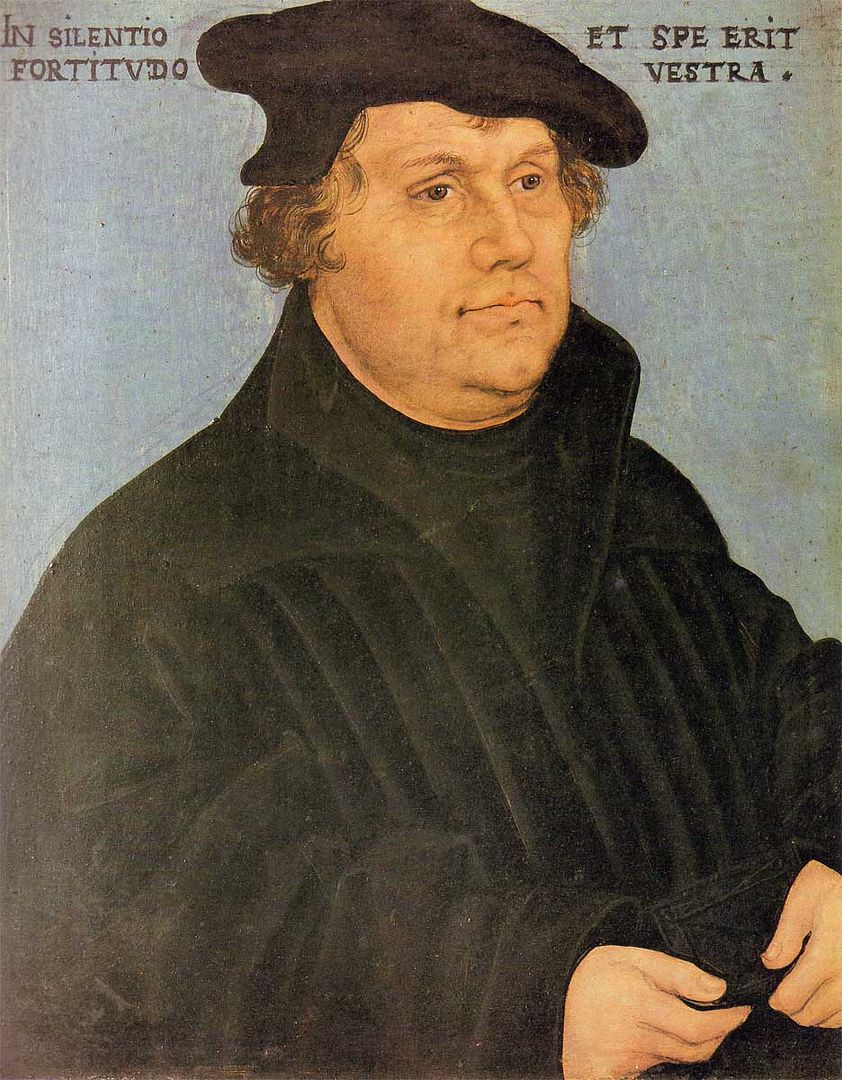
Martin LutherAs Christians our ultimate model of power is our God of glory, majesty and sovereignty willingly abrogating that power and becoming "small for us in Christ"—as Martin Luther expressed it: small enough to die. For us! From Christmas and the vulnerability of the manger we go to Good Friday and the vulnerability and absolute defenselessness of the cross. As Christians we confess we find the height of God's sovereignty in the vulnerability and weakness – in the hiddenness – of a human dying on the scandal of a tree.

We discover and recognize the fullness of the Shekinah Glory—the glory of the presence of God—in the weakness of Jesus, "The Human One," who dies without defense. And that powerlessness proved enough to annihilate the powers and principalities; it was sufficient to effect the death of the old order of death itself; Jesus' dying on the tree of death that paradoxically becomes the Tree of Life.

Our Good Friday/East Sunday proclamation is the end of the supremacy of death and the birth, the ascendancy of the primacy of life—the eschatological reign of the Power of God, most eloquently uncovered and found in the Lordship of Jesus of Nazareth, the crucified and risen One both Human and Divine, who shared our common lot and in whose birth, life, death, resurrection and ascension we know and affirm the definitive manifestation of the God beyond time and beyond space. ...

Now to today's topic: deliverance, homecoming, shame and grace.

Vis-à-vis Good Friday's cross and the empty grave of Easter Sunday's dawn, Christianity has developed an intricate theology of deliverance from slavery, redemption from bondage and homecoming from exile, but for Jews, shame was the cultural piece about the cross! However, when you assess any of those dimensions of salvation and wholeness, they're actually all about freedom.
Deuteronomy 21
22 If a man has committed a sin deserving of death, and he is put to death, and you hang him on a tree, 23 his body shall not remain overnight on the tree, but you shall surely bury him that day, so that you do not defile the land which the LORD your God is giving you as an inheritance; for he who is hanged is accursed of God.

Galatians 3
13 Christ has redeemed us from the curse of the law, having become a curse for us (for it is written, "Cursed is everyone who hangs on a tree," 14 that the blessing of Abraham might come upon the Gentiles in Christ Jesus, that we might receive the promise of the Spirit through faith.

Hebrews 12
1 Therefore we also, since we are surrounded by so great a cloud of witnesses, let us lay aside every weight, and the sin that so easily ensnares us, and let us run with endurance the race that is set before us, 2 looking unto Jesus, the author and finisher of our faith, who for the joy that was set before Him endured the cross, despising the shame, and has sat down at the right hand of the throne of God.
Clearly shame is cosmic and embraces every aspect of a person, but if it's possible to place it more in one category than in others, shame is more cultural than it is psychological or spiritual. Exactly the same way the cultural piece about the cross was shame, for us also, shame as an aspect of culture invades our total lives and affects ourselves and our (lacking a better word) total performances. For all of us and any of us, the situations, events and various miscellanea that cause us shame also tend to constitute the unspeakable we cannot permit ourselves to articulate!

Not only was death from hanging on a tree in itself a major curse under Old Covenant law—there's a ton of ritual and religious freight connected to that; in Jesus' case, dying outside the city gates located him outside humanity. For eons, city and civilization essentially have been synonymous; from days of old, cities have been places of population density, high-end commerce, and focal points of religious leadership and authority (hmmmm...thinking about Canterbury, Rome, Chicago, Louisville, Cleveland in this context?); typically cities have served as crossroads on the way to other places and historically, cities have been communication hubs, with news coming in and being broadcast out in various ways. As cities evolved, despite some barter and mutual exchange of goods still happening today (even now in the more-developed economies of the 21st Century First World), for a multitude of reasons, very early on a cash economy emerged and evolved. It's still emerging and still evolving, though these days credit and subsequent non-payment is becoming a habit for some.

But God chose to be born into humanity, into our life style and our longings, not at the local Cedar Mount Sinai or Presbyterian Hospital equivalent; and the society – and culture – chose to put God to death not according to contemporary antisepsis. Is there an antiseptic death? Well, yes. In Christ Jesus, God entered humanity and socialized with society at every level, but ultimately chose to identify most completely with the least of humanity, the cast-out, cast-off and cast-always. Over on my testimony blog, this far by faith, recently I posted this passage from John's gospel:
8:31 Then Jesus said to those Jews who believed Him, "If you abide in My word, you are My disciples indeed. 32 And you shall know the truth, and the truth shall make you free."
33 They answered Him, "We are Abraham's descendants, and have never been in bondage to anyone. How can You say, 'You will be made free'?"
34 Jesus answered them, "Most assuredly, I say to you, whoever commits sin is a slave of sin. 35 And a slave does not abide in the house forever, but a son abides forever. 36 Therefore if the Son makes you free, you shall be free indeed."
And from Romans 8, where Paul uses the same word as John uses for free eleutheria:
18 For I consider that the sufferings of this present time are not worthy to be compared with the glory that shall be revealed in us. 19 For the earnest expectation of the creation eagerly waits for the revealing of the offspring of God. 20 For the creation was subjected to futility, not willingly, but because of Him who subjected it in hope; 21 because the creation itself also will be delivered from the bondage of corruption into the glorious liberty of the children of God.
Also on this far by faith, two days ago, July 19, 2005, regarding Holy Shelter I wrote,

And there I will meet with you, and I will speak with you from above the mercy seat...Exodus 25:22a

God promises to meet us at the throne of sovereign mercy and grace; God meets us at the cross of Mount Calvary...

...after all, isn’t homecoming the ultimate thanksgiving?

Christianity has developed a complex theology of deliverance from slavery, redemption from bondage and homecoming from exile, but for Jews, shame was the cultural piece about the cross; when you assess any of those dimensions of salvation and wholeness, they're actually all about freedom! Clearly shame is cosmic and embraces every facet of a person; shame as judgment from our culture invades our total selves.

God promises to meet us at the throne of sovereign mercy and grace; God meets us at the cross of Mount Calvary... shame invades our total selves, but in the Divine Sovereignty and provision of the Cross of Jesus Christ, in mercy and grace God meets us, take all of our shame upon Himself and, at Resurrection dawn, transforms our entire selves into a homecoming of freedom without shame!

But always and for all times it hasn't been about signs and wonders—remember, even the gods of the Egyptians could do the fireworks! For the God of Abraham, Isaac and Jacob, the God of the prophets, the God and Father of Jesus Christ, all ways and every time it has been about constant, unmediated, unevoked and surprising Presence. For today I'm finished thinking about this, so I'll conclude with a handful of promise-texts:
Exodus 3
10 Come now, therefore, and I will send you to Pharaoh that you may bring My people, the children of Israel, out of Egypt."

11 But Moses said to God, "Who am I that I should go to Pharaoh, and that I should bring the children of Israel out of Egypt?"

12 So He said, "I will certainly be with you. And this shall be a sign to you that I have sent you: When you have brought the people out of Egypt, you shall serve God on this mountain."

13 Then Moses said to God, "Indeed, when I come to the children of Israel and say to them, "The God of your fathers has sent me to you,' and they say to me, "What is His name?' what shall I say to them?"

14 And God said to Moses, "I AM WHO I AM." And He said, "Thus you shall say to the children of Israel, "I AM has sent me to you."' 15 Moreover God said to Moses, "Thus you shall say to the children of Israel: "The LORD God of your fathers, the God of Abraham, the God of Isaac, and the God of Jacob, has sent me to you. This is My name forever, and this is My memorial to all generations.' 16 Go and gather the elders of Israel together, and say to them, "The LORD God of your fathers, the God of Abraham, of Isaac, and of Jacob, appeared to me, saying, "I have surely visited you and seen what is done to you in Egypt; 17 and I have said I will bring you up out of the affliction of Egypt to the land of the Canaanites and the Hittites and the Amorites and the Perizzites and the Hivites and the Jebusites, to a land flowing with milk and honey."'

Joshua 1
5 No man shall be able to stand before you all the days of your life; as I was with Moses, so I will be with you. I will not leave you nor forsake you. 6 Be strong and of good courage, for to this people you shall divide as an inheritance the land which I swore to their fathers to give them. 7 Only be strong and very courageous, that you may observe to do according to all the law which Moses My servant commanded you; do not turn from it to the right hand or to the left, that you may prosper wherever you go. 8 This Book of the Law shall not depart from your mouth, but you shall meditate in it day and night, that you may observe to do according to all that is written in it. For then you will make your way prosperous, and then you will have good success. 9 Have I not commanded you? Be strong and of good courage; do not be afraid, nor be dismayed, for the LORD your God is with you wherever you go."

Deuteronomy 1
32 Yet, for all that, you did not believe the LORD your God, 33 who went in the way before you to search out a place for you to pitch your tents, to show you the way you should go, in the fire by night and in the cloud by day.

Deuteronomy 2
7 "For the LORD your God has blessed you in all the work of your hand. He knows your trudging through this great wilderness. These forty years the LORD your God has been with you; you have lacked nothing."'

Matthew 28
18 And Jesus came and spoke to them, saying, "All authority has been given to Me in heaven and on earth. 19 Go therefore and make disciples of all the nations, baptizing them in the name of the Father and of the Son and of the Holy Spirit, 20 teaching them to observe all things that I have commanded you; and lo, I am with you always, even to the end of the age."

Sunday, July 17, 2005

Anticipation

I'm cross-posting this on this far by faith, my testimony blog with no changes, so please bear with me if you visit both blogs! Desert Spirit's Fire is the place for my more intentionally formal writing, but this post contains both approaches, so it belongs both places. The ideas I'm posting this evening could be developed far more, so one more time, here are some more sprawling connections—but they do cohere, however jaggedly.
Anticipation is another pungent biblical theme!
Friday afternoon at the 99¢ Only Store (local-dwellers know the store's addictiveness), for the first time in close to forever I heard Carly Simon's haunting Grammy-winner

Anticipation. Both music and lyrics are Carly Simon originals:

from Anticipation:
We can never know about the days to come
But we think about them anyway
And I wonder if I'm really with you now
Or just chasing after some finer day

Anticipation, Anticipation
Is making me late
Is keeping me waiting...


© 1971 Quackenbush Music Ltd.

Reformation Notes
Because of their historical location the Reformers, especially Luther and Calvin, necessarily concentrated on a highly humanity-focused theological model, and theologizing within that, they also developed a compelling concept of God's gracious descent to all creation, which I believe laid open extensive possibilities for developing a comprehensive theology of redemption and sanctification that would include all creation. Both of those magisterial Reformers viewed all creation – not only human creatures – as an arena for the revelation of God's glory. In the Hebrew Bible there are ample precedents for this kind of holistic view of God's passion for creation and for an all-encompassing view of the sovereignty of Jesus Christ. I love the deuteronomic historian's relentless refrain, "into the land, into the land, into the land!" Hebrew Bible scholar Walter Brueggemann is one of my favorite authors; in his The Land: Place As Gift, Promise, and Challenge in Biblical Faith, he insists theology and theologians have concentrated far too much on covenant to the often near-exclusion of The Land.

As I continue my still very preliminary study and writing for my future book about ecological theology, besides the Bible, Brueggemann's plentiful work has influenced me a lot; Matthew Fox has influenced me some (though my theology is far more sacramental than Fox's); also, I'm drawing on the historical and still-present influences and insights of Celtic spirituality. Paul Santmire and Jürgen Moltmann are a pair of contemporary theologians in the Reformation tradition I need to thank and credit, as well.

Second Isaiah
I'm always thinking a lot about how much I love 2nd Isaiah of the exile (I need to figure out how to post some of my Isaiah graphics here). Check out the persistent theme of redemption and hope running through these verses, and particularly humanity's salvation physically located in the midst of the natural creation's redemption—the Reformers' theology of God's descent and infilling of everything created so recapture these passages! Related to these 2nd Isaiah texts, note well Luther's theology of the ubiquity of the Risen and Ascended Christ! [...looks as if I'm being excessive with the exclamation points?!]

from Isaiah 41

8 "But you, Israel, are My servant,
Jacob whom I have chosen,
The descendants of Abraham My friend.
9 You whom I have taken from the ends of the earth,
And called from its farthest regions,
And said to you,
"You are My servant,
I have chosen you and have not cast you away:
10 Fear not, for I am with you;
Be not dismayed, for I am your God.
I will strengthen you,
Yes, I will help you,
I will uphold you with My righteous right hand.'
18 I will open rivers in desolate heights,
And fountains in the midst of the valleys;
I will make the wilderness a pool of water,
And the dry land springs of water."

Isaiah 43

Isaiah 43:1

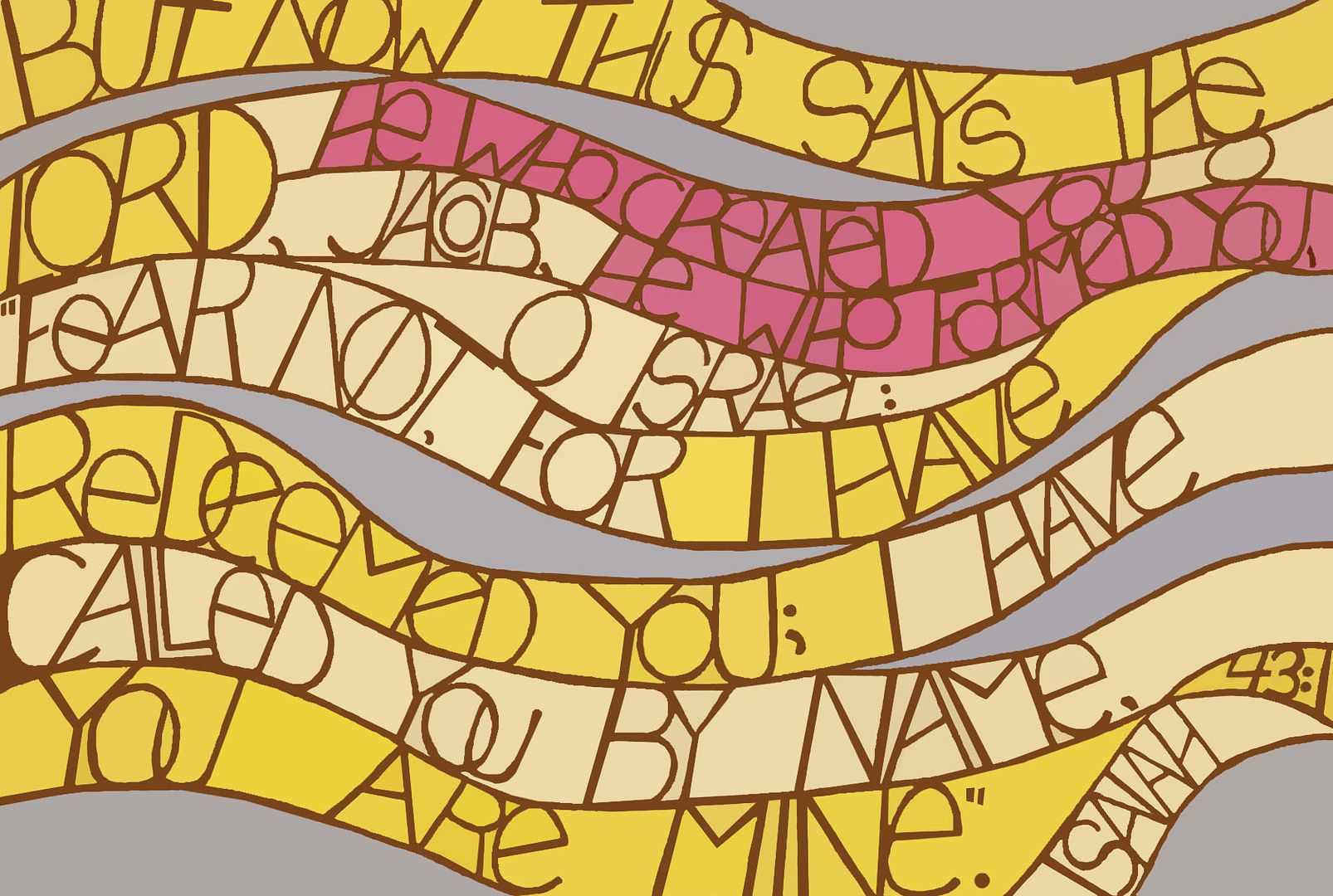
1 But now, thus says the LORD, who created you, O Jacob,
And He who formed you, O Israel:
"Fear not, for I have redeemed you;
I have called you by your name;
You are Mine.
2 When you pass through the waters, I will be with you;
And through the rivers, they shall not overflow you.
When you walk through the fire, you shall not be burned,
Nor shall the flame scorch you.
3 For I am the LORD your God,
The Holy One of Israel, your Savior;
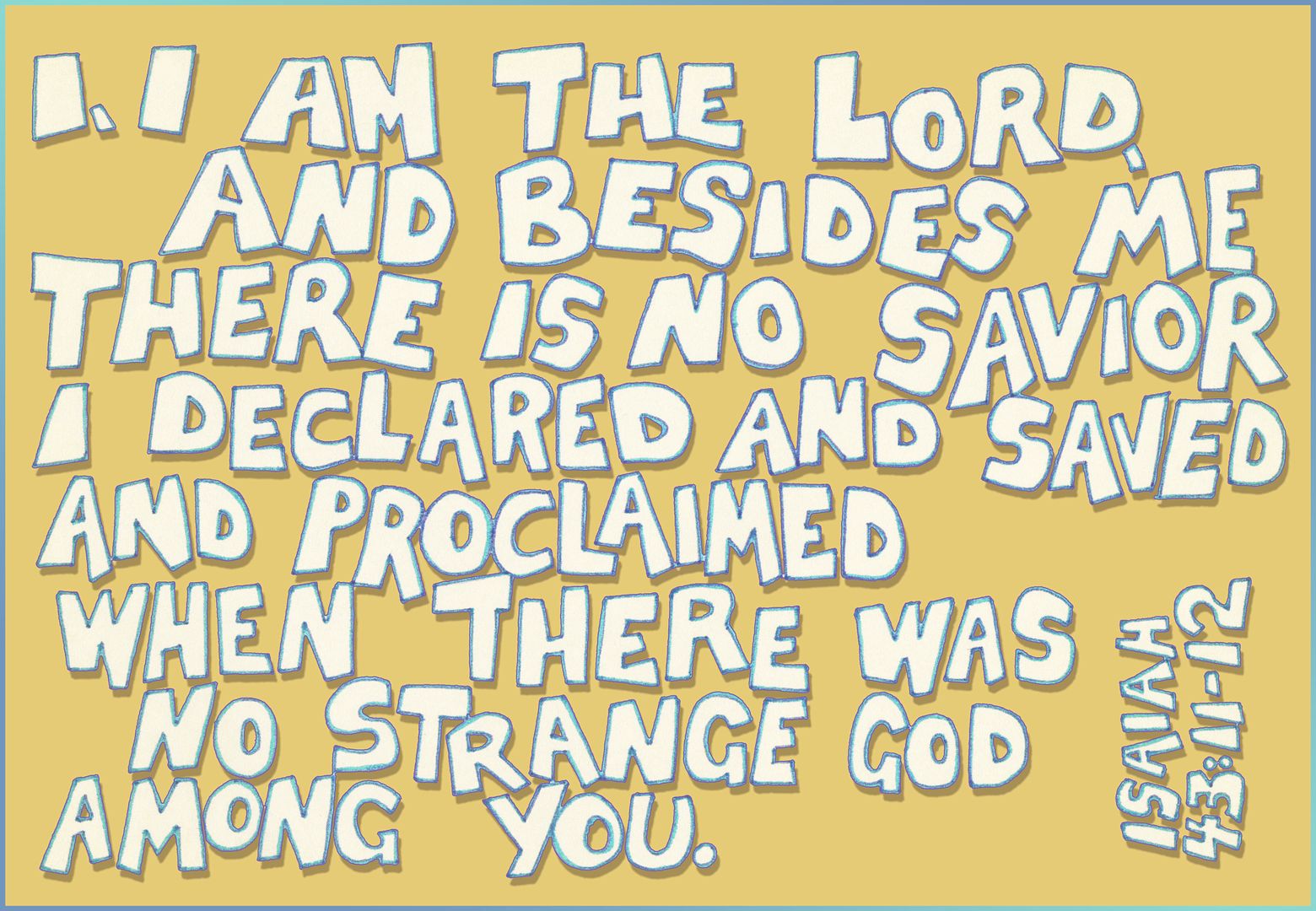
11 I, even I, am the LORD,
And besides Me there is no savior.
12 I have declared and saved,
I have proclaimed,
And there was no alien god among you;
Therefore you are My witnesses,"
Says the LORD, "that I am God.

Isaiah 43:1-2
15 I am the LORD, your Holy One,
The Creator of Israel, your King."
16 Thus says the LORD, who makes a way in the sea
And a path through the mighty waters,
18 "Do not remember the former things,
Nor consider the things of old.
19 Behold, I will do a new thing,
Now it shall spring forth;
Shall you not know it?
I will even make a road in the wilderness
And rivers in the desert.
20 The beast of the field will honor Me,
The jackals and the ostriches,
Because I give waters in the wilderness
And rivers in the desert,
To give drink to My people, My chosen.
21 This people I have formed for Myself;
They shall declare My praise."

Isaiah 44

23 Sing, O heavens, for the LORD has done it!
Shout, you lower parts of the earth;
Break forth into singing, you mountains,
O forest, and every tree in it!
For the LORD has redeemed Jacob,
And glorified Himself in Israel.

Isaiah 51

Isaiah 51:3

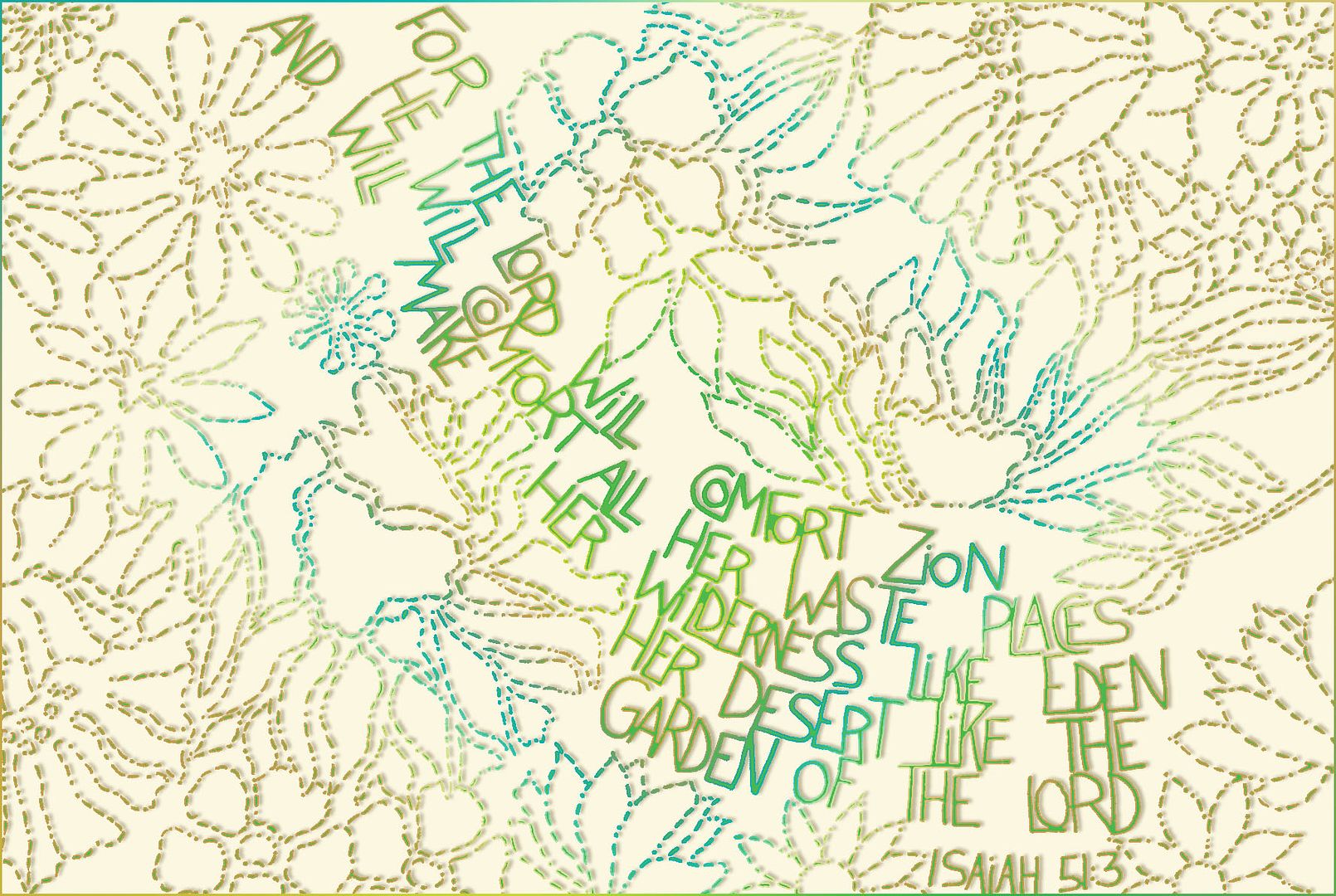
3 For the LORD will comfort Zion,
He will comfort all her waste places;
He will make her wilderness like Eden,
And her desert like the garden of the LORD;
Joy and gladness will be found in it,
Thanksgiving and the voice of melody.
4 "Listen to Me, My people;
And give ear to Me, O My nation:
For law will proceed from Me,
And I will make My justice rest
As a light of the peoples."
Walter Brueggemann essentially comments,

Of course the trees sing and clap their hands—no more clear-cutting! Of course the seas roar and everything in them rejoices—no more toxic waste and pollution!

Milk and Honey, Reign of Heaven: right here In the Land
Although I like mystery (how can you be a theologian and not be drawn to mystery?), I absolutely love paradox! On that theme, I need to ask how you can be a Christian without the mysterious paradox of God's clearest self-revelation in the vulnerability of a human, amazing and overwhelming and drawing you into itself? Look in the manger and look at the cross, insists Martin Luther! Milk and honey is a sign of the fullness of the sovereignty of God; in Jesus of Nazareth we meet face-to-face the embodiment of the realization of the time of salvation, the epoch of the Reign of Heaven. But this paragraph began with milk and honey! Flowing honey and surging milk begin with fertile land and rivers of usable water. Ample milk means abundant cattle grazing on luxuriant grass, producing healthy calves and fertilizing grains and vegetable gardens. Of course it includes bees pollinating fruits and flowers, vineyards and other food crops. Hearty vineyards, healthy fields and sufficient water. Dairy and beef, honey and harvest lead to nourishment for the farmers, their families and the community, with overflowing everything to sell at market or barter and trade in order to acquire whatever you cannot produce on your own. Likely I've left out a slew of probable connections, but my intent is clear: heaven's blessings aplenty on earth!

However, Israel became Israel, receiving the identifying name, not in the Promised Land flowing with milk and honey but in the desert of the trek toward that promised-landed freedom. In the desert's sparse economy, with surprising gifts like water from the rock and manna from the sky, Israel and Yahweh encountered each other into the kind of relationship that later would enable God's people to recognize God's paradoxical self-revelation in the preached Word and proffered sacraments...

Now and here, like Christ Jesus, face-to-face with the world, the church is the incarnation of the fullness of the time of salvation, the era of the Reign of Life; as persons of the ekklesia, of the church, our sacramental liturgies and lifestyles replay God's paradoxical self-revelation in the exodus desert, recognizing and celebrating God's sustaining presence in, with and under creation's commonest stuff, the utmost essentials for life produced from the heart of the earth.

We can never know about the days to come
But we think about them anyway


But, with God in charge of those days to come, we can have some ideas about a little of what will happen! First of all, (once again!) I need to include one of my favorite passages from Martin Buber's The Prophetic Faith:

In The Prophetic Faith, Jewish theologian Martin Buber writes,
"[for Jeremiah] Not the priest but the prophet he regards as the mediator between heaven and earth, messenger of God and intercessor in one. The contact between godhead and manhood in his view is not bound up with the rite but with the word...the word comes again and again from heaven as something new, and makes its abode within man...and the man who has to make it heard is over and over again subdued by the word before He lets it be put in his mouth. This is not the expression of a familiar deity, with whom man comes into regular contact in fixed places and at fixed times. He, Who speaks, is incomprehensible, irregular, surprising, overwhelming, sovereign. Therefore it is the virtue of this word, and of this alone, to lead, that is to say, to show the way.[my emphasis] ...In order to speak to man, God must become a person; but in order to speak to him, He must make him too a person." (pages 164-165)

Stewardship, Jesus and Us, the churches and the Church
Early on in the Genesis narrative God charges humanity with stewardship of everything created; that's a Yahwist text, meaning it's early! Moving forward quite a few centuries, the Heidelberg Catechism includes (approximate paraphrase), "Why is the Son of God called Jesus, meaning Savior?" "Why is he called Christ, meaning anointed?" Then the probing, "But why are you called a Christian?" "Because by faith I share in Christ's anointing, and I am anointed to reign with Christ over all creation for all eternity." Many of us (most of us?) exercise our baptismal calls to prophecy and to priesthood infrequently, but our everyday lives are replete with insistent opportunities to claim the co-sovereignty over creation we share with the crucified and risen One, or more accurately, the stewarding reign Christ graciously shares with us.

Anticipation is another pungent biblical theme!
There's a famous quote credited to Martin Luther (I've read a fair amount of Luther, but can't cite any source, so I'm saying credited to him): "Sin boldly, but trust even more boldly in the Risen Christ!" That's a glorious reality for every person, every community, and all creation to anticipate!

That's almost all for this evening...but one more Heidelberg Catechism paraphrase: we move from Christmas, with the mystery of Spirit in flesh, to Ascension, with the mystery of flesh in Spirit!

May joyful anticipation of the crucified Jesus of Nazareth, now become the Risen and Ascended One, always sustain you!

Saturday, January 15, 2005

wilderness handbook: the desert again

wilderness handbook: the desert again
desert living...
...living in the desert.
wilderness: freedom living!
the whole world changes: you shall be called Israel!
...and live as God's chosen people...

This evening I've considered these ideas just a little more and finally I'm getting them out of saved stuff and up on to my blog.


Repeatedly I've written and spoken about the desert's precariousness, life-giving and transformative austerity, as in this pair of citations:
In the desert Israel first rendezvoused with Yahweh; in the desert – driven out by the Spirit – Jesus first met the Spirit; possibly our first meeting with the real presence of the HS happens in the desert, too...not the presence we imagine we need but the Presence God knows we need.

"In the desert Israel ...and the desert frequently becomes the place of our meeting God and of self-encounter, as well." In that post I added, "For us as Christians, baptism is our primal liminal experience. As we enter the waters, should we be prepared to drown? Yes! And we should be equally prepared to be surprisingly raised from that death by drowning!"
Exactly as for God's original people Israel, for us, the contemporary People of God, the desert provides the dynamic reciprocity of intimate relationship, and doesn't relationship test us and ultimately transform us into being truly the person for others in addition to our becoming most authentically ourselves and respecting of our self? Living in the desert means living in risking trust rather than assumption and comfort; it means learning about, interacting with, about relating to an "other"; reconciling and reuniting; shedding the past while [hopefully] learning from it. In the wilderness we learn about moving into the future with hope and about thriving in spite of scarcity; fearlessly learning not to hoard during times of prosperity and relative abundance. Ditching self-reliance, depending on the human *other* and – finally – depending completely upon the Divine *Other*.

wilderness: freedom living!

Trekking through the wilds means living in liberty at that very moment just as much as our desert exoduses are passages to the land of promise. True in our wilderness as individuals and particularly for our community we seek a metaphorical Jordan, but on the way, what do we find? We find and meet insistent others with needs and gifts parallel to ours; we discover natural resources above, beneath, before and around us, assets that will help everyone meet the requirements of daily existence. Freedom living? Either in solitude or in community, when we’re in the desert we do not have a whole lot of choice about our responses; we have little choice if we seek substantial quality of life, so in the desert wilderness our easiest and most free course of action becomes obedience to God’s demands to love one another and bear each others’ burdens, eventually and ultimately holding not only a single Feast in the Wilderness but countless Feasts in the Wilderness!

Isaiah 35

Isaiah 35:1-2

1 Wilderness and desert will sing joyously,
the badlands will celebrate and flower—
Like the crocus in spring, 2 bursting into blossom,
a symphony of song and color.
Mountain glories of Lebanon—a gift.
Awesome Carmel, stunning Sharon--gifts.
GOD's resplendent glory, fully on display.
GOD awesome, GOD majestic...
6a Springs of water will burst out in the wilderness,
streams flow in the desert...
7 Hot sands will become a cool oasis,
thirsty ground a splashing fountain.
Even lowly jackals will have water to drink,
and barren grasslands flourish richly.
—MSG
Rivers in the desert!

Once upon a time, as in ages ago, I put together a photo-collage of desert images and phrases; one of my favorites was "Don’t go bare into the wilderness," followed with, "You have the words of eternal life" and "Claim it today!" The Words of eternal life is exactly what Jesus took into the desert with him right after his baptism in the real River Jordan; Moses'people left Egypt led and accompanied by a Word-speaker who in real life interacted with the Word-giver and even mediated the celebrated Sinai Covenant. In theology, water is a recurrent metaphor for the Holy Spirit; each individual and each community has a quadrivium of needs that includes water, food, shelter and places of nurture. Scripture calls us to choose between life and death, blessing and curse and as I've stated here before, I believe the Reconciling Christ Event is so drastic, so inclusive and so all-encompassing of everything and everyone created, all creation is born, lives, dies and rises in Christ. However, God sets before us the ways of life and death, and to a limited extent, the choice of salvation, wholeness and reconciliation becomes ours.

Streams in the wilderness

Streams tend to be smaller and generally less extensive than rivers? But primarily because they're littler, streams have other attributes, such as compelling us to careful stewardship of the essential gift of water, such as making us thankful; such as leading us to bless the Giver of the Gift—including the gift of the wilderness desert that makes us so aware of its concealed beauty and unseen life.

Desert rivers

As we more and more live in trust, those "rivers in the desert" slowly and imperceptibly become desert rivers! In other words, the rivers take on characteristics of the desert. Paradox? Yes, of course!!!

Wilderness streams

In the same way rivers in the desert become desert rivers, "streams in the wilderness" become wilderness streams. How and why?

the whole world changes...

The whole world changes? Not just my, your, our smallish and more-or-less self-contained worlds? A lot of life is synergistic in a lot of ways. The "World" goes far beyond and transcends our little, proprietary universes and begins touching, reaching and transforming people, places and ideas far, far beyond our immediate heres and nows and this world of ours becomes huge! Astounding? Both yes and no! As we approaching our Jordan, we're on the cul-de-sac of life, a place with no outlet except to continue – you cannot go back (if you keep looking back you won'’t know where you’re going). Because – really! – God does not see our past...

you shall be called Israel!

Jacob refused to leave without a blessing: God loves, God blesses people who persevere, who are tenacious! After Jacob wrestled with the spirits of the [Genesis 32] human and the Spirit of the Divine, God conferred on Jacob his new name; Jacob left Gilgal and went to [genesis 28] Bethel, "House of God," because he needed to go there to get established in God’s house. After [Joshua 5] Gilgal and then at Bethel, no longer was it "God of Abraham, Isaac and Jacob,"” but rather the Jacob of God, the one newly-named Israel! Named and called by your name by the Word of Life!
22 And [Jacob] arose that night and took his two wives, his two female servants, and his eleven sons, and crossed over the ford of Jabbok. 23 He took them, sent them over the brook, and sent over what he had. 24 Then Jacob was left alone; and a Man wrestled with him until the breaking of day. 25 Now when He saw that He did not prevail against him, He touched the socket of his hip; and the socket of Jacob's hip was out of joint as He wrestled with him. 26 And He said, "Let Me go, for the day breaks."

But he said, "I will not let You go unless You bless me!"
27 So He said to him, "What is your name?"
He said, "Jacob."
28 And He said, "Your name shall no longer be called Jacob, but Israel; for you have struggled with God and with men, and have prevailed."
29 Then Jacob asked, saying, "Tell me Your name, I pray."
And He said, "Why is it that you ask about My name?" And He blessed him there.
30 So Jacob called the name of the place Peniel: "For I have seen God face to face, and my life is preserved." 31 Just as he crossed over Penuel the sun rose on him, and he limped on his hip. NKJV
Long later, the New Covenant scriptures give us this amazing text:

"To the one who overcomes I will give some of the hidden manna to eat. And I will give him a white stone, and on the stone a new name written which no one knows except the one who receives it."...and I will give her the Morning Star!... Revelation 2:17

...and live as God’s chosen people...

Well, yes, of course! The whole idea and purpose of learning to live through hot, dry days and chilly, dry nights is to learning how to live as People of the Covenant, learning how to live as people elected by grace and enabled in the power of the Holy Spirit…did I say something about water symbolizing the Spirit? Throughout the witness of scripture and in the course of our daily walk, water, wind and fire equally symbolize the gift of Divine Life!

Exodus 13

From Exodus 13:
3 And Moses said to the people: "Remember this day in which you went out of Egypt, out of the house of bondage; for by strength of hand the LORD brought you out of this place. No leavened bread shall be eaten. 4 On this day you are going out … 5 And it shall be, when the LORD brings you into the land...a land flowing with milk and honey, that you shall keep this service in this month. 6 Seven days you shall eat unleavened bread, and on the seventh day there shall be a feast to the LORD. 8 And you shall tell your son in that day, saying, "This is done because of what the LORD did for me when I came up from Egypt.

14 So it shall be, when your son asks you in time to come, saying, "What is this?' that you shall say to him, "By strength of hand the LORD brought us out of Egypt, out of the house of bondage.
[scripture text heading: The Wilderness Way]

17 Then it came to pass, when Pharaoh had let the people go, that God did not lead them by way of the land of the Philistines, although that was near; for God said, "Lest perhaps the people change their minds when they see war, and return to Egypt." 18 So God led the people around by way of the wilderness of the Red Sea. And the children of Israel went up in orderly ranks out of the land of Egypt.

21 And the LORD went before them by day in a pillar of cloud to lead the way, and by night in a pillar of fire to give them light, so as to go by day and night. 22 He did not take away the pillar of cloud by day or the pillar of fire by night from before the people.