Showing posts with label Nehemiah. Show all posts

Friday, October 07, 2022

Five Minute Friday :: Become

five minute friday become header
Five Minute Friday :: Become Linkup

This week's become prompt reminded me of God rebuilding the ruins of Jerusalem with help from the leadership of Ezra and Nehemiah. You may know about the Babylonian siege of the city, destruction of the temple, deportation of many prominent people to Babylon, and eventual return of some exiles to Judah.

God's people Judah had to rebuild structures and infrastructure; they had to restore almost everything connected to economic, political, and civic life. They needed to reinstate public worship. In recent years several books related to Ezra and Nehemiah in the Old Testament have been published.

Restore, reinstate, rebuild? Doesn't that sound like right now, two and one half years into a global pandemic? Even people Covid has minimally disoriented still need to explore and trust what and how God will have them become in themselves and become for others.

I especially appreciate Barry Pearman's Broken to Build (I read it a couple years before Covid snuck into the world and then engulfed it) because of practical ways it parallels Nehemiah's narrative with our need to move forward after loss and disappointment—and because it's short enough to easily start and finish. Here's my blog review.

Mental Health Pastor Barry explains, "…we are in recovery mode. We are building and growing a life out of the rubble of what was left behind. In the choking dust of rubble we find that this is no fairy tale. The biblical Book of Nehemiah is a love story. God is in love with the people of Jerusalem and sees them broken, shamed and without dignity." … "The big idea is that recovery/life takes place in a relational context."

"Become" is a helpful and holy consideration at any time, but as we gradually ease out of Covidtide into new activities, new or renewed employment, restored or new relationships, absolutely everyone will become other than who they had been to a far more radical extent than typically would happen so soon.

Similar to God's people who returned home to the Land of Promise in literal ruins, we feel as if we need to recover a life of participation from rubble and fragments; often we can't clearly remember what a full life was like.

We are who we've become so far, both up to the dawn of Covid and in our struggles through the worst of the pandemic; God has dreams for our future becoming. And remember Barry's reminder, The big idea is that recovery/life takes place in a relational context. Although we've discovered real relating can happen on zoom, let's celebrate and enjoy meeting face to face. Because now we can!
# # #

PS A super shoutout to Kate for the irresistible succulent in process of becoming where it's been planted. Last I knew, she finds most pictures for FMF on unsplash.
five minute friday become
five minute friday icon

Wednesday, June 27, 2018

Barry Pearman :: Broken to Built

Broken to Built: 31 Days of Rebuilding with Nehemiah by Barry Pearman on Amazon

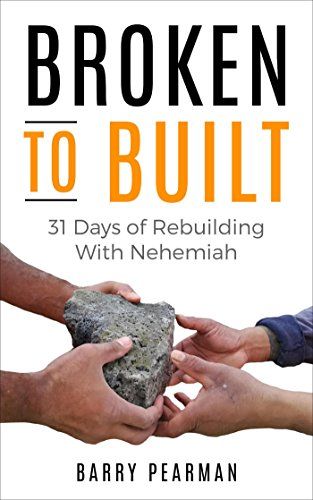
broken to built book coverFor several years I've followed Pastor Barry Pearman's Turning the Page website and his twitter. I also belong to his related Facebook page and highly recommend all of them to you.

With a short chapter a day for a month of 31 days, mental health advocate and practitioner Barry Pearman anchors his reflective insights in the post-exilic Hebrew Bible book of Nehemiah. Although the book guides individuals as they move from being Broken to becoming (re)Built, Pearman reminds us of the necessity of having community alongside us and the necessity of constant connections with God, the only truly reliable One. The visually striking cover of the book photographically illustrates the idea of interaction and cooperation; in fact, the author crowd-sourced on his Facebook page to determine which one of four cover choices most appealed to people.

This book is for everyone! in his intro the author explains, "...we are in recovery mode. We are building and growing a life out of the rubble of what was left behind. In the choking dust of rubble we find that this is no fairy tale. The biblical Book of Nehemiah is a love story. God is in love with the people of Jerusalem and sees them broken, shamed and without dignity." And, "The big idea is that recovery/life takes place in a relational context."

Each chapter opens with a very short real-life vignette from people the author knows in real life; each chapter ends with a (1)Quote to consider, (2)Question to answer, and (3)A rock to build with. I'd suggest at first quickly glancing through the entire book to get a basic overview, then using each chapter as part of your daily devotions, and during the day remembering the end of chapter Quotes, Questions, and Rocks.

Hopefully everyone's life isn't completely in shambles and shards all the time, yet there's always some element that needs to be healed and helped back to wholeness. Maybe you've heard someone mention they started therapy or counseling because parts of their lives were going extremely well, while another aspect or two was in disastrous condition? Maybe that's been your experience? Despite being grounded in scripture Jews and Christians can relate to and affirm as having authority for their lives, this book is for everyone!

By the historical time period of Nehemiah's narrative, God's people had left their existence under Egyptian imperialism centuries earlier, returned to their home-land Jerusalem after exile under the Babylonian empire (though many deported to Babylon stayed there), and now they needed to deal with another empire. The post-[Babylonian] exilic book of Nehemiah describes life under that other empire—Persia. Scripture shows us how cleverly and effectively Jews – including Nehemiah – found ways to live well, grow healthy, and thrive in spite of far from ideal surroundings. Nehemiah even was employed by the Persian king! Often we simply cannot escape negative influences; for many reasons, we frequently need to stay in our current living situation or employment context, but must figure out work-arounds, as Nehemiah did.

I especially appreciate how Barry emphasizes the critical need of having supportive people alongside us at the same time he keeps emphasizing connecting with God in prayer. Those other humans help a lot, but (aside from Jesus of Nazareth) there's not yet been a perfect, totally reliable person, so God must remain our ultimate recourse and rock.

Notice of material connection: I received a copy of this book from the author with no obligation to write a positive review. As always, my opinions are my own.

My Amazon review: Connecting with Scripture and Community

Friday, May 05, 2017

Green Team Talk: Ezekiel

Here's an approximation of my talk this morning to open our Judicatory Green Faith Team meeting; I paraphrased the Ezekiel text rather than reading it, though I've included actuals here.

Since we'd scheduled a meeting Friday after Lent 5 and I often default to lectionary because I appreciate both the discipline and the ease, I'd planned to reflect on the first reading for Lent 5A, Ezekiel 37:1-14. When we rescheduled for Friday after Easter 3, I decided to keep the Ezekiel passage. The RCL appoints it for Lent 5 of this lectionary year A and for the Day of Pentecost in year B. As one of our primary resurrection pericopes and also majorly about the gift of the Holy Spirit, it's the eighth reading for the Easter Vigil in all three years A, B, and C.

God called Ezekiel to the office of prophet when Ezekiel was in exile in Babylon; you know how it goes!
Ezekiel 37:1-14

1The hand of the Lord came upon me, and he brought me out by the spirit of the Lord and set me down in the middle of a valley; it was full of bones. 2He led me all around them; there were very many lying in the valley, and they were very dry. 3He said to me, "Mortal, can these bones live?" I answered, "O Lord God, you know."

4Then he said to me, "Prophesy to these bones, and say to them: O dry bones, hear the word of the Lord. 5Thus says the Lord God to these bones: I will cause breath to enter you, and you shall live. 6I will lay sinews on you, and will cause flesh to come upon you, and cover you with skin, and put breath in you, and you shall live; and you shall know that I am the Lord." 7So I prophesied as I had been commanded; and as I prophesied, suddenly there was a noise, a rattling, and the bones came together, bone to its bone. 8I looked, and there were sinews on them, and flesh had come upon them, and skin had covered them; but there was no breath in them.

9Then he said to me, "Prophesy to the breath, prophesy, mortal, and say to the breath: Thus says the Lord God: Come from the four winds, O breath, and breathe upon these slain, that they may live." 10I prophesied as he commanded me, and the breath came into them, and they lived, and stood on their feet, a vast multitude.

11Then he said to me, "Mortal, these bones are the whole house of Israel. They say, "Our bones are dried up, and our hope is lost; we are cut off completely.' 12Therefore prophesy, and say to them, Thus says the Lord God: I am going to open your graves, and bring you up from your graves, O my people; and I will bring you back to the land of Israel. 13And you shall know that I am the Lord, when I open your graves, and bring you up from your graves, O my people. 14I will put my spirit within you, and you shall live, and I will place you on your own soil; then you shall know that I, the Lord, have spoken and will act, says the Lord."
The New Heart / New Spirit

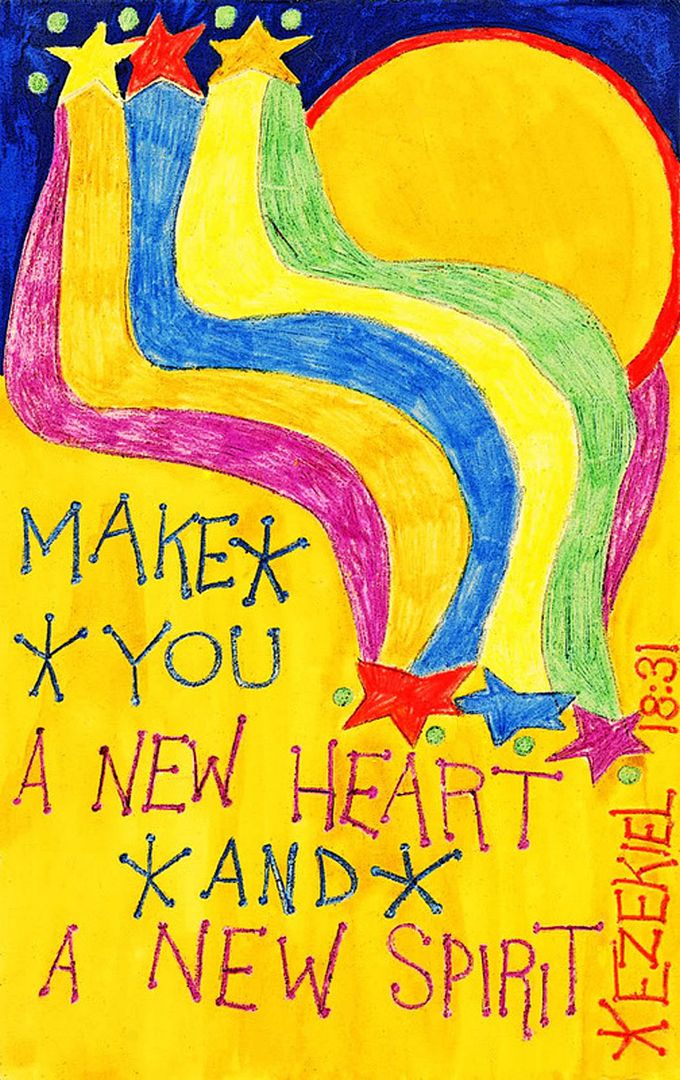
Ezekiel 18:31The book of Ezekiel is long, influential, and dense; it probably didn't get written-down and readable until after the exile ended, likely around the time of rediscovery of the books of Moses that we read about in Ezra and Nehemiah when Israel / the Jews became a people of the book, so in what order Ezekiel and cohorts originally recorded everything is up for grabs. Earlier than chapter 37 I just cited we find three new heart – new spirit passages. God tells the people to get renewed hearts and resolve; God also promises to provide that newness. And why? Primarily for covenantal obedience. Not in order to get the gift, but in response to the gift, to put God first, to keep covenant with and care for all creation.

I will give them one heart, and put a new spirit within them; I will remove the heart of stone from their flesh and give them a heart of flesh, so that they may follow my statutes and keep my ordinances and obey them. Then they shall be my people, and I will be their God.
–Ezekiel 11:19-20

Cast away from you all your transgressions, whereby ye have transgressed; and make you a new heart and a new spirit: for why will ye die, O house of Israel?
–Ezekiel 18:31

A new heart I will give you, and a new spirit I will put within you; and I will remove from your body the heart of stone and give you a heart of flesh. I will put my spirit within you, and make you follow my statutes and be careful to observe my ordinances. Then you shall live in the land that I gave to your ancestors; and you shall be my people, and I will be your God.
–Ezekiel 36:26-28
The Valleys

We know agricultural valleys as fertile places of great richness. We also know how everything trickles down the mountain into the valley: the beneficial and helpful, the not so good, sometimes the toxic. When an ecosystem is in proper balance, bugs, aquatic life, and other factors help keep it healthy. God showed Ezekiel a vision of literal dead bodies. At least as much as the reality of those physical deaths, Judah felt the death of being cut off from their God in the strange land of Babylon. They also had a sense of death because they no longer were in the Promised Land where valleys had yielded bounty as streams and rivers flowed down the hills. Judah knew Yahweh as a fertility god, but they didn't yet realize Yahweh was not a place god, a deity confined to and connected only with a particular location.

The New Creation

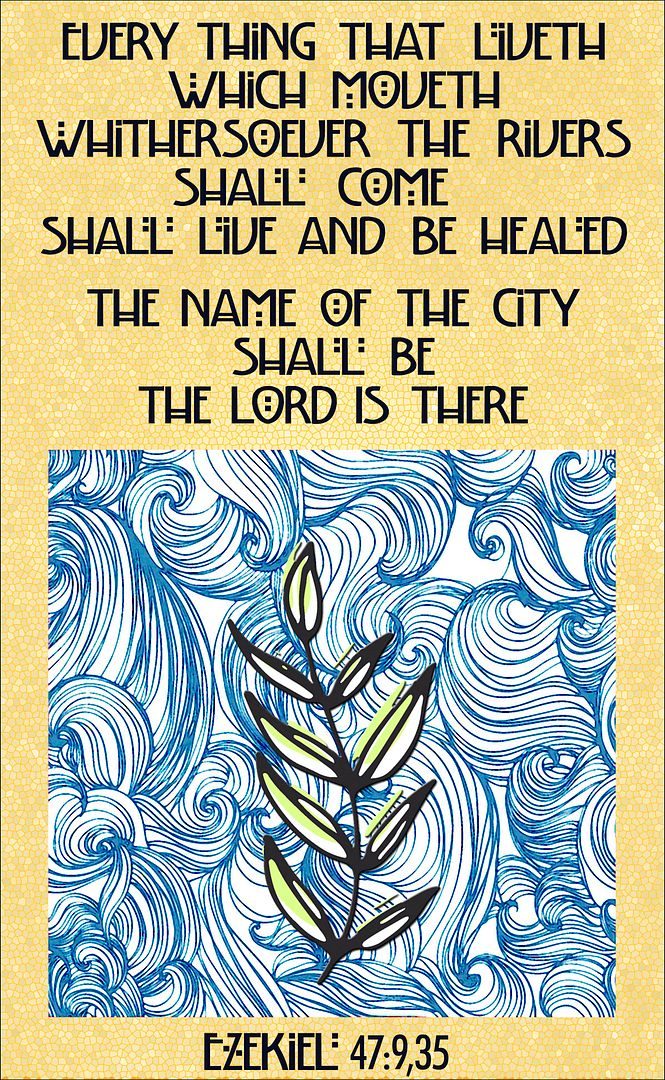
Ezekiel 47:35Near the end of his writings, Ezekiel shows us the Land of Promise reapportioned amongst the tribes of Israel. Ezekiel was a priest in the holiness tradition of the Jerusalem Temple, the tradition of "You shall be holy, for I, your God am holy!" We sometimes use water as metaphor for the Holy Spirit. Ezekiel brings us a vision of the river of life flowing from the throne of God, into the valley and the desert, out to the sea. He tells us everything whithersoever the river flows shall live, shall be healed. His vision includes trees for food and for healing on the riverbanks. Everything in the path of this river lives because people with the new hearts and new spirits have cared well for the river as part of their keeping covenant with creation. Ezekiel concludes by telling us the name of this city is "The Lord Is There!"

God commanded Ezekiel, "the human one" to speak a word of life to the dead bones; to evoke the presence of the Holy Spirit, to summon the Spirit of life! How about us? Does the human gathering of the church speak a word of life? How does the church speak a word of life? When people look at creation, will they see it so healthy and green they'll be able to say The Lord Is There?!

The Prayer

Holy God, thank you for these days of May Gray and the June Gloom we anticipate, too, as they help nourish creation. You amazingly claim and call us by water, spirit, and word. May we hear, heed, and obey your charge to speak words of life that help revive the dead in our midst! Thank you for calling us together as your Green Faith Team; please help us complete the agenda for this meeting and offer useful resources at Synod Assembly. In the name of the One Crucified and Risen for the life of the world, for the resurrection of all creation. Amen!

Thursday, April 07, 2011

sprout 7, yeast: communion bread 1

april blogging sprout

I found two recipes for Communion Bread on a friend of a friend's blog, Lindy's blog. Both recipes are from Wartburg Seminary and Lindy gave me permission to re-blog them. Here's the first; the second will be later in this April "sprout" blog series.


Communion Bread 1
  • 2 1/2 cups very warm water (although too hot will kill the yeast). For best results you will probably want to have a thermometer and a specific temperature. That information can usually be found on the yeast package or the website bread world.
  • 1 Tbsp dry yeast (not rapid rise)
  • 1/4 cup soft shortening
  • 1 1/3 Tbsp salt
  • 1/2 cup honey, brown sugar or light molasses
  • 6 cups whole wheat flour (or 2 cups whole wheat flour & 4 cups white flour)
In mixing bowl, proof yeast in water with a pinch of sugar. When ready (should look foamy... takes about 10-15 min.), add the shortening, salt, honey and 3 cups flour. Beat 2 min. at medium speed using dough hook (or 300 vigorous strokes by hand). Scrape bowl frequently. Add remaining 3 cups flour and blend on low speed. Scrape batter from sides of bowl. Cover bowl with a dish towel or cloth, and let rise in a warm place until double- about 1 hour.

Stir down batter by beating about 25 strokes or punch down by hand. Batter will be sticky. Turn out onto a floured surface and knead for 2-3 minutes or until the dough is smooth. Can add a little flour while kneading, if desired. Split dough into 4 parts (for about 100 people/loaf) or up to 6 parts for smaller loaves. Let rise a second time in a warm place for about 10 min. Roll out each loaf with a rolling pin into a 4" round shape. Mark each loaf with a deep cross (+) in the center. Place loaves on flat cookie sheet, lightly greased. Let rise again in a warm place for about 40 minutes.

Bake in preheated oven at 375 degrees for 15-20 minutes. Cool slowly, away from a draft.

Use within a day or freeze immediately, wrapped tightly in plastic wrap. Lindy says, "I have had great success freezing this bread when it is partially cooled, then removing from the freezer a day in advance (i.e. Saturday morning for Sunday morning)."

"Go and celebrate with a feast of rich foods and sweet drinks, and share gifts of food with people who have nothing prepared. This is a sacred day before our Lord. Do not be grieved, for the joy of the Lord is your strength!"
Nehemiah 8:10

Saturday, January 30, 2010

biblical perspectives on evangelism

by Walter Brueggemann, Biblical Perspectives on Evangelism: Living in a Three-Storied Universe on Amazon.
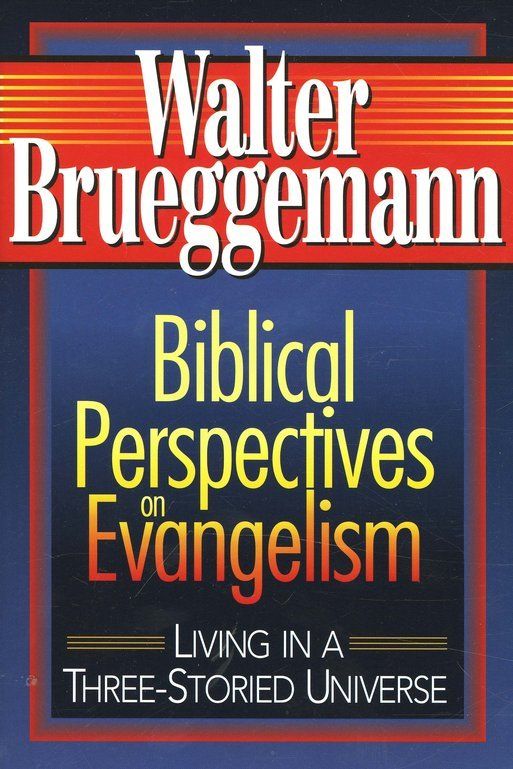
biblical perspectives coverAfter my recent 4th reading of this tightly focused book, I knew it was time for a blog. Did you know the colonial Americans - some of the antecedents of today's United Church of Christ insisted God acts in history only by covenanting? In scripture we can trace a series of significant covenants from Adam through Jesus, but was not the Divine passion for relationship that engendered creation in itself a covenantal act? Throughout the author emphasizes obedience along with explaining why we need to remember... after all, when we forget the possibility of a free future is all over. (Therefore, I'm making a conscious attempt to remember more clearly, even to revisit the past I've often almost choked on in order to start claiming a freer future for myself and those around me, too.)

Rooted firmly in the Hebrew Bible, in God's loving grace and the possibility of human response, reminding us about ways to be and ways to live as the people of God (=as the Church), just as in many of his other books, Walter Brueggemann emphasizes the importance of the commandments. On page 31 he describes the ten commandments as "the working documents for covenanted community..." on page 68 "covenant is ... a relation which frees each in vulnerability to receive life from the other, to be postured in mutual dependence." The commandments are "...boundaries and limits which define the horizon of covenantal humanity." On page 115: just as earthly parents teach their offspring that which concerns them most, our heavenly parents do exactly the same. "I do suggest, however, that the ten commands turn out to be God's most 'cared for matters.'" And he includes references to his other two non-negotiables: the tithe and the sabbath.

The world is about a multi-faceted "3-stories" of architectural floors or tiers and narrative tales about the lives of people: long-time insiders to the gospel, typical outsiders, and the next generation coming up. In addition, there are three central narrative stories in the salvation story (Heilsgeschichte) that in turn opens us to 3 scenes to the evangelism drama:
  1. God's victory over chaos and death
  2. the announcement of that victory—"gospel"
  3. its appropriation by those who hear the announcement
3 stories are focal and normative and definitive:
  1. the promise made to the [Israel's] ancestors
  2. deliverance from slavery
  3. the gift of the land
WB offers a pair of concrete definitions of evangelism, an activity impacting every aspect of life—personal, public, economic, political... first on page 10 "Evangelism ... is the invitation to re-imagine our lives in these narrative modes." And last, in the conclusion on page 129 "Evangelism ... is an activity of transformed consciousness that results in an altered perception of world, neighbor and self, and an authorization to live differently in that world."

WB brings us a trilogy to illustrate the 3 stories:

1. Joshua 24 "a meeting at Shechem whereby outsiders become insiders"

2. in Nehemiah 8 forgetful at least one-time insider members are "re-tented into the passionate vision of risk and vulnerability that is decisive for the community."

3. ongoing conversation with the offspring of believers/insiders = "children becoming adults." In this [hopefully] dialogue, [page 55]"It is always 'them' and it is always 'us,' always then and now, always there and here, concerning all of this community of telling and listening through time."

That continuing, continuous conversation is because "...in Jesus Christ, God has overcome the power, threat, and attraction of the power of death" and [pages 37-38]"...the continued re-enaction of this dangerous [page 38] news ... is the definitional account of [the church's] life in the world." But what news, news for what? [page 43] "...news for alternative obedience in the world" as we [page 46] "...recover the focal drama of baptism, which is a subversive act of renunciation and embrace" and are summoned [page 47] "From our several enslavements ... to a common, liberated obedience."

Regarding our ongoing need to live faithfully in the twenty-first century, yet possibly concerned that the texts we rely on were transmitted and recorded thousands of years ago, WB reminds us "...all through the Bible the gospel has been exactly and precisely concerned with social relations related to power, goods, and access. Indeed, there is almost no aspect of the biblical presentation of the gospel that is otherwise." [pages 40-41] "The victory of God in our time over this deathly idolatry is hidden from us. ... It is hidden in the cross where it is always hidden, and in all subsequent manifestations of the power of the cross." In his marvelous book The Land, WB explains how the Church has concentrated on covenant to the near-exclusion of the centrality of land in the biblical witness and, without a doubt, in current twenty-first century politics and economics.

Some reasons for us to remember, remember, remember...include
page 78 "If Israel, birthed in liberation [Exodus] and situated in covenant [Sinai], forgets these memories, it will very soon start playing the old power games of Egypt, and start practicing brick quotas again in order to get ahead by the standards of the empire."

page 78 "Everything depends on a live memory. Everything is jeopardized by careless forgetting. Everything ride on remembering and forgetting."

page 79 Jeremiah 2:1-13 Israel did not say, did not proclaim, announce or confess their history with the God who liberated them because they had forgotten the story, the history...

page 82 parallels Deuteronomy 8 || Jeremiah 2

page 82 "And when they forget, they forget the past, they forget Yahweh, they forget themselves, their history, their identity, their faith, their vocation, their raison d'etre."

page 83 "... the Bible is constant in asserting that this terrible ending ... is rooted in the loss of [torah] memory."

page 84 "Remembering is the hard choosing of an alternative present, authorized by a subversive past. When that subversive past is given up, an alternative present is rendered completely unavailable."

page 72: by the time of Nehemiah 8, Israel is a "people of the book." But in the re-texting of Israel in the Festival of Booths "Israel must bodily re-experience and re-enact the memory, recovering its vulnerability in bodily exposure."

parallel to his words on page 75, "This old [torah] text of Israel's memory never exists as authoritative for the community without imaginative interpretation." "people of the interpreted book", on page 97 WB tells us conversation with youth "in a context of unconditional advocacy ... that mediates free grace." [page 98] "The conversation with our young must be persistently interpretive."
Closely related to the near-plethora of existential and situation insecurities in which almost everyone currently finds themselves, I love WB explaining [page 87] how in Nehemiah 8:13-18 "olive, wild olive, myrtle, palm and other leafy trees" make the temporary shelters for Succoth, the Festival of Booths or Tabernacles, granting participants both "exposed homelessness" and "true homefulness". Interesting too, was the experience of the newly-borning people of God with a God who traveled alongside them in a tabernacle, a portable shelter and gospel-writer John (1:14) tells us how incarnate in Jesus of Nazareth, God pitches a tent, a tabernacle.

Amidst all this talk about following and keeping the commandments in gracious response to the God Who in Jesus Christ calls us, saves us and sanctifies us by grace, [page 114] Martin Luther begins his Small Catechism, traditional preparation for First Communion with the Ten Commandments, "...for the one with whom the church communes is Lord of the commands. Finally it comes down to that, but it does not come down to that quickly or simply."

The church charges parents and sponsors of a child or children to be baptized to teach them the Lord's Prayer, the Creed and the Commandments; to bring them to the Services of God's House and Place the Scriptures in their hands. Why? These are some of the ways they can learn, hear and live the story and the stories, make them their stories and remember the stories of the covenanted people of God as they learn the place of their own individual story in the journey of the community. At the services of God's House they celebrate and participate in the Eucharist, God's feast of justice, reconciliation, forgiveness and inclusion for all creation. This is God's manner of making new beginnings that's also a living sign of God's promised end, the eschatological feast of justice and equality, the table of "go and do likewise." They learn to be prepared to forgive and to be forgiven... learning to live every moment "wet behind the ears" again with baptismal water, committed again to Good Friday and to Easter, constantly recovering "...the focal drama of baptism, which is a subversive act of renunciation and embrace" summoning us [page 47] "From our several enslavements ... to a common, liberated obedience."

In his conclusion, WB insists evangelism isn't an ecclesial, a church thing, nor a church agenda—"It is rather an offer that we might be on the receiving end of 'all things new.'"


my amazon review: grace, memory, faithfulness and life

Sunday, September 07, 2003

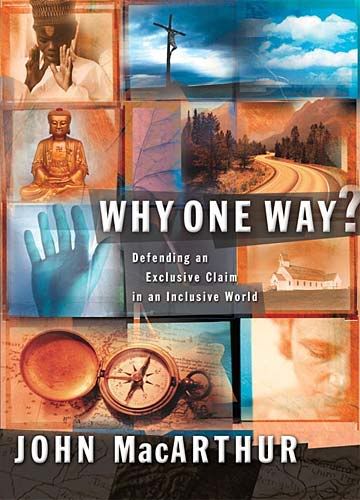
Why One Way? 6

Incompatibility

Why One Way? by John MacArthur

why one way coverHi, everyone…gosh, once again Dr. Mac so loses me! Again we need to ask, "What exactly is the Good Friday-Easter proclamation" Is it about a "personal relationship" (a concept not in Scripture) with Jesus as Personal Savior? Or isn't it rather the declaration of the end of the reign of death, the proclamation of the reality, primacy and ascendancy of the reign of life – "The Sovereignty of God," since someone on one of the other threads said "Reign of God" sounds exactly the same as "Rain of God!"

To quote a translation into English of Martin Luther's paraphrase of Psalm 46:

"That Word above all earthly powers
No thanks to them abideth
The Spirit and the gifts are ours…"
Continuing on this chapter's topic, I need to say both exclusivity – salvation only in the Christ event – and inclusivity – that the salvific Christ Event has a cosmic, totally all-encompassing scope and reach to all creation, whether or not the person or entity affirms Jesus as "personal savior" or publicly confesses the name of Jesus.

Nehemiah chapters 8 and 9 are wonderful, but we need to read them in historical context, and since that's available in a lot of places I won't go into it here. Here are the verses our facilitator mentioned:
Nehemiah 9:2: "And the Israelites separated themselves from all foreigners..."

2 Cor 6:14: "Do not be mismatched with unbelievers. For what partnership have righteousness and iniquity? Or what fellowship has light with darkness?"

E also suggested:

2 Corinthians 11:4: "For if someone comes and proclaims another Jesus from the one we proclaimed, or if you receive a different spirit from the one you received, or a different gospel from the one you accepted…"
and then E, you questioned,

"How does they apply when we worship? Are those verses and example authoritative? Are we incompatible?" And, "May I ask respectfully those who would worship with other faiths if you love Jesus how can we not proclaim Him? Or why would "you deny Him before men." Or are you proclaiming Jesus but .... (fill in the blank)."

For me, ecumenical Christian services are simplicity in that regard, though most more doctrinally conservative Christians around here almost never associate with more liberal Christian types, since in general they don't consider people like me really Christian partly because of our not considering the Bible literally inerrant. So far as interfaith services go (and especially since 9/11/2001 we've had a bunch of those here in Paradise) if I have an opportunity to speak in public I always self-identify as Christian; when I'm not part of the leadership I don't say unless people ask. My point is there's only one true God so whoever worships God worships the one true God, and I'd be very uncomfortable with Satan worshipers, for example, but that's not the issue here?

Again Dr. Mac's doing Scripture as the "objective, authoritative truth of God," rather than Christ Jesus as the truth he proclaimed himself to be.

E, you closed with, "E loves Jesus, the ultimate TRUTH! Have a great Lord's day!" I'll echo with "Leah loves Jesus, the ultimate TRUTH!" And with "everyone have a great Lord's day," too! That's exactly what it's about – it's about the living Christ, and about the Scriptures of the Old and New Testament to the extent that they reflect and proclaim Jesus Christ.