Showing posts with label hebrews. Show all posts

Friday, October 11, 2024

Five Minute Friday :: Flee

Psalm 139:7
Whither shall I go from thy spirit?
or whither shall I flee from thy presence?
Psalm 139:7

Five Minute Friday :: Flee Linkup
Psalm 139:7-10

7 Whither shall I go from thy spirit? or whither shall I flee from thy presence?
8 If I ascend up into heaven, thou art there: if I make my bed in hell, behold, thou art there.
9 If I take the wings of the morning, and dwell in the uttermost parts of the sea;
10 Even there shall thy hand lead me, and thy right hand shall hold me.

Almost every translation of verse 7b says "flee!" That sounds fast—probably desperate and frightened. We claim to know God best in the loving, compassionate Savior Jesus Christ. After all, he lived a human life like ours (though in a very different place and time), so he "gets" pressure, temptation, disappointment, anger, sorrow, and joy. But even so, don't we often look askance on our own shortcomings and try to hide from God as well as from other humans?

This week I've been studying the book of Hebrews in preparation for my weekly scripture reflection. The assigned passage is a study in law and gospel.

Hebrews 4:12-16

12 Indeed, the word of God is living and active and sharper than any two-edged sword, piercing until it divides soul from spirit, joints from marrow; it is able to judge the thoughts and intentions of the heart. 13 And before him no creature is hidden, but all are naked and laid bare to the eyes of the one to whom we must render an account.

14 Since, then, we have a great high priest who has passed through the heavens, Jesus, the Son of God, let us hold fast to our confession. 15 For we do not have a high priest who is unable to sympathize with our weaknesses, but we have one who in every respect has been tested [or tempted] as we are, yet without sin.

16 Let us therefore approach the throne of grace with boldness, so that we may receive mercy and find grace to help in time of need.

Exodus 25 instructs, "you shall make a cover of pure gold; two cubits and a half shall be its length and a cubit and a half its width." (verse 17) and continues, "there I will meet with you, and I will speak with you from above the mercy seat... verse 22

Scholars who know Hebrew explain the root of kapporet that Martin Luther translated as Gnadenstuhl or "mercy seat" is a place of covering that logically would extend from the physical gold covering of the ark to covering for sin, made especially clear as every year they sprinkled blood on it.

It's only a slight exaggeration to say Luther perceived Jesus Christ in [almost] every passage in the Hebrew Bible. For Luther the Gnadenstuhl, the definitive mercy seat, the place of grace, was the cross of Jesus Christ.

After explaining that Jesus as high priest, as mediator between heaven and earth in his resurrection and ascension, knows us and sympathizes – resonates! – with us, Hebrews 4:16 advises us to "approach the throne of grace with boldness in order to receive mercy."

Do we still want to flee from God?
# # #

five minute friday flee
five minute friday icon logo button

Friday, August 18, 2017

Five Minute Friday: Speak

This week Kate Motaung hosts another versatile Five Minute Friday prompt—speak! A hundred people might take speak in fifty different directions.

speak listen hearAs a theologian and as an artist-illustrator-designer, sign and symbol are my currency. Signs and symbols of every variety – including written and spoken words, of course – primarily aim to communicate—to point to, or indicate something other than themselves. Sometimes speech is clear; sometimes ambiguous. Sometimes people speak in order to confuse!

The scriptures are God's word – God's speech – spoken through human agents; we know Jesus of Nazareth is the ultimate word of God, "spoken" or revealed as a human person to be attended to with all our senses. Typically humans speak words, but sometimes they sing words. Song is melodic speaking! And maybe you've heard references to how particular organ pipes speak? Hebrews 1:2

The theological tradition of the community that brought us John's gospel tells us Jesus Christ, God's ultimate spoken revelation, is the preexistent logos or word. In a manner almost identical with branding for a product or service that includes a graphic logo design, the logos of God points to origins or source, and also to immanence or future.

Long ago God spoke to our ancestors in many and various ways by the prophets, but in these last days he has spoken to us by a Son, whom he appointed heir of all things, through whom he also created the worlds. He is the reflection of God's glory and the exact imprint of God's very being, and he sustains all things by his powerful word. Hebrews 1:1-3

Thanks for visiting. I don't know how much longer I can endure the grief and weariness, but again this week I had to FMF because I had speak-related design to include. Peace and abounding joy to all!


five minute friday speak five minute friday new button

Thursday, August 20, 2009

summer conversation 3

3. Jesus, us, culture, counterculture

Continuing awareness of the interdependence of all creation…

In Jesus of Nazareth God became incarnate within a particular culture, geography and historical time. And Jesus accepted death! How much more countercultural does it get?

Contexts, worldviews: natural, economic, ethnic, symbolic, class, linguistic, religious around us and within us shape us and limit where we go, what we think about, the options open to us. An individual becomes a person by becoming embedded in a textured, interwoven history of experiences shared with others. Insiders, outsiders, strangers and friends…

Contextualizing ministry, evangelism and worship. For Martin Luther, worship and hymn-singing in the vernacular was one of the marks of the true church; there are many vernaculars besides the linguistic.
1 Corinthians 12:4-7 There are diversities of gifts but the same spirit, and different kinds of ministries and ways to serve, yet the same Lord. Although there are many various types of activities and enterprises, the same God is active and works in all of them, and each person receives gifts of the Spirit for the good of the entire community.
Christus Victor: an atonement model moving away from a focus on guilt and condemnation under the law to emphasizing freedom and victory of Christ, in Christ.
Colossians 2:15 Having made hash of the rulers, the powers and the principalities and having been victorious over them, Christ then made a public spectacle of them!
Also consider 1 Corinthians 15:54-57 and…
Hebrews 2:14-15 Therefore, since the children shared in the blood and the flesh and Christ shared in the same things, that through death he might destroy the one having power over death - that is, the devil - and he might free all those who by their fear of death were bound to slavery throughout their lives.
Let the river run, let all the dreamers wake the nation. Come, the New Jerusalem. Carly Simon, "Let the River Run"
Who is this Lord of the Church, this Jesus? Consider Jesus' awareness of his own culture and the customs of others.

Next week: 4. A Eucharistic community: the Welcome Table

An inclusive meal and a feast of justice and righteousness accomplished on earth for all creation. Now I saw a new heaven and a new earth, for the first heaven and the first earth had passed away. Then I saw the holy city, the New Jerusalem…

© leahchang

Friday, March 09, 2007

Theology of the Cross 3

Oh wow—I just accidentally posted this on ...urban wilderness...

Theology of the Cross 3 | Lent 3 | 11 March 2007

Theology of the Cross: what does this mean for the Church’s and especially for this congregation’s life and mission?
All Who Love and Serve Your City

1. All who love and serve your city,
all who bear its daily stress,
all who cry for peace and justice,
all who curse and all who bless,

2. In your day of loss and sorrow,
in your day of helpless strife,
honor, peace, and love retreating,
seek the Lord, who is your life.

3. In your day of wrath and plenty,
wasted work and wasted play,
call to mind the word of Jesus,
“I must work while it is day.”

4. For all days are days of judgment,
and the Lord is waiting still,
drawing near a world that spurns him,
offering peace from Calvary’s hill.

5. Risen Lord! shall yet the city
be the city of despair?
Come today, our Judge, our Glory;
be its name, “The Lord is there!”

Words: Erik Routley © 1969 by Stainer & Bell Ltd., administered by Hope Publishing Co., Carol Stream, IL 60188
Theology of glory vs. theology of the cross: Theologians of the cross build their theology in the light of God’s own revelation of himself, particularly God’s self-revelation in Christ crucified. In addition, the cross of Calvary forms a paradigm and model for God’s characteristically hidden and paradoxical, sacramental presence in the commonest things, situations and people.
  • Law and Gospel; interpreting scripture and life with “What preaches Christ.”
6. Paul and his ilk; Martin Luther: the cross as Weltanschauung, as an all-encompassing worldview. Why?

Romans; Philippians—texts we looked last Sunday.

2 Corinthians 5:16-21 – we are a new creation; ministry of reconciliation

Colossians 1:15-20 – Christ reconciled all to himself, making peace through his shed blood

Colossians 2:9-15 – buried and raised with Christ, who disarmed and made a public spectacle of the powers and authorities

Hebrews 12:1-3 – for the joy set before him endured the cross; not the when or why of bad things happening to good people, but the how of God blessing us and all creation

Acts 1:5-8 – restore the Kingdom to Israel? In the power of the HS we are witnesses from Jerusalem to the ends of the earth!

Luther spoke about “The God Who became small for us in Christ”—small enough to die.

From Dietrich Bonhoeffer, Nachfolge (Discipleship): “When Christ calls us, he bids us come and die...to go one’s way under the sign of the cross is not misery and desperation, but peace and refreshment for the soul, it is the highest joy...we do not walk under our self-made laws and burdens, but under the yoke of him who knows us and walks under the yoke with us.”

Great Ends of the Church 6: The exhibition of the Kingdom of Heaven to the world – that’s us!

To the five Reformation solas – Sola Scriptura, Solus Christus, Sola Fide, Sola Gratia, Soli Deo Gloria – theologian Martin Marty adds a sixth: Cross Alone - Sola crux.

7. Some familiar theologians of the cross

Especially look for God’s hidden yet apparent presence and for “Types of Christ.” Today’s discussion primarily is about discovering lives that preach Christ crucified – and risen. However, it’s not only about being the presence of Christ to and for the world, living a responsive yet unassuming servant lifestyle that may take us to the Cross of Calvary; it also includes recognizing the presence of Christ in the world and in our neighbors. Matthew 25:31-40 – Lord, when did we see you hungry...”

For starters, here’s a very short list: Bonhoeffer; Dorothy Day; Gandhi; Martin Luther King; Desmond Tutu; Mother Teresa; us! Who else comes to mind? Some of our relatives, friends and neighbors? In the church and out of the church? Christian and not? Describe and explain.

A few days I was listening to Lionel Richie’s song, “Endless Love.” “My love, there’s only you in my life; you’re every breath I take; you’re every step I make, and I want to share all my love with you. Two heart, two hearts that beat as one...and love, I’ll be a fool for you – my endless love” reminds me of God’s love for us in Jesus Christ and of the foolish love any theologian of the cross has for all creation.

Considering these theologians of the cross—including us, particularly vis-à-vis our immediate neighbors, how do we become fools for love? Paul describes the cross as a scandal, a stumbling block to trip into and fall over to Jews who emphasize keeping the law to the extreme, and as complete foolishness to Greeks – or to anyone who aspires to high levels of intellectual pretense. Think about both of those aspects!

© Leah Chang 2007

Sunday, December 31, 2006

Christmas 2006 Blog

(...finally...)

Oh, I'd sort of been working through a few blog ideas for Christmas but ultimately gave up, so on this early New Year's Eve afternoon these three amazing texts win, rather than my own imaginings. Maybe you know Martin Luther loved the letter to Titus? All texts NRSV

Christmas Eve: Titus 2:11-14

titus - grace has appearedFor the grace of God has appeared, bringing salvation to all, training us to renounce impiety and worldly passions, and in the present age to live lives that are self-controlled, upright, and godly, while we wait for the blessed hope and the manifestation of the glory of our great God and Savior, Jesus Christ. He it is who gave himself for us that he might redeem us from all iniquity and purify for himself a people of his own who are zealous for good deeds.

Christmas Dawn: Titus 3:4-7

Hebrews 1:1But when the goodness and loving kindness of God our Savior appeared, he saved us, not because of any works of righteousness that we had done, but according to his mercy, through the water of rebirth and renewal by the Holy Spirit. This Spirit he poured out on us richly through Jesus Christ our Savior, so that, having been justified by his grace, we might become heirs according to the hope of eternal life.

Christmas Day: Hebrews 1:1-4

Long ago God spoke to our ancestors in many and various ways by the prophets, but in these last days he has spoken to us by a Son, whom he appointed heir of all things, through whom he also created the worlds. He is the reflection of God’s glory and the exact imprint of God’s very being, and he sustains all things by his powerful word. When he had made purification for sins, he sat down at the right hand of the Majesty on high, having become as much superior to angels as the name he has inherited is more excellent than theirs.

A Very Blessed Nativity to All Creation!

Tuesday, November 08, 2005

The Joint Declaration on the Doctrine of Justification

joint declaration on the doctrine of justification by faith
Close to a year ago, in December 2004, I began this post and planned to write more (which I've done, but as notes for discussion rather than formal presentation); now 10-months-and-counting later, my intended ideas remain in an outline and I've been thinking and writing about other things, but the Joint Declaration is so important and I am so into being an ecumenist, I needed to post something about it here. Here's the gist of my original post:
Next month—January 2005—at Faith, Order and Witness, again we'll discuss the Joint Declaration; I had made a few notes about some points in the text of the Joint Declaration and about the Annex, and at some point I'd wanted to compile them into at least somewhat coherent form so they could go on this site and possibly I could distribute them...

...at that long-past January meeting, but I got so involved with my usual endeavors of reading theology and writing theology my ideas never made it further than our live discussion at the meeting. Nonetheless, here are parts of the text we discussed, and here's the complete document: The Joint Declaration on the Doctrine of Justification
Preamble

1. The doctrine of justification was of central importance for the Lutheran Reformation of the sixteenth century. It was held to be the "first and chief article"1 [footnote 1 The Smalcald Articles, II,1; Book of Concord, 292.] and at the same time the "ruler and judge over all other Christian doctrines."2 [footnote: 2 "Rector et judex super omnia genera doctrinarum," Weimar Edition of Luther's Works (WA), 39, I, 205.] The doctrine of justification was particularly asserted and defended in its Reformation shape and special valuation over against the Roman Catholic Church and theology of that time, which in turn asserted and defended a doctrine of justification of a different character. From the Reformation perspective, justification was the crux of all the disputes. ...

2. For the Lutheran tradition, the doctrine of justification has retained its special status. Consequently it has also from the beginning occupied an important place in the official Lutheran-Roman Catholic dialogue.

5. The present Joint Declaration has this intention: namely, to show that on the basis of their dialogue the subscribing Lutheran churches and the Roman Catholic Church9 [footnote: 9 The word, "church" is used in this Declaration to reflect the self-understandings of the participating churches, without intending to resolve all the ecclesiological issues related to this term.] are now able to articulate a common understanding of our justification by God's grace through faith in Christ. It does not cover all that either church teaches about justification; it does encompass a consensus on basic truths of the doctrine of justification and shows that the remaining differences in its explication are no longer the occasion for doctrinal condemnations.

1. Biblical Message of Justification

9. In the New Testament diverse treatments of "righteousness" and "justification" are found in the writings of Matthew (5:10; 6:33; 21:32), John (16:8-11), Hebrews (5:3; 10:37f), and James (2:14-26).10 In Paul's letters also, the gift of salvation is described in various ways, among others: "for freedom Christ has set us free" (Gal 5:1-13; cf. Rom 6:7), "reconciled to God" (2 Cor 5:18-21; cf. Rom 5:11), "peace with God" (Rom 5:1), "new creation" (2 Cor 5:17), "alive to God in Christ Jesus" (Rom 6:11,23), or "sanctified in Christ Jesus" (cf. 1 Cor 1:2; 1:30; 2 Cor 1:1). Chief among these is the "justification" of sinful human beings by God's grace through faith (Rom 3:23-25), which came into particular prominence in the Reformation period.

11. Justification is the forgiveness of sins (cf. Rom 3:23-25; Acts 13:39; Lk 18:14), liberation from the dominating power of sin and death (Rom 5:12-21) and from the curse of the law (Gal 3:10-14). It is acceptance into communion with God: already now, but then fully in God's coming kingdom (Rom 5:1f). It unites with Christ and with his death and resurrection (Rom 6:5). It occurs in the reception of the Holy Spirit in baptism and incorporation into the one body (Rom 8:1f, 9f; I Cor 12:12f). All this is from God alone, for Christ's sake, by grace, through faith in "the gospel of God's Son" (Rom 1:1-3).

13. Opposing interpretations and applications of the biblical message of justification were in the sixteenth century a principal cause of the division of the Western church and led as well to doctrinal condemnations. A common understanding of justification is therefore fundamental and indispensable to overcoming that division. ...

3. The Common Understanding of Justification

14. The Lutheran churches and the Roman Catholic Church have together listened to the good news proclaimed in Holy Scripture. This common listening, together with the theological conversations of recent years, has led to a shared understanding of justification. ...

15. In faith we together hold the conviction that justification is the work of the triune God. The Father sent his Son into the world to save sinners. The foundation and presupposition of justification is the incarnation, death, and resurrection of Christ. Justification thus means that Christ himself is our righteousness, in which we share through the Holy Spirit in accord with the will of the Father. Together we confess: By grace alone, in faith in Christ's saving work and not because of any merit on our part, we are accepted by God and receive the Holy Spirit, who renews our hearts while equipping and calling us to good works.11

18. Therefore the doctrine of justification, which takes up this message and explicates it, is more than just one part of Christian doctrine. It stands in an essential relation to all truths of faith, which are to be seen as internally related to each other. It is an indispensable criterion which constantly serves to orient all the teaching and practice of our churches to Christ. When Lutherans emphasize the unique significance of this criterion, they do not deny the interrelation and significance of all truths of faith.

4.5 Law and Gospel

31. We confess together that persons are justified by faith in the gospel "apart from works prescribed by the law" (Rom 3:28). Christ has fulfilled the law and by his death and resurrection has overcome it as a way to salvation. We also confess that God's commandments retain their validity for the justified and that Christ has by his teaching and example expressed God's will which is a standard for the conduct of the justified also.

32. Lutherans state that the distinction and right ordering of law and gospel is essential for the understanding of justification. In its theological use, the law is demand and accusation. Throughout their lives, all persons, Christians also, in that they are sinners, stand under this accusation which uncovers their sin so that, in faith in the gospel, they will turn unreservedly to the mercy of God in Christ, which alone justifies them.

4.6 Assurance of Salvation

34. We confess together that the faithful can rely on the mercy and promises of God. In spite of their own weakness and the manifold threats to their faith, on the strength of Christ's death and resurrection they can build on the effective promise of God's grace in Word and Sacrament and so be sure of this grace.

35. This was emphasized in a particular way by the Reformers: in the midst of temptation, believers should not look to themselves but look solely to Christ and trust only him. In trust in God's promise they are assured of their salvation, but are never secure looking at themselves.

36. Catholics can share the concern of the Reformers to ground faith in the objective reality of Christ's promise, to look away from one's own experience, and to trust in Christ's forgiving word alone (cf. Mt 16:19; 18:18). With the Second Vatican Council, Catholics state: to have faith is to entrust oneself totally to God19, who liberates us from the darkness of sin and death and awakens us to eternal life20. ...

4.7 The Good Works of the Justified

38. According to Catholic understanding, good works, made possible by grace and the working of the Holy Spirit, contribute to growth in grace, so that the righteousness that comes from God is preserved and communion with Christ is deepened. When Catholics affirm the "meritorious" character of good works, they wish to say that, according to the biblical witness, a reward in heaven is promised to these works. Their intention is to emphasize the responsibility of persons for their actions, not to contest the character of those works as gifts, or far less to deny that justification always remains the unmerited gift of grace.

39. The concept of a preservation of grace and a growth in grace and faith is also held by Lutherans. They do emphasize that righteousness as acceptance by God and sharing in the righteousness of Christ is always complete. ...


From The Joint Declaration on the Doctrine of Justification Annex

... 2. Together we confess: "By grace alone, in faith in Christ's saving work and not because of any merit on our part, we are accepted by God and receive the Holy Spirit, who renews our hearts while equipping and calling us to good works"(JD 15). ...

D. Grace as fellowship of the justified with God in faith, hope and love is always received from the salvific and creative work of God (cf. JD 27). But it is nevertheless the responsibility of the justified not to waste this grace but to live in it. The exhortation to do good works is the exhortation to practice the faith (cf. BSLK 197,45). "The good works of the justified should be done in order to confirm their call, that is, lest they fall from their call by sinning again" (Apol. XX,13, BSLK 316,18-24; with reference to 2 Pet. 1:10. Cf. also FC SD IV,33; BSLK 948,9-23). In this sense Lutherans and Catholics can understand together what is said about "the preservation of grace" in JD 38 and 39. Certainly, whatever in the justified precedes or follows the free gift of faith is neither the basis of justification nor merits it" (JD 25).

E. By justification we are unconditionally brought into communion with God. This includes the promise of eternal life; "If we have been united with him in a death like his, we will certainly be united with him in a resurrection like his" (Rom 6:5, cf. Jn 3:36, Rom 8:17). In the final judgment, the justified will be judged also on their works (cf. Mt 16:27; 25:31-46; Rom 2:16; 14:12; 1 Cor 3:8; 2 Cor 5:10 etc.). We face a judgment in which God's gracious sentence will approve anything in our life and action that corresponds to his will. ...Any reward is a reward of grace, on which we have no claim.

3. The doctrine of justification is measure or touchstone for the Christian faith. No teaching may contradict this criterion. In this sense, the doctrine of justification "...is an indispensable criterion which constantly serves to orient all the teaching and practice of our churches to Christ." (JD l8)

Saturday, July 23, 2005

Deliverance, Homecoming, Shame and Grace

Another topic big enough for a book, but here's a beginning! To introduce this article, I'll quote parts of a pair of posts from early 2003; you can read my whole entire February 2003 here.
Tuesday, February 11, 2003

Synagogue and Basilica are meeting places—Church is People

...Liberation theology categories bring us back to God's self revelation in scripture and in the Christ Event. Mary's Magnificat is a central liberation theology concept and text:

"He has pulled down princes from their thrones and exalted the lowly, the hungry he has filled with good things, the rich sent empty away." –Luke 1:52-53

These words are grounded! Aren't those happenings demonstrated by Jesus' life and kerygma, Jesus' proclamation? I also like the liberation theology theme of the obliteration of shame: middle-class mainline U.S. Christianity often emphasizes annihilation of individual sin and guilt ...as devastating and as paralyzing as sin and guilt can be, shame is a far more cosmic category, visited upon individuals, cultures and societies by forces outside of themselves, forces over which they have no control—Paul's apocalyptic "powers and principalities." ...although the historical roots of deutero-Paul's exposition of and concern with the powers and principalities was somewhat "other than" what I've been writing about.

To paraphrase Johan Christiaan Beker in Paul's Apocalyptic Gospel: The Coming Triumph of God, the Church is the sign of the dawn of the new age and of the powers of life over and against the powers of death, and God calls the Church to active engagement with the world in order to fulfill its redemptive mission in the world. As I'd express it, God calls the Church, the Body of the Risen Christ, to be an instrument of grace to the world.

As an aside, although Paul may have been calling "on the Name of the Lord" on the fabled Damascus Road, I'm not completely convinced, since often grace and salvation break unbidden into life...into this world.

this relates, as well (also from February 2003):

Monday, February 17, 2003

Power and Sovereignty

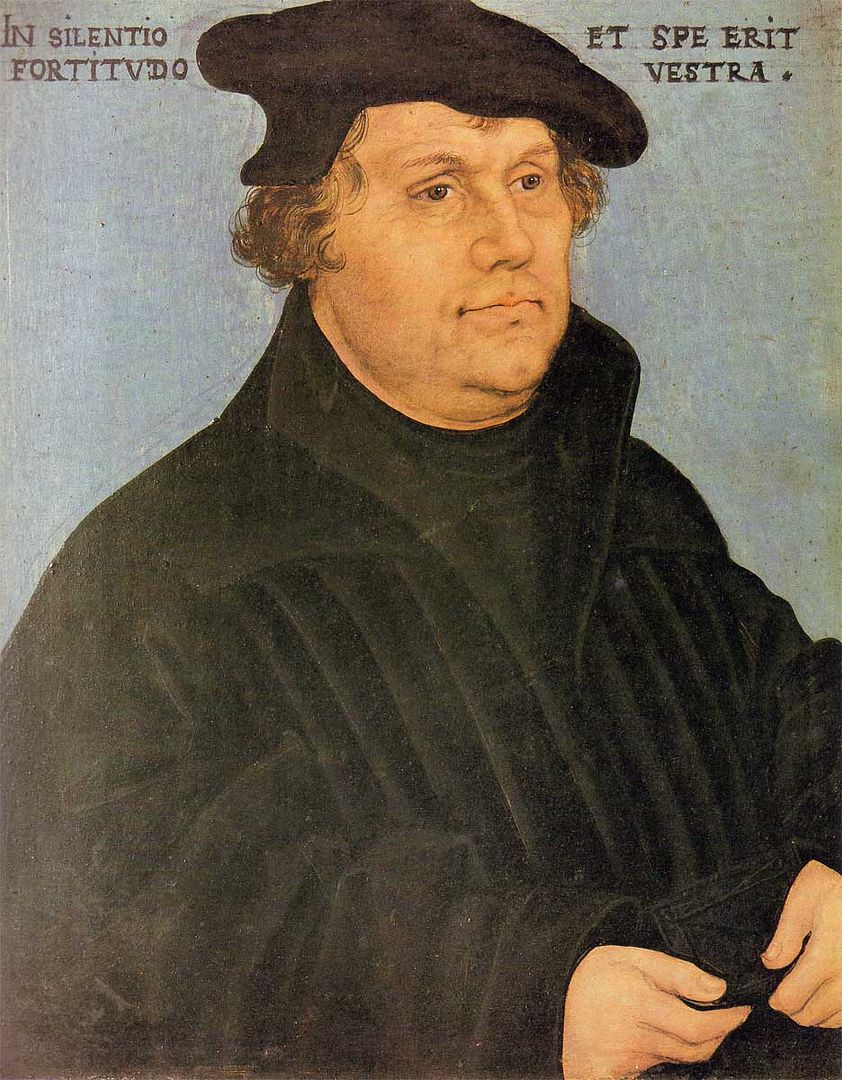
Martin LutherAs Christians our ultimate model of power is our God of glory, majesty and sovereignty willingly abrogating that power and becoming "small for us in Christ"—as Martin Luther expressed it: small enough to die. For us! From Christmas and the vulnerability of the manger we go to Good Friday and the vulnerability and absolute defenselessness of the cross. As Christians we confess we find the height of God's sovereignty in the vulnerability and weakness – in the hiddenness – of a human dying on the scandal of a tree.

We discover and recognize the fullness of the Shekinah Glory—the glory of the presence of God—in the weakness of Jesus, "The Human One," who dies without defense. And that powerlessness proved enough to annihilate the powers and principalities; it was sufficient to effect the death of the old order of death itself; Jesus' dying on the tree of death that paradoxically becomes the Tree of Life.

Our Good Friday/East Sunday proclamation is the end of the supremacy of death and the birth, the ascendancy of the primacy of life—the eschatological reign of the Power of God, most eloquently uncovered and found in the Lordship of Jesus of Nazareth, the crucified and risen One both Human and Divine, who shared our common lot and in whose birth, life, death, resurrection and ascension we know and affirm the definitive manifestation of the God beyond time and beyond space. ...

Now to today's topic: deliverance, homecoming, shame and grace.

Vis-à-vis Good Friday's cross and the empty grave of Easter Sunday's dawn, Christianity has developed an intricate theology of deliverance from slavery, redemption from bondage and homecoming from exile, but for Jews, shame was the cultural piece about the cross! However, when you assess any of those dimensions of salvation and wholeness, they're actually all about freedom.
Deuteronomy 21
22 If a man has committed a sin deserving of death, and he is put to death, and you hang him on a tree, 23 his body shall not remain overnight on the tree, but you shall surely bury him that day, so that you do not defile the land which the LORD your God is giving you as an inheritance; for he who is hanged is accursed of God.

Galatians 3
13 Christ has redeemed us from the curse of the law, having become a curse for us (for it is written, "Cursed is everyone who hangs on a tree," 14 that the blessing of Abraham might come upon the Gentiles in Christ Jesus, that we might receive the promise of the Spirit through faith.

Hebrews 12
1 Therefore we also, since we are surrounded by so great a cloud of witnesses, let us lay aside every weight, and the sin that so easily ensnares us, and let us run with endurance the race that is set before us, 2 looking unto Jesus, the author and finisher of our faith, who for the joy that was set before Him endured the cross, despising the shame, and has sat down at the right hand of the throne of God.
Clearly shame is cosmic and embraces every aspect of a person, but if it's possible to place it more in one category than in others, shame is more cultural than it is psychological or spiritual. Exactly the same way the cultural piece about the cross was shame, for us also, shame as an aspect of culture invades our total lives and affects ourselves and our (lacking a better word) total performances. For all of us and any of us, the situations, events and various miscellanea that cause us shame also tend to constitute the unspeakable we cannot permit ourselves to articulate!

Not only was death from hanging on a tree in itself a major curse under Old Covenant law—there's a ton of ritual and religious freight connected to that; in Jesus' case, dying outside the city gates located him outside humanity. For eons, city and civilization essentially have been synonymous; from days of old, cities have been places of population density, high-end commerce, and focal points of religious leadership and authority (hmmmm...thinking about Canterbury, Rome, Chicago, Louisville, Cleveland in this context?); typically cities have served as crossroads on the way to other places and historically, cities have been communication hubs, with news coming in and being broadcast out in various ways. As cities evolved, despite some barter and mutual exchange of goods still happening today (even now in the more-developed economies of the 21st Century First World), for a multitude of reasons, very early on a cash economy emerged and evolved. It's still emerging and still evolving, though these days credit and subsequent non-payment is becoming a habit for some.

But God chose to be born into humanity, into our life style and our longings, not at the local Cedar Mount Sinai or Presbyterian Hospital equivalent; and the society – and culture – chose to put God to death not according to contemporary antisepsis. Is there an antiseptic death? Well, yes. In Christ Jesus, God entered humanity and socialized with society at every level, but ultimately chose to identify most completely with the least of humanity, the cast-out, cast-off and cast-always. Over on my testimony blog, this far by faith, recently I posted this passage from John's gospel:
8:31 Then Jesus said to those Jews who believed Him, "If you abide in My word, you are My disciples indeed. 32 And you shall know the truth, and the truth shall make you free."
33 They answered Him, "We are Abraham's descendants, and have never been in bondage to anyone. How can You say, 'You will be made free'?"
34 Jesus answered them, "Most assuredly, I say to you, whoever commits sin is a slave of sin. 35 And a slave does not abide in the house forever, but a son abides forever. 36 Therefore if the Son makes you free, you shall be free indeed."
And from Romans 8, where Paul uses the same word as John uses for free eleutheria:
18 For I consider that the sufferings of this present time are not worthy to be compared with the glory that shall be revealed in us. 19 For the earnest expectation of the creation eagerly waits for the revealing of the offspring of God. 20 For the creation was subjected to futility, not willingly, but because of Him who subjected it in hope; 21 because the creation itself also will be delivered from the bondage of corruption into the glorious liberty of the children of God.
Also on this far by faith, two days ago, July 19, 2005, regarding Holy Shelter I wrote,

And there I will meet with you, and I will speak with you from above the mercy seat...Exodus 25:22a

God promises to meet us at the throne of sovereign mercy and grace; God meets us at the cross of Mount Calvary...

...after all, isn’t homecoming the ultimate thanksgiving?

Christianity has developed a complex theology of deliverance from slavery, redemption from bondage and homecoming from exile, but for Jews, shame was the cultural piece about the cross; when you assess any of those dimensions of salvation and wholeness, they're actually all about freedom! Clearly shame is cosmic and embraces every facet of a person; shame as judgment from our culture invades our total selves.

God promises to meet us at the throne of sovereign mercy and grace; God meets us at the cross of Mount Calvary... shame invades our total selves, but in the Divine Sovereignty and provision of the Cross of Jesus Christ, in mercy and grace God meets us, take all of our shame upon Himself and, at Resurrection dawn, transforms our entire selves into a homecoming of freedom without shame!

But always and for all times it hasn't been about signs and wonders—remember, even the gods of the Egyptians could do the fireworks! For the God of Abraham, Isaac and Jacob, the God of the prophets, the God and Father of Jesus Christ, all ways and every time it has been about constant, unmediated, unevoked and surprising Presence. For today I'm finished thinking about this, so I'll conclude with a handful of promise-texts:
Exodus 3
10 Come now, therefore, and I will send you to Pharaoh that you may bring My people, the children of Israel, out of Egypt."

11 But Moses said to God, "Who am I that I should go to Pharaoh, and that I should bring the children of Israel out of Egypt?"

12 So He said, "I will certainly be with you. And this shall be a sign to you that I have sent you: When you have brought the people out of Egypt, you shall serve God on this mountain."

13 Then Moses said to God, "Indeed, when I come to the children of Israel and say to them, "The God of your fathers has sent me to you,' and they say to me, "What is His name?' what shall I say to them?"

14 And God said to Moses, "I AM WHO I AM." And He said, "Thus you shall say to the children of Israel, "I AM has sent me to you."' 15 Moreover God said to Moses, "Thus you shall say to the children of Israel: "The LORD God of your fathers, the God of Abraham, the God of Isaac, and the God of Jacob, has sent me to you. This is My name forever, and this is My memorial to all generations.' 16 Go and gather the elders of Israel together, and say to them, "The LORD God of your fathers, the God of Abraham, of Isaac, and of Jacob, appeared to me, saying, "I have surely visited you and seen what is done to you in Egypt; 17 and I have said I will bring you up out of the affliction of Egypt to the land of the Canaanites and the Hittites and the Amorites and the Perizzites and the Hivites and the Jebusites, to a land flowing with milk and honey."'

Joshua 1
5 No man shall be able to stand before you all the days of your life; as I was with Moses, so I will be with you. I will not leave you nor forsake you. 6 Be strong and of good courage, for to this people you shall divide as an inheritance the land which I swore to their fathers to give them. 7 Only be strong and very courageous, that you may observe to do according to all the law which Moses My servant commanded you; do not turn from it to the right hand or to the left, that you may prosper wherever you go. 8 This Book of the Law shall not depart from your mouth, but you shall meditate in it day and night, that you may observe to do according to all that is written in it. For then you will make your way prosperous, and then you will have good success. 9 Have I not commanded you? Be strong and of good courage; do not be afraid, nor be dismayed, for the LORD your God is with you wherever you go."

Deuteronomy 1
32 Yet, for all that, you did not believe the LORD your God, 33 who went in the way before you to search out a place for you to pitch your tents, to show you the way you should go, in the fire by night and in the cloud by day.

Deuteronomy 2
7 "For the LORD your God has blessed you in all the work of your hand. He knows your trudging through this great wilderness. These forty years the LORD your God has been with you; you have lacked nothing."'

Matthew 28
18 And Jesus came and spoke to them, saying, "All authority has been given to Me in heaven and on earth. 19 Go therefore and make disciples of all the nations, baptizing them in the name of the Father and of the Son and of the Holy Spirit, 20 teaching them to observe all things that I have commanded you; and lo, I am with you always, even to the end of the age."

Saturday, June 19, 2004

Servant of Yahweh

Jackie, you specifically asked about 2 Corinthians 4:5:
For we proclaim not ourselves but Jesus Christ [as] Lord, and ourselves your slaves because of Jesus.
As I briefly explained, Israel had a long and essential Servant of Yahweh tradition from which Paul derived a lot of his servant/slave rhetoric. Here are some details...if you read through all of this, you'll get to a discussion of Paul!

Servant of Yahweh, Servant of the Lord in the Old Covenant Scriptures

The Hebrew word for servant, eber, denotes "authorized messenger of the LORD": the presence of Yahweh's servant equated with Yahweh's presence and carried the same clout! In Israelite history, the servant of the LORD was chosen by Yahweh, the LORD Himself; from its inception, the "Servant of Yahweh" concept implied the position of a slave.

For Israel, the highest tribute you could give a person was to call them "the servant of Yahweh." In the Hexateuch Moses is "servant of the LORD [Yahweh], and "Moses My servant." In fact, "Moses the servant of Yahweh" is just about Moses' official title, and later in the New Covenant Scriptures, the author of Hebrews (13:5) describes Moses by saying, "Moses was faithful in all His [Yahweh's] house as a servant." Joshua, "Moses' servant," who led Israel into the Promised Land also was "the servant of the LORD" (Joshua 24:29).

Through Jeremiah (7:25) Yahweh says, "I have sent you all My servants the prophets." Jeremiah even calls Babylonian King Nebuchadnezzar "My [Yahweh’s] servant" (25:9, 27:6)…although he fantasized himself Top Dog, Nebud unknowingly was God's servant and the vehicle for liberating God's people.

Also, compare Jeremiah 30:10
So do not be afraid, my servant Jacob--—it is Yahweh who speaks--Israel, do not be alarmed: look, I will rescue you from distant countries and your descendants from the country where they are captive. Jacob will have quiet again and live at ease, with no one to trouble him. [11] For I am with you to save you...

and 46:27

But do not be afraid, my servant Jacob, Israel, do not be alarmed: look, I will rescue you from distant countries and your descendants from the country where they are captive. Jacob will have quiet again and live at ease, with no one to trouble him [28] Do not be afraid, my servant Jacob--it is Yahweh who speaks--for I am with you…
The psalm-singers call themselves the LORD'S servants, and according to Psalm 34:22. "The LORD redeems the soul of His servants, and none of those who take refuge in Him will be condemned." In Zechariah 3:8b of the Book of the Twelve [sometimes referred to as the "Minor Prophets"], the angelic messenger calls the promised Messiah a servant: "...for behold, I am going to bring in My servant the Branch."

2nd Isaiah's Servant Songs, "Songs of the Suffering Servant"

In the book known as Isaiah, "servant" first appears in Isaiah 41:8, where it indisputably refers to Israel, "created by Yahweh and not to be forgotten."

Four poems from the unidentified Deutero-Isaiah are known as the Servant Songs or the Songs of the Suffering Servant. Biblical scholarship considers these poems a related whole that explicates a coherent identity of the Servant of Yahweh. Generally speaking, 2nd Isaiah (chapters 40-56) is considered exilic, although the literary style is more consonants with the post-exilic era of the scribes (as in 3rd Isaiah, chapter 56-66), but a prophetic message of hope would be work well during the gloomy discouraging days of exile!

* 42:1-9 | The servant will bring justice to the nations, the peoples

In this first servant poem Yahweh describes the servant as His chosen, bearer of His Spirit, who quietly and gently will bring justice to the peoples of all the earth, to mediate a covenant for all and to liberate the unfree.

* 49:1-9a | Israel as a light to the nations, the peoples

In the second poem the servant, clearly distinct from the people Israel (though in Isaiah 49:3 Yahweh addresses the servant as Israel...that's usually considered a gloss by a later redactor because in himself the Servant subsumes the meaning of the ideal Israel) ...continuing, in the second poem the Servant mentions being called from the beginning, sheltered in Yahweh, and speaks of both discouragement and trust. Yahweh promises the Servant will be a light to the Gentiles and leader of the people's restoration.

* 50:4-11 | My back to those who beat me

Here the Servant tells of being taught a message for the weary and he describes his sufferings that were a result of his obedience and confidence in Yahweh. In 50:10-11 Yahweh first encourages those who listen to the Servant, and then addresses those who scorn and spurn the Servant.

* 52:13-53:12 Bruised for our iniquities

In 52:13-15 Yahweh speaks of the Servant's humiliation, wise actions and later exaltation, though the Servant’s appearance suggests anything but dignity and will astonish nations and kings! Beginning at Isaiah 53:10, the prophet-servant becomes the instrument of Yahweh, Who acknowledges His Servant. Here the Servant becomes a trespass offering but at last he will be exalted and will justify the nations, the *peoples.* Deliverance from exile and deliverance from sin, separation, debt and bondage (essentially the same in the Hebraic economy) are joined in a single person, this Servant of Yahweh. Since mediator Servant was a prophet, too, here priest and prophet meet in one individual and with his assured exaltation, prophet, priest and king meet together in the Suffering Servant.


The Person of the Suffering Servant - speculations

Ages ago I copied this and have no clue as to the source, sorry!
"the exilic prophet gradually passed from the conception of Israel as a nation to [the concept of Israel as] a person through whom its true destiny would be realized. In this passage the Servant's mission in this passage seems highly bound up with the restoration."
Here’s a paraphrase from some of my class notes; I'm not sure of my sources here, I've learned to be a lot more careful than when I took these notes:

Some consider the Servant of Yahweh a personification of the ideal Israel, endowed with Yahweh's Word and Spirit; others believe the servant was a metaphor for Judah's suffering exile in Babylonia (Judah, the southern nation, was Deutero-Isaiah's original audience), and that by its misery and distress, Judah vicariously delivered healing to other nations by witnessing to Yahweh's salvific, justifying power. Also, given that Israel's prophets characteristically were called "my servants, the prophets" and "servant of Yahweh," the servant may have been an individual, and if the servant was a real prophetic figure, Jeremiah would be a likely candidate, since according to Kings and his self-titled book Jeremiah was a social outcast and physically very ill-treated. Besides Jeremiah, other suggestions include Judah's king in exile, Jehoiachin, 2nd Isaiah himself, and Zerubbabel, the first post-exilic governor of Judea. However, Deutero-Isaiah may have intended the *Servant* illusion to be indistinct and nonspecific, not so much particularly historical but more of a *standard model* for the people of God everywhere and in every time. The church historically has interpreted the Suffering Servant of 2nd Isaiah to mean the Crucified Jesus…and Jesus calls the church, Jesus calls us to service, only service, in the power of the Holy Spirit!


Servant and Slave in the New Covenant Scriptures

In his epistles, Paul of Tarsus draws upon the *servant* image, applying it to Christ Jesus [Philippians 2:6-8; Romans 15:8], to himself [Philippians 1:1; 1 Corinthians 3:5, 4:1, 9:19; 2 Corinthians 11:23; Romans 1:1, 1:9], to individual Christians [1 Corinthians 4:1, 7:22; Galatians 5:13; Romans 6:16-19 (this is Paul's marvelous slaves of righteousness passage: v. 18 literally reads "your were enslaved to righteousness!"), Romans 14:18], those in political authority [Romans 13:4, from the passage Martin Luther famously interpreted] and to the church at large [1 Corinthians 4:1, Galatians 5:13; Romans 14:18].

Possibly Paul's most celebrated *servant* passage is his quoting in his letter to the Philippian (2:6-8) church what unquestionably was one of the very earliest Christian songs:
although He existed in the form of God, did not regard equality with God a thing to be grasped, but He poured out Himself, taking the form of a slave [morphen doulou, to transliterate, since this blog template doesn't support Greek], and in the likeness of men having been born, and being found in appearance as a man, He humbled Himself by becoming obedient to the point of death, and that death by a cross.
According to Mark (10:45) the gospel-writer, in his own words Jesus declares the culmination of His servanthood: "For even the Human One did not come to be served, but to serve, and to give His life a ransom for many." Later on, in an immediate reminder of the 2nd Isaiah's Servant of Yahweh Songs in Isaiah, in Acts 4:27, 4:30 and Acts 3:13, Luke reveals how the emerging church called Jesus "servant."