Showing posts with label deutero-paul. Show all posts

Tuesday, November 29, 2022

Five Minute Friday :: Like

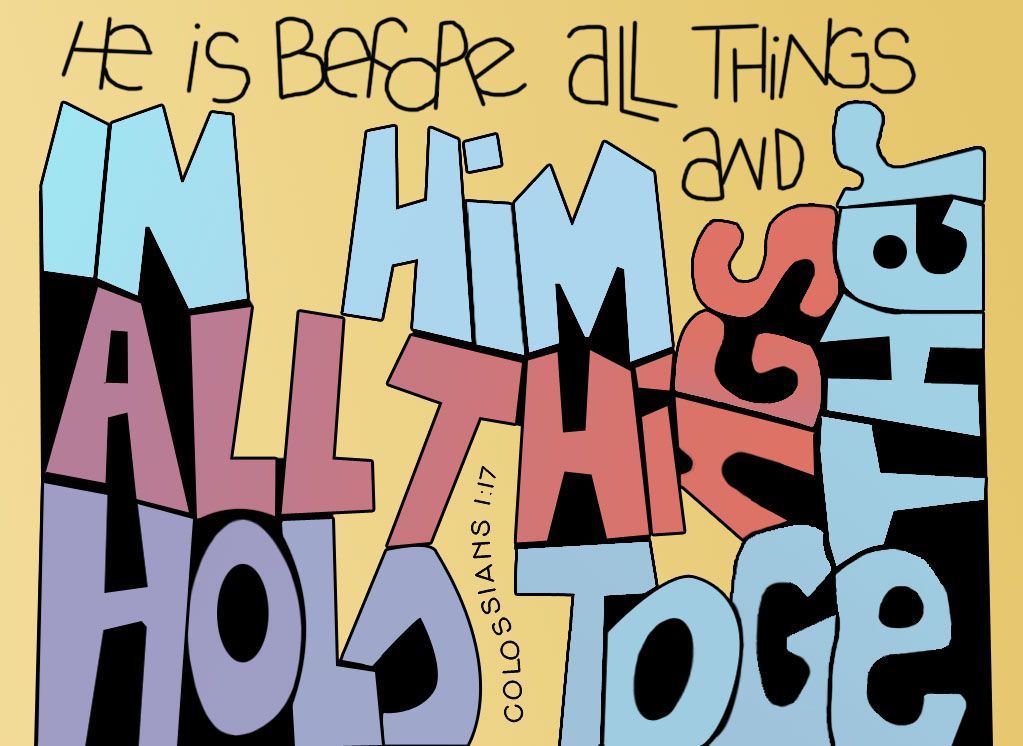
Colossians 1:17, He is before all things and in him all thing hold together
Five Minute Friday :: Like Linkup

Christ is the image of the invisible God, the firstborn of all creation… Colossians 1:15

To like a person, food, activity, or place goes beyond simple preference of one over another: you want it, gravitate to it; you choose it, connect with it. That's the verb "like," but the adjective like compares objects, ideas, people—and food, too. How similar or different is one to the other? Exactly the same or almost identical? Some common features? What are the differences?

Particularly chapter 1 of the letter to the church at Colossae brings us the pre-existent and still regnant Christ who fills and rules the entire cosmos, who subverts empire, inverts the political, social, economic, and religious status quo, who is the image and the reality of God parallel to In the beginning was the word, and the word was with God, and the word was God. (John 1:1) Colossians 1:15 announces, "Christ is the image of the invisible God"; in John 14:19 Jesus tells us, "If you have seen me, you have seen the Father."

Imperial Rome and its colonies were full of coins stamped with the emperor's image. The Roman Caesar supposedly was the son of a god, bestowing on him a slice of divinity. Formal church history locates the confession of Jesus as fully human and fully divine in the Definition of Chalcedon from the ecumenical council that convened in the year 451, but four centuries earlier, the pastoral letter to the church at Colossae declares Jesus divine.

How do you picture something that's invisible, that can't be seen? Do you remember Genesis 1:27 tells us God created humanity (us!) in the divine image—imago Dei?

Early Christians believed Jesus was fully imprinted with God. A slice of divinity? No! The whole entire thing—For in him all the fullness of God was pleased to dwell! Colossians 1:19

This scripture that describes Jesus as God's authoritative presence and the actual ikon / icon / image / likeness of the invisible God is so relevant to our contemporary political and economic concerns. In terms of the first century's (and this twenty-first's) status quo, these words from Colossians are seditious and subversive! They proclaim the person, power, and rule of Jesus Christ in terms that only are supposed to belong to the emperor. If Jesus is supreme, then caesar isn't. If (because!) Jesus is supreme, than the US government isn't. Samsung isn't. Amazon isn't, nor is Shell.
# # #

This FMF is edited, contracted, and expanded some from several posts on my weekly lectionary blog, urban wilderness.
five minute friday like
five minute friday icon

Saturday, December 02, 2017

Five Minute Friday • Near

I've been playing and working catch-up, but I had to Five Minute Friday this week because Kate Motaung's near prompt aligns with my preparation for introducing the Gospel according to Mark on Sunday. Everyone already knows Mark's gospel quite well, but with the start of a new Revised Common Lectionary year B that's Mark's year, I needed to create a quick overview. I'm also Friday Fiving because of the beautiful illustration Kate provided; I took the liberty of decorating her banner photo for my header.

five minute friday near

A few minutes ago on urban wilderness I blogged a short overview of the Gospel According to Mark I'll use to open my adult SS class session tomorrow. Similar to many people today, back in those days of the Ancient Near East (love that ANE terminology!) people tended to think of God far away, unapproachable, distant, and uninvolved. Or if they believed God was a little closer, they imagined God contained and protected in a space or place like the Jerusalem temple they'd worked so hard to build.

Particularly as we've studied a pericope or selection from one of the four gospels each week, we've been discovering and uncovering a God who's anything but distant and far away, anything but unapproachable and uninvolved in creation—and in our own sometimes difficult lives and pressing concerns, in our joys and everyday routines! Especially as God self-reveals in Jesus of Nazareth, God has drawn near to earth, to creation. So near that God has chosen to live as one of us, as a human, in a body formed from stuff of the earth. But paradoxically, God-with-us, close-to-us still is the God of the Hebrew scriptures who fills heaven and earth, who remains free, elusive, and can't remotely be contained in space or in time. But you already knew that!

Given that humans tend to be more mimetic than thoughtful, the temple concept partly imitated gods of other ANE religions that mostly were gods for a certain place. Not only Mark but all the gospels reveal God so near that in Jesus God becomes and lives as part of creation—yet we find actual "near" vocabulary more in the deutero-Pauline theology of Ephesians and Colossians than elsewhere in scripture. In any case, as another Advent dawns, literally breaks open this week, let's remember God's abiding passion for all of us. God incarnate as a baby in the Bethlehem manger. God embodied in each of us so we can live as God's presence very near to our neighbors, friends – and enemies.

disclaimer: I wrote this very quickly in a little less than five minutes, but unlike most weeks, I found too many discrepancies and discontinuities, and In the interest of overall coherence, I edited so it would make sense, so this represents closer to fifteen minutes than to five.

five minute friday near five minute friday new button

Tuesday, November 08, 2016

Green Team Talk – Reformation/All Saints

Here's the devotional talk I gave last Thursday for the Green Faith Team meeting.

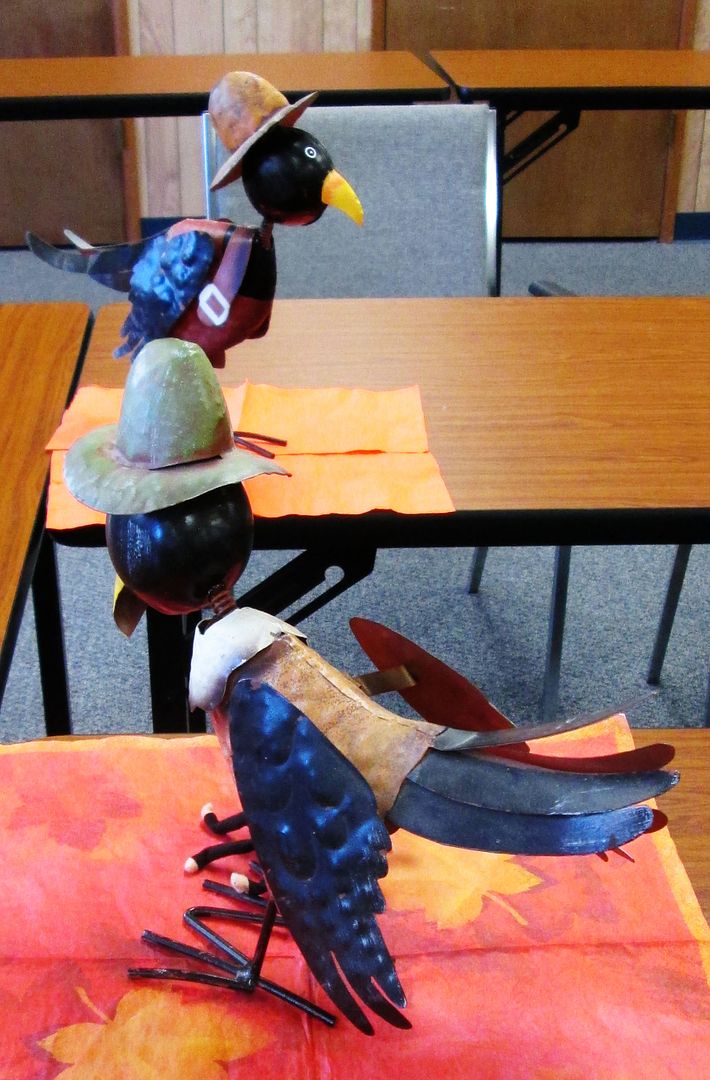
Congress of Two Crows• This week brings a confluence – a literal flowing together as rivers and streams of water do – of Reformation and All Saints. We celebrated Reformation last Sunday, recalling changes in the church the Holy Spirit made through human agency and also anticipating a church that never remains stagnant, always is alive. Next Sunday will be All Saints, when we especially remember those who have passed into the Church Triumphant, but All Saints is our day, as well. These actually are back-to-back festivals on 31 October and 01 November, but most churches celebrate both Reformation and All Saints on Sundays, since few people will attend weekday or weeknight services.

• Reformation is a major festival of the Holy Spirit when we "wear red," as we always do on the Day of Pentecost. The reading from Ephesians [1:13-14] for All Saints reminds us each of us in baptism carries the sign and seal of the Holy Spirit. All Saints is another festival of the Spirit!

• Pretty much from necessity, the Reformers particularly emphasized theology of redemption, of God's grace freely poured out, offered to all, given to all, through the birth, life, death, resurrection and ascension of Jesus Christ.

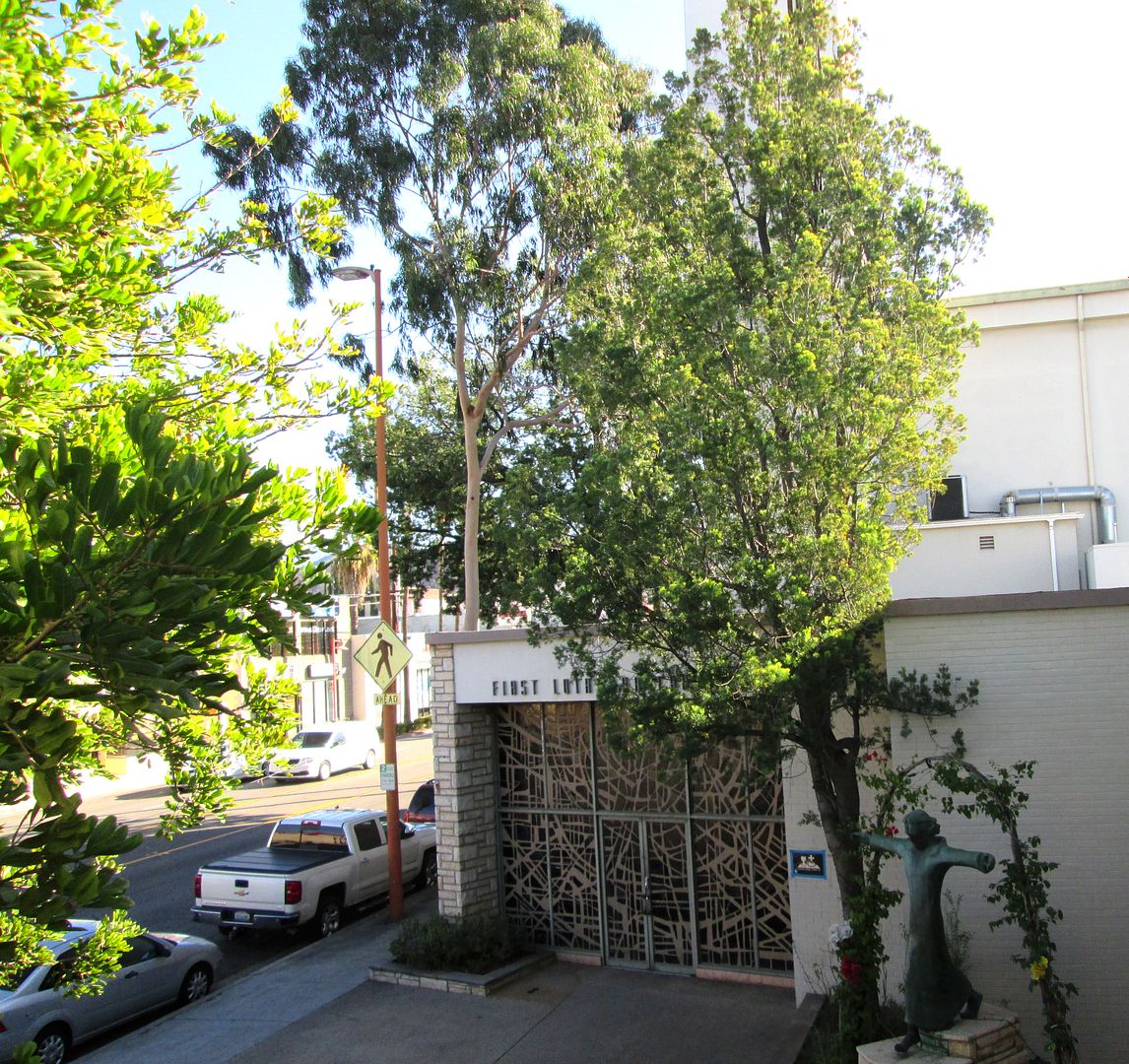
• The reformer Martin Luther got his theology from Galatians and from Romans, 1st Lutheran Glendale CAbut the psalms gave Luther his passion! Everyone knows the hymn he wrote based on Psalm 46; Pastor Eugene Peterson's version tells us the city streets are safe because God lives in the city; the city is safe because God bans war and breaks weapons. The city is a delight because God plants trees and flowers!

• We celebrate Pentecost and Reformation as major festivals of the presence of God in the Holy Spirit. But there is more! The priestly scribes who brought us the latest Pentateuch source [designated P] wrote late in the Babylonian exile or possibly after the exile, since dating is a bit confounded. They received a revelation that the destruction, the end of the Jerusalem Temple wasn't such a huge deal, after all. Imagine the crazy idea of a real God beyond space and time contained in a mini-replica of the earth and the heavens—that's what temples were! In Genesis 1 the priestly scribes show us all of the living structure of planet earth, the whole panorama of creation as God's dwelling place, the temple of the Divine. Genesis 1 also bring us the spoken Word that creates, orders, tames – redeems, renews, and reforms. And of course, we know Jesus Christ supremely as the Word of God.

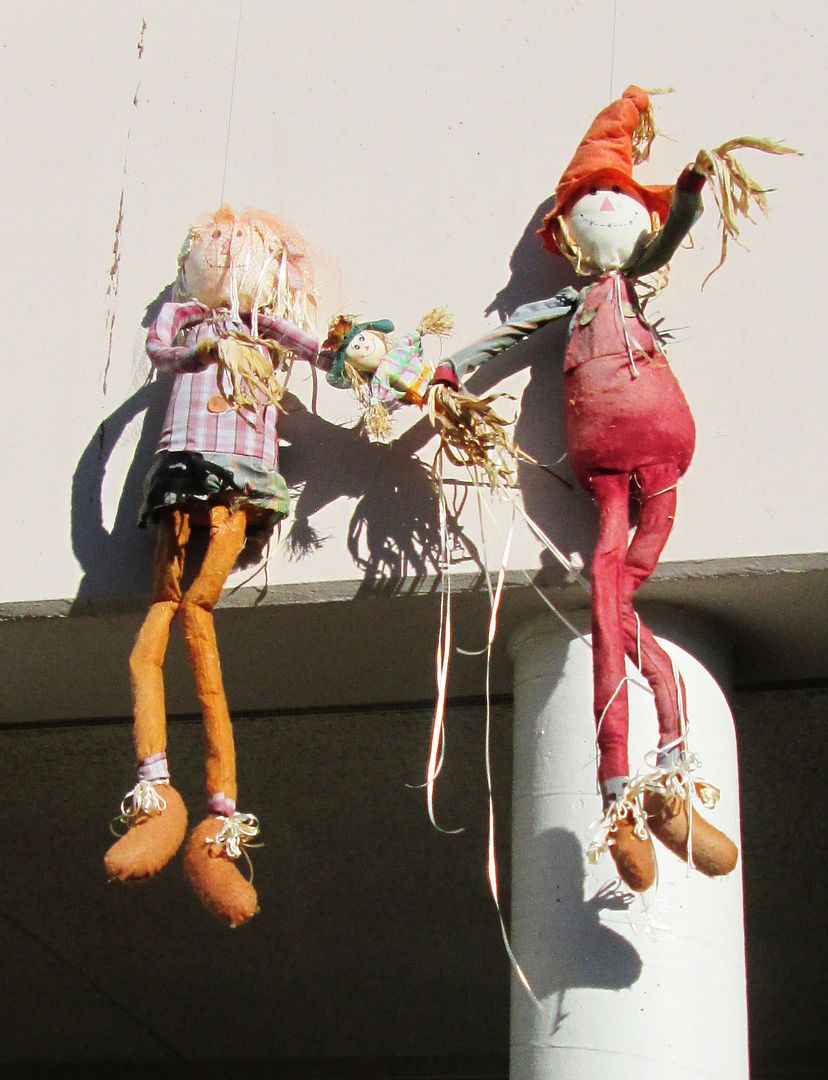
• But there is still more! The Reformers – especially magisterial reformers John Calvin and Martin Luther – mostly concentrated on theology of God's grace-filled redemption of human creatures through the reconciling Christ Event. Halloween peopleHowever, John Calvin brings us a rich theology of creation revealing God's providence, of God's grace and providence revealed for all creation, not solely human creatures. Martin Luther brings us the insight of the Divine presence in, with, and under all creation. Beyond that, Luther affirms the ubiquity – the everywhere-ness – of the risen and ascended Jesus Christ. Can you say sacraments?

• The lectionary reading from Ephesians for All Saints reminds us baptism marks and seals us with the Holy Spirit. In the power and presence of the Holy Spirit, like all of planet earth, each of us is a dwelling place of God! Along with Reformation, All Saints is a festival of the Spirit; besides commemorating those in the Church triumphant, All Saints is a day for those of us still on planet earth, as well. How exciting to have the confluence of those major festivals this time of the year!

• And now? We need to trust, we can trust, the bounty of life in the Holy Spirit, the imagination of all creation, the reign of grace.

To God Alone Be glory; Amen!

Judicatory offices share the campus with First Lutheran Glendale Church and School.

Sunday, August 05, 2012

desert spirit's fire @ 10

revised common lectionary for Pentecost 10 (the texts relate to this post).

pineappleDuring the month of July I celebrated ten years of blogging, but this anniversary post begins with the previous summer, 03 July 2001, when I bought a pineapple and drew this picture of it. Pineapples are an historic symbol of hospitality, the type of welcome the people of God are supposed to offer. Very early September 2000 I'd returned to Paradise; I still was in adventure mode and unsure whether or not a possible job on the east coast would materialize for September.

During summer 2000 I'd started writing some again when I created an urban discussion space in the old defunct msn groups and around the same time started participating in the United Church of Christ online forums; writing was a way of making lemonade from bitter tart sour lemons, but I'm delighted I got back to it. In fact, I copied some of the early content of this blog from some of my posts on ucc.org, and most of the content from my msn city group now is on my urban blog, preservation project.

The possible position didn't happen for September 2001 and after I'd finished a 2-semester long Community Economic Development graduate certificate in May 2002 and was wondering how to find related employment, I decided to start a weblog. Blogging was becoming the thing to do! This blog's actual blogoversary date was 16 July; at first I planned to write a post within the octave, but that got away from me… the Pentecost 10 lections for today are a good fit for what I'm saying, so it's timely, after all.

Last spring in a commencement speech posted online the speaker mentioned how very few of those talks tell the graduates how the people you journey with are what really will make your life and in many ways, will become your life. Again and over again, I've watched military homecomings; I've no doubt people are supposed to care for other people, to get attached to them, to miss them, to grieve when they are gone, to long for their return.

It isn't that meaning and purpose and people and participation make your life worthwhile; people, participation, purpose, and meaning define life—they are life! More than anything, no one expects to journey alone for such a long time. Decades of social isolation have made me strange to others and a stranger to myself; we truly know ourselves only vis-à-vis the mirrors of others.

Somehow I need to retrieve the life of service I prepared for, the life I've lost. Looking back over my years before Former City, how very true that it's not who you know, it's not what you know, but it's who knows you. My phone never started ringing again, either socially or professionally.

desert spirit's fire at 10The Pauline and later the deutero-Pauline expectation was that the solitary, isolated, individual would become part of the gathered body of Christ and assume one of many differentiated roles and positions appropriate to their gifts and experience; the movement is not from solitary, isolated, individual to becoming part of an undifferentiated blob. A member of a committee I serve on expressed surprise that "among the homeless" social structure with roles, expectations, and positions naturally (and organically) happens. Of course! It's a lively and life-giving process and occurs without planning.

I've mentioned Cornel West's "dangling people," with no organic connection to community or to other individuals. With a couple of decades of stories finally starting to be written and then suddenly erased or gradually vacated, too many years without a persistent core of shared memories, of remember whens, the sacraments and the liturgy that connect me horizontally and vertically to the people of God in every place and time no longer are enough. Am I seeking something? Oh, yes! Looking to duplicate past specifics? Oh, no! From "Here In this Place / Gather Us In" by Marty Haugen:

See, in this space, our fears and our dreamings,
brought here to you in the light of this day.
Call to us now, and we shall awaken,
we shall arise at the sound of our name.

Here we will take the wine and the water,
here we will take the bread of new birth.
Here you shall call your sons and your daughters,
call us anew to be salt for the earth.

here in this place, the new light is shining;
now is the Kingdom, now is the day.

Did I mention today's pericopes being a good fit? They are, and we sang "Gather Us In" this morning, though I'd planned to include it in this blogoversary post before I realized that was happening!

life stuff buttonLife is about story! I've buried 1,000 pasts, made 1,002 new beginnings. Does life begin again, the story continue, when I pick myself up again, stand up again, and start moving? no.......... life begins again when someone responds to my invitation, begins to recognize me, invites me, I respond, and we enter each others stories. Telling stories of how we got here. first steps; roadblocks; events along the way; the fun the people friends meals lonelinesses disappointments eucharists

A eucharistic anamnesis: the covenant with abraham water from the rock manna from the sky the exodus from egypt olives pomegranates words of the prophets homecoming from exile a prophet like moses bread from heaven rivers of life tree of life taken blessed broken given remembering

Eleven years ago I had no reason to be concerned. My life had taken a huge hit, but I still was in adventure mode. What do I seek? To experience the hospitality the pineapple symbolizes.

Here's my number—so call me, maybe?!

Sunday, June 12, 2011

remembrance, hope...

Remembering a lively past, hoping into a living future...


sign on the highway: San Diego River Watershed: Keep It Clean!

listening to American Pie: "and a voice that came from you and me... the day the music died, the day that I die."

How realistic have I been to expect an occasional oasis of good food, good drink and good conversation? How reasonable had I been to expect to be fully re-integrated into and re-claimed by mainstream society and mainline church?

Theology types engage in a fair amount of margin/center // edges/heart talk, especially considering more edgy, less centered liberation, womanist, cruciform theologies. All that's more marginal? Some people in some quarters consider them so, yet throughout the witness of scripture, God consistently acts is ways that subvert that status quo, in way that are hidden and unapparent until later on, until the principles involved step away and look backwards to where they've been and then are able to discern that's happened and even a little bit of how it's happened. Someone said if you keep looking back you can't see where you've going, but if you don't look back for sure you'll make the same mistakes and take the very same mis-steps.

Right now as another season of summer is almost here, I need to do some faithful remembering of Whose I am and who I am: where I've been, the journey I've taken with the gifts and opps God has given me, the people I've met who've ignored or rejected me and even those few people and places who've been occasions of embrace.

For Paul of Tarsus, the gospel is death and resurrection. Originally the literary form "gospel" referred to the returning Roman conquering general's proclamation of his victory over opposing forces, his announcement of how he'd vanquished the enemies to the nether regions of the dead. For Christians, "gospel" is God's victorious action in vanquishing death, "the last enemy" and initiating the victorious reign of life. Baptized, we live within the gospeled community called to reconciliation yet called out from, set apart from and different from the empires of death and deadly imperialisms in which many reside and toward which others strive.

Referencing the Ephesians pericope for Ascension that pleads for "the eyes of our heart" to be enlightened, PGB suggested one of the emphases of the Feast of the Ascension is the Christ Event becoming an event in the heart of God. Here our physical eyes can see nothing without some ambient light, so our heart-eyes need light too. Long ago at the weekly Monday evening women's bible study that met at my house, JHD (she and I were the group's usual leaders/facilitators) pointed out the eye is the most sensitive part of our physical bodies.

Baptismal River Watershed: Keep It Clean! and how, but how?! Keep the commandments, keep covenant with all creation, stay put in community because in spite of everything, most times staying put is the test of faithfulness because we perceive everything as imperfect...

Sunday, November 21, 2010

Reign of Christ: Colossians 1:17

Colossians 1:17

Oh, I so love the cosmic Christ of Colossians! This is one of my favorite texts and also one of my faves of all my graphic art.

Monday, August 30, 2010

season of creation 1c: Ocean Sunday

The Season of Creation is a recent emphasis for liturgical observation as late summer cycles into fall in the northern hemisphere, winter into spring in the southern. The site explains
What Is the Season of Creation?

For four Sundays in September, prior to St Francis of Assisi Day, we join in celebrating with Christ the wonders of creation. In the liturgy, we follow the lead of the psalm writers and celebrate with creation — with the forests, the rivers and the fields, which praise the Creator in their own way. Bible readings focus especially on the story of Earth, which complements the story of God and the story of humanity in the Scriptures. We commit ourselves to a ministry of healing Earth, with Christ and creation as our partners.
Norman Habel gives us part of the history; here's an excerpt:
The season of Creation begins as an Australian story. I, like many in our Lutheran Church in Australia, grew up in the bush. I climbed every tree within miles. I felt close to creation: the soil, the streams and the sounds of the bush. Celebrating the creation I love has long been one of my dreams.

season of creation 1c: Ocean Sunday
Needless to say, this is very in process and well may be different within a couple days; if you use these prayers, please make your own changes and additions as freely as you like.

Call to Worship

leader: As we gather for worship today in the name of the Father and of the Son, and of the Holy Spirit, let us bless the Lord for the bounty of creation, the mercy of redemption and the hope of a new creation.

response: We bless you Lord God, for the wonder and majesty of sun, moon, stars and seas, for all of earth's abundance, for the love of Jesus Christ and for the gift of the Spirit in our midst.

ocean sundayleader: Today on Ocean Sunday we especially remember your provision of water ranging from deeps of the primal creation, to rivers that flowed from Eden, through streets of the new Jerusalem. On this Ocean Sunday we also acknowledge and repent of ways we have squandered and spoiled gifts you called us to care for.

response: We admit our sin and wrongfulness in behaviors that have harmed the waters, that have hurt creatures who live in the oceans and rivers and have broken the lives of humans who depend on water for income, nutrition, sustenance and health. We especially repent of the complicity, ignorance and greed that led to the recent disaster in the Gulf Coast region of the United States of America. We ask for your forgiveness as we resolve to start over with new awareness and sensitivity, that we might live as bringers of the new creation.

leader: In gratitude and in hope we remember, retell and reappropriate stories of gifts of water that carried Noah's ark to salvation, that splashed from the rock in the exodus desert, that became the boundary of promised land freedom, that in baptism is the tomb of our death and womb of our new life in Jesus Christ.

Collect

God of glorious love, your Word calls forth the mystery and magnificence of creation! We ask that you would make us faithful stewards and caretakers of your gifts, especially brooks, creeks, seas, and glaciers, that all might be redeemed, live and thrive to give life to others, through Jesus Christ, who was baptized in the waters of the River Jordan, became living water to the world and sends us forth to baptize by water, Word and Spirit. Amen!

Eucharistic Prayer
The Lord be with you.
And also with you.
Lift up your hearts.
We lift them to the Lord.
Let us give thanks to God.
It is joy to offer thanks and praise!
This is a day of hope! This is a time to celebrate the gift of water, to recall and reclaim the redemption of everything there is!

Lord God, you laid the foundation of the earth and set firm its cornerstone;
You were there when the morning stars sang together;
You commanded the morning, and showed dawn its time of awakening;
Your word formed the springs of the seas and spread out the expanse of the earth with all that grows from it.
You gave a portion of your Spirit to all creation,
and charged humanity with stewardship of the works of your hands.

By water and Word you claimed and baptized us as your people;
You have given us water and bread and fruit of the vine as signs of your presence among us;
You call us and send us to proclaim your gospel of love and justice to all the world.

And so with the company of heaven and with all creation in every time and every place we sing:
Holy are you, God of mercy, glory and love, and blessed is Jesus your son, who lived among us in a body made from stuff of the earth.
Jesus died for the redemption of all creation,
and was raised from death for the life of the world.
He ascended to reign in justice and righteousness over everything his Word had created.
With the Church in all the ages we proclaim the mystery of faith:
Dying you destroyed our death;
Rising you restored our life;
Lord Jesus, come in glory!
bread and cupOn the night of betrayal and desertion, our Lord Jesus took bread; when he had given thanks, he broke it and said,
"This is my body, broken for you. Do this in remembrance of me."
In the same way after supper, he also took the cup, saying,
"This cup is the new covenant in my blood. Do this, as often as you drink it, in remembrance of me."
As often as you eat this bread and drink this cup, you proclaim the Lord's death until he comes again in glory.
Come, Spirit of Holiness; come upon all creation everywhere and upon this assembly of saints;
Come, Holy Spirit; sanctify these gifts of grain and grape uniting us with all creation in every time and every place;
Come, Spirit of Life and bless our feasting at this table of reconciliation and renewal,
That baptized into the death and resurrection of Jesus Christ,
in the power of the Spirit we may daily live as the gracious presence of the crucified and risen Jesus Christ.

Glory and thanks
wisdom, acclaim
dominion and righteousness be to God,
Father, Son and Holy Spirit,
endlessly throughout eternity,
Amen!


© leah chang 2010

Friday, April 09, 2010

prophetic imagination conference 3

power to the power john august poster
The next Thursday session I attended began with Artful Imagining from Andrew Hendrixson, who teaches studio art at the University of Florida, as the first presenter in an excellent, varied group of three. The last presenter in the trilogy was Teri Marcos from not far away from San Diego Azusa Pacific University. In an outstanding presentation, Jesus and the Disinherited she emphasized some aspects of Howard Thurman's life and teaching. Thurman was Preacher to Boston University a while before I attended, but his name and even his presence on campus still was legendary.

and then

In Farmer Wendell Berry's A Call to Agrarian Leadership slide presentation with commentary by Paul Kaak (also from Azusa Pacific) particularly emphasized "placed stewardship" of the church. Careful placed stewardship leads us to be concerned with where God has planted us as wherever we are, wherever the church is reminds us of what we've forgotten about the organic church and that we've forgotten and neglected it.

Paul Kaak paralleled farm with parish—after all, both concepts are geographical; he also told us Eugene Peterson (remember him? The pastor-scholar who did The Message version of the Bible) considers Wendell Berry the best pastoral theologian in the USA! Someone I knew in another life told me when he observed some people who serve in a pastoral capacity, he frequently remembered that pastoral means "rural." Moving along from C. Wright Mills Sociological Imagination to Walter Brueggemann's Prophetic Imagination... I especially love observations about agrarianism as a synoptic worldview, as comprehensive vision uniting land—agri-culture and human culture, or ways of being and acting. And oh, yes, too often the Church is all at once 1) not worldly enough; 2) too worldly and 3) needing to be whole, healthy and holy. John 17, Jesus, us and God's glory on earth, where God has "placed" us and placed, planted The Church, calling and enabling it to live as the Presence of Jesus Christ in the world.

Communications media and the individuals, communities and organizational entities of many types we observe and encounter almost daily have been returning to less toxic, simpler behaviors, as have almost all of us. In my own life it's been slow and gradual, yet I can reflect on two or three years back or more dramatically, ten or twelve years ago and even from this close a perspective I can notice small lifestyle changes that have added up to less physical and mental clutter around me and better stewardship of the places – household, neighborhood, city, county, state and world – in which I live.

Paul Kaak more than suggested contemporary industrial economies were founded on "the breaking of all ten commandments" and said the economy, the household law/stewardship of the church has behaved in the same way, also violating all of the commandments. "The organized Church makes peace with a destructive economy" though how can it make peace with the "empires of illusion" scripture forbids? Ephesians 4:18-24 Wendell Berry loves the metaphor of marriage as a model for husbandry of the land - we need to get out of passive consumption modalities and being embodying, incarnating, our own "better" stories.

Thursday, August 27, 2009

summer conversation 4

4. A Eucharistic community: the Welcome Table

John 1:1, 3 In the beginning was the Word, and the Word was with God, and the Word was God. All things came into being through him, and without him not one thing came into being.

John 12:24 …unless a grain of wheat falls into the earth and dies, it remains just a single grain; but if it dies, it bears much fruit.

1 Corinthians 11:23-24 …our Lord Jesus on the night when he was betrayed took a loaf of bread, and when he had given thanks, he broke it and said, "This is my body that is for you. Do this in remembrance of me."

And what about "this is my body"?
And "this cup is the new covenant in my blood"?
The bread points to nourishment in that same self-giving of God
At work in my body, that is in me.
And the cup points to the new community drawn together and nourished
In my blood, that is in God's total self-giving in my death.

–Paul L. Hammer–

You choose to be made at one with the earth;
the dark of the grave prepares for your birth.
Your death is your rising, creative your word;
the tree springs to life and our hope is restored…

–Fred Kaan–


In Saxon English, the Lord provided the loaf, the bread, the essentials for sustaining life. We are baptized into the biography of the baby born in Bethlehem, House of Bread. In the Eucharist, we celebrate the ultimate earth day, a feast of justice and reconciliation for all creation, that brings together the ground's fruitful yield along with the labor of farmers, vintners, truckers, grocers, bakers, sellers, weavers and potters, carpenters and contractors.
Revelation 21:1-2a Then I saw a new heaven and a new earth…and I saw the holy city, the new Jerusalem.
Who is this Lord of the Church, this Jesus?

Consider Jesus' lifestyle of justice and inclusion along with Jesus' command "do this!"


Backtracking:

1. A baptized community: Water and the Word
Galatians 3:28 There is no longer Jew or Greek, there is no longer slave or free, there is no longer male and female; for all of you are one in Christ Jesus…
Who is this Lord of the Church, this Jesus?
Consider Jesus' relationship to creation, Jesus' stewardship of all life.


2. Spaces, places, locations…

First, Second, and Third spaces, (Fourth?) places in cyberspace; the liminal, the marginal, and the central; thresholds, edges. and centers; insiders, outsiders, strangers and friends
Romans 13:8 Owe no one anything else except to love one another…
Who is this Lord of the Church, this Jesus?

Consider Jesus' sense of home and geography.


3. Jesus, us, culture, counter culture
Colossians 2:15 Having made hash of the rulers, the powers and the principalities and having been victorious over them, Christ then made a public spectacle of them!
Who is this Lord of the Church, this Jesus?

Consider Jesus' awareness of his own culture and the customs of others.

© Leah Chang

Thursday, August 20, 2009

summer conversation 3

3. Jesus, us, culture, counterculture

Continuing awareness of the interdependence of all creation…

In Jesus of Nazareth God became incarnate within a particular culture, geography and historical time. And Jesus accepted death! How much more countercultural does it get?

Contexts, worldviews: natural, economic, ethnic, symbolic, class, linguistic, religious around us and within us shape us and limit where we go, what we think about, the options open to us. An individual becomes a person by becoming embedded in a textured, interwoven history of experiences shared with others. Insiders, outsiders, strangers and friends…

Contextualizing ministry, evangelism and worship. For Martin Luther, worship and hymn-singing in the vernacular was one of the marks of the true church; there are many vernaculars besides the linguistic.
1 Corinthians 12:4-7 There are diversities of gifts but the same spirit, and different kinds of ministries and ways to serve, yet the same Lord. Although there are many various types of activities and enterprises, the same God is active and works in all of them, and each person receives gifts of the Spirit for the good of the entire community.
Christus Victor: an atonement model moving away from a focus on guilt and condemnation under the law to emphasizing freedom and victory of Christ, in Christ.
Colossians 2:15 Having made hash of the rulers, the powers and the principalities and having been victorious over them, Christ then made a public spectacle of them!
Also consider 1 Corinthians 15:54-57 and…
Hebrews 2:14-15 Therefore, since the children shared in the blood and the flesh and Christ shared in the same things, that through death he might destroy the one having power over death - that is, the devil - and he might free all those who by their fear of death were bound to slavery throughout their lives.
Let the river run, let all the dreamers wake the nation. Come, the New Jerusalem. Carly Simon, "Let the River Run"
Who is this Lord of the Church, this Jesus? Consider Jesus' awareness of his own culture and the customs of others.

Next week: 4. A Eucharistic community: the Welcome Table

An inclusive meal and a feast of justice and righteousness accomplished on earth for all creation. Now I saw a new heaven and a new earth, for the first heaven and the first earth had passed away. Then I saw the holy city, the New Jerusalem…

© leahchang

Thursday, April 03, 2008

Time of the Spirit - Season of the Church

Adult Study Proposal | Early Summer 2008

In a special emphasis on the Pentecostal reign of the Spirit, in 3 class sessions we'll investigate selected texts from Galatians; Acts, Ephesians and Colossians, particularly in terms of our identity as a people uniquely constituted by Jesus' death and resurrection. We'll explore concepts of gracism and inclusion and consider a Christus Victor atonement model of Jesus' triumph over the pretense, dehumanization and violence of Roman imperial rule.

The congregation at Galatia was the first ethnic church; we need to become more aware of our own conscious and unconscious cultural and other attachments that lead to our living and proclaiming either more than our less than the gospel. As Martin Luther insists, worship and hymn-singing in the vernacular is a mark of the true Church; we also need to contextualize, cast into local vernacular (but there's not just one!) our outreach to our neighbors. How can we fully bring others into our congregation's life of worship, witness and service and also graciously receive their gifts of hospitality when they invite us closer to the centers of their worlds?

In his books Multicultural Ministry: finding your church's unique rhythm and Gracism: The Art of Inclusion, David A. Anderson, pastor of Bridgeway Community Church in Baltimore writes about Gracism, a word comprised of "racism" preceded by the letter "g" for God. "Gracism" encourages people to extend favor to others based on their unique class, culture, ability, color or other distinctions, and to make that preference visible and apparent. How can we become gracists with each other and with newcomers?

The synoptic gospels, the undisputed epistles of Paul and deutero-Paul ring with language of Roman imperialism and domination. What deathly economic, political and cultural forces control and determine our contemporary situation? Can we live and proclaim a Christianity as explicitly anti-imperial as that of the early churches, when to be ekklesia still was primarily political rather than religious or theological? What Word of Life does the cross of Calvary and the empty tomb of Easter dawn speak and enact here in this corner of Paradise in 2008? As we live in Christ, does our theology become our biography to a sufficient degree to liberate and redeem our neighbors from their false allegiances? Can we grasp the stories of Jesus' birth, life, death, resurrection and ascension in ways that challenge our understanding of society and our fundamental loyalties?