Showing posts with label cities. Show all posts

Thursday, July 16, 2026

Five Minute Friday :: Route

downtown los angeles in may
Downtown Los Angeles in May

Five Minute Friday :: Route Linkup

In my footer pics you can see one of my takes on the sign at the very end of Route 66 at the Santa Monica Pier. My church sits along Route 66; second pic is the sign on the building accented with a couple of cables. It's always a joy when the sun comes up on the Santa Monica Boulevard along Route 66 and we're there to gather around Word and Sacrament. Again. And next week, too.

What can I say about a route, a path, a road? The road home, or the road to the cross? The route that intersects with another every time I venture east or west or almost anywhere?

I'm writing about a route and routes on Thursday 16 July. It's the middle day of July, it's this blog's twenty-fourth blogoversary, and I'm still working through an anniversary post that I'll pre-date when I finish.

My header provides a hint of what my intended route has been all along. Only a hint, because my passion for cities and The City includes downtown with its skyscrapers, mid-city, the CBD, the edges, the margins, the central city, and the not yet imagined.

How does a person discern their path or route? Gifts, passions, opportunities. Circumstances, too, as a subset of opportunities. My chosen route felt so logical. The way opportunities and circumstances came together, I knew God was choosing the city for me, and awaiting my response and participation. What happened?

Did an alternate route slowly or suddenly appear? No. Did I uncover an old interest and try to revive it? No. Did I change my mind about cities and The City and decide to sit things out? No.

Or did the city start happening and then continue with sometimes clear, sometimes imperceptible twists, turns, detours, and dead ends? Not that I've noticed. Did I take a different route home? No. I didn't and I haven't yet.

What personality and path has your route or routes taken?

# # #
end of route 66
route 66 west los angeles
sylvia with ice cream
five minute friday route
five minute friday logo

Thursday, July 02, 2026

Five Minute Friday :: Outcome

Life Stuff
Five Minute Friday :: Outcome Linkup

Soccer and the World Cup isn't one of my preoccupations, but I love Major League Baseball (MLB); I've been known to get excited and despondent during the post-season. My first ever MLB game was at the old Tiger Stadium after I'd taken my first solo flight as a passenger. I was in grade 7 or 8. I've noticed parents and kids often make things complicated when a kid or a teen flies unaccompanied, but I went to Boston-Logan, got on the plane, flew to Detroit-Metro, got off the plane. No big deal, but that may have been because I'd been riding city buses and subways alone forever.
Fenway Park
Fenway Park by Chris Devers, 2004

Although back then I had next to zero knowledge of the game, in retrospect the Tigers game with an opponent I don't remember was a watershed. A couple years later during high school the Boston Red Sox and Fenway Park started to become part of the narrative of my life. Later on when I served an inner city Boston church, senior pastor was able to get Red Sox tickets almost on a whim, and I went to many games that way. A few times I drove youth group kids to Fenway in the church van; other times we traveled there on the subway. For sure I considered myself On The Clock whenever I took on that responsibility.

Today's word is outcome. "I often remind myself" the best way to predict the future is to create it; that's what I knew I was doing with a series of schools, skills, and experiences. As of now, the outcome is far from the minimum I'd anticipated. But God's promises and God's faithfulness are outside of time as we humans measure time. Can I trust God for the outcome of all those years of preparation and expectation?

There's spring training and there's the fall post-season, but I love that baseball is mostly an icon of summer. Although baseball is country, suburban, and everywhere, there's something particularly urban about it, and cities are my jam. Did I already mention Detroit and Boston?

I love baseball's leisurely pace as if clocks and watches don't exist. I love that baseball is an American invention. I love those memories of Fenway Park. I love watching stellar defense and crazy offense. Baseball majorly qualifies as one of my major Life Stuff topics. As I wonder about hopes, dreams, and disappointments, "I often remind myself" baseball is a perfect model for life.

The outcome? You win some; you lose some. Tomorrow is another day, another game, another outcome.
# # #
baseball
Tiger Stadium
Sylvia with ice cream
fmf outcome
FMF logo

Thursday, April 23, 2026

City Resist

crayon resist city scene with green tree

Street Art Tuesday

street art
For this week's Tuesday day off I happened upon a LA Street Art tour in an industrial section of the Boyle Heights East Los Angeles neighborhood. Graff Tours [Graffiti Tours Art Studio] offered it; Mala was my host for the 90 minute walkabout. Mala's website is La Mala Luna.
dumpster with  tags
street mural
I won't list all the information I got, but I'll tell you if it's not illegal, it's not graffiti. If you ask anyone casually about street art, graffiti probably would be their first response. Some of the pictures I took are graffiti (illegal because it defaces someone's property) or graffiti-style (legal because the artist has permission), some have elements of fine art, while others combine different styles.
street art
street art
Whenever I present a banner workshop, I remind participants they're doing public art that needs to contain concepts or elements most people understand. In other words, art out in public generally is not an obscure insider pursuit, although if it's specific to a particular culture – like Persian New Year or a new Egyptian restaurant on the block – people may get curious and need to ask questions to find out more.
graffiti style art
street art
LA is full of graffiti everywhere and it's a form of public art, yet it still is somewhat of an insider endeavor. I learned a tiny amount and expect to learn more as I look around and when I have a chance to collect a few people and create my own graffiti-style art in one of the workshops Graff Tours offers. Remember, it won't be graffiti because it will be legal.
portrait with cat icons
graffiti style cat
believe in rainbow colors
I hope you enjoy this collection of graffiti and other street art; I trust you'll appreciate the "Museums" tag for this blog post.
greek salad and peach lemonade
mocha frappe
For a late afternoon lunch, i had an amazing big Greek salad and a peach lemonade at the new to me Salata: The Next Generation Salad Bar in the Fig At 7th food court. (I'm finally resigned to even that section of DTLA being gruddier than it used to be.) And later a large Mocha Frappe.

Saturday, February 07, 2026

Pentecost 4B Creation Care

creation care box
Sometimes people want to hear what they already know.

Scriptures

• Ezekiel 47:9

Wherever the river goes, every living creature that swarms will live, and there will be very many fish once these waters reach there. It will become fresh, and everything will live where the river goes.

• Ezekiel 47:12

On the banks, on both sides of the river, there will grow all kinds of trees for food. Their leaves will not wither nor their fruit fail, but they will bear fresh fruit every month, because the water for them flows from the sanctuary. Their fruit will be for food and their leaves for healing.

• 2 Corinthians 5:17

So if anyone is in Christ, there is a new creation: everything old has passed away; look, everything has become new!

• Mark 4:26-34

26 Jesus also said, "The kingdom of God is as if someone would scatter seed on the ground 27 and would sleep and rise night and day, and the seed would sprout and grow, he does not know how. 28 The earth produces of itself first the stalk, then the head, then the full grain in the head. 29 But when the grain is ripe, at once he goes in with his sickle because the harvest has come."

30 He also said, "With what can we compare the kingdom of God, or what parable will we use for it? 31 It is like a mustard seed, which, when sown upon the ground, is the smallest of all the seeds on earth, 32 yet when it is sown it grows up and becomes the greatest of all shrubs and puts forth large branches, so that the birds of the air can make nests in its shade."

33 With many such parables Jesus spoke the word to them as they were able to hear it; 34 he did not speak to them except in parables, but he explained everything in private to his disciples.
blueberries blackberries raspberries
Creation Care Outline

Where are we now in the church's year of grace? One month ago we celebrated the Day of Pentecost, the fiftieth day of Easter. We recollected when a large group of Jesus' first followers gathered in Jerusalem for the Jewish Pentecost. They remembered and affirmed God giving the Ten Words or Commandments through Moses, that way of obedience you could call the Working Papers for our lives together. And they celebrated the wheat harvest, God's gift from the ground that sustains our bodies every day.

Here in the church we recently started the six month long green and growing season of Pentecost; during this stretch of time we emphasize all creation as God's planting,. You know the story of God and God's people and the land from Genesis through Revelation.

Today's scriptures offer agricultural images. We hear from the prophet Ezekiel, and we hear two parables from Mark's gospel: scattered seeds and the famous mustard seed! The gospels of Luke and Matthew also include the mustard seed parable, so that may mean it's especially important.

A month ago we celebrated the Christian Day of Pentecost, or the fiftieth day of Easter. Christians have been celebrating Easter for two thousand years! Our formal theology tells us Jesus Christ's death and resurrection ended endless cycles of death, violence, and everything contrary to God's intention, but we look around and still see war, climate chaos, sorrow, sickness, death—none of that is over and done with yet.

Even though Jesus Christ has died, is risen from the grave, and ascended to reign from the right hand of God, even though we identify as Easter people… what's going on?

Jesus' original followers wondered, too.

After Jesus' resurrection and before his Ascension, in Luke's book of the Acts of the Apostles, his friends and followers asked if now he finally would "restore the kingdom" to the world. Jesus informed them the question was wrong. He told them to stay and wait right there in Jerusalem. and they would be his witnesses, they would testify to new life. In the power of the Holy Spirit of Pentecost, they would be Jesus' presence in the world.

In Romans 8:19-21 the Apostle Paul tells us all creation waits, hopes, and longs to discover us as God's authentic offspring, as people who embody, reflect, and act in God's image to help redeem all creation. Like Jesus!

The agricultural parables in the Good News of Jesus Christ, Son of God, according to Mark, align well with today's song, "God, Whose Farm Is All Creation." All creation. Not only prairie and heartland. But also crowded, overbuilt cities and suburbs. Remote rural wide spots in the road. Deserts. All creation is God's garden. God's land. God's farm.

God whose farm is all Creation,
take the gratitude we give,
take the finest of our harvest,
crops we grow that all may live.

Take our ploughing, seeding, reaping,
hopes and fears of sun and rain,
all our thinking, planning, waiting,
ripening into fruit and grain.

All our labor, all our watching,
all our calendar of care,
in these crops of your creation,
take, O God; they are our prayer.

Author: John Arlott

Romans reminds us creation hopes to discover that we'll treat oceans, wetlands, savannas, and cities in ways that help them heal. Creation watches us and waits for us to become good caretakers of waterways, trees, animals, insects. Of our own backyards and window boxes!

The new creation began 2000 years ago. That eighth day of the week, was the first day of a new reality. The new creation is not finished. The old creation still waits and hopes for us to be green people.

What's a biblical creation care model? We need to learn about plants, about seeds and soils, climates and seasons. It's also a great idea to act locally!

In the bible's promised land we see:

Crops watered by cascades down mountains into valleys and not by water shipped thousands of miles Gardens warmed by the great light of the sun and not by plugged in grids

Scripture shows us act locally. You know some of the ways:

• farmers markets
• street vendors
• community gardens
• backyard plots
• kitchen windowsill herb gardens
• composts

School and community gardens can help cancel food deserts
Besides, living local adds savor and flavor
Although we lose some long term keeper food
When that happens?!
Share the extras!
Trust the mystery!

In Ezekiel we hear about rivers flowing from the temple and healing everything the waters touch. Because everything those waters reach becomes healthy and well, the name of the city then becomes The Lord Is Here.

Today Jesus invites us to his table of grace. This eucharistic festival of thanksgiving is a taste, a token, a sign, a promise of creation completely redeemed.

Christ is raised and dies no more.
By water and the word
we share his death
his Eastered life

The new creation comes to life and grows
Everywhere we go!
Alleluia.
Amen!

Thanks be to God.
Amen.
creation care

Tuesday, September 02, 2025

Summer in America :: City Left Behind

delights USA 5 summer in america 3
• Delights USA 5

• The City As Left Behind

• Summer in America 3

Thursday, March 20, 2025

Five Minute Friday :: Engage

five minute friday engage flowers banner
Five Minute Friday :: Engage Linkup

Rules or guidelines for engagement. We often talk about contextualizing ministries— our engagement with individuals, groups, sometimes even entire communities or entities such as schools or hospitals. That means knowing some of their histories, their cultures, their desires, and their dreams. Because as sincere as our admiration may be for our histories, our cultures, our visions of them and the futures we might imagine for them, the people God sends us to serve need to be on board and own whatever we're doing. They need to engage with us as we engage with them.

If you've pastored a church or been a missionary – "sent person" – anywhere, you've probably spent time reading and watching videos about the place you're going to. Whenever possible meeting with and engaging with people who've lived there. If the primary language isn't the same as yours, you've learned basic vocabulary and something about the personality of the language. That's especially important if it's in a different language family than yours.

You study their culinary preferences and try not to assume what they enjoy at home is the same as a fusion version you've had at the fast food place on the corner. If a family in your ministry area hosts you as a guest, you do your best to fully engage the flavors, textures, colors, and deliciousness of what they offer you. You find out in advance the most suitable (literally!) attire to wear when you visit.

Maybe you know deep in your heart they need to learn some scripture, but you've found out the literacy rate is low, with some adults not able to read at all. So you start by engaging them with the alphabet, simple words and easy sentences before you go to an Easy Reader Bible or maybe just verses of scripture. You then explain what it's all about so they can engage with the scripture that in turn engages their lives and futures.

Do you put your own culture, language, and experience aside? No, because that's impossible and it would be unwise if it even were an option. You enter a congregation's or other community's life so engagement will be a two-way street, with no stop signs along the way—ideally only a few cautions to slow down and explain what's going on.

God has called and sent you there because their lives will be enhanced if they engage with the gifts you offer. When you engage with the gifts they offer, you'll also be changed. Contextualizing is a two-way street, an engagement that's a both ways treat for everyone.
# # #

• The flowers are so beautiful I had to use them twice! I believe Kate usually gets her images from Unsplash.
city buildings
five minute friday engage flowers
five minute friday engage button icon logo

Friday, March 07, 2025

Citylist

federal street kitchen table
I like this citylist I created and curated:

Urban Oasis

Special Edition: Some Extras

Limited Edition: Lots of Extras

you can live in ours!!!!!

Sailing through the city: easy living

cloudbreak

…when the Winter's gone…

Urban Daydreams

cityblues…

the kitchen at dawn—takes you back

Cities are Beautiful: a world of real living

Sun Country House | HomeWorks 1, 2, 3

Look this way | It's Summer. | It's about time!

Starshine—Dawn—Sunshine

Summer Breakaway | easy living

Sun Country Living

City Lights!!!!!
california golden poppies

Friday, September 20, 2024

Sun Tree Music Summer 2024

sun tree music 2024
Sun Tree Music Summer 2024

• Wednesdays
12:15 - 1:00
• August 2024
• City Delights Plaza
• In the CBD

another day on the bay

1 breaking day
2 singing rivers
3 along the coastline
4 invoice blues
5 molto adagio
6 pasteboard extras
7 blue ribbon winner
8 line dancing
9 beach trip
10 breaking bread together
11 nightfall
12 nightshift
13 daybreak

Monday, September 16, 2024

Friday, September 13, 2024

City Left Behind

the city as left behind
The City as Left Behind
Delights USA 5
Summer in America 3

Wednesday, July 24, 2024

City Blues and Brights

truro house
That we can be "City Lights!!!"

City Blues & Brights—City Lights

It's a morning glow – the kitchen at dawn.
City blues. The kitchen at dawn.
Come on, get up, wake up!
            It's a brand new morning!

Look out the window, look at the sky...
Watch the stars fade
            the night stars
             lights of night fade
          take some stars into your heart
Quick! Look up in the sky – look quickly.
          quietly, softly, look
            while still there's time
Circle some stars circle some stars
          to bring them into your heart

You're up, you're awake. You’re ready
You're ready, you're alive
          It's a brand new morning!
          It's a beautiful morning!
Hold onto the morning, day is breaking
        night is over
This is the sunshine place
It's a city bright

Take that heartful of stars you've
          borrowed from the sky
there's a basket over there
          set some of those stars
            into that basket
You'll need them in the darkness of your night.

Day's breaking
Day's broken all over the city
City blues     the city at dawn

Sit and savor the sunrise
            savor the day
bask in and savor the kitchen at daybreak
Watch that basket of stars
          guard that basketful of stars
Are the stars still in your heart?
          Delight in them    Hold them dear
          And share them
            Share them...

City blues, urban blues that is.
Sun's up     Morning's here

Morning's ready! There's a city out there
A big city out there A Great City
          get on out there and scratch for
            life
          hold on, hold on
      hold on.     Don’t let go.
Keep those stars in your heart
          and give all of them away.
There’s lots more where those came from.
This city will be a sunshine place.

Day's done, it's end o'day
Watch those stars in your heart,
            in that basket
Morning's over, so's afternoon
          it's evening now
            night's closing in...

It's sundown. Night's right at hand
Watch those stars in that basket,
            on that table
Watch them closely
          night's...almost...here

What promise will you offer the night?
What answer will you give to the night?
Night has dawned upon all of us
Night's here now
Now is the season of night
          sleep

You made a covenant with the day
The stars you show are its sign
Will your covenant enfold the night
            as well?

It's night now, darkness time
Stars in the basket on the table
Stars in your heart
          In your heart       Sleep quietly
            ...now...
Morning's on the way


© leahchang

Saturday, July 20, 2024

Life. Style.

life. style
Life. Style. Dwelling Place, Living Space!
©suntreeriverdesign.com

Friday, July 12, 2024

Citizen Schools

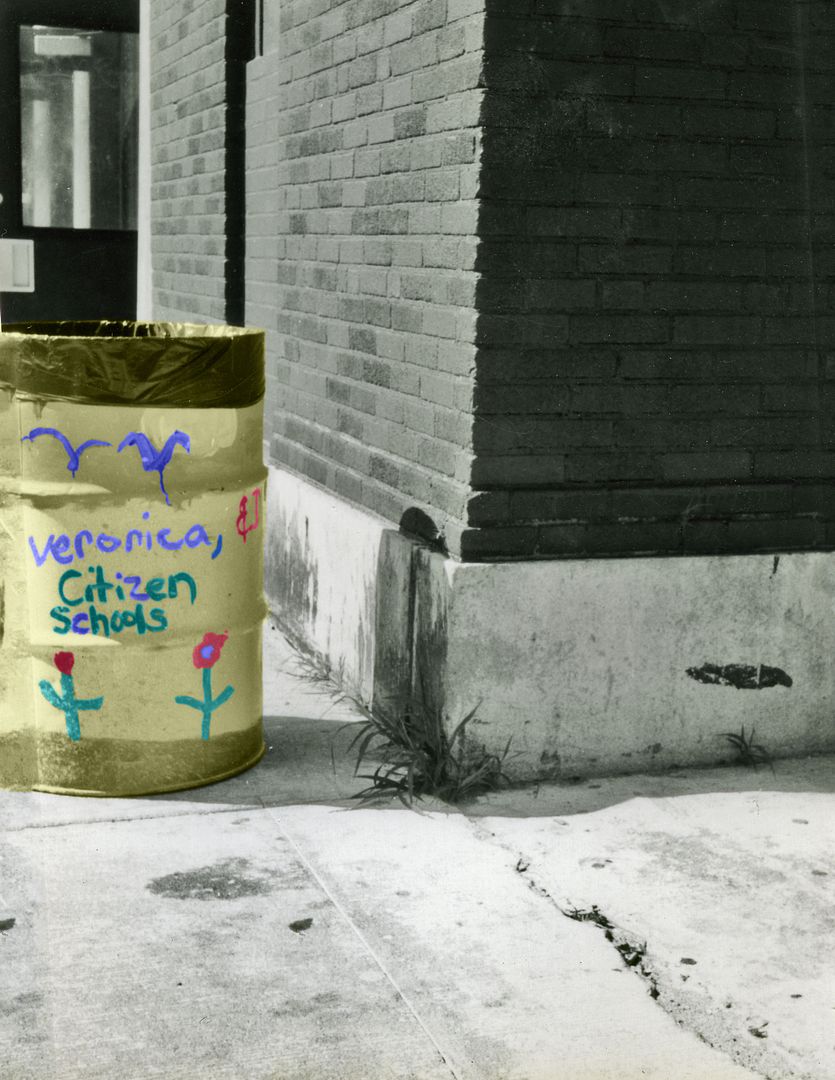
On a corner of the Shawmut MBTA RedLine station in Dorchester—summer 2000.

The acronym for Massachusetts Bay Transportation Authority - sometimes called "The T" - is pronounced exactly as it's spelled and commonly referenced as such.

trash can citizen schools

Veronica Citizen Schools

Friday, May 31, 2024

The New Shingled House

The New Shingled House: Ike Kligerman Barkley on Amazon

The New Shingled House book cover

Architects John Ike, Thomas A. Kligerman, and Joel Barkley have been partners for twenty-five years.

I'm a graphic designer with an interest in houses, and a theologian with a passion for their homemaking implications, so I ordered The New Shingled House―thanks, Amazon Vine! I've long majorly been about The City and Cities, too, and this book enhances my collection of quality printed urban books and city literature. However, the fourteen dwelling places in The New Shingled House are all around everywhere across the vast expanse of the continental USA, and not exclusively in cities. To cite the book description, "the shingled house can suggest the beach, the countryside, the mountains, and even the city."

The 10.3" x 12.3" format, (physically very) heavyweight book is packed full of full-color, mostly full page photographs of interiors and exteriors. It also provides descriptions, commentary, and floor plans. The grand scale of these places impresses me, but possibly part of that impression comes from the perspective of the photographer's camera? The often subtle, usually understated natural colors, materials and textures in every design and production detail of these houses is my idea of elegance! These are models I'd love to draw on and change around to the needs of my own environment.

From any viewpoint, what a wonderfully inspiring resource for designing your own rooms, offices, studios, or almost any work place or living space. Summing up this book and the houses in the book? Fabulous, simply fabulous!

• my amazon review: stunning, opulent, brilliant

The City as a Tangled Bank

The City As A Tangled Bank: Urban Design versus Urban Evolution – AD primer (Architectural Design Primer)

City as a Tangled Bank book cover


The City as a Tangled Bank has taken a permanent place in my growing cities-related library! Terry Farrell, principal of Farrells architect-planners (London, Hong Kong, and Shanghai) brings perspective and wisdom of the kind only a long life of experience and observation can provide! The subtitle implies somewhat of a contest between planning imposed from "outside and above," and growth that occurs from "inside and below" urban space and place, but that expresses it too simply. Along with intro and conclusion, throughout the nine chapters, we learn about the truly endless organic process of letting the city (any city―ancient, young, or in-between) itself show and guide you into what needs to happen for its health and growth―similar to Kevin Lynch's legible city: a city you can read.

Tangled Bank in the title, Evolution in the subtitle both refer to Darwin's Origin of Species. Sir Terry celebrates connecting, communicating, time, layering, adaptation, emergence, and conversion in any urban growth and development process. The author is no fan of Big Architecture, not enthusiastic about Mies, Corbu, et al. After all, that's the type of inorganic, imposed-from without style he decries and dislikes, because it does not spring up from within the urban organism, and is a product of human initiative rather than of the city itself as place-maker―at one point he describes "place as client." If the results are visually attractive, why is that so terrible? Because it does not result in a humanly livable habitat or surroundings.

The bibliography truly is brief, listing five books in the Emergence and Evolution category, a dozen in Urban Design and Architecture, although each chapter includes detailed endnotes. With some in black and white, others full-colour, the many many drawings, photographs, sketches, and maps (with a heavy emphasis on London) enhance the book's clarity and usefulness, helping make it a visual delight. However, I wish the basic text had been printed in a larger type size, and that goes double or triple for the microscopic end notes. Also, physical weight and dimensions make it a nice size to heft. This is not a school textbook or a how-to handbook, so please don't assess it in those terms!

• my amazon review: helping cities become themselves

Wednesday, March 20, 2024

The Exploding Metropolis

The Exploding Metropolis on Amazon
There are several versions; most likely you can buy one very inexpensively.

The Exploding Metropolis Cover

I'm blogging and reviewing the original that's copyright 1958. It has been in my library close to forever but I'm posting my review with the 1993 revision.

A group of "Editors of Fortune" magazine at the time, William H. Whyte, Jane Jacobs, Francis Bello, Seymour Freedgood, and Daniel Seligman considered essential elements of urban design and pondered their effects on city dwellers and urban workers. The book's working definition of city simply is the area within the city limits (viii); almost needless to say, "metropolis" indicates the functional and statistical area or areas geographically beyond yet contiguous to the named incorporated entity.

Exploding sounds like unanticipated, sudden, randomness; if the authors knew they'd seen a lot of that from the mid-20th century up to the time they put this book together, they hadn't seen anything yet, though each of them accurately describes the unexpected, often distressingly unattractive results of urban growth and sprawl—even in some cases of planned change and development. In terms of explosive, the schematic "classic case of sprawl" (on page 119) in Santa Clara County, California from 1945 to 1956 is instructive.

Chapter topics

• Are Cities Un-American?
• The City and the Car
• New Strength in City Hall
• The Enduring Slums
• Urban Sprawl; and
• Downtown is for People

add up to Urban Studies 101 as the authors explore existing infrastructural and superstructural configurations in a dozen established USA population centers (along with a couple of references to Toronto, Ontario, Canada), assess ideas in progress and process, and propose future arrangements that might work in terms of "how to live in cities," the central thesis of The Exploding Metropolis.
the exploding metropolis back

This book now is more than a half-century old, but ever since humans began moving from hunter-gathering into settlements, they've had to figure out the best relationships between living space and working space and the most convenient ways to get back and forth from one to the other; planning and implementing the most pleasing, amenable, visual layouts alongside the practical became close to essential.

Jane Jacobs especially emphasizes "working streets," and advises us to walk, walk, walk, in order to feel and learn how the city all comes together.

Whether discussing clearing and developing land, rehabilitating and rebuilding on an existing site, different styles of city government, housing authorities, port authorities, water works or watersheds, every one of the contributors comes back to human scale and human functionality again and again, making The Exploding Metropolis both basic and classic.

• my amazon review: Urban Studies 101

The Image of the City :: Kevin Lynch

The Image of the City. Kevin Lynch, Harvard-MIT Joint Center for Urban Studies, © 1960

Kevin Lynch The Imge of the City

The Legible City—a city you can read! As an iconographer writes rather than draws or paints an icon, a city comprised of colors, shapes, motion, and light can be viewed, read, and interpreted as an environmental image. The picture includes identity (what is it?), structure (space, shape, pattern relation and discrimination), and meaning (emotional, psychological, historical values) from the observer's own experiences. Each image derives from here and now; the city "image also is soaked in memories and meanings." [page 1] And, of course, there's not a single public image of any city, but a series of overlapping and interrelated ones.

From author Kevin Lynch: "This book is about the look of cities, and whether this look is of any importance, and whether it can be changed." This book is "a first word not a last word…" it's "at once tentative and presumptuous." The research method consisted of relatively objective systemic field reconnaissance and relatively subjective interviews with a small sample of mostly professional and managerial city residents. Citizens interviewed in Chapter 2, "Three cities," were exceedingly small samples: 30 in Boston, 15 each in Jersey City and Los Angeles, so these are not necessarily commonly held public images of those cities.

Kevin Lynch and his colleague Gyorgy Kepes researched and wrote this book during the 1950s; since then we've moved from Metropolitan Statistical Areas to a string of Megalopoleis (I found 3 possibilities for the plural of megalopolis and chose this one). At least two Boston features in the book no longer exist: Scollay Square, superseded by Government Center that includes City Hall of still controversial love it or hate it (I adore it) architectural design, and the Central Artery, replaced by the most expensive public works project in history: The Big Dig. But you will find physical structures of paths, edges, nodes, districts, and landmarks in any human population center larger than a village, so they're not necessarily an urban distinctive. "Districts are structured with nodes, defined by edges, penetrated by paths, and sprinkled with landmarks." [pages 48-49]

The five chapters include:

• The Images of the Environment

• Three Cities—Boston, Jersey City, Los Angeles. In each case, studies came from a small central area of 2.5 x 1.5 miles.

• The City Image and Its Elements

• City Form

• A New Scale

Appendices are sufficient to make another short book:

• Some References to Orientation

• The Use of the Method

• Two Examples of Analysis [Beacon Hill and (the late) Scollay Square, Boston]. There's also a bibliography and index. Margins throughout the book include many many line drawings and there are quite a few Black and White photographs.

In terms of future cities The Image of the City might influence, "We have an opportunity of forming our new city world into an imageable landscape: visible, coherent, and clear." By definition a city is multi-purpose with mixed functions yet with "fundamental functions of which the city forms may be expressive: circulation, major land-uses, key focal points. [pages 9-92] The common hopes and pleasures, the sense of community may be made flesh. Above all, if the environment is visibly organized and sharply identified… it will become a true place, remarkable and unmistakable."

As a handbook about present and about possibilities, "what we seek is not a final but an open-ended order, capable of continuous further developments" [page 8] The Image of the City "is about the look of cities, and whether this look is of any importance, and whether it can be changed," but appearance is an immeasurably critical part of the infrastructure that supports all the activities of the urban enterprise, the work, play, school, and home lives of the city's citizens. A city's physical appearance and the emotional responses that arise from it can be the reason someone wants to move there or the reason they long to leave. "The map, whether exact or not, must be good enough to get one home." [page 9]

Close to the end Kevin Lynch reminds us of Susanne Langer and gives us her definition of architecture: "the total environment made visible." Remember Langer's Philosophy in a New Key where she writes about our human need for symbols and our need to symbolize, to invent and invest meanings in objects, our environments, our activities, and our world?

These are shapes, spaces, and vistas that will – or won't – attract new artistic, educational, and commercial enterprises; no wonder this book is a classic! Kevin Lynch's prose is dryer than I'd prefer, but it is what it is, and if someone doesn't write like a poet, they don't. I'll give The Image of the City a high recommend to read and to read again.

• my amazon review: The Legible City

Welcome to the City!

On a couple of my other blogs I've posted some old material; the following paragraphs are from a short-lived site on the MSN pages I hosted during summer 2000 and so fun to remember and think about. I'm blogging the introduction here, and then posts on the three topics we actually developed, in topical order rather than jumbled according to date. In what used to be my almost usual social-scientist identity (whatever happened? It got outpaced by the theologian, I guess), I initiated the subjects we discussed.

Welcome to The City!

Welcome to The City! Whether you've always been a city person, whether you live in a suburb or rural area and wouldn't have it any other way, whether you come to the city mainly for fun – to see the sights, hear the sounds, shop the stores, enjoy the restaurants, have an out-of-the-ordinary experience – you'd probably like to join our virtual city! We'd love to have you, and you probably have lots and lots of ideas and opinions to contribute. Welcome!


Atlanta Georgia skyline
The City and Distributive Justice

From: Leah (Original Message) Sent: 8/23/2000 12:27 PM

Who gets what, why, when, how and where in terms of goods and services long has been and continues to remain the central focus of life in the city for many people. This has always been so in any geopolitical area with a distinct income disparity between different groups and different individuals. Globally, of course, but also in the "First World."

In the United States we see it in striking terms, striking because there exists such splendid wealth back-to-back with such indescribable poverty. "Why" probably is the first question. Individual income combined with the inefficient and short reach of governmental and private not-for-profit agencies first come to mind as primary factors. But there are people living in the inner city with adequate incomes who have known only a culture of poverty and who therefore choose either consciously or unconsciously to continue that lifestyle.

From: Aisha in response to Message 1 Sent: 8/29/2000 11:14 PM

America's foundation is built on the many backs that we step on or stab to get to where we are today. It's definitely survival to the fittest. This is not a democratic country. There is no such thing. Democracy would only be successful if everyone wanted the same thing for everyone else...Pure equality. That will never be. Because there's always someone that wants you to kiss their ass.

On the other spectrum, there are so many spineless jellyfish out there that are willing to do it. Fighting for beliefs or rights has become about as faddish as bell-bottoms. The rich will be the "haves" while the poor will be the "have nots." When the "have nots" finally get tired of pressing their noses against the windows of the "haves" lives, that's when the division will stop. Knowledge is power. If everyone could empower themselves and their children with the will that you can be successful no matter where you're from, then we can ALL receive equal justice.


Boston Massachusetts financial district
The Arts in Inner City Boston

From: Leah (Original Message) Sent: 8/26/2000 1:38 PM

Living in Boston this summer, I've experienced an incredibly rich diversity in what might be called the "popular arts." The music takes two basic forms: live and impromptu (Gospel, soul, hip-hop, steel drums, rap, and probably some forms I don't recognize) and recorded CDs. Some of the CDs blast forth from houses, cars, or boomboxes on foot, some of them are simply background to whatever activity is in progress, for all ages, any age. And the CDs are quite likely to contain what's generally called "objectionable lyrics," as well as evoking very definitely objectionable images.

I'll comment just briefly on the visual arts. To me, they're far more exciting than the music. Colorful, representational paintings on the sides of buildings, on trash cans, on sidewalks. And of course, the large paintings the local daycamps and preschools turn out—some of them are very well done!

In contrast to the Inner City Arts are the Downtown Arts. Some more sophisticated, professional versions of what we have here in the inner city, but downtown one also can find classical concerts, free and not, as well as museums, most of which charge an admission price way out of the range of most of the people around where I live. However, there are a few cost-free times at some of the museums, but unfortunately it's still a hefty price to get into the special exhibits.


Cleveland Ohio
Metro Area Population

From: Leah (Original Message) Sent: 8/19/2000 6:46 AM

I'm concerned that the high price of good housing in most cities will be sending people out of the Metro/Central City area to less expensive, but also less desirable and attractive neighborhood and housing. Part of my concern includes the very real possibility of more affluent people and families moving into the vacated housing, rehabbing it, and increasing the value not only of their own housing, but also of the housing stock in the surrounding neighborhoods.

From: Aisha in response to Message 1 Sent: 8/20/2000 8:57 PM

I live in Georgia. Suburban "sprawl" has affected every area of our state. No community is really safe. Even though there is more money being brought into the less desirable communities, the prices have been skyrocketing. Whoever has the gold holds the key...

From: Leah in response to Aisha

You said it perfectly: "Whoever has the gold, holds the key..." Community organizing is the only answer that has any chance at all. People may think it's behind the times, but if bunches of people would get out there, they'd find it works!

From: Torrie in response to Message 1 Sent: 8/25/2000 4:30 AM

It seems that here, in Ohio, the cost of housing is less expensive within the city. There are a few exceptions—German Village, Victorian Village, Italian Village. The cost of housing in the suburbs is skyrocketing—along with increased property taxes. Property taxes alone consume 30% of my monthly mortgage.