Showing posts with label mark. Show all posts

Friday, August 28, 2026

Five Minute Friday :: Here

here with  fancy background

Five Minute Friday :: Here Linkup

1 God is here! As we your people
meet to offer praise and prayer,
may we find in fuller measure
what it is in Christ we share.
Here, as in the world around us,
all our varied skills and arts
wait the coming of your Spirit
into open minds and hearts.

2 Here are symbols to remind us
of our lifelong need of grace;
here are table, font, and pulpit,
here the cross has central place.
Here in honesty of preaching,
here in silence as in speech,
here in newness and renewal
God the Spirit comes to each.

• words by Fred Pratt Green, ©1979, Hope Publishing Co.
• music, Abbot's Leigh, Cyril V Taylor ©1942, renewed ©1970, Hope Publishing Co.

Do you know this hymn? It's one of my favorites to lead from organ or piano and a favorite to sing when someone else leads it well. Do you know the promise of this song? God is here. With references to God's assembled, Spirit-filled people and God's presence in the sacraments, in scripture, and in preaching, it's especially appropriate as the gathering song for worship.

Scripture tells us Jesus Christ ascended to the right hand of God. [Mark 16:19] As Martin Luther explains, God's right hand, God's sovereignty, is everywhere, therefore Christ is present not simply right here, but everywhere—though in a special way "for you, for me, for each of us" [1 corinthians 11:24] in the Savior's particular presence in the Lord's Supper.

We start and continue worship aware of God's presence here within the gathered assembly. Does that remind us to look for God elsewhere, because if God is here in this place, God may be there in our next here, in every right "here" where we find ourselves and others find us?

Do you remember the promise of God's life in us here in the world?

On the day of Pentecost the gathered people received the indwelling Spirit of Life [Acts 2:1-18]. Because at baptism each of us receives the Spirit, in our daily walk in the world we are the Body of the Crucified and Risen Christ here on earth. [1 Corinthians 3:16]

Being in God's presence during worship is an important "here" place to be, but in many ways it's a model, a rehearsal, and a reminder that God is right here – and right now – wherever we are.

What places are your favorite heres?
# # #
all saints san diego font
saint marks los angeles communion table
Sylvia
FMF here
FMF logo icon

Saturday, June 27, 2026

Brian Drinkwine :: Kingdom Over Empire

• The release date for Kingdom Over Empire is Tuesday 30 June. If this overview entices you to get the book, it would be best if you wait until the morning of June 30th.
kingdom over empire cover

Kingdom Over Empire: Recovering the Gospel from Political Captivity by Brian Drinkwine on Amazon

Brian's Website

Page numbers are from the ARC PDF and are not the same in the print copy.


Poetic, pastoral, and probing, Kingdom Over Empire provides scripture and history to help you sort out your allegiances. Pastor Brian Drinkwine doesn't advise is. He trusts us. I need this book! Whether you live in a Western-style democracy or elsewhere, you need this book!

Kingdom Over Empire. Particularly in politically blue circles in the USA, one major reaction to goings-on in the current presidential administration has been an active, vocal No Kings movement. The general idea is American colonials broke away from royal rule and chose elected leadership rather than hereditary monarchies, and we continue on that path.

Related to not having kings, in protestant mainline churches, especially some individuals in so-called professional leadership in local churches or judicatories have come close to conflating deep blue politics and progressive Christianity. Though I've hovered on the edge, I haven't quite gone there. Brian's book shows us what a Yes Kings affirmation is when the King is Lord of the Universe, Lord of Life Jesus Christ.

I plan to take seriously assessing how outside forces and influences have affected our (my) perspectives and our (my) fears. That's called formation as in the shape, the traits, instincts, love, convictions, assumptions that intrinsically are part of us—that motivate us, too.

And what we are willing to excuse! Brian offers us "companionship from nearby" because according to one of his blockquotes, You do not need a movement. You need companions.
companionship

Two critical definitions:

page 33: "Patriotism is love of place without allegiance to place." It's "grateful stewardship of the land, people, and institutions where God has planted us … At its best, it seeks the welfare of the city."

page 34: "Nationalism happens when love of country becomes something it was never meant to be. Nationalism is what happens when patriotism crosses the line from stewardship to identity."

In the church we casually talk about belief, which too many equate with intellectual assent. But first century pistis belief is allegiance, loyalty, trust; it's a whole body-essence of your being posture. [page 44]

Although it's political, social, and economic, in its essence empire is a way of organizing power over time. You likely can list biblical empires such as Egypt, Babylon, Persia, Rome; you can add in more recent Spanish, British and others. But educational, ecclesiastical, consumer, and other entities also operate in an imperial manner because Babylon/empire is pattern rather than place. It is out there. It is in here. Think about it!

Brian provides a short list of lifestyles and religions you could call Christian Pretenders because they're not the good news Mark, the earliest gospel announces to open his proclamation. They aren't Theology of the Cross; many are theology of glory that humans find appealing and humanly doable.

For the Apostle Paul, the gospel is death and resurrection. In Kingdom Over Empire, the author traces the subversive power of the cross and God's faithful actions that paradoxically create new life out of death.

Brian beautifully reminds us Jesus came announcing, "Not a kingdom built on dominance, but on restoration. Not a kingdom advanced by force, but by faithfulness. Not a kingdom that secures itself through control, but one that grows through surrender."

"In this kingdom, blessing begins with the honest recognition of need. The poor are lifted up. The imprisoned are set free. Those far from God are not threats to be managed but treasures hidden in a field. …This kingdom promises not control, but resurrection." [page 84]
formation

"Writing to a church confused about what faithfulness meant, Paul does not appeal to their influence or their success. He appeals to the resurrection."

“But Christ has indeed been raised from the dead, the firstfruits of those who have fallen asleep” (1 Corinthians 15:20).

"Firstfruits. The first sign of a harvest that is coming, proof that more is on the way. If Jesus has been raised, then death does not have the final word. And if death does not have the final word, then neither does empire. Neither does failure. Neither does obscurity." [page 162]

Short summary:

"The call is not to disengage from society but to disentangle from idolatry. You can vote without making the vote your hope. You can advocate without making advocacy your salvation. You can be present in the public square without giving the public square the allegiance that belongs to Christ.

"The call is an echo of the Exodus. It is a summons to live as exiles—in the empire but not of it.

"This does not mean we abandon society. It means we refuse to be seduced by its idols. We resist its economy, its nationalism, its violence, its counterfeit hopes.

"We live as if Jesus is King, because he is. And we hold loosely to everything Babylon promises, knowing that it will not last." [page 178]

Kingdom Over Empire is a workbook. It's devotional. It's heavy-duty theology. It offers a direction for us to travel together in order to restore life and hope to a world dominated by empires. Throughout the book, Pastor Brian offers his own testimony. Will your life testify of a King who reigns from a cross?
no king but chrisr

Disclaimer: As a member of the launch team I received an Advance Reader Copy with no expectation or obligation to write a positive review. As always, my opinions are my own (and you know I wouldn't have it any other way).

Monday, June 08, 2026

Pentecost 2A

My sermon from yesterday.

Matthew 9:9-13

As Jesus was walking along, he saw a man called Matthew sitting at the tax-collection station, and he said to him, "Follow me." And Matthew got up and followed Jesus.

And as Jesus sat at dinner in the house – Matthew's house – many tax collectors and sinners came and were sitting with Jesus and his disciples.

When the Pharisees saw this, they said to his disciples, "Why does your teacher eat with tax collectors and sinners?"

But when Jesus heard this, he said, "Those who are well have no need of a physician, but those who are sick. Go and learn what this means, 'I desire mercy; not sacrifice.' For I have not come to call the righteous but sinners."
picnic table
Here in the global North, we're one week into the halcyon days of summer, with sunny days, star-spangled nights, picnics, barbecues, music on the half shell, and feeling all of our dreams may come true, after all.

At the same time, the church's year of grace has opened wide the six month long season when we count Sundays after the Feast of Pentecost, a time of the Holy Spirit of Pentecost when the Church really comes into its own as we discern God's call and claim on our lives, and what ministries God may be calling us to respond to. Green is the liturgical color for these months, as we act in ways that help the world around us bloom and flourish.

This is the year of Matthew's gospel; today's gospel reading is Jesus' call to Matthew and Matthew's response. Although none of the earliest gospel manuscripts indicate an author, a community gathered around this disciple Matthew probably wrote this gospel.

As we just heard, Jesus notices Matthew at his workplace. Matthew collected taxes, tariffs, and tolls in the employ of the occupying Roman government. People generally hated tax collectors because – among other abuses – they added on their own charges to the amount required to return to Rome.

The gospels of Matthew, Mark, and Luke all contain this story. And, Mark and Luke tell us this tax collector's name was Levi, which means he was from the priestly tribe of Levites that ministered at the Jerusalem Temple. In other words, his life had fallen off the rails and he was in a profession opposed to his origins.

Today's reading from Matthew's gospel only mentions a house, but Luke and Mark tell us it was Matthew's house where Matthew/Levi made an extravagant banquet. Although we don't know the elapsed time between Jesus' invitation and Matthew's response, Matthew doubtless already knew a lot about Jesus. As part of his response to Jesus' invitation to follow him, Matthew offered an amazing feast to all comers, as if he already knew plentiful food was one of the signs of the presence of God's reign on earth.

Luke tells us everyone reclined at table. In that culture, reclining for a meal was a sign of shalom, of having "enough," no longer needing to scratch for life or be beholden to empire. Reclining at table meant everyone was an equal among equals.

* * *

You know about the ultra-religious pharisees with their self-righteous attitudes, and how they separated themselves from everyone else to avoid contamination. Jesus references "sacrifice" of the ceremonial law that did nothing to connect anyone to God, nothing to benefit anyone anywhere. Jesus reminds us he wants mercy.

Long ago in a previous life I knew a young woman I'll call Cheryl, because her name was Cheryl. Life dumped a lot on her from outside, and she made some decisions that had negative outcomes. It felt as if everyone was giving her unhelpful suggestions. When a new dog came into Cheryl's life and she decided to adopt him, she told me she asked herself what trait or characteristic did people need most? Her answer was mercy, so she named her new canine companion Mercy.

Is God able to name and call each of us Mercy and Merciful?

* * *

Originally for this start of the season of Pentecost when we discern and engage ministries that help the world bloom and flourish, I considered asking all of us to divide our lives into our immediate home, workplace, neighborhood; this parish and any other church communities where you're involved; and the larger, greater world out there. I thought I'd ask each of us what God is calling us to do in each of those arenas—smaller, manageable acts of service. That still feels like a good idea, but it's clear to me that the past couple of months, last Sunday's guest from Global Refuge, the needs of the city and county of Los Angeles and beyond, and today's immigration focused retreat after worship all point us to a continued emphasis on immigration and immigrants.

Last week Karla from Global Refuge placed immigration in the context of the Pentecost of our baptism! Scripture tells us we all are strangers and sojourners everywhere we go, and God travels with us.

I don't have an answer or a suggestion for ways to engage and minister around immigration during the next few months. We know it takes prayer, thought, listening, time, and conversations to discern where God is leading us and the nature of our responses.

* * *

Again today Jesus invites everyone to the table of grace for a foretaste of the feast to come when…

…many will come come from the east and the west, the north and the south, and recline at table in the Kingdom of Heaven. Luke 13:29

Amen? Amen!

Our song of the day is "We Come to the Hungry Feast"
table filled with food

Monday, February 09, 2026

Pentecost 3B :: Good News

Mark 1:1
Mark 3:16-35

16 So Jesus appointed the twelve: Simon (to whom he gave the name Peter), 17 James son of Zebedee and John the brother of James (to whom he gave the name Boanerges, that is, Sons of Thunder), 18 and Andrew, and Philip, and Bartholomew, and Matthew, and Thomas, and James son of Alphaeus, and Thaddaeus, and Simon the Cananaean, 19 and Judas Iscariot, who handed him over.

20 Then he went home, and the crowd came together again, so that they could not even eat. 21 When his family heard it, they went out to restrain him, for people were saying, "He has gone out of his mind." 22 And the scribes who came down from Jerusalem said, "He has Beelzebul, and by the ruler of the demons he casts out demons."

23 And he called them to him and spoke to them in parables, "How can Satan cast out Satan? 24 If a kingdom is divided against itself, that kingdom cannot stand. 25 And if a house is divided against itself, that house will not be able to stand. 26 And if Satan has risen up against himself and is divided, he cannot stand, but his end has come. 27 But no one can enter a strong man's house and plunder his property without first tying up the strong man; then indeed the house can be plundered.

28 "Truly I tell you, people will be forgiven for their sins and whatever blasphemies they utter, 29 but whoever blasphemes against the Holy Spirit can never have forgiveness but is guilty of an eternal sin"— 30 for they had said, "He has an unclean spirit."

31 Then his mother and his brothers came, and standing outside they sent to him and called him. 32 A crowd was sitting around him, and they said to him, "Your mother and your brothers are outside asking for you." 33 And he replied, "Who are my mother and my brothers?" 34 And looking at those who sat around him, he said, "Here are my mother and my brothers! 35 Whoever does the will of God is my brother and sister and mother."
* * *

What's good news to you?

We're in Mark's gospel year!

Mark has been our main gospel since a new year of grace began on the first Sunday of Advent. During the Great Fifty Days of Easter, we heard from John's gospel; now we're back in Mark as we start the six month long season of the Spirit. This is the green and growing season of Pentecost, when the church comes into its own with the Acts of the twenty-first century apostles. That's us!

First, Mark opens with "the beginning of the Good News, the gospel, of Jesus Christ, Son of God."

What's good news to you?

• Mark is the earliest gospel and the shortest one. It has no birth account. No genealogy. No resurrection in the earliest sources.

• Mark includes a lot of miracles, healings, and exorcisms.

• Mark is about the end of the world as we've known it!

• In Mark's gospel, Jesus' journey to Jerusalem and the cross is incessant and focused. For Mark, his passion, cross, and death by imperial powers that be provides the best understanding of Jesus of Nazareth's purpose and identity.

• Our baptism into Jesus death and resurrection provides the best understanding of the church's mission and identity.

• We are the people who continue this written-down "beginning of the Good News."

What's good news to you?

* * *

According to the evangelist Mark, we don't find God in the Jerusalem Temple. God is not far away and unreachable. We cannot find God in any religious, social, cultural, political, or economic establishment.

Mark tells us we find God:

• in the cross
• in the wilderness
• outside the city limits
• in the stranger
• in the unexpected

Mark's Jesus brings the end of the world as we've known it.
Mark brings us the great good news of the Reign of Life.

* * *

Where are we now?

Two weeks ago on the Day of Pentecost and the fiftieth day of Easter we celebrated the Holy Spirit symbolized with wind and fire. We anticipated full diversity and inclusion. The first Christian Pentecost happened when some early Jesus followers were in Jerusalem for the Jewish Pentecost, the annual celebration of God giving the ten words of the Sinai covenant through Moses. The commandments that shape our life together. And they were in Jerusalem to celebrate the wheat harvest that fed and sustained their physical lives.

The fiftieth day of Easter, the Festival of the Spirit gets us ready for the green and growing season of the church…

…baptized into the HS of Pentecost, we follow Jesus into the world abounding with the good news of the end of the dysfunctional parts of the world

We follow Jesus to the edges, the margins, the wild places, and we continue to minister right here in this space, in our homes, in our workplaces, in this neighborhood. We help create the end of the world as everyone has known it.

* * *

Back to today's reading. We're near the start of Jesus' public ministry and we hear,

"THEN" Jesus went home. Then? After what?

• after John's baptism by John in the Jordan River
• after forty days in the wilderness–an even more remote location than the Jordan
• after teachings and miracles
• after interactions with powers that be

Most important for us, then Jesus went home "AFTER" he called disciples and sent them out.

Today's cast of characters that we know about includes:
• A packed crowd
• Jesus' family of origin
• Religious leaders from Jerusalem

all of these people followed disruptive provocative Jesus home to Nazareth!

We could write a book about Jesus and the people who crowded him
About Jesus and his biological family in this reading and elsewhere


People have written books about the religious leaders' reaction to Jesus' home invasion robbery parable that we heard today.

Because tying up and immobilizing dysfunctional aspects of economic, religious, political, educational institutions is central to Jesus' ministry. Those actions are especially vital to the cross of Good Friday and the empty grave of Easter. They helped create the end of the world as everyone had known it and expected it to continue? Were Jesus' actions blasphemy against the HS? Some onlookers thought so.

* * *

But we're at the start of the second half of the church's year of grace, so let's consider Jesus' words and actions. He wondered:

33 Who are my mother and my brothers?
34 Looking at those around him he said, "here are my mother and my brothers."
35 Whoever does the will of God is my brother and sister and mother.

Did you noticed Jesus never excludes his biological family?

"Church as family" sometimes doesn't sit well, especially given traits of some biological and adoptive families. But we are Jesus' family, joined to him and to each other in our second birth by water and word; filled with the HS in baptism.

Mark's gospel opens by announcing the beginning of the good news

What's good news to you?

• a new family arrangement?
• a new family?

How about the end of the bad, dysfunctional parts of our economic, religious, political, educational systems?

Something different from the disappointments of your last half dozen years?

What's good news to you?

Those early Jesus people gathered on the Jewish Pentecost. Pentecost celebrated the ten words or commands of the Sinai Covenant that still bind us to our God and to one another and charge us:

• to do justice
• to act with mercy
• to love God by loving our neighbors

Whether the neighbor is human, plant, animal, or water. We're still caring for the LA River, right?

To love the immigrant and the refugee and that annoying person at work

When we love creation, the ground, the waters, the cities and the outskirts, a bountiful harvest will help feed us and our neighbors.

* * *
bread and cup
What's good news to you?

Today Jesus invites us to the table of grace for the good news of a taste of heaven on earth.

In the Lord's Supper

• all are forgiven
• all is healed

This Holy Communion, this Eucharist is good news.

Amen? Amen!

To God alone be glory.
Amen.
Los Angeles River

Saturday, February 07, 2026

Pentecost 4B Creation Care

creation care box
Sometimes people want to hear what they already know.

Scriptures

• Ezekiel 47:9

Wherever the river goes, every living creature that swarms will live, and there will be very many fish once these waters reach there. It will become fresh, and everything will live where the river goes.

• Ezekiel 47:12

On the banks, on both sides of the river, there will grow all kinds of trees for food. Their leaves will not wither nor their fruit fail, but they will bear fresh fruit every month, because the water for them flows from the sanctuary. Their fruit will be for food and their leaves for healing.

• 2 Corinthians 5:17

So if anyone is in Christ, there is a new creation: everything old has passed away; look, everything has become new!

• Mark 4:26-34

26 Jesus also said, "The kingdom of God is as if someone would scatter seed on the ground 27 and would sleep and rise night and day, and the seed would sprout and grow, he does not know how. 28 The earth produces of itself first the stalk, then the head, then the full grain in the head. 29 But when the grain is ripe, at once he goes in with his sickle because the harvest has come."

30 He also said, "With what can we compare the kingdom of God, or what parable will we use for it? 31 It is like a mustard seed, which, when sown upon the ground, is the smallest of all the seeds on earth, 32 yet when it is sown it grows up and becomes the greatest of all shrubs and puts forth large branches, so that the birds of the air can make nests in its shade."

33 With many such parables Jesus spoke the word to them as they were able to hear it; 34 he did not speak to them except in parables, but he explained everything in private to his disciples.
blueberries blackberries raspberries
Creation Care Outline

Where are we now in the church's year of grace? One month ago we celebrated the Day of Pentecost, the fiftieth day of Easter. We recollected when a large group of Jesus' first followers gathered in Jerusalem for the Jewish Pentecost. They remembered and affirmed God giving the Ten Words or Commandments through Moses, that way of obedience you could call the Working Papers for our lives together. And they celebrated the wheat harvest, God's gift from the ground that sustains our bodies every day.

Here in the church we recently started the six month long green and growing season of Pentecost; during this stretch of time we emphasize all creation as God's planting,. You know the story of God and God's people and the land from Genesis through Revelation.

Today's scriptures offer agricultural images. We hear from the prophet Ezekiel, and we hear two parables from Mark's gospel: scattered seeds and the famous mustard seed! The gospels of Luke and Matthew also include the mustard seed parable, so that may mean it's especially important.

A month ago we celebrated the Christian Day of Pentecost, or the fiftieth day of Easter. Christians have been celebrating Easter for two thousand years! Our formal theology tells us Jesus Christ's death and resurrection ended endless cycles of death, violence, and everything contrary to God's intention, but we look around and still see war, climate chaos, sorrow, sickness, death—none of that is over and done with yet.

Even though Jesus Christ has died, is risen from the grave, and ascended to reign from the right hand of God, even though we identify as Easter people… what's going on?

Jesus' original followers wondered, too.

After Jesus' resurrection and before his Ascension, in Luke's book of the Acts of the Apostles, his friends and followers asked if now he finally would "restore the kingdom" to the world. Jesus informed them the question was wrong. He told them to stay and wait right there in Jerusalem. and they would be his witnesses, they would testify to new life. In the power of the Holy Spirit of Pentecost, they would be Jesus' presence in the world.

In Romans 8:19-21 the Apostle Paul tells us all creation waits, hopes, and longs to discover us as God's authentic offspring, as people who embody, reflect, and act in God's image to help redeem all creation. Like Jesus!

The agricultural parables in the Good News of Jesus Christ, Son of God, according to Mark, align well with today's song, "God, Whose Farm Is All Creation." All creation. Not only prairie and heartland. But also crowded, overbuilt cities and suburbs. Remote rural wide spots in the road. Deserts. All creation is God's garden. God's land. God's farm.

God whose farm is all Creation,
take the gratitude we give,
take the finest of our harvest,
crops we grow that all may live.

Take our ploughing, seeding, reaping,
hopes and fears of sun and rain,
all our thinking, planning, waiting,
ripening into fruit and grain.

All our labor, all our watching,
all our calendar of care,
in these crops of your creation,
take, O God; they are our prayer.

Author: John Arlott

Romans reminds us creation hopes to discover that we'll treat oceans, wetlands, savannas, and cities in ways that help them heal. Creation watches us and waits for us to become good caretakers of waterways, trees, animals, insects. Of our own backyards and window boxes!

The new creation began 2000 years ago. That eighth day of the week, was the first day of a new reality. The new creation is not finished. The old creation still waits and hopes for us to be green people.

What's a biblical creation care model? We need to learn about plants, about seeds and soils, climates and seasons. It's also a great idea to act locally!

In the bible's promised land we see:

Crops watered by cascades down mountains into valleys and not by water shipped thousands of miles Gardens warmed by the great light of the sun and not by plugged in grids

Scripture shows us act locally. You know some of the ways:

• farmers markets
• street vendors
• community gardens
• backyard plots
• kitchen windowsill herb gardens
• composts

School and community gardens can help cancel food deserts
Besides, living local adds savor and flavor
Although we lose some long term keeper food
When that happens?!
Share the extras!
Trust the mystery!

In Ezekiel we hear about rivers flowing from the temple and healing everything the waters touch. Because everything those waters reach becomes healthy and well, the name of the city then becomes The Lord Is Here.

Today Jesus invites us to his table of grace. This eucharistic festival of thanksgiving is a taste, a token, a sign, a promise of creation completely redeemed.

Christ is raised and dies no more.
By water and the word
we share his death
his Eastered life

The new creation comes to life and grows
Everywhere we go!
Alleluia.
Amen!

Thanks be to God.
Amen.

creation care

Friday, March 15, 2024

Five Minute Friday :: Hurry

interstate 8 in San Diego California
Mid-June 2015 along Interstate Highway 8 in San Diego, California


Five Minute Friday :: Hurry Linkup

Intro

FMF host Kate has been participating in a study of the gospel according to John at her church. When she mentioned they're using a book by Melissa Spoelstra, I lit up because I remembered Melissa's excellent study on Joseph and forgiveness I read and reviewed.

Although Kate observed that Jesus never seemed to hurry through his (three year long, according to John) public ministry, that really depends on which gospel account you're considering. John's Jesus feels focused, calm, and deliberate, because *even* more than synoptics Mark, Luke, and Matthew, John brings us realized eschatology of the right here, right now of the reign of heaven on earth. Celebrating at a wedding party is Jesus' first act of public ministry in John, so we've got the astonishing goods that happen "on the third day" at this very moment, in this very place, and it only will get better.

John is the latest gospel, and in many ways it's an outlier from the other three that made the canonical cut.

However, when we read Mark, the earliest and shortest gospel, all the action is urgent and the Savior moves nonstop. In Mark the transitional word "immediately, straightway/straightaway" occurs at least forty times. Just sayin'…


Hurry

As I write to Hurry alongside Kate's roadway traffic image, the vehicular freeway congestion and pollution that has emerged as an icon of American haste and ambition won't escape me. The worst part is that so few of us differentiate between ideas, activities, and outcomes that need to be treated as urgent, that must be attended to post-haste, and those that can take their time, those many that fare much better if they have time to wait, sprout, then finally blossom and bloom.

The day I took these photos along "The 8," or Interstate Highway 8 in Mission Valley, San Diego, I was on my way to a noontime meeting and intentionally captured the road without cars. That probably would have been impossible in Los Angeles, but San Diego is slower paced, hurries less, and leans into its small town heritage and personality more readily than places like ultra megalopolis Los Angeles (yet the city of LA has neighborhoods zoned for horses!). Does that mean San Diegans are better at discerning whether or not to hurry? To a limited extent, yes.

Whether within our family, at work, sharing the gospel, or caring for ourselves, we need to discern when to hurry ("time is of the essence!") and when hurrying is unnecessary or counter productive.


Heaven on Earth

Along with John's, the synoptic gospels all acknowledge the reign of heaven, God's Kingdom already is here on earth. A couple of proof texts, though God's presence, love, healing, and hope fills all the gospels:

• But if I cast out demons with the finger [power] of God, surely the kingdom of God has come upon you. Luke 11:20

The reign of heaven is here.

• But if it is by the Spirit of God I cast out demons, surely the kingdom of God has come unto you. Matthew 12:28

If. Since. Then. Surely. Without a doubt.

In the Spirit of Pentecost God's reign continues with the church in the world as the body of Christ. We often don't feel the calm deliberation of John's Jesus, but I love how we're slowed down and unhurried when we assemble on the Lord's day. In words from one of my favorite more recent hymns we acknowledge:

God is here!
As we your people meet to offer praise and prayer. …
Here are symbols to remind us of our lifelong need of grace;
here are table, font, and pulpit; here the cross has central place.

Written by Fred Pratt Green; please sing it to the tune Abbot's Leigh

# # #
Interstate 8 Mission Valley San Diego
five minute friday hurry highway
five minute friday button icon logo

Friday, January 19, 2024

Five Minute Friday :: Say

Nark 11:23-24
"…if you say to this mountain,
'Be taken up and thrown into the sea,'
and if you do not doubt in your heart
but believe what you say will come to pass,
it will be done for you." Mark 11:23

"So I say to you,
whatever you ask for in prayer,
believe that you have received it,
and it will be yours." Mark 11:24


Five Minute Friday :: Say Linkup

In Mark's gospel, the journey to Jerusalem and to the cross is particularly incessant and relentless. Jesus' assuring teaching on the power of speech, word, and prayer (also in Matthew 21:21-22) happens during his final trip to the Holy City, after he has cleansed the temple and cursed a barren fig tree (another subject for another blog on another day).

Jesus and the twelve have been on a perilous journey together. When he called followers, he asked them to follow him. They left their family fishing enterprise with its conventional, pre-planned days and expected outcomes to follow Jesus, although they couldn't have known the future.

Even reading silently or aloud from Mark's pages, we can feel it had been quite a trip. Although Mark opens his gospel by announcing, "The beginning of the Good News of Jesus Christ, the Son of God," and close to the end, a Roman centurion declares Jesus "Son of God" [Mark 15:39], were there many or any clues along the way to suggest or affirm Jesus as God with them, God among us? We need to remember all the gospel accounts – even Mark, the earliest one – were written from scattered sources quite a while after Jesus' death and resurrection. In any case, back to say, our word for today.

Jesus is conversing about the power of speech, the effectiveness of words and communication. Would anyone want to send a mountain or a beachside cliff into the ocean? Hebrew literature long had been full of hyperbole! In the midst of your own turmoil, would you consider addressing an element of creation, suggesting it do your bidding? I don't know.

But I do know I love the "if - then" promises in this passage, especially pertaining to prayer.

• Do you pray without doubting?
• Do you say with believing?
• Do you pray knowing you've already received what you asked for?
• And do you then claim God's response as yours?


• You might enjoy this overview of Mark I wrote for my scripture blog.

five minute friday say
five minute friday button icon logo

Saturday, February 13, 2021

Transfiguration 2021

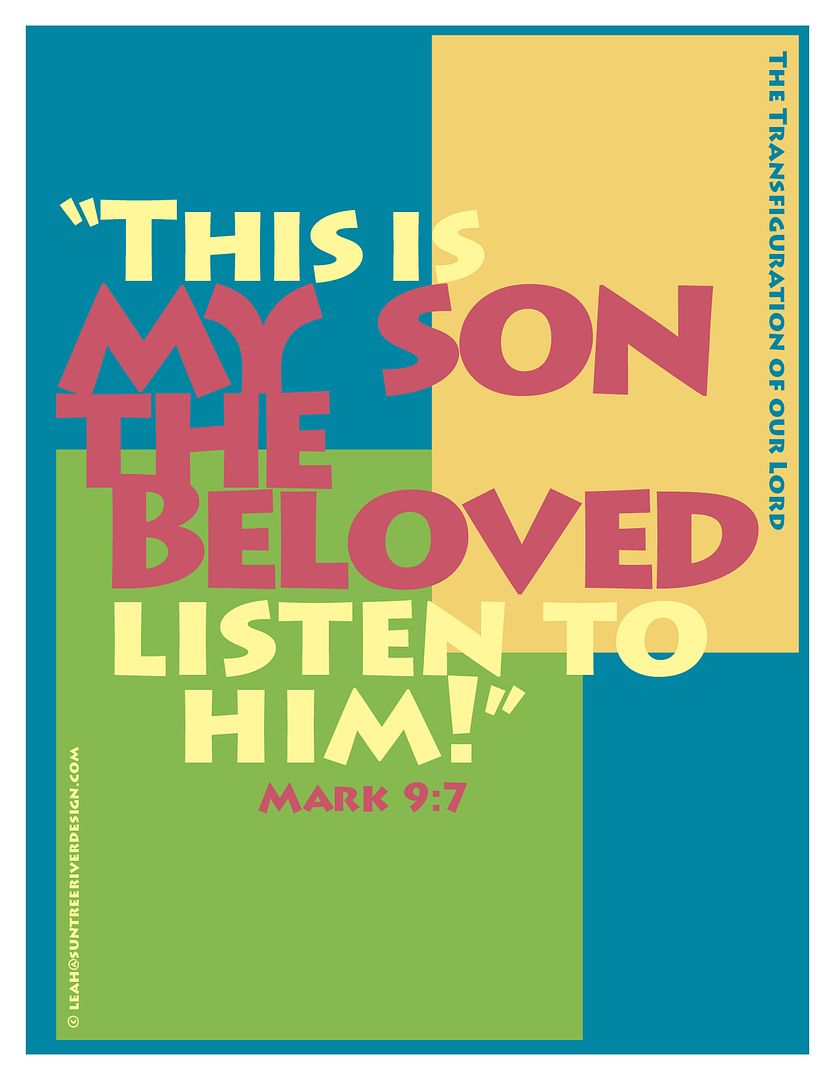
Transfiguration 2021 Mark 9:7
Transfiguration 2021

"This is my Son the Beloved.
Listen to him!"

Mark 9:7

Saturday, January 09, 2021

Baptism of Jesus 2021

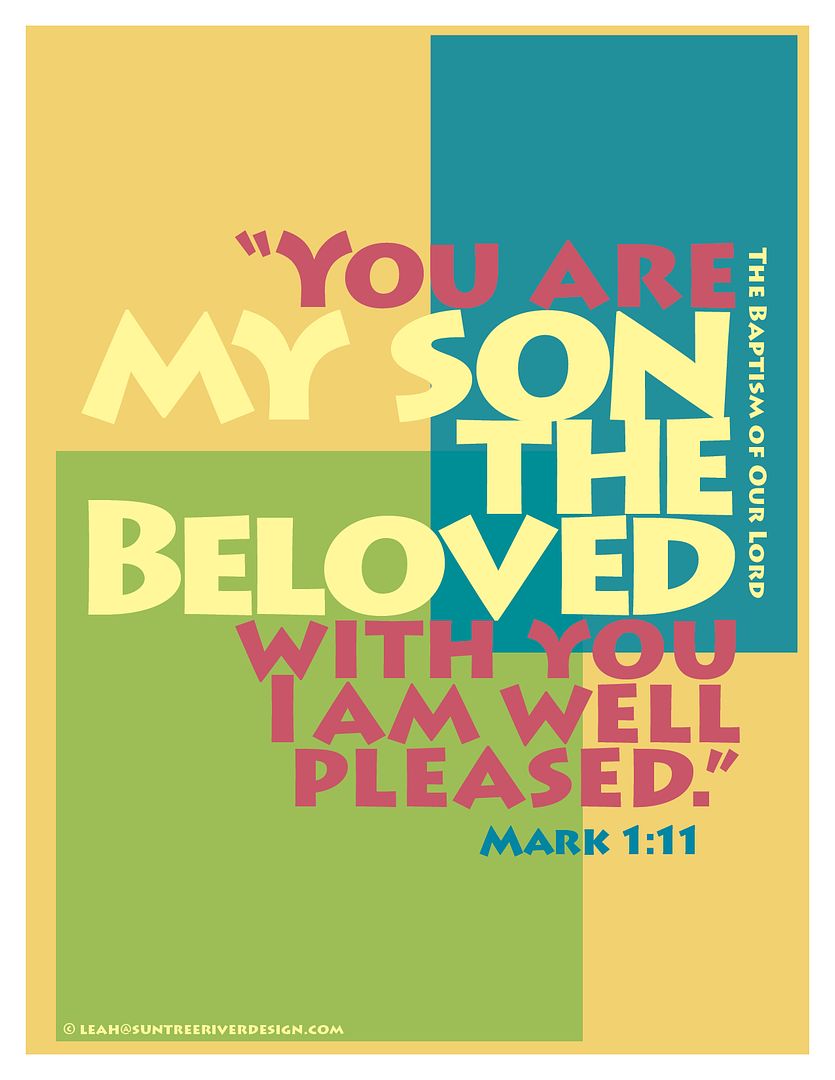
baptism of Jesus 2021 Mark 1:11
Baptism of Jesus 2021

"You are my Son the Beloved. With you I am well pleased."

Mark 1:11

Wednesday, March 21, 2018

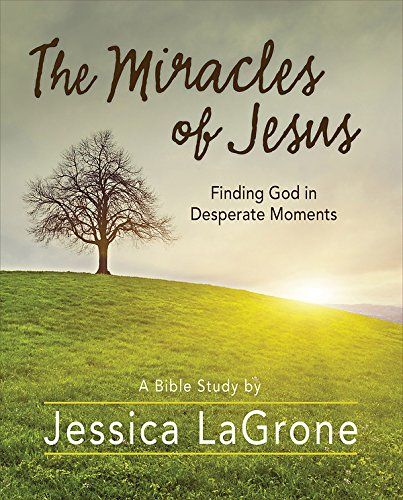
The Miracles of Jesus :: Jessica LaGrone

Miracles of Jesus Jessica LaGrone, book coverOriginally and/or (maybe) ideally intended for group study, this 6-weeks of weekdays consideration of Jesus of Nazareth's miracles in 30 short chapters was sheer excellence for my individual study at this stage of my journey. I spent about 3 weeks with The Miracles of Jesus; some days I'd study more than one chapter, occasionally skip over a day and not open the book at all.

Classic definition of a true miracle of God probably would be a suspension or even a reversal of humanly expected rules of nature, but trying to describe the divine and subsequently limit God's grace and activity with humanity and the rest of creation has led to far too many unfaithful expressions of biblical religion, so I'll leave it at that.

"Desperate moments" refers to physical, spiritual, social, and/or cultural situations of extreme need. "Cultural?" Yes, of course—had the hosts of the first of Jesus' signs we find in the gospel according to John, the Wedding at Cana, run out of wine, it would have been complete cultural embarrassment and true disaster that would have cascaded down through subsequent generations. (If you're familiar with differences between synoptic gospels Mark, Matthew, and Luke and the fourth canonical gospel, you probably remember John's community refers not to miracles but to signs human senses can perceive.) "Cultural" of course, because by definition Christianity always is incarnational, embodied within a particular culture. Including yours, including mine, including and encompassing theirs and ours. I love how the author brings in a few of her own experiences related to the miracle under discussion, but rather than making everything about her life and testimony she does it in a way that encourages readers to search their own daily lives, helps a reader trust God's paradoxical activity to meet their needs, as well. I also appreciate her intelligently referencing critical biblical scholarship in a manner that demonstrates the scriptural text itself comes to us in, with, and under the apparent accidentals of daily earthbound life.

Book size and layout is very attractive with plenty of room to write your own notes if you desire. This is part of a series of studies from the United Methodist Church's Abingdon Women, which is almost too bad and very sad, because nothing at all in The Miracles of Jesus is gender-specific, and that information might discourage a few guys from checking it out and benefiting from it. Though I'd be willing to loan out Jessica LaGrone's Miracles of Jesus, I plan to keep this book and work my way through it again. I'd also be open to participating in a group study focused on these chapters. What else? I'm curious about the content of the accompanying video.

my Amazon Review: Outstanding in Every Way

Saturday, December 02, 2017

Five Minute Friday • Near

I've been playing and working catch-up, but I had to Five Minute Friday this week because Kate Motaung's near prompt aligns with my preparation for introducing the Gospel according to Mark on Sunday. Everyone already knows Mark's gospel quite well, but with the start of a new Revised Common Lectionary year B that's Mark's year, I needed to create a quick overview. I'm also Friday Fiving because of the beautiful illustration Kate provided; I took the liberty of decorating her banner photo for my header.

five minute friday near

A few minutes ago on urban wilderness I blogged a short overview of the Gospel According to Mark I'll use to open my adult SS class session tomorrow. Similar to many people today, back in those days of the Ancient Near East (love that ANE terminology!) people tended to think of God far away, unapproachable, distant, and uninvolved. Or if they believed God was a little closer, they imagined God contained and protected in a space or place like the Jerusalem temple they'd worked so hard to build.

Particularly as we've studied a pericope or selection from one of the four gospels each week, we've been discovering and uncovering a God who's anything but distant and far away, anything but unapproachable and uninvolved in creation—and in our own sometimes difficult lives and pressing concerns, in our joys and everyday routines! Especially as God self-reveals in Jesus of Nazareth, God has drawn near to earth, to creation. So near that God has chosen to live as one of us, as a human, in a body formed from stuff of the earth. But paradoxically, God-with-us, close-to-us still is the God of the Hebrew scriptures who fills heaven and earth, who remains free, elusive, and can't remotely be contained in space or in time. But you already knew that!

Given that humans tend to be more mimetic than thoughtful, the temple concept partly imitated gods of other ANE religions that mostly were gods for a certain place. Not only Mark but all the gospels reveal God so near that in Jesus God becomes and lives as part of creation—yet we find actual "near" vocabulary more in the deutero-Pauline theology of Ephesians and Colossians than elsewhere in scripture. In any case, as another Advent dawns, literally breaks open this week, let's remember God's abiding passion for all of us. God incarnate as a baby in the Bethlehem manger. God embodied in each of us so we can live as God's presence very near to our neighbors, friends – and enemies.

disclaimer: I wrote this very quickly in a little less than five minutes, but unlike most weeks, I found too many discrepancies and discontinuities, and In the interest of overall coherence, I edited so it would make sense, so this represents closer to fifteen minutes than to five.

five minute friday near five minute friday new button

Monday, May 08, 2017

F Willis Johnson - Holding Up Your Corner

Holding Up Your Corner: Talking about Race in Your Community by F. Willis Johnson on Amazon. Pastor Johnson currently leads Wellspring United Methodist Church in Ferguson, MIssouri, and serves as Vosburgh Visiting Professor of Ministry and Social Engagement at Drew Theological School.

You also can find Holding Up Your Corner as a standalone website.

Holding Up Your Corner book cover"Every issue is not our fault, but every issue of injustice, indifference, and oppression is our fight." Is Holding Up Your [Our] Corner mostly about inspiration, about practice, about God in the Spirit creating justice and safety for every human, health and well-being for all creation? Yes. And then some.

#Ferguson has become a buzzword for the worst racial profiling and resulting inequality, but Johnson explains assumptions people [you, me, everyone everywhere] necessarily make, prejudices they almost instinctively have about all those "others" in our lives are almost inevitable, because human brains operate by organizing and categorizing information and experiences. So the author constantly reminds us guesses about, even negative reactions to others tend to be value-neutral; what we "do with them" is the clincher. The social scientist construct of race dominates Holding Up Your Corner, but otherness includes any human with characteristics I don't possess, you don't happen to have.

I wouldn't quite call Holding Up Your Corner a handbook, a guidebook, or a collection of case studies, either. Though its 115 pages includes brief aspects of all those, it's not extensive enough or sufficiently comprehensive to serve as an model for activism and results. More than anything it excites and encourages Jesus' 21st century disciples and anyone else to "hold up their corner," a phrase derived from the gospel story in Mark 2:1-12 of the four guys who picked up the paralytic's cot and imaginatively figured out ways to bring the paralyzed guy into Jesus' presence. A lonely only person could not have done that on their own, but along with strategically positioned others, the person on that corner helped achieve the goal. That narrative from Jesus' earthly ministry opens chapter 2 that's about Empathic Models of Transformation—would you believe abbreviated EMT? To activate that model we need to Acknowledge – Affirm – Act in ways that affirm the Imago Dei – the image of the divine – in every human person.

Because Johnson's book is short enough and direct enough for everyone to read, I won't detail more of the contents. But I'll enthusiastically recommend this basic book, the related digital and print resources on pages 108 to 111, along with leader and participants guides for churches, other organizations, and anyone who wants to learn more and act more effectively. Remember, given the complexities of life, most of the inequality among others truly is not my fault or your fault, but responding to God's call through the Spirit of life to help create vibrant, life-giving and world-enhancing equalities is everyone's responsibility. "Every issue is not our fault, but every issue of injustice, indifference, and oppression is our fight," and like the pebble cast into the pond, even our seemingly tiny changes of attitude and minuscule actions are synergistic, adding up to more than the sum of their individual components.

My Amazon Review: for intelligent, empathetic activism

Tuesday, October 06, 2015

06 October: Possible

31 days of free writes

Day 6 of Kate Motaung's 31 days of free writes, October 2015 edition. Write for five minutes. Just write.

Tuesday 06 October: Possible

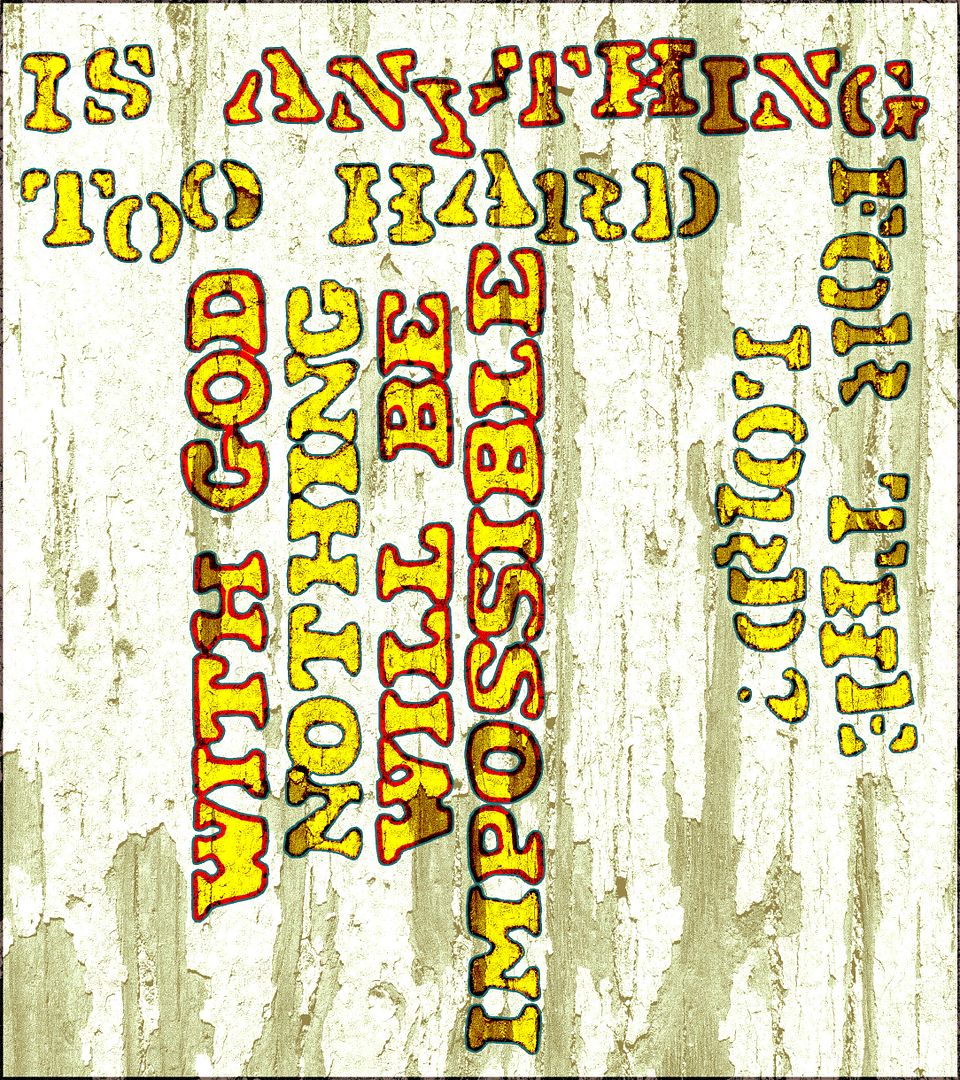
As I was preparing bible study for this coming Sunday (Revised Common Lectionary Proper 23B / Ordinary Time 28B / Pentecost 20) I noticed the gospel reading includes "For God all things are possible." Mark 10:27b. Here's my visual inspiration and interpretation I retrieved from the past and updated with grungy background style. So literally providential it also fits today's Possible prompt perfectly!

oct 06, possible

If you can! All things will be possible if only you will trust! Stop even imagining in conventional human terms and categories! With God nothing will be, nothing is, nothing ever has been impossible. Anything is possible! Is anything too hard for God? Nothing is too hard for the Lord!

I AM the God who raises the dead! God whose word creates out of nothing, God whose Spirit redeems the impossibly broken and dead.

My own future possible? Is it not possible for me to trust the God who raises the dead? For the apostle Paul the gospel is death and resurrection. In that case, you must need to be dead before you can be resurrected. In that case, I need to be dead before God can raise me to new life.

Is it even remotely possible I might write 31 days of five minute blog posts? Yep, so far I've been doing it, and if I keep on in this direction, the possible will become probable will become real. But I'm also seriously slowing down and after my five minute write, it's been taking two or three hours to format and post. I don't usually lay shoulds on myself, but the entire process reasonably should be about 15-20 minutes, and I can use all that time to be productive elsewhere and otherwise.

October 2015 31 days of free writes

Thursday, September 24, 2015

Five Minute Friday: Doubt

Five minute Friday shifts from last week's easy-to-write about "celebrate" to this week's single word prompt of doubt. As usual, Kate Motaung hosts; as always, we write unedited for five minutes.

doubt

"Do not doubt; only trust." Mark 5:35

In the world where the new testament scriptures originated, trust and faith was the expected response to the grace and favor someone might give you. We know from the scriptures – especially from the apostle Paul – that the ability to receive and respond to God's grace, to God's favor, the ability to trust, to lead a life of faithful response, witness, and testimony is in itself a gift of grace. Scripture and the Church testify first of God's grace and God's faithfulness–not nearly as much of human faithfulness. So why do so many of us get hyped up with the the excitement of it's all going to be fine, discover themselves actually living and responding with joy and excitement, and a scant few minutes later, become overwhelmed with doubts? Doubt that God or anyone else truly cares; doubt that I'm any good, that the world or the church – or the world of the church –has a place for me. A calling to me.

It seems to be a major aspect of what we sometimes call the human condition: despite grace, finding ourselves again in creaturely brokenness and bondage and doubt, yet at the same time still redeemed by grace to walk in trust. Left to our own devices and everyday druthers, we can see little other than the negative side of situations and other people, the negative inside our own selves. We tend to choose not life but death.

* * * * * end of 5 minutes * * * * *

Seems to me the reformer Martin Luther had something to say about that.

In Mark 5:36 that opened my free write, the Greek in what we commonly translate as "do not doubt," actually is "do not fear, only trust."

This evening I listened to about half the songs in my YT worship play list; it includes Kent Henry's gently rocking "No Condemnation," with text from Romans 8:1:

There is therefore now no condemnation
For those who are in Christ Jesus
For the law of the Spirit of life,
in Christ Jesus, will set you free
From the law of sin and death

BTW, because I've gone through my blog and hopefully deleted all YT links because they come and go so unpredictably, I'm not linking to the song, but it's easy to find.

glorify thy name 5 minute friday icon

Thursday, August 09, 2012

2nd friday random 5

2nd Friday random 5 (again). Hosted by revkjarla (again); this one's a bit challenging (again).

1. Have you planned anything for the fall/winter that you are so proud of yourself for doing so? What is it?

Yep. Taking a class in web development for androids and related devices. There literally are zero local design (print only or classic web and print) jobs, and knowing basics of smart phone development will help lots.

hibiscus new 2. What day of the week describes how you feel about yourself and why?
Fridays. When I served on church staff, whenever possible I took Friday as my day off. Since then, Friday often has been a full or half work day, yet there's something complete about the formal end of a 5-day M-F work week. Whether I haven't worked on Friday, gotten off work early afternoon, or later in the day, I try to make the day special in some way or ways. Why does Friday describe how I feel about myself? I tend to be disciplined, goal-oriented, and compulsive, yet also love to celebrate and have fun; my views about Friday describe all those traits. Cornel West: "We are people of hope! Why do we party on Friday nights? Why do we go to church on Sunday?"

3. If you could have been with Jesus at any one of his miracles, which would it have been, and why?

Ummm.... my theology's not big into miracles, signs, wonders, etc., but rather more into God's constant unmediated presence, but I'll take this as part of the challenge and "pick one" that shows care for people, stewardship of creation, and also demonstrates God's constant, unmediated presence: Mark 4:37-41
And a great windstorm arose, and the waves beat into the boat, so that it was already filling. But he was in the stern, asleep on a pillow. And they awoke him and said to him, "Teacher, do you not care that we are perishing?" Then he arose and rebuked the wind, and said to the sea, "Peace, be still!" And the wind ceased and there was a great calm. But he said to them, "Why are you so fearful? How is it that you have no faith?" And they feared exceedingly, and said to one another, "Who can this be, that even the wind and the sea obey him!" nkjv
4. If you could have had another brother or sister, what would you have wanted, and why?

Given that I found out I had a younger sister (no surprise) and then discovered I also had an older sister (what?!) only about a dozen years ago, I'll say two siblings is fine with me, but I wish I'd known them earlier and I wish the younger one had some interest in connecting with me, rather than (reportedly) considering me her "extra sister."

5. If you had to choose one word that defined you and your life, what word would it be?

Hopefilled.

Monday, February 27, 2012

Lent 1 reflections

about Lent 1, 26 February

A friend from my blog ring started a Lenten Journey group on Facebook. For the first Sunday in Lent for all three lectionary years A, B, and C, Jesus' wilderness temptations always are the gospel reading. This is year B, Mark's year; in typical hasty manner, in a scant few verses he moves from Jesus' baptism, into the wilderness, and then to Jesus' public ministry:
In those days Jesus came from Nazareth of Galilee and was baptized by John in the Jordan. And just as he was coming up out of the water, he saw the heavens torn apart and the Spirit descending like a dove on him. And a voice came from heaven, "You are my Son, the Beloved; with you I am well pleased." And the Spirit immediately drove him out into the wilderness. He was in the wilderness forty days, tempted by Satan; and he was with the wild beasts; and the angels waited on him.

Now after John was arrested, Jesus came to Galilee, proclaiming the good news of God, and saying, “The time is fulfilled, and the kingdom of God has come near; repent, and believe in the good news." Mark 1:9-15
Matthew and Luke provide us considerably more detail about this event; here's Luke's version.

In the group I commented, "every Lent 1 I remember Henri Nouwen's commentary on this text as the 3 temptations of the world: bread - to be relevant; throw yourself down from this pinnacle - to be spectacular; all the kingdoms of this world - to be powerful."

awakenLater I wrote, "regarding the temptation to be 'relevant' by changing stones into bread, isn't bread the staff of life, didn't Jesus, born in Bethlehem, House of Bread, tell us he's the Bread of Life, are there not countless examples of Jesus eating and feasting with friends and finally giving his body for the life of the world? All that is true, but last Friday, as I was yearning for some of the blackberries that have been plentiful lately though there were none in the house, it was all I could do not to run to the store and buy more. Berries, tomatoes, etc. are nutritious, healthful, gifts of creation and can brighten a meal or a day, but it comes down to asking if we eat to live or live to eat?!" Besides, at about $1.00 for 6 ounces at the 99.999¢ store blackberries have been highly affordable, so price is no excuse.

In Awaken Your Senses, Brent Bill tells us keeping kosher is about being intentional and parallels it to the way he needs to plan and be totally intentional about eating as a diabetic. We all can do that about eating and about life and how wonderful it would be if our practice of living with purposeful intention (hopefully with fewer and fewer already-prepared and processed foods) during Lent then would become routine into the 50 days of Easter and beyond, eating, drinking, relishing and savoring the gifts of creation - and gifts of the creative culinary arts - not because we're living to eat, but eating better in order to live and serve more fully.

Friday, February 03, 2012

image association 5

Just returned from Big Event 5.0, Songbird hosts an image association 5; here's the drill:
For today's Friday Five, let's have a mini-BE 5.0 workshop. Take a look at these five portions from the gospel lections for this Sunday and next, and share with us the images that come to mind for you. Feel free to use words or pictures.
Needless to say, I'd love to crunch these texts and design my own images, but Friday 5 is supposed to be a quick, fun play and a way to get to know each other a little better—so I won't but I will give it a touch of local context. I love how this instant replay of a chunk of Mark 1 that amounts to only 1/3 of the chapter shows the evangelist's excited and exciting style that will pervade his gospel and become its hallmark. As I worked through these brief pericopes, I realized they do need either artistic images or acted imagery to convey what I'm trying to say, but here's my play anyway.

1. As soon as they left the synagogue, they entered the house of Simon and Andrew, with James and John. Now Simon's mother-in-law was in bed with a fever, and they told him about her at once. He came and took her by the hand and lifted her up. Then the fever left her, and she began to serve them. (Mark 1:29-31)

image: A worriedly concerned group of amigos, amigas y familiares gather around her bed, wondering whether she will die or just may live. As soon as the fever leaves and she realizes she's well, Simon's MIL scurries to the cocina and pulls together a fiesta of nachos, fajitas, tamales, cerveza and tortas and serves everyone; as soon as she's able, she responds well to God's first call of hospitality !

2. That evening, at sundown, they brought to him all who were sick or possessed with demons. And the whole city was gathered around the door. And he cured many who were sick with various diseases, and cast out many demons; and he would not permit the demons to speak, because they knew him. (Mark 1:32-34)

image: "The whole city" is a LOT of peeps and brings to mind some paintings of the Day of Pentecost that feature a crowd gathered outdoors. Close to day's end, a microcosm of humanity from toda la ciudad completely surround in a circle the adobe house where Jesus stays. Patiently, one by one, he touches them with his hand, his word, his glance or all three, when necessary addressing demons and the demonic by name and rendering them without power. As one by one they leave to return to their more normal lives, the ambient air in toda la ciudad entera assumes a sense of the fullness of shalom.

3. In the morning, while it was still very dark, he got up and went out to a deserted place, and there he prayed. And Simon and his companions hunted for him. When they found him, they said to him, "Everyone is searching for you." (Mark 1:35-37)

image: Jesus leaves the adobe house before first light, makes his way to the nearest patch of desierto, finds an east-facing bench and soon becomes intently caught up in prayer. Very soon he hears footsteps and perceives a change in the air. In a sense he feels annoyed because the hombres still don't quite get what he's about, but he's also happy they consider him safe and trusted enough to seek him out whenever.

4. He answered, "Let us go on to the neighboring towns, so that I may proclaim the message there also; for that is what I came out to do." And he went throughout Galilee, proclaiming the message in their synagogues and casting out demons. (Mark 1:38-39)

image: You know everyone is dressed in Baja Hoodies and obeys the scriptural charge to "wear sandals" as they set out together and although the text has Jesus suggesting "we" and "us" as in together, he also says "that I may proclaim" (sorry this is Friday 5 and I'm not checking the Greek) every one of them excitedly, in the mildly manic style of Mark, begin practicing proclaiming in nearby pequeñas ciudades.

5. A leper came to him begging him, and kneeling he said to him, "If you choose, you can make me clean." Moved with pity, Jesus stretched out his hand and touched him, and said to him, "I do choose. Be made clean!" Immediately the leprosy left him, and he was made clean. After sternly warning him he sent him away at once, saying to him, "See that you say nothing to anyone; but go, show yourself to the priest, and offer for your cleansing what Moses commanded, as a testimony to them." But he went out and began to proclaim it freely, and to spread the word, so that Jesus could no longer go into a town openly, but stayed out in the country; and people came to him from every quarter. (Mark 1:40-45)

image: This hombre contemporáneo long has been overcome and overrun with all kinds of health and *other* concerns. This again is a situation of someone's infinite trust in Jesus and Jesus' corresponding joy that someone has come to him. Healing of every kind visibly ripples through the guy and oh yes, on some level he heard Jesus say he only was supposed to fulfill the levitical requirement to visit the ecclesiastical authorities and please, nothing more at this time since Jesus' time has not yet quite arrived, but what incomparably great news has this healing into new life been?! He also wants to practice the gymnastics he'd learned as a niño, so he tells his entire known world of nearby pequeñas ciudades.

Friday, March 30, 2007

Theology of the Cross 6

Although I planned this sixth class for NPC as a wrap and recap of the previous five, it was Palm / Passion Sunday, everyone participated in Holy Week and Easter prep so we didn't meet. I offered this series at OS-ELCA-NP for the adults for the five evenings of VBS during summer 2007, so we would not have needed a sixth session there anyway.


Theology of the Cross: what does this mean for the Church’s and especially for this congregation’s life and mission?
1. Go to dark Gethsemane, ye that feel the tempter’s power;
Your Redeemer’s conflict see, watch with Him one bitter hour,
Turn not from His griefs away; learn of Jesus Christ to pray.

2. See Him at the judgment hall, beaten, bound, reviled, arraigned;
O the wormwood and the gall! O the pangs His soul sustained!
Shun not suffering, shame, or loss; learn of Christ to bear the cross.

3. Calvary’s mournful mountain climb; there, adoring at His feet,
Mark that miracle of time, God’s own sacrifice complete.“It is finished!” hear Him cry; learn of Jesus Christ to die.

4. Early hasten to the tomb where they laid His breathless clay;
All is solitude and gloom. Who has taken Him away?
Christ is risen! He meets our eyes; Savior, teach us so to rise.

James Montgomery, in Selection of Psalms and Hymns, by Thomas Cotterill (London: 1820).
The cross of Calvary forms the ultimate type and reality of God’s characteristically hidden and paradoxical, sacramental presence in the commonest things, situations and people. Especially in the cross we learn God totally subverts evil for good, as the death of Jesus Christ becomes a redemptive reality for all creation.

Throughout the witness of scripture, we find God’s Self-revelation from a series of mountains: the Mount Sinai Covenant recorded in Exodus 20:3-17 and Deuteronomy 5:6-21; the Sermon on the Mount in Matthew 5:1-11 (there’s the parallel Sermon on the Plain plus in Luke 6:17...); the Transfiguration, with Mount Tabor, rising out of the Jezreel Valley as one of the traditional suspects; finally, Mount Calvary brings God’s definitive self-revelation, and ultimate covenant! (I love the name of the hymn tune, Bryn Calfaria...)

New Covenant: Jeremiah 31:31-34; 1 Corinthians 11:23-26; Luke 22:[19]-20; 2 Corinthians 3:4-8; read the book of Acts!

New Covenant: On the day of Pentecost, Jews commemorated the Sinai Covenant; on the Christian Pentecost, we celebrate the gift of the Spirit through which God enables us to perform the New Covenant. Read the book of Acts!

Jesus said, “Do this!” Do this liturgical action? In the power of the Holy Spirit, God calls the church—
  • As the body of the risen Christ, the Bread of Life, to nourish the world, especially the stranger, the outcast and the “other”;
  • As branches of Jesus, the Vine, to pour out our lives to those around us.
12. What does the cross mean for the world in which we live and serve?

Martin Luther begins his Small Catechism – traditional preparation for First Communion – with the 10 Commandments. Walter Brueggemann observes, “It is the God of the Commandments with whom we commune!” In the Book of Common Prayer, The Holy Eucharist, Rite One, begins with the Ten Commandments—with the Great Commandment as an alternative.

We’ve been discussing God’s action and presence in the sacraments, considered a “means of grace.” American theologian Robert McAfee Brown suggested that people who aren’t practicing justice and righteousness in their daily lives should be kept from the Communion Table.

Decalogue: Exodus 20:3-17; Deuteronomy 5:6-21; the Great Commandment: Mark 12:28-31; Matthew 22:36-48

Some churches practice foot washing as a sacrament or as preparation for participating in the Lord’s Supper. Think about it!

13. The cross of Jesus Christ: Foolishness to the Greeks and foolishness to us?

“When Christ calls us, he bids us come and die...to go one’s way under the sign of the cross is not misery and desperation, but peace and refreshment for the soul, it is the highest joy...we do not walk under our self-made laws and burdens, but under the yoke of him who knows us and walks under the yoke with us.” Dietrich Bonhoeffer, Nachfolge (Discipleship)

14. Concluding questions, observations and loose ends.

For Paul, the gospel is death and resurrection.

Jubilee Year Redemption for all creation: Leviticus 25:8-24; Leviticus 23 and 24:

The land must not be sold permanently, because the land is mine and you are but aliens and my tenants. Throughout the country that you hold as a possession, you must provide for the redemption of the land.

How does living as people of the cross ultimately lead to Jubilee Justice for all creation?
Let us Talents and Tongues Employ

1. Let us talents and tongues employ,
reaching out with a shout of joy:
bread is broken, the wine is poured,
Christ is spoken and seen and heard.
Jesus lives again, earth can breathe again,
pass the Word around: loaves abound!

2. Christ is able to make us one,
at his table he sets the tone,
teaching people to live to bless,
love in word and in deed express.
Jesus lives again, earth can breathe again,
pass the Word around: loaves abound!

3. Jesus calls us in, sends us out
bearing fruit in a world of doubt,
gives us love to tell, bread to share:
God, Immanuel, everywhere!
Jesus lives again, earth can breathe again,
pass the Word around: loaves abound!

–Fred Kaan, 1975–
© Leah Chang 2007