Showing posts with label proverbs. Show all posts

Friday, September 15, 2017

Porch Stories: Friends

porch stories: friends

Our Porch Stories host Kristin provides outstanding email content that's so worth another sign-up; this week she write about the category of Email Friends and asks us to "Join me on my {email} porch."

With the ascendancy of Facebook and other social media connections we often call "friends," friendship has become controversial topic. Is a FB friend a "real" friend? Is it ok to unfriend someone on social media or even in real life? The few times I've mentioned to a current friend how all my former friends abandoned me {now that one's very complicated}, their instant response was "then they weren't real friends! As a matter of fact, most of them had been very good friends who shared long histories, joys, and expectations for futures together.

Churches that follow the Revised Common Lectionary are almost four months into the green and growing time of the Season of {the Holy Spirit of} Pentecost that we often call the Season of the Church. We've been studying and considering Jesus' examples and instructions via the gospel writer Matthew on how to be church coupled with related passages from the epistles that over the past few weeks have been from the letter to the church at Rome. Last Sunday we heard the apostle Paul's exhortation about owing and obligation – oughtness – debt and obedience summarized into love, followed by his explanation of why we love:

8Owe no one anything, except to love one another; for the one who loves another has fulfilled the law. 9The commandments ... are summed up in this word, "Love your neighbor as yourself." 10Love does no wrong to a neighbor; therefore, love is the fulfilling of the law.
Romans 13

From Jesus's famous Johannine discourse on friendship and friends:

15I don't call you servants any longer, because servants don't know what their master is doing. Instead, I call you friends, because everything I heard from my Father I have made known to you. 16You didn't choose me, but I chose you and appointed you so that you could go and produce fruit and so that your fruit could last. As a result, whatever you ask the Father in my name, he will give you. 17I give you these commandments so that you can love each other.
John 15

Three variations of Proverbs 17:17:

• Friends love through all kinds of weather, and families stick together in all kinds of trouble.
The Message

• Friends always show their love. What are relatives for if not to share trouble?
Good News Bible

• Friends love all the time, and kinsfolk are born for times of trouble.
Common English Bible

porch stories button

Friday, July 07, 2017

Five Minute Friday: Play

As summer in the northern hemisphere continues, Five Minute Friday host Kate Motaung prompts us to play. I've made this only somewhat of a FMF; because I love the topic of play, I wanted to write more than five unedited minutes would allow, so I spent less than five making a quick outline, a lot more than five writing, and I edited beyond the usual checking to find repeated words and to be sure auto-correct accurately guessed what I tried to type. But it's still quite rough... I won't revise this one, but may try another post about play.

summer play wisdom 8

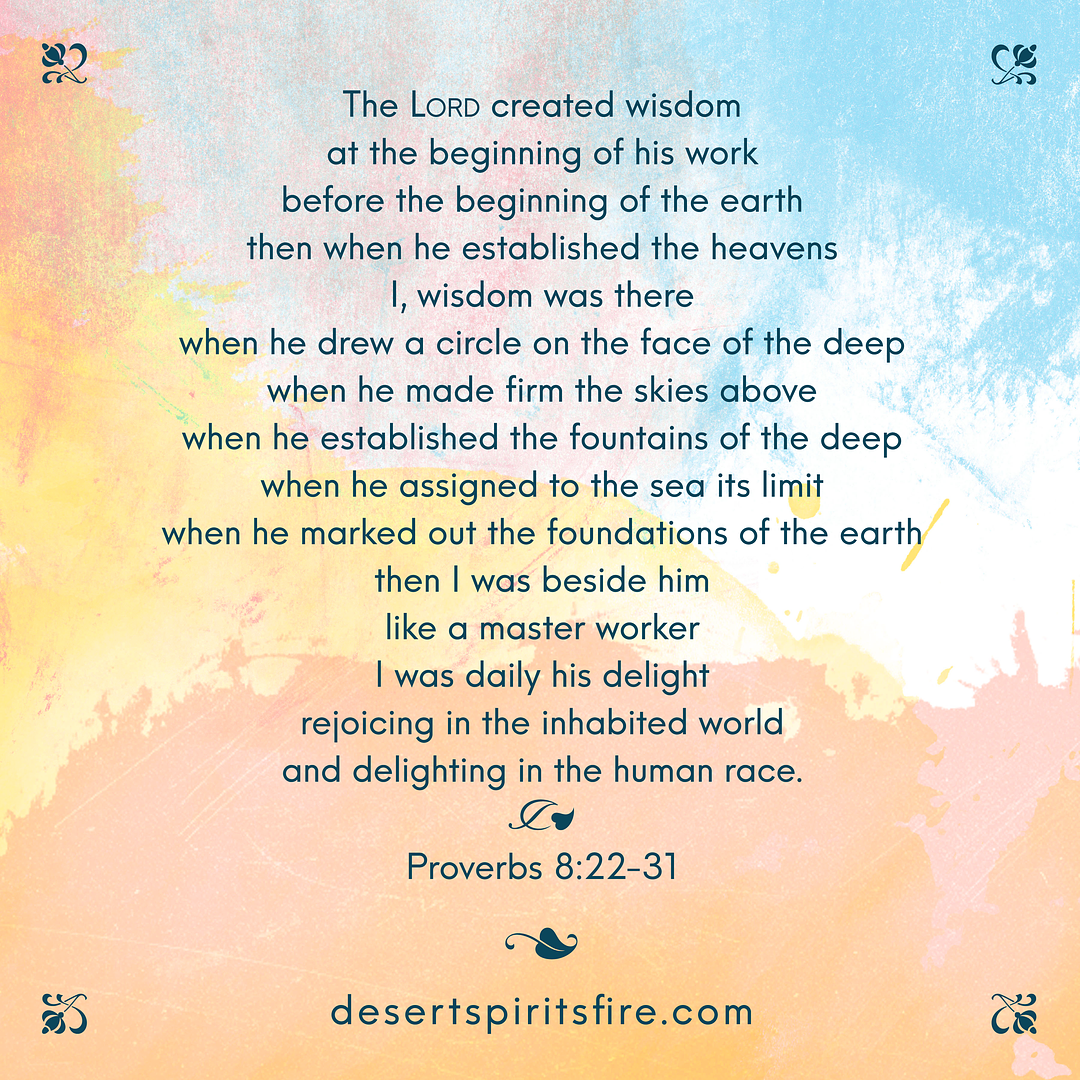
The Lord created wisdom
at the beginning of his work
before the beginning of the earth
and then when he established the heavens
I, wisdom was there
when he drew a circle on the face of the deep
when he made firm the skies above
when he established the fountains of the deep
when he assigned to the sea its limit
when he marked out the foundations of the earth
then I was beside him, like a master worker
I was daily his delight
rejoicing in the inhabited world
and delighting in the human race.

Proverbs 8:22-31
This creation account from the writings in the Hebrew Bible shows us the logos at the play the logos at the work of the first creation. In scripture and in Greek philosophy, the logos is both source and immanence, in a sense that's not very different from the way a logo for an organization or a business anchors its identity and promises more to come.

Unlike much of the rest of the times of our lives, have you noticed that whenever we play, we live almost entirely in the present?

Rituals and liturgies were one of the ways God's people Israel persistently recalled the past so it would remain present. Within a context that was play more than it was anything else, Israel retold and reenacted the story of their experiences with the God of the exodus, the God who covenants with creation, the God of the commandments. Like Israel, when we worship we remember who God is, who we are, how God has acted. We affirm our dreams. We announce our hopes for the future. Not only is much of our liturgy in the present, just as play is—liturgy also creates a new and different self-contained world that exists with and within our everyday world. Liturgy provides that "foretaste of the feast to come" of the new creation.

In Hebrew history people remembered and talked about past events as if they still were in the present; their history with God gave Israel confidence about the future and willingness to continue in open and responsive covenantal partnership with God. Because they knew God's saving deeds of redemption and homecoming, they faced the future with lively hope. Sacraments and liturgy form the model we follow during the week in the world outside the gathered Sunday (or Saturday evening/Sunday vigil) assembly. In the presence and power of the Holy Spirit, the people of God at the work of the new creation are the people of God fully engrossed in the play of a making a new creation from the ruins of the old.

The Good Book tells us God created humans in the divine image—a picture you can perceive. Still further, scripture reveals the God who fills heaven and earth becoming human and finite in Jesus of Nazareth. God in Jesus Christ gave us a dream of a whole, healed, reconciled world, a world at peace and at play; Jesus challenged us to make it our dream and in the power of the promised Holy Spirit to make the new heaven and new earth reality. Just as Jesus resembles, represents, and reveals God, we become images of God when we play, when we dream, when we worship. We become people alive in the now—creative, responsive, and responsible.

The passage from Proverbs show us the logos at work is the logos at playful celebration of the first creation. In the presence and the power of the Spirit of Pentecost, the spirit of resurrection, the spirit of the new creation, our liturgies are the first fruit, the guarantee we finally will end up in God's image, since God's indwelling Spirit makes possible our play, our dreams—our parties! Like play, worship ends the division between material and spiritual we often make. Dreams start to become reality. In worship, God's people at play are God's people at the work of the new creation. Cornel West exclaims, "We are people of hope! Why do we party on Friday nights? Why do we worship on Sunday?!"


Pastor Eugene Peterson's The Message expresses it...
I don't think there's any comparison between the present hard times and the coming good times. The created world itself can hardly wait for what's coming next. Everything in creation is being more or less held back. God reins it in until both creation and all the creatures are ready and can be released at the same moment into the glorious times ahead. Meanwhile, the joyful anticipation deepens. Romans 8:18-21

Because God includes everything in the plan of liberation and redemption, as the twenty-first century people of God involved in the play and in the work of the new creation, we can wait expectantly for that time when all of life becomes play for every one of us, and like wisdom at the first creation, as co-creators with God in the Spirit we rejoice in the world inhabited by all of God's creatures.


five minute friday future five minute friday new button

Friday, March 17, 2017

Five Minute Friday: Friend

Kate Motaung continues to host Five Minute Friday, and who wouldn't love today's single-word prompt—friend!

"take 5"—minutes.

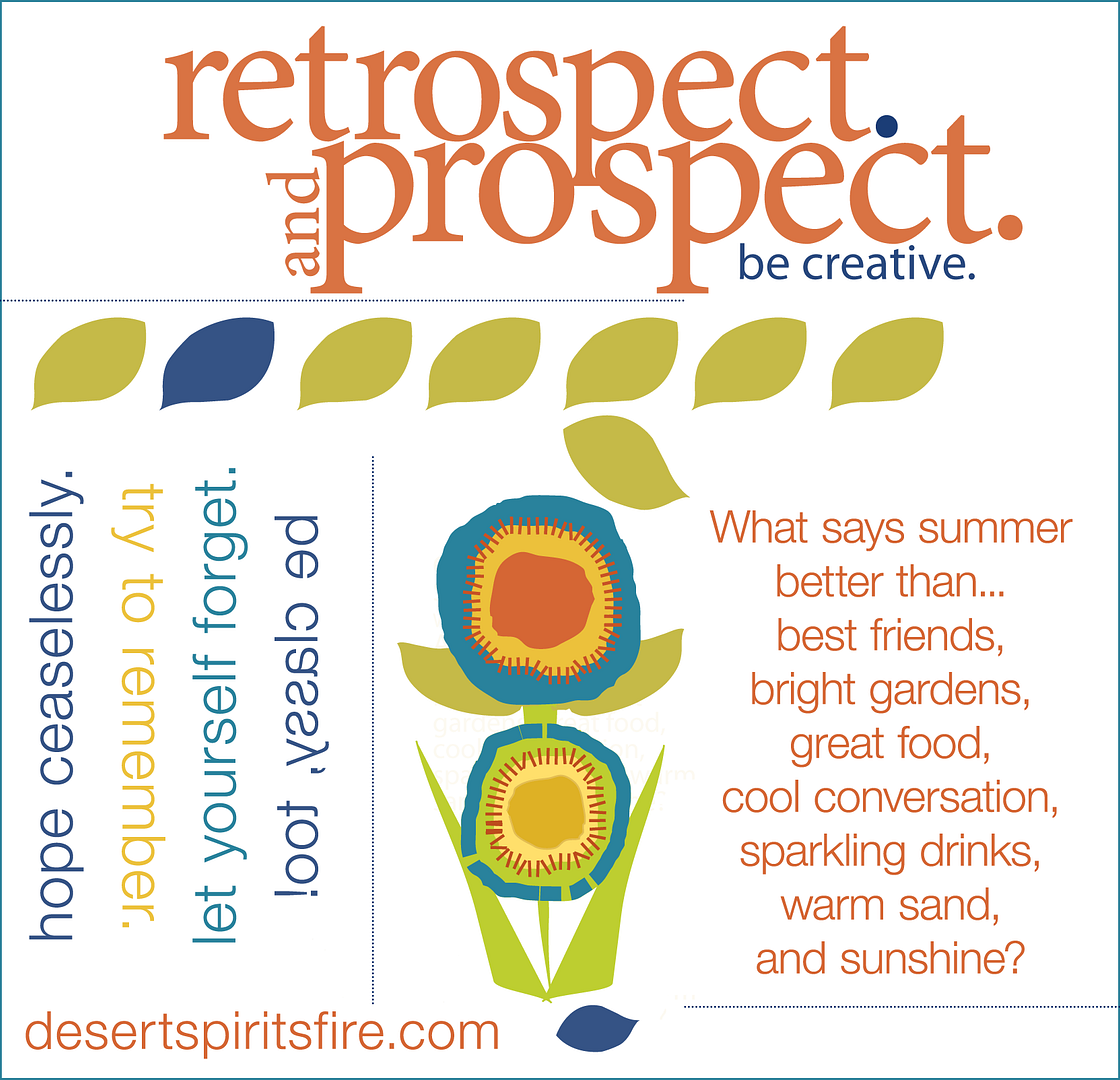
five minute friday friendI've been adding my own illustrations to most week's FMFs; sometimes a brand new idea, sometimes an old one as-is, occasionally an updated and edited older design concept. This slightly re-done retrospect and prospect describes activities that any "level" or type of friends might enjoy together during those magical summer months when life slows down to a bask in the sun, we try to finish our work faster and better to allow time for fun. I invented the "What says summer better than best friends, bright gardens, great food, cool conversation, sparkling drinks, warm sand, and sunshine?" quote... but I'll amend it to say those friends around the backyard or rooftop garden, sharing yummy eats, talking seriously, lightly, or idly, appreciating the tang and refreshment of a sparkling drink don't always need to be "best friends forever" or even simple "best friends." Around our gatherings there's plenty of room for a new acquaintance, just-hired coworker, neighbor from two streets over, anyone who wants to be there. The Hebrew Bible book of Proverbs (17:17a) tells us a friend loveth at all times; via the gospel of John 15:15, Jesus calls us friends and goes on to explain how friends share their lives with (even lay down their lives for!) their friends. So for this spring – or summer, autumn, or winter – gathering, I include every one of you in my friends lists.


five minute friday button five minute friday friend

Monday, November 03, 2014

Every Bitter Thing Is Sweet: review/blog

Every Bitter Thing Is Sweet: Tasting the Goodness of God in All Things on Amazon

"The satisfied soul loathes the honeycomb, but to the hungry soul, every bitter thing is sweet." Proverbs 27:7, NKJV

every bitter thing is sweet coverI loved reading Sara Hagerty's story, learning a little about the yearnings of her heart, and appreciating the model she provides for very slowly, randomly, surprisingly learning to trust God. Maybe Sara teaches us how ultimately to tell about our own struggles in ways that will benefit others?

Some reviewers interpreted Every Bitter Thing Is Sweet: Tasting the Goodness of God in All Things as mostly about the author's more than a dozen years' long inability to conceive and birth a biological child, but I feel that part of the book's all but peripheral. Like most of us, Sara had major problems with openness and vulnerability, and she tells us about sometimes intentionally, at other times almost accidentally opening herself to her husband, her kids, to God.

Everyone carries with them yearnings and questions of "Lord, how long? When, Lord? I know you have called me [to a particular task, ministry, role] but how will it happen? I'm out of options!" If you've gone to church much, just as Sara did, you totally have noticed all the young married 20-somethings who are pregnant, nursing, trailing a toddler behind them, or maybe both PG and with a toddler or two in tow. Though Every Bitter Thing is far more about Sara's experiences waiting on God's faithfulness with increasing trust, needless to say, her expectation that she'd get pregnant shortly after she and Nate got married (in other words, many years before she actually conceived) interweaves through her story. One cannot humanly avoid trying to figuring out why their own well-prepared readiness for a particular task, ministry or role isn't causing it to happen.

Several times Sara refers to the covenant relationship she has with her husband. We live in the mercy-filled, loving sovereignty of the God who covenants, the God who remembers, and this includes God remembering that we humans frequently forget. In the copy of the book I received, chapter 14 is all about "The One Who Remembers."

Every Bitter Thing is Sweet demonstrates Sara's daily solid grounding in scripture―in my theological tradition, that would include a close parallel of being grounded in the sacraments. Theologies not only spoken but also worn with (and within) our entire beings!

Please let me assure you, this isn't about maintaining a "Praise the Lord anyway" mindset while disappoints engulf you type of book. This isn't about someone who fantasizes she's imitating the apostle Paul and becoming sanctified by glorying in her sufferings. How wonderful the book title isn't (for example) an über-difficult to untangle theological sentence from Romans or Galatians, or one of Jesus of Nazareth's charges to us that more often than not feels impossible, but rather an everyday observation from Proverbs, a book included in what we sometimes call scripture's "wisdom" literature.

In the interest of getting this blog post finished and published, I'll mention the way God has brought me back to my original aspiration (from all the way back before kindergarten!) of being a designer as both very sweet and sometimes too too bitter. I've tried to begin telling some of my back story to disappointingly few blog post hits, but the short version of bittersweet includes I've even won awards for my design in recent years, yet no one has been there to celebrate with me, least of all the now former friends I'd truly love to observe my comeback.

A snippet of scripture heads each chapter; scripture passages "For Your Continued Pursuit" conclude each chapter. I hope you'll visit Sara's Every Bitter Thing Is Sweet site and blog, and maybe watch her video on her amazon page, too!

Because amazon vine sent me a prepublication copy that's missing the foreword by Katie Davis – and possibly other features – I only have been able to comment on Sara's own words.

"Open your mouth and taste, open your eyes and see―how good God is. Blessed are you who run to him." Psalm 34:8, MSG

my amazon review: grounded in scripture and in God's love


#everybitterthingissweet

Wednesday, October 30, 2013

In Man We Trust: the Neglected...

In Man We Trust: The Neglected Side of Biblical Faith by Walter Brueggemann on Amazon

in man we trust Most likely I picked up a hardbound copy of In Man We Trust in perfect condition with no dust jacket, no bookplate, or owner inscription from a free books shelf or bin at divinity school. I've recently reviewed and blogged a few other books by Walter Brueggemann, so here's another, this time it's a first reading of the ©1972 book for me; there's a later 2006 edition.

Particularly for those of us within the theological and ecclesiastical traditions of the Reformation who tend to run with a Paul – Augustine – Luther theological focus and a Heilsgeschichte theological perspective, a strong emphasis on human freedom, responsibility, capability, and competence doesn't quite ring true. Wisdom literature? For sure I'm neither the first nor the last to believe on some level that Proverbs and Ecclesiastes don't really belong in the biblical canon—or in a third or a fourth canon, either. Although Brueggemann discusses Job, Proverbs, and Ecclesiastes to some extent, more than anything he reminds us we discover the same ethos along with material from similar sources in the "J" or Yahwist Pentateuch source—supremely in the life and style of King David, to a more limited degree in the social, religious, and economic styles of United Monarchy bookends Kings Saul and Solomon. Beyond that, the author points out the life and ministry of Jesus of Nazareth (particularly in Matthew's gospel account) reveals Jesus as Son of David, as a King like unto David, and in human wholeness, freedom, and a rare ability to seize the day – including the day of resurrection – very much as the New David, dancing in the face of death.

We confess we follow the Way of the crucified and risen One. What does it mean to take his name upon us? An arduous journey to the cross? Possibly for a literally select few. What about assuming the fullness of responsible, responsive, humanity? Everyone in the Western world does not spend their days hung up with sin and guilt; in fact, even most protestants aren't mini-Luthers. This viewpoint isn't necessarily one to assume in place of Paul – Augustine – Luther; it's complementary to it in the sense of completing or rounding out, as a way to balance our days. At least since the late twentieth century, fewer and fewer have been walking that walk. Between a little too much, "God, be merciful to me, a miserable sinner, I'm here to claim forgiveness again" amongst church-going adults, and too many parents coddling their kids, absolving their offspring of taking charge of their own lives, every one of us could benefit from the wisdom literature's exploration of wise, fruitful living. You could call this celebration of human freedom, responsibility, capability, and competence a kind of "possibility thinking," and why not?

"They cut me down, and I leapt on high; I am the life that'll never, ever die. I am the Lord of the dance, said he."

my amazon review: an important perspective

Sunday, September 26, 2010

Season of Creation 4C: Cosmos Sunday

26 September 2010

September constellation Dabih
Cosmos Sunday! Liturgy brings cosmic time and chronological time to an intersection where all times everywhere – past, present and future ≠ meet in this present now. The person presiding at eucharist holds the totality, entirety and completeness of the redeemed and restored cosmos in their hands as the risen, ascended One also is now descended, once again incarnate among and within the gathered and transformed Eucharistic community and within all creation. Martin Luther speaks about the ubiquity of the Risen and Ascended Christ...

Cosmos Sunday!

"We are stardust, we are golden,
We are billion year old carbon,
And we got to get ourselves back to the garden."
Woodstock, by Joni Mitchell

Michin Kaku tells us "...we are children of the stars; the atoms in our bodies were forged on the anvil of nucleo-synthesis within an exploding star aeons before the birth of the solar system. Our atoms are older than the mountains. We are literally made of stardust." Hyperspace, 1994

from Madeleine L'Engle: "If we look at the makeup of the word disaster, dis-aster, we see dis, which means separation, and aster, which means star. So dis-aster is separation from the stars. Such separation is disaster indeed. When we are separated from the stars, the sea, each other, we are in danger of being separated from God." A Stone for a Pillow, 1986

We Bow Down

by Twila Paris

You are Lord of the Heavens and Lord of my life
Lord of the land and the sea
You were Lord of Creation before there was time
And Lord of all Lords You will be

We bow down and we worship You, Lord
Lord of all Lords You will be

You are King of the Heavens and King of my life
King of the land and the sea
You were King of Creation before there was time
And King of all Kings You will be

We bow down and we crown You the King
King of all Kings You will be

Sunday, July 03, 2005

Heart Knowledge: sermon

Sunday in Ordinary Time 14 A proclamation
Sunday between July 3 and 9

Sunday, 03 July 2005

Let’s begin by hearing a Word of Life
from the Gospel according to

Matthew, chapter 11:16-19; 28-30
Jesus exclaimed:
16 “To what can I compare this age group? They are like children sitting in the marketplace and calling out to others:
17 “‘We played the flute for you, and you did not dance; we sang a sad song and you did not lament.’ 18 John the Baptist came neither eating nor drinking, and they say, ‘He has a demon.’ 19 Jesus, the Human One, Jesus, came eating and drinking, and they say, ‘Here is a glutton and a drunk, a friend of tax collectors and sinners.’ But wisdom is vindicated by wisdom’s deeds!”
Jesus continued,
28 “Come to me, all of you who are weary and burdened, and I will give you a break. 29 Take my yoke upon you and learn from me, for my heart is gentle and unpretentious, and in me you will find rest for your souls. 30 For my yoke is easy and my burden is light.”
Let’s pray together (more and less from Psalm 145:8-14):

God, for your gracious, compassionate, loving goodness to all creation, we thank You! Draw us to Yourself and let us learn from You, so we will be able to enter Your dance and show the world the glorious splendor of Your constant presence among all people of every generation. In the Name of the Living Word, Jesus Christ, Amen!
Sermon title: Heart Knowledge

Grace, mercy and peace to you from our Creator, Redeemer, Sustainer God!

How can you know someone and say something true about a person unless you know that person's heart? How can any of us say anything about God unless we know God’s heart?

Our central Christian message to the world is the way God reveals Himself to us most clearly in the human, Jesus of Nazareth; one of the primary ways we learn about God is by reading the Bible. Especially in the Gospel accounts we find in the Bible, we learn how God in Christ Jesus lived a human life like ours and learned the human heart from the experience of living human. In Jesus Christ, God learned the heart of a human person, but as humans, can we know God’s heart?

A great deal of the Bible was a product of Jewish life and culture, and in Hebrew biology, above all, the heart is the seat of the will.

Throughout all of the Bible’s witness, in the demonstration of Jesus’ life and today, in the life of the contemporary people of God, the Church, we encounter the heart of God. Maybe you know the story of Abram or Abraham from the Old Testament book of Genesis? The Bible’s text informs us Abraham was an Ivri – a Hebrew: someone from the other side! You don’t need to know formal theology or have spent time in church to realize that God is very much the Other-than-us, God is way beyond time and space, God comes from that exceedingly “other side!” However, the Bible tells us and the Church always has taught how God became incarnate, God became enfleshed as one of us, God lived as a human, in Jesus of Nazareth. From what we read in the gospels, Jesus spent most of his earthly life and ministry outside of the religious establishment and outside of the high-end social establishment; Jesus lived most of his life on the conventional systems’ and accredited authorities’ “other sides,” all the while inviting everyone to become part of his insider circle, always inviting everyone to belong to the people of God.

Back to how we can know God’s heart; from his words recorded in Matthew’s gospel, Jesus said:
16 “To what can I compare this age group? They are like children sitting in the marketplace and calling out to others:
17 “‘We played the flute for you, and you did not dance; we sang a sad song and you did not lament.’ 19 Jesus, the Human One, came eating and drinking, and they say, ‘Here is a glutton and a drunk, a friend of tax collectors and sinners.’ But wisdom is vindicated by wisdom’s deeds!”
In Hebrew biology the heart is the seat of the will; in this passage from Matthew 11, Jesus identifies with Wisdom in the Old Testament book of Proverbs; here’s part of the Wisdom text:
Proverbs 8
1 Does not wisdom call out?
Does not understanding raise her voice?
5 You who are simple, gain prudence;
you who are foolish, gain understanding.
12 “I, wisdom, dwell together with prudence;
I possess knowledge and discretion.
20 I walk in the way of righteousness,
along the paths of justice,
33 Listen to my instruction and be wise;
do not ignore it.
35 For whoever finds Wisdom finds life
and receives favor from the LORD.”
According to these words, in justice and righteousness, a wise person grabs hold of this moment, this right now; according to Jesus’ example the God-like gentle-hearted wise person invites everyone to the meal, whether it’s a banquet or a simple spread on a picnic table, helping sustain them on every life level with food and companionship, in friendship helping carry their sorrows and rejoicings.

We know Jesus as the best-ever image of God, and Jesus asks us to behave the way he did! In other words, if we’re going to be like God, one of the ways we need to imitate Jesus is by not intentionally excluding anyone...but how can we do that? We’ve already learned the heart is where the will resides, and every one of us knows how many times we fail to do what we intend to do, no matter how hard we try. A prominent author of part of the Bible, Paul, or Saul, from the city of Tarsus, has an answer for us; in the book of Romans, the letter to the Church at Rome, Paul sounds a lot like us when he says in chapter 7:
Romans 7:21a-25a

21 ...even when I want to do good, evil is right there alongside the good; 22 while in my inner being I delight in God’s law; 23 I see another law at work in my body, waging war against the law of my mind and making me a prisoner of the law of sin at work within my body. 24 What a deplorable person I am! Who will rescue me from this body of death? 25 Thanks be to God, Who rescues me through Jesus Christ our Lord!
Paul insists God rescues “through Jesus Christ our Lord.” However, for people who haven’t spent much time in church, that needs some explaining. There’s a ton of theology connected with it, but the basic truth is that in Jesus’ death on the cross of Good Friday and God raising Jesus to new life on Easter Sunday, God has done everything necessary to deliver us, to save, rescue us and forgive us from our own frustrating and often highly self-defeating behaviors, such as not feeling like bringing others into our circles, frequently wanting to put our own desires before the needs of others, constantly repeating behavior we already know leads to negative outcomes. In other words, in Jesus Christ, God rescues us from the worst parts of ourselves by re-newing and re-forming us into people who live according to Jesus’ example!

In Hebrew biology, the heart is the seat of the will! Throughout the gospels’ narrative we encounter Jesus feasting with friends, outsiders and strangers, showing the world the heart of God that wills to include, renew and restore all people into a community where everyone belongs, where there is no outsider! According to Jesus, the wise person’s - wisdom’s - practice of including everyone at meals helps lead to righteousness. We celebrate righteousness or justness as one of God’s attributes or qualities, and we recognize righteousness as one of God’s qualities Christ gives us! Does this happen when we come to faith in Jesus and in baptism? Yes, of course! But also as we continue following the gracious and inclusive Way of Jesus every day.

Via the gospel-writer Matthew, Jesus recommends, “Come to me, all of you who are weary and burdened, and I will give you a break. For my yoke is easy and my burden is light.”

During his earth-walk, Jesus found many of his examples in everyday life; in biblical days a yoke spanned the shoulders of oxen so they could share the weight of a load by pulling together. Jesus knows we need a yoke; we need to be linked together in community and connected together with Jesus, in order to lighten the many loads every one of us carries.

I can assure you – from my own experience, from other people’s testimony and from the witness of the biblical record – God knows the human heart because in Jesus Christ God has lived as one of us, God has lived a fully human life. I reassure you – from my own experience, from other people’s testimony and because of God’s faithful and unbreakable promises – as the Holy Spirit, God still lives with us, within us and among us, most specifically in the gathered assembly of the Church. In the Church we call this time in the history of the world Pentecost, meaning the days of the Reign or Sovereignty of the Holy Spirit of God.

Because the Holy Spirit of God and of the Christ is with us, we can know God’s heart as we continue fully becoming people who show the world the heart of God, including others in our insider circle. Because the Holy Spirit of God and Jesus is here, right now, we can be yoked with Jesus and yoked into community, helping friends and sometimes strangers carry their heavy loads as in turn they help bear ours. May we trust God and Jesus as together we follow the Way of Jesus!

To God Alone be Glory!!!
Amen!!!!!

Saturday, June 25, 2005

Heart Knowledge: blog

Another reflective saunter!

Doing theology and living theology: how do you speak a valid word about a person without knowing that person's heart? How can you speak the word about God unless you know the Divine Essence from live experience? How does one - how do you, how do I, how does anyone - faithfully, authentically and with just plain reality talk about a person unless you know their experiences and especially their heart? During one of our online book discussions I’m remembering because recently I posted a lot of what I’d written, after mentioning how God in Christ Jesus shared our common lot and learned the human heart from the experience of living human, semi-rhetorically I asked, “As humans, can we know God’s heart?”

In Hebrew biology the heart is the seat of the will.

Throughout the Bible’s witness, the demonstration of Jesus’ life and the life of the Church we encounter the heart of God, which is the heart of a stranger, the heart of the *other*, the exiles, the outcast, the different ones: the anawim, least of these. Inside presupposes an outside (center/periphery? interior/exterior? probably both). Considered one of our most major progenitors in faith, Abram/Abraham was an Ivri - a Hebrew: one from the other side! In Jesus of Nazareth, God the Truly Other-than-us, God beyond time and space, from that exceedingly “other side,” became incarnate, spending most of his earthly life and ministry on the religious and social establishment’s geographic and functional peripheries and exteriors, on the conventional systems’ and accredited authorities’ “other sides.”

Remember imperial religion with its futile and fruitless quest to control and keep God at a distance (on the other side of human affairs and concerns) and at humanity’s beck and call (only coming close when humanity allowed)? As in the Jerusalem Temple, as in a lot of today’s institutional ecclesiastical entities? To shape God into exactly the *what* people wanted their god(s) to be?

Back to how we can know God’s heart: in Hebrew biology the heart is the seat of the will. Our central Christian hermeneutic is God’s definitive self-revelation in the human Jesus of Nazareth; in Christ Jesus - and in this present Pentecost, Sovereignty of the Spirit, Rain of God, in glory, grace, mercy and surprising vulnerability, the heavens are open to all the earth!

For Sunday, July 3rd (Sunday in Ordinary Time 14 A), one of the mix of at least eight Revised Common Lectionary texts is from Matthew 11; part of the part of Matthew 11 I’m planning to preach on includes:
Matthew 11:16-19; 25-30

Jesus exclaimed:
16 “To what can I compare this age group? They are like children sitting in the marketplace and calling out to others:
17 “‘We played the flute for you, and you did not dance; we sang a sad song and you did not lament.’ 18 John the Baptist came neither eating nor drinking, and they say, ‘He has a demon.’ 19 The Human One, Jesus, came eating and drinking, and they say, ‘Here is a glutton and a drunk, a friend of tax collectors and sinners.’ But wisdom is vindicated by wisdom’s deeds!”

28 “Come to me, all of you who are weary and burdened, and I will give you a break. 29 Take my yoke upon you and learn from me, for my heart is gentle and unpretentious, and in me you will find rest for your souls. 30 For my yoke is easy and my burden is light.”
To the jumble of lections for that Sunday, from Proverbs 8 I’m adding:
Proverbs 8

1 Does not wisdom call out?
Does not understanding raise her voice?
4 “To you, O humanity, I call out;
I raise my voice to all creation.
5 You who are simple, gain prudence;
you who are foolish, gain understanding.
12 “I, wisdom, dwell together with prudence;
I possess knowledge and discretion.
20 I walk in the way of righteousness,
along the paths of justice,
33 Listen to my instruction and be wise;
do not ignore it.
34 Blessed is the person who listens to me,
watching daily at my doors,
waiting at my doorway.
35 For whoever finds me finds life
and receives favor from the LORD.”
In Hebrew biology the heart is the seat of the will; in the Matthew 11 passage, Jesus identifies with Proverbs’ Wisdom. In justice and righteousness, the wise person grabs hold of this right now and feasts with friends; the gentle- and unpretentious-hearted wise one invites everyone to the banquet (or sometimes to the simple meal spread on our own picnic table), helping sustain them on every level with food and community, in the intimacy of friendship helping carry their sorrows and rejoicings. Throughout his earth-walk, Jesus’ close to indiscriminate table companionship with almost everyone except the insiders foreshadowed - yet was a taste of the completeness - of the final eschatological Reign of God. In the eucharist, in a single broken loaf and one shared cup, the assembled community of the church offers the Welcome Table’s Bread of Life in which the fruits of the totality of the redeemed and restored creation are gathered together in a single place and time.

In Hebrew biology, the heart is the seat of the will! Throughout scripture’s narrative we encounter a multitude of images of Jesus’ feasting with friends, enemies, outsiders and strangers, showing the world the heart of God that wills to redeem and restore all people and all of creation into a community where everyone belongs, where there is no outsider and not any insiders, either! Jesus’ everyday practice of eating and drinking with all gave the world a foretaste of Maundy Thursday’s New Covenant announcement, Good Friday’s New Covenant enactment and Easter Sunday’s New Covenant ratification, of Jesus’ giving his life for the lively redemption of all creation. According to Jesus, wisdom’s deeds of inclusive table camaraderie lead to righteousness, which we celebrate as one of God’s attributes, and we recognize as one of God’s attributes with which Christ attires and endows us! In faith and in baptism? Yes, of course! But also as we continue following the Way of Jesus every day.

Saturday, August 21, 2004

Baptism again 3

Baptism again!     3

Just like so many of the Bible's witnesses: like Noah (Genesis 7-9), Jacob (Genesis 32:33), Moses (Exodus), and Joshua (Joshua 1-3), and like Jesus (Matthew 3:16; Mark 1:9; Luke 3:21) our journey to wholeness and holiness takes us to the saving fountain of living, lively water: down to the riverside. For Christians, our Christ-walk begins with God's gracious invitation to the waters of baptism! Our Christian pilgrimage begins with our Creator's invitation to relinquish control of our destiny, Her invitation to be fully embraced, restored, and reclaimed from "sin, death and the devil," as Martin Luther paraphrases Paul in his Small Catechism. God's invitation to us, for us to be "the beloved," to enter freedom and forgiveness, to return from exile and to be at home with our Creator and with one another, to achieve our "chief and highest end" of living in Covenant with God and with one another, to partake of the purpose for which we were created, God's welcome and beckoning to us begins with baptism and continues forever into eternity. In our baptism God Himself makes Shekinah, "dwelling place" with us! (Zechariah 2:10-11; Romans 8:9-11) God is our Redeemer, dwells with us in the midst of us, making us the People of God, making all things new! (Isaiah 42:9; 43:18-19) Our baptism is a river in the desert of the wilderness of our lives! (Isaiah 41:18:b; 43:19b)

What a prevalent image and symbol water is throughout scripture! From Genesis through Revelation water occurs and reoccurs constantly and incessantly! (Genesis 1:2 - Revelation 22:17b) Have you ever thought about how essential water is for our ordinary, everyday physical lives and existence? What does water do that makes it so necessary? Water does a multitude of wonderful and necessary things! You probably can think of more than I'll mention right now, but for a short list water helps create and recreate; it cleans, renews, refreshes. Water forms two-thirds of each of our bodies; water covers more than three-quarters of the earth's surface.

Just as the river meant the boundary and the border between the old life and the new life for many of our biblical heroes, the living waters of baptism form the border and boundary between our old, disconnected, alienated shattered and tattered lives and our new life in Christ, our new life in the community, which is the Body of the Risen Christ, the Church of Jesus Christ. The baptismal waters bestow on us a brand-new name, the name "Christian," a name that for us is new but that name also is the name of the One who was present at creation's dawn and through whom everything was created. (Genesis 1; Proverbs 8:22-31; Colossians 1:15-16) To us baptism gives the name of the Holy One who calls worlds into being and who sets before us the ways of life and death, naming us "Christian."

In baptism God calls us "Christian" and we're forever transformed! Just as Jesus rose from the moving waters of his baptism, his mikvah in the River Jordan and the Great Spirit hovered above the waters as the Father declared Jesus "Beloved Son," (Matthew3:17; LK 3:22) so also the Dove is on the wing at each of our baptisms, as our Beloved Creator names us "Beloved." Since baptism changes us forever, what is this transformation? What does it mean for us, what does it mean for the community into which we're gathered, and, perhaps most of all, what does it mean for the world into which God sends us as Christians, as members of the baptized Body of Christ? At the end of his gospel, Matthew records the words of Jesus: "Go now into all the world and make disciples of all nations, baptizing them in the name of the Father, and of the Son, and of the Holy Spirit, teaching them to observe all that I have commanded you; and behold, I am with you always, even unto the end of the age." (Matthew 28:19) Then, quoting Jesus, in the book of Acts Luke writes: "But you shall receive Power from on High when the Holy Spirit has come upon you. And you shall be my witnesses in Jerusalem and to the ends of the earth." (Acts 1:8) In other words, we are "Spirit-sent people," sent into the world by the command of Jesus and in the power of the Holy Spirit. In baptism we seek to discern and delineate our call to ministry, to service: we are baptized for events such as September 11; we are baptized for times of loss and grief and sorrow; we are led to the baptismal waters in order to make real and to reveal to the world the promised presence of Jesus the Christ. Above all, we are baptized in order to enter into the joy! To quote from 2nd Isaiah again: "You shall go out in joy and be led forth in peace; the mountains and the hills shall break forth into singing, and all the trees of the field shall clap their hands! (Isaiah 55:12)