Showing posts with label faves 2005. Show all posts

Saturday, September 10, 2005

Katrina again

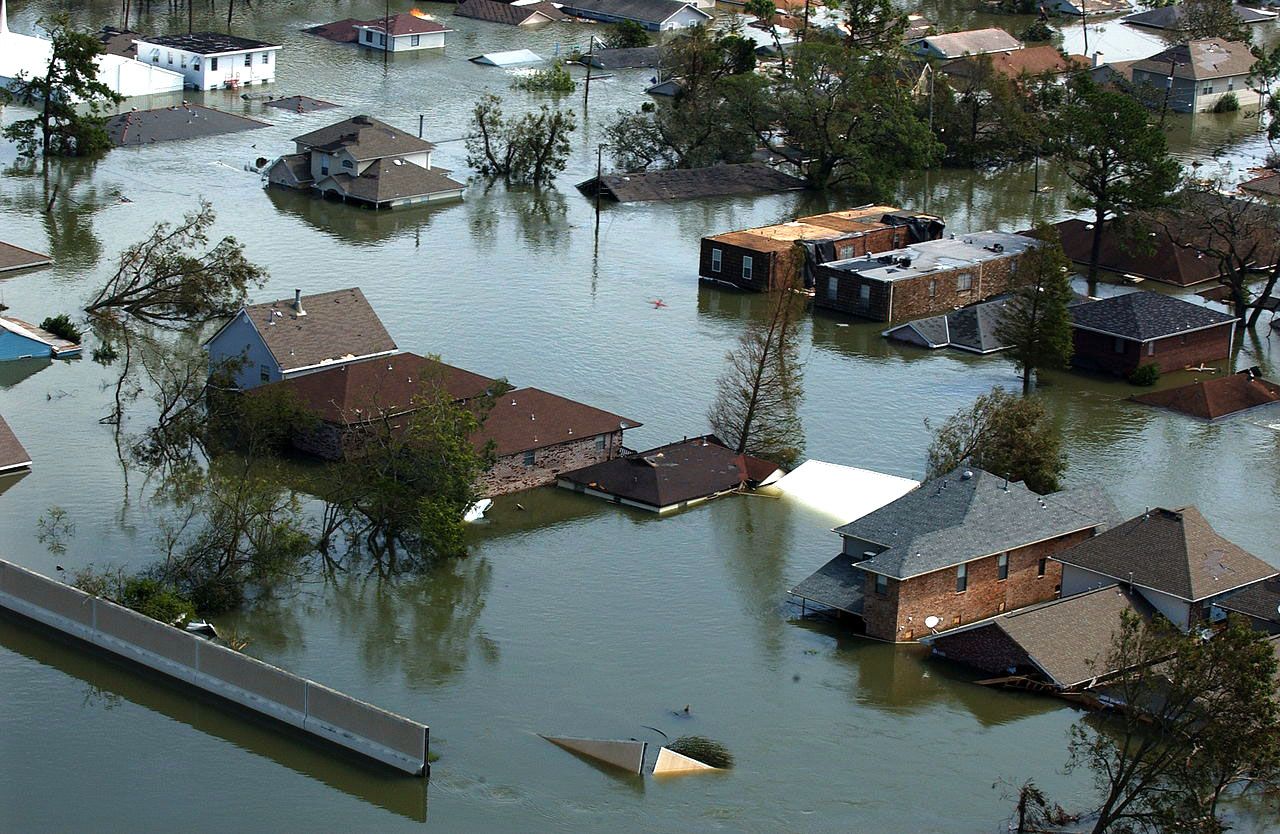
hurricane katrina biloxi mississippi
Last Saturday I posted Boundless Community intertwined with some thoughts on Katrina; here are some reflections about a couple of the RCL texts from last Sunday—a sabbath-day majorly in Katrina's wake:
Matthew 18:15-20

15 "And if your brother sins against you, go and reprove him, just between the two of you. If he hears you, you have gained your brother. 16 But if he will not hear, take with you one or two more, that 'by the mouth of two or three witnesses every word may be established.' [Deuteronomy 19:15] 17 And if he refuses to hear them, tell it to the church. But if he refuses to hear even the church, let him be to you like a gentile and a tax collector.

18 "Truly I say to you, whatever you bind on earth will have been bound in heaven, and whatever you abolish on earth will have been abolished in heaven.

19 "Again truly I say to you, if two of you agree on earth concerning anything that they ask, it will be done for them by my Father in heaven. 20 For where two or three are gathered together in my name, I am there in the midst of them."

Romans 13:8-14

8 Owe no one anything else except to love one another, for anyone who loves another has fulfilled the law. 9 For the commandments, "You shall not commit adultery," "You shall not murder," "You shall not steal," "You shall not covet," [Exodus 20:13-15, 17; Deuteronomy 5:17-19, 21] and if there is any other commandment, are all summed up in this word, "You shall love your neighbor as yourself." [Leviticus 19:18] 10 Love does no evil to a neighbor; therefore love fulfills the law.

14 But put on the Lord Jesus Christ, and give no thoughts to gratifying the aimless desires of your flesh.
Put on the Lord Jesus Christ! From Paul himself we know our baptismal clothing is Jesus' death and Christ's resurrection, leading to the demise of our false, unconnected selves and subsequent living in the reconciled community that in Christ Jesus is born, lives, breathes and keeps on dying and rising for the life of others—both in our own nearby communities (church, neighborhood, family, school, workplace) and those others geographically distant and/or culturally faraway from wherever we are, others we've never met and possibly never will meet.

Paul insists we owe, we "ought" the love of Christ to every one another; the extravagantly unbounded love for us God demonstrated in Christ Jesus obliges us to return that love to every person we encounter and to all creation. Within the church community and in our imagined more-private interactions, love becomes the energetic power flowing through our community and keeping us joined together in the Spirit—maybe especially in times of discord and disagreement.

Paul compares love for others to a debt - an ought that we owe them - and summarizes all the commandments into one single directive: Love does no harm to a neighbor; therefore love is the fulfillment of the law. To understand the obligatory nature of a debt and the ensuing fallout when we don't attend to repaying that obligation, a person does not need to have reached anything resembling chronological maturity. In the Bible's economy and worldview, sin and debt essentially are synonymous.

Via Matthew, God calls upon us (the church, yep, we are the church!) carefully to care for one another radically and graciously, even vis-à-vis—especially in the face of—sin, offense or disagreement; Matthew tells us, the church, to begin by privately addressing the person with whom they are in conflict, next to seek impartial mediators [probably members of the church's governing board] to help resolve the situation, and then, it sounds as if the entire congregation needs to intervene.

Matthew quotes Jesus' pledge that his gracious, loving presence will be the power reconciling and uniting the two, the three - or the many - gathered together. The Matthean text disparagingly mentions "gentiles and tax collectors," but that reference probably did not come from Jesus of Nazareth; most likely it's Matthew the former tax-collector's gloss regarding interactions and conflicts within his own local church. By the way, Matthew is the only gospel-writer who uses the term "church," or ecclesia!

Both of these passages are about maintaining the fragile-appearing web of connectivity among church members, and I'd definitely carry it through to the entire world (right now in particular I'm thinking of New Orleans, Mississippi, Alabama and the entire Gulf Coast region), since our Father-God, Christ Jesus the Son and our brother, in the dynamic power of the Holy Spirit connect, reconcile and enable our interresponsibility for one another and for all creation. But for us - particularly in the churches of the Reformation, who tend to live as intellectual people of the Enlightenment, too often acting and thinking as "individuals" more than we do as members of community - what about the inevitable strain between perceived individual rights and necessary local and global community solidarity?

The dialogue partners in The Gospel in Solentiname, my favorite gospel commentary, propose regarding this text,
  • "The publicans or tax collectors were the ones who collaborated with the Roman occupation, and the religious Jews considered them excluded from the Jewish community just like the pagans. But here Jesus isn't concerned with religious questions. He's saying that if somebody does evil and doesn't reform he ought to be excommunicated from the community. The unjust person (and not the person of another religion), that's the one that ought to be considered by us as 'pagan' or 'publican.'"

  • "Which is like saying the oppressor or the collaborator of the oppressor. ...He has removed himself from the community. He's outside, but we have to fight to get him back in."

  • "For Christ the ones who don't believe in God are the ones who don't love their neighbor, the ones who don't want to live in harmony with their companions."

  • ..."You mustn't accuse anyone to the police judge in San Carlos. It's the community that must judge."

I tell you the truth; what you tie in this world will be tied also in heaven, and what you untie in this world will be untied in heaven."

  • "This means that everything the community decides will be ratified by God. ...all of us here are in agreement, God's also in agreement with us. ... You could almost say they're like the three Divine Persons. And the three Divine Persons are like a single true God. And the three persons who are in agreement would be three who are united with God." ...

    "The people's verdict is the verdict of God, says Christ."

    "...And Christ is there with them even though they don't realize it."

Because wherever two or three are gathered in my name, there am I in the midst of them.
  • "...in the language of the Bible 'name' doesn't mean the name of a person but the person himself, or also what we now call the character of a person. When Christ speaks of gathering in his name he doesn't mean that they're going to be mentioning his name but that they'll be gathered in his spirit, in agreement with his teachings and his message. That community will have such great power because he will be in the midst of them."

  • from The Gospel in Solentiname, volume 3, pages 152-158
Back to Katrina for a moment: within our own local churches, sometimes the air is so thick with irresolution and conflict, newcomers and visitors actually can feel the tension, so they drop out very quickly. The last section in the post I linked to at the beginning of this one includes:
God mightily acts to overcome the division between our old, solitary, disconnected existence and our new lives in the fullness of community. Baptism obliterates the boundaries and the unimportant distinctions between us and God and between us and every other facet of creation, human and not.

...because of our irrevocably entwined lives, Katrina's wounded and broken are all of us, and the responsibility of every one of us, but especially those of us who live in Jesus Christ as The Church, who every day live aware we are the Kingdom of Heaven on earth. God calls us, and in the Spirit God empowers us, to be a crucified and resurrected presence among all people and all creation. As the Church and the churches, may we be, live and act as God calls us and the Spirit enables us: to be his presence, to live in trust and to act in compassion!
Long, long ago, I read, reread and then read over again, I and Thou by Martin Buber. I don't know if the words are from that book, or maybe they were on a poster I once owned or noticed in a gallery, but the quote is from Buber:

Love is the responsibility of an I for a thou.

Speaking of posters, maybe some of my readers know about the Benedictine Conception Abbey's Printery House? At once point in time I owned a bunch of them, but most poignantly a couple remain stuck in my memory: the first, with a quote from Harvey Cox, "Not to decide is to decide"—that one hung on the wall in my kitchen in Boston's North End, and when a mini-flood trickled down the wall from the kitchen above mine, it kind of like soaked the poster, which I decided wasn't in sufficiently optimal condition to take with me to my next sojourn in time and space. I have no clue what happened to the other, which featured a train whirring through the night on its way to wherever; that one read, "Life is a journey, not a destination." So much for asides!

Continuing about Katrina: I cannot say more than endlessly to reiterate that all of us form a single created and redeemed community and to wonder at the non-humanness of the Federal government's leadership and also wonder if part of it is not sheer ignorance? When I heard folks locally and on TV ask why the literally left-behind in the city - transformed from site of civilization into situation of devastation - by Katrina's wrath did not heed counsel to get out of town, I had to believe the people who asked that question were by no means uncompassionate or generally ignorant but they did not realize that too many Americans cannot jump into their SUV or related trophy vehicle, gas up and flee from the path of whatever physical or metaphorical storm that's about to hurtle into their territory because they lack the financial, psychological or whatever resources to do so.

Love is the responsibility of an I for a thou.

This blog began about last Sunday's lectionary texts...how can it be possible for any of us to bear and live out our responsibilities for each- and one-another? For all of us to live in community, thriving as citizens of a planet increasingly interconnected but also more and more fragmented in close to every imaginable way, we all must learn to perceive others' situations and needs as they really are. Is it possible for any of us to move beyond stereotypes and assumptions? You shall love your neighbor as yourself.

Saturday, September 03, 2005

Boundless Community... Katrina

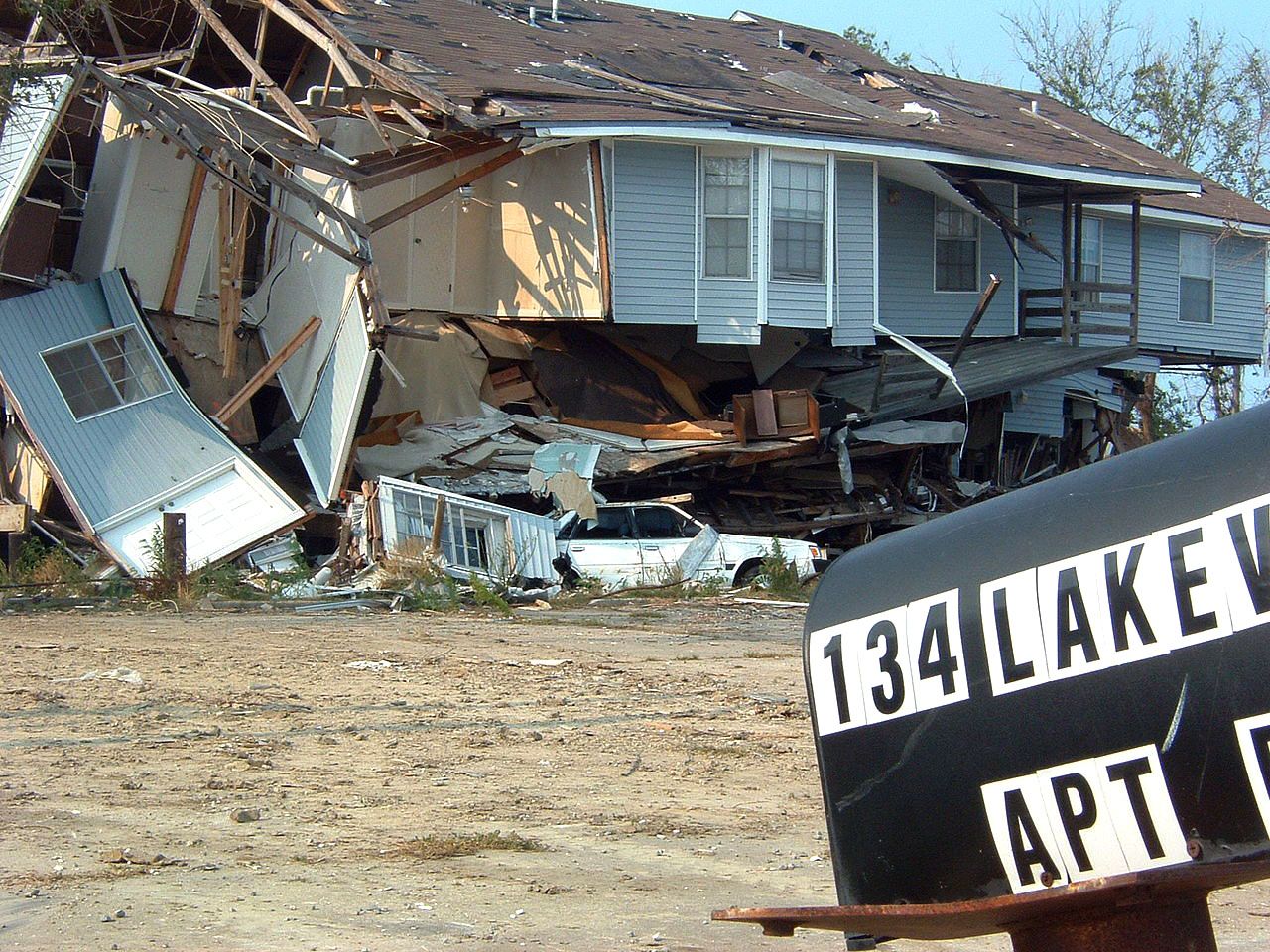
Hurricane Katrina, Slidell, LA

Boundless Community intertwined with some thoughts on Katrina

Introduction

A few weeks ago I reposted my old blogs with titles so the recent posts code I added to the template actually would work throughout the blog, and in the process of doing so I came across one of many of my felicitous phrases: boundless community! As I do so often, I was writing about baptism when I wrote boundless community. As I do so routinely, I grabbed onto some words and began writing about them.

One of my excuses to myself for not finishing this earlier was the unusually hot and sultry weather here in paradise San Diego, and again we're having a lot of humidity, making the weather feel like Summers in the City I experienced living in Boston... in the course of not developing "Boundless Community" into publishable form I wrote some others for this far by faith, my testimony blog and I've left a couple things here on Desert Spirit's Fire, but since today is Saturday, September 3, it's more than high time I finished what I began on Sunday evening, July 24.

But first, I want to mention that this weblog, Desert Spirit's Fire, is aging! Here's my kick-off, Welcome from way back three summers and more than three dozen moons ago, July 16, 2002. Since then I've done close to a ton of customizing to the template (it fits the content well, so I probably won't switch to another one any time soon) in order to align it with most of the niceties most present-day blog templates come with by default.

Paradoxical Presence: Sacraments and Church

As closely as it relates to this blog I won't repost it here, but for more of what I've written about the Boundless baptismal/eucharistic Community, check this out from April 7, 2004: Sovereignty, Eucharist and Ascendancy. Okay, I will cite a bit of what I wrote, though it's extreme theological shorthand (almost to the point of crudeness!) with a hint of Luther and a scrap of Zwingli:
...the person presiding at eucharist holds the totality, entirety and completeness of the redeemed and restored cosmos in her or his hands in the person of the risen, ascended One Who also is now descended, once again "incarnate," among and within the gathered and transformed Eucharistic community...
However, it seems well-nigh providential that I returned to this blog for maybe the dozenth time since beginning it, because when today I consider Boundless Community, I cannot help but agonize over the devastating toll hurricane Katrina has been taking in the excruciating suffering of all God's sentient beings - 2-legged, 4-legged and multi-legged - as well as the cost to the terrain and the waterways (far beyond the technical confines of Lake Pontchartrain and the Mighty Mississipp) and to the total infrastructure. Katrina has been a substantial jolt out of the surreality in which we amble and drift far too much of the time, and if repair, rebuilding, revitalization and the life-giving essential of the renewal of hope gets left to merely human devices and human power, possibly the damage and destruction will be beyond repair?

This past Wednesday evening I posted some Katrina-related scripture: "Who is this? Even the winds and the sea obey him!" from Mark 4, followed by the Pantocratur ascription from Revelation 11:17, and concluding with Revelation 21's New Heaven, New Earth, New Jerusalem-City of God, proclaiming to all:
"Now God pitches his tent and lives among all humanity, and God will travel alongside all the people wherever they may go. They will be God's people, and God himself will dwell with them and be their God. And God will wipe their tears from their eyes. No more will they know death or grief or sorrow or pain, because the old order of things has gone away."
I pulled the passages out of my head (well, out of my experiences and theology) and left them without even minimal commentary or exegesis, because when I ponder the responsibility God gives us, the Church and the churches--the responsibility of being his presence, specifically the Presence of the crucified and risen Christ in the world, the exhibition of the Kingdom of Heaven to the world, it is scary awe-full and also reassuring, because God believes in us that much, God trusts that in the power of the Holy Spirit we can be his ambassadors and envoys, his healing, hope-restoring, life-renewing, transforming, mysterious, humanly illogical Eastered power!

Recognizing the Risen One

Boundless Community: didn't Paul insist we discern the body, recognizing and acknowledging the Risen Christ's hidden presence in the church and in the world—discerning the body particularly as we prepare to partake of the eschatological feast of the eucharist? ...although we need that admonition absolutely everywhere, all the time. The Body of the Risen Christ, also known as The Church and the churches supremely are a single body, one common community, eternally linked vertically and horizontally; admitting and living with those dimensions can make a person very uncomfortable.

Boundaries of any kind are time-limited and space-demarked human constructions, but because God knows and understands our human condition and its accompanying propensities so thoroughly, in Jesus of Nazareth God became one of us and lived a fully human life, in order to wipe out all of the barriers between earth and heaven, because in God's Sovereignty no such limitations can exist. Since Jesus Christ' birth, life, death, resurrection and ascension obliterated them forever by reconciling us to one another and to God, why do we still live and act as if this were the old order of the reign of death rather than the new order of the dominion of life?

Once more I need to recall the beginning of the First Lesson from Advent 1 in lectionary year B: Isaiah 64:1 O that you would tear open the heavens and come down, so that the mountains would quake at your presence...That's about a permanent breaking, a truly irreparable ripping apart and keeping apart forever of the obstacles and obstructions between heaven and earth. ...I've blogged on that text at least twice in this site, and since this coming-up Advent 2005 we'll begin RCL year B again, I'll probably theologize about it again.

In God's Sovereignty there are no limitations of time or space, of person, culture or creed, no distinctions of young, old, class or race, education or ethnicity. Today, Paul of Tarsus still tells us to discern the body, and Martin Luther's theology of the ubiquity of the Risen and Ascended Christ insists the Risen Christ is everywhere, not solely in the formally configured and institutionally recognized and authorized entity known as church.

Newness of Life

We teach and proclaim resurrection (is our central kerygma God's Self-revelation in Jesus of Nazareth or, indeed, is resurrection our primary hermeneutic?), but too much of the time we exist between death and life in a kind of no-person's land that's neither God's nor the devil's realm: we stay stuck in the three days and three nights in the Belly of the Great Fish, also known as three days and three nights in the Heart of the Earth. Nonetheless, with its nurturing, nutrient-rich, cushioning, fluid environment the Great Fish's Gut becomes a womb-like ambiance of safety and preparation for (re)-birth; the Earth's Heart reminds us of our origins in dust coupled with assurance of our ultimate return not to the dust but to a new re-borning to the fullness of resurrection.

Whether Belly of the Great Fish or Heart of the Earth, it's still about baptism, endlessly about baptism, meaning wherever we are and however we are (primarily to remind myself, it's fact, not feeling), it's about community and about our unbreakable connectedness to one another and to all creation, past, present and future. God mightily acts to overcome the division between our old, solitary, disconnected existence and our new lives in the fullness of community. Baptism obliterates the boundaries and the unimportant distinctions between us and God and between us and every other facet of creation, human and not.

Katrina the Hurricane's destruction affects each of us individually and each of our communities, whether church, neighborhood, city or any other group; because of our irrevocably entwined lives, Katrina's wounded and broken are all of us, and the responsibility of every one of us, but especially those of us who live in Jesus Christ as The Church, who every day live aware we are the Kingdom of Heaven on earth. God calls us, and in the Spirit God empowers us, to be a crucified and resurrected presence among all people and all creation. As the Church and the churches, may we be, live and act as God calls us and the Spirit enables us: to be his presence, to live in trust and to act in compassion!

Wednesday, August 31, 2005

Katrina | 31 August 2005

Hurricane Katrina, 30 August 2005

Mark 4

35 On that same day when evening came, Jesus said to his disciples, "Let us go over to the other side." 36 And leaving the crowd behind, they took Jesus along in the boat, just as he was—there were some other boats, as well. 37 A tremendous storm came up, and the waves broke against the boat, almost overwhelming it. 38 Jesus was in the stern, asleep on a cushion. The disciples woke him and said to him, "Teacher, don't you care if we drown?"

39 Jesus got up, admonished the wind and spoke to the sea: "Quiet! Be still!" Then the wind died down and there was a tremendous calm.

40 Jesus asked his disciples, "Why all the fear? Do you still have no faith?"

41 They were tremendously fearful and asked each other, "Who is this? Even the wind and the sea obey him!"

Revelation 11

15 And the seventh angel sounded his trumpet, and there were tremendous voices in heaven, saying:

"The kingdom of the world has become the kingdom of our Lord and of his Christ, and he will reign forever and ever." 16 And the twenty-four elders, seated on their thrones before God, fell on their faces and worshiped God, 17 saying:
"We give thanks to you, Lord God All-Powerful,
the One who is and who was,
because you have taken your tremendous power
and have begun to reign."

Revelation 21

1 And I saw a new heaven and a new earth, for the first heaven and the first earth had passed away, and no longer was there any sea. 2 And I saw the holy city, New Jerusalem, descending out of heaven from God, dressed as a bride adorned for her husband. 3 And I heard a tremendous voice from the throne saying,
"Now God pitches his tent and lives among all humanity, and God will travel alongside all the people wherever they may go. They will be God's people, and God himself will dwell with them and be their God. 4 And God will wipe their tears from their eyes. No more will they know death or grief or sorrow or pain, because the old order of things has gone away."
5 He who was seated on the throne said, "Behold! I now make all things new!" Then he said, "Write this down, for these words are faithful and true."

6 He said to me: "It is done. I am the Alpha and the Omega, the Source and the Destination. To anyone who thirsts I will give – without any cost – abundant cascades of the waters of life."

22 I saw no temple in the city, because the Lord God All-Powerful and the Lamb are its temple. 23 And the city has no need of the light of the sun or the moon, for the glory of God gives light to the city, and the Lamb is the city's lamp. 24 All the peoples everywhere will walk by its light, and the rulers of the earth will bring their glory into the holy city.

Saturday, May 28, 2005

Stored Value: from Lent 2005

olive garden
Here's a spinoff on one of my favorites (Rivers, Deserts, Identity and...Freedom!) from this blog; for our Lent 2005 Church Devotional Book I reworked it some, so here's the newer version on this eve of Pentecost plus.

Exodus 16; John 6:25-34

A while ago I had lunch at Olive Garden and spent part of one of my stored value gift cards. Since I think theologically something resembling 24/7, I began thinking about the theological implications of stored value and how it could play out in our everyday lives, away from restaurants, malls, and all those shopping scenes where gift cards are easily spendable; I started connecting stored values to events defining us as Christians and as Church.

During those years of being manna-fed in the desert, Israel lived and thrived with the experience of the heavenly gifts and divine justice that meant enough for everyone and too much for no one; under Moses' leadership and Yahweh's Lordship, the wilderness sojourners lived in daily com-pan-ionship. The people Israel called the manna "Bread of Heaven," and for a long forty years wandering through the desert, the "stored value" in the manna nourished them; in trust they journeyed with the One Who bestows the bread of physical provision, gifts of mercy, and gifts of justice!

In chapter 6, John the evangelist calls Jesus, the one born in the Little Town of House of Bread, Bread of Heaven, and today, in the Lord's Supper, we know the benefit of living manna blessed and broken, given to us to supply our needs. Like the Israelites in the journey to freedom, as long as we remain faithful by doing justice and righteousness, that reality of the eucharistic manna's "stored value" will keep working for us and in us, enabling our ministry for the world and in the world.

Via the gospel writer John, Jesus called himself the real manna from Heaven, and promised anyone who ate that manna, that "Bread of Heaven," never would be hungry, would live forever and never die! Talk about stored value! Jesus the Living Word of God is the Bread of Life; Jesus is our manna and the entire world's manna. Along with the Old Covenant scriptures, Paul insists, "the Word is very near you, in your mouth and in your heart, so you can do it." (Deuteronomy 30:11; Romans 10:4) In Christ Jesus we have values of justice, mercy, and righteousness stored in our communities and in our inmost beings to give for the life of the world, to give as manna towards the world's healing and wholeness.

Thursday, March 17, 2005

Church Prayer Rug

free ramble

In my mailbox this week I found what may become an Lenten annual: another blatant example of idolatry, another human attempt to create a god in its image, another slot-machine divinity of jumbo payoffs, a deity completely congruent with one of contemporary American society's most brazenly unsubtle gods—consumerism. From a skinny envelope I unpacked purportedly a face of Jesus, sketchily represented crowned with a thorny tiara; four-color printing is the graphics industry standard, but this is a two-color likeness! In addition, nowhere in the mailing could I find either a web address nor an email address—in this year 2005?!?!?!

Next Sunday, continuing its journey through the liturgical year, the church reaches Palm Sunday, with Jesus' triumphant entry into Jerusalem, city of prophets and in ages past, home to the Temple that for the Jews formed the axis mundi between earth and heaven—Jerusalem, the biblical City of God. Following the Revised Common Lectionary, the gospel chronicles the church reads during Lent consistently focus on Jesus' going to Jerusalem and to the cross (lest you imagine I haven't read the Bible, Crucifixion Friday gradually turns into Resurrection Sunday, with its astonishing empty grave: in God's system you cannot have Easter unless Friday precedes it).

Returning to the Church Prayer Rug! Conceptually, it is closely related to the common contemporary practice of consumer-driven and marketing-modeled churches, as in let's study the location, the demographics, traffic flow, in-migration and even out-migration (likely I've missed a slew of necessary statistical assessments), and then decide what the people will be clamoring for and what consumer options they'll be needing so our church can offer the right menu to meet their needs. Is that biblical?! Most likely Martin Luther (among others) would call it an example of that humanly always-popular Theology of Glory! The designation Church Prayer Rug (contrasted with simply Prayer Rug, or other possibilities, such as Tribal Meditation Rug, Rya Prayer Rug, Dhurrie Prayer Rag, Acrylic Broadloom Whatever…) reveals a lot, too!

Jesus: friend of sinners, companion of outcasts, Son of God, Son of Humanity, liberator of women, freer of slaves, lifter-up of underdogs, putter-down of overdogs, political upstart and rouser of the rabble, challenger of the religious establishment, yet Servant, Lord of all creation, Pantocratur…but…talk about a domesticated god, idolatry?! This one is offset printed, not even engraved, flattened onto a flimsy 11" x 16" sheet of not non-acid-free paper; due to the paper's quality (not!) I doubt it would qualify as a kitchen god, since exposed to any light for any length of time, it would crumble and fade; not surprisingly, the legend on the B-side is phenomenally unbiblical:
"This Prayer Rug is soaked with the Power of Prayer for you. Use it immediately, then please return it with your Prayer Needs Checked on our letter to you."
Here the quotes end, but the centered paragraph continues with: It must be mailed to a second home that needs a blessing after you use it. Prayer works. Expect God's blessing.

Tucked into the envelope with the rug itself (how much wear and tear could a paper rug withstand, anyway? Huh? Tell me, please!), there's a list of testimonials citing Rugged Benefits. They include, "Blessed with $46,000.00 after using prayer rug…;" "God blessed me with over $5,000.00"; "Received $10,000 in a financial blessing…"; "I've gotten a new car and a job,…"; "…17 acres of land…;" "Big 6 room house..." To assuage doubters, the *they* who sent me the Church Prayer Rug even threw in a spiritual boon, "Praise God! it is so wonderful to know that my husband is saved…"

A pair of scripture verses justifies the Prayer Rug endeavor:
  • Evening, and morning, and at noon, I will pray and he shall hear my voice. ~Psalm 55:17
  • God can do anything. ~Mark 10:27
My current email signature includes this site's address and pleading lines from the hymn, Make Our Church One Joyful Choir; I haven't posted it on this blog, so I'll quote the entire hymn:
  1. Make our church one joyful choir on this glad and festive day
    and by song invoke the fire that invites our hearts to pray:
    Shape us, Christ, to live and claim all it means to bear your name.
  2. Bend us low by song and prayer, low enough to lift the cross
    and to take the weight and bear love's uncounted final cost:
    Shape us, Christ, to live and claim all it means to bear your name.
  3. Lift us up by song and prayer till the way we deal with loss
    and our acts and words of care trace the pattern of your cross:
    Shape us, Christ, to bear your name.
  4. Bend us, lift us, make us strong, send us out with wind and fire,
    so the world may hear the song that we offer as your choir:
    Shape us, Christ, to live and claim all it means to bear your name.
    Amen, amen, amen!
Thomas H. Troeger
© 1994 Oxford University Press, Inc.

Shape us, Christ, to live and claim all it means to bear your name!
Bend us low by song and prayer, low enough to lift the cross
And to take the weight and bear love's uncounted final cost…
…and our acts and words of care trace the pattern of your cross:
Shape us, Christ, to live and claim all it means to bear your name!
To bear the name of Jesus Christ! One of the greatest theologians of the cross insisted,

"I have been crucified with Christ and I no longer live, but Christ lives in me." ~Galatians 2:20a

(Oh, by the way, that's from Paul of Tarsus' collected writings; I found it in the Bible!) For Jews in Jesus' time, the Jerusalem temple formed a gathering place and holy space connecting earth and heaven; for us Christians, the cross of Jesus Christ is the axis mundi between humanity and divinity! Our baptism into the cross affirms our creation and re-creation in God's image—that particular part of our Imago Dei is one of certified cross-bearers! Living and claiming all it means to bear the name of Jesus Christ means in us, the Church, Jesus still is friend of sinners, comforter of the sorrowful, liberator of the oppressed, companion along the way, forgiver of offenses; because of us, Jesus still is in this world, still carrying the cross. The Holy Spirit calls all of us who – in the words of the Apostle Paul – are "in Christ," to become and to be cross-carriers; for everyone our lives touch, God calls us to span what often seems to be a very far distance between heaven and earth.

Amen!

Sunday, February 06, 2005

Transfiguration: Until the Day Dawns

Texts – NKJV

Matthew 17:1-9

1 Now after six days Jesus took Peter, James, and John his brother, led them up on a high mountain by themselves; 2 and He was transfigured before them. His face shone like the sun, and His clothes became as white as the light. 3 And behold, Moses and Elijah appeared to them, talking with Him. 4 Then Peter answered and said to Jesus, "Lord, it is good for us to be here; if You wish, I will make here three tabernacles: one for You, one for Moses, and one for Elijah."

… 9 Now as they came down from the mountain, Jesus commanded them, saying, "Tell the vision to no one until the Son of Man is risen from the dead."


2 Peter 1:16-19

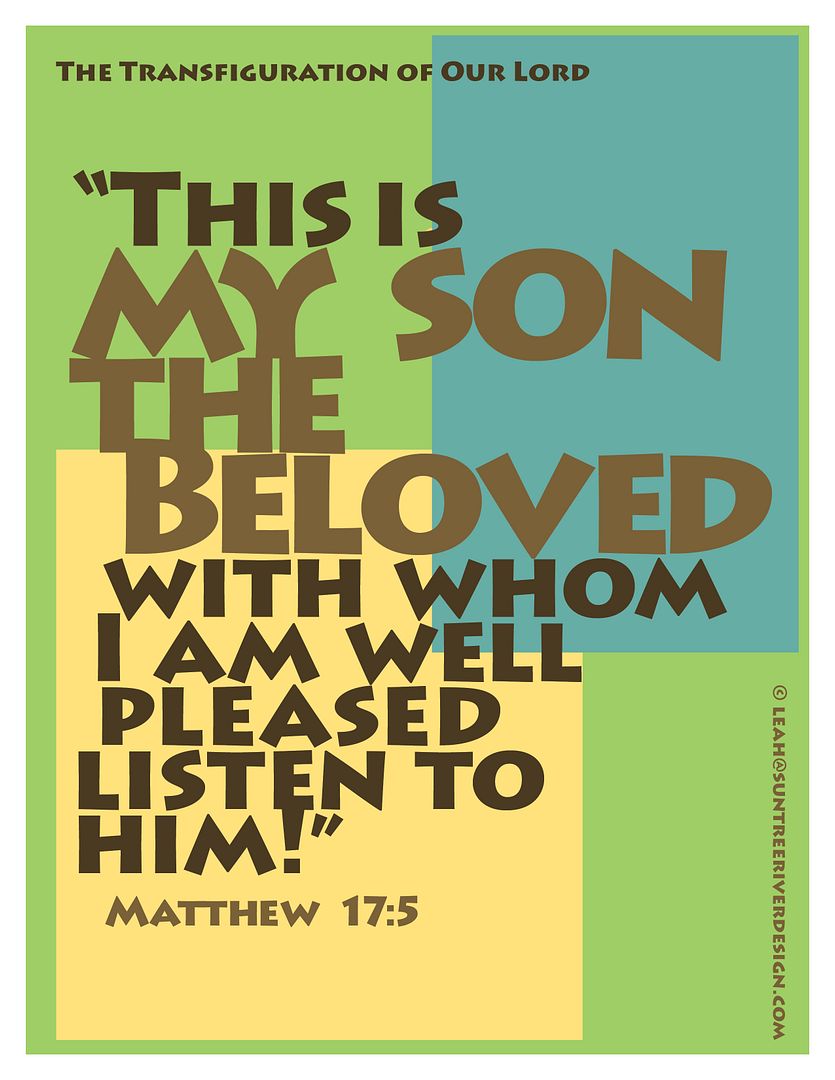
2 Peter 1:1916 For we did not follow cunningly devised fables when we made known to you the power and coming of our Lord Jesus Christ, ...but were eyewitnesses of His majesty. 17 For He received from God the Father honor and glory when such a voice came to Him from the Excellent Glory: "This is My beloved Son, in whom I am well pleased." 18 And we heard this voice which came from heaven when we were with Him on the holy mountain.

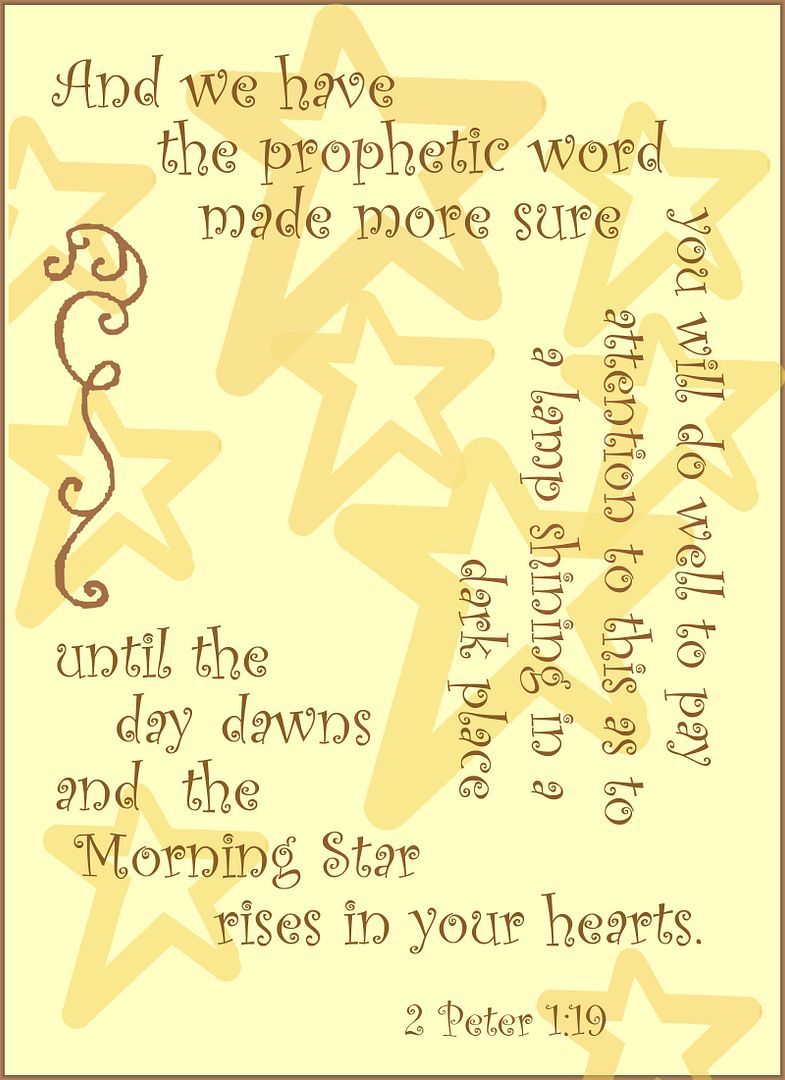
19 We also have the more sure prophetic word, which you do well to heed as a light that shines in a dark place, until the day dawns and the morning star rises in your hearts…


Until the Day Dawns
Son of the Excellent Glory, Whose birth and life among us sanctifies all creation, Creator of the Cosmic Dance and Hope Everlasting: as we celebrate another spectacular vision of your Sonship, may we relentlessly live as signs of the reconciliation of heaven and earth, in service to one another and the world. Amen!

"Tell the vision to no one until the Son of Man – the Human One – is risen from the dead!"


Also in some of Jesus’ words recorded by the gospel-writer Matthew, we hear: [12:40] An evil and perverse generation seeks signs, but no sign will be given it except the Sign of Jonah: for just as Jonah was three days and three nights in the belly of the great fish, so will the Human One – the Son of Man – be three days and three nights in the heart of the earth!

In the Good News according to Luke:[11:29] And while the crowds were thickly gathered together, Jesus began to say, "This is an evil generation. It seeks a sign, and no sign will be given to it except the sign of Jonah the prophet."

The Sign of Jonah—Death and Resurrection! For two thousand years, theologians and faith communities have struggled to learn and discern what Jesus means to them. We know Jesus as teacher and Jesus as political prophet; doubtless many of us consider Jesus a social activist, too. Jesus as a healer? Probably. But Jesus, the man of Nazareth, who died outside the city on a cross of shame as the Christ of God?

At the very heart of the story of Jesus of Nazareth stands the seven days we call Passion Week: a crucified man – but – then an empty grave, a narrative with no easy answers or clear-cut implications, a series of events so far outside the normally credible many of us would like to dismiss it as legend. But today's lections are not about death and resurrection but about something else altogether—they're about a spectacular manifestation of God's Glory on yet another mountaintop.

"We were eyewitness. We saw...with our own eyes." There on the mountain of the event called Transfiguration were Moses and Elijah and there was that voice...and there were Peter, James and John who saw, who eye-witnessed the meeting of earth and heaven, the holiness of everything created. Within Judaism, clouds, mountains and other expressions of nature were traditional signs of God's presence—you remember the cloud that went before Israel as a sign of God's presence in the Exodus story, and the mountain Moses climbed to receive the law, the Sinai Covenant? In telling about the Transfiguration,

Matthew, the gospel writer and Peter, the author of the epistle describe a meeting between heaven and earth, of the reconciliation of life, spelling God-with-us—of course, then there's the reciprocal of God's presence to us: our presence to God! Heaven comes down to earth countless times throughout the biblical witness, just as heaven and earth meet countless times in this world in which we live.

Jesus cautioned the Mount of Transfiguration Trio – Peter, James and John – to tell no one about the experience with Moses and Elijah, the law and the prophets, until he, the Son of Man, the Human One, had been raised from death. Tell no one until Easter! "Just as Jonah spent three days and three nights in the belly of the great fish..."

Matthew 17:5 transfigurationAnother Jonah, Simon bar Jonah, son of Jonah – the fisher of men renamed Peter or "Rocky" by Jesus himself – experienced the vision of Jesus transfigured and for Peter, we know the later reality of resurrection could not remain forgotten or untold! Over and over in the book of Acts and then in the later letter called 2 Peter we keep hearing Peter proclaiming the Risen Christ!

Often we recount stories about gutless Peter, almost rejoicing because he and we are similar in too many ways, but after the events of Easter and Pentecost, when preaching Christ even meant risking life itself, Peter could not help but do so.

Because of the stories of Peter's sometimes reluctance during the time he spent ministering alongside Jesus in the years prior to the crucifixion – especially the triple betrayal – I think if Peter had his human preference, he would rather not have stood up before those institutional religious leaders and assorted "others. But the word of the Risen One was not a philosophical theoretical idea out there but rather it was a word within Peter's heart, from his real-life experience walking and living with a friend who unconditionally loved him even in his weakest moments of total failure, that One he had seen crucified...

"We were eyewitnesses...with our eyes." The eye is the most sensitive part of the body; to be an eyewitness suggests vision and perception. On the Mount of Transfiguration Peter saw Jesus, Elijah and Moses; later Peter eyewitnessed Christ crucified; then he saw and experienced Christ Risen! In the life, death and resurrection of Jesus, Peter witnessed the love of God, and how could Peter be silent? Everything his teacher and companion Jesus spoke about had happened, everything – including death and resurrection, the fabled Sign of Jonah – and those events birthed hope in Rocky-Peter, so he began believing, living and proclaiming the hope of resurrection to the world.

Tell the vision to no one until the Human One is risen from the dead. A long time has passed since Jesus, James, John and Peter stood with Moses and Elijah on the Mountain of Transfiguration; a long time has passed since Peter told about seeing with his own eyes the transfigured Man of Nazareth and the glory of the Crucified and Risen Christ. In the centuries since then, far too much other than the boundless and unqualified love of God has been connected with Jesus and laid on the name of Jesus; Peter didn’t need to explain slave ships from Africa, or the Crusades, or the Salem witch trials or the decimation of villages in South America and Central America by unjust church politics; in those days of the nascent church, people hadn't yet suffered under the illegitimate authority of over-formed ecclesiastical clout.

So these days and in our own communities we can hear voices asking why we still proclaim the Crucified and Risen Lord of All!? Still today?! Like Peter? Because we too have witnessed Christ crucified in every life that falls at the hand of hatred, every heart broken by betrayal, every community brutalized by the powerful, every person left for dead; in those situations and far too many like them our eyes have witnessed Christ crucified.

And though many times we may run away like Simon bar Jonah also called "Peter," in the wake of the Day of Crucifixion we have seen and met the Risen One on Resurrection morn! Jesus promises us the Sign of Jonah—death and resurrection; Jesus charges us to "Tell no one until the Human One is risen from the dead!"

Just as the Spirit sent Peter, James and John to the Transfiguration site, the Holy Spirit takes us to places where God meets us, the contemporary people of God; the Spirit send us to places where we witness meetings between heaven and earth and see evidence of God's life-restoring and reconciling presence to us, while the Spirit enables us to be present to God, living in full response to the power of Easter within our once-devastated lives.

Together with Peter, we have been eyewitnesses of Christ's crucifixion but we also know the experience of the paradoxical power of new life born from death; those events birth hope in us—how can we be silent? Now we can believe, live and proclaim the hope of resurrection to the world!

As we prepare to enter the coming weeks of Lent, let us continue living as signs of the meeting of heaven and earth, people ready for Good Friday and eyewitness of Easter Sunday's glorious dawn!

The Word of Life,
Amen!