Saturday, March 29, 2008

culture bound: spring 2008

my earlier culture bound blog.

introductory thoughts

As Pastor Martin [Luther] insisted, worship and hymn-singing in the vernacular is a mark of the true Church. We've been praying and talking, studying and working together to contextualize, cast into our local vernacular (but there's not just one!), not only our worship and preaching but especially our evangelism and outreach to our nearby neighbors. I really am in the process of writing a short proposal that'll lead to an outline that in turn will lead to actual course material related to multicultural and other decidedly relevant neighborhood ministry...slow as the process has been, and a few questions we'll be asking include: according to us, who are we? According to scripture - and especially according to Jesus - who are we? What do we consider our calling? According to scripture - and especially according to Jesus - what is God's call to us as individuals, as a local church and as the ecumenical church?

Models for [especially local church] Ministry

resurrection witnessesHere's the mission statement I wrote for the church I served in City of History; I'm quoting it again [because the deployed staff guy from the national church declared it "a model" and asked permission to show it to other congregations? - no, not] because all these years time later I agree it is finely succinct and every bit as relevant to the congregations I'm involved with on this coast as it was to that one on the other coast.
We are the people of God, forgiven and set free by the death and resurrection of Jesus Christ; by the power of the Holy Spirit we are called together and sent into the world as witnesses to his resurrection. God calls us, a servant people, to proclaim in word and action the presence of the risen Lord to all those whom our lives touch, especially in this community.

past ecclesiastical blasts include...

basic business model

Up until a few decades ago the now recently departed dad of a friend worked for the UCC's national church; the family lived in New Jersey, and the dad took the commuter train into New York City, to 475 Riverside Drive by Riverside Church, where in those days the national offices of most mainline church bodies hung out. Due to financial and other constraints, the UCC eventually moved to Cleveland, the PC(USA) to Louisville and the ELCA to Chicago, though those cities' names still more than suggest Basic North American style and sensibilities, diverse as this continent has become—but at least they're geographically and otherwise a little decentralized. Even as theologians and pastors, we often casually call ourselves and our churches the "mainline" that in the beginning was more of a sociological designation than an ecclesiastical one. Given that at its start during the 1880s the Main Line railroad relocated the city of Philadelphia's social, political and business elite, effectively creating some extremely affluent new sub-urbs, is that what we in today's protestant mainline aspire to be and seek to live? It's only terminology? Words can carry so very much power and impact! Words can create worlds! Words do create worlds and words destroy worlds (as well as people and communities).

During my tenure at the above-referenced congregation, I was attending seminary and serving in the very inner city, so in the cold winter months I typically wore corduroy levis and sweaters to work and school; denim and khaki skirts with polo shirts were my usual summer attire. At least once senior pastor said, "The Church must emulate business, and business...wears dark and formal suits and shoes, etc." Talk about non-vernacular! In that ultra-urban setting (not all that different from where I currently live) as in others, already each one of us is unique though not immediately apparently so, but why attempt to make unnecessary distinctions that can lead to further divisions rather than essential unity? In real life, I definitely wasn't dressing or behaving all that much like most of my neighbors, but I attempted a semblance of approachability, and given the results, I believe I succeeded.

European model

Riverside Church in New York City is far from the only church building in this country designed after a western or northern European cathedral model. Built by financial and railway tycoon John D. Rockefeller, Riverside physically presents as a Gothic cathedral, but taking history into consideration, we need to remember the Christianity first experienced by colonial America and later on by the new republic featured imported doctrine and liturgy, with protestantisms from continental Europe and the British Isles, Roman Catholicism from Germany, Italy and central Europe. Gradually church structures imitating local rather than foreign architecture came about—Spanish Mission adobe being a still prevalent popular style.

biblical model
They devoted themselves to the apostles’ teaching and fellowship, to the breaking of bread and the prayers. Awe came upon everyone, because many wonders and signs were being done by the apostles. All who believed were together and had all things in common; they would sell their possessions and goods and distribute the proceeds to all, as any had need. Day by day, as they spent much time together in the temple, they broke bread at home and ate their food with glad and generous hearts, praising God and having the goodwill of all the people. And day by day the Lord added to their number those who were being saved. Acts 2:42-47, NRSV

current contemporary

Again I'm agonizingly wondering if we've been designing our worship, modifying the bible's theology and editing our lifestyles to appear non-threateningly culturally congruent; do we present the gospel of Jesus Christ as another slick spiritual smörgåsbord (browser spell check added the diacriticals) selection rather than a tremendous offense, a scandal, a stumbling block in almost every sense? Mercy driven, grace given, world-transforming? Is it even possible to tamely articulate the reality of the cross and resurrection? Or maybe worse, do we offend humanity and blaspheme God with some kind of unbiblical folk religion? Is Jesus basically another guy like us or is Jesus of Nazareth The Wildest of the Wild? It seems as if I talk and write and blog the same stuff over and over again, but far too much of what I've been seeing and hearing and feeling sure ain't nothing I can imagine living for, let alone dying for.

It looks as if right alongside the mega- and related churches those of us in the mainline who really really need to discover all kinds of newer models for ministry and to recover a sense of our own worth have become just as similar to popular culture and society as the earlier European and business models. But the gospel is not an extension or an expression of popular culture, not a separate compartment of some folks' existence, hardly an optional selection in God's solution to all creation's quest for the fullness of redemption, for dwelling within the milk and honey of the sovereignty of heaven. God calls and by grace enables us to live baptized into Christ each moment every day; we are the community that in Jesus Christ, in baptism, already has experienced its first death and its second birth!

In subtle and insidious ways, artifacts and habits of consumerism and overall general superfluity make inroads into the lives of people who never intended it, just as political, economic and religious imperialisms often far exceed the sum of their discrete parts. You know Colossians specifically describes powers and principalities, while other biblical writers more than hint at them. In one of his sermons Paul Tillich says most of us insist they don't do the really big sins, but rather fall prey to smaller ones; in exactly the same manner, we often claim we don't subscribe to super bling, ultra sex or super-excessive consumerism (though of course we like nice things and lovely clothes...) Besides, "a little can't do any harm." Do we appear, talk and act just like our nearby neighbors who have no conscious knowledge or awareness of Jesus or do we live and walk with Christ in ways our neighbors can see, touch, hear, taste and hope for more of?


Neil Brown

Saturday of Bright Week. The Seventh Day of Easter.

On behalf of the Presbytery of North Central Iowa, today we celebrated a Witness to the Resurrection for Neil Brown, who in 2003 had returned to live in this place we often call Paradise before crossing into the next phase of eternal life to meet Jesus Christ face-to-face in the Heavenly Realms—also known as "Paradise." Pentecost DoveAfter his ordination to ministry of Word and Sacrament Neil pastored two local churches, and then served the larger church on judicatory staffs. When he left this earth Neil was a member of the Presbytery of North Central Iowa, where he'd served as Executive Presbyter.

Due to various events I had the privilege of serving as organist for the service! Each of us got to take home a red flower to symbolize the Coming of the Spirit, so my illustration is from the bulletin cover I designed almost a year ago for Pentecost 2007. In the narthex the family had arranged a wonderful group of Neil memorabilia; the San Diego Padres shirt, a mostly red Hawaiian shirt (seems as if whenever I saw Neil he was wearing Hawaiian...), along with his alb and a Pentecostal red stole were my favorites and seemed most characteristically Neil.

As I considered whether to post this here on desert spirit's fire, my more formally theological blog or on my more informal testimony and related blog, This Is The Place that won—I've been writing a lot about the Spirit and this blog title references desert, spirit and fire.

Just last Sunday on Easter Day we heard from the first part of Jeremiah 31, the same chapter that later reveals God's New Covenant promise:
1At that time, says the LORD, I will be the God of all the families of Israel, and they shall be my people. 2Thus says the LORD: The people who survived the sword found grace in the wilderness; when Israel sought for rest, 3the LORD appeared to him from far away. I have loved you with an everlasting love; therefore I have continued my faithfulness to you.
grace in the wilderness and everlasting love!

Thursday, March 20, 2008

covenanting.

Psalm 116:7 | Return, O my soul, to your rest, for the Lord has dealt bountifully with you.
Today is Maundy Thursday—and my first post on this blog this month, though I've done a few things on "this far by faith" and posted some recent design on "sun country living."

These days the church generally schedules the rite of confirmation, affirmation of baptism for a majorly resplendent festival day like Pentecost, Reformation or Easter; we also welcome kids to Holy Communion way younger than in days of yore, when youth were not routinely admitted to the Lord's Supper until around 13 (bat/bar mitzvah age) or older. Post-the ordinance of confirmation they were ready to take their place as adults within the community of worship, witness and service, in some cases even serving on council, vestry or session and on committees other than youth. This week in his pastoral letter, United Church of Christ [now former, as i edited this for a new image fourtenn years after original post] President and General Minister John Thomas told about his own confirmation on a Maundy Thursday in New England, where "owning the covenant" was a long-standing practice.

Jeremiah 31:31-34 | The days are surely coming, says the Lord, when I will make a new covenant with the house of Israel and the house of Judah.
Jeremiah New Covenant
It will not be like the covenant that I made with their ancestors when I took them by the hand to bring them out of the land of Egypt—a covenant that they broke, though I was their husband, says the Lord.

But this is the covenant that I will make with the house of Israel after those days, says the Lord: I will put my law within them, and I will write it on their hearts; and I will be their God, and they shall be my people. No longer shall they teach one another, or say to each other, "Know the Lord," for they shall all know me, from the least of them to the greatest, says the Lord; for I will forgive their iniquity, and remember their sin no more.
1 Corinthians 11:23-26 | For I received from the Lord what I also handed on to you, that the Lord Jesus on the night when he was betrayed took a loaf of bread, and when he had given thanks, he broke it and said, "This is my body that is for you. Do this in remembrance of me." In the same way he took the cup also, after supper, saying, "This cup is the new covenant in my blood. Do this, as often as you drink it, in remembrance of me." For as often as you eat this bread and drink the cup, you proclaim the Lord's death until he comes.
The idea of living in covenant partnership with the Servant God of Israel is at least overwhelming, but as I reminded one of the classes I facilitated during Advent "This is not a covenant between equals!" Remember the classic Lent 1 pericope…"turn stones into bread?" But Jesus himself is bread, not the ordinary kind but the bread of life that never rots, molds or decays. And by the way, Jesus is the stony, solid rock of redemption.

"Here we will take the wine and the water, here we will take the bread of new birth, here you shall call your sons and your daughters, call us anew to be salt for the earth. Give us to drink the wine of compassion, give us to eat the bread that is you; nourish us well, and teach us to fashion lives that are holy and hearts that are true. Marty Haugen, Here in This Place, © 1982 GIA Publications.

I love the idea of receiving the sacrament for the first time on Maundy Thursday, but since that can't happen for most of us, we can take the Bread of Life and Cup of Salvation again as if for the very first time each Holy Thursday and at every other opportunity. Somewhere I read, "Without Thursday, Jesus' disciples wouldn't have understood Friday; without Friday, they wouldn't have believed Thursday." Exactly. At your right and at your left? … "You do not know what you are asking." Yes, we know the rest of the story, but do we dare trust God enough to live the whole story? During the Lenten DVD series, Left Right in the City's Senior Pastor told me the guy who was pianist for the morning series privately suggested to SP maybe in the Reformation tradition we emphasize God's gracfe and mercy too much, possibly to the near-exclusion of human agency and responsibility. Do we dare trust the Spirit of Life enough to do whatever we can to uphold our side of the covenant? In his famous explanation of the 3rd article of the creed in his Small Catechism, Martin Luther reminds us,

"…the Holy Spirit has called me through the Gospel, enlightened me with his gifts, and sanctified and preserved me in true faith, just as he calls, gathers, enlightens and sanctifies the whole Christian church on earth and preserves it in union with Jesus Christ…"

Psalm 22:2-3 | O my God, I cry by day, but you do not answer; and by night, but find no rest. Yet You are holy, enthroned on the praises of Israel.

Tuesday, February 26, 2008

Handbook of Spiritual Ecumenism 2

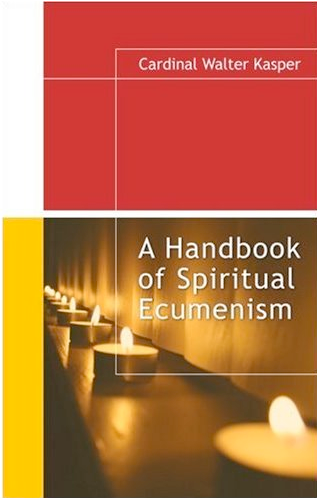
Tomorrow we'll have the second of our local Faith, Order & Witness conversations about A Handbook of Spiritual Ecumenism, by Walter Cardinal Kasper; here's my first blog about the book and here's my second.

Handbook of Spiritual Ecumenism coverOf late I've been blogging so sparsely I wanted to write some notes this evening, though I well may write more after tomorrow's meeting. I like this Prayer and Worship section a lot; I feel it can serve as a short how-to handbook. Some points that impressed me included on page 45, in the Personal Prayer section, Cardinal Kasper quotes the encyclical Ut Unum Sint: "Prayer should always concern itself with the longing for unity...In this journey which we are undertaking with other Christians ... prayer must occupy the first place." Cardinal Kasper adds, "...prayer for unity remains at the heart of any Christian prayer." On page 47 in the section Prayer in Common I love his saying, "Such prayer might focus on the mystery of the Church and its unity, on Baptism as a sacramental bond of unity, on the renewal of personal and communal life, or on the healing of the brokenness of humanity." On the following page he nicely puts forth the idea of retaining local (and confessional, denominational) particularity in liturgical practice rather than going for a blending mode when Christians from different traditions worship together—non-eucharistically, though I'm beginning to get some sense of the Roman Catholic ideal of shared eucharist as a visible sign of accomplished unity rather than a means or a stage of unity as it is in the Protestant churches. But appropriately, on page 57 he claims the eucharist as the "privileged" place to pray for unity. Cardinal Kasper considers joint public worship events a live possibility on occasions such as he lists on page 49 (you know what they are so I don't need to relist them here). In my first blog on the book I said, "I'm curious about the implications and resonations of the word spiritual with a lower-case "s," though in this chapter I didn't notice the expression "spiritual ecumenism" until I found it on page 53 in conjunction with our common baptism into Christ. I rejoice in and celebrate Cardinal Kasper's idea (page 54) that "An ecumenical affirmation or commemoration of baptism can [among other options] be a welcome occasion for a common catechesis on the mystery and the effects of baptism." But I'll caution that'd work well alongside church bodies of Reformation, Anglican, and Wesleyan heritage, but most likely the discussion would get lost with churches who affirm a sign of grace rather than a means of grace or effective means of grace interpretation of baptism.

Cardinal Kasper provides words of hope and grace regarding Mixed Marriage Families, and the Roman Catholic Church's two Sacraments of Healing, Penance/Reconciliation and Anointing of the Sick, in which "In certain circumstances and under certain conditions" (page 64) non-Roman Catholic Christians may participate, but if I read the symbolically fine print correctly, I believe he's referring solely to Christians in the Orthodox and Anglican communions, so once again I've officially been excluded. In the short Liturgical Year section Kasper again cites more than two dozen possible occasions for shared ecumenical worship, prayer and related celebrations.

So far I've read only thus far, mostly so I won't bring next month's discussion material into this month's topic, but I'm looking forward to chaper three, Diakonia and Witness. In our local FOW committee we've mainly been discussing documents specifically related to Faith and Order, but several times our committee chairperson has said, "Why not Witness one of these times, since that's part of our name?!"

Monday, February 18, 2008

gracism!

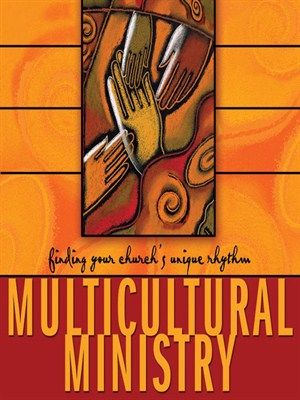
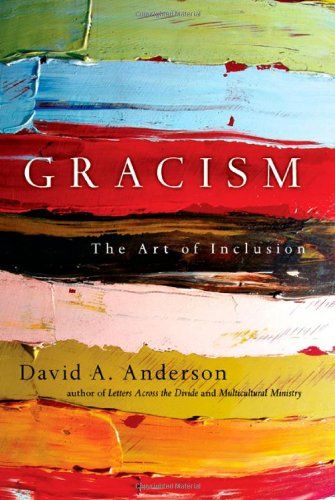
anderson multicultural ministry coverAbout a week ago I finished reading Multicultural Ministry: finding your church's unique rhythm by David A. Anderson, pastor of Bridgeway Community Church in Baltimore, and last Friday I finished digging into his Gracism: The Art of Inclusion. As I understand it, gracism, a word comprised of "racism" preceded by the letter "g" for God, encourages people to extend special favor to others based on their unique class, culture, ability or color and make that preference visible and apparent. In the preface the author writes [page 11]: "Gracism, unlike racism, doesn't focus on race for negative purposes such as discrimination. Gracism focuses on race for the purpose of positive ministry and service." However, race, gender and ethnicity form only a part of the gracism taxonomy, which also includes folks who are less educated, less physically or mentally able than some others, are lower income, less confident and/or posses anything else "different from." anderson gracism cover

On page 20 Pastor Anderson further explains, "The positive extension of favor toward certain people does not have to mean favoritism." And on page 23, "The one who hears, sees and pays attention to those on the margins—those in the desert—is a gracist." The liberation theology buzz-phrase of God's "preferential option for the poor" long ago made it into mainstream vocabulary; gracism is an expression of that type of preference. In what for me is an unexpected twist, Pastor David Anderson describes his church consciously configuring church staff, worship leadership, music group membership (and everything else) to appear visibly diverse rather than uniform.

Under the Grace-onomics(!) heading, Pastor David explains how a person can extend their connectional networks for the economic, professional or social benefit of others. On page 15 he refers to people "who may not be able to speak for themselves," adding, "And many times, even when they do speak, they are not heard." That's been my experience as I've attempted to reweave a peer network that would allow me to participate more fully than I've been able to as the result of my own efforts. I consider myself educated, articulate and expressive, but have been shut out too many times, thoughtlessly in some cases and probably intentionally in others.

An online friend who pastors somewhere east of the Mississippi wrote on one of our message boards:

I'm thinking about the temptation of Jesus story coming up this Sunday [Lent 1] and preaching about how this situation could tempt us to withdraw and pull into ourselves out of anger and fear but that the Gospel still calls us to move out of our comfort zones and give up both the anger and the fear of the "them."

My response to him included, "Excellent! I really like the direction you're taking with that text...Like everywhere, here we're encountering and potentially meeting lots of assorted 'others' and need to learn not to retreat into righteousness other than Christ's and need to learn to make safe places and space for those unlike us." (this may be old news?) I'm developing an adult series for some time around the day of Pentecost, partly based on Mark Nanos' The Irony of Galatians as I'm also making my way through the text of Galatians in preparation. I'm convinced my discovering this pair of books about gracism has been inspired and will influence our class discussions, especially since I'm going to circulate both books among class members.

Back to Galatians' author! After his encounter with the Risen Christ, Paul, a Jerusalem-educated Roman citizen born in the Jewish Diaspora, self-described as a "Hebrew of Hebrews," proclaimed and lived as if the birth, life, death and resurrection of Jesus Christ initiated a paradigm-shifting (I had to include that phrase!) cosmic transformation. Just as Saul/Paul insisted no longer would people be defined by ethnicity, race, outward appearance, gender or such particular semi-accidentals (but hey, folks, this was not exactly emancipation proclamation...) can we, the church of Jesus Christ in this community live by not defining people as Mexican or American, foreigner or native-born, green- or brown-eyed, straight or bi, military or civilian? Maybe in such an apparently gracist way so that our congregation and our community is visibly diverse and multi-everything? Can everyone be as equal to us as they are before God?

The brother-in-law of a friend described the truly astonishing degree of inclusiveness of a Roman Catholic congregation near his workplace: all ages, abilities, gender orientations, economic and educational levels, ethnic identities and cultural persuasions—a visible slice, a representation (maybe that needs to be "presentation") of the kingdom of heaven. But he added, "officially we're not welcome at *their* communion table, and our pastors can't preside, officially or not." So is that God's kind of diversity? Is it a true gracist community?

I'll conclude this blog with a couple of my own experiences. The first happened last spring at Old Condo Shadows. I'd offered to present the fruit of one of my talents as part of the program for the monthly Friday evening potluck, so they took me up on it, and in addition scheduled a photographer who'd been in that group forever and a quilter who'd moved into this neighborhood more recently. I presented a DVD portfolio of about 60 or 70 pieces of my graphic art. My blog readers know my art has a lot of energy and color, but very little of it is obscure or "hard to get." After my show I got only one compliment, from the guy who was interim pastor at the time. As usual, I made a string of excuses: the resolution on the TV wasn't exactly great (it really wasn't); Pastor Scott and I are a year and a half apart, meaning we inhabit the same world and share the same culture. As an aside, despite my persistent complaints of lack of shared history in my current life, another person who has been through the same cultural, political and social times, even if not directly alongside me, makes a very good stand-in for someone who has been there with me.

A week later a member of that dinner group posted pics he'd taken of the evening of the others' artistic presentations, but there were none of me! Truly, not for a split second do I believe he intentionally excluded me from his documentation of the evening, but a Gracist approach would have thought of me and decided to take a few pics, even if he didn't like, or get, or understand my art or considered me weird or unusual.

Then, I'll reference the time I was intermittent (approximately monthly) pianist and choir accompanist for a Tongan United Methodist congregation. In many ways it was an ethnic church, but despite a sizable Tongan community in that city, still they lived as strangers, with customs, spoken language, native dress and food very different from the majority mostly USA-born, culturally western-USA/Western-hemisphere populations. Yes, I had something to offer them they needed and wanted, but they constantly showed me hospitality as they invited me to holiday parties and events, always gave me food to take home after Sunday church (we'd have morning worship followed by a huge meal and then return to the church sanctuary for a testimony meeting). Although they worshiped in Tongan, the pastor would read the scripture passage he was preaching on in English—although I had little clue as to his interpretation, at least I knew the text!

So how do we start gracist living in our communities and in our churches? How can we bring others into our center and also receive their gifts of hospitality when they choose to invite us closer to their centers rather than leaving us on the margins of their worlds? We need to begin prayerfully risking to live out God's answers to those questions as we become Gracists and enable others to live Gracefully, as well!

my amazon review: noticing and celebrating differences

Friday, February 15, 2008

Water and the Word...

...Friday 5; RevHRod lines out today's Water and the Word Friday 5 for us; she also provided the elegant, energetic graphic image, which I'm happily including rather than one of my own designs.

baptism spirit water1. When and where were you baptized? Do you remember it? Know any interesting tidbits?

I was baptized in an Episcopal Church somewhere in the deep south (either Mississippi or Alabama); despite growing up far away from any ecclesiastical involvement, learning from my grandmother about my baptism began giving me a sense of church was where I belonged. As I wrote during summer 2003, "On the day I was baptized as an approximately 2-year old I received both my second birth and my first death and because of God's infinite faithfulness to that cosmic event, God still holds me and possesses me!" Then after asking "does God not hold all creation close?" my response becomes, "Of course! But by covenanting with me in baptism, God also demands more of me..." No, I can't mentally re-image the event, but whenever I attend a baptism I try fully to identify with the person(s) being baptized and to (re)immerse myself in the spoken and enacted Word.

2. What's the most unexpected thing you've ever witnessed at a baptism?

The person who had to be dunked 13 (thirteen) times at an immersion/submersion baptism.

3. Does your congregation have any special traditions surrounding baptisms?

No...unless I mention the not-unusual practice of the pastor carrying the newly baptized around the sanctuary when it's an infant or young child baptism. And, of course, lots of applause!

4. Are you a godparent or baptismal sponsor? Have a story to tell?

Only from being part of the witnessing and promising assembly surrounding the person being baptized.

5. Do you have a favorite baptismal song or hymn?

For now try "We Know that Christ is Raised" (Presbyterian Hymnal 495, Evangelical Lutheran Worship 449...); I love the text by John Geyer, the breadth and sweep of Charles Villiers Stanford's Engelberg tune.

Monday, February 11, 2008

Lent 1: Matthew 4:1-11

1Then Jesus was led up by the Spirit into the wilderness to be tempted by the devil. 2He fasted forty days and forty nights, and afterwards he was famished. 3The tempter came and said to him, “If you are the Son of God, command these stones to become loaves of bread.” 4But he answered, “It is written, ‘One does not live by bread alone, but by every word that comes from the mouth of God.’” 5Then the devil took him to the holy city and placed him on the pinnacle of the temple, 6saying to him, “If you are the Son of God, throw yourself down; for it is written, ‘He will command his angels concerning you,’ and ‘On their hands they will bear you up, so that you will not dash your foot against a stone.’” 7Jesus said to him, “Again it is written, ‘Do not put the Lord your God to the test.’” 8Again, the devil took him to a very high mountain and showed him all the kingdoms of the world and their splendor; 9and he said to him, “All these I will give you, if you will fall down and worship me.” 10Jesus said to him, “Away with you, Satan! for it is written, ‘Worship the Lord your God, and serve only him.’” 11Then the devil left him, and suddenly angels came and waited on him. NRSV
In this classic gospel pericope for Lent 1, the devil first tempts Spirited into the wilderness Jesus to be oh, so relevant by turning unconsumable stones into useful bread...but not only is Jesus himself bread, he is far more than basic survival food, Jesus is The Stuff of ultimate revival, a.k.a. Living Bread, nutritious grain that won't rot or mold or decay! Challenging Jesus to be ultra-spectacular by jumping off the iconic Jerusalem Temple? But we know Jesus is the temple; in fact Jesus is more than the temple. Would the Son of Heaven yield to promises of power so extensive and extreme as possession of all the empires of the world? But in Christ Jesus all the world possesses the cross of Calvary, power of life over the death-dealing, life-negating pretenses of too many earthly governments and *other* assorted administrations. Jesus provides and Jesus is Eternal Supply; Jesus is Lord over and against the insufficiency of temple sacrifice, the pretense, dehumanization and violence of Roman imperial rule. Food, worship, lordship. How do we, why do we trust decayables and consumables and symbols of our own cultural realities rather than the Word of Life and the Spirit of Life?

Leading up to the day of Pentecost I hope to be teaching a 4-class series on Galatians; in tandem with Paul's text we'll explore our own and maybe even imagine our neighbors' conscious and apparent ethnicities, assorted "people hoods" and typical expressions of those traits and persuasions and try to discern why and what forms of worship (teaching, fellowship, outreach, etc.) appeal to us and discern ways to honor Galatians 3:28 without becoming an undifferentiated blob. Where was Galatia? Galatia had shifting boundaries; Galatia was the first ethnic church! A Roman province, Galatia was largely an immigrant community that hadn't originally been Jewish before becoming Christian; Gaul denotes Gaelic or Welsh or Celtic ethnicity, peoplehood. In Galatia practices that were more than and less than the gospel were transpiring: where are we? do we happen to live in Galatia? In 1 Corinthians 15 Paul reminds us:
Now I would remind you, brothers and sisters, of the good news that I proclaimed to you, which you in turn received, in which also you stand, through which also you are being saved, if you hold firmly to the message that I proclaimed to you—unless you have come to believe in vain. For I handed on to you as of first importance what I in turn had received: that Christ died for our sins in accordance with the scriptures, and that he was buried, and that he was raised on the third day in accordance with the scriptures...
Quintessentially Paul, the gospel is death and resurrection, and throughout the letter to the church at Galatia Paul writes about the freedom and bondage of the gospel...bound by faith to the cross and the empty grave, chained to liberty in Christ with freedom to be and freedom for service.

As the Spirit of Life drives us into and leads us through our post-baptismal desert and seductively suggests we meet people's demands for appropriately relevant programing, to become the blingiest, dazzlingest building on this mesa or *even* in the tri-mesa area and to aspire to mega-amounts of income (you know about the measurable values of financial articulation) and overflowing church sanctuaries...will we be ready to respond with words of scripture, Words of Life, and more than anything, will we be a Living Word on our neighbors' lives, a reality that demonstrates the death of death and the victory of life? Will we live as the presence of the crucified and risen Christ?? In the power of the Spirit of Life, I trust we will—God being our help!

Monday, January 28, 2008

Handbook of Spiritual Ecumenism 1a

Last Wednesday was the first of three Faith, Order & Witness meetings we'll read and talk about A Handbook of Spiritual Ecumenism, by Walter Cardinal Kasper; here's my first blog about the book. Handbook of Spiritual Ecumenism coverAlthough we won't meet to discuss chapter 2 until late February, I decided to add to my earlier thoughts, both to comment post-our group discussion and tamely and politely (I trust) write a little about how some of Cardinal Kasper's assumptions about protestants and Mariology surprised me. For lack of time but primarily because in print and on the computer screen the reader has neither the face nor the inflection of the writer, last week I hesitated to write anything, so I didn't. For example, on page 14 he uses the phrase, "Mary, the Virgin Mother of God," which no protestant I've ever known could agree with, but like many others I'm cool with Theotokos—God-bearer; pages later, starting with a heading, Mary, the Mother of God and onto page 34 he suggests, "Together, Christians can
  • acknowledge the place of Mary in sacred Scripture and ponder with her the great things that God has done in salvation history [yes, of course, to both of those ideas, at least from where I sit]
  • study the witness of early Christianity regarding Mary…[I'll agree to this, as well]...
  • promote mutual knowledge and appreciation of various traditions in devotion and spirituality related to the Mother of God in both the East and West…" [my Roman Catholic and Antiochian Orthodox committee colleagues distinguished "veneration" and "adoration", so I can go there as long as Mary is God's-bearer and not God's-mother…]"

But in a far more radiant light, everyone in our group appreciated the ecumenicity of Cardinal Kasper's section headed Martyrs and Witnesses unto Death starting on page 35, and I love his quoting John Paul II's Tertio Millennio Adveniente, "Perhaps the most convincing form of ecumenism is the ecumenism of the saints and of the martyrs. The communio sanctorum speaks louder than the things that divide us." [page 36] He follows the JP II citation with examples including, "Together, Christians can
  • offer ecumenical prayers for Christians of all traditions who still are victims of persecution and violence...
  • publish locally or regionally updated registers and biographical notes regarding recent witnesses to the faith unto death; this can be done ecumenically, reminding everyone that the shedding of blood is a common inheritance of all Christian traditions."

Then, on page 38, without specifying names other than "the four Evangelists and the Apostles" Kasper seems to consider holy persons and redemptive actors from all Christian traditions Saints, apparently not limiting sainthood to those in the Roman Catholic or Orthodox canon. It's not clear to me if this is like "saints" in a Pauline salutation or something other-than.

In my first blog on the book I said, "I'm curious about the implications and resonations of the word spiritual with a lower-case "s". Even non-church people often talk generically about spiritual aspects of existence (and hey, everyone's heard "I'm not religious but I'm spiritual" far too many times)." One of our members sort of equated "spiritual" with "prayer," so I'll leave that alone for now.

We also had a short-go-around about ecclesial communities and valid sacraments/eucharist, as well as my own near-craziness about Catholics under Rome's aegis not qualifying their name with Roman; to that Fr. Vince, a retired *Roman* Catholic priest, told us he had been ordained a priest (in other words, lots of church experience) when someone in England or elsewhere in the UK asked him if he was "Roman Catholic," and he'd replied, "No! I'm Irish Catholic!" He told us that was the very first time he'd ever heard Roman Catholic!

During August 2004 in Culture Bound (Culture, identity, home, belonging, etc.) I wrote:
As those cultural anthropologists insist, each of us inhabits a range of cultures; more than a single culture encumbers each of us. We see, hear and feel; we remember, dream and hope through the senses our cultures have given to us and we've inadvertently received; and to some extent, our cultural identities constrain and limit us.
From July 2007, here's my blog about my experiences at the Orientale Lumen conference. Although I'm considering seriously attempting to ferret out the claim of the Antiochian Orthodox Church as the only, most true church, though they credit Roman Catholic and other Orthodox church bodies with valid sacraments because of apostolic succession, last July I found the Orthodox Eucharistic liturgy very eastern, highly un-western in style and expression. Clearly I have a habit of bringing Pastor Martin Luther into a lot of my blogs and live-talk, and Luther famously lists as one of his marks of the true church prayer and hymn-singing in the vernacular—in spoken, visual, symbolic, and cultural speech people in the pews can comprehend! But of course there's valid argument for liturgies that are more formal and elaborate in terms of music, visuals, and gestures sometimes helping people more easily imagine the Reign of Heaven here on earth, assisting their belief and trust in something "other than" the mundaneness of routine everyday existence.

Regarding various varieties of theology and expression, again I'm considering my own experience as someone who didn't grow up in the Church or on its peripheries; I first met Jesus, the Church, and the Spirit within a context powerfully related and completely relevant to my own cultural background, passions, and hopes: a small, very urban, passionately worshipful, liturgically variable, socially and politically activist community that demanded, expected, and guided my full participation and commitment in all those areas. How many times have I told myself (probably) none of the congregations I've formally served on staff nor any I've attempted to get involved with since then wouldn't have attracted me at all, because I'd have been unable to discern the reality amidst the unfiltered and uninterpreted apparent clutter. And although these days I'm a good-enough cultural anthropologist, I know sufficient theology and understand the Western (and the Eastern) Churches' historical liturgy so I'm able to get a clue to the texts, actions, and meanings I experienced during the Orthodox Liturgy, I cannot imagine any person who's a product (literally) of Western culture and sensibilities comprehending Orthodox Liturgy as much more than an Adventure in Anthropology or in Comparative Christianity.

Listening for God blog 1

Listening for God cover The first RevGals book for almost new year 2008 is by scripture scholar and pastor Renita Weems—Listening for God. Not that Amazon was exactly slow shipping my super-saver order, but I took a long time choosing books from my wish list I could justify buying at this time of scarce $$$ resources, so I was the stuck one in the transaction, and as a result my shipment didn't arrive until last Wednesday. As usual, I'd planned to read this entire RevGals monthly book selection before tuning in on anyone else's blogs, but given that it's already the last Monday of the month and book discussion day and the sun has gone down, before reading further in the book I'll reflect on the preface and chapter 1, "The Mystery of Silence and Prayer" I've read so far, all of which encompasses almost half the pages of the book, not so much in detail but as to how the author's ideas reflect and relate to my own experiences, especially of the past dozen years.

A few years ago we discussed another of Renita Weems' books in a group I belonged to, but neither by searching my bookshelves nor by checking out Amazon could I remember the title, but I do remember appreciating our discussions and I'm also very proud that group was one of the few things in my entire life I've actually quit...though it took too long for me to do it! Nonetheless, I'm well aware my habit of sticking with whatever it is coupled with often making too many excuses for people has served me well, since it's the same person who has tolerated lots of %&*#%^* in order to keep on keepin' on toward what she's wanted and felt called to achieve. And to do.

In the preface, bottom of page 18 to top of page 19 Renita explains "...much of what has been written in recent years appears to be directed to the novitiate, the recent traveler, the newcomer to the inward journey...What about those of us who are beyond the first blush of the spiritual journey..." Then on page 20, "If God was going to speak to me, God would just have to do it amidst the clutter of family, the noise of pots and pans..." Needless to say, but every one of us requires reminders from someone else that God is walking and will continue to walk alongside and go before us, wherever we are and to whatever place God calls us. Last summer I insisted, "Yahweh's specialty was constant, unmediated presence with creation; so was Jesus' and so must ours become..." So many times I've said we people of faith, who sometimes trust in the humanly incredulous and who often journey without being able to rely on our physical senses like hearing and sight, also need to live with ambiguity and paradox. With mystery, too? Oh, yes—that one, also! Picking up on a few ideas, at least once I've blogged about my observing ages ago in the Monday evening Bible study that met at my house "people have seasons," and how everyone immediately picked up on that not-at-all-novel idea, so I especially like the way Renita discusses human heart, mind, body, spirit and soul seasons in this first chapter. Related to seasons (assorted ambient situations and environmental conditions, textures to use Renita's word I found on page 31, typically not related to our own plans or agency) in which we find ourselves, in ages past we used to talk a lot about living "as if," in Wendell Berry's words, to "Be like the fox who makes more tracks than necessary, some in the wrong direction. Practice resurrection." I also find myself in the habit of doing a lot out of plain obligation, oughtness to God, to humanity and all creation.

On last week's winter friday 5 I wrote, "I've learned to appreciate the subterranean, near-silent growth that happens during the colder seasons, closely parallel to the vast amount of life underneath the immediately apparent top layer of the desert..." and every one of my commenters picked up on that phrase! From pages 63 through 67, in a section headed "Ordinary Time," she equates the less sensational, less festive, more routinely mundane "green" seasons of the liturgical year with similar periods in each of our lives, immediately followed by the wonderful "Saint Fallow" section lining out parallels and similarities between plant life and our life. In my blog Earth Day 2007, which really is about my (award-winning! yay!) Earth Day postage stamp series, I said, "The images – all slices from my digitized analog graphics – aren't from my specifically bible-based or liturgical art but about our living green everywhere in faithful stewardship of creation. Interesting that we call Sundays in Ordinary Time "GREEN" Sundays!" In so many places Renita affirms exactly what of necessity I've been doing for what feels like a far too long forever; for example, on page 28, "...it is enough simply to cling to the memory of a memory with God." And of course, as I've been bloggin', talkin' and teachin, maybe especially in my own ecclesiastical context of emphasis on God's persistent (and paradoxical!) presence in Word and Sacrament, by grace the Spirit of Life helps me remember and assists the community in recalling, re-appropriating the narrative and the reality of our deliverance from death to life, in re-membering our identity as a people of God in this place and time.

Beginning on page 39, the ambiguity, sometimes paradox that can exist between theological scholarship and living within Christian community is something else I easily relate to. Unlike Renita, I don't hold a doctorate in theology, I didn't do an academic theology degree, but people have suggested I didn't get into my "safe" seminary because the interviewers thought I'd be getting a PhD or ThD and teaching at seminary level. Recently I've been told and tried to hear, "Leah, you could be teaching in seminary now, but you don't have the academic credentials—do you want to go back to school?" No, I don't. And from another: "Your Greek is so much better than mine!" Maybe it is, and maybe not, but I've claimed and made excellent use of the time I've had to work through a lot of the texts. Had God called me to become an academic theologian? My best guess is no, because I cannot believe I'd've been that obtuse and unresponsive, and I trust the possibility would have crossed my mind and heart more than once, but whatever God's past calls to me, all I can do is go on from here, and Renita's clear articulation of the messiness and chaos of existence and of life helps affirm that reality.

Amidst all the pain, seemingly endless disappointments and rejections, and everything else I won't enumerate, like Renita, I need to live out my baptism not only in the world, but within a worshiping, confessing and witnessing community of faith; I need my more formal theology to become my biography! For quite a while now, I've been telling myself and even other people I cannot go on this way, using my gifts, skills and education to such a small degree; despite realizing my experience post-deciding not to finish seminary and not to continue serving FT in the church would have been very different had I returned to Cambridge (for example), I also recognize my wisdom in choosing a parish church, one that's geographically near (in my current case, so geographically proximate to Where I Live that I walk out of my condo parking lot into my church parking lot), but I also need to grasp and risk acting on the wisdom to reach out for more possibilities within other communities claimed by Jesus' death and resurrection and called to faith by the Spirit.

Lies and living in hope; journaling as a form of prayer. In "The Longest Prayer," on pages 60-61 Renita observes: "By dusting off and rereading my journals, I get to relive the past and to retrace the hand of blessing in it. I get to relive the past and to redeem it. I get to relive it and to reinterpret the parts that once felt unsurvivable. More important, through my journals I get to play back God's voice." Further down page 61: "I've changed so little and yet changed so much." Me, too! I began this post talking about ambiguity, and in sometimes obsessively reliving and trying to make sense of past pasts, etc. I've noted both a typical female (human, probably) tendency to discern kernels of truth and partial truths in my attitudes and behaviors, and despite untruths (lies, whatever word you prefer) at times being facts of life, I'm realizing my incessant rationalizations and explanations aren't so much about stereotypical shades of gray as about near-absolute truth existing within my reasons and excuses for overstaying situations that no way are yielding fruit for me or for anyone else. That was oblique (gray?!) but I need to post this, so I'll conclude with words about journaling on paper. I haven't regularly kept a journal for quite a while, though a few years ago at one point I filled 4 or 5 70-page spiral notebooks within 4 or 5 months. When I knew I needed to get into a journaling phase and asked a friend who has taught English and writing with exceptional creatively, she insisted the ideas need to go "from head and heart to hand to paper; afterwards you can do whatever you want with what you've wrote." She also emphasized – as long ago I'd learned – to not use a lovely, beautiful, fancy journal book, because you won't want to ruin it with your writing. My experience with digital design has been exactly the same: despite sort of being in the process of developing what I refer to as an independent digital style and despite having produced maybe a dozen really cool pieces, maybe because I didn't grow up digital like younger denizens of this society, but most likely because of the way people are wired - wired was intentional, trust me - the only way I can design well digitally is to begin in analog format, scan what I've done (however detailed and/or complete or not) and then go on from there. Similarly, when I'm learning a complex piece of music on piano or organ (think Beethoven Sonatas, J.S. Bach's Prelude, Toccatas and Fugues), I'll learn the basic notes first, often commit them to memory and become technically adept at the piece, then it's always time to put is aside "for a season," maybe a few weeks or even several months.

I've no idea when I'll read and blog more about this book, but even if it's not for a long while, this chapter has been so very helpful and assuring.

Tuesday, January 22, 2008

Handbook of Spiritual Ecumenism 1

In an attempt to keep myself on the local map or possibly re-map myself, I sort of volunteered but mostly got drafted to facilitate this coming Wednesday's Faith, Order & Witness Committee discussion. For the most part we've gone roundabout in typical traffic circle style a series of documents we hope will bring our local group (Roman Catholics, one Antiochian Orthodox, mainline Protestants from several theological traditions) to a convergence of faith; our discussions have included several World Council of Churches Faith & Order papers along with sundry and assorted "others." For the next three meetings we'll read and talk about A Handbook of Spiritual Ecumenism, by Walter Cardinal Kasper, published by New City Press, site-described as "the North American publishing house of the Focolare, an ecclesial movement approved by the Roman Catholic Church…"

The book description on Amazon includes:
This Handbook offers practical suggestions for implementing and strengthening spiritual ecumenism… It is grounded in the documents that have shaped the Catholic Church's engagement in seeking Christian unity, those of the Second Vatican Council, as well as others such as the encyclical Ut Unum Sint and the Catechism of the Catholic Church.

Amazon also gives biographical info about the author:
Walter Cardinal Kasper, born in Germany in 1933, was ordained a priest in 1957. An accomplished theologian and author of many books and articles, he studied at the University of Tübingen and taught at The Catholic University of America in Washington, D.C. Wide respect for Kasper's ecumenical work led John Paul II to appoint him president of the Pontifical Council for Promoting Christian Unity, a position he has held since 2001.

I'll get to comment and facilitate discussion about the 3-section Preface that touches on three subjects (A Handbook; Spiritual Ecumenism; Growing in Communion) as well as the 2-part Chapter 1, Deepening Christian Faith (The Word of God in Sacred Scripture; Witnesses to the Word of God). Although I trust our group discussion will enlighten me, from my perspective something is un-okay, especially given the copyright dates of 2006 and 2007.

Handbook of Spiritual Ecumenism coverFirst, I'm curious about the implications and resonations of the word spiritual with a lower-case "s". Even non-church people often talk generically about spiritual aspects of existence (and hey, everyone's heard "I'm not religious but I'm spiritual" far too many times), which includes the Holy Spirit's call to us and claim upon our lives, whether or not we actively admit to it, along with the Spirit of Life's sanctifying actions in human persons and communities, in the Church and the churches, throughout creation and pervading the world, *even* institutional, organizational, and bureaucratic structures—Jesus made hash of the power and principalities… Churches of Reformation heritage long ago cited Word and Sacrament as essential for the local (and global) presence of the Church, with other things being not-so of the essence, or adiaphora. Days of forming new church bodies out of the old on a basis of structural, organic union followed by re-denominating most likely are over, but the protestant mainline (is the concept of culturally, socially, and theologically mainline still viable, still a reality?) remains committed to conversation and exploration of ways to attain and to thrive with full-communion agreements and related enduring partnerships under the sovereignty of Jesus Christ. In all of this, it's not simply about spiritual aspects of the gospel, but about the fullness of redemption Jesus Christ brought to the world and calls the church to continue doing.

So I'm asking what lower-case "s" spiritual ecumenism is all about! The gospel does have a spiritual aspect, but also physical, social, and cultural dimensions; while almost easily acknowledging essential unity, although there are many reasons The Protestants no longer are going for organic union between church bodies, reconciling differing polities along with more structural organizational arrangements has been one of the major concerns and difficulties in the past. Every one of us lives in a world bounded by language, geography, and an array of other factors, and we gotta live together with and despite those differences. In addition, the redemption and sanctity of all creation – not simply human creatures – is a huge part of the Bible's and Jesus' reality, and I'm wondering how the Roman Catholic Church, maybe especially with its emphasis on sacraments and a sacramental worldview, complacently can focus even primarily on the small-"s" spiritual?

At this time I've read no further than my assigned portion, but throughout chapter 1 Cardinal Kasper constantly references ecclesial communities, a phrase I first became aware of from the current Bishop of Rome when he was Cardinal Ratzinger. After Ratzinger's election to the See of Peter I exclaimed, "But that's the guy who called us 'ecclesial communities!'" My conversation partner responded, "Ecclesial community is a big step up from 'heretical ministries!'" Agreed…and as I prepare for continued participation in several geographically, culturally, and theologically nearby (near-to-where I live in every sense) heretical ministries, I know I'm participating as a part of the church in apostolic and prophetic continuity, and I know those church bodies belong to the church catholic, so would you Christians under the authority of the Petrine See please begin calling yourselves not simply "Catholic" but "Roman Catholic?"

Thursday, January 17, 2008

any good book friday 5

any good book friday 5 from Rev Gal (Guys, Friends) Blog Pals...

intro: hosting today, Heidi says, "...some books ARE better than others, " and I totally agree.

1. a book from the last 6 months that really has stayed with me—my checkbook, thankfully;

2. One of my favorite childhood books—Charlotte and the White Horse by Ruth Krauss, with Maurice Sendak's enchanting, dreamlike, delicate, etc. illustrations:

Charlotte and the White Horse jacket
This is the song of Charlotte
and Milky Way, her horse...
–the winter is going,
the wind and the rains are gone...
–the time of my singing is come.
Arise, my love, my fair one
my milk white Milky Way —
...the flowers appear on the earth.
Then the multitude gather and sing
Happy Birthday, dear Milky Way,
and when he hears his given name for the first time
the tears come up in his eyes ...


3. Favorite book of the Bible? Do tell? Just for now I'm telling you Deuteronomy, with its constant refrain into the land, into the land, into the land...please see my bonus regarding The Land!

I and Thou cover4. I could and have and probably will keep on reading over and over again Martin Buber's I and Thou;

5. For at least daily reading during Lent I'd recommend...Reflections for Ragamuffins by Brennan Manning, and why? He's been there, done that, bought the redemption, realizes the only way out is through, slices through to the root drive, cuts out and drains out the gunk and never spouts the stupid platitudes most Christians do in order to make me feel better but that actually wound further;

And because we all love bonus questions, if you were going to publish a book what would it be? Who would you want to write the jacket cover blurb expounding on your talent?

Working title: Justice, Freedom and Redemption: Divine Image and Creation's Glory, and in July 2004, I posted the bibliography I'd read thus far, but since then, the book has been sidelined, mainly due to my doing so much theology...I'm not sure who'd write about the author, but my Community Economic Development (mini-MBA) classmates called me "Renaissance Person," so I'd love someone to pick up and elaborate on that accolade! Thanks for the earliness, Heidi.