Wednesday, December 26, 2007

Noel 2007

[boxing day]

Oh, I am so too very tired that almost the first time ever I went back to bed and back to sleep this morning. Christmas Eve? Don't ask. Christmas Day?

Excellent dinner (turkey, dressing/stuffing, gravy, mashed potatoes, sweet potatoes, cranberries, green bean casserole, rolls and butter, Noel 2007creamed onions, olives, mixed veggies, mince pie (baked by Richard) with brandy. California chardonnay, some kind of vin de France, red wine of some type.

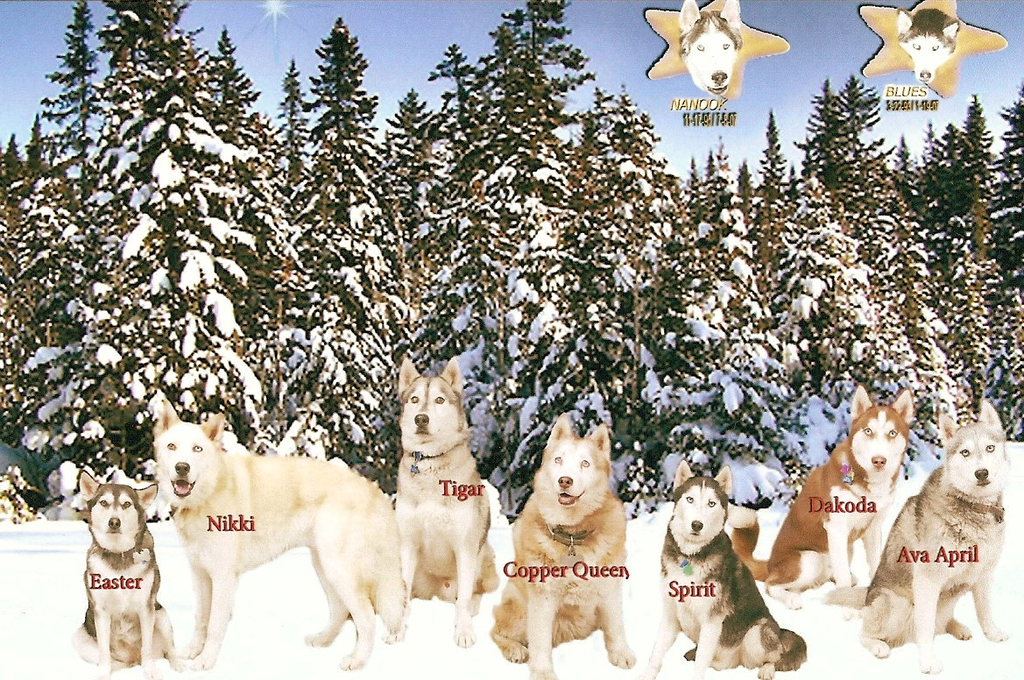
Good company (Patti, Floyd, Miriam, Richard, Carla, me, Ava April, Copper Queen, Dakoda, Easter Angel, Nikki, Spirit of 2004, Tigar).

No church… no PM, Cruiser or AM… I don't know how I'll return to Paradise another time. I thought Carla would be driving back and I didn't make a reservation on the Socialist (or on any other) Airline.

This afternoon we met Jim and Cheryl at the Humane Society so they could meet, greet, and drive home with Kino, their new pup they just happened to meet serendipitously.

Monday, December 24, 2007

advent 4

Sunday afternoon, Advent 4 (yep, I'd intended to blog this about 12 hours ago)

Southwest Airlines 737
Big 737 was not set to go by the 3:05 scheduled flight time, and while I waited along with a holiday-sized throng in a new to me location, Gate 1 downstairs at Lindbergh Field, in quick succession they announced boarding would start, had stopped, an engine needed inspecting and we could get on board, after all, but to do so we needed to match up the number and letter on our boarding pass and queue up numerically under the new, clearly-numbered overhead signs. Doubtless most of my blog readers know about Southwest, the Socialist Airline, and today was my first encounter with "You Are Still Free to Choose Your Seat: Southwest's new boarding enhances the preflight experience," (I spent too much time last week preflighting InDesign stuff…) as the December inflight magazine, Spirit expresses it.

Invariably and inevitably, socialism's way of the people, by the people, for the people generates rules, restrictions and unyielding structures that eventually inhibit slow down and stop the people's freedom. But oh, by the way, SW still has unassigned seating—at least for now. At Christmas Jesus came to us born for the people as one of the people, lived for us the people, died for the people – us! – and rose from the dead for the people—for all creation, actually. An original basic intent of carrying the Good News to more and more people and organizing churches properly and in decent order, has resulted in local congregations, denominated church bodies and judicatories overburdened (hmmm…in mining the overburden gets removed and hauled away, far away) with rules, restrictions, infrastructures and superstructures that inhibit the freedom of the people Jesus lived and died for and that in the end sometimes contradict The Way of The Crucified and Risen One.

In my typical way I've made excuses for the development of institutional structures, but too often they develop because people seeking Their Own Place and a Sense of Importance will declare and decree in order(!) to get themselves more clout and greater visibility. Last week more than once IRL again I mentioned I have no regret (none whatsoever—really!) that I didn't finish seminary, adding (again) I didn't want to be a senior pastor or head of staff…friend and colleague pastor I was talking with again observed most of the people who get to be senior pastors in a multiple-staff church are impossible to work with and no one wants to stay on staff with them anyway. Refer to what I wrote above.

This evening we'll celebrate Nativity Eve with fajita burritos accompanied by Mexican Feast; tomorrow morning I'll attend morning liturgy at Sacred Heart Roman Catholic. I do hope to post a more hopeful blog by Christmas evening!

Wednesday, December 19, 2007

Feast of the Nativity • Eucharistic Prayer

  • The Lord be with you.
  • And also with you.
  • Lift up your hearts.
  • We lift them to the Lord.
  • Let us give thanks to God.
  • It is joy to offer thanks and praise!
Christmas Tree 8Root of Jesse, Son of Heaven, Mary's Child,

Cradle of Joy, Word in the Manger, Astonishing Grace and Lord of Creation, in jubilation heaven and earth adore you!

Abundant Promise and Dayspring of Peace,

At the dawn of time you spoke a Word of light into the darkness, taming the primeval disorder;

From the mountain you offered a Word of Covenant and Freedom;

Prophets spoke your Word of Justice and Hope, and in Jesus, born of Mary, you came to earth as God-with-us, a Ransom for all.

With the angels, the stars, the Bethlehem hills, with people in every time and every place we sing:
Holy are you, God of mercy and love, and blessed is Jesus, your Son;

He left the realms of heaven, was born, served and taught as one of us, died for all on Calvary Hill, rose from death for the life of the world and ascended to reign over all creation.

And with the saints we confess the mystery of faith:
  • Christ has died;
  • Christ is risen;
  • Christ will come again!
On the night of betrayal and desertion, our Lord Jesus took bread, and when he had given thanks, he broke it and said, "This is my body, broken for you. Do this in remembrance of me."
In the same way after supper, he also took the cup, saying, "This cup is the new covenant in my blood. Do this, as often as you drink it, in remembrance of me."
As often as you eat this bread and drink this cup, you proclaim the Lord's death until he comes again in glory.
Come, Spirit of Holiness—come upon the prairies, the hills, the deserts, the seas, this city and upon this assembly;

Come, Holy Spirit—sanctify these gifts of grain and fruit of the vine uniting us with all creation;

Come, Spirit of Life—bless our feasting at this table and open our eyes to recognize the risen Christ in each other, in all for whom Jesus died, and especially our enemies...

Make us bearers of your peace and shepherds of your grace,

That washed in the waters of rebirth and reborn in the image of the Bethlehem Baby, we may live as people purified for your own purpose,

So in that day, when all creation dwells in heaven's reign, as we gather around heaven's Welcome Table, we will celebrate you as Emmanuel, God-among-us, in the unity of the Holy Spirit, endlessly throughout eternity,

Amen!

© leah chang 2007

Monday, December 17, 2007

posada sin fronteras...

...14th annual

el otro lado del otro lado || the other side of the other side

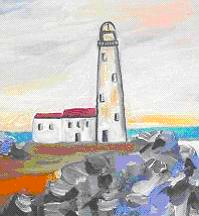
This is a slice of Gloria Caballero's painting of the Tijuana Lighthouse; although unlit, its brightness and elevation formed a beckoning beacon Tijuana lighthouseSaturday afternoon from 3:30 until dark when a couple hundred of us gathered on each side of the international border at Border Field State Park in Chula Vista – "Lovely View" – where Alta California and Baja California meet each other. We sang and prayed; we heard words of hope, hospitality and freedom. Getting there took some effort this year because everyone had to park over a mile away and trek through the sand. When we tried walking through loose sand our footing was unsteady and difficult, but closer to the shore the ocean water packed the sand, making it firm enough to walk in relatively comfortable safety. Nice metaphor that reminded me "On Christ the solid rock I stand; all other ground is sinking sand."

Before sun country living became my design blog, the first 24 posts were random, sometimes unworked-through ideas, including some from my commonplace books. Related to this topic of borders, this post quoted from an old series of AT&T (print and television both, I believe); here's what I blogged:
  • At least talk to each other!
  • Divisions evolve from the barriers we construct
  • Evol/Love (in addition to the print ad, I saw this one in a video at the Museum of Science and Industry in Chicago)
  • Meet somebody halfway
  • Out of a sense of self, a sense of the other
  • Reach out for someone
  • Understanding begins with communication
  • There's something you can do about it ... meet somebody halfway ... to communicate is the beginning of understanding!
...did someone say "speech is the language of covenant?" I read that somewhere and I completely agree!
the descriptive intro ¶ in the posada bulletin explains
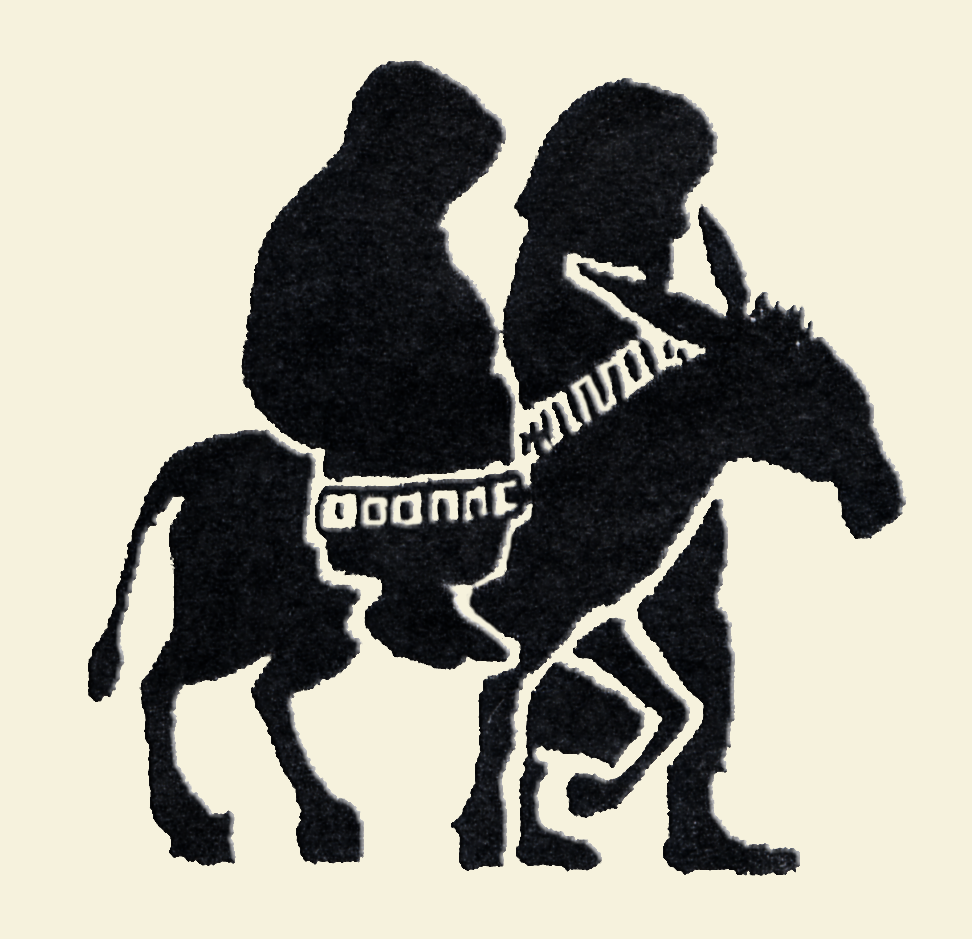
All the world's great religions recognize hospitality for the stranger as a sign of mature faith. La Posada is a reenactment of the Bible story of Mary and Joseph who, while sojourners in Bethlehem, were forced to seek shelter on the night of Jesus' birth. It is a venerated Christmas tradition across the Americas. BTW, this drawing of a couple and their donkey is a scan of the event bulletin cover; I don't know the artist.
posada family This resonates immensely with our Advent discussions about God from the exceedingly other side (heaven) coming to this side (earth) in order to make a home among the people—un hogar entre humanidad! God's makes shekinah, tabernacles, pitches a tent in order to journey alongside creation; in Jesus, God makes a posada sin fronteras, a boundless dwelling! "Posada" implies more of a fixed and reliable stopover place than it does a portable carry-on-your-back tent, but as image and reality of God's essential call to hospitality, the posada concept works as well as the tent.

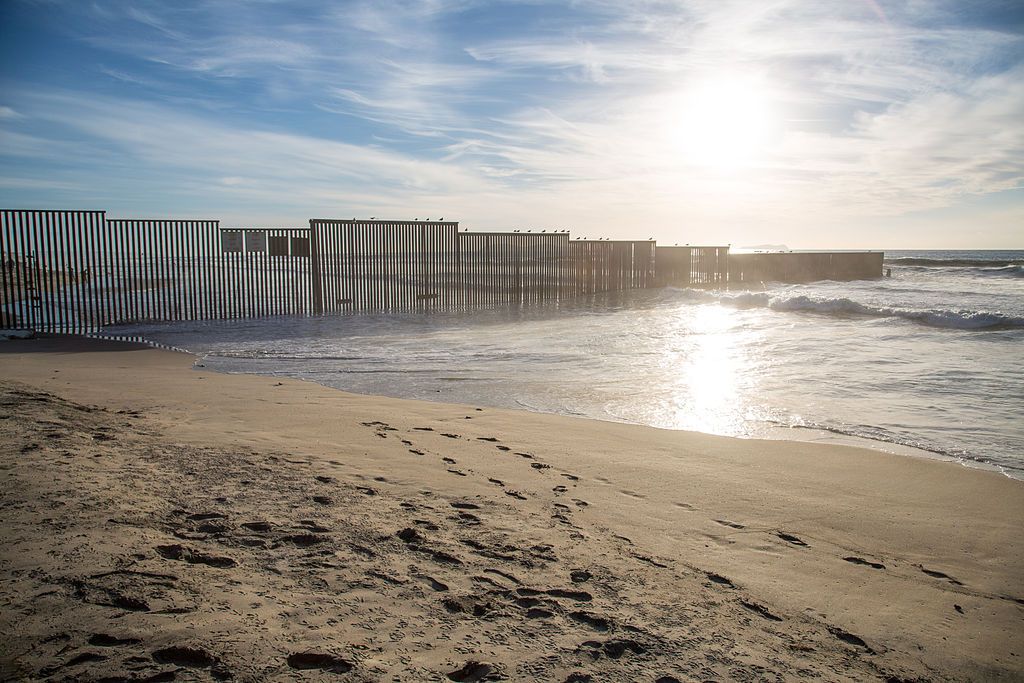
Along with the contemporary Mexican church we celebrated hospitality with a party to welcome the Holy Family, and akin to practice of the ancient church, we also mourned those who have died crossing the border, responding "presente" to the reading of each name: present to God, finally at home. border fence This years theme was Families without Borders; Mexican sponsors included Casa del Migrante, Comision Nacional del los Derechos Humanos and Arquidiocesis de Tijuana/Pastoral de la Movilidad Humana. American Friends Service Committee, Ecumenical Council of San Diego and Interfaith Coalition for Immigrant Rights were among the many posada sponsors on this side of the border; happily, the sponsors list is too long reasonably to include in this type of blog. Note that the border fence extends out into the Pacific surf...

When I blogged about Miroslav Volf's Exclusion and Embrace: A Theological Exploration of Identity, Otherness, and Reconciliation, I quoted from the author:
“...baptism into Christ creates a people as the differentiated body of Christ…[which] lives as a complex interplay of differentiated bodies—Jewish and gentile, female and male, slave and free—of those who have partaken of Christ’s self-sacrifice. The Pauline move is not from the particularity of the body to the universality of the spirit, but from separated bodies to the community of interrelated bodies—the one body in the Spirit with many discrete members." –page 48
As singulars or as plurals, whether we stand face-to-face or shoulder-to-shoulder, inevitably and invariably we are on each others' other sides. I do not and cannot know myself other than vis-à-vis another. When you are not there I am familia sin fronteras braceletwithout a mirror, have no reference and cannot define or describe myself. How many people have said, "Don't listen to other people"? I have no choice but to listen, because God formed me for community, has called me into communities of humans, of creation and of the Church, charging me to live as other to my other. 'Nuff said!

Because Families Without Borders – Familia Sin Fronteras – is this year's emphasis, each of us on this side received a familia sin fronteras bracelet to wear. When will difference and differentness be celebrated and welcomed? When will all of us become and live as safe posadas where our others can find a dwelling place and sacred space? If we hear the Spirit's call and trust the Spirit's provision, that parousaic time soon will be this eternal now. Amen? Amen!

Tuesday, December 11, 2007

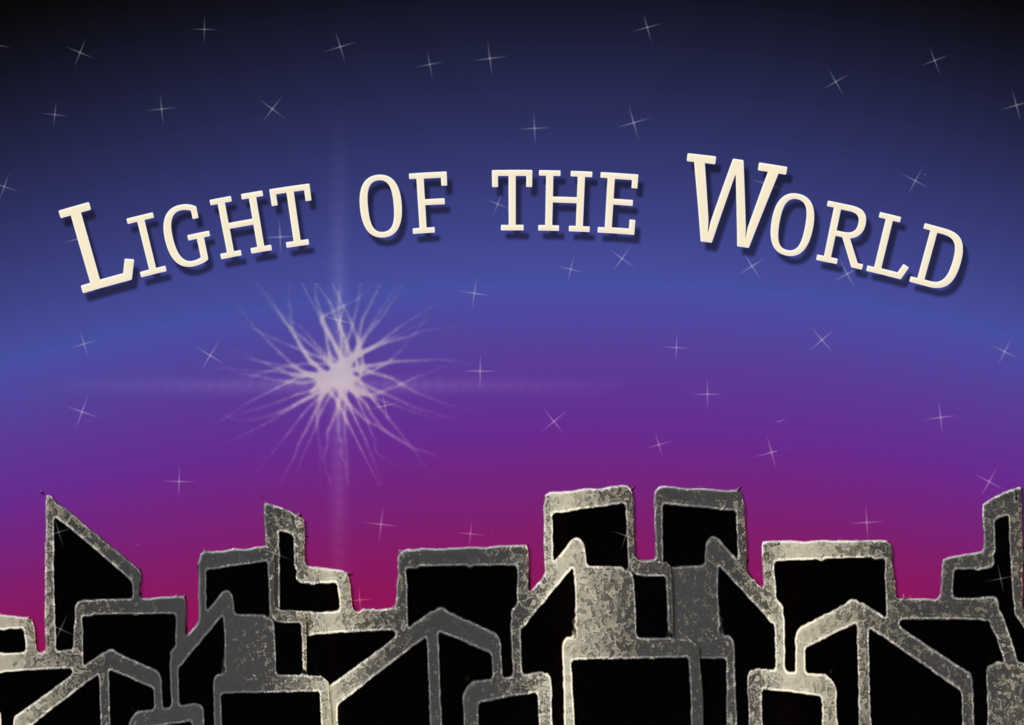
Light of the World

Here's the design I created for the Christmas mailer from one of my churches; I may design a couple of additional pieces, too.

update: I'm going to do 2 bulletin covers — legal and letter sizes — and an invitation for people to give to their friends, families and neighbors.

update 2: you can check out the letter-size bulletin cover here and the legal-size here; they're going to consider the invitation the mailer, so I don't need to design another piece!

Light of the world

Friday, December 07, 2007

God Among Us discussion 03

Advent 1: Historical Witness – Creation and Prophets

Advent 2: Historical Witness – Jesus Christ

Advent 3: Liturgy, Word, Sacrament

Advent 4: Contemporary Witness – us and our neighbors

The class will get a copy of love one another by Paul Hammer.

Backtrack

Abraham, Jesus, us—from the other side of the dominant social and economic culture of consumerism and exorbitant consumption; from the other side of death…alive in Jesus Christ!

2 Samuel 7:5-6 "I have not dwelt in a house from the day I brought the Israelites up out of Egypt to this day. I have been moving from place to place with a tent as my dwelling.'" John 1:14 And the word became flesh and tabernacled, pitched a tent among us...

Historical and contemporary

Exodus 5:1 Afterward Moses and Aaron went to Pharaoh and said, "Thus says the Lord, the God of Israel, 'Let my people go, so that they may celebrate a festival to me in the wilderness.'" From the time Israel and Yahweh rendezvoused into covenantal relationship in the desert of the Exodus, the liturgies of God's people have recounted and playfully reenacted into present-time the stories of God's faithfulness in their lives. The church gathers as the community that already has experienced its first death and second birth, fully alive under the subversive Lordship of Jesus Christ. Some congregations (not us?!) deliberately quest to become like those bigger or more ostentatious churches. But did God ever call the People of God to live in ways congruent with their local culture? Or in a radically culturally incongruent, actually counter-cultural manner? How about prophetic liturgy and prophetic living?

Theologically, psychologically, anthropologically and economically an individual becomes a person, a social entity by becoming embedded in a textured, connected, interwoven history of shared experiences and different viewpoints; there is no other way to create a humanly connected sense of your own identity, form memories and become part of history. Baptism and the Lord's Supper are cosmic events in each of our lives and part of our transformation from individual into person.

In worship, especially when we celebrate the sacraments, we anticipate, celebrate and commemorate and carry with us a microcosm of a redeemed world, a living and a life-giving memory of Jesus. In us, Jesus again becomes alive in the world and we offer the world a living connection to the heaven of God's Reign here on earth.

Liturgy, time; Sacraments, space and matter

Liturgy - Holy Time: remembering Whose we are! Who has called us! We recall, retell and re-enact our corporate and individual histories of the journey from death into life.

Sacraments - Holy Place and Holy Stuff—sacred creation: re-membering who we are! The person and communities God has called and enabled us to be and to do.

Water is the womb of creation. In baptism, we enter the state of this world yet unborn and submerge ourselves in the substance from which primal life emerged, completely engulfed by God's creative power of death and resurrection, identifying with this planet's history and with Jesus Christ.

Genesis 1:1-2 In the beginning when God created the heavens and the earth, the earth was a formless void and darkness covered the face of the deep, while a wind from God swept over the face of the waters.

Bread – in Saxon English, the Lord provided the "loaf" (of bread) essential for sustenance; we live born/baptized into the biography of Jesus, born in Bethlehem (House of Bread) baby; we recognize Jesus Christ as our Lord. The Heidelberg Catechism says in the Lord's Supper we become "bone of his bone and flesh of his flesh!"

Fruit of the Vine – a potent and polyvalent biblical symbol and reality.

Corporate Identity Package

We are the body, corpus, of Christ! Each of us is a member of the body of Christ. Jesus Christ incarnate, in the flesh again, re-enfleshed in us. Corporate Identity [package]: our logo, our résumé, our curriculum vitae, detailing where we've been, what we've learned, what we live for and die for...who are we? In Christ, we have experienced our second birth and our first death. We live under the reign of life rather than in the enslavement, the subjugation of death.

Baptism: primal experience, water, womb; Romans 6:3-10

Eucharist: we find sacred memory and discover hope for a free future in the meta-narratives of redemption, of deliverance from death to life in the Exodus and Passion/Easter stories. Theologian Jürgen Moltmann describes baptism as "sign, witness, representation and illumination of the Christ Event, and" we can claim the same about the Eucharist. We know Jesus Christ as sovereign, prophet and priest; baptized, we participate in that royal, prophetic priesthood. In the Eucharist, the church in every place and every time blesses and reintegrates all creation in every place and time; we recognize as sacred everything we see and touch and smell and hear and taste; 1 Corinthians 11:23-28

Liturgy: holy time - remembering Whose we are

Sacraments: holy space - re-membering who we are

Time and space are the conditions in which all creation lives. Living within the cycle of the liturgical year as it replicates the history of God and the people of God and celebrating the sacraments within that context helps refocus time and space as the necessary environment of God's revelation to us as human creations. But we know Creator and creature are discontinuous, so how do we discover God amidst creation? How does the Divine Presence enter our lives in decayables such as human speech, grain, grape, memory and music?

Time in space: during gestation we are immersed in time, in the rhythms of heartbeat and lungs, rather than imagining time as external to our world. Outside the maternal womb, we rework and re-collect for a lifetime the sounds and rhythms of our primal becoming. Liturgy brings both cosmic time and chronological time to an intersection where all times everywhere, past, present and future, meet in this present now, filling it with hope for a free and full future. The sacraments are actions of the entire Church in every time and every place, and connect us with the whole people of God in every time and space.

Space in time: the dwelling-spaces, schools and neighborhoods of our earliest years immersed us in space in a foundational way that continues transforming us today. In its proclamation and with the sacraments the church recovers historical events for us and helps us make all time and space sacred. We know anywhere God encounters creation is sacred space, but in the sovereignty of the crucified and risen Christ the formal sacraments expand to include all creation. Baptized into the Christ Event of God's supreme self-revelation in measurable, definable space and time, we become prophet, priests and sovereigns, in stewardship of creation and of life.

Living on the limen, the threshold

Toward the end of the Lenten series on theology of the cross, I asked, "can our presence in the world and in our neighborhoods be a liminal, in the process of becoming, though not-quite-yet one? Partly in our own world and way, partly in theirs, and wholly in the sovereignty of heaven?"

© leah chang 2007

Thursday, December 06, 2007

love one another

This coming Sunday, Advent 2, we'll be discussing God's Presence Among Us in liturgy, preaching and sacraments, and I'm going to give the people in my class a copy of this holy reflection for Maundy Thursday by Paul Hammer. If you're not familiar with Dr. Hammer, he offered one of the Taking the Bible Seriously talks they posted on the old UCC site. You still can find it at the link I provided.

love one another

Jesus, how common can you get? Foot washing, bread, wine!
If you're going to be religious, at least use something special.
No, my friend, I came not to perform special religious rites
But to touch the daily life of everyone
With God's love in the commonest of things.

O.K., water, bread, wine.
But isn't foot washing a bit ridiculous?
And what about "this is my body"?
And "this cup is the new covenant in my blood"?

Foot washing is the work of the commonest servant—I came to serve.
But it points beyond to the "washing" of the cross—
God's self-giving service in me to cleanse away estrangement
And heal the distortions in people's lives.
The bread points to nourishment in that same self-giving of God
At work in my body, that is in me.
And the cup points to the new community drawn together and nourished
In my blood, that is in God's total self-giving in my death.

Do you mean that this common stuff of water, bread and wine
Becomes in you the very focus of God's love for me and for the world?
That there is no excuse for my not loving my common neighbor?
Because you have shown the depth of God's love for me?

You've got it!
But it isn't a love for special occasions.
It has to be that daily love that's as common as water, bread and wine!

Monday, December 03, 2007

Liturgy Proclamation Sacraments - post 333

Almost randomly, today I'm blogging preliminary notes for next Sunday's 3rd class in my God Among Us series. So far we've discussed the Divine Presence in creation, in the prophets and in the Bethlehem manger; next Sunday we'll explore God's grace-filled Presence in liturgy, word and sacraments, and most likely I'll give the class a separate file with some details about scriptural roots and historical eucharistic practice.


Liturgy—Holy Time: remembering Whose we are! Who has called us! We recall, retell and re-enact our corporate and individual histories of the journey from death into life.

Sacraments—Holy Place and Holy Stuff—sacred creation: re-membering who we are! what God has called and enabled us to be and to do.


Water, the primordial substance of the world, existed before anything else in creation; in Genesis we read:
Genesis 1:1 In the beginning when God created the heavens and the earth, 2 the earth was a formless void and darkness covered the face of the deep, while a wind from God swept over the face of the waters.
Water is the womb of creation. In baptism, we enter the state of this world yet unborn and submerge ourselves in the substance from which primal life emerged, completely engulfed by God's creative power of death and resurrection, identifying with this planet's history and with Jesus Christ.

In Saxon English, the Lord provided the "loaf" (of bread) essential for sustenance; we live born/baptized into the biography of the baby born in Bethlehem (House of Bread) baby; we recognize Jesus Christ as our Lord. The Heidelberg Catechism says in the Lord's Supper we become "bone of his bone and flesh of his flesh!" In faith and baptism Jesus' biography becomes our biography: suffered under Pontius Pilate—the conventional, death-dealing, life-killing political, social and economic and cultural establishment(s), crucified, dead, buried...on the third day he rose again from the dead, ascended to sovereignty...

We are the body, corpus, of Christ! Each of us is a member of the body of Christ. Jesus Christ incarnate, in the flesh again, re-enfleshed in us. Corporate Identity [package]: our logo, our résumé, our curriculum vitae, where we've been, what we've learned, what we live for and die for...who are we? In Christ, we have experienced our second birth and our first death. We live under the reign of life rather than in the enslavement, the subjugation of death.


We've talked about Abraham, Jesus and us being from the other side of the prevailing culture. Now let's consider all of us living on the other side of the culture of death, alive in the sovereignty of life! Baptism: primal experience, water, womb.

Eucharist: our meta-narrative, primal narrative as a community. Both cosmic events in each of our lives are part of our transformation from individual to person. Theologian Jürgen Moltmann describes baptism as "sign, witness, representation and illumination of the Christ Event, and" we can claim the same about the Eucharist. We know Jesus Christ as sovereign, prophet and priest; baptized, we participate in that royal, prophetic priesthood. Especially related to those roles, how can our lives signify, witness to, represent and illuminate the birth, life, death, resurrection and ascension of Jesus Christ? To partly quote and partially paraphrase from another blog:
Theologically, psychologically, anthropologically, and economically a lone individual becomes a person, a social entity, by becoming embedded in a textured, connected, interwoven history of shared experiences and different points of view. There is no other way to create a humanly connected sense of your own identity, form memories and become part of history. You (I need, one needs) need a stable community and probably a plot of land to give you a stable sense of self if you are going to be healthy! Without those fluid living processes in a real sense a individual or a people has no history, but lives in a neither here not there "nowhere" of a fragmented series of stories starting to form, but without a persistent core that includes people who have journeyed alongside us through time, so it's possible to "remember when" together, to evoke and rekindle tarnished dreams and splintered hopes. No matter how many other people come and go in each of our lives, each of us needs persons (and maybe places, too) of shared history, to accurately name ourselves and recognize others.
Especially in an increasingly anomic and anonymous world (this is southern California, but it's happening everywhere),we need awareness of our history with the people of God and God of the people in every time and space, and this is where scripture, sacraments and liturgy become saving realities, "means of grace" as we refer to preaching and sacraments (and, of course, the cross) in this tradition. Congregations, people, and groups can read out of the texts of scripture and the persons of the prophets, the apostles and Jesus the Christ into their own experiences; they can write, re-write and image a shared past into a full present and meaningful future, right along with awareness of themselves as community. Other people and events may enter, stay a while, leave for a while and possibly return, but being grounded and rooted in historical existence lived, narrated, written down and liturgically re-enacted keeps on and continues transforming lives.


lifelines and heartbeatsold journal notes:
The colors, texts, textures and music marking the events in the liturgical calendar were more real to me than any of my own individual history ever had been and had shaped my life into deep, indelible patterns and designs. The rhythms, pace and pulse of local church ministry with its alternating consistency and surprising interventions shaped my days and literally outlined my identity.


More paraphrases from one of my blogs:

The synagogue's and later the church's liturgy developed and became shaped in a way that addresses, interacts with and speaks to the human condition and Divine response to human need. One way Israel kept remembering the past so it would remain present was with rituals, celebrations and liturgies in which they remembered, talked about and reenacted past events as if they still were in the present, and within a context that was play more than it was anything else. Israel told and retold the story of the people’s experience with the God of the covenants, and like God’s primal people Israel, in our worship we remember who God is, who we are, how God has acted. In the power of the Holy Spirit we affirm our dreams and announce our hopes for the future.

Like play of all kinds, worship also creates a new and different self-contained world existing with and within our everyday world. In worship, but especially when we celebrate the sacraments, we anticipate, celebrate and commemorate and we carry with us beyond this building this microcosm of a redeemed world that has been created by us and God, between us and God, as we become a living and a life-giving memory of Jesus so in us, Jesus again becomes alive in the world and we become sacraments mediating between God in Christ and the world, offering the world a living connection to the heaven of God’s Reign here on earth.


liturgy, time; sacraments, space

Time and space are the conditions in which all creation lives. Living within the cycle of the liturgical year as it replicates the history of God and the people of God and celebrating the sacraments within that context helps refocus and change the meaning of time and space as the necessary context God's revelation to us as human creations.

Liturgy: holy time—remembering Whose we are

Sacraments: holy space—re-membering who we are

Time in space: we spend nine months immersed in the watery womb from conception to birth, immersed in the rhythms of heartbeat and lungs. During gestation we are immersed in time, rather than imagining time as external to our world. Outside the maternal womb, in our daily lives and in the church, for a lifetime we rework and re-collect the sounds and rhythms of our primal becoming. Through liturgy, the church recovers the sacredness of all time, not just the perfunctorily, formally schedules times of Sunday worship. Liturgy brings both cosmic time and chronological time to an intersection where all times everywhere, past, present and future, meet in this present now, filling it with hope for a free and full future. The sacraments are actions of the entire Church in every time and every place, and connect us with the whole people of God in every time and space.

Space in time: Just as the gestational womb provided an immersion in time and space prior to our physical birth, the dwelling-spaces, schools and neighborhoods of our earliest years immersed us in space in a foundational way that formed us and continues transforming us today. In our search for home, for safety and for belonging, recognition and acknowledgment, in its proclamation and with the sacraments the church recovers historical events for us and helps us make all time and space sacred. As people of the Bible, we know anywhere God meets, encounters creation is sacred space, but in the sovereignty of the crucified and risen Christ the formal sacraments expand to include all creation. Baptized into the Christ Event of God’s supreme self-revelation in measurable, definable space and time, we become prophet, priests and sovereigns, in stewardship of creation and of life. In the Eucharist, the church in every place and every time blesses and reintegrates all creation in every place and time; we recognize as sacred everything we see and touch and smell and hear and taste. (That was redundant, but for Sunday I'll choose which way to express it, or maybe invent a third way.)


As Christians, God's people in Jesus Christ, we find sacred memory and discover hope for a free future in the meta-narratives of redemption, of deliverance from death to life in the Exodus and Passion/Easter stories.

I love Exodus 5:1 Afterward Moses and Aaron went to Pharaoh and said, "Thus says the Lord, the God of Israel, 'Let my people go, so that they may celebrate a festival to me in the wilderness.'" From the time Israel and Yahweh rendezvoused into covenantal relationship in the desert of the Exodus, the liturgies of God's people have recounted the story of God's faithfulness in their lives and recollected ways in which God shaped and formed the identity of the people of God along with God's call to the people to be His Presence in the world and God's enabling and fulfilling that call in the power of the HS. Worship forms a microcosm of our daily, lively encounter with a Holy God, Who calls us to be Holy as He is! Martin Luther's story is so well-known, but no way did he minimize the awesomeness and the demands for justice of the God of Jesus Christ. It was exactly that awareness that initially led Brother Martin to extreme measures in attempts to please and placate God. Predictable I sort of needed to include Luther note! Moving on, now.

The sacraments and the order of worship create a microcosm of redeemed, restored creation, bringing to life a hint of the eschaton, the new creation. (I won't say "eschaton" on Sunday without explaining it, trust me!)


In April 2006 I blogged about Emerging Church, emerging churches
The church gathers as the community that already has experienced its first death and second birth, the community that thrives under the Lordship of Jesus Christ, in the reign of life. The barely formed churches we hear about in the epistles (I'm thinking of Corinth as especially instructive) were way different from the over-formed institutional Church Luther wrote and spoke against; in this 21st Century, the church almost has become something else altogether.

Some congregations deliberately quest to become like those other churches across the street, down the boulevard, or in geographically near, but more visibly and ostentatiously affluent areas. Although I hesitate to write "evangelical," that was the Reformer's word for Protestantism in general and evangelical remains the word for "Protestant" in non-English speaking countries. Nonetheless, my readers know what I'm trying to say!

Prayer and hymn singing in the vernacular is one of Luther's marks of the true church; the Reformers also insisted where the gospel was rightly proclaimed (Calvin added "heard) and the sacraments administered, there the church was—everything else was adiaphora. "Evangelism in the vernacular" also needs to happen for the Church, as the Body of the Risen Christ, to be true to its call, as Jesus always met people more than half-way—Jesus met people as who they were and where they were. The churches I've been visiting and the protestant mainline I identify with all have been trying to meet people where they are and speak in a language they'll understand. But did God ever call the People of God to live in ways congruent with their local cultures? Or in a radically culturally incongruent, actually counter-cultural manner? How about prophetic liturgy and prophetic living?

Evangelism in the vernacular? Telling the Good News in the people's muttersprach, in their lingua franca, which, of course, means far more than the syntax, colloquialisms and grammar of their spoken and written language. Our evangelical language needs to reach all of their cultural sensibilities as well as their actual native idiom of every aspect of their everyday lives, reaching far into their values, hopes and dreams. What do they desire for themselves, their children, their community, and even for worlds beyond their immediate ones? What would they perceive as Good News; above all, what can we demonstrate to them that would make them willing to risk change?


On Lent 5, toward the end of my Lenten series on theology of the cross, again I blogged on this site geographically, socially, culturally, chronologically, theologically and/or spiritually liminal modes of Christian presence and asked, "can our presence in the world and in our neighborhoods be a liminal, in the process of becoming, though not-quite-yet one? Partly in our own world and way, partly in theirs, and wholly in the sovereignty of heaven?"

Note that I [originally] concluded with text in fiery Pentecostal red! Now to further consider these ideas and write them down in coherent form for next Sunday's class meeting.

© leah chang 2007

Thursday, November 29, 2007

God among Us discussion 02

Advent 1: Historical Witness – Creation and Prophets

Advent 2: Historical Witness – Jesus Christ

Advent 3: Liturgy, Word, Sacrament

Advent 4: Contemporary Witness – us and our neighbors

Backtrack

Abram/Abraham was an Ivri, a Hebrew, one from the other side. In Jesus we meet the God from the very other side. Abraham, Jesus, us—from the other side of the dominant social and economic culture of consumerism, exorbitant consumption and self-aggrandizement (among other things)?!

2 Samuel 7:5-6 "I have not dwelt in a house from the day I brought the Israelites up out of Egypt to this day. I have been moving from place to place with a tent as my dwelling."

John 1:14 And the word became flesh and tabernacled, pitched a tent among us...

Revised Common Lectionary, Christ the King year C: Luke 22:23-27 …the greatest among you must become like the youngest, and the leader like one who serves. …I am among you as one who serves.

RCL year C, Christ the King: Jeremiah 23:1-6 …the days are surely coming…a righteous branch, justice and righteousness…

Advent

During the darkest, shortest days of the year, we anticipate the God of justice, mercy, compassion and common-wealth arriving incarnate in our midst in Jesus of Nazareth, to continue reshaping and renewing us into the divine image. Consider: what changes to the world and to us does God's incarnation in Jesus bring? Consider: Jesus' journey from the Bethlehem manger to the Calvary cross to Easter to reigning over all creation. Consider: God loves and saves us freely by grace and without reservation, so what's all the talk about works and deeds and doings, especially in the Christmas texts? Consider: How we can become mangers? Martin Luther refers to the bible as "the cradle in which Christ is laid" – a container to keep the free and elusive Word safe?

The liturgical color for Advent has changed from penitential purple to blue, a color that symbolizes hope. How about the talk of repentance and judgment? Penitence or hope?

Acts 1:1-8 …they asked him, "Lord, is this the time when you will restore the kingdom to Israel?" He replied… "you will receive power when the Holy Spirit has come upon you; and you will be my witnesses in Jerusalem, in all Judea and Samaria, and to the ends of the earth."

RCL Advent 2A: Isaiah 11:1-10 A shoot shall come out from the stump of Jesse, and a branch shall grow out of his roots. The spirit of the Lord shall rest on him…with righteousness he shall judge the poor, and decide with equity for the meek of the earth…

RCL Advent 2A: Psalm 72:1-7, 18-19 May he judge your people with righteousness, and your poor with justice. …May he defend the cause of the poor of the people, give deliverance to the needy, and crush the oppressor.

RCL Advent 2A: Matthew 3:1-12 In those days John the Baptist appeared in the wilderness of Judea, proclaiming, "Repent, for the kingdom of heaven has come near."

Advent 3 – Gaudete—rejoice! the introit began with Philippians 4:4-6

Advent 3 continues announcing and anticipating God arriving into our midst with a subversive (in terms of the status quo) rule of justice for all creation, a reign of shalom. Yet this ruler first appears on earth in the vulnerability and humility of the Bethlehem manger. Countercultural? Consider: the King who reigns from a cross. Opulence and glory? Advent 3 features Mary’s Magnificat and also emphasizes the redemption, wholeness and integrity of all creation.

Check out these parallels:
1 Samuel 1: 24 When she had weaned him …[Hannah] brought him to the house of the Lord at Shiloh…

Luke 2: 22-27 Mary presents Jesus to the Lord at the temple in Jerusalem.

1 Samuel 2:1-10 Hannah prayed and said, "My heart exults in the Lord…Those who were full have hired themselves out for bread, but those who were hungry are fat with spoil."

Luke 1:46-55 And Mary said, "My soul magnifies the Lord, and my spirit rejoices in God my Savior … He has brought down the powerful from their thrones, and lifted up the lowly; he has filled the hungry with good things, and sent the rich away empty."

Cool stuff: Luke includes four canticles in his gospel: Mary's Magnificat in 1:47-55; Zechariah's Benedictus in 1: 67-79; the angels’ Gloria in Excelsis in 2: 13-14; and Simeon's Nunc Dimittis in 2:28-32. Similar in form and content to the Hallel Psalms, they reverberate with Israel’s salvation history as they celebrate God's life-transforming reversals in the lives of Mary and her contemporaries—and now in our lives and world. Luke-Acts' particular emphasis, focus and passion?! Advent's persistent theme?

RCL Advent 3A: Isaiah 35:1-10 The wilderness and the dry land shall be glad, the desert shall rejoice and blossom… Then the eyes of the blind shall be opened… waters shall break forth in the wilderness, and streams in the desert…

RCL Advent 3A: Psalm 146:5-10 whose hope is in the Lord their God …who executes justice for the oppressed; who gives food to the hungry. The Lord sets the prisoners free…watches over the strangers...(this is the appointed psalm, but the church typically uses the Magnificat for the 2nd reading.)

RCL Advent 3A: Matthew 11:2-11 "Are you the one who is to come?" "Go and tell John what you hear and see: the blind receive their sight, the lame walk...and the poor have good news brought to them..."

Christmas texts

Christmas Eve: Titus 2:11-14 Grace has appeared… to redeem us as a people -zealous for good deeds!

Christmas Dawn: Titus 3:4-7 Goodness and loving kindness of God appeared... justified by his grace…not because of works, despite redeeming us as people zealous for good deeds!

Christmas Eve: Luke 2:1-14 In those days a decree went out from Emperor Augustus that all the world should be registered ... And she gave birth to her firstborn son and...laid him in a manger, because there was no place for them in the inn.

Christmas Eve and Dawn: Luke 2:8-20 In that region; night; angel = messenger, "Be not afraid!" sign: child in the manger. The Lord has made known to us – revelation...

© leah chang 2007

Sunday, November 25, 2007

Reign of Christ: Pack Up Your Sorrows

Today we celebrate the last Sunday of the liturgical year—the King Who Reigns from a Cross! The late Richard Farina wrote this song about a Christ-figure, a not unfamiliar topic in the world of music. Think about James Taylor singing 'Handyman,' 'You've Got a Friend,' 'Shower the People You Love'—and? Can't think just now, but it's interesting that JT didn't write those songs. How about 'Up on the Roof,' which I know is from Carol King & Gerry Goffin?! I'll add more when I think of more.

Pack Up Your Sorrows | Richard Farina

No use crying, talking to a stranger,
Naming the sorrows you've seen.
Too many sad times, too many bad times,
And nobody knows what you mean.
Chorus:
Ah, but if somehow you could pack up your sorrows,
And give them all to me,
You would lose them, I know how to use them,
Give them all to me.
No use rambling, walking in the shadows,
Trailing a wandering star.
No one beside you, no one to hide you,
Nobody knows where you are.

[Chorus.]

No use gambling, running in the darkness,
Looking for a spirit that's free.
Too many wrong times, too many long times,
Nobody knows what you see.

[Chorus.]

No use roaming, lying by the roadside,
Seeking a satisfied mind.
Too many highways, too many byways,
And nobody's walking behind.

[Chorus.]

Thursday, November 22, 2007

psalm 150:6

for Thanksgiving Day late afternoon—
A Word of Life.

Praise the Lord | Psalm 150:6


Let everything that moves
And everything that breathes
Praise the Lord.
Praise the Lord.

From the rising of the sun
'Til the time that it goes down,
Praise the Lord.
Praise the Lord.

Everybody, let's prai-ai-ai-ai-aise the Lord!
Come on, let's prai-ai-ai-ai-aise the Lord.
Let everything that lives
Sing praises to the Lord.
Praise the Lord!

Let everything that walks
And everything that runs
Praise the Lord.
Praise the Lord.

No matter where you are,
No matter where you've been,
Praise the Lord.
Praise the Lord.

Everybody, let's prai-ai-ai-ai-aise the Lord!
Come on, let's prai-ai-ai-ai-aise the Lord.
Let everything that lives
Sing praises to the Lord.
Praise the Lord!

Everybody, let's prai-ai-ai-ai-aise the Lord!
Come on, let's prai-ai-ai-ai-aise the Lord.
Let everything that lives
Sing praises to the Lord.
Praise the Lord!

Let everything that lives
Sing praises to the Lord.
Praise the Lord!

Amen!!!!!

by Jay Stocker. © 2005 Group Publishing, Inc. All rights reserved.

Monday, November 19, 2007

God Among Us discussion 01

Here's the link to the basic course description and outline; since my first class will be this coming Sunday, Reign of Christ, due to the short week I actually finished my handout this morning and I'm blogging it now before it gets away from me. Because there will be interested people at both churches (4 Sundays at one; 3 Wednesdays at the other) who won't be able to attend the discussions, I've tried to be fairly comprehensive, though these all are biblically literate folks! The study is for Advent as we anticipate God coming into our midst in a unique way, so I'm drawing some of the Reign of Christ and Advent pericopes from the RCL. This time I've imported my MS Word doc into google docs rather than going back into word to change the smart quotes into straight ones as I usually try to do; these days it seems as if the internet handles curly quotes and diacriticals far better than in the former days. BTW, my series title comes from «Dieu parmi nous» in Olivier Messiaen's La Nativité suite for organ. Except for John 1:14, all scriptures are NRSV.
Advent 1: Historical Witness – Creation and Prophets

Advent 2: Historical Witness – Jesus Christ

Advent 3: Liturgy, Word, Sacrament

Advent 4: Contemporary Witness – us and our neighbors

Intro

Before Jesus came onto the scene, throughout the earlier witness of the Bible, God partially revealed himself in ways humans could see, touch, hear and feel, giving people some idea of a God close to creation rather than far-away and distant. In our own lives, word, sacrament and liturgy are audible, tangible signs of the presence of the Divine and are some of the ways we remember God’s past saving deeds and find living hope for a free and surprising future.

Isaiah 64:1-5 O that you would tear open the heavens and come down, so that the mountains would quake at your presence...

2 Samuel 7:5-6 “Go and tell my servant David, “This is what the Lord says: Are you the one to build me a house to dwell in? I have not dwelt in a house from the day I brought the Israelites up out of Egypt to this day. I have been moving from place to place with a tent as my dwelling.’”

John 1:14 And the word became flesh and tabernacled, pitched a tent among us...The Word became flesh and blood, and moved into the neighborhood. [MSG] In the Exodus desert and supremely in Jesus, God pitched a tent—traveling alongside us. How about us? Tent-toting, tent-pitching alongside each other and our neighbors?! Think about it; pray about it! Dream about it!

Creation

Creation is a product of God’s word and will.

Revised Common Lectionary year C – Christ the King: Colossians 1:11-20 He is the image of the invisible God, the firstborn of all creation…in him all things in heaven and on earth were created…

Genesis 1:1 - 2:4 God creates everything, and also provides for the healthy environment all creation needs to live faithfully and fully. God creates humanity in a multifaceted Image of the Divine; God’s attributes and our attributes include holiness, justice, righteousness, servanthood and creativity.

RCL, year C, Christ the King: Luke 22:23-27 …the greatest among you must become like the youngest, and the leader like one who serves. ... I am among you as one who serves.

Genesis 2, 3 Do not eat of the tree in the middle of the garden, in the center. We find the real Tree of Life, the cross of Jesus Christ, on the edge, on the margins, outside the political, social and religious establishment, and in Jesus we partake of the real Tree of Life. You shall be as gods? In Jesus Christ we fully participate in the divine nature as servants, co-creators and stewards of creation.

From these early Yahwist texts in Genesis to the end of the bible:

Revelation 21:1-4; 22:1-6 The new Jerusalem, City of God with the River of life flowing from the throne of God and of the Lamb, from the cross.

Genesis 6:1 - 9:17 God freely and persistently approaches us, draws us into covenant. “But I will establish my covenant with you ...and with every living creature… this is the sign of the covenant ...when the bow is in the clouds, I will see it and remember…”

Genesis 11:27…through Genesis 25 Abram/Abraham was an Ivri, a Hebrew, one from the other side. In Jesus we meet the God from the very other side, yet paradoxically contained within human flesh. Abraham, Jesus, us – from the other side of culture, the other side of the world, from our neighbors’ other sides? Think about it!

RCL year C – Christ the King: Psalm 46 God is in the midst of the city; the Lord of hosts is with us…

Stewardship of Creation

Creation: “Into the land” is the deuteronomic historian’s (Deuteronomy, Joshua, Judges, Samuel, Kings) constant refrain, and clearly shows God’s Jubilee passion for the vital and complete needs of creation.

Deuteronomy 4:32-40 Keep his statutes and his commandments, which I am commanding you today for your own well-being and that of your descendants after you, so that you may long remain in the land that the Lord your God is giving you for all time.

Leviticus 19:1-18 “You shall be holy, for I the Lord your God am holy.” This section includes the Ten Commandments.

Leviticus 25:1-12 is the Jubilee text and points to Jesus’ establishing the fullness of Jubilee.

Prophets

Prophet: spokesperson for God, speaking against the conventional political, social and religious establishments, against injustice and exploitation, and laying out alternatives that will lead to justice, righteousness and faithful stewardship of all life, to a true common-wealth. Back to the Deuteronomy and Leviticus texts, especially Leviticus 25.

The prophets came into a setting in which the adjacent cultures had place and fertility gods that existed within cyclical time, with the endless recurrence of the same thing; Yahweh’s people, Israel, wanted a god like the other people’s gods, a god housed in a fixed stone structure and location. Yahweh self-reveals as the God who forms ever-changing, surprising and endlessly permeable history, with a presence often hidden from sight, always free, most typically elusive and never subject to human control. One of the revolutionary things about Yahweh as opposed and contrasted with the other Ancient Near Eastern deities, was that Yahweh didn’t require beseeching, entreating, sacrifices or other extraordinary displays of loyalty; Yahweh’s specialty was constant, unmediated presence with creation. How about us?

Amos 5:18-24 I hate, I loathe, I despise your festivals; I am not appeased by and I take no delight in your solemn assemblies. ...But let justice well up like water, and righteousness like an unfailing ever-flowing stream.

Micah 6:8 ...And what does the Lord require of you but to do justice and to love mercy and to walk humbly with your God?

Isaiah 58:6-8 Is not this the fast I choose: to loose the bonds of wickedness, to undo the heavy burdens, to set the broken free, and to shatter every subjugation? Is it not to share your bread with the hungry...the glory of the Lord shall be your safety and security.

RCL year A – Advent 1: Psalm 122 I was glad when they said to me, “Let us go to the house of the Lord!”

RCL year C – Christ the King: Jeremiah 23:1-6 Woe to the Shepherds...the days are surely coming...a righteous branch, justice and righteousness...

RCL year A – Advent 1: Romans 13:8-14 Owe no one anything, except to love one another...

© Leah Chang 2007

Sunday, November 18, 2007

water, towel, servant: deacon!

In her Diakonia! post last May, Tara explained,
Diakonia means service. In my call to Diaconal ministry, I am called to pick up my basin and towel; to serve God in Word and service; bridging the gap between the church and the world.
sea sky surfTara of Praying on the Prairie is a Diaconal Minister of Word and Service in the ELCA, succinctly summed up as "Towel and Basin Ministry." Lately I've been thinking a lot about some implications of service (=ministry) in general, and about possible meanings of basins, bounded containers for water that in turn becomes an agent of cleansing, refreshing, renewal and—baptism; I've been considering the usefulness of towels, too.

Here in this part of the world, in Paradise, we possess an extreme Surfing Culture. The Towel is an essential part of a surfer's equipment. Functional? Oh, yes, very! As a changing booth, because sometimes you need to get into that wetsuit and there's no nearby fixed shelter, so in that situation, your towel needs to be big enough to hide behind; surfer towel uses include drying off, of course; wiping away sand and seaweed; loaning to a friend in need, who maybe lacks a towel or only has a completely soaked towel. To use in place of the sweater or jacket you somehow forget to bring along with you, because by late afternoon the days get cool and clouds can appear out of nowhere at almost any time.

In the past few years I've bought several inexpensive and wonderfully colored towels made in Bangladesh and Pakistan, in every case expecting superior absorbency and drying power, probably because cotton from geographically not too far away Turkey has such a great reputation. As much as I detest stereotypes and do whatever I can to dispel them, I believe in Turkish cotton's reputation for drying well, and I have at least a half-dozen Indian [from the same sub-continent as Bangladesh and Pakistan] cotton shirts that are comfortable and soak up the sweat however hot the weather gets. Although the aforementioned towels definitely get the basic drying done, I'd discovered that more expensive domestic cotton that's been given extra treatment dries more thoroughly and effectively.

As we read the book of Acts, we discover the nascent church first ordained not ministers of word and sacrament, not elders for formal (bureaucratic) leadership, but deacons, bearers of towel and basin, helping grow the early church into a body of servants in the image of the servant God, who self-revealed in Jesus of Nazareth as "one who serves."

Acts 6:1 Now during those days, when the disciples were increasing in number, the Hellenists complained against the Hebrews because their widows were being neglected in the daily distribution of food. 2 And the twelve called together the whole community of the disciples and said, "It is not right that we should neglect the word of God in order to wait on tables.
3 Therefore, friends, select from among yourselves seven men of good standing, full of the Spirit and of wisdom, whom we may appoint to this task, 4 while we, for our part, will devote ourselves to prayer and to serving the word."

5 What they said pleased the whole community, and they chose Stephen, a man full of faith and the Holy Spirit, together with Philip, Prochorus, Nicanor, Timon, Parmenas, and Nicolaus, a proselyte of Antioch.
6 They had these men stand before the apostles, who prayed and laid their hands on them.

In the Church, the stole – actually a kind of towel – forms a visible, symbolic yoke of service worn by people ordained to Ministry of Word and Sacrament. And especially in recent years, a lot of us have discussed the ordinance of foot-washing as sacrament or sacramental—after all, it mostly fits the protestant criteria for sacrament: earthly matter and direct command of Jesus (at his last earthly meal with his disciples the church celebrates in its Maundy Thursday liturgy):

Jesus, knowing that the Father had given all things into his hands, and that he had come from God and was going to God, got up from the table, took off his outer robe, and tied a towel around himself. Then he poured water into a basin and began to wash the disciples' feet and to wipe them with the towel that was tied around him. [John 13:3-5]

but it doesn't include accompanying words, beyond Jesus' reply to Peter's objection to his Lord washing his feet, in that culture typically the task of the lowliest servant:

Peter said to Jesus, "You shall never wash my feet." Jesus answered him, "If I do not wash you, you have no share with me." Simon Peter said to him, "Lord, not my feet only but also my hands and my head!" Jesus said to him, "The one who has bathed does not need to wash, except for his feet, but is completely clean." [John 13:8-10]

...in humility both serving and being served; giving a gift and receiving a gift. I'm blogging this partly as response to T and partly because of concerns of my heart, and I'll mention there are all kinds of deacons and diaconates; almost every church body or denomination has a deacon equivalent serving primarily to assist with more temporal, physical needs (food, rides to appointments, etc.) within the congregation, and the ELCA has a slew of people in a bunch of professional diaconal roles and callings.

But it's interesting that despite the fact 21st century deacons usually limit their service to within a particular local church, historically the deacon has been called to serve not the church but the surrounding community, and historically deacons have been consecrated (or in some cases, ordained) by the bishop or overseer of the judicatory. Seems as if lately the needs within the congregation get attended to before those outside. Sad, because ministering to the world around us can become such a powerful way of incarnating Jesus Christ, the definitive revelation of the servant God. Please read all of John 13; thanks!

Thursday, November 01, 2007

Font/Table

For safekeeping and possibly future reference and use, I'm posting the essence of a couple of my comments on a theology thread from a while ago.

I believe the Font/Table connection is important and worthy of continued discussion, *even* around this modest table. But as the comments suggest, some kind of starting point needs to clarify if baptism and holy communion are sacraments or simple ordinances and if we perceive them as means of grace, effective signs of grace, or signs of grace. In the end, God may smile at our deliberations, but is God's smile not at least as much pleasure that we're interested and concerned as it is amusement that we think we can figure this out after millennia of theologizing?

...and I do agree it would be the height of fallen humanity to refuse to commune anyone who approached the Table with pleading hands. And I so agree about "seed planted!" One of the years I taught confirmation I expressed surprise to the senior pastor that a certain teenager was getting confirmed. He replied, "she thinks she's given her life to the Lord," and then added,"ultimately, I'm okay with it because she's also being baptized – receiving a sacrament – on that day." In other words, God's Word, God's Work, God's Thing, not primarily ours, but done for us and in us.