Thursday, April 09, 2009

Resurrection of Our Lord: Eucharistic Prayer

A Glorious Easter to all! Although I'd intended to make this Great Thanksgiving more generic for the Sundays of Easter, it's quite focused on the Easter Day texts plus a couple of hints from Holy Week. Of course you can rearrange the elements of the prayer for your preferences, as well as adding or subtracting to your taste. I really like the drama of positioning the verba after the Sanctus and the triple epiclesis parallels the one in the Canon I wrote for Nativity 2007 (it got great reviews); the doxology is Revelation 7:12.

  • The Lord be with you.
  • And also with you.
  • Lift up your hearts.
  • We lift them to the Lord.
  • Let us give thanks to God.
  • It is joy to offer thanks and praise!
This is the feast of victory for our God, alleluia!
This is the feast of victory for all creation, alleluia!

Lord God, you created the heavens and stretched them out,
you spread out the earth and all that grows from it,
you gave a portion of your Spirit to all creation, alleluia!
Now you have brought former things to pass
and you have made all things new, alleluia!
Jesus Christ, our Paschal Lamb, has died for our sins; Christ has been buried and has been raised from the grave, alleluia!
Christ has ransomed us with his blood and has washed away our guilt; he has annihilated the powers of darkness and death and opened the gates of heaven, alleluia!
You have made for us a feast of fat things and well-aged wines, alleluia!
You have given us water and bread and fruit of the vine as signs of your presence among us, alleluia!

And so with the hosts of heaven and with all creation in every time and every place we sing:

Holy are you, God of mercy, glory and love, and blessed is Jesus, your Son. He came to earth and lived among us as one of us, he died for all on Calvary Hill, and was raised from death for the life of the world and ascended to reign in justice and righteousness.

With the Church in all the ages we proclaim the mystery of faith:
  • Dying you destroyed our death;
  • Rising you restored our life;
  • Lord Jesus, come in glory!
On the night of betrayal and desertion, our Lord Jesus took bread, and when he had given thanks, he broke it and said, "This is my body, broken for you. Do this in remembrance of me."
In the same way after supper, he also took the cup, saying, "This cup is the new covenant in my blood. Do this, as often as you drink it, in remembrance of me."
As often as you eat this bread and drink this cup, you proclaim the Lord's death until he comes again in glory.
Come, Spirit of Holiness; come upon all creation everywhere and upon this assembly;
Come, Holy Spirit; sanctify these gifts of grain and fruit of the vine uniting us with all creation;
Come, Spirit of Life and bless our feasting at this table of reconciliation
That baptized into the death and resurrection of Jesus Christ, in the power of the Spirit we may live as the just and righteous presence of the Crucified and Risen One...

Praise and glory
wisdom and thanksgiving
honor and power and
strength to our God,
Father, Son and Holy Spirit,
endlessly throughout eternity,
Alleluia, Amen, Alleluia!!!

© leah chang 2009

enough, sufficient

Blog pal, Facebook friend and sister in Christ Theresa Coleman tagged me; this is one many people and probably most Christians constantly need to consider.

NASB text of Matthew 25:31-46; I especially appreciate the cross-references (check out the Bible Gateway page). Here's the NRSV passage Theresa posted:
‘When the Son of Man comes in his glory, and all the angels with him, then he will sit on the throne of his glory. All the nations will be gathered before him, and he will separate people one from another as a shepherd separates the sheep from the goats, and he will put the sheep at his right hand and the goats at the left. Then the king will say to those at his right hand, “Come, you that are blessed by my Father, inherit the kingdom prepared for you from the foundation of the world; for I was hungry and you gave me food, I was thirsty and you gave me something to drink, I was a stranger and you welcomed me, I was naked and you gave me clothing, I was sick and you took care of me, I was in prison and you visited me.” Then the righteous will answer him, “Lord, when was it that we saw you hungry and gave you food, or thirsty and gave you something to drink? And when was it that we saw you a stranger and welcomed you, or naked and gave you clothing? And when was it that we saw you sick or in prison and visited you?” And the king will answer them, “Truly I tell you, just as you did it to one of the least of these who are members of my family, you did it to me.” Then he will say to those at his left hand, “You that are accursed, depart from me into the eternal fire prepared for the devil and his angels; for I was hungry and you gave me no food, I was thirsty and you gave me nothing to drink, I was a stranger and you did not welcome me, naked and you did not give me clothing, sick and in prison and you did not visit me.” Then they also will answer, “Lord, when was it that we saw you hungry or thirsty or a stranger or naked or sick or in prison, and did not take care of you?” Then he will answer them, “Truly I tell you, just as you did not do it to one of the least of these, you did not do it to me.” And these will go away into eternal punishment, but the righteous into eternal life.’
Theresa began by talking about her 22 year old fridge and contrasting replacement options priced at $2200 and $1200. She wonders, "Why do we always want more than enough? And what exactly is "enough"? There is a book [that] states that enough is when all your basic needs are met. One dollar more than that becomes 'wealth.'"

The contemporary English word wealth derives from the Old English "weal" or well-being. Massachusetts, Virginia, Pennsylvania and Kentucky of the United States of America are commonwealths, originally carrying a connotation of political governance for the common good, for the well-being of The People rather than the benefit of a particular owner class. (We know all about landed gentry and property rights in the Constitution!)

Theresa ponders, "Well then, what are 'basic needs'? According to another book...there are 5 basic needs: Food; Shelter; Clothing; Medical; Education..." In addition, she is considering a "permanent" place of residence (also one of hospitality and possibly refuge?) for formal retirement and as a place from which to itinerate (she's a true circuit-riding United Methodist) and asks, "Is this sufficient? Is this enough? My impulse is to junk the trailer and build fresh, but there are so many who would be grateful for this. What is enough?"

It's interesting that the Matthew passage became part of chapter 25 and we find the Jubilee text in Leviticus 25. The jubilee mandate is not only about sufficiency and enough-ness; it's especially about active justice that redistributes and restores resources that for whatever reason have left society lop-sided, with a few folks having just right amounts and other having far more than they need and others not nearly enough.

I often reference a taxonomy I found somewhere; it accurately says our Body Image is where: body, mind, psyche, spirit and culture converge, and further explains its impact reverberates in all areas of life: mental, physical, emotional and spiritual. That's a short description of the way culture becomes embedded, grounded and deeply rooted within our very beings.

life stuff buttonThe concept of "shalom" in the Hebrew Bible means not simple peace in an absence of active conflict sense, but about sufficient essentials for everyone, a fullness of "enough." Considering this blog topic (thanks, Theresa!), we cannot escape that always there element of culture. For a pair of examples from my own life, about two years back I'd arranged to be pianist for the wedding of a couple raised in another country and culture but when I arrived at the church the pastor told me they'd changed their mind and asked someone else to play. In that case I needed to be professional and explain they'd contracted with me, I'd reserved that hour plus of time (it hadn't involved a separate rehearsal) and I needed to be compensated; without a doubt, that type of conventional USA middle-class practice can be assimilated and followed. In a related case, I told a wedding couple I was a professional (and yes, a friend of their ethnic UMC that had welcomed and included me with immense grace), but clearly they valued having 50 roast suckling pigs for their reception and were willing to pay whatever those cost, and no, I would not play pro bono.

Culture-bound as we are, can most of us learn to live comfortably in fewer square feet? Probably. Setting our dinner tables with food locally produced in less labor- and resource-intensive ways? Without a doubt! It may take extra effort and at times it may cost more in $$$, but just as frequently the $$$ cost to the consumer will be less, the benefits to everyone greater.

Matthew the gospeler at least paraphrases Jesus, who went about doing good and being good, Jesus the guy who informed people in order to be saved they needed to "keep the commandments," the guidelines for loving self, neighbor and God that are all about living well in community by looking out for each other. If I look out for you and my other neighbors, presumably you and they will watch out for my needs, at least if they're faithful. According to this text those who did not feed, clothe, visit, the least of these will go away into eternal punishment and the righteous into eternal life. Those who didn't do don't get a label like wicked or evil or bad, but the doers get called "righteous." In theology we refer to works-righteousness, the concept that a person can earn goodness, actually become good by doing good, which both Old and New Covenant scriptures hint at almost as much as they tell us only trusting God and Divine provision get us into the Presence. In very brief, the prophets clearly let us know the religious fast God chooses is to *do* justice and righteousness, to know God is to plead the cause of the poor and the needy, God measures and assesses length and height and depth of a person, of a society with how they do in the justice and righteousness - and mercy - departments.

However, I'm asking what is enough for me, not considering the tension and/or complimentarity between faith and works. Does God's economy allow me to purchase or otherwise acquire more than minimum basics? Do I need to give away anything that exceeds bare sustenance? How about concepts like food storage, like saving for a rainy day, for my own future need so I don't burden society and the public fisc or private charities? Or can I hold on tight until I actually observe or accidentally encounter a least of these in need? After all, I do want to be "righteous," as I sing "clothed in the righteousness of Christ alone, spotless to stand before the throne." On a slightly different accent, I know I have needed beautiful color, pattern, line and design in my immediate environment as long as I can remember, but for sure I don't need to spend big bucks and buy textiles, tiles and trinkets, because I have the gifts and experience to design my own beauty for my own surroundings to a great degree. Possibly even as hunter-gatherers, people did what they could to surround themselves with pleasing visual artifacts, and music also was an early, "primal" discovery. So what now? I'm going to post this blog, that's what now.

Friday, April 03, 2009

Time Out Friday 5

Sally hosts today's RevGals Time Out Friday 5; In her intro Sally reflects:
Holy Week is almost upon us, I suspect that ordained or not, other revgal/pals calendars look a bit like mine, FULL, FULL, FULL........

Mary and MarthaJesus was great at teaching us to take time out, even in that last week, right up to Maundy Thursday he withdrew, John's gospel tells us he hid! He hid not because he was afraid, but because he knew that he needed physical, mental and spiritual strength to get through...

So faced with a busy week...
1. Restful sleep (not always for a long time) and good food restore me physically. Long ago I finally(!) realized that intensive working out, jogging or related physical exercise makes me agitated and increases my overall restlessness, so I do those activities very cautiously and sparingly.

2. Food and conversation with others strengthen me emotionally and mentally, above all giving me a reasonable perspective and affirmation telling me no, I'm not quite that crazy and my believing I need a community of support is biblically rational, not self-centered and irrational.

3. The example of Jesus (of course) encourages me spiritually, and even more so, saints like Apostle Peter and the reformer Martin Luther, who, just like us regular people, consistently took 3.4 steps forward followed by 2.5 backwards.

4. Love One Another, a Maundy Thursday and any time reflection by Paul Hammer is my favourite poem or piece of music from the coming week. I also was thinking of Francois Couperin's Tenebrae Services for Holy Week but didn't want to take the time to search for CDs or videos.

5. Maundy Thursday is my most looking forward to liturgy for this coming week. I love the sacraments and when I served as associate it seemed as if I always got to preach on Maundy Thursday... The Easter Vigil is my favorite liturgy, but for various reasons I haven't attended one for too long, now.

Friday, March 20, 2009

5 signs of hope

Signs of Hope Friday 5 from Rev Gal Blog Pals:

My play for today isn't as creative as it sometimes is, but it's hope-filled with 5 sensory signs of spring and the new life the season brings.

1. J.S. Bach's keyboard Concerto in A Major, BWV 1055, especially the jubilant, "springing" 3rd movement.

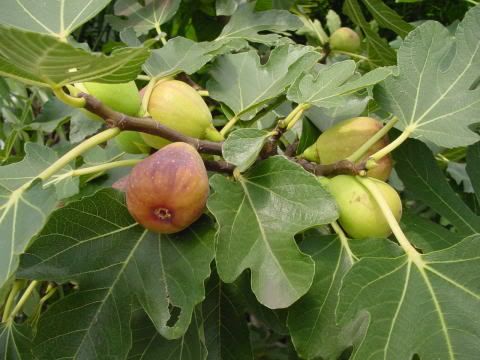
fig2. Images like this fig Songbird included—beautiful colors, contours and composition and it reminds me how much I love to teach and particularly enjoy mentioning relatively obscure facts and facets. The sycamore fig was the national tree of Israel...

3. what other than longer days along with shorter nights?

4. and of course the semi-sweet, partly pungent scent of freshly turned soil...

5. and the sight of flower kittens pushing through the soil and making their way into the world.

Monday, March 09, 2009

musical musings: March of Days, Days of March...

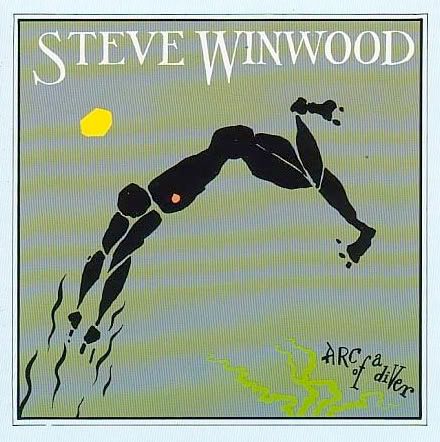
Stravinsky Rite of Spring CDArc of a Diver CD cover
Again I got to compile and host the RevGalBlogPals monthly music feast! Since we're in the liturgical season of Lent, meteorological spring has begun and it's almost the astronomical season of spring in the northern hemisphere, I chose my focus accordingly. I especially enjoyed collecting the CD cover images; here are two of the seven.

March of Days, Days of March musical musings

Wednesday, February 25, 2009

poetry party 32: from dust to dust

invitation to poetry icon

abbey of the arts poetry party 32

poetry party 32from dust to dust

Ash Wednesday
cascading memories
Mississippi Delta dirt
Nana's zinnias
daffodils springing from Salem soil
on to the university greenhouse
begonias in living room flowerpots
digging troughs for tulips on 5th avenue
Heather's perennials
Nick's greenery
condo complex landscape committee
Ash Wednesday
liturgy and another memory
I am dust and
starlight and
golden
Jesus takes us back to the garden

Friday, February 06, 2009

favorites 5

RevGalBlogPals Favorites Friday 5

(original post was in red, so I opened with,) "Today I'm writing in red to honor Wear Red Friday! Songbird suggested this easy yet wonderful topic for today."

1. Beethoven's music: I particularly love listening to symphonies #1, 2, 4 and 7 and playing the piano sonatas—27 of the 32 total so far. Oh, and Cello Sonata No. 3 in A Major, Opus 69. More than a dozen years ago another music-lover gave me a video of late greats Glenn Gould and Leonard Rose playing the piece together and I've since found it on YouTube—YAY!!!

2. Color! Inventing new color palettes for design projects, home improvements and what I'm going to wear today is one of the most soul-enhancing things ever, anywhere. On the other hand, despite my love of playing with new possibilities, I cannot count the times I've loaded a palette from a previous project into a new one because I was so in love with it and figured it'd work well once again.

3. Cats: fur, purr, attitude and catitude.

4. The hot desert: it always strips me down to essentials, restores my perspective and reminds me life and resurrection ultimately always prevail, even when we don't or can't take time to seek it out; for me the desert is a constant sign of grace and yes, also a means of grace...

5. Enjoying a feast of food and conversation with friends, something I haven't experienced literally for years, but I've had a few meals with acquaintances and when the mood, flavors and conversations flow without fear, we've been given a foretaste of the Feast to Come, amen!

Thursday, February 05, 2009

Anglican Roman Catholic Dialogue

On the last Saturday of last month I was privileged to attend the formal Annual (half) Day of Anglican/Roman Catholic Dialogue (ARC) at the Roman Catholic Diocese of San Diego's Pastoral Center, a special conclusion to the Week of Prayer for Christian Unity that began with Morning Prayer in the high-ceilinged, light and bright, fairly austere, exceptionally resonant stone-floored chapel. I need to note there was a 2-manual Holtkamp tracker organ I didn't get to try because the guy who served as pianist and cantor didn't have keys or permission, but it looked enticing! Maybe another time...

St. Benedict's counsel to "Prefer Christ Above All Things" centered in Spirituality in Search for Unity was the topic. The first speaker was Fr. Luke Dysinger from St. Andrew's Benedictine Abbey in Valyermo, CA; Fr. Luke, a professed monk, ordained priest and board-certified physician teaches at St. John's Seminary in Camarillo, California. You easily can find information about Fr. Luke's splendid achievements so I won't detail them here.

Though I heard this during the Q&A at the end, for starters there is no Benedictine order per se, no one truly serves as abbot primate, but worldwide there are many communities following the Rule of Benedict. After the formal conclusion of our time together, Pastor John George Huber, who chairs our Faith, Order & Witness Committee, pictured Canon David and Father Luke in front of a beautiful illumination.
Canon David and Father Luke


From Father Luke I was surprised to hear that his Rule, the Regula Sancti Benedicti from the 6th century, predating all divisions within Christianity, is the only thing extant about Benedict; its antiquity makes it common to Roman Catholics, Anglicans and every other expression of the Church, as well. Because I live baptized, the Rule of Benedict is mine already—it is a "primordial articulation of the way we live together in community" and all about the "spirituality of the baptized, about the way Christians lived when they knew they had to give witness to their faith in a hostile world," Fr. Luke explained.

The harsh, grandiose abbot speaking in The Rule of a Master forms approximately 1/3 of Benedict's Rule. However, chapter 72 is exclusively Benedict's with nothing from the earlier Rule of a Master. As Fr. Luke observed, we find the two paths of life and death in many spiritual traditions. Check out this link to Benedict's Rule.

I savored hearing others explain what I've been trying to tell people about how God speaks through the voices of those with whom we live (work, play and pray), and through our guests, too. Not that I don't trust my own insights and perceptions, but the ongoing lack of peer conversation (still) and the way my comments and observations seem barely tolerated for a while and almost every time I know I'm making a cogent and critical contribution to the topic on tap it gets changed or my perspective dismissed. "The light that deifies" (sanctifies, uncovers and reveals our Divine nature, engenders theosis) changes and transforms us; living words bring nuances you can't "get" from a mere printed, written text. Sounds exactly like Jesus and even about Jesus' life still lived through us!

For Benedict the "Schola" is not only about a typical, formal arrangement of speaker - listener - hearer, but evokes a school of fish, a group of creatures, of created ones moving together in the same direction, an assembly, a gathering of community united in spirit and purpose. The Schola Cantorum in the monastery, the cathedral or the local parish is more than the usual choir, but a unity that sings with a single voice.

Fr. David cited claims by Paul and Benedict that living in community there's a good, legitimate competitiveness, as Paul writes in Romans 12:10-11,

love one another with mutual affection; outdo one another in showing honor. Do not lag in zeal, be ardent in spirit, serve the Lord.

I love the idea that when we look past whatever irritating thing our neighbor, friend or relative is doing and act in love anyway, there's no need whatsoever to pretend they're not driving us nuts! Dionysius the Areopagite says there is no unmediated grace, so we live as channels of divine grace to one another. That sounds Jesus-y, too! Needless to say, "only in dialogue with 'others' do we make any spiritual progress." Reprising one of our intercessions during worship: "Through your cross and resurrection, fill us with the consolation of the Spirit," Fr. Luke cited Martin Luther's insisting the "consolation of the brethren is a means of grace."

Moving from spectacles, signs and wonders to simple presence...in the past I've written, taught and tried to remind myself that even the gods of the Egyptians could do the signs and wonders, but one of the revolutionary things about Yahweh was YHWH's constant, unmediated, presence with creation. Although he responded later to several questions from the audience, Fr. Luke closed his formal talk by telling us our self-identification with a particular denomination, tradition, community, liturgical style or theological perspective is "wonderful and beautiful, but insufficient." We need the great(er) whole.

Canon David Caffrey, rector of Trinity Episcopal Church, Redlands, in the San Bernardino mountains presented the second and concluding talk.

As Father Luke already had told us, in Thomas Cranmer's Book of Common Prayer we find "Anglican spirituality is profoundly Benedictine." Canon Caffrey explained a trio of main points: 1) the Benedictine nature of Anglicanism; 2) points of convergence between Roman Catholicism and Anglicanism; and 3) practical grounds and common witness between the two traditions. There are varying cultural expression but no substantive differences; in other words, we all have the same DNA. As he pointed out, literally hundreds of monastery ruins are scattered throughout the British Isles!

Briefly for this blog, triune pairs: work, study and prayer plus obedience [ob + audire - "leaning toward listening"], stability [doing life with others, being a Christian with others and yes, you do need to go to church to be a Christian, you need to be stable to stay put and sink deep roots, since nothing can thrive or even survive with multiple random uprootings and replantings] and conversion - the dynamic process of growth and metanoia, conversion.

A shorthand description of Anglicanism and, of course, its primary expression in this country as The Episcopal Church would say it's neither experiential nor confessional, but pragmatic and liturgical: it's about showing up, gathering in assembly, eating together and drinking together—a life centered in the Eucharist. In all 3 lectionary years we find the pericope about the apostle Thomas on Easter 2. Canon Caffrey told us Thomas was no doubter; Thomas showed up, and that is faith! The opposite of faith is disobedience, not doubt.

Like Father Luke, Canon Caffrey reminded us God best speaks to us within community, when others are present. These days I'm still wondering about things the mirror I've found in others has been showing me about myself for all too long. The monastery abbot is commissioned by rule to listen to others! In describing some differences in style, Canon Caffrey more than suggested the strong suit of both Anglicanism and Roman Catholicism is the post-conversion resources the traditions provide a person "for the long haul, for the day to day, daily grind." Both toolshed and sacristy are equally sacred...

Before lunch of sandwiches, chips (pickles, cookies, soft drinks and healthy beverages) from a local Togo's, both speakers fielded a handful of questions. Regarding iconography of the Divine, Fr. Luke reminded us the only face of God is the face of Jesus Christ—the gray-haired bearded guy behind a cloud is false and there never was an avian incarnation, either...

This reminds me of the small Yahweh fan group (ummm..."Product Page") I belong to on Facebook! Nonetheless, ever since the Bethlehem manger held the mystery of Spirit in Flesh, God never has a dis-carnate existence. An audience member asked about the emphasis on Christ rather than on Jesus—especially interesting given the Nazarene's own preference as recorded in the synoptics for calling himself son of man, the human one. An excerpt from one of Brian Wren's hymns has been making web rounds, from the Christmas cantata Welcome All Wonders:

Good is the flesh that the Word has become
good is the birthing, the milk in the breast,
good is the feeding, caressing and rest,
good is the body for knowing the world,
Good is the flesh that the Word has become.

Good is the body for knowing the world,
sensing the sunlight, the tug of the ground,
feeling, perceiving, within and around,
good is the body, from cradle to grave,
Good is the flesh that the Word has become.

Good is the body from cradle to grave,
growing and aging, arousing, impaired,
happy in clothing, or lovingly bared,
good is the pleasure of God in our flesh,

Good is the flesh that the Word has become.

The half-day with ARC San Diego again has gotten me thinking. How did I feel in that environment? Very much the way I feel on the University of San Diego Campus, actually: peacefully calm, often wondering what it would be like to attend school and learn in such a space. The scriptural grounding and thoughtful structure of the very well performed liturgy and the excellent congregational participation made me realize (again) why people remain in the Roman Catholic tradition and reminded me of my need for the Church's historic sacramental liturgies and the way they connect the extreme brokenness of my history of the past dozen plus years to the church and to the people of God in every place and time.

My near-constant cry and overwhelming grief has been about the loss of history shared with people I'd fully expected to grow old(er) with, though I truly appreciate people I've met who do seem to take me for what they see and seem willing to gradually hear more of my story. In my own words, "people willing to hear my story and to trust me with theirs."

In the wake of the ARC dialogue, again I'm seeking God's current calling to me, again I'm agonizing about stewardship of my gifts, education and experience—of my life. I've never lived inside its gates, but the social scientist and the human within me has a sense that churches that are organized more vertically and heirarchically somehow have more freedom within the ranks, as if the lines are clearer.

Amidst my continued praying, thinking and hoping, I'll conclude with a picture of this ceramic that's exactly like the one I received as a gift at one of the many parties and farewell receptions held for me before I left City of History for the Intermountain West. And yes, not only the sacraments but memories and physical symbols of my own achievements and accomplishments are a huge part of what gives me hope for a meaningful life of service in what I need to trust will be the very proximate future.

Holy Family Benedictine Ceramic
Saint Andrew's Abbey features many of the uniquely characteristic ceramics designed by Father Maur van Doorslaer, O.S.B.. I wish to my (probably very occasional, given the rate I haven't been posting) blog readers, to the world and these days particularly to myself fulfillment of this Celtic prayer of many versions and variants I first heard in the Moody Blues' Celtic Sonant:

Deep peace of the running wave to you
Deep peace of the flowing air to you
Deep peace of the quiet earth to you
Deep peace of the shining star to you
Deep peace of the son of peace to you

May the endless peace
of the Crucified and Risen One heal us all and abide with us.
Amen!

Tuesday, January 20, 2009

poetry party 30

invitation to poetry icon

poetry party 30 – wings/taking flight

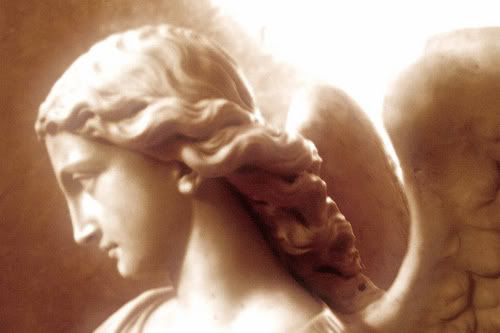
angelAbout twice a month, Christine Valters Paintners from Abbey of the Arts has a poetry party. This time I'm posting here and on this far by faith, my testimony blog where I usually participate in the poetry parties (and where I typically play Friday 5). As always, Christine hints at a possible focus and direction:

"In the US, today is of course Martin Luther King, Jr. day ...And tomorrow is Inauguration Day... So I invite you to enter into the image below. ...Write a poem about the process or the moment, or perhaps in honor of the significance of this day or tomorrow. (Photo taken at St. Bart’s church in NYC last spring)"


the angel
an ev-angelical
a messenger
"good newser"
announces fear not
to us has arrived a God-spell
a whispered do not be afraid
lift every voice and sing
our new day begins!

Monday, January 12, 2009

Losing Moses on the Freeway

Moses came and told the people all the words of the Lord and all the ordinances; and all the people answered with one voice, and said, "All the words that the Lord has spoken we will do." —Exodus 24:3

Now behold, one came and said to Jesus, "Good Teacher, what good thing shall I do that I may have eternal life?" So Jesus said to him, "Why do you call me good? No one is good but One, that is, God. But if you want to enter into life, keep the commandments." —Matthew 19:16-17

The way we know we've been transferred from death to life is that we love our brothers and sisters. Anyone who doesn't love is as good as dead. —1 John 3:14

Blessed are those who do his commandments, that they may have the right to the tree of life, and may enter through the gates into the city. Revelation 22:14
from the baptismal liturgy:
"In Christian love you have presented these children for Holy Baptism. You should, therefore, faithfully bring them to the services of God's house, and teach them the Lord's Prayer, the Creed, and the Ten Commandments. As they grow in years, you should place in their hand the Holy Scriptures..."

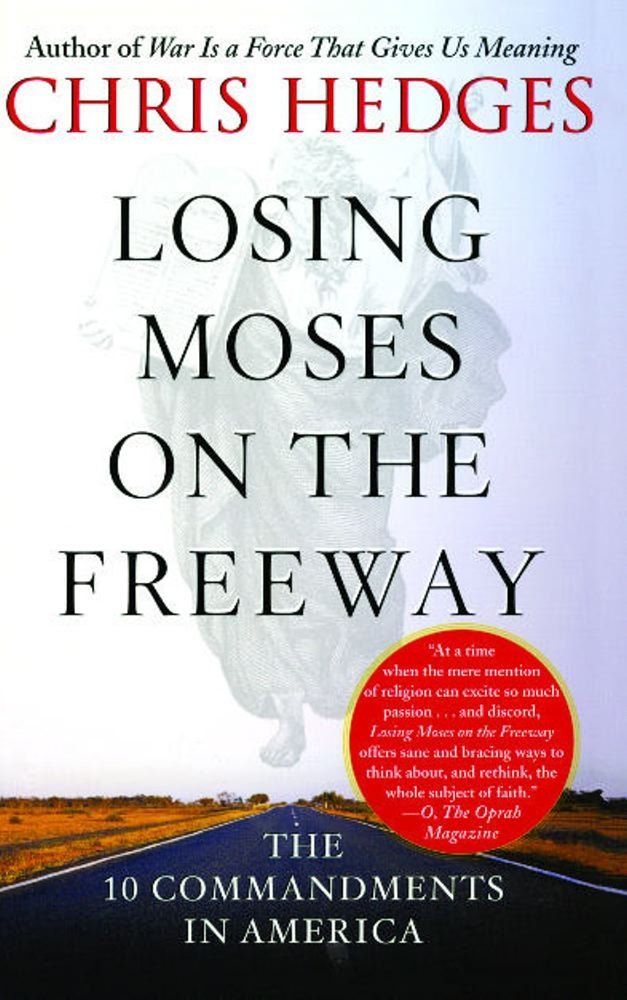
Losing Moses cover A few days ago I serendipitously happened to buy a book by former New York Times foreign correspondent Chris Hedges; it's Losing Moses on the Freeway: The 10 Commandments in America, and in the author's story I recognize major parts of my own journey. In the prologue, author Chris Hedges explains God gave us the Sinai Covenant, the commandments, in order to enable and sustain community—"They [the commandments] were for the ancients, and are for us, the rules that, when honored, hold us together and when dishonored lead to alienation, discord and violence."

Chris Hedges opens the first chapter, Mystery, with his experience as a young seminarian serving a people and a church in the inner-city Boston neighborhood of Roxbury; its normative violence and human degradation, crumpling, decaying physical infrastructure, pervasive aura of wastedness and death amounted to a setting previously unknown (and probably unimagined) by him. On page 10 he calls it ghetto, and I'll define "ghetto" as any place - whether financially affluent or impoverished, ethnically and socially self-described or characteristically anything else - where nothing much goes in or out of that wasn't there the day before. By not interfacing with or even seeing people and ideas "other than" my own and my own kind, I fail to appreciate my uniqueness or even my identity.

On page 18 Hedges, son of a pastor, admits in words essentially identical to what I've said and written dozens of times over the past few years, "The church was part of my daily rhythm. I look at the world through the eyes it gave me." And also parallel to my experience he says, "But I also knew the church's dark side, its self-righteous smugness, its crushing piety, the way it used religion to exalt itself and how it often masked human cruelty behind the quest for virtue and piety." [page 19] To that I'll add the petty viciousness, self-centeredness, and destructiveness of both local and judicatorial church politics.

I relate closely to the author's anger as he chronicles [page 11] smashing a glass bottle against the front door of the church building as "...an ending, a final conclusion to a life spent in the powerful and claustrophobic embrace of the church. It is meant to be a break from God. But you trade one god for another. This is how life works. We all have gods."

For myself, the unanticipated separation from full participation in the church to which I'd devoted years of my life and that had played a central role in shaping my goals, lifestyle, and my entire worldview is like experiencing my own death.

On page 11 Hedges says we circle back to the origins our our lives, "if not to embrace it then to understand how it shaped us, to examine with less heat and anger our marks and scars." I'm still examining the mosaic in order to find my place, just as I try to discern ways I've helped create it as it has created and recreated me.

On page 175 the author wisely reminds us "They [the commandments] do not call us to practice total self-abnegnation, empowering others, as I did at first in Roxbury, to abuse us. They call us rather toward mutual respect and mutual self-sacrifice." In words from a pastor with whom I worked alongside, "God calls us to serve, but not to be walked all over." To illustrate his advice of setting (physical, in this case) boundaries so you won't be broken and violated, Hedges gives the example of Martin Luther King, Jr. walking from Montgomery to Memphis with a detachment from the National Guard. [pages 29-30]

From the Holy Communion liturgy in the Book of Common Prayer:
God spake these words, and said:

I am the Lord thy God who brought thee out of the land of Egypt, out of the house of bondage. Thou shalt have none other gods but me.

Lord have mercy upon us, and incline our hearts to keep this law.

Examine your lives and conduct by the rule of God's commandments, that you may perceive wherein you have offended in what you have done or left undone, whether in thought, word, or deed. ...

Ye who do truly and earnestly repent you of your sins, and are in love and charity with your neighbors, and intend to lead a new life, following the commandments of God, and walking from henceforth in his holy ways: Draw near with faith, and make your humble confession to Almighty God, devoutly kneeling.

Like the Israelites formed in the searing heat and God's minimal yet faithful supply of the exodus desert, we are above all a people, a nation. In Lord's Day, Sunday, Sabbath worship we retell, re-enact in baptism and the Eucharist and reclaim the meta-narrative of our deliverance from death into life, of Jesus' death and resurrection. Although sometimes I think I loved the Church more than I loved Jesus, after beginning really to hear my story, someone asked me why on earth I'd remained in the church at all and I replied, "This is where I find the sacraments!"

As I wrote in the class handout for class 4 of the Theology of the Cross series I developed and facilitated during Lent 2007 and the following summer, Theologian Jürgen Moltmann describes baptism as "sign, witness, representation and illumination of the Christ Event" and we can claim the same about the Eucharist. We also know Martin Luther did not understand sola scriptura – "Word Alone" outside of grace alone and Christ alone. The sacraments are actions of the entire Church in every place and time. Do they belong to Jesus? Yes, of course, but Jesus uniquely charges and authorizes his followers with continuing his life-giving action in baptism and the Lord's Supper.

In the Love chapter: "But by giving up parts of ourselves for others, by accepting that we must be willing to lose life to create and preserve life, we honor the core of the commandments. The commandments hold out to us the possibility of love." [page 173] Chris Hedges [page 174]: "The covenant offered by the commandments, the covenant of life, is the covenant of love. It is a covenant that recognizes that all life is sacred and love is the force that makes life together possible. ... But it is never too late to turn back. Atonement permits a new way of being. It calls us to life." [pages 173-175] We are people of Maundy Thursday, who have been given and who have received Jesus' New Commandment, the mandate of love faithful unto death; by faith and in the Spirit we have infinite access to Jesus Christ's atonement for the buying back, the redemption, for the life of all creation.

To quote Moltmann again, "Nomadic religion is a religion of promise!" John the gospel-writer tells us God makes tabernacle, a portable temporary shelter, "pitches a tent" with us, traveling essentially unencumbered so as to be able to pick up easily to continue the journey alongside creation. Like Jesus of Nazareth, we are created in the very image of God, both fully human and completely divine and claim our Divine Nature until the human and divine hardly can be distinguished from each other.

Then Moses took the book of the covenant, and read it in the hearing of the people; and they said, "All that the Lord has spoken we will do, and we will be obedient." —Exodus 24:7

The Hebrew bible witnesses to God among us in tabernacle and temple, in the prophets and in the people. Doing The Word, "Performing the Scriptures": The Word made Flesh—doing the Word? Try simply being the Word, God's gracious, unmediated presence? Jesus and us! Losing Moses on the Freeway... people in vehicles move fast on freeways and on toll roads, too, and they tend to travel by themselves and distracted by media. In any case, it's not an optimal situation for observing a neighbor's needs or for slowing down enough to respond to anyone else's situation or recognizing one's own needs, either. Every day the implied give-and-take of "conversations" in Gmail strikes me as a possibility of moving away from anonymity and alienation to being known and connected.

In the Idols chapter about the band Phish Chris Hedges observed, "The experience of belonging to the crowd appeared to give to followers a new, vibrant community, even as it destroyed community." [page 45] But baptized into the reconciling Christ event, we no longer live under the reign of death, its idols and its artifacts, but in the alternative community countering individualisms of covetousness, greed, commoditization, consumption, superfluity and (ultimately) despair.

Here we will take the wine and the water;
here we will take the bread of new birth,
here you shall call your sons and your daughters,
call us anew to be salt for the earth.

Give us to drink the wine of compassion;
give us to eat the bread that is you;
nourish us well, and teach us to fashion
lives that are holy and hearts that are true.

Marty Haugen, Here in This Place/Gather Us In, © 1982 GIA Publications, Inc.

my Amazon review: law that binds; commands that free

Monday, December 29, 2008

tagged by Brent...

An embarrassingly long time ago Brent Bill tagged me and introduced this meme challenge by explaining:
My friend and fellow blogger Shawna "meme'd" me and so I'm trying the same thing back at her -- and including you. I looked up "meme" in Wikipedia, and got completely and totally lost. So I reread Shawna's post and thought, well, maybe I can do this and so, here goes....
Meme "rules:"
1. Link to your tagger and post these rules on your blog.
2. Share 7 facts about yourself on your blog, some random, some weird.
3. Tag 7 people at the end of your post by leaving their names as well as links to their blogs.
4. Let them know they are tagged by leaving a comment on their blog.
5. Present an image of martial discord (as in "war," not as in "marriage") from whatever period or situation you’d like.
Brent's tag reminds me well that I picked up on a pair of ideas from Shawna's main blog way back last summer and have yet to finish blogging them, but meanwhile, here's Brent's post: Is a meme as annoying as a mime? Finally, here's my 7, though I'm not convinced any of them are weird except I decided to include numbers in all of them and given that everyone in the blogosphere probably has played or declined an invitation to play, consider yourself tagged and invited and let me know if you do.

life stuff button1. I love the number 5 and multiples of 5

2. I've lived in 3 parsonages

3. I hope for countless, innumerable – try 999,999,999 - tomorrows for everyone, for Jubilee Justice for all creation and for peace in our time

4. I've attended 5 professional schools: music; social work; divinity; biz (mini-MBA in entrepreneurship) and design

5. My 2 favorite jobs were about food: writing restaurant reviews for the local radical rag and working as a line chef at a semi-high end restaurant

6. I've moved house at least 20 times

7. I have 2 particular theological interests: ecological theology and liturgical theology

For an image of martial discord I'll cite too many local church and judicatory meetings I've experienced.

Sunday, December 28, 2008

grace in (fluff)land

(fluff) Friends have become a huge Facebook favorite for quite a few. These virtual critters (mostly animals, a few foods like radish and tofu) are friendly, social, generous, energetic gourmet types. I've adopted a leppit and named him WildSpirit; leppits look like rabbits but have trouble pronouncing rabbit. However, "leppit" is close enough to Lepus the hare the meaning shouldn't be confounding. fluff election results

(fluff) Friends developers keep busy offering new events (keep busy endlessly writing code) that recently have included a pirate ship treasure hunt, Halloween trick or treat and most recently, Christmas stockings and gifts. Around presidential election time in the USA, there was an exciting couple of weeks of (fluff) elections, so people ran around casting votes for each others critters. According to the way participants interpreted (fluff) press releases, the top vote-getter would become (fluff) president and receive perks like seal, podium, white house, (fluff) force jet and related. Runners-up would become ambassadors, secretary of (fluff) fence, vice-fluff and similarly influential political positions. Given the common perception that whoever got the most votes would win, everyone cast their hourly votes and waited for the outcome.

However, after the (fluff) polls closed and (fluff) owners went to check on election results, it turned out everyone had won the position of president! In other words, there was nothing anyone could have done to make the results any different, either any better or any worse: election results turned out to be an undeserved, unmediated gift of grace. I've no clue as to the history and background of any of the (fluff) developers, but this was yet another example of the world outside of the Church "getting it" more correctly than the world inside the Church. Just sayin'...

Wednesday, December 24, 2008

Nativity 2008

With its retrospect and prospect of judgment, repentance, renewal, redemption and hope, Advent 2008 is past; the Feast of the Nativity and the season of Christmas have arrived! In the Bethlehem manger we meet God surprisingly come to earth amidst darkness and cold, pleased to share our common lot...of huge casino payoffs, sunny endless summers, mega-mansions and financially prosperous career tracks? Surely job layoffs, bankruptcies, brokenness, alienation, urban decay, ecological degradation, disillusionment, mining disasters, organizational disarticulation, loneliness and betrayal are far more customary than what the world typically covets and deems success, so God enters history in the thick of human need and in human need, too...

Yahweh's people Israel called the desert manna "Bread of Heaven," and for forty years of peregrinations it nourished and sustained them. In chapter 6, John the evangelist calls Jesus born in Bethlehem, Little Town of House of Bread, Bread of Heaven and Bread from Heaven, and because of Jesus' touching everyday lives with God's love in the commonest essentials of creation, today we have living manna blessed and broken, given and shared to sustain, to nourish, to mend and to heal.

But for you who revere my name the Sun of Righteousness shall rise, with healing in its wings. You shall go out leaping like calves from the stall. Malachi 4:2, NRSV

As we ponder the witness of scripture and discern God's call daily to live as his Presence, we discover a constant interplay of theological realities and current cultural inclinations; you can't contextualize the gospel into a culture you're not familiar with! Right along that vein, recognizing Jesus Christ as Sun of Righteousness reflects the Mithric feast of the Unvanquished Sun that in turn came into imperial Rome through evolution and syncretism.

The first two songs on this list made it into a special Christmas edition of RevGalBlogPals Musical Musings and you might like to check out some of the other wonderful suggestions. I'm also bringing a mostly musical Christmas greeting for this year!

First, lyrical beauty from Amy Grant, "I Need a Silent Night" by Chris Eaton and Amy Grant
I've made the same mistake before
Too many malls, too many stores...

And the angels said fear not for behold
I bring you good news of a great joy that shall be for all people
For unto you is born this day a Savior, who is Christ the Lord
And his name shall be called Wonderful Counselor, Prince of Peace

I need a silent night, a holy night
To hear an angel voice through the chaos and the noise
I need a midnight clear, a little peace right here

To end this crazy day with a silent night

With our frequent multitasking and sensory overload, still we realize we need the kind of peace only the Son of Peace can bring us, yet at times we imagine we can buy it rather than awaiting it as gracious gift; nonetheless, the Savior's birth arrives again and brings along with it an end of fear and the song of the angels, messengers of gospeled good news, and we receive a silent night conclusion to this particular chaotically noisy crazy day (and to tomorrow's craziness, too).

I really discovered "Valley Winter Song" by Fountains of Wayne on a December LLBean commercial and even found a very appropriate, sepia-toned Winter in New England video:

fountains of wayne
This song evokes the New England winters I've experienced and endured, with their gray, salted, slushy snow, wind chill temps below zero, trying to write papers, anticipating final exams, Lessons and Carols at Harvard's Memorial Church, house parties with eggnog and hot spiced glögg along with the assurance "summer's coming soon" because the winter solstice is finally here, coming "to those who wait"...what else to do but to bring to you a creative gift, a valley winter song?

You know the summer's coming soon

Though the interstate is choking under salt and dirty sand
And it seems the sun is hiding from the moon

And the snow is coming down
On our New England town
And it's been falling all day long
What else is new
What could I do
I wrote a valley winter song
To play for you
Faith Hill, "Where Are you, Christmas?"
Where are you Christmas
Why can't I find you
Why have you gone away...
My world is changing
I'm rearranging
Does that mean Christmas changes, too...
Christmas still is here, after all, as God constantly comes into the world, into each of our worlds, often in hidden not always immediately apparent sacramental ways, reminding us God is there if only we will look and often surprises us before we even think to seek God, because the God of Jesus Christ graces with unmediated Presence...and unanticipated presents.

Next, full tilt boogie with Sheryl Crow and Eric Clapton, "Merry Christmas, Baby"

Feeling mighty fine, living in Paradise, lit up with gifts of creation (diamonds!) and light of the unvanquished Son of Righteousness...around 3:30 a.m., amidst deepest darkness the gifts of Christmas surreptitiously and surprisingly arrived in my very own dwelling, so "Merry, merry, merry, merry Merry Christmas, baby..."

Also via John chapter 6, Jesus calls himself the real manna from heaven, and promised anyone who ate that Heavenly Bread of Life never would be hungry, would live forever and never die! In revelation about the Logos, the chapter 1 "Prologue" to John's gospel identifies Jesus as the Word, the verb, God's action! The infant Jesus in the Bethlehem manger is the Word of Life, Jesus is the Bread of Life, Jesus is our manna and the entire world's manna. So finally for this Christmas, Amy Grant sings a rockin' "Little Town" with an unconventional melody that's neither St. Louis nor Forest Green along with tangy instrumentation:

"Little Town"

Merry Christmas, Happy New Year 2009, World!

PS Due to YT vids coming and going, I've been deleted all YT links in this blog but keeping the song titles so you can find your own.

Monday, December 08, 2008

advent 1, advent 2

Advent 1

This has been an Advent full of hope! We're again in Revised Common Lectionary year B, and this time my own journey started out with a jazz-tinged eucharistic liturgy at one of the Big First Churches here in Paradise, First United Methodist, though this one's in the Valley rather than Downtown. As Pastor Molly Vetter responded on Facebook to my asking if we'd be hearing the Isaiah passage that's the 1st lection for Advent 1B and one of my very favorites, of course--and Mark's little apocalypse, too: jazz, prophecy, and apocalyptic go together so very well! From Isaiah 64:1-9:

64:1O that you would tear open the heavens and come down, so that the mountains would quake at your presence— 2as when fire kindles brushwood and the fire causes water to boil— to make your name known to your adversaries, so that the nations might tremble at your presence! 3When you did awesome deeds that we did not expect, you came down, the mountains quaked at your presence. 4From ages past no one has heard, no ear has perceived, no eye has seen any God besides you, who works for those who wait for him.

Abram was an Ivri, a Hebrew, one from the other side. In Jesus we meet God from the exceedingly other side as God tears open the gates of heaven and comes to earth, permanently obliterating boundaries and distinctions between holy and mundane and confirming the covenant between heaven and earth. It's interesting we identify Abraham as our progenitor in faith, because both Old Covenant and New Covenant people of God form a gathered assembly and the solitary individual before God is the anomaly, the a-nomen, the "other than" the law rather than the general rule, yet scripture and history in general are replete instances of God claiming, calling and enabling a particular individual to a distinctive, transformative endeavor.

Regarding God incarnate in our midst, last week at The Rising we watched part of a DVD that reminded us 1) Joseph and Mary trekked to Bethlehem because Joseph was from Bethlehem and likely still had relatives there; 2) no, Jesus was not born in "straw poverty" (though I love that expression I heard a couple of Nativity seasons ago), Jesus was born as what a recent bank commercial would call a "regular guy," someone who "shared our common lot," in the words of the UCC Statement of Faith.

Regarding the otherness aspect of Abraham as the prototypical person of God in being from the other side (of the hills, of this city, of mainstream culture, supremely from the other side of death), what does God's incarnation in the baby in the manger, the Nazarene carpenter and the cross of Calvary show us about us? Paraphrasing Jeremiah 22:15-16, Jesus ate and drank (no ascetic!) and did justice and righteousness, and it was well with him (and better with the world)...this not only is what it means to know God, but to be like God!


Advent 2

Sunday afternoon of Advent 2, featured another unforgettable liturgical event; this time it was the festival of Lessons and Carols in Founder's Chapel at nearby University of San Diego, and an exceptionally worthy piece of preparation for God's birth in our very midst, "fulfillment beyond all human reckoning," as one of the worship leaders described it.
Angelo Musicante by Melozzo da Forl

To call this experience perfect is a huge understatement! For the prelude music choir and orchestra exulted with Pergolesi's Magnificat, then more than a dozen (I didn't distract myself by counting) people jubilantly processed into the worship space with "On this Day, Earth Shall Ring," in an arrangement by the illustrious Alice Parker (I attended her hymn sing workshop at 1st UMC a couple months ago). Standard scripture selections, etc., and the gospel procession…

Back in City of History, after an Easter Vigil several of us attended, when I asked the senior pastor I'd served with his opinion of that congregation's liturgical style (I had my own opinions, of course), he replied he did not care for the gospel procession because it elevated The Book too much. But the gospel procession at the Lessons and Carols was something else altogether as it demonstrated and celebrated how God comes into human history to live as one of us so we can touch, see, smell, taste, and hear evidence of God among us; this gospel procession on Advent 2 appealed to and teased all our senses.

We had incense during the opening processional, the closing recessional and to accentuate the proclamation of the Word of Life. A couple of advents ago I asked "Is God among us not a Hallelujah moment?" Yes, a time for singing multiple responses of "Yahweh be praised" as we heard the gospel text. Finally, the recessional song was a West Indian Spiritual proclaiming...

The Virgin Mary Had a Baby Boy

The Virgin Mary had a baby boy,
And they say that his name is Jesus.

Refrain:

He came from the glory,
He came from the glorious kingdom.

The angels sang when the baby born,
And proclaimed him the Savior Jesus.

Mary's boy named Jesus brought the Glorious Reign, the Sovereignty of Heaven down to earth—Dietrich Bonhoeffer speaks of God's "unfathomable condescension" and the Christmas carol sings "Pleased in flesh with us to dwell: Jesus, our Emmanuel, God with us!" During this season of Advent 2008 we once again await the arrival in our midst of The Wild Guy from Nazareth whose presence among us levels mountains, makes valleys higher, shatters barriers, blurs distinctions that separate us and raises the dead.