Tuesday, September 16, 2003

Radishes in the Bible

Topical Study or Word Study or...

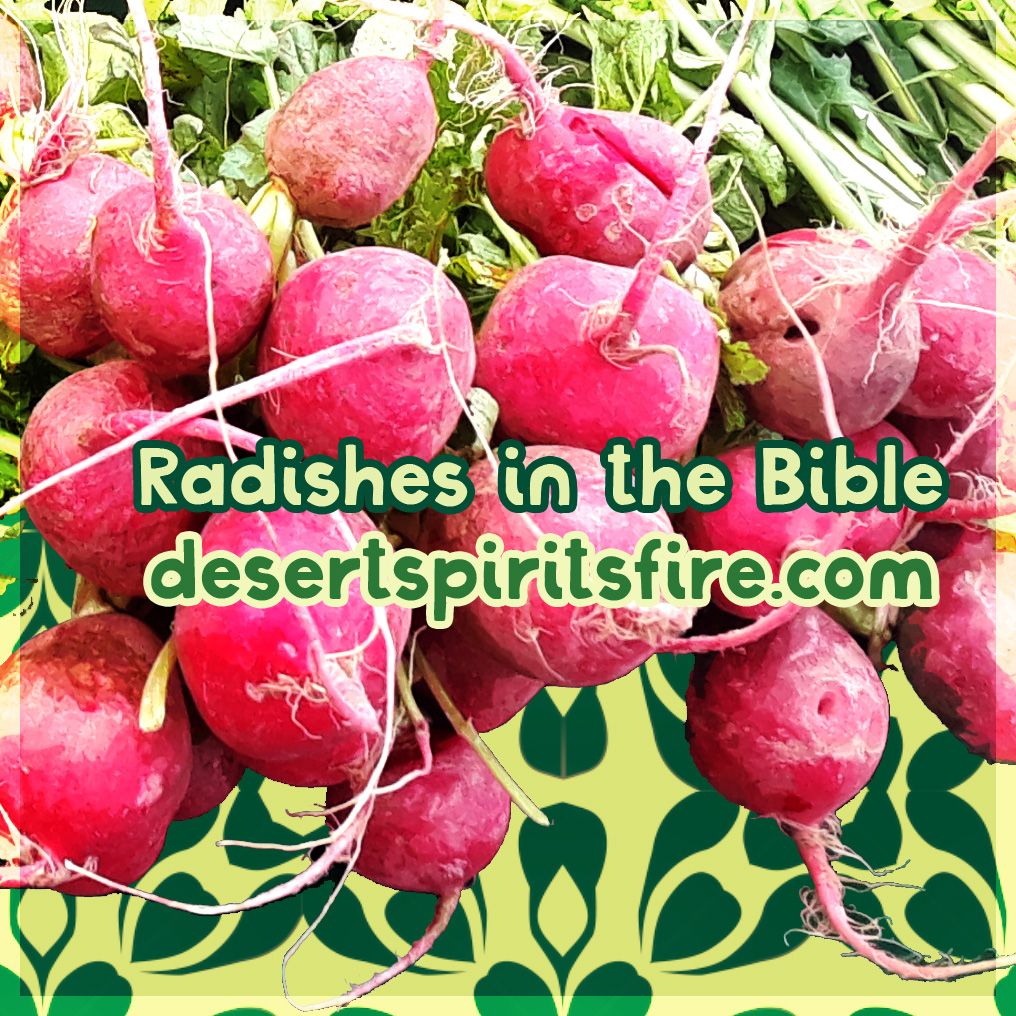
Since I've wondered about my current topic, "Radishes in the Bible," ever since I heard an allusion to it somewhere at whatever time that was, I decided it's high time I posted something regarding Radishes in the Bible on Desert Spirits Fire, my theology place. So here goes!

Charlotte and the White Horse,© 1955, @copy; renewed 1983 by Ruth Krauss with Maurice Sendak's exquisite illustrations (published by HarperCollins), long has been one of my favorite books, the kind of book you read over and over again. As it describes the end of the rainy season, the poetic narrative says:
the wind and the rains are gone
the grass is coming out of the ground
the leaves are coming out of the trees
the people are coming out of doors
they are coming out of windows
they are coming out and planting radishes
the worms are coming out of the old apples—the time of my singing is come.
summer radishesUnlike my usual approach, I searched for "Radishes in the Bible" and radishes Bible – which yielded 66 hits, like the number of books in the Bible! But none of those was truly biblical, so it looks like I'm on my own (as usual). To begin, the root of radishes means root, meaning it's both a root veggie (that we already know from how it grows) and it must be very basic or fundamental, as in the mathematical concept of "radical," and in the sense a person, behavior, idea or action can be radical. So far quite good. Then, the seeds germinate very fast, yielding greenery in only a few days. I remember buying one of those cool kits kids like and that contained radish seeds and appropriately radish-y soil, a very fun thing since the sower (me – we're talking about "biblical," not?) could see results really fast. So how biblical is that? According to a couple of my recent posts and in-person discussions, being fast, doing things fast and things that are fast or act fast aren't particularly biblical at all, since I've been observing how our God tends to act slowly – at least when we humans want God to be a fast God – and since a thousand years is to God as a nanosecond is to us...insights I gleaned, BTW, from the online discussion of Water Buffalo Theology I participated in a while ago. Isn't "gleaned" an agricultural word?

From Beliefnet I get a daily Torah reading along with Jewish Wisdom, and for September 15th they called the Wisdom, "To be rooted," and the quote from Simone Weil says, "To be rooted is perhaps the most important and least recognized need of the human soul." (from The Need for Roots found in A Treasury of Jewish Quotations, edited by Joseph L. Baron, Jason Aronson Inc.)

Enough for this time about Radishes in the Bible...

Wednesday, September 10, 2003

Why One Way? 7

Integrity

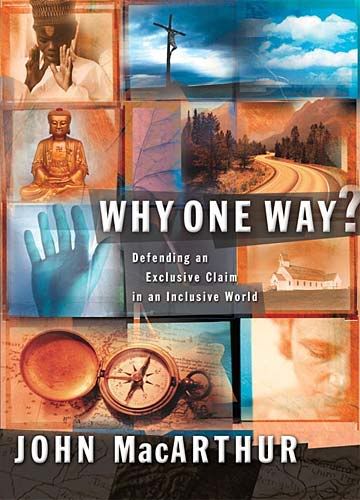
Why One Way? by John MacArthur

why one way coverHi again, everyone! And E, I totally agree with J about your being a most gracious and also a most supportive facilitator: knowing you is a pleasure!

First I'll respond to your asking why I don't affiliate more with more conservative Christians and say it is more them than it is me…I'd love more ecumenism vis-à-vis them and me, but they're the ones who consistently separate themselves.

M, I just got online and read your post and you've got it all right, alright! My friend and neighbor who's active at one of the large local metaphysical churches keeps telling me about "prosperity thinking" [theology??? I guess any worldview or lifestyle can become one's god-talk.] I'll try to comment further on your post at another time, but right now I have only a few minutes.

E, you wrote: "I have found in this world INTEGRITY is a quality one must constantly work at. But, I cannot think of a better quality knowing that someone's word is a bond." And God's Word is God's bond – amply and fully demonstrated in Jesus Christ!

Dr. Mac quotes Scripture in saying church leadership must be "above reproach…" as Paul points out, no one is righteous, no not one…but I agree with Dr. Mac (and with E, of course) not only church leadership but every Christian's gotta walk the talk.

In another passage E refers to Dr. Mac's asking, "But whose church is this? Is this your church to be used at your discretion, or is this Christ's church?" At Dr. Mac's church they "gather to worship God, to exalt Christ, and to hear the Word of God preached." E, your reference to Dr. Mac's pride is most telling!

"…a return to these six distinctives of Biblical Christianity…"

He says this is Christ's church, but Dr. Mac never even ever mentions the sacraments, not even a single time! How can any local church or church-body be fully biblical without a sacramental emphasis and lifestyle, without constant awareness of our baptism and of God's call to Eucharistic inclusivity?

To all participants and lurkers, a "God bless you all" and a big thank you from me, as well! This has challenged me and I've learned more of where I stand and I know our discussion participants better than I did.

Sunday, September 07, 2003

Why One Way? 6

Incompatibility

Why One Way? by John MacArthur

why one way coverHi, everyone…gosh, once again Dr. Mac so loses me! Again we need to ask, "What exactly is the Good Friday-Easter proclamation" Is it about a "personal relationship" (a concept not in Scripture) with Jesus as Personal Savior? Or isn't it rather the declaration of the end of the reign of death, the proclamation of the reality, primacy and ascendancy of the reign of life – "The Sovereignty of God," since someone on one of the other threads said "Reign of God" sounds exactly the same as "Rain of God!"

To quote a translation into English of Martin Luther's paraphrase of Psalm 46:

"That Word above all earthly powers
No thanks to them abideth
The Spirit and the gifts are ours…"
Continuing on this chapter's topic, I need to say both exclusivity – salvation only in the Christ event – and inclusivity – that the salvific Christ Event has a cosmic, totally all-encompassing scope and reach to all creation, whether or not the person or entity affirms Jesus as "personal savior" or publicly confesses the name of Jesus.

Nehemiah chapters 8 and 9 are wonderful, but we need to read them in historical context, and since that's available in a lot of places I won't go into it here. Here are the verses our facilitator mentioned:
Nehemiah 9:2: "And the Israelites separated themselves from all foreigners..."

2 Cor 6:14: "Do not be mismatched with unbelievers. For what partnership have righteousness and iniquity? Or what fellowship has light with darkness?"

E also suggested:

2 Corinthians 11:4: "For if someone comes and proclaims another Jesus from the one we proclaimed, or if you receive a different spirit from the one you received, or a different gospel from the one you accepted…"
and then E, you questioned,

"How does they apply when we worship? Are those verses and example authoritative? Are we incompatible?" And, "May I ask respectfully those who would worship with other faiths if you love Jesus how can we not proclaim Him? Or why would "you deny Him before men." Or are you proclaiming Jesus but .... (fill in the blank)."

For me, ecumenical Christian services are simplicity in that regard, though most more doctrinally conservative Christians around here almost never associate with more liberal Christian types, since in general they don't consider people like me really Christian partly because of our not considering the Bible literally inerrant. So far as interfaith services go (and especially since 9/11/2001 we've had a bunch of those here in Paradise) if I have an opportunity to speak in public I always self-identify as Christian; when I'm not part of the leadership I don't say unless people ask. My point is there's only one true God so whoever worships God worships the one true God, and I'd be very uncomfortable with Satan worshipers, for example, but that's not the issue here?

Again Dr. Mac's doing Scripture as the "objective, authoritative truth of God," rather than Christ Jesus as the truth he proclaimed himself to be.

E, you closed with, "E loves Jesus, the ultimate TRUTH! Have a great Lord's day!" I'll echo with "Leah loves Jesus, the ultimate TRUTH!" And with "everyone have a great Lord's day," too! That's exactly what it's about – it's about the living Christ, and about the Scriptures of the Old and New Testament to the extent that they reflect and proclaim Jesus Christ.

Thursday, September 04, 2003

Why One Way? 5

Authority

Why One Way? by John MacArthur

why one way coverThere were some things I really liked on the first couple of pages of chapter 5, so I'll mention those and then go on to express my dismay about what I really did NOT like further on in 5! First, together with E I like Dr. Mac's saying the authority of the Word of God is the authority of Godself, rather than of any office, calling, church body, or any other expression of the church. And I love his words, "To speak boldly and declare that God has spoken with finality is neither stylish nor politically correct." I also much appreciate his describing our decision as Christians as being "to accept Scripture and set its authority and ourselves against the rest of the world."

But as he continues, once again he's totally lost sight of the ambiguity, vulnerability and sometimes outright plain complexity of the manifestation of the Word the Good Book is. Again he uses the phrase "biblical Christianity!" Well, I totally believe my Christianity is "biblical" and becoming more so every day, but it's not much like what Dr. Mac's been talking about! I won't comment again on his saying "effeminate and powerless" in the same breath!

"False religion!" With M, I'm not sure how much more of this I can take, but I also know for a fact this kind of discussion and exploration is very good for opinionated "moi." I have no trouble whatsoever with the course description (BTW, from Claremont) that appalls him so. And I sure do need a large does of humility these days! I agree with M that God enjoyed everything about the picnic she described and I also believe (in all humility) God likes interfaith dialogue and cooperation.

Someone asked,
I guess the real question is — what constitutes an "other worldview?" is it Islam vs. Christianity or is it the teachings of Christ (mercy, humility, compassion) vs. the teachings of the materialistic, self-centered and self-interested world?
I think you're absolute correct in saying that's the "other worldview" we see in the life of Christ and in his teaching, so in closing and once again, I need to ask Dr. Mac, "where is the person and work of Jesus Christ in all of this?"

Saturday, August 30, 2003

Why One Way? 4

Veracity

Why One Way? by John MacArthur

"A Christian worldview." "Authentic Christianity…is concerned first and foremost with truth" "Biblical Christianity is all about truth." "God's objective revelation (the Bible)…" One of the conservative Christian buzz phrases regarding scripture is propositional revelation. So we have the KJV and NASB (other translations, too?) laid out with each verse as a separate statement, a distinctive "proposition," so the reader can rest assured knowing it's all clean and neat and clearly defined.

why one way coverEarl, it looks as if you and I pulled out some of the same concepts from this chapter! I very much like Dr. Mac's saying on page 42, "Christian truth…isn't nullified by changes in worldly opinion or standards or political correctness. It doesn't need to be adapted and redefined for every generation." And, "The same truth Abraham, Moses, David and the apostles believed is still truth for us." Right on! And to be picky, Timothy's deutero-Paul! On page 45 he says what I wrote in an earlier post about letting scripture interpret scripture, so I gotta agree with him there, as well. Together with Earl, I like his saying, "Real faith involves the assent of the mind and the submission of the will to the truth." IOW, not a feeling, though I agree with Dr. Mac that reflecting on God's self revelation and salvation in the course of our human history will generate some extremely intense emotions.

But, "…the truth is instrumental in salvation? …hearing and embracing the truth…we are called…to proclaim Scripture as the supreme truth against every lie propagated by the world." ??? I'll think about that, though I need to say, "called to proclaim Christ Jesus crucified and risen!" And, of course to proclaim, "God still among us and God still with us!"

From Dr. Mac I want to hear about the possibility and the reality of transformative relationship(s), about our God who calls a people and in covenant creates a people. The biblical accounts of the people of God for sure are messy, untidy and frequently chaotic narratives of people living, loving, sinning and dying, but they're also about our God entering the people's history to the extent of tabernacling, of "pitching a tent" to live among the people, of God in Jesus Christ literally dying to love creation, and of God daring and risking to call the people – yes the people!!!!! – as God's partners in bringing salvation, wholeness and healing to a broken world. Why One Way? is a short book that can't possibly cover everything, but Dr. Mac is making Christianity too much of a head way rather than a relational heart way.

Monday, August 25, 2003

Why One Way? 3

Rationality

Why One Way? by John MacArthur

why one way cover

Moving right along, or I would be, but I open every file I had about chapter 3 and the title, "Rationality" was the only content.

Friday, August 22, 2003

Why One Way? 2

Objectivity

Why One Way? by John MacArthur

One of the discussion participants posted: "The Bible in the UCC is viewed as "the authoritative witness to the Word of God" that's us right?"

Although I didn't participate in the survey you mentioned, I'd call the biblical witness "authoritative," though technically my description of its authority most likely would place me within the 30%. As we teach in Sunday school the Bible's not a history textbook, not a science textbook, not a book of rules and not a book of general religious platitudes, but a highly specific witness to the saving acts of a Holy, Transcendent, still-Living God as that Sovereign God calls and forms a covenant people, completing the redemption, liberation and deliverance of all creation in the birth, life, death, resurrection and ascension of the human one, Jesus of Nazareth, whom we affirm and celebrate as the ultimate and definitive manifestation of God.

Jesus Christ is the ultimate authority: for me, the biblical text has authority to the degree it "shows forth Christ," to paraphrase Martin Luther, which some passages do splendidly, others really not at all.

why one way coverCurrently I'm without call, but people in the congregations I've served literally have been all over the map in their views of biblical authority, from a scattered few who openly said they wanted "nothing to do with that old Bible stuff," to folks who were literalists to the last comma and period – though not necessarily KJV adherents – to some others who considered the Bible an authority in a vague, exceptionally freewheeling manner, to a bunch that pretty much concurred with most of my interpretations (must've been listening to me!).

M said, "And sometimes God-truth gets made the most real in story, myth and song. Then as now." And I respond, "Amen, amen, and AMEN!!!"

Dr. Mac "truthfully" loses me when he writes (page 24), "But if we really believe Scripture is the Word of God, why should we balk at saying it has an objective meaning, it is absolutely true, and all other interpretations are false!...The Bible is God's revelation to us." The cultures into which the biblical texts were revealed and recorded simply didn't run with the same post-enlightenment view of truth, objectivity and accuracy we've inherited from the Enlightenment, and which, as he admits, post-modernism has pretty much discredited. As I said last evening, for me, as a Reformation Christian, Jesus Christ is the "true" Word of God; the sacraments are visible words, too. Although casually I frequently refer to scripture as the "Word of God," Christ Jesus is God's definitive Word of revelation, telling us of our created-in-the Divine-image-humanity, God's Word insisting on justice (the righteousness of God!) for all creation, the still-speaking Divine Word of Life.

Dr. Mac claims, "Scripture…is also sufficient to equip us thoroughly with all the spiritual truth we need." If by "spiritual truth" he means revelation about the Holy and Transcendent Other self-revealed in Jesus Christ, I'll agree. And for sure there are many times that the written words of scripture leap off the Bible's pages to become incarnate and human in various ways, but Dr. Mac appears to be seeking the kinds of cut-and-dried answers we can't obtain anywhere as we live in this world.

Our author uses the expressions, "authentic Christianity" and "historic Christianity." But it seems as if he's not particularly in touch with Christianity's historic and cultural – and religious – origins! So I'm struggling to converse with Dr. Mac, since he and I seem to be running on divergent tracks.

But I'm still thinking!

J, excellent points, thanks! Some of Dr. Mac's writing does sound biblio-idolatrous, and indeed, the decision to canonize which books was very rooted in culture and history; IOW, for cultural and historical reasons we (on this thread) might decide different writings "should" be canonical.

I don't hear enough about the person and work of Jesus Christ from Dr. Mac, though the book's title references the "One Way" of Jesus Christ. Go figure.

W wrote, "I worry when we take the Bible as THE ONLY word of God. God speaks in so many ways…when I disagree with the "message" do I ignore it because I disagree... when MAYBE the message is coming from God?"

Part of F's response included, "Perhaps some of us dwell too much on the written Word and do not stop to listen to God's spoken Word in our hearts and minds. In learning to listen to God's spoken Word, we may also learn to listen to God's written Word in a new way!"

Yes, yes, yes – it's about the Word again becoming a reality we can sense and therefore really appreciate and appropriate as a part of us, part of our very living, breathing and relating – an incarnate word! W, I know discerning the spirit behind the message has gotta be one of the most difficult things we do, and despite all the classical "tests" we can perform to decide the validity of the message, sheer human obstinacy still often remains in the foreground and in the background…you KWIM! The day finally arrives when all a person can do is what they see as the most likely and least unlikely choice.

M, your words remind me of my writing a couple of days ago that I think I was a better preacher and teacher before I'd learned quite so much about the incredible complexities of biblical interpretation! As I just said to W, as the deadlines loom, sometimes you need to Just do it ® – to quote and credit Nike from a couple years back.

Wednesday, August 20, 2003

Biblical Christianity

The Church in the World

Doing yet another CROP Walk, helping build another Habitat for Humanity have become expected Christian “works.” People have told me they think my “religiousness” is silly or superstitious. I can roll with it, though! Because biblical Christianity ain’t popular! But if one simply were a “spiritual” person, that’d probably be OK with most of the rest of society. It’s the activism, the concern for the sojourner, the stranger, the “other” whom our God became in Christ Jesus that makes us less than trendy. I like describing Christians as “salt and light!” I’ll add “leaven” to that, as well.

To comment on “modernism ‘…began with a presupposition that nothing supernatural is real…’” Much of the world’s offense regarding the Bible remains its peculiarly and particularly not-spiritual witness, though of course I acknowledge it as the narrative describing a Holy Transcendent Other’s actions and interventions in creation’s life and history that makes its witness so physical and material!

Tuesday, August 19, 2003

Why One Way? 1

The Church in the World

Why One Way? by John MacArthur

Moving into chapter 1: first of all, thank you, thank you to our moderator for your most gracious "facilitation" of our discussion! Thanks everyone else for participating, too.

Have I ever been "seriously 'hated'" for believing in something so fully? I've being called inappropriate, unchristian and who knows what else, because I do insist on taking a stand and why one way coverwhenever necessary I insist on demonstrating my convictions. The lonely individual stance is what's difficult – doing yet another CROP Walk, helping build another Habitat for Humanity have become expected Christian "works." The same as M's experience, people have told me they think my "religiousness" is silly or superstitious. I can roll with it, though! Because biblical Christianity ain't popular! But if one simply were a "spiritual" person, that'd probably be OK with most of the rest of society. It's the activism, the concern for the sojourner, the stranger, the "other" whom our God became in Christ Jesus that makes us less than trendy. I love E's describing us as "salt and light!" I'll add "leaven" to that, as well.

To comment on modernism "…began with a presupposition that nothing supernatural is real…" Much of the world's offense regarding the Bible remains its peculiarly and particularly not-spiritual witness, though of course I acknowledge it as the narrative describing a Holy Transcendent Other's actions and interventions in creation's life and history that makes its witness so physical and material! That's all for now; I'll be back tomorrow!

Saturday, August 16, 2003

On Heaven

Desert Spirits Fire on Heaven

I'll comment on what seems to be the central concern. Yes, I believe ultimately everyone will "go to heaven" – once again, Jesus promises to "draw all to himself." The gift of reconciliation, restoration, wholeness, healing is offered to all – and when God offers a gift, God never rescinds the offer – God's Word is sure and God cannot contradict Godself: in Christ Jesus, the incarnation of the Eternal Word, we have physical evidence of the fulfillment of all God's promises, although I'm not a universalist in the sense that I consider all "religions," all "ways" equally good and valid. Back to Elmer: I agree that whatever heaven is, it definitely needs to be "different from our present reality," though we catch glimpses of the heaven experience off and on, now and again. Doesn’t this get back to our definition of "heaven" – whether it's a here-and-now, a hereafter-now, or some of both (which is what I consider heaven to be). Being bold with my experiences and emotions again, I'll say "homecoming" is my definitive description of heaven.

Election? Well, (semi-)orthodox Reformed theologian that I am, I believe in election, but I read the Bible as proclaiming God has elected every part of creation to be redeemed, reconciled, made whole – whatever terminology works for you. Since linear time is a gift of God's condescension to humanity/creation, and because God is outside of and beyond both time and space, God has foreknowledge of any "future" creation may experience.

"Does the Bible make exclusive claims?" Yes!!!!! The song of the scriptures we affirm sings of a God of Sovereignty and Glory, a God Who expresses power and dominion in love, mercy – and justice; a God Who reveals his Glory ultimately in becoming one of us, in being "high and lifted up" on a cross of shame in solidarity with society's outcasts, those he declares most worthy of positions at his right and at his left. Scripture sings of a holy, righteous God of justice Whose children also partake of the Divine crucified glory.

For me the Bible's and Jesus' central message (in Marty Haugen's words in his "Now the Feast and Celebration") remains:

For God has come to dwell with us
to make us people of God
to make all things new!!!


And I've long assumed our faithful God will eternally indwell all creation.

Friday, August 01, 2003

More Theology of the Cross Notes

When I saw your introductory post for Chapter 4b I started thinking before reading, and a few minutes ago I checked our thread again where you said, "What I think IS foolishness, a stumbling block, and just plain ANATHEMA to our culture is the Christian claim that we are not made for ourselves, we do not live for ourselves and we do not die for ourselves." Exactly! I was planning to respond to your previously asking, “Just what is it about our faith that is 'foolishness' to our culture?” And I’ll say that peculiar foolishness is evident in our proclaiming we worship the foolishness, the indignity, of our God crucified; when we proclaim the reality of resurrection, when we aspire to living in the weakness, vulnerability, shame and dishonor of servanthood rather than existing in the comfort and triumph of being served. This gets back to the un-churched and de-churched considering Christianity yet another possible selection on the smorgasbord of spiritual delights: it's all about "me and me," and maybe peripherally about "I" but not about an "I" truly connected to any other "I." Our God crucified, dead – and risen – isn't about prosperity thinking, isn't about conspicuous achievement; it's unreasonable and illogical and unscientific.

Tuesday, July 01, 2003

Our slow God...

Our slow God...for 40 years wandered in the wilderness with the people of God

that God might learn what was in the hearts of the people of God

and that the people might learn one doesn’t live by bread alone…

God created us in the image of God, so that image includes:

  • creativity
  • love
  • naming, designating
  • [limited!] sovereignty over creation
  • justice!
  • community
  • free will and the capacity to choose
  • and slowness!

Thursday, June 12, 2003

Prayer

Breathing Life of all, Breath of the Merciful, Giver of the Journey, Creator of the Cosmic Dance, Mystery of Life and Hope Eternal, send your Spirit into our lives, open our hearts to your truth and grant us wisdom to follow your voice, that the Risen Christ will live in each of us. In the name of the one who came that we might have life let us give thanks and praise to our God for such a gift, in Jesus’ name we pray!

Amen

Thanks to Nan C. Merrill and her Psalms for Praying: An Invitation to Wholeness...

Tuesday, May 27, 2003

10 theological issues...

(my reflections about) 10 theological issues facing theologians in the U.S.:

• Interdependent World

• The Bible

• Proclamation, accommodation and syncretism

• U.S. megalomania, economic and cultural imperialism

• Economic greed and consumerism

• Cultural, spiritual and religious relativism

• The Church’s identity and the meaning of that identity: can the organism known as the Body of the Risen Christ coexist with the institutional church?

• Education of clergy and especially education of laity

• Ecumenism – can we mainline churches (Protestant and Roman Catholic) live, study, talk and work, pray and worship with those not like us church bodies?

• Taking academic theology to the streets, as some already have been doing