Thursday, July 29, 2010

lovin' the place you're in 5

kathrynzj hosts loving'the one you're with / lovin' the place you're in 5:

please name five things you like about where you are living now... and as your bonus - 1 thing you don't like.

1. year-round weather is great!!

2. 4 distinctly different climates within about a half-hour of each other: beach/ seacoast/ ocean; inland; desert; mountain...

sea bright new3. central business district, inner-city, working-class and affluent suburban within an easy concentric ring; small town and rural within about a 45-minute range; international border less than an hour away.

4. although my apartment complex weighs in on the side of Asian and Hispanic, there's also a fair African-American and Caucasian proportion, making for an excellently attractive ethnic and cultural mix.

5. lots of culinary and gastronomical diversity in locally owned, regional and national restaurants, fast-food, sit-down, high-end and "other" (whatever I mean by that).

bonus. during spring 2004 I observed, "I love being everywhere, feel everywhere is home for me, yet I always have a sense of longing not only for where I've just been but for every place I've ever lived. So I usually have a feeling of not belonging 'here' because of my intense longing for 'there!'"

Thursday, July 22, 2010

friday 5: decisions, decisions...

Songbird hosts this week's Friday 5:
Let's keep it simple and go with five word pairs. Tell us which word in the pair appeals to you most, and after you've done all five, give us the reason why for one of them.
These are fun and I'm adding reasons for all five of my answers.

1) If it's really really decadent, rich, and amply frosted, I'll take cake, but pie (better yet, cobbler) chocked full of fresh-picked berries is a blue-ribbon winner, too (please see my response to 4). Either one needs to be crowned with a huge scoop of ice cream--I adore Safeway's Homestyle Vanilla! It has a slightly rough texture along with pronounced vanilla flavor and only that one variety comes in that particular packaging.

2) Airplane, for speed, convenience and getting there without feeling unslept and unbathed. Trains carry a heavy freight of glamour, and I love watching and hearing Amtrak's California Zephyr glide through town. The commuter trains seem somewhat cool...

3) I'd choose not a PC but a Mac for sure, because of its ultra-high reliability and the way it supports design software (not to mention its high-end, techie, semi-geek image). But I'm completely cross-platform, so ultimately it's about whatever gets results without too much chugging or too many serious crashes.

4) I'm a theologian, so I do ambiguity, equivocation, mystery and ambiguity very very well. In case someone happens upon this blog and wonders about the other word in this pair, I'm giving univocal its separate sentence.

5) I like the language of both 1 Peter and 2 Peter, though I'm equivocal about the theology of both books. But who wouldn't and who couldn't love the guy Rocky/Peter/Simon bar Jonah? Paul/Saul, for all time, especially the undisputed epistles though Paul's language gets more and more difficult as his years and ministry progress.

Thanks so much, Songbird!

Monday, July 19, 2010

RevGalBlogPals is 5 today!

Today, 19 July 2010, Rev Gal Blog Pals (Guys and Friends), the intentional community and blogring I belong to celebrates its Fifth Birthday, Anniversary and Blogoversary. I designed a birthday card to parallel the one I made for this blog's eighth year:

rev gal blog pals @ 5

Happy Happy Day to all of us!!!

Friday, July 16, 2010

5 about pets

Jan hosts Pets or Not Friday 5

1. Yes, I grew up with pets and in fact had both cats and dogs before I was born. We always had at least one dog and three cats.

2. Currently I'm owned solely by one cat, the amazing and amazingly big bengal-style brown tabby boy AlleyMalibu, "AM."

Patches, Benjie Betsy3. I can't think of a funniest or worst thing my pets have done in terms of hilarity or destruction, but I hate the cat habit of hiding where they can't be found, and then after I've searched every possible place and concluded they must have escaped into the wild somehow, they nonchalantly appear from nowhere and ask "where is dinner?"

4. I wouldn't dare claim a favorite pet, though I've had more rapport and better soul-connections with some, but I will admit cats are my favorites, to the extent I'm definitely severely cataholic.

5. Given that as an adult I've had only cats, I don't train them but rather serve them.

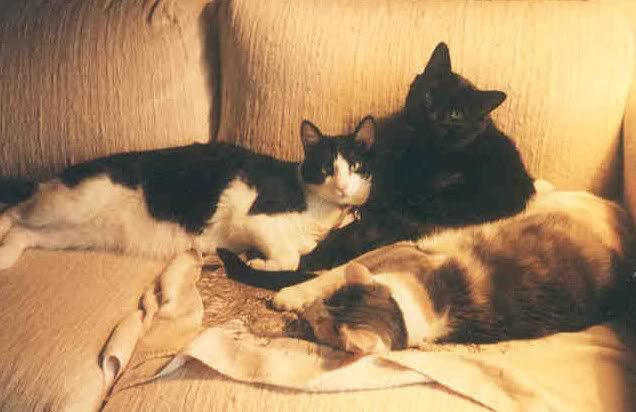
My bonus pic is of Patches!, Benjamin/ Benjie and Betsy. Betsy and Patches! were littermates; all three are waiting for me at Rainbow Bridge.

Friday, July 09, 2010

forgetful 5

Songbird hosts today's forgetful Jones Friday 5

...original blog post was in blue for remembrance...

a) The last thing I forgot? I don't remember.

e) I track appointments and other options with an approx. 4" x 7" purse-sized paper calendar. For the past 10 years I've used the same kind (though they no longer make the slightly larger size I prefer that I think was 5" x 8") and I even save them at the end of the calendar year.

i) Yes, I typically keep a running grocery list and rarely shop without some kind of list... mainly recalling the time I needed 3 ingredients, including rice, and got home from the store with 3 ingredients minus rice.

o) When circumstances insist I improvise, I usually enjoy it but occasionally don't. The pastor I served with in Historical City (as opposed to City of History) told me I loved "the thrill of the chase," and he was right.

u) I hope I never forget the smells of sea air and scents of mountain flowers, the pungency of hot summer in the city, the olfactory sensations of vanilla, honeysuckle and gardenia. I hope to remember for all time the wows! of onions sizzling on the grill... I could list some taste phenomenons too, but will leave this 5 with smell.

Thanks, Songbird!

Friday, July 02, 2010

henry beston: the outermost house and more...

Twelve Coast Guard stations with halfway houses in between arrayed themselves along the 50-mile span of sand and ocean from Monomoy Point to Race Point, Provincetown.
To understand this great outer beach, to appreciate its atmosphere, its "feel," one must have a sense of it as the scene if wreck and elemental drama.
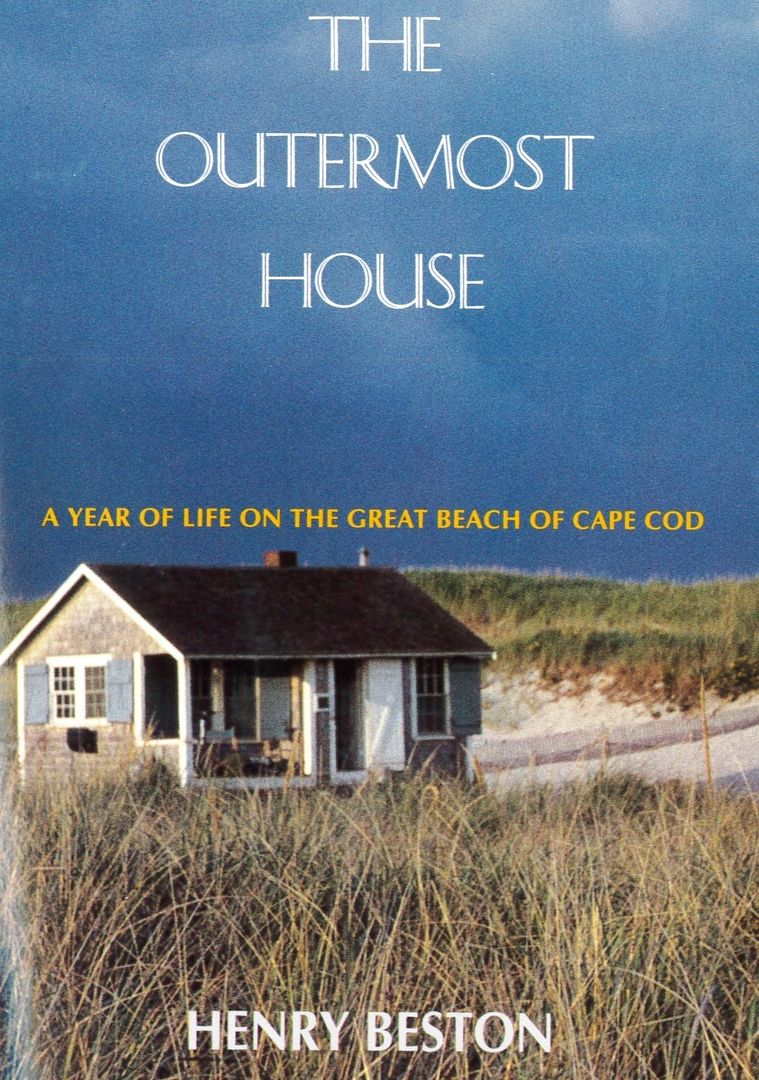
The Outermost House: A Year of Life on the Great Beach of Cape Cod by Henry Beston on Amazon.

outermost house coverOn February 6-7, 1978, high tides from The Blizzard of '78 swept the Outermost House from Coast Guard Beach in Eastham, Cape Cod, Massachusetts. Some Beston basics and some Outermost House background:

Henry Beston Society

The Outermost House from Henry Beston dot com.

You might want to look at How to write like Henry! ...although I am absolutely positive it will not lead to anyone writing like Henry Beston. Like William Faulkner, Beston is the kind of writer who makes ordinary others reluctant ever to type (or pen, as your case may be) another sentence, but we keep on keepin' on nonetheless.

In his introduction ©1988 Robert Finch explains some geography and geology of Cape Cod. Cape Cod stands a full thirty miles out in the North Atlantic; its eastern beaches front a 50 mile stretch of New England coast and frequently contend with a thousand-mile expanse of North Atlantic weather. Plentiful eponymous cod fish still are caught by mariners on "the outermost of outer shores."

Henry Beston reminds us in his forward to the 1949 edition:
Nature is a part of our humanity, and without some awareness and experience of that divine mystery man ceases to be man. When the Pleiades and the wind in the grass are no longer a part of the human spirit, a part of very flesh and bone, man becomes, as it were, a kind of cosmic outlaw, having neither the completeness and integrity of the animal nor the birthright of a true humanity.
The Outermost House The Book includes the towns of Eastham, Nauset, Brewster, Orleans, Truro and Wellfleet... Provincetown, too. Beston calls birds and other wildlife "other people, other nations..." and scatters phrases like "these ocean peoples" – "these winter folk" – "people of the outermost waters" – "those sea peoples." I love his telling us, "The gull population of the Cape is really one people ... though separate gull congregations." [page 115]

beach fenceI also know Cape Cod, not as a native, either, but from visiting grandparents at their mid-Cape house and because I settled there for a couple of years at the end of the last century. I know about Eastham, Nauset, Brewster, Orleans, Truro and Wellfleet... Provincetown, too. Nor were my grandparents CC "natives." Grandmother was born in Dearborn ("Deer Burn") Michigan and grew up in Detroit; Chattanooga-born grandfather lived for a short time in Denver, Colorado but was raised Southern Presbyterian in Jackson, Mississippi. They had farmed in Nebraska and North Carolina, then found themselves in the greater Boston area. In time they bought an old, hand-hewn clapboard-sided mid-cape house for occasional weekend and summer use and later sort of retired there, but really not quite. Decades after Henry Beston built his 2-room dwelling and sojourned for a year on the beach, the earth drew them. I'd guess that by then the year-round population was at least 4 or 5 times larger, summer definitely more touristy, but the Cape Cod mystique enticed my grandparents as it had Henry.

beach pathAlong my own 3,000+ mile span from Mobile Bay, north to New England, to southern California and back, and forth, and back and forth again, I've known more than a dozen stations of life and ways of being with countless halfway houses in between. As an adult I've preferred boundless expanses of prairie, desert and Pacific Ocean, but as I write I'm learning how much I learned about loving the earth from my grandmother and from the Cape Cod land itself. Observing and participating in the agricultural cycle, identifying which birds were natives, which migrants and when they typically arrived, gave me a feel for our human place in the meteorological seasons and for the circles of birth, life and death. A few years on the land helped me grasp how following the liturgical year, with its apparent round-trips of waiting and watching, living, dying and rebirth, connects us to the entire people of God in every place and time and helps us connect to sun, sky, sea and soil. Years on the land helped me learn to trust death.

Walter Brueggemann insists much of life is sabbatarian, spent in the interstitial, liminal time between Good Friday afternoon and Easter Sunday dawn. During winter in a four-season climate like Cape Cod's, there is a simply being who we've become thus far that has a sense of Sabbath about it. We almost hang suspended in time waiting for gifts of birth, of spring, of new life to ready themselves.

In addition to time at my grandparents' place, I spent a week with a classmate's family on the beach at Truro, in a wood-frame house where you walked out the door straight onto the sand. At least two weekends I went camping with friends at Nickerson State Park. Everyone mid-cape knew the only real surfable waves were at Nauset Beach, yet I do not recall any of those remotely approaching double-overheads I've seen in Southern California. However, when I described Atlantic Ocean storminess to someone who'd only known Pacific Ocean calmness, she said "no wonder they call it Pacific—it's relatively placid almost all the time! Yes, despite double, occasionally triple-overheads.

Henry Beston's Cape Cod was small-scale in terms of square miles, of rocks and landscape reduced by eons of erosion, but the storms he describes were epic in size, style and consequence. Early on in The Outermost House he mentions the "human scale" of Cape Cod and its beaches, and that's exactly right. Having lived in the Intermountain West and gloried in the vastness and geological diversity of the state of Utah (as well as enjoying the closer-by seven canyons of Salt Lake City) and after loving the wide-open drive up California's Central Coast, I can appreciate the greater geological age of the Appalachian Mountain Range, the ancientness of kettle ponds formed by glaciers long-retreated, the antiquity of the shores, trees, rocks and shells of Cape Cod.

Likely you've read some of those "you know you're from" – "you might be from" lists. I'm not a native, not really from Cape Cod, but I still know some Cape Cod truths; for example:
  • I know where Truro is: a few paragraphs supra I told about the idyllic week I spent in that lower-cape town.
  • I know where the Cape Cod Tunnel is: there are bumper stickers and window decals but there is no CCT.
  • I know Plymouth and Wareham are not Cape Cod: and get too tired of people saying they're from The Cape when they're really from off-The Cape.
  • I know that there still is life on Cape from Labor Day to Memorial Day weekend: I've spent more than one winter there.
  • I wear flip flops until Thanksgiving then start again in February: that's what I do in southern Alta California and it's even what I did most of the time living and schooling in Boston. Officially Thanksgiving eve was my last sandals day and I wore street-length skirts until then, too, but I'll admit it got chilly.
  • I know you're not "IN" Cape Cod you're "ON" it: well, yes, of course—it's an island, or more properly, a peninsula.
  • No one asks what mall I'm going to because there’s only one: this one.
  • I know that just because people have a house here or have summered here since they were 4 does NOT make them true Cape Codders: I can claim days, weeks, months and years on Cape Cod, but I know I'll never ever really be a Cape Codder.
life stuff button

my Amazon review: an outermost house, cape cod and more...

I want to be part of a church that...5

"I want to be part of a church that 5..." for today's Friday 5, from Sally, who says in her intro:
This has been a good week for British Methodism, The Annual Conference has discussed and debated many things and not shied away from some difficult stuff. ... In the Vice-President's Address Eunice Attwood gave an inspiring account of the type of church she wants to be a part of, almost poetic she said:

I want to be part of a church that is prayer-filled -
A church that is resourced and sustained by the Bible,
A church that can offer hope even in a credit crunch,
A church that can live well with difference and diversity.

I want to be part of a church that welcomes the wealthy, those who have power and influence -
A church that knows how to party and celebrate life,
A church that acknowledges death and speaks boldly of resurrection,
A church that doesn’t pretend to have all the answers but encourages all the questions.

I want to be part of a church that throws parties for prostitutes -
A church that welcomes those who seek asylum,
A church that longs and yearns for justice,
A church that listens to those no-one else wants to listen to.

I want to be part of a church that believes in transformation not preservation -
A church where all who are lost can be found,
A church where people can discover friendship,
A church where every person takes responsibility in sharing the good news.

I want to be part of a church whose hope is placed securely and confidently in the transforming love of God -
A church that engages faith in its communities,
A church that makes and nurtures disciples of Jesus.

A church where the story of God’s love is at the centre.
I want to be part of a church that offers outrageous grace, reckless generosity, transforming love and engaging faith.
This is God’s story Transforming Love: Engaging Faith.

My prayer is that by the power of the Spirit of God at work amongst us, it will increasingly be our story.
Very beautiful and inspiring! In Pentecostal red, here's my quick list 5:

1. I want to be part of a church with the sacraments at the centre of its practice and proclamation.

2. I want to be part of a church that does not seek to be attractive to the world and similar to the world in its style but desires to live faithfully in the Gospel, at the same time living out its life and mission in incarnational ways people can relate to.

3. I want to be part of a church that celebrates the earth and teaches stewardship of all life, that lives constantly aware of our covenant with all creation.

4. I want to be part of a church that welcomes my full participation, as well as the involvement of all comers.

5. My final 5 is from Sally's list: I want to be part of a church that acknowledges death and speaks boldly of resurrection.

Monday, June 14, 2010

Truman G. Madsen: The Sacrament...

...Feasting at the Lord's Table

scholarship, devotion and joy!

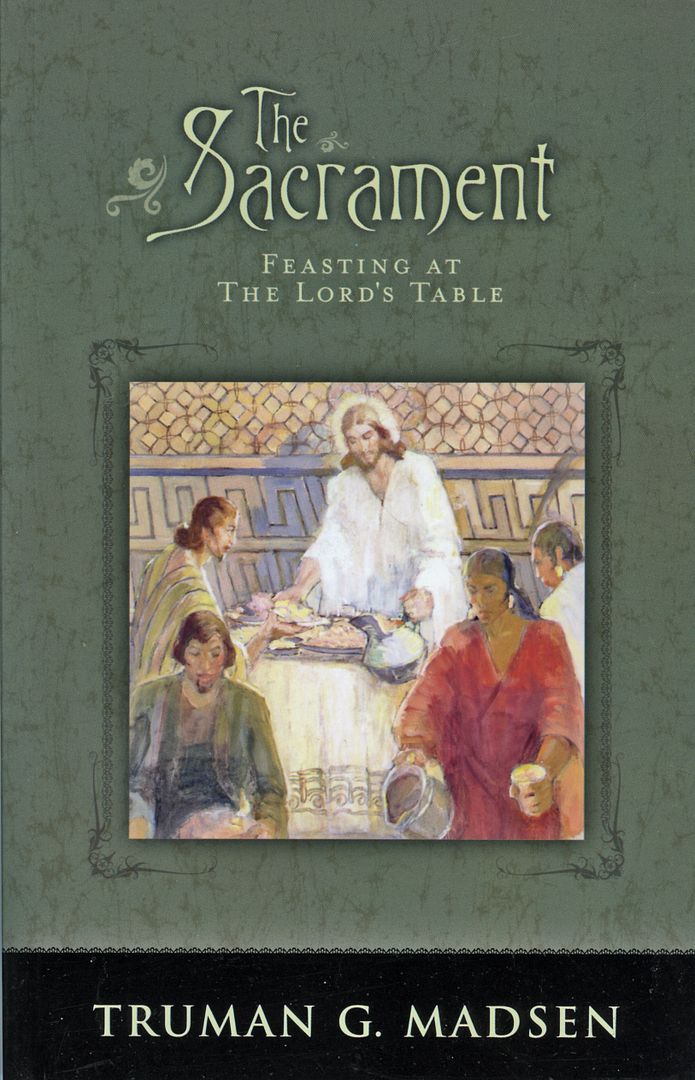
The Sacrament: Feasting at the Lord's Table, by Truman G. Madsen. The author, who was born in 1926 and died only a year ago, on 28 May 2009, was emeritus professor of philosophy and religious studies at Brigham Young University in Provo, Utah and director of the Jerusalem Center for Near Eastern Studies. In addition to his scholarly pursuits, Truman Madsen served in many callings in the Church of Jesus Christ of Latter-day Saints, including ward bishop, stake president and stake patriarch. The LDS Church long has had a worldwide presence, but during the earlier part of Brother Madsen's life it still was something of a Wasatch Front, Utah phenom. With the exception of the exceptionally ecumenical Christian Churches-Disciples of Christ, like the other church bodies that evolved from the various 19th century restoration movements, the LDS Church has not been involved in ecumenical dialogue though it regularly cooperates with other churches and church-related entities in humanitarian endeavors and responses. As you can read in the biography I linked to (but that does not chronicle his passing, so needs to be updated), geographically, intellectually and spiritually Truman Madsen's own world grew and flourished far beyond basic Utah Mormonism, making this a book I imagine even a completely unchurched person could enjoy. And they might be astonished at the depth, breadth, inclusiveness and un-preachiness of this book by a passionately committed follower of Jesus Christ!

the sacrament - I love the content and the format; each of the ten chapters relates to different aspects of the Lord's Supper—Atonement, The Prayers, Sabbath, Fasting, Glimpses Beyond are some topics. Within each chapter there are a dozen or more sub-topics, each a single page or less. The titles ring like poetry...listen to: How Long Is an Hour? Why Not "Thy Kingdom Come?" Holiness and the Name; The Word "Always" and the Rock; Inspired Introspection; The Lower Part of the Inner Court; A Time to Trust the Silence; Invincible Gratitude; Of Union and Surroundment; Of Pistachio Oil; Can the Spirit Enter a Stone? My Power Lieth Beneath; On Beauty and Overcoming... In the preface the author points out about The Sacrament: Feasting at the Lord's Table "There is no fixed beginning or end. It need not be read in sequence, but can be 'dipped into' at random." An unusual feature for this type of book is the alphabetical topical index at the end. Similar to mudhouse sabbath this is more of a handbook than something you'd tend to read cover-to-cover, though for sure it is engaging enough to be read straight through.

The book is full of fascinating scholarly morsels! On page 104 concerning John 12:3-8 and Matthew 26:12, "Was this Mary of Bethany also Mary of Magdala?" asks Brother Madsen. But in any case, the oil with which she anointed Jesus unto death was "...a mixture of balsam and pistachio and perhaps also the balm of Gilead from trees beyond the Jordan." In Greek, pistis means faith, trust. Regarding Matthew 20:23, on page 101 he tells us "In Semitic languages, 'cup' has the same root as the word for door or vestibule or entry way. 'The cup' in antiquity was the figure of one's role in life, one's condition or one's destiny... it remains the metaphor of a divinely appointed role." That's the kind of detail I love to include in my own writing and teaching, and both delighted me since they previously were in my own who knew? category.

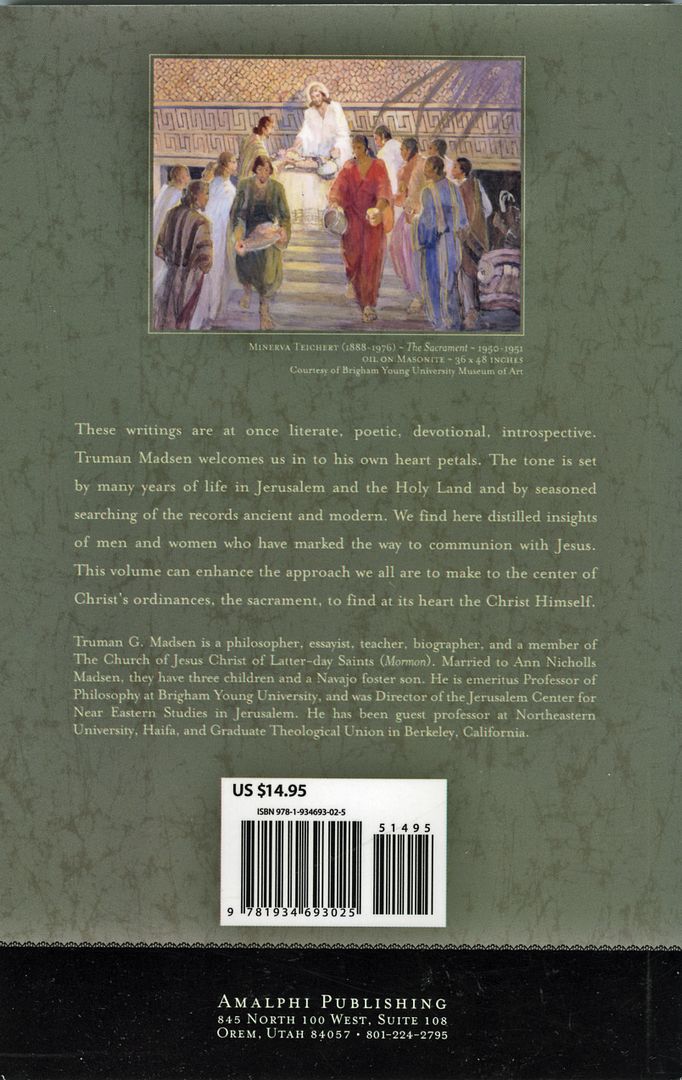
the sacrament - back coverAlthough Truman Madsen's worldview extends well beyond the perspective of a single denomination or specific ecclesiastical tradition, each of the dozen pages in the third from the last "Glorious Modern Precedents" chapter recapitulates an event in Latter-day Saint history. Vignettes range from "Tuesday Sacrament" where President Madsen says Tuesdays are the preferred day of the week for Jewish couples to marry, because on the third day of the week God pronounced "it is good" not once but twice, to a description of astronaut Don Lind's "Sacrament in Orbit" to concluding the section with "A Solemn Assembly" in the upper room of the (Salt Lake City? location not specified) Temple.

Beyond devotion, beyond scripture, doctrine and theology, beyond exquisite scholarship, beyond simply "Christian," The Sacrament: Feasting at the Lord's Table shows us glimpses and visions of the eschatological feast to which God summons all creation, from which no one and nothing ever is excluded—a true Wholly Holy Communion. This is the way God calls us to be and to live, with joy, with passion and in total trust.

my amazon review: scholarship, devotion and joy!

Wednesday, June 09, 2010

race matters

...by Cornel West

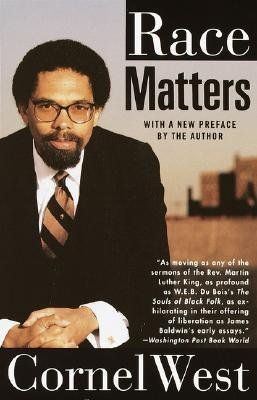
Race Matters first hit the bookstores in 1993; the second Random House Vintage Book edition "with a new preface by the author" is dated May 2001.

Cornel West is teaching at Princeton again; check his site for more information as it invariably evolves and updates.

race maters coverRegarding "matter" as verb and the fact that ethnicity, phenotype, genotype, color, gender and nationality are concerns race matters; it's about "matter" the noun when it comes to stuff concerning nationality, phenotype, regionality, color and accent; a few other burdens every one bears include stereotypes, assumptions, body type, dietary habits and sexual preference... all this relates to how seemingly subcultural gear interfaces with the supposedly dominant culture, how it can separate and divide, how at other times helps attract and cohere.

Especially in the race-aware, extremely socially stratified - yet almost as multicultural and multilingual as it gets - USA, Cornel West's arguments and conclusions are worth considering. As social scientist he deconstructs structuralists and behaviorists and like everyone else, realizes causality ain't all that clear cut or simple, nor are solutions. Oh, yes, of course, "people of color" have progressed hugely in this country, attitudes and practices have become more just and equitable all around, yet true equality remains rare anywhere. In his Preface 2001 Professor West explains "...The most immediate consequences of the recent experience of multiracial democracy is increasing class division and distance in American society and black communities. This is so primarily because the advent of the multiracial American regime coincided with escalating levels of wealth inequality." [xv]

Mary Chapin Carpenter sings "Stones in the Road"...
And the TV glowed that long hot summer with all the cities burning down // And the stones in the road flew out beneath our bicycle tires // Worlds removed from all those fires as we raced each other home...
Unlike Mary Chapin Carpenter, who is one of my favorite singers and musicians and sings the way I wish I could, during the days "Stones in the Road" is about [later edit: I recently found out this isn't a MCC original—Joan Barz wrote the song about an earlier era. I'm referring to MCC's experience and mine.], I was growing up in a very urban world that was trying to survive, make sense of the present and imagine a future amidst all those fires.

Writing first in the 1990s and doing some revisions closer to present-day 2010, in Race Matters Cornel West laments how particularly in the (lower-case) black community (but is there a cohesive black community still to be found anywhere?) "We have rootless, dangling people with little link to the supportive networks--family, friends, school--that sustain some sense of purpose in life." [page 9] and asks, "How do we capture a new spirit and vision to meet the challenges of the post-industrial city, post-modern culture, and post-party politics?" [page 11] He perceives an "eclipse of hope and a collapse of meaning" [page 19] and describes "Nihilism [as] ... the lived experience of coping with a life of horrifying meaninglessness, hopelessness, and (most important), lovelessness." [pages 22-23] Although there are "...new kinds of personal turmoil and existential meaningless in black America" [page 56] he could be talking about almost everyone who recently has been affected by what's politely called "economic downturn" folks who find themselves less structurally connected than they were, and especially less able to reconnect in ways that help rebuild a recognizable identity and reclaim a place in the world. Mary Chapin Carpenter has a song about "A Place in the World," too; it doesn't bring along with it stinging social commentary the way "Stones in the Road" does, but it speaks to everyone's deepest yearnings:
What I'm looking for, after all this time
Keeps me moving forward, trying to find it
Since I learned to walk all I've done is run
Ready, on my mark, doesn't everyone
Need a place in the world

Could be right before your very eyes
Just beyond a door that's open wide
Could be far away or in your own backyard
There are those who say, you can look too hard
For your place in the world ...

But to be alive is to know your purpose
It's your place in the world...
For sure I'm blogging about myself and the insane frustrations of not being able to achieve some kind of way to serve world and community. But I'd also point out recent statistics about more families preparing, eating and enjoying far more meals together, finding less-expensive and free recreation options, in some cases becoming emotionally and (of necessity) physically closer than they were, appreciating each other more.

Money talks! Cornel West says there's "...a crisis of too much poverty and too little self-love." [page 93] Quite a few blogs ago I mentioned especially when I lived and served in the inner city I observed ways people exist in many kinds of poverty, economic almost being the least, albeit often becoming the last straw. Race Matters doesn't mention how increased suburban racial and ethnic homogenization had left a permanent underclass living in neighborhoods like New York's Harlem and Boston's Roxbury, but in the olden days of racial segregation, African-American professionals were visible examples of financial and educational accomplishment and lived alongside single mothers on welfare. Teachers, attorneys, entrepreneurs and physicians were living example and inspiration to those less well-off who hadn't made it yet. In recent decades housing in general has become more economically than racially or ethnically stratified .

More optimistically, Cornel West mentions current multicultural popular culture in the USA that has expanded almost to cover the globe (seen any recent news or entertainment clips about mainland China or Japan?) [page 121]. A sign of acceptability (within limits) and desirability (that has its boundaries), it also is a kind of cultural assimilation; Professor West mostly means the way sartorial styles and particularly musical genres that originated in the black ghettos have mainstreamed. I've blogged a definition of ghetto as "nothing much goes in or out of it that wasn't there the day before." However, historically most of the money that's spent in isolated ethnic enclaves does leave and doesn't return. Ever. Interesting that "Malcolm X feared the culturally hybrid character of black life." [page 145]

Providentially also, during the past decade a significant number of African-Americans have purchased and rehabbed residential property in the Roxburies and Harlems of this country, gone back there to live (or moved there for the first time, since some of them grew up in suburbia or exurbia) and sometimes opened their own businesses or established franchises of national entities.

Jazz is music and jazz is "a mode of being in the world." [page 150] On the first Sunday of Advent 2008 for the start of lectionary year B, one of the local churches featured a Eucharistic liturgy featuring jazz orchestra and jazz choir. The lections included the "Little Apocalypse" of Mark 13 and one of my all-time favorites, Isaiah 64:1-9. Someone observed how jazz, prophecy, and apocalyptic go together so very well! As a musical genre, jazz can boast multicultural, multiethnic and multi-musical origins and most characteristically is rhythmically improvised over a particular harmonic ground. As a mode of being in the world, jazz living celebrates convergence of multicultural, multiethnic and multi-linguistic origins, with rhythms most characteristically and most authentically improvised over the particular ground we're on right now.

I'm blogging after my second reading of Race Matters, and probably will reread it in a year or two or three; it is good food for solid thought!
life stuff button
my amazon review: good food for solid thought

Tuesday, June 08, 2010

lauren winner: mudhouse sabbath

mudhouse sabbath by Lauren Winner on Amazon

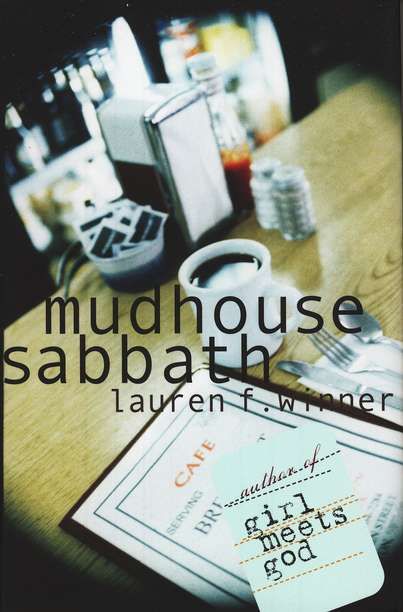
Small in size and light to hold, making it easy to slip into purse or backpack, mudhouse sabbath could become a handbook and resource for almost anyone's spiritual journey. Lauren Winner writes from the perspective of two of the great Abrahamic traditions, Judaism and Christianity; from her Jewish upbringing she brings perspectives on prayer, liturgy and community and she filters her Christian experiences as a present-day member of the Episcopal Church. Each of the eleven chapters has a dual title in (transliterated) Hebrew and English; topics include sabbath, food, morning, hospitality, weddings and doorposts. Notes at the back reference scripture and other books, too. Her words and sentences flow almost exactly like real-life speech and the sentences are short enough not to need to go back and read it again to be sure you got it. Such a pleasure to read!

mudhouse sabbath"Mudhouse" is the name of the coffeehouse in Virginia the author enjoys and at the time of writing (book is © 2003) sometimes visited on Sunday after church. (The site looks very pretentious to me.) I didn't try to find the origins of the name, but I like to think of similarities with mudrooms that form a liminal space that's neither still out in the world (or even in the yard) nor quite yet completely inside the house, a conscious bridge between outside, more public space and inside, more private space. They're especially common in climates that feature winter snow, and provide a handy, safe place to shed boots, shovels, mittens and parkas so you're not out in the elements and you're not wrecking the best rug or the great room, for that matter, with mud, dirt and leaves. In each chapter Lauren talks at least a little about her own perspectives and sometimes struggles between being private and being public, about how much to bend in order to let other people into her own bent spaces, something that only can be done in spaces where you're not afraid of spoiling pristine surroundings, where you know it's okay to drop some crumbs and let sentences hang mid-air.

Lauren talks a lot about obedience. As a Jew, you don't do something because it feels good or because you desire or like the outcome; you do it because God has commanded it. And not surprisingly, in the long run you usually do feel good and discover the outcome is exactly what you desire. Life grounded in Torah and directed toward God is intentional and almost seamlessly integrated between sacred and secular, between public and personal. I particularly love how shopping for food, preparing it, feasting on it and fasting from it, preparing for Shabbat, grieving death and anticipating new life in marriage all take time and thought because they need to be done properly, in a way that almost forces you to consciously be aware of God, gracious Creator and bountiful Giver to Whom it all belongs, anyway. As I mentioned in my intro, this is literally a hand book and Lauren could have included other subjects or expanded on the chapters she chose. But one of the beauties of mudhouse sabbath is the way every chapter can apply to every reader and easily be adapted to your own circumstances. I hope you'll buy the book, enjoy it and make some of these insights, disciplines and practices part of your own daily walk.

my amazon review: bridging and integrating Judaism and Christianity

Sunday, June 06, 2010

last days: deepwater horizon take 2

Deepwater horizon, blog take one: oil and water

oil spill day 48: Sunday, 06 June 2010. 31 May completed the biblical number of 40 days…

nature conservancy


The photographs of oil-soaked waterfowl are unbearable to view; they reinforce that without any doubt Obama's presidency will be marked by, possibly solely remembered by, an epic environmental disaster over which he had no control. No one can unwind time, though conventional wisdom and common sense says some of us might be able to consider and examine what has gone wrong, learn from it and use the knowledge to help make a different future that's not an endless recycling of the same behaviors and outcomes. A couple years back someone in a bible study I'd been attending and sometimes facilitated suggested "end times" as a possible study topic. People who hold onto the worldview of conservative evangelicalism typically look forward to the end of this physical earth as we know it. Those final days especially will feature The Rapture in which they confidently expect to be included as in, "in case of rapture this car will be unmanned" / "In case of rapture, can I have your vehicle?" / "In case of rapture, I'm not sure reading this bumper sticker is a top priority for you." Truth to tell, in so-called liberal mainline denominations not only is "end times" in that sense not a viable theological topic, it's not a plausible or possible one. In terms of responsible interpretation of scripture, to consider the faithful in Christ caught up into the air and floating away as the earth is undergoing the most catastrophic event imaginable mocks and negates the gospel call to journey alongside all people and all creation, to be the presence of Jesus Christ in the world, just as it turns upside down scripture's call to love and cherish the earth just as the Creator God cherishes and cares for all creation.

For some millennial (premillennial, amillennial, postmillennial, Darby, Ryrie, Scofield…) dispensationalist basics, check out this site; it explains dispensationalism more concisely than I could or care to:
…a system of Bible teaching or hermeneutics which holds: 1. That the revelation of truth from Adam to Christ was progressive and that none of the Old Testament writers or prophets had or knew all of the truth of God. 2. That through the various ages or periods of time, God revealed special portions of truth to humanity and placed humanity under a particular test regarding this revelation.
But there is an important theological topic of eschatology, or the word about the redemptive consummation of creation's original purpose. Christianity proclaims the birth, life, death, resurrection and ascension of Jesus Christ completed the work of salvation for all creation, yet typically we assert that we actually live in the proleptic or anticipatory realization of the eschaton, rather than in its fulfillment. Throughout its witness, scripture calls humanity to help initiate justice and redemption for all creation and an ultimate vision of the messianic feast to which the entire earth is invited, welcomed, gathered together healthy and restored, living in mutual dependence and covenant. Without water, that dream cannot be realized.

For sure many prophets we know from the Hebrew Bible wrote and preached about a Day of the Lord, which variously was a time of deep darkness, doom and despair, a occasion for immediate repentance followed by redemption or a time of hope. Apocalyptic writing full of metaphor, code, mystery and hidden (apocalypse literally means uncovering, therefore a "revealing") symbolism tends to emerge and flourish in times of political unrest, turmoil and uncertainty; besides the the book of Revelation in the NT, parts of Daniel, Zechariah, Ezekiel, 1st Isaiah, the "Little Apocalypse" of Mark 13, some of the writings of Paul of Tarsus, 2 Peter (probably I've missed some) all include hidden symbolism, dreams, visions, and often dualism.

In my previous blog about the Deepwater Horizon incident I wrote, "Through its witness, scripture brings humanity a call to help initiate justice and redemption for all creation and an ultimate vision of the eschatological feast in which the entire earth is healthy and restored, living in mutual dependence and covenant. Without water, that dream cannot be realized."

Noel Paul Stookey and Peter Yarrow (remember them? from Peter, Paul and Mary) wrote and recorded "Very Last Day"; The Hollies had a version, too. In some ways it's a slice of vernacular apocalyptic, though it contains a huge burden of scriptural, ethical and practical reality.
Chorus:
Everybody gonna pray on the very last day
When they hear that bell a-ring the world away
Everybody gonna pray to the heavens on the judgment day.

Well the law is given and the law is known,
A tale is told and the seed is sown,
From dust we came into dust we'll go,
You the know the Lord once told us so.
Each brother takes his hand,
Heed the meaning of the Lord's command
Get ready, brother, for that day.

published by Neworld Media Music Publishers and Silver Dawn Music
"The law is given (to us) and the law is known (by us) … Heed the meaning of the Lord's command…" God's covenantal decree is nothing like the arbitrary social code self-righteous pharisee types invented and continue to invent in order to separate out people they didn't like with impossible demands and elevate themselves; it is a graciously given way of life that brings sustenance and more life along with it to those who observe it. Over these past eight years I've blogged a fair amount about the Ten Words or Commandments of the Sinai Covenant and the Great Commandment (love God, neighbor and self) and won't repeat what I've previously said, at least not right at this moment. No one knows how much more devastation creation can bear. But there is something we can do, even the majority of us who do not have the kind of money that talks (a high level of financial articulation). Check out the Nature Conservancy link in The Gulf: Ways You Can Help image at the top of this blog and may peace, justice, and righteousness return to the earth of God's creation the earth God calls – and enables us in the Spirit – to help preserve, sustain and re-create!

Friday, May 28, 2010

Bethel

bethel center building

Joel David Trout used to pastor North Park Apostolic Church, where I heard his dynamic exposition of 2 Kings 2. The particular topic of Bethel related well to Maundy Thursday as it eased into extremely early Good Friday when I started this blog post eight weeks back; the tripartite triduum liturgy had begun a few hours prior to then—here's Bethel, extrapolated and interpreted for here and now.

So you've (we've, I've) just been to Gilgal, the place of rolling away doubts, pasts, fears, transgressions, regrets and anything else that's been getting in the way. But now we need (I need, you need) to get to God's House, to Beth-El! During my undergrad years I was involved in a church that was part of an urban homeland mission and we met in a building called Bethel, though the congregation itself had a different name. During January I blogged some reasons for taking your offspring to the services of God's house; they equally apply to everyone, every age and every circumstance. At church we hear, learn and begin living the story and the stories of the covenanted people of God; we start making the old stories our stories and practice telling the stories.

At the services of God's House we celebrate and participate in the Eucharist, God's eschatological feast of justice, reconciliation, forgiveness and inclusion for all creation. This is God's manner of making new beginnings that's also a living sign of God's promised end, the welcome table of "go and do likewise." We learn to be prepared to forgive and to be forgiven... learning to live every moment "wet behind the ears" again with baptismal water, committed again to Good Friday and to Easter, constantly recovering in Walter Brueggemann's words, "...the focal drama of baptism, which is a subversive act of renunciation and embrace summoning us 'From our several enslavements ... to a common, liberated obedience.'" Something expressed so well bears repeating often!

But what else happened at Bethel for me? I began learning how to take care of the neighborhood's people and infrastructure with political action and community organizing. I enjoyed reading some Paul Tillich and Thomas Merton, although Paul of Tarsus and especially Romans overwhelmed me. We worshiped together and studied scripture and theology alongside each other. We shared meals—part of our general economic style included barter and exchange. I did homework on the roof with friends while we listened to the radio and talked; I did some art, some music and a little writing; during the summer I loved driving friends to beaches along the north shore and sometimes down route 3 to the south shore.

leaving bethel
After a season at Bethel, learning the joy and craziness of community along with its shared tasks, frustrations, anxieties and sometimes surprising hope, it's time to move on. After Bethel we need to reach Jericho, the place of radical, unquestioning, liberating obedience that continues preparing us for a together (in more than one sense) future.

(This image of the street alongside the Bethel Center in my old neighborhood shows how it is, as the street curves away from the ethnic, student, yuppy semi-ghetto – remembering "nothing much goes in or out of it that wasn't there the day before" to explain ghetto – toward commercial financial downtown City of History, but back in my days, if you didn't take the underpass walkway between the mainly residential neighborhood and downtown, you'd walk right into the central artery that now is way far gone, the result of an extravagantly expansive and $14,600,000,000 worth of "expensive" public works project, The Big Dig.)

And after Jericho? Going to Jordan... the place of boundaries between old and new, borders between strange and known, stranger and friend, barriers between where we are and where we need to be, what we have and what we want. Going to Jordan, the place of baptism for Jesus and the paradigmatic location of our baptism, too.

From Gilgal to Bethel into Jericho, all of us take along stuff – goods, bads and some indifferents – from previous locations. At Jericho we're in the place of often counter-cultural, counter-intuitive obedience and radical trust to the point of not daring question or ask a "why" out loud. At Jericho we're preparing for Jordan, for "...the focal drama of baptism, which is a subversive act of renunciation and embrace summoning us 'from our several enslavements ... to a common, liberated obedience.'"

From Gilgal to Bethel, to Jericho, to Jordan... and then to?

life stuff button

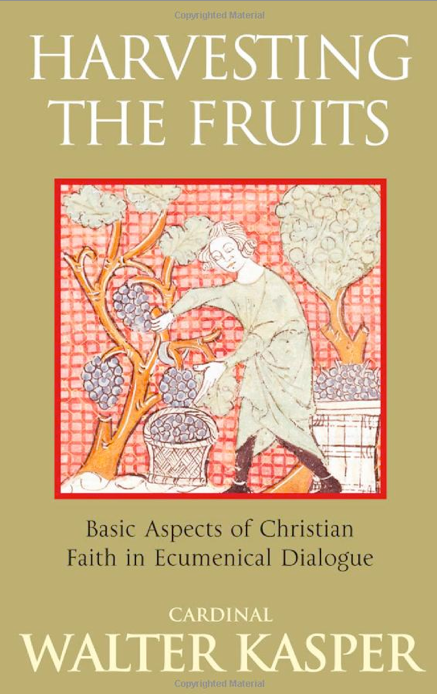
Harvesting the Fruits

Harvesting the Fruits: Aspects of Christian Faith in Ecumenical Dialogue by Walter Cardinal Kasper

Product information includes: Publisher, Continuum (December 14, 2009); ISBN-10 - 1441162720 and an updated ISBN-13 - 978-1441162724

Harvesting the Fruits"Harvesting the Fruits" references Galatians 6:9, "So let us not grow weary in doing what is right, for we will reap at harvest-time, if we do not give up." As the title of the book and the featured scripture imply, this is not a season of frustration or discouragement in ecumenical relations, we are not in an ecumenical winter, but "rich fruits" already have been harvested from these and other dialogues.

Writing about "ecumenical consensus, convergences and differences" over the biblical number of the past 40 years, Walter Cardinal Kasper brings us an easily readable, very useful overview of formal, bilateral conversations between worldwide organizational expressions of Christianity: Lutherans and Catholics / Methodists and Catholics from 1967 through the publication date of 2009; Reformed and Catholics / Anglicans and Catholics from 1970 through 2009. These dialogues were grounded in "Catholic understanding of ecumenical dialogue" and ecumenical principles stated in Vatican 2 documents Unitatis redintegratio and Lumen gentium and as Cardinal Kasper notes, they reflect multilateral interrelationships amongst the various expressions of Christianity that participated. The book is comfortable to hold, has an easily readable type face (style and point size) and includes a near-comprehensive list of abbreviations from each phase or period of each formal dialogue, one of several features that make it a wonderful reference book. The author attempts to outline where we are at this present time as well as where we in the churches can move ahead and should move ahead in the quest for common unity. Cardinal Kasper uses the traditional, 2-millennia-long theological "Father, Son, Spirit" theological vocabulary without equivocation or apology.

Harvesting the Fruits is logically organized into an introduction, four chapters and preliminary conclusions (at the end). Chapter subjects are:
1. Jesus Christ and the Trinity; 2. Salvation, justification, sanctification; 3. The Church - Nature and mission; Sources of authority; Ministry - "whole people of God" and "ordained"; Episcope / oversight - of both local church and Universal Church; 4. [dominical] Sacraments - baptism and Eucharist
Particularly beginning with the Vatican 2 Decree on Ecumenism, Unitatis redintegration in 1964, the See of Rome has considered restoration of unity in the Church a primary concern; Jesus Christ founded one Church, and only one. This particular book does not include Easter or Orthodox expressions of the Church (Cardinal Kasper refers to those as "Churches" but calls other non-Roman Catholics ecclesial communities). Except for those of Wesleyan heritage the Pentecostal churches do not participate in ecumenical activities and except when one includes the highly ecumenical Disciples of Christ (in the USA) in that category, church bodies that evolved from the various restoration movements in the 19th Century are not inclined toward ecumenism, either.

For these discussions a "common confession of the Trinity and of Jesus Christ" was the starting point. The ultimate goal of ecumenical dialogue and other shared activities includes "full visible communion in faith, sacramental life, apostolic ministry and mission" alongside the invariable and necessary differences in culture, styles of liturgy, hymnody and worship, as well as differing emphases in all the above... All of the ecumenical partners hold a fundamental common understanding of the Gospel including: creedal faith; Trinitarian conviction; and salvific action of the persons of the Trinity. Despite the basic need for more conversation and consensus, "What we share in faith is therefore much more than what divides us."


my amazon review: a healthy yield with more to come

Monday, May 24, 2010

Pentecost 2010

This is the text I wrote 3 years ago for the back of the bulletin cover I designed for the Day of Pentecost, 2007; I'm reposting for this year's Season of Pentecost.

acts 1:22 witnesses to his esurrection

In the Bible and in Christian tradition, there is no narrative or legend about the creation of fire, but there are abundant experiences of the Divine Presence in some form of fire. From the desert of the Exodus through Isaiah's vision in the temple, to Malachi and to John the Baptizer's promise of One who will baptize not only with water – but with Spirit and with Fire – a strand of purifying, redemptive heat weaves through the witness of scripture. Luke begins the Acts of the Apostles with the risen Christ promising the apostles' forthcoming baptism with the Holy Spirit; in the next chapter, we hear about the Spirit given to individuals gathered in community.

The Spirit of Life that raised Jesus from the dead calls us from wherever we are, and gathers us into an assembly that in baptism already has experienced its first death and its second birth. The Holy Spirit of God and of the Christ shapes and forms us into the people of God, a gathering of the ordinary that daily walks the extraordinary Way of the crucified and risen Jesus Christ, living as an alternative community to those under the reign of death.

Like the apostles of Jesus Christ two thousand years ago, we live baptized into the cross of Calvary, into the empty grave of Easter dawn, and into the freedom and fire of Pentecost. When our friends and neighbors meet us, like Jesus' disciples of old, may they also become witnesses to the Risen Christ!